A founder closes a promising U.S. customer. The sales team celebrates. Then procurement sends a vendor packet asking about sanctions screening, privacy controls, employee training, whistleblower reporting, records retention, and who in the company owns compliance. Nobody has a clean answer.
That's the moment many SMEs realize growth has outpaced governance. The issue usually isn't bad intent. It's that the business added staff, systems, contractors, and cross-border revenue faster than it added control over risk.
A compliance officer exists to close that gap. The role is not paperwork for its own sake. It's the function that turns legal requirements into operating rules people can implement.
Your Growing Business Has a Compliance Blind Spot
A small business can operate informally for a long time. Founders approve expenses by text, HR keeps records in shared folders, and contracts get signed before anyone checks whether the company can meet the customer's security or regulatory terms. That may work domestically for a while. It tends to break when the business starts hiring across the border, handling customer data in two jurisdictions, or selling into regulated sectors.

The pressure is rising. In PwC's 2025 Global Compliance Survey, 85% of respondents reported that compliance requirements have become more complex over the past three years, a trend noted in Compliance & Risks' summary of the survey. For a U.S.-Canada business, that complexity shows up in overlapping privacy rules, different employment documentation obligations, industry-specific reporting, and customer-driven compliance demands.
What founders usually miss
The blind spot is rarely a single missing policy. It's the absence of ownership.
Without a designated compliance lead, companies often end up with this patchwork:
- Finance owns AML questions until they become legal questions.
- HR handles work authorization records until an audit letter arrives.
- IT answers security questionnaires without knowing what the contract promises.
- Operations writes procedures that don't line up with the law.
That structure fails under pressure because nobody is responsible for seeing the whole map.
A company doesn't need a giant legal department to have a compliance problem. It only needs cross-border activity, inconsistent processes, and one important counterparty asking better questions.
A proper compliance function helps a business answer due diligence requests, detect weaknesses before an audit does, and keep growth from creating hidden liabilities. In practical terms, that may involve policy design, training, monitoring, escalation procedures, and regular review of contracts and workflows.
For businesses dealing with operational safeguards and continuity risk, related legal planning often overlaps with broader governance issues such as software in escrow arrangements, especially when a key vendor or platform supports regulated activity.
The Core Responsibilities of a Modern Compliance Officer
The title can sound administrative. The job isn't. Modern compliance officer responsibilities sit at the center of risk management, internal controls, and business execution.
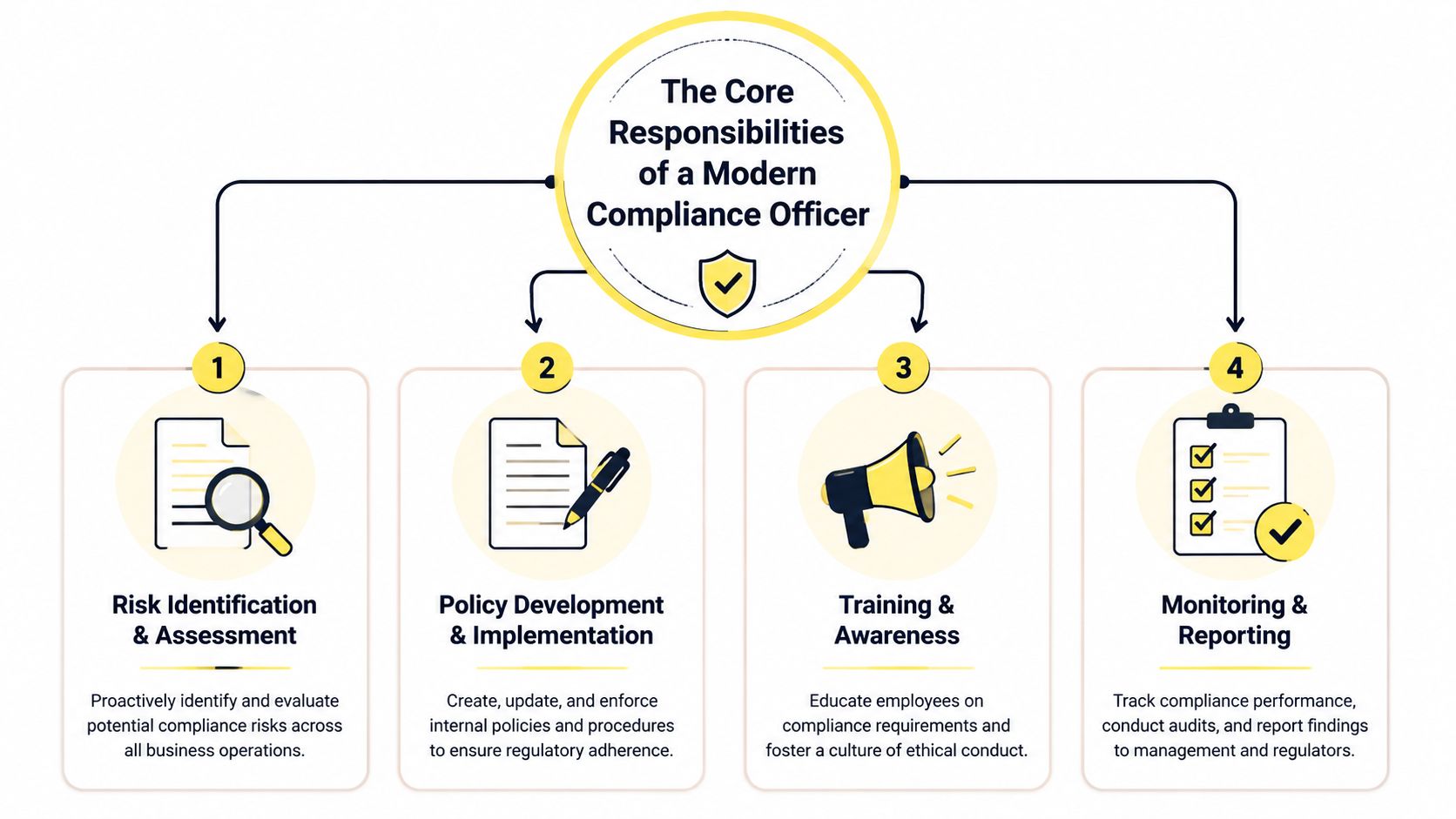
The role changed materially after the 2002 Sarbanes-Oxley Act, which pushed companies toward stronger internal controls and risk oversight. As described in Robert Walters' discussion of the role of a compliance officer, today's duties include staying current on laws, advising leadership, developing policies, auditing, investigating violations, and training staff.
Risk identification and assessment
A good compliance officer starts with exposure, not templates. Where can the company break a law, breach a contract, mishandle data, miss a filing, or create evidence problems if a regulator comes calling?
That means mapping the business by function:
- People risk such as hiring, onboarding, visas, contractor classification, and employee expense practices
- Data risk such as customer data movement, storage, access controls, and vendor processing
- Financial risk such as payment approvals, unusual transactions, books and records, and reporting
- Commercial risk such as reseller conduct, channel partners, marketing claims, and procurement promises
A weak compliance program starts by copying a policy library from another company. A useful one starts by identifying how this company operates.
Policy development and implementation
Policies matter only if they fit the business. A startup with twelve people does not need a binder full of corporate language nobody reads. It needs short, enforceable rules that connect to real workflows.
Examples usually include:
- Code of conduct
- Anti-bribery and gifts rules
- Privacy and records retention
- Internal reporting or whistleblower process
- Approval controls for payments, vendors, and contracts
The compliance officer's job is to convert legal obligations into decisions employees can make quickly and correctly.
Training and awareness
Training fails when it's generic, annual, and disconnected from roles. Sales needs different guidance than HR. Finance needs different examples than engineering.
Practical rule: If your training doesn't change what employees do on Monday morning, it's not training. It's theatre.
Effective compliance officers build short, repeatable instruction around actual risk points. They also track who completed what, who needs refreshers, and where confusion keeps resurfacing.
Monitoring and reporting
The role demonstrates its value. Compliance officer responsibilities include checking whether the controls in place are working.
That can involve:
- Testing records for completeness and consistency
- Reviewing incidents and near misses
- Auditing higher-risk functions
- Reporting findings to leadership with clear remediation steps
For companies building or reviewing formal controls, broader guidance on regulatory compliance legal support can help define which obligations should sit with management, HR, finance, or an external adviser.
Navigating US vs Canadian Compliance Nuances
Most SMEs don't struggle because they ignore compliance entirely. They struggle because they assume the U.S. and Canada are close enough that one system will cover both. Sometimes it will. Often it won't.
Cross-border compliance officer responsibilities include what practitioners call regulatory horizon scanning. In cross-border settings, that means systematic monitoring of updates from bodies such as the U.S. SEC and the Canadian OSC. According to the verified data tied to IOSCO material on cross-border monitoring, firms using this technique have reduced audit findings by up to 62%.
Where the two systems diverge
The practical challenge is less about abstract legal theory and more about operational mismatch. One form changes in the U.S. but not Canada. One privacy disclosure works for one side of the border but not the other. One reporting issue belongs to a federal regulator in one country and a mix of federal and provincial or state rules in the other.
Here is a working comparison for SME leaders.
| Compliance Area | United States Key Regulation | Canada Key Regulation | Primary SME Consideration |
|---|---|---|---|
| Data privacy | State-based rules such as CCPA may apply depending on activity | PIPEDA often sets the baseline for private-sector handling of personal information | Don’t assume one privacy notice or consent flow covers both markets |
| Anti-money laundering | U.S. rules can trigger obligations tied to sector, transaction flow, and federal enforcement expectations | FINTRAC-facing obligations may apply differently depending on business model | Map whether your company is directly regulated or contractually expected to meet AML controls |
| Employment verification | Form I-9 and related U.S. work authorization processes create recordkeeping risk | Canadian work authorization and employer compliance obligations follow a different structure | HR should not run one combined process without jurisdiction-specific review |
| Securities and fundraising | SEC, FINRA, and other U.S. actors may shape disclosure and sales conduct | OSC and CSA frameworks can differ in filing pathways and exempt market practice | Fundraising documents should be reviewed separately for each side of the border |
| Consumer and marketing claims | U.S. advertising and state consumer rules can vary | Canadian consumer protection and competition-related rules may frame claims differently | Sales copy and promotions need legal review before being reused cross-border |
What works in practice
The companies that handle this well usually do three things.
- They track change centrally. Someone owns regulatory updates and decides whether each change affects contracts, policies, training, or systems.
- They localize only where needed. Not every policy needs two versions, but privacy, HR, and reporting workflows often do.
- They test assumptions early. If a founder says, “Our U.S. form should be fine for Canada,” that's a signal to verify, not a conclusion.
A similar issue appears in competition and market conduct questions. Businesses often assume ordinary commercial behavior is harmless until a regulator or counterparty frames it differently. For context on that risk area, see this discussion of what an antitrust lawsuit involves.
Sample Job Description and KPIs for a Compliance Officer
If you're hiring for this role, vague drafting causes expensive confusion. The job description should define authority, scope, reporting lines, and what success looks like.
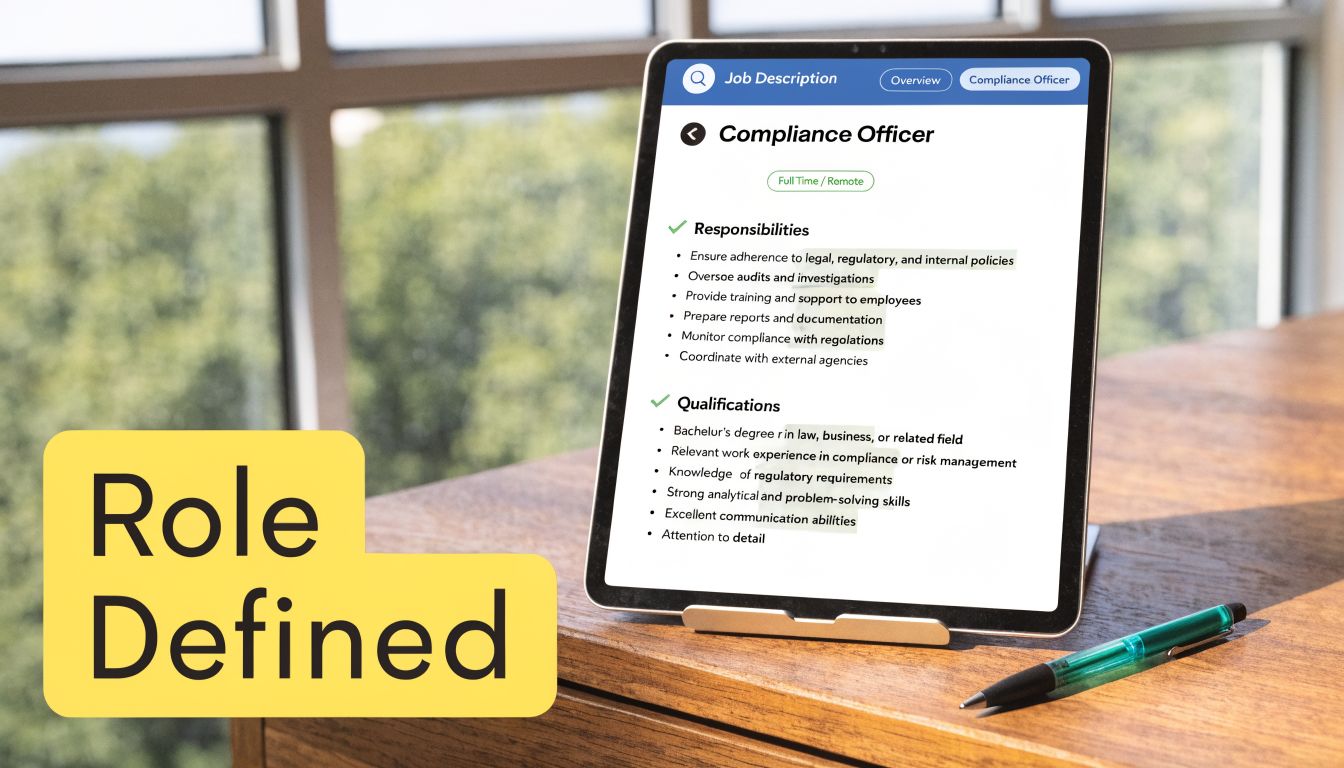
A practical compliance function often includes audit simulations. Verified data summarized with Indeed's compliance officer job description resource states that proactive firms using mock audits and automated verification can cut potential liabilities from worksite enforcement actions by as much as 70%. That matters for any employer managing U.S. work authorization records or cross-border personnel movement.
Sample job description
Role title
Compliance Officer
Reports to
CEO, CFO, General Counsel, or Board committee, depending on company size and structure
Core mandate
Own the company's compliance program across operations in the United States and Canada. Monitor legal and regulatory developments, maintain policies, coordinate training, test internal controls, manage investigations, and escalate material issues to leadership.
Key responsibilities
- Risk reviews across HR, finance, sales, data handling, and third-party relationships
- Policy drafting and maintenance for conduct, privacy, records, reporting, onboarding, and approvals
- Training delivery for staff and managers in higher-risk functions
- Audit support and mock audits including document testing and remediation tracking
- Incident response coordination for internal reports, policy breaches, and regulator-facing issues
- Leadership reporting with plain-English summaries of risk, gaps, and required action
Useful qualifications
- Experience in legal, regulatory, internal audit, HR compliance, or financial controls
- Ability to work across departments without becoming captive to any single one
- Strong written judgment, especially where U.S. and Canadian rules diverge
KPIs that actually matter
Avoid vanity metrics. Counting how many policies exist tells you almost nothing.
Use measures tied to execution:
- Training completion quality by role, not just overall attendance
- Time to close audit findings
- Time from regulatory change to policy update
- Percentage of high-risk vendors reviewed before onboarding
- Number and severity of repeated control failures
- Escalation quality, meaning whether serious issues reach the right decision-makers promptly
Good KPIs show whether the company can detect, escalate, and fix problems. They shouldn't reward silence.
Employment classification and payroll treatment can also create compliance drift, especially for growing teams. This often intersects with exempt versus non-exempt worker issues in U.S. operations.
Building a Compliance Framework for Your SME or Startup
Most smaller companies don't need a sprawling enterprise system on day one. They need a framework simple enough to run and strong enough to survive scrutiny.

That framework matters even more because compliance officer responsibilities now extend into ESG oversight and AI risk management, as noted in Red Flag Reporting's overview of the role. For SMEs, a key challenge isn't knowing these topics exist. It's integrating them into an already busy control environment without creating duplicate processes nobody maintains.
A workable five-part framework
1. Start with a risk map
List the activities that create legal exposure. Don't start with every law that could theoretically apply. Start with what your company does.
Typical categories include:
- Cross-border hiring and immigration
- Customer data collection and storage
- Payments, approvals, and books and records
- Sales practices and channel partners
- Vendor management and outsourcing
Rank them by operational impact and likelihood of failure.
2. Draft only the policies you can enforce
A short code of conduct plus a handful of focused policies is better than a long manual copied from a public company. Each policy should answer three questions: who must do what, when must they do it, and who approves exceptions?
3. Build training into operations
Don't wait for annual training season. Add compliance checkpoints to onboarding, manager training, contract approval, vendor intake, and HR documentation.
What SMEs often get wrong
They over-document low-risk areas and under-document decisions in high-risk ones. They also treat emerging topics like AI and ESG as separate projects, even when those issues can be folded into existing approval and reporting processes.
For example:
- AI use can be added to procurement, privacy review, and customer disclosure workflows
- ESG claims can be reviewed through marketing approval and board reporting
- Third-party risk can sit inside vendor onboarding instead of becoming a standalone bureaucracy
Set an escalation path before you need it
Many frameworks fall short in these areas. If an employee spots a records problem, a visa documentation issue, or a suspicious payment, who gets the report? How quickly? What gets preserved? Who decides whether outside counsel should be involved?
The answer should be written down. It should also be tested.
Mayo Law works with businesses on cross-border compliance design, including policy development, risk reviews, and escalation planning where U.S. and Canadian obligations overlap. Companies also benefit from making sure internal governance documents, including corporate bylaws, line up with who has authority to oversee and report on compliance.
Common Pitfalls and Personal Liability Risks
The hardest part of this role is that responsibility often expands faster than authority. The compliance officer is expected to detect issues, prevent violations, train staff, satisfy customers, and reassure leadership. Yet in many SMEs, the role still lacks budget, access, or independence.
Verified survey data summarized by Vigilant's discussion of under-resourced compliance functions shows that 72% of compliance professionals are concerned that regulators have expanded the role in ways that impose personal liability, while 70% report that the compliance function is under-resourced. That combination creates a serious governance problem.
Three recurring failures
- Unclear authority. The compliance lead is told to “own” the issue but can't stop risky conduct or require cooperation.
- No direct reporting path. Material concerns get filtered through the same executive team whose decisions may have created the problem.
- Poor documentation. Concerns are raised informally, recommendations aren't recorded, and nobody can later show what was escalated or ignored.
If a company wants a compliance officer to carry real responsibility, it must also give that person clear authority, access to decision-makers, and a written escalation route.
How to reduce the risk
For the company, the fix starts with structure. Define the officer's mandate in writing. Identify which decisions require legal review, executive sign-off, or board visibility. Preserve meeting notes and remediation records.
For the officer, self-protection is usually procedural. Keep contemporaneous records. Escalate in writing when necessary. Don't let repeated high-risk concerns live only in hallway conversations. If the company consistently ignores documented issues, that isn't a paperwork problem. It's a governance problem.
Frequently Asked Questions About the Compliance Officer Role
When does a startup need a dedicated compliance officer
Usually when the business crosses into regulated activity, hires across borders, handles sensitive data at scale, faces repeated customer diligence requests, or can no longer assign compliance tasks informally without things falling through.
Can outside counsel replace a compliance officer
Not completely. Outside counsel can advise, investigate, and help build the framework. A compliance officer owns day-to-day execution inside the business.
Who should a compliance officer report to
The answer depends on size and structure, but the role should have access to senior decision-makers and a path to escalate serious issues without being blocked by operational management.
What software do compliance officers commonly use
Many teams use policy management, training, document retention, and governance platforms. In larger or more regulated environments, GRC tools such as MetricStream or EQS may support monitoring and regulatory tracking.
What is the difference between legal and compliance
Legal interprets rights, obligations, and risk. Compliance turns those obligations into daily controls, training, monitoring, and reporting. In smaller companies, the two functions often work closely together.
How do you build an escalation path that works
Keep it short. Define what must be reported, to whom, how quickly, and how the report is documented. Then test it with realistic scenarios, not just written policies.
If your business is expanding between the U.S. and Canada, hiring internationally, or responding to regulatory or customer diligence demands, Mayo Law can help assess the gaps in your compliance structure and clarify where legal review, policy design, and operational controls need to meet. This article is for informational purposes only and does not constitute legal advice. Every situation is different. Consult a licensed lawyer about your specific circumstances.