

Contents
- Is there an American entrepreneur visa?
- Temporary pathways: work in the U.S. while you build the business
- Permanent options: green cards for entrepreneurs
- How much do you need to invest?
- How to choose the right pathway
- What U.S. entrepreneur visas cost
- Cross-border founders: planning a move from Canada
- Frequently asked questions
- The bottom line
- How Mayo Law can help
- Disclaimer
There is no single American entrepreneur visa. The United States does not issue a visa with that exact name. Instead, founders and investors reach the U.S. market through a group of temporary work visas, a startup parole program, and several green card categories, each with its own rules. The right choice depends on your nationality, how much capital you can commit, whether you already run a business abroad, and how long you want to stay. This guide walks through each pathway, what it costs, and how a cross-border founder from Canada or elsewhere can plan the move.
Quick answer. There is no visa officially called the American entrepreneur visa. Founders typically use the E-2 treaty investor visa, the L-1A transfer visa, the O-1A extraordinary ability visa, H-1B, or International Entrepreneur Parole to work temporarily, and the EB-1, EB-2 national interest waiver, or EB-5 categories for a green card. The best fit depends on nationality, investment, and long-term goals.
Is there an American entrepreneur visa?
Not by that name. U.S. Citizenship and Immigration Services (USCIS) sorts the options for foreign entrepreneurs into two groups. Temporary pathways, which include nonimmigrant visas and parole, let you live in the country and build a business for a set period without granting permanent residence. Permanent pathways are the employment-based green card categories that lead to lawful permanent resident status and, in time, the option to apply for citizenship.
That structure matters because the term "entrepreneur visa" hides real differences. Some options turn on how much you invest. Others turn on your track record, your degree, or a corporate relationship with a company abroad. A founder who picks the wrong category can spend months preparing a filing that never fit the facts. The sections below cover the temporary options first, then the green card routes, then how to weigh them.
Temporary pathways: work in the U.S. while you build the business
These options let you operate a U.S. business for a defined time. They do not, on their own, make you a permanent resident, although several can set up a later green card filing.
E-2 treaty investor visa
The E-2 is the pathway most people mean when they search for an entrepreneur visa. It lets a national of a treaty country invest a substantial amount of capital in a U.S. business and come to the country to develop and direct it.
USCIS sets out clear requirements. You must be a national of a country that maintains a qualifying treaty of commerce and navigation with the United States. You must have invested, or be actively investing, a substantial amount of capital in a bona fide enterprise, meaning a real, active business that produces goods or services for profit rather than an idle or speculative holding. The capital must be irrevocably committed and at risk, must be your own, and must come from a lawful source. The business cannot be marginal, so it must have the capacity to generate more than a minimal living for you and your family, or reach that capacity within five years. Finally, you must own at least 50% of the enterprise or hold operational control through a management role.
There is no fixed dollar minimum for the E-2. The investment has to be substantial in relation to the total cost of the business, and the lower that cost, the higher the proportion your investment must represent. Qualified investors receive an initial stay of two years, with extensions available in two-year increments and no limit on the number of renewals, as long as the business keeps qualifying and you intend to depart when your status ends. Spouses of E-2 workers are authorized to work.
Most applicants apply abroad through the DS-160 form and a U.S. consulate, where the Department of State application fee for an E-category visa is $315 (as of June 2023). A founder already in the United States in a lawful status can instead file Form I-129 to request a change of status. One important limit: the E-2 does not lead directly to a green card. It is renewable for as long as the business qualifies, but it stays a temporary status. Our guide to E-2 visa requirements covers the eligibility rules in more detail, and if you want to hire counsel, our E-2 visa lawyer page explains how we help.
L-1A intracompany transferee (open a U.S. office)
The L-1A suits an executive or manager who already works for a company abroad and wants to expand it into the United States. To qualify, you must have worked for at least one continuous year in the previous three for a related foreign company (a parent, branch, affiliate, or subsidiary) in an executive or managerial role, and the U.S. entity must keep a qualifying corporate relationship with that foreign employer.
The L-1A allows a "new office" transfer, where a foreign company sends a manager to launch its first U.S. location. A new-office L-1A is usually approved for one year at first. To extend it, the office must be active and operating and must support a genuine managerial or executive position. This is a common route for Canadian and other foreign companies opening a U.S. subsidiary, and it can pair later with the EB-1C green card for multinational managers and executives.
O-1A visa for extraordinary ability
The O-1A is for founders with extraordinary ability in the sciences, education, business, or athletics, shown by sustained national or international acclaim. You establish that either with a major internationally recognized award or by meeting at least three of eight evidentiary criteria that USCIS lists, such as original contributions of major significance, published material about your work, or a high salary relative to the field.
A founder cannot self-petition for an O-1A, but a separate legal entity that the founder owns can file the petition on the founder's behalf, and the filing needs an advisory opinion from a relevant peer group. There is no investment requirement, which makes the O-1A attractive for accomplished founders who would rather show a track record than write a large check.
H-1B specialty occupation
The H-1B covers roles that normally require at least a bachelor's degree in a related field. A startup that a founder owns can petition for that founder, but only if it can show a real employer-employee relationship, meaning the company can hire, pay, fire, supervise, or otherwise control the work.
The H-1B carries an annual cap of 65,000, plus 20,000 for holders of a U.S. master's degree or higher, and it runs through an electronic registration and selection process each spring. Because demand routinely exceeds the cap, timing and planning matter more here than in most other categories.
International Entrepreneur Parole (startup founders)
The International Entrepreneur Rule is not a visa. It is a discretionary grant of parole that the Department of Homeland Security may give, case by case, to a founder whose startup would provide a significant public benefit. It suits high-growth, venture-backed startups more than small businesses.
To qualify, your startup must have been formed in the United States within the past five years, and you must hold at least 10% of it and play a central, active role. The startup must show substantial potential for rapid growth and job creation through funding received within the past 18 months: at least $311,071 in qualified investment from qualifying U.S. investors, at least $124,429 in qualified government awards or grants, or alternative evidence if you partly meet those levels. Those figures took effect on October 1, 2024, and adjust every three years for inflation. Parole runs for an initial period of up to two and a half years, renewable once for up to two and a half more, for a maximum of five years. Up to three founders of the same startup can be paroled, and a spouse may apply for a work permit.
Short-term and student options
Two other statuses round out the temporary picture. The B-1 business visitor visa lets you come for a short period to lay groundwork: securing funding, scouting or leasing office space, negotiating contracts, or attending meetings. You cannot draw a U.S. salary or actually run the business on a B-1, and stays are usually up to six months. Separately, an F-1 student may use Optional Practical Training, including the STEM extension, to start a business tied to their field of study.
Permanent options: green cards for entrepreneurs
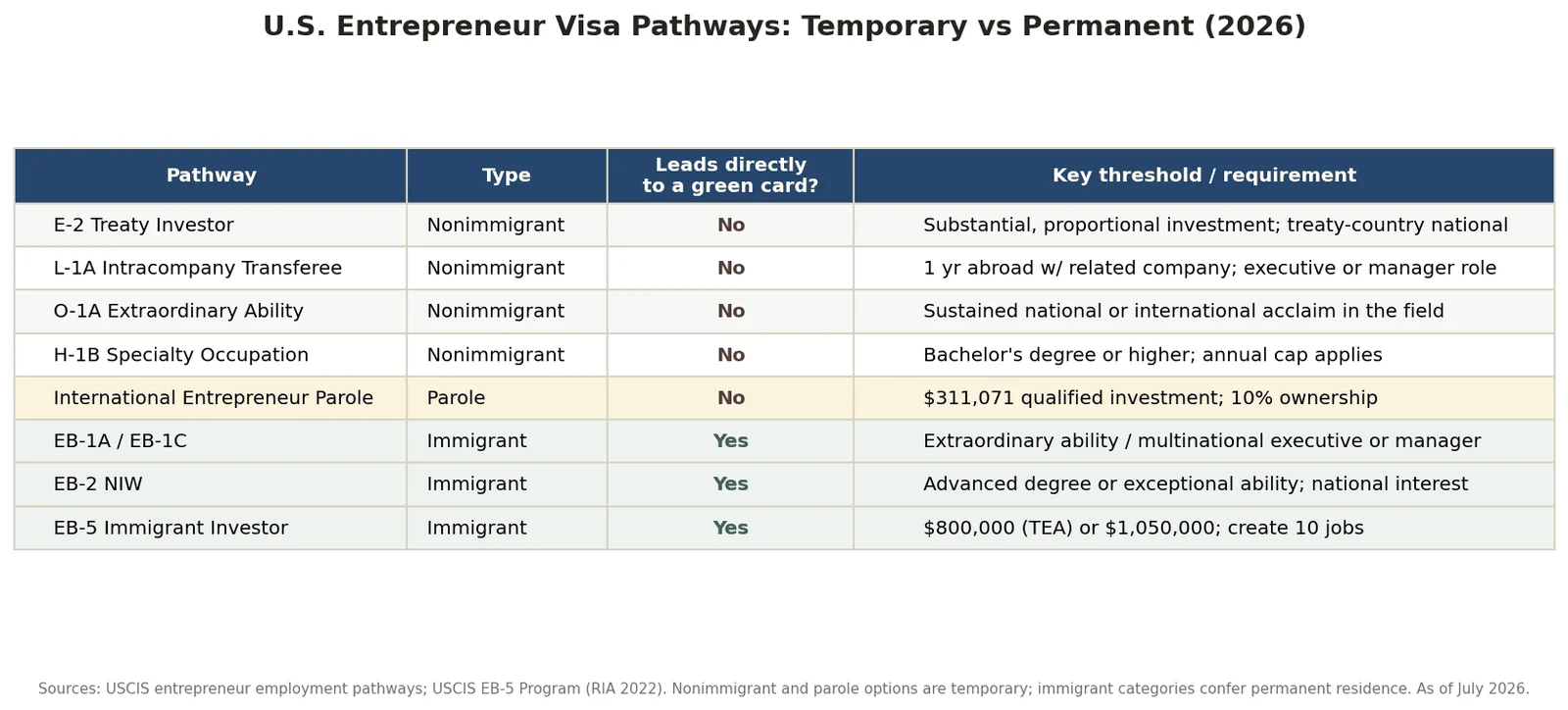
Founders who want to stay for good look to the employment-based green card categories. Four fit entrepreneurs most often.
- EB-1A, for individuals of extraordinary ability. It is the immigrant version of the O-1A standard, it allows self-petition, and it does not require a job offer.
- EB-1C, for multinational managers and executives. It is the green card counterpart to the L-1A and rewards founders who built and ran a qualifying company abroad.
- EB-2 national interest waiver (NIW), for those with an advanced degree or exceptional ability whose work serves the national interest. It also allows self-petition.
- EB-5, the immigrant investor category, which leads directly to a green card. You invest $800,000 in a targeted employment area (a rural or high-unemployment area) or an infrastructure project, or $1,050,000 elsewhere, and the investment must create at least 10 full-time jobs for U.S. workers. Those amounts come from the EB-5 Reform and Integrity Act of 2022 and are scheduled to adjust on January 1, 2027.
Keep in mind that the E-2 and parole options do not convert into a green card on their own. Many founders start on a temporary status and later file in one of these categories. Our guides to the E-2 visa to green card pathways, the employment-based green card process, and choosing between the E-2 and EB-5 visas go deeper, and an EB-5 immigration attorney can assess an investor case.
How much do you need to invest?
Investment requirements vary widely, and several pathways ask for none at all.
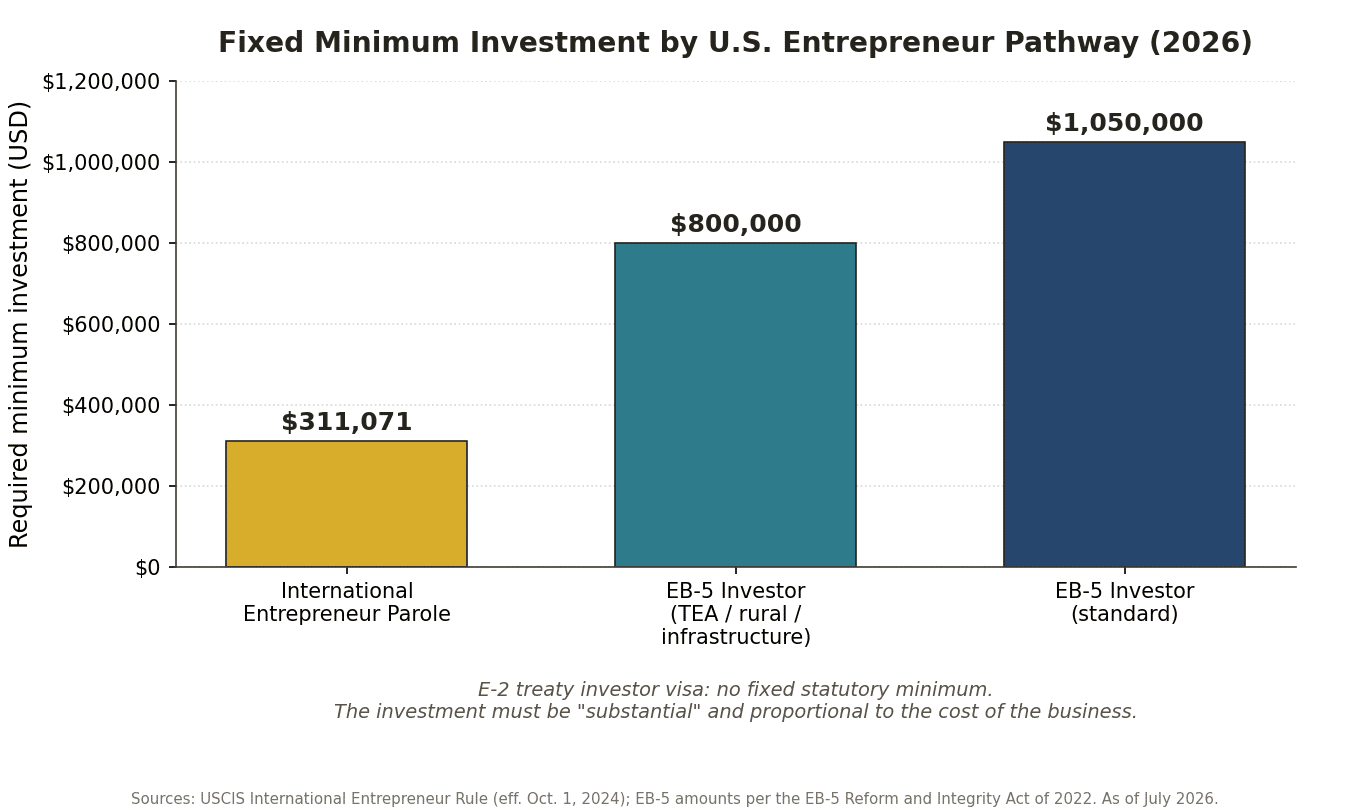
- E-2 treaty investor: no fixed statutory minimum. The investment must be substantial relative to the cost of the business, and the lower the cost, the higher the proportion has to be. Many small E-2 businesses start in the low six figures, but there is no set number.
- International Entrepreneur Parole: at least $311,071 in qualified investment from qualifying investors, as of October 1, 2024.
- EB-5: $800,000 in a targeted employment area or infrastructure project, or $1,050,000 elsewhere, plus the creation of 10 jobs.
- L-1A, O-1A, H-1B, EB-1, and EB-2 NIW: no set investment figure. These turn on a corporate relationship, your credentials, or the nature of the role rather than a dollar amount.
Investment is separate from the government filing fees, which the cost section below covers.
How to choose the right pathway
A handful of questions usually point to the right category.
- Nationality. The E-2 requires a treaty country. The EB-1, EB-2, EB-5, O-1, and L-1 categories do not.
- Available capital. EB-5 is capital-heavy. The E-2 is flexible on amount. The O-1A and EB-1A reward accomplishments rather than money.
- An existing business abroad. The L-1A and EB-1C reward founders who already built and ran a company outside the United States.
- Track record. The O-1A and EB-1A fit founders with top-tier, well-documented achievement.
- Timeline and goal. Decide whether you need to be operating quickly on a temporary status, or want a green card from the outset.
A few short examples show how this plays out. A Canadian founder with a profitable Toronto company opening a U.S. subsidiary often looks first at the L-1A, then EB-1C later. A treaty-country investor buying a franchise usually looks at the E-2. A researcher with a strong publication record may qualify for the O-1A or an EB-2 national interest waiver without investing at all.
What U.S. entrepreneur visas cost
Government filing fees are separate from any investment, and they change over time. A few current figures give a sense of scale. An E-2 applicant applying at a consulate pays the $315 Department of State application fee for an E-category visa (as of June 2023); an applicant already in the United States changes status on Form I-129 instead. For EB-5, the Form I-526E regional center petition fee is $11,160 under the 2024 USCIS fee schedule, on top of the investment itself. Employment-based immigrant petitions in the EB-1 and EB-2 categories use Form I-140, with a $715 filing fee. Legal fees, business-plan preparation, and other professional costs are additional. Because fee schedules are updated periodically, confirm the current amounts on the official USCIS and Department of State pages before you file.
Cross-border founders: planning a move from Canada
For founders moving between Canada and the United States, a few points deserve early attention. Canada is an E-2 treaty country, so Canadian citizens can use the E-2 route; our guide to the E-2 visa from Canada covers the Canadian specifics. Canadian companies expanding south often use the L-1A new-office transfer to send a manager and stand up a U.S. subsidiary.
Because the E-2 and parole options do not lead directly to a green card, Canadian founders should plan the tax and structuring side from the start, including the Canadian departure questions and the U.S. entity setup, rather than treating immigration and tax as separate problems. A lawyer licensed in both Ontario and New York can coordinate both ends of the move. Our cross-border business immigration and U.S.-Canada immigration pages explain that work, and our business immigration hub gathers the service in one place. For recent State Department data on how one flagship route performs, see our analysis of the E-2 visa approval rate.
Frequently asked questions
Is there an American entrepreneur visa?
No single visa carries that name. The United States does not have one "entrepreneur visa." Founders and investors use a set of temporary options, such as the E-2, L-1A, O-1A, H-1B, and International Entrepreneur Parole, and permanent green card categories, such as EB-1A, EB-1C, EB-2 NIW, and EB-5. The right one depends on your nationality, capital, and goals.
What is the easiest entrepreneur visa to get in the United States?
There is no universally easy option, because each category has strict, specific rules. For a national of a treaty country who has capital to invest and wants to run the business, the E-2 is often the most accessible route. A founder with an established company abroad may find the L-1A more direct, and a highly accomplished founder may prefer the O-1A. The best fit is fact-specific.
Can a Canadian get a U.S. entrepreneur visa?
Yes. Canada is an E-2 treaty country, so Canadian citizens can qualify for the E-2 treaty investor visa. Canadian company owners expanding into the United States frequently use the L-1A new-office transfer instead, and accomplished founders may qualify for the O-1A. The right route depends on whether you are investing, transferring a company, or relying on your credentials.
Does the E-2 visa lead to a green card?
Not directly. The E-2 is a nonimmigrant status that you can renew for as long as the business keeps qualifying, but it does not convert into permanent residence on its own. Many E-2 holders later pursue a green card through EB-5, EB-1C, an employment-based petition, or a family route. Planning that transition early helps avoid gaps.
How much do I need to invest for a U.S. entrepreneur visa?
It depends on the pathway. The E-2 has no fixed statutory minimum; the investment must be substantial and proportional to the cost of the business. International Entrepreneur Parole generally requires at least $311,071 in qualified investment. EB-5 requires $800,000 in a targeted employment area or infrastructure project, or $1,050,000 elsewhere. Several other options, including the O-1A and L-1A, require no set investment.
How long can I stay on an entrepreneur visa?
It varies by category. The E-2 grants an initial two years and renews in two-year increments with no set limit while the business qualifies. International Entrepreneur Parole runs up to five years total. The L-1A has its own maximum periods. Green card categories such as EB-5, EB-1, and EB-2 lead to permanent residence rather than a fixed term.
Do I need a lawyer to apply for an entrepreneur visa?
A lawyer is not legally required, but these filings are document-heavy and often discretionary, and a weak or mismatched petition can be denied. A cross-border immigration attorney can confirm which category fits your facts, assemble the evidence, and coordinate the U.S. immigration side with the tax and corporate structuring on both sides of the border.
The bottom line
There is no single American entrepreneur visa, so the practical question is which of the temporary and permanent pathways fits your nationality, your capital, and your timeline. The E-2 remains the flagship for treaty-country investors, the L-1A suits company expansion, the O-1A and EB-1A reward accomplishment, and EB-5 offers a direct green card for those who can invest at scale. Getting the structure and the category right at the outset saves time and reduces the risk of a denial.
How Mayo Law can help
Mayo Law is a cross-border firm serving clients between Canada and the United States, with offices in Toronto and New York. Joseph Mayo is the principal attorney, licensed in Ontario and New York, and the firm advises founders and investors on U.S. entrepreneur pathways alongside the Canadian side of a cross-border move. We help clients identify the category that fits their facts, prepare the supporting evidence, and coordinate immigration with corporate and tax planning. You can learn more on our business immigration page or reach us through our contact page to discuss your situation.
Disclaimer
This article is for general informational purposes only and is not legal advice. Reading it does not create an attorney-client relationship. Immigration rules, fees, and investment thresholds change and depend on your specific facts. For advice about your situation, consult a qualified attorney. Mayo Law provides legal services in Ontario and New York.