

Contents
- Quick answer
- Can the spouse of an E-2 visa holder work in the United States?
- What is E-2S status, and how is it different from E-2?
- How does an E-2 spouse prove work authorization to an employer?
- Do you still need an EAD card?
- What can an E-2 spouse do, and what can dependent children do?
- How does a Canadian family get E-2S status?
- The travel trap: why the spouse’s clock can run out first
- Mistakes that cost E-2 spouses working time
- Frequently asked questions
- Conclusion
- How Mayo Law can help
- Disclaimer
When a Canadian founder moves to the United States on an E-2 visa, the question that decides whether the move works is rarely about the investor. It is about the spouse. E-2 visa spouse work authorization is one of the few genuinely generous rules in US business immigration: the spouse can work for anyone, immediately, without a separate work permit. The catch is that the paperwork proving it is easy to get wrong at the border, and a wrong code on one document can stall a job offer for months.
This guide sets out what the current regulations and USCIS guidance actually say, what an employer needs to see, what it costs, and the travel trap that catches more E-2 families than any other single mistake.
Quick answer
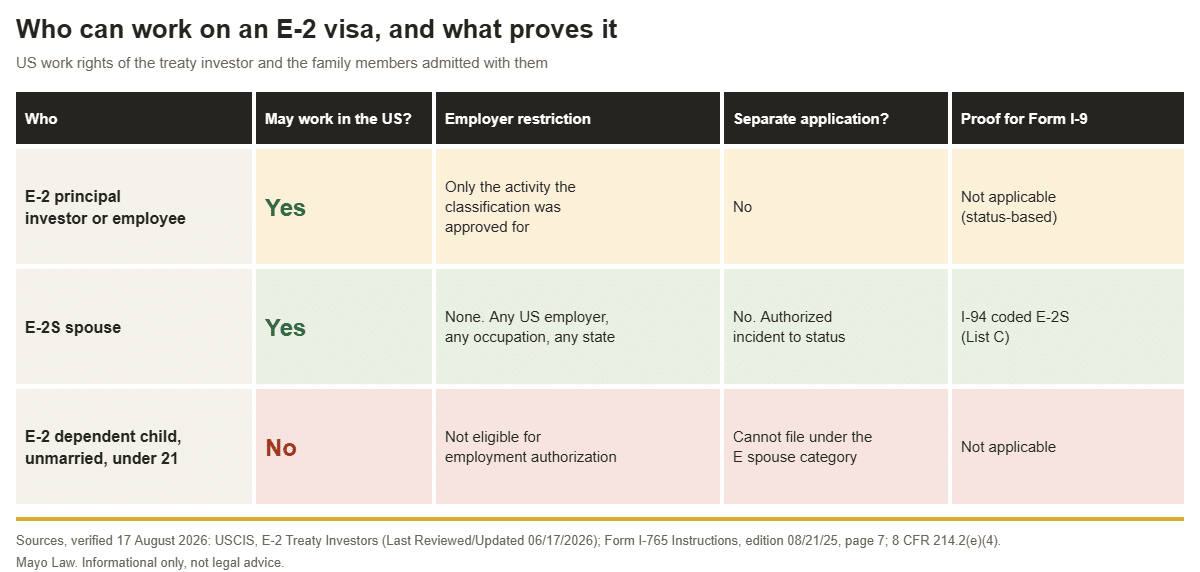
Yes. A spouse admitted in E-2S status is authorized to work for any US employer the moment they are admitted, with no separate work permit. Authorization comes from the status itself. An unexpired Form I-94 showing E-2S is what the employer accepts. Dependent children cannot work.
Can the spouse of an E-2 visa holder work in the United States?
Yes, and the authorization is broader than most people expect.
USCIS states on its E-2 Treaty Investors page that spouses of E-2 workers in valid E-2 or E-2S status "are considered employment authorized incident to status." The phrase carries real weight. Incident to status means the right to work arrives with the status itself. There is no application to file, no adjudication to wait for, and no approval notice to receive before the first day of work.
There is one carve-out, and it is narrow. USCIS excludes spouses of long-term investors in the Commonwealth of the Northern Mariana Islands, known as E-2 CNMI investors, who are required to apply for employment authorization under 8 CFR 274a.12(c)(12). For a Canadian family relocating to New York, Toronto’s usual destination markets, or anywhere else in the fifty states, that exception does not apply.
The scope of the authorization is what separates the spouse from the investor. The principal E-2 holder may only work in the activity for which the classification was approved, a restriction USCIS spells out under the terms and conditions of E-2 status. The spouse has no such limit. The spouse’s authorization is not tied to the treaty business, not tied to a named employer, and not tied to a job category.
What is E-2S status, and how is it different from E-2?
E-2S is not a different visa. It is an admission code.
As of January 30, 2022, USCIS and CBP began issuing Forms I-94 with a new admission class for certain spouses of E-2 workers: E-2S. The underlying immigration status is the same derivative E-2 classification that 8 CFR 214.2(e)(4) has always provided, under which the spouse and child of a treaty investor "may receive the same classification as the principal alien." The regulation also confirms something families frequently worry about without cause: the nationality of a spouse or child is not material to the classification. A Canadian investor’s spouse who holds only a British or Indian passport still qualifies as an E-2 dependent.
What the E-2S code adds is proof. Before the code existed, an E spouse who wanted to demonstrate work authorization to a US employer generally needed a physical card. The code moved that proof onto the I-94 itself.
The practical consequence is that two spouses with identical legal rights can have very different experiences at a job offer, purely because of what a CBP officer typed at the port of entry.
How does an E-2 spouse prove work authorization to an employer?
This is where E-2 visa spouse work authorization becomes an administrative problem rather than a legal one.
Every US employer must complete Form I-9 for a new hire, and the employee must present documents from the government’s published lists. USCIS identifies the following as DHS-issued evidence an E spouse may present:
- An unexpired Form I-94 with a notation reflecting E-2S nonimmigrant status. USCIS states this is acceptable as evidence of employment authorization under List C of Form I-9.
- An unexpired Form I-94 with a notation reflecting E-2 status, together with the notice USCIS sent regarding the new admission code. USCIS sent that notice to E spouses whose USCIS-issued I-94 predated January 30, 2022. The two documents together serve as List C evidence.
- An unexpired Employment Authorization Document. An EAD is acceptable under List A of Form I-9, which covers both identity and work authorization.
- A facially expired EAD accompanied by documentation showing it is automatically extended.
Note what is missing from that list: an I-94 that says only "E-2" and was issued after January 30, 2022, with no accompanying USCIS notice. A spouse in that position holds valid status and is legally authorized to work, but does not hold the document the employer’s I-9 process is built to accept.
The fix is administrative. CBP operates more than seventy Deferred Inspection Sites across the United States and its outlying territories, where travellers are referred when documentation requires additional review or possible correction. That is the route for a mis-coded I-94, and it is worth checking the I-94 record immediately after entry rather than on the morning a new employer runs I-9 paperwork.
Do you still need an EAD card?
No, but you may still want one, and the current paperwork carries a wrinkle worth knowing about.
USCIS is direct: E spouses who are employment authorized incident to status "are not required to request employment authorization by filing Form I-765," but may still file Form I-765, with fee, in order to obtain an Employment Authorization Document.
Why would anyone pay for a document they do not need? Because some employers, particularly larger ones with automated onboarding, are more comfortable with a List A card than with a List C I-94 they have not seen before. A card removes the argument.
Here is the wrinkle. The Form I-765 instructions in force, edition 08/21/25, still list the filing category for a "Spouse of an E-1 Treaty Trader, E-2 Treaty Investor, or E-3 Specialty Occupation Professional from Australia" as category (a)(17). Meanwhile, the current text of 8 CFR 274a.12 in the eCFR, with Title 8 last amended August 11, 2026, shows paragraphs (a)(17) and (a)(18) as "[Reserved]."
We are reporting that discrepancy as we found it, not interpreting it. What matters practically is this: the optional card is genuinely optional, and anyone who chooses to file should confirm the eligibility category printed in the form instructions in effect on the day of filing. That point is sharper than usual right now. USCIS has announced that a revised edition of Form I-765, edition date 09/15/26, publishes on September 15, 2026, and that there will be no grace period for the prior edition.
What can an E-2 spouse do, and what can dependent children do?
The two answers are very different, and the difference surprises families with older teenagers.
The spouse may work for any lawful US employer, in any occupation, in any state. Nothing in the incident-to-status authorization confines the spouse to the treaty enterprise.
Dependent children may not work at all. The Form I-765 instructions state it plainly, in a note attached to the E spouse category: "Other relatives or dependents of E nonimmigrants in E status are not eligible for employment authorization and cannot file under this category." Children qualify as E-2 dependents while unmarried and under twenty-one, per USCIS, and they may study, but the work authorization stops with the spouse.
This matters for planning. A nineteen-year-old in E-2 dependent status cannot take a summer job. A family that assumed otherwise has usually discovered it after the offer.
How does a Canadian family get E-2S status?
There are two routes, and they cost different amounts.
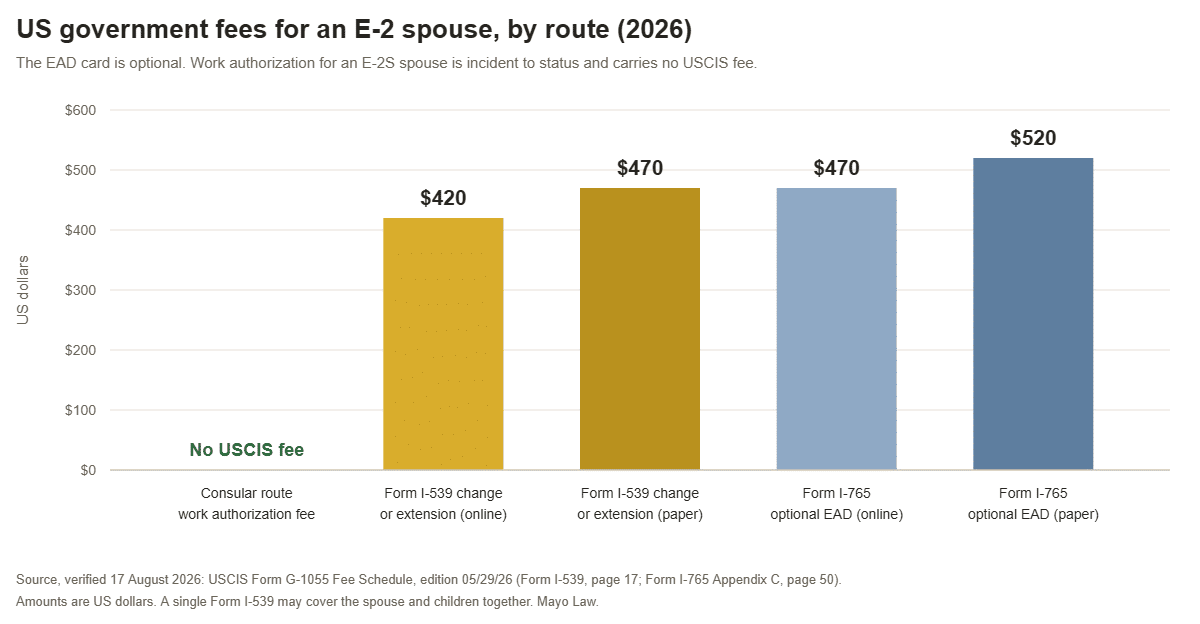
Route one, consular. The spouse applies for the E-2 dependent visa alongside the principal investor, is issued the visa, and is admitted at a port of entry with an I-94 annotated E-2S. There is no separate USCIS work authorization fee on this route because there is no USCIS work authorization application. This is the ordinary path for a family relocating from Canada, and it runs on the same track as the investor’s own E-2 visa application and consular interview, on the timeline set out in our guide to E-2 visa processing time.
Route two, change of status inside the United States. If the family is already in the US in another status, USCIS provides that family members seeking a change of status to, or extension of stay in, an E-2 dependent classification "may apply by filing a single Form I-539, Application to Change/Extend Nonimmigrant Status, with fee." One form covers the spouse and the children together, which is the one piece of genuinely good news in USCIS’s fee structure.
The government fees, taken from the current USCIS fee schedule, are set out below. They sit alongside the investor’s own filing costs, which we break down separately in our guide to E-2 visa cost.
A note on the I-539 route that is easy to miss: a change of status inside the United States gives the spouse E-2S status, but it does not produce a visa. A visa is a travel document issued by a consulate. If the family leaves the United States after an I-539 approval, the spouse will need to obtain the E-2 dependent visa at a consulate before returning. Our guide to E-2 visa renewal covers that status-versus-visa distinction in detail, because it produces the same confusion for investors.
The travel trap: why the spouse’s clock can run out first
This is the single most consequential rule in this article, and it is the one competitor guides most often skip.
USCIS confirms that an E-2 nonimmigrant who travels abroad will generally be granted an automatic two-year period of readmission when returning to the United States. Investors rely on this. It is why an E-2 holder whose I-94 is running short will often take a short trip.
The automatic readmission does not automatically extend to the family. USCIS states that unless the family members are accompanying the treaty investor at the time the investor seeks readmission, or the family members separately travel abroad and return within the new readmission period, the new readmission period will not apply to them. USCIS then adds the instruction: family members must carefully note the period of stay they have been granted and apply for an extension of stay before their own validity expires.
The failure mode is quiet. An investor takes a business trip alone, returns with a fresh two-year I-94, and reasonably assumes the household is covered. The spouse, who did not travel, is still running on the old admission. When that I-94 expires, the spouse’s status lapses and the work authorization that depends on it lapses with it, usually noticed only when an employer reverifies the I-9.
Two further regulatory points belong alongside it. Under 8 CFR 214.2(e)(19)(ii), the spouse and minor children are admitted for the period during which the principal is in valid treaty investor status, and a temporary departure by the principal does not by itself affect the derivative status of the spouse and minor unmarried children, provided the family relationship continues and the principal remains eligible. And under 8 CFR 214.2(e)(19)(iii), no one is admitted in E classification for a period extending more than six months beyond the expiration of their own passport. A spouse whose passport is closer to expiry than the investor’s will simply receive a shorter admission, regardless of what the investor received.
Check both I-94 records after every trip. Not one of them.
Mistakes that cost E-2 spouses working time
Five recur often enough to be worth naming.
Assuming the I-94 says E-2S. It frequently says E-2. Retrieve the record after entry and read the class of admission field.
Waiting for a card before accepting a job. The card is optional. A correctly annotated I-94 is sufficient under List C, and waiting for an EAD that was never required can cost months of income.
Treating an I-539 approval as a visa. It is not one. International travel after a change of status requires a consular visa application.
Assuming the investor’s travel refreshes everyone. It does not, unless the family travelled too.
Letting the marriage evidence go stale. Derivative status rests on the family relationship. The I-765 instructions require a marriage certificate for anyone filing for the optional card, and the same relationship underpins the status whether or not a card is ever requested.
Frequently asked questions
Does E-2 visa spouse work authorization expire?
It lasts as long as the underlying status. Because the authorization is incident to E-2S status rather than granted by a separate document, it ends when the spouse’s admission period ends. USCIS instructs family members to note the period of stay they have been granted and apply for an extension before their own validity expires, which is why the I-94 expiry date matters more than any card.
Can an E-2 spouse start their own business in the United States?
Nothing in the incident-to-status authorization limits the spouse to employment by others or to the treaty enterprise. The spouse’s authorization is not employer-specific, unlike the principal investor’s, who USCIS confines to the activity for which the classification was approved. Anyone planning to operate a business should still take advice on entity choice, licensing and tax before starting, since immigration authorization and business compliance are separate questions.
Do E-2 dependent children get work authorization when they turn eighteen?
No. Age is not the issue. The Form I-765 instructions state that relatives and dependents of E nonimmigrants other than the spouse are not eligible for employment authorization. Dependent children hold E-2 status while unmarried and under twenty-one and may study, but the work authorization attaches only to the spouse regardless of the child’s age.
How much does the optional EAD card cost in 2026?
Under the USCIS fee schedule, Form G-1055, edition 05/29/26, general filing of Form I-765 for an initial, replacement or renewal EAD is $520 by paper and $470 online. The fee is the same whether or not the applicant already has work authorization incident to status, because the payment buys the card rather than the authorization.
What happens to the spouse’s work authorization if the marriage ends?
Derivative E-2 status depends on the family relationship continuing to exist, a condition stated in 8 CFR 214.2(e)(19)(ii). If the qualifying relationship ends, the basis for the derivative status ends with it, and the work authorization that flows from that status ends too. Anyone in that position should take advice promptly, because the timing of a change of status matters.
Is the spouse’s E-2S status affected if the investor’s business fails?
The spouse’s status is derivative, so it depends on the principal remaining in valid E-2 status and eligible to perform the treaty activity. If the principal loses E-2 eligibility, the derivative status is exposed. This is one of several reasons investors monitor the substantiality and non-marginality of the enterprise throughout the period of stay rather than only at the E-2 visa requirements stage.
Does the spouse need a Social Security number before starting work?
A Social Security number is administered by the Social Security Administration and is a separate process from immigration status. It is not the source of work authorization, and E-2S status does not depend on it. Employers ordinarily need one for payroll, so it is worth applying early, but the authorization to work exists from admission regardless.
Conclusion
The rule itself is generous. A spouse admitted in E-2S status can work for anyone in the United States from the day of admission, with no application, no fee and no waiting period. Almost every problem E-2 families encounter here is documentary rather than legal: a code typed incorrectly at the border, a card bought that was never required, or an I-94 that quietly expired while everyone was watching the investor’s.
The families who avoid those problems tend to do one thing consistently. They check both I-94 records after every trip, and they read the class of admission field rather than assuming it.
How Mayo Law can help
Mayo Law is a cross-border firm with offices in Toronto and New York. Joseph Mayo, the firm’s principal attorney, is licensed in Ontario and New York, which means the same lawyer can look at the Canadian side of a family’s move and the US filing that follows.
For E-2 families, the work usually involves preparing the principal’s case and the dependants’ applications as one package rather than two, checking admission records after entry, and tracking the family’s expiry dates alongside the investor’s. If you are planning a move and want the spouse’s working position mapped out before the visa application rather than after it, our E-2 visa lawyer page explains how we work, and our wider business immigration practice covers the alternatives when E-2 is not the right fit. Canadians researching the route from the beginning may want to start with our guide to the E-2 visa from Canada, and families comparing dependent work rights across categories can read our guide to the H-4 visa and work permit, which follows a very different set of rules.
Disclaimer
This article is for general information only and is not legal advice. Reading it does not create a lawyer-client or attorney-client relationship with Mayo Law or with any lawyer at the firm. Immigration rules, government fees and form editions change, and the position described here reflects the sources cited as of August 2026. You should obtain advice on your own circumstances before acting. Mayo Law provides legal services in Ontario and New York.