

Contents
- Quick Answer
- What is extra-provincial registration in Ontario?
- Which class is your corporation in?
- When does a corporation "carry on business" in Ontario?
- What does a federal or other-province corporation file?
- What does a corporation from outside Canada file?
- Which Ontario filings continue after registration?
- What happens if a corporation does not register?
- How do you file, and what does it cost?
- How does Ontario compare with New York for a cross-border business?
- What this means for a corporation entering Ontario
- Frequently Asked Questions
- Conclusion
- How Mayo Law Can Help
- Disclaimer
A corporation that was not created under an Ontario statute, but that starts doing business in Ontario, walks into a filing regime that catches it whether it planned for Ontario or not. Extra-provincial registration is that regime. It applies to a federal corporation opening a Toronto office, to an Alberta corporation that keeps a representative in the province, and to a Delaware corporation that acquires Ontario real estate. What each of those three has to file is different, and the differences are worth knowing before a filing deadline passes.
The rules sit in two Ontario statutes that work together: the Extra-Provincial Corporations Act, which controls licensing, and the Corporations Information Act, which controls registration. Most of the confusion in this area comes from treating them as one thing.
Quick Answer
Extra-provincial registration in Ontario means filing an Initial Return under the Corporations Information Act within 60 days of beginning to carry on business in the province. Corporations from other Canadian jurisdictions file only that return, at no fee. Corporations incorporated outside Canada must first obtain an Extra-Provincial Licence, which costs $330.
What is extra-provincial registration in Ontario?
An extra-provincial corporation is defined in section 1(1) of the Extra-Provincial Corporations Act as a corporation, with or without share capital, incorporated or continued otherwise than by or under the authority of an Act of the Legislative Assembly. Read plainly, that is every corporation on earth except one incorporated in Ontario. A federal corporation under the Canada Business Corporations Act is an extra-provincial corporation in Ontario. So is a British Columbia corporation. So is a Nevada corporation.
Two separate obligations attach to that status, and they are often collapsed into one in general commentary:
- Registration under the Corporations Information Act. This is the Initial Return. Section 3(1) requires every extra-provincial corporation that begins to carry on business in Ontario to file one, and section 3(2) sets the deadline at 60 days.
- Licensing under the Extra-Provincial Corporations Act. This applies to a much smaller group. Section 4(2) prohibits only a class 3 corporation from carrying on business in Ontario without a licence.
Section 4(1) of the same Act says the quiet part directly: a corporation within class 1 or 2 "may carry on any of its business in Ontario without obtaining a licence under this Act." The licence is a foreign-corporation instrument. The registration is universal.
Which class is your corporation in?
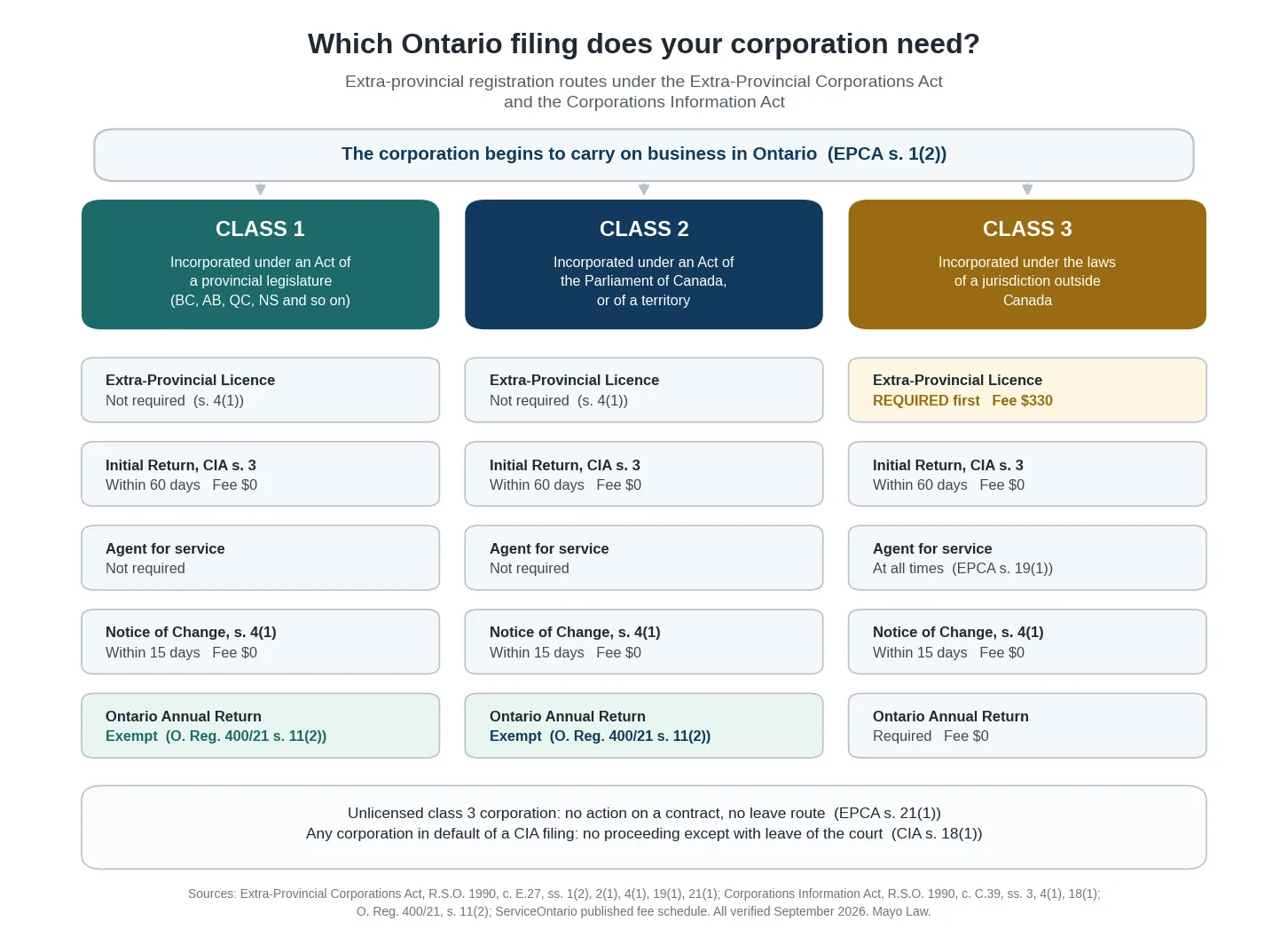
Extra-provincial registration turns on class, and the classes are set by section 2(1) of the Extra-Provincial Corporations Act. The ordering catches people out: class 1 is not the federal category.
| Class | Who is in it | Licence required | Initial Return required |
|---|---|---|---|
| Class 1 | Corporations incorporated or continued under an Act of a provincial legislature (British Columbia, Alberta, Quebec, Nova Scotia and so on) | No | Yes, within 60 days |
| Class 2 | Corporations incorporated or continued under an Act of the Parliament of Canada, or of a territorial legislature | No | Yes, within 60 days |
| Class 3 | Corporations incorporated or continued under the laws of a jurisdiction outside Canada | Yes, before carrying on business | Yes, within 60 days, after the licence |
Section 2(2) adds a wrinkle worth noting: a corporation incorporated under the laws of the Northwest Territories or Nunavut, but governed by the corporation laws of a province, falls into class 1 rather than class 2.
The class label is not cosmetic. It decides whether a licence is needed, whether an Ontario agent for service must be appointed, whether the Ontario annual return applies, and what happens if the corporation ends up in litigation without having filed. Each of those is covered below.
When does a corporation "carry on business" in Ontario?
The 60-day clock starts when the corporation begins to carry on business in Ontario, so the definition does real work. Section 1(2) of the Extra-Provincial Corporations Act says a corporation carries on business in Ontario if it:
- has a resident agent, representative, warehouse, office or place where it carries on its business in Ontario;
- holds an interest, otherwise than by way of security, in real property situated in Ontario; or
- otherwise carries on its business in Ontario.
That third limb is open-ended, and it is the one that decides most real cases.
Section 1(3) gives the only carve-out in the Act. A corporation does not carry on business in Ontario by reason only that it takes orders for or buys or sells goods, wares and merchandise, or offers or sells services of any type, by use of travellers or through advertising or correspondence.
Note what is absent. There is no carve-out for maintaining a bank account, none for holding directors' or shareholders' meetings in the province, and none for defending a lawsuit. New York, by contrast, lists all three as activities that do not constitute doing business in the state, at section 1301(b) of its Business Corporation Law. A company that reasons from the New York list to the Ontario position will reach the wrong answer. Our guide to what a US company doing business in Canada actually triggers covers the tax side of the same line, including permanent establishment and withholding, and is worth reading alongside this one.
What does a federal or other-province corporation file?
A class 1 or class 2 corporation has one core obligation on entry: the Initial Return under section 3 of the Corporations Information Act, due within 60 days after the date it begins to carry on business in Ontario. There is no licence, no agent for service, no certificate of status and no Nuans report.
Ontario's published service standard for the filing is 2 business days online and 15 business days by mail, and the government fee is $0 on both channels.
Section 2(1) of Ontario Regulation 400/21 sets out what the return contains:
- The corporate name.
- The Ontario Corporation Number, if one has already been assigned.
- The date of incorporation or amalgamation, whichever is most recent.
- The jurisdiction of incorporation, continuance or amalgamation, whichever is most recent.
- The address of the head or registered office.
- Whether the corporation has share capital.
- The date activities commenced in Ontario, and where applicable the date they ceased.
- The name and address for service of the chief officer or manager in Ontario, if any.
- The address of the principal place of business in Ontario, if any.
- The agent for service, where the corporation is required by law to have one.
Two practical points sit behind that list. First, Ontario does not accept a post-dated commencement date, so a corporation that has not yet started cannot pre-register; Corporations Canada says so on its own guidance for federal corporations. Second, a federal corporation incorporating online can be registered in Ontario at the same time through the Joint Online Registration System, which fills the Ontario form from the incorporation data. That is a genuine time saver, and it is also a trap: a corporation that used it years ago and has since moved offices still owes the Notice of Change described below.
What does a corporation from outside Canada file?
A class 3 corporation has to clear the licence first. Section 4(2) is a prohibition, not a filing deadline: no class 3 corporation "shall carry on any of its business in Ontario without a licence under this Act to do so," and no person acting as its representative or agent may carry on that business either.
Section 8(1) of Ontario Regulation 401/21 sets the supporting documents for the licence application:
- an Ontario biased or weighted Nuans name search report, dated not more than 90 days before the application is submitted (a Canada-biased report is not accepted);
- any consent to the name required by the regulation;
- a certificate of status from an official of the governing jurisdiction, confirming the name, the date of incorporation or amalgamation, the governing jurisdiction, and that the corporation is valid and subsisting; and
- an appointment of an agent for service in the approved form, executed by the corporation.
Where the Director is not satisfied that the corporation is valid and subsisting, including where the home jurisdiction does not issue a certificate of status at all, section 8(2) requires a legal opinion from a lawyer qualified to practise in that jurisdiction.
The agent-for-service requirement is continuous, not a one-time box. Section 19(1) of the Extra-Provincial Corporations Act requires the corporation to ensure the appointment, at all times, of an individual aged eighteen or older who is resident in Ontario, or a corporation with its head or registered office in Ontario, on whom service of process may be made. Service on the agent is deemed to be service on the corporation.
There is one exemption inside the class. Section 16 of Ontario Regulation 401/21 exempts a class 3 corporation that does not have gain for any of its objects from the licence requirement. A foreign not-for-profit still registers under the Corporations Information Act, but it does not need the licence.
A US limited liability company reaches this regime through a slightly different door, because Ontario has no LLC form of its own and the entity is classified differently on each side of the border. We cover that separately in our guide to whether you can form an LLC in Ontario.
Which Ontario filings continue after registration?
Registration is the beginning of a maintenance obligation, and this is where the most common error in circulation shows up.
Notice of Change. Section 4(1) of the Corporations Information Act requires a notice of change for every change in the information filed under the Act, within 15 days after the day the change takes place. Where the change is to the appointment of an agent for service under section 19(3) of the Extra-Provincial Corporations Act, section 4(2.1) makes the notice due immediately rather than in 15 days. There is no fee.
Annual Return. Here is the point that a great deal of general guidance gets wrong. Section 11(2) of Ontario Regulation 400/21 exempts all corporations from the annual return under section 3.1 of the Corporations Information Act, except four classes:
- Corporations subject to the Business Corporations Act (Ontario).
- Corporations subject to the Corporations Act.
- Foreign corporations that have a licence endorsed under the Extra-Provincial Corporations Act.
- Corporations subject to the Not-for-Profit Corporations Act, 2010.
A class 1 or class 2 extra-provincial corporation appears nowhere on that list. A federal corporation registered in Ontario, or a Saskatchewan corporation registered in Ontario, does not file an Ontario annual return. Corporations Canada states the same conclusion in its own guidance to federal corporations: "You do not have to file annual returns with the Government of Ontario." Anything that tells a federal corporation its Ontario registration will lapse without an annual return is describing an obligation that the regulation does not impose.
For the class 3 corporations that do owe the annual return, the deadline is not stated as a number of months in the regulation. Section 3(3) of Ontario Regulation 400/21 ties it to the federal tax filing deadline: the return is delivered within the time period for delivery of the corporation's tax return for its last completed taxation year. Section 150(1)(a) of the federal Income Tax Act sets that at six months after the end of the year, which is where the familiar six-month figure comes from. Section 11(3) then adds a further exemption: a corporation is exempt in a year in which it is not required to file a federal tax return at all.
The Ontario Business Registry itself repeats the practical version, telling corporations to file the Annual Return within six months of their fiscal year-end. The regulation is the controlling text, and it points at the tax deadline.
What happens if a corporation does not register?
The consequences differ by class, and they differ more sharply than most summaries suggest.
Fines, for everyone. Section 14(1) of the Corporations Information Act makes contravention an offence carrying a fine of not more than $2,000, or not more than $25,000 where the person is a corporation. Section 14(2) extends liability to every director or officer, and for an extra-provincial corporation to every person acting as its representative in Ontario, who authorized, permitted or acquiesced in the offence. Section 20 of the Extra-Provincial Corporations Act carries the same two figures for contraventions of that Act. Section 13 of the Corporations Information Act adds imprisonment of up to one year for a materially false or misleading statement, with a due-diligence defence at section 13(2).
Prosecution is constrained. Section 15(1) requires the Minister's consent or direction, and section 15(2) bars a proceeding commenced more than two years after the facts first came to the Minister's knowledge, as certified.
Losing the courtroom, with two different severities. Section 18(1) of the Corporations Information Act says a corporation in default of a filing requirement, or with unpaid fees or penalties, is not capable of maintaining a proceeding in an Ontario court in respect of its business except with leave of the court. Section 18(2) directs the court to grant leave where the failure was inadvertent, there is no evidence the public was deceived or misled, and the corporation has since filed everything and owes nothing. Section 18(3) preserves the contracts themselves: no contract is void or voidable by reason only of the contravention.
Section 21(1) of the Extra-Provincial Corporations Act is harder. A class 3 corporation that is not in compliance with the agent-for-service requirement, or that has not obtained a licence when required, "is not capable of maintaining any action or any other proceeding in any court or tribunal in Ontario in respect of any contract made by it." There is no leave provision. The only route back is section 21(2): correct the default, and the action may then be maintained as if the default had been corrected before it started.
So an unregistered federal corporation can ask a judge for leave. An unlicensed foreign corporation has to fix the licence and the agent first, then start over.
Orders and cancellation. Section 14(1) of the Extra-Provincial Corporations Act lets the Director apply to the court for an order prohibiting a class 1 corporation from carrying on business in Ontario, with failure to comply with a Corporations Information Act filing requirement expressly listed as sufficient cause at section 14(3)(a). For class 3 corporations, section 7 lets the Director cancel the licence outright, and section 7(3) lists failure to comply with section 19 and failure to comply with a Corporations Information Act filing requirement among the sufficient causes. The Ministry's own notice records that the Act contains no provision for reviving a cancelled licence.
Notice who is missing from section 14(1): class 2. A federal corporation is not subject to the prohibition order, and sections 10 and 11, which govern deceptive names and cease-use orders, apply to class 1 or class 3 only. A federally incorporated company carries the narrowest Ontario exposure of the three classes.
How do you file, and what does it cost?
Every extra-provincial registration filing runs through the Ontario Business Registry, which launched on October 19, 2021 and replaced the previous filing system. Entities registered before that date had their information migrated.
To file online you need a company key, a 9-digit code unique to the business, together with an Ontario Business Account and an Ontario.ca Login. The ministry issues the company key free, by email where an address is on file or by mail where one is not. For a class 3 corporation, the company key arrives with the licence itself, sent only to the official corporation email address.
| Filing | Statute | Online | By mail |
|---|---|---|---|
| Extra-Provincial Licence | EPCA | 5 business days, $330 | 10 business days, $330 |
| Amended Extra-Provincial Licence | EPCA | 5 business days, $150 | 10 business days, $150 |
| Termination of Extra-Provincial Licence | EPCA | Immediate, $0 | 10 business days, $0 |
| Initial Return or Notice of Change (extra-provincial) | CIA | 2 business days, $0 | 15 business days, $0 |
| Annual Return (extra-provincial foreign corporation) | CIA | Immediate, $0 | 15 business days, $0 |
| Certificate of status | Search product | $26 | $26 |
| Profile report | Search product | $8 | $8 |
Fees and service standards are as published by ServiceOntario and read in September 2026; the ministry treats service times as subject to change. Filings that are handwritten, on the wrong form, or missing the company key, payment or email address are returned unprocessed, and forms must be on 8.5 by 11 inch paper.
Ontario is also connected to the other registries. Section 7(1) of Ontario Regulation 400/21 prescribes Canada and every province and territory other than Ontario as jurisdictions for the information-sharing mechanism in section 8.1 of the Corporations Information Act, so information arriving from another registry can be entered as if the corporation had filed it. Corporations Canada names its counterpart the Multi-Jurisdictional Registry Access Service. The mechanism reduces duplicate filing; it does not remove the corporation's own obligation to make sure the Ontario record is right.
How does Ontario compare with New York for a cross-border business?
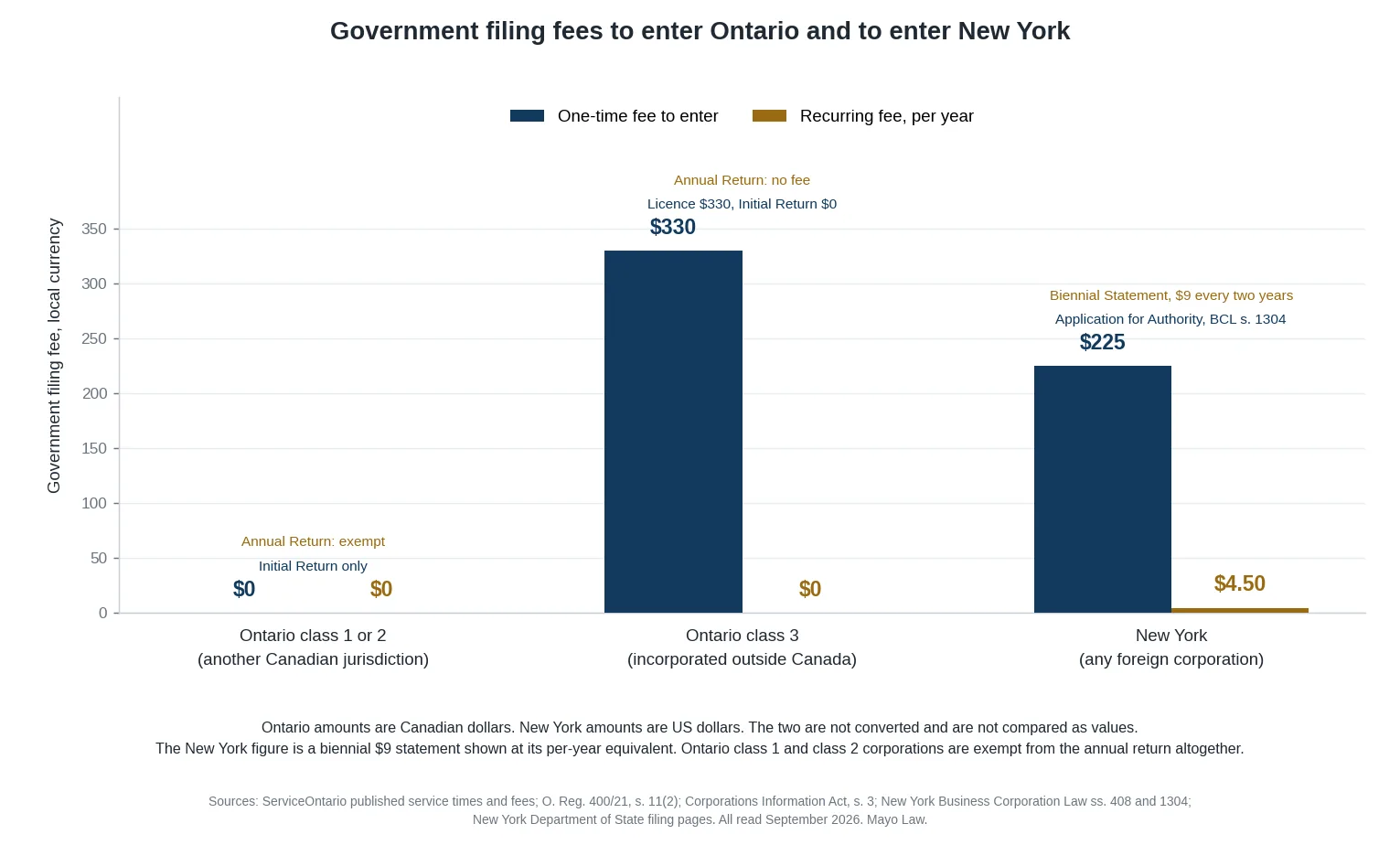
A company expanding in both directions faces two qualification regimes that look similar and behave differently. The comparison below draws on the Ontario provisions above and on New York's Business Corporation Law and Department of State fee schedule.
| Question | Ontario | New York |
|---|---|---|
| Entry filing for a corporation from outside the jurisdiction | Initial Return (all classes); Extra-Provincial Licence for class 3 only | Application for Authority under BCL section 1304, for every foreign corporation |
| Entry fee | $0 for the Initial Return; $330 for a class 3 licence | $225 |
| Supporting proof of existence | Certificate of status, class 3 only | Certificate of Existence, dated within one year |
| Name search | Ontario-biased or weighted Nuans report, class 3 only, within 90 days | Name availability inquiry, $5 per name under Executive Law section 96 |
| Activities that do not count | Orders, sales and services by travellers, advertising or correspondence (EPCA s.1(3)) | The same commercial channel is not listed, but litigation, meetings, bank accounts and securities transfer offices are excluded (BCL s.1301(b)) |
| Recurring filing | Annual Return, $0, class 3 only; classes 1 and 2 exempt | Biennial Statement under BCL section 408, $9, every two years, no exemption for out-of-state corporations |
| Effect of not qualifying | Leave of the court under CIA s.18(1); no leave for an unlicensed class 3 corporation under EPCA s.21(1) | No action maintained until authorized and all fees, taxes, penalties and interest are paid (BCL s.1312(a)); contracts unaffected and defence preserved (s.1312(b)) |
The sharpest difference is at the bottom row. Ontario's cure is procedural: file, pay, then proceed. New York's cure under section 1312(a) is conditioned on settling the tax account first, and the prohibition follows into the hands of a successor in interest. A Canadian company that has been selling into New York for two years without authority should price that clean-up before it counts on suing a customer there.
The second difference is the recurring one. An Ontario registration for a federal or other-province corporation generates no annual filing at all, while every foreign corporation authorized in New York owes a biennial statement whether or not anything has changed. Groups that run business operations on both sides of the border tend to under-calendar the New York side for exactly that reason.
What this means for a corporation entering Ontario
Three practical habits cover most of the risk that extra-provincial registration creates.
Fix the commencement date before anything else. The 60-day clock runs from when business began, not from when someone noticed the filing was outstanding, and the date goes on the public record. Where the date is genuinely uncertain, that uncertainty is a legal question about section 1(2), not a form-filling question.
Calendar the 15-day notice of change, because it is the obligation that quietly generates default. Directors change, offices move, agents resign. Section 18(1) of the Corporations Information Act attaches to any default, not only to a missing Initial Return, and the corporation usually discovers the problem when it needs to start a proceeding.
Decide who holds the company key, and record it. It is the only credential that permits online filing, and a corporation without it is pushed onto the mail channel and its longer service standards.
Corporations comparing Ontario entry against incorporating here from the start should read our Ontario incorporation guide alongside this one, and the overview of Ontario business structures if the entity form is still open. Where the corporation will sign Ontario contracts once registered, contract review and governing-law terms are the next question.
Frequently Asked Questions
Does a federal corporation need an extra-provincial licence in Ontario?
No. Section 4(1) of the Extra-Provincial Corporations Act says a corporation within class 1 or class 2 may carry on any of its business in Ontario without a licence, and a corporation incorporated under an Act of the Parliament of Canada is class 2 under section 2(1). The federal corporation still files an Initial Return under section 3 of the Corporations Information Act within 60 days of beginning to carry on business in Ontario.
What is the deadline for extra-provincial registration in Ontario?
Sixty days. Section 3(2) of the Corporations Information Act requires the Initial Return to be filed within 60 days after the date the corporation begins to carry on business in Ontario. A class 3 corporation, meaning one incorporated outside Canada, must obtain its Extra-Provincial Licence before it carries on business at all, so the licence comes first and the 60-day return follows.
How much does extra-provincial registration cost in Ontario?
The Initial Return and every Notice of Change carry no government fee, on either the online or the mail channel. An Extra-Provincial Licence for a corporation incorporated outside Canada costs $330 online or by mail, an amended licence costs $150, and terminating a licence costs nothing. Those are the ministry's own published fees, read in September 2026.
Does an extra-provincial corporation have to file an Ontario annual return?
Only if it is a foreign corporation holding a licence endorsed under the Extra-Provincial Corporations Act. Section 11(2) of Ontario Regulation 400/21 exempts all corporations from the annual return except Business Corporations Act corporations, Corporations Act corporations, licensed foreign corporations and Not-for-Profit Corporations Act, 2010 corporations. Federal and other-province corporations registered in Ontario are not on that list.
Does maintaining a bank account in Ontario count as carrying on business?
The Ontario statute does not say it does not. Section 1(3) of the Extra-Provincial Corporations Act excludes only taking orders, buying or selling goods, and offering or selling services through travellers, advertising or correspondence. Unlike section 1301(b) of New York's Business Corporation Law, the Ontario provision contains no carve-out for bank accounts, corporate meetings or defending litigation, so a company should not assume the New York analysis transfers.
Can an unregistered corporation sue in Ontario?
It depends on the class. Under section 18(1) of the Corporations Information Act a corporation in default cannot maintain a proceeding except with leave of the court, and section 18(2) requires leave where the default was inadvertent, nobody was misled, and everything has since been filed and paid. Under section 21(1) of the Extra-Provincial Corporations Act an unlicensed class 3 corporation is simply not capable of maintaining an action on a contract, with no leave route; section 21(2) allows the action once the default is corrected.
What is a company key and why is it needed?
The company key is a 9-digit code unique to a business, issued free by the ministry, that grants authority to file online in the Ontario Business Registry. It is sent by email where an email is on file and by mail otherwise, and for a newly licensed foreign corporation it is issued with the licence to the official corporation email address. An intermediary such as a lawyer or accountant can file using the key if the corporation shares it.
What happens if a corporation stops doing business in Ontario?
A licensed foreign corporation files a Notice of Change under the Corporations Information Act and then an Application for Termination of an Extra-Provincial Licence, which carries no fee. Section 12(2) of the Extra-Provincial Corporations Act also lets the Director cancel a licence, after an opportunity to be heard, where the corporation has not carried on business in Ontario for two consecutive years. A class 1 or class 2 corporation records the cessation date through the Corporations Information Act filings.
Conclusion
Extra-provincial registration in Ontario is two regimes wearing one name. Nearly every corporation entering the province files the same free Initial Return within 60 days, and only corporations incorporated outside Canada add a licence, an agent for service and an annual return on top. Getting the class right at the start decides the cost, the paperwork and the position the corporation will be in if a contract dispute reaches an Ontario court.
How Mayo Law Can Help
Mayo Law is a cross-border firm with offices in Toronto and New York. Joseph Mayo, the principal attorney, is licensed in Ontario and New York, which means one file can cover both the Ontario registration or licence and the New York Application for Authority without handing the matter between jurisdictions.
For corporations entering Ontario we advise on class and carrying-on-business analysis, extra-provincial licence applications and the supporting Nuans and certificate-of-status requirements, agent-for-service arrangements, Corporations Information Act filings and the calendar that follows them, and clean-up where filings have been missed. For Canadian companies moving the other way we handle New York qualification and the related corporate work. Our corporate and business law team works with small and mid-sized companies on both sides of the border, and clients who need one point of contact for both jurisdictions can read more about working with a dual-licensed Ontario and New York lawyer. Ongoing filing calendars and registry maintenance sit within our compliance practice.
Disclaimer
This article is for general information only and is not legal advice. Reading it does not create a solicitor-client or attorney-client relationship with Mayo Law or with any of its lawyers. Registration and licensing requirements turn on the specific facts of a corporation's activities in Ontario, and statutes, regulations, fees and service standards change. You should obtain advice on your own situation before acting. Mayo Law provides legal services in Ontario and New York.