

Contents
- Quick answer
- What counts as insider trading in Canada?
- Who is in a special relationship?
- Tipping and recommending: the second offence
- Insider trading Canada penalties
- Insider reporting and SEDI
- Canada vs US insider trading rules
- How companies and executives reduce the risk
- Frequently asked questions
- Conclusion
- How Mayo Law can help
- Disclaimer
Insider trading Canada law is not one statute. A trade made on undisclosed corporate information can create liability under a provincial securities act, the federal Criminal Code and, for a company incorporated federally, the Canada Business Corporations Act, all at the same time. Executives, directors, deal advisers and the friends they talk to can each be caught.
This guide explains what Canadian law treats as insider trading and tipping, who is covered, the penalties as they stand in October 2026, the insider reporting deadlines and how the rules compare with the United States. It uses Ontario's Securities Act as the provincial example, because each province and territory has its own securities statute.
Quick answer
In Canada, a person in a special relationship with a public company may not trade its securities while knowing an undisclosed material fact or material change, and may not tip others. Ontario fines reach the greater of $10 million or triple the profit, and the Criminal Code allows up to 10 years in prison.
What counts as insider trading in Canada?
Ontario's rule is in section 76(1) of the Securities Act. A person or company in a special relationship with an issuer may not purchase or sell the issuer's securities with knowledge of a material fact or material change about the issuer that has not been generally disclosed. Under section 76(5), "issuer" here means a reporting issuer or any other issuer whose securities are publicly traded.
Three ideas carry most of the weight:
- Material fact: section 1(1) of the Act defines it as a fact that would reasonably be expected to have a significant effect on the market price or value of the securities. Pending takeover talks, a missed earnings target or the loss of a major customer can qualify, depending on their likely effect on the price.
- Not generally disclosed: the information has not yet reached the market through a public release. A rumour circulating in a few inboxes is not general disclosure.
- Securities: section 76(6) extends the rule to options, other rights to buy or sell, securities whose price varies materially with the issuer's securities, and related derivatives.
The federal Criminal Code sets out its own offence in section 382.1. It applies to anyone who, directly or indirectly, buys or sells a security while knowingly using inside information obtained as a shareholder, through a business or professional relationship with the issuer, through a proposed takeover or merger, through employment or office with the issuer, or from someone who obtained it in one of those ways. Section 382.1(4) defines inside information as information that has not been generally disclosed and could reasonably be expected to significantly affect the market price or value of a security of the issuer.
Not every trade by an insider is illegal. Directors and officers buy and sell their own company's shares regularly. What the law prohibits is trading with undisclosed material information, and it requires insiders to report their trades so the market can see them.
Who is in a special relationship?
The Ontario prohibition applies only to a "person or company in a special relationship with an issuer", and section 76(5) defines that phrase broadly. It reaches well beyond the boardroom, as Figure 1 shows.
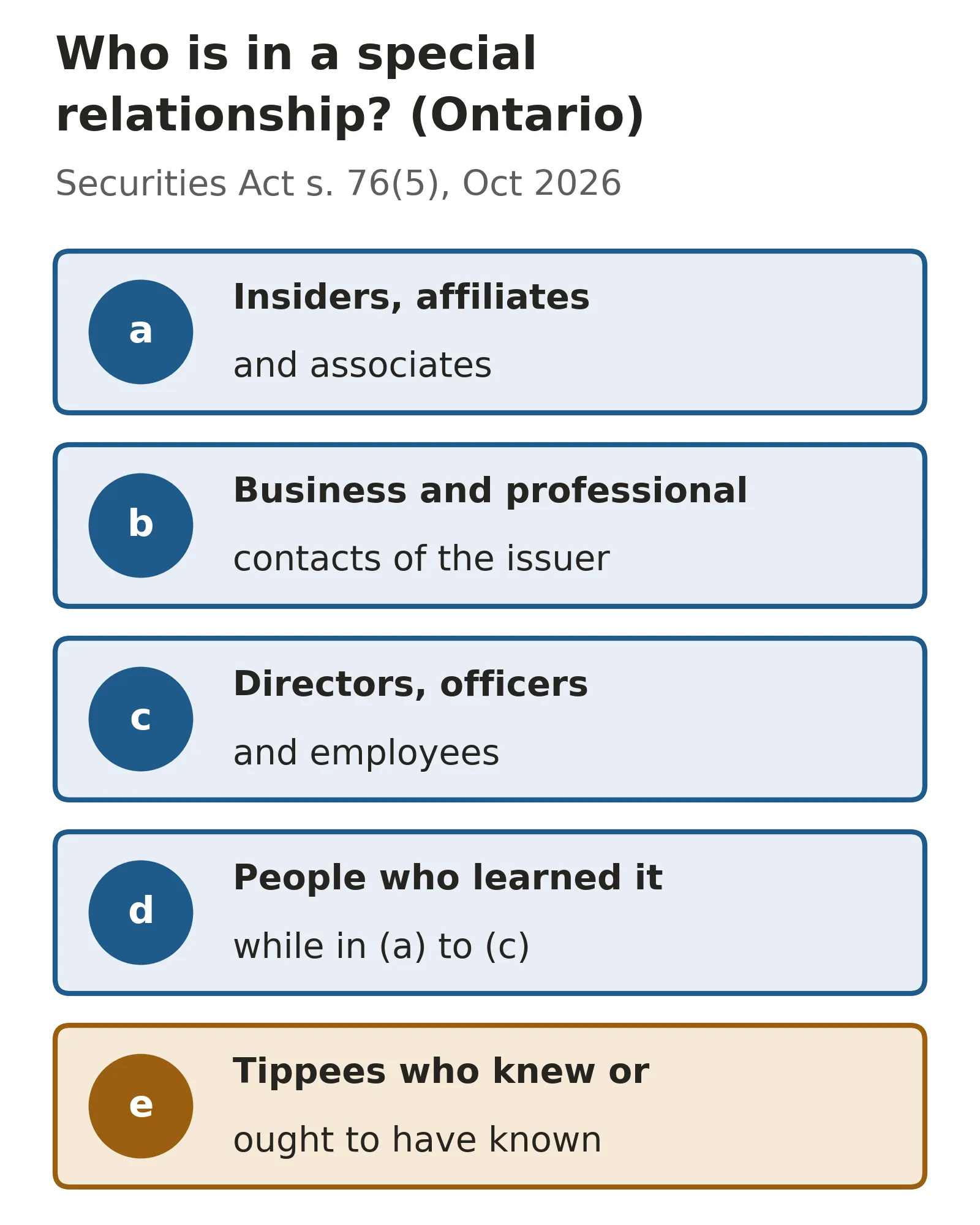
In plain terms, the five groups in section 76(5) are:
- Insiders, affiliates and associates of the issuer, or of a company considering a takeover bid or a merger with it.
- Business and professional contacts: anyone engaging in, considering or proposing business or professional activity with or on behalf of the issuer, such as deal advisers, accountants, consultants and bankers.
- Directors, officers and employees of the issuer, its subsidiaries, a company that controls it, or a bidder or merger partner.
- People who learned the fact while in one of those roles, even if they have since left.
- Tippees: anyone who learns a material fact from a person in a special relationship and knows or ought reasonably to have known that the source was in such a relationship. This includes people further down a chain of tips.
The last category matters for families and friends. In Finkelstein v. Ontario Securities Commission, 2018 ONCA 61, information about a takeover passed along a chain of five people. The Court of Appeal for Ontario considered section 76(5)(e) for the first time and upheld findings against two remote tippees who did not actually know their source's connection to the company, because they ought reasonably to have known it.
Tipping and recommending: the second offence
A person does not need to trade to break the law. Section 76(2) of the Ontario Act prohibits an issuer, or anyone in a special relationship with it, from informing another person of an undisclosed material fact or material change "other than in the necessary course of business". Section 76(3) applies the same rule to a company that is considering or proposing a takeover bid, a merger or a large asset acquisition.
Section 76(3.1), added in 2016, also prohibits recommending or encouraging another person to buy or sell the issuer's securities while knowing an undisclosed material fact. A director who tells a friend "now would be a good time to buy" without explaining why can still be caught.
The Criminal Code has a matching tipping offence. Section 382.1(2) applies to a person who knowingly conveys inside information to another person, knowing there is a risk that the recipient will trade on it or pass it on to someone who may trade. It does not apply when the disclosure is necessary in the course of business.
Ontario also provides a defence in section 76(4): no one is found to have contravened these rules if they prove they reasonably believed the material fact or change had been generally disclosed. The burden of proving that belief sits with the person relying on it.
Insider trading Canada penalties
The consequences come from three directions at once: criminal prosecution, provincial securities enforcement and civil claims for damages. The table below sets out the maximum penalties we confirmed in the current statutes.
| Provision | Maximum fine | Maximum prison |
|---|---|---|
| Criminal Code s. 382.1(1) trading | Not set in s. 382.1 | 10 years |
| Criminal Code s. 382.1(2) tipping | Not set in s. 382.1 | 5 years |
| Ontario Securities Act s. 122 | $10 million or triple profit | 5 years less a day |
| Ontario s. 127 (Tribunal order) | $5 million per failure | None (administrative) |
Criminal Code prosecution
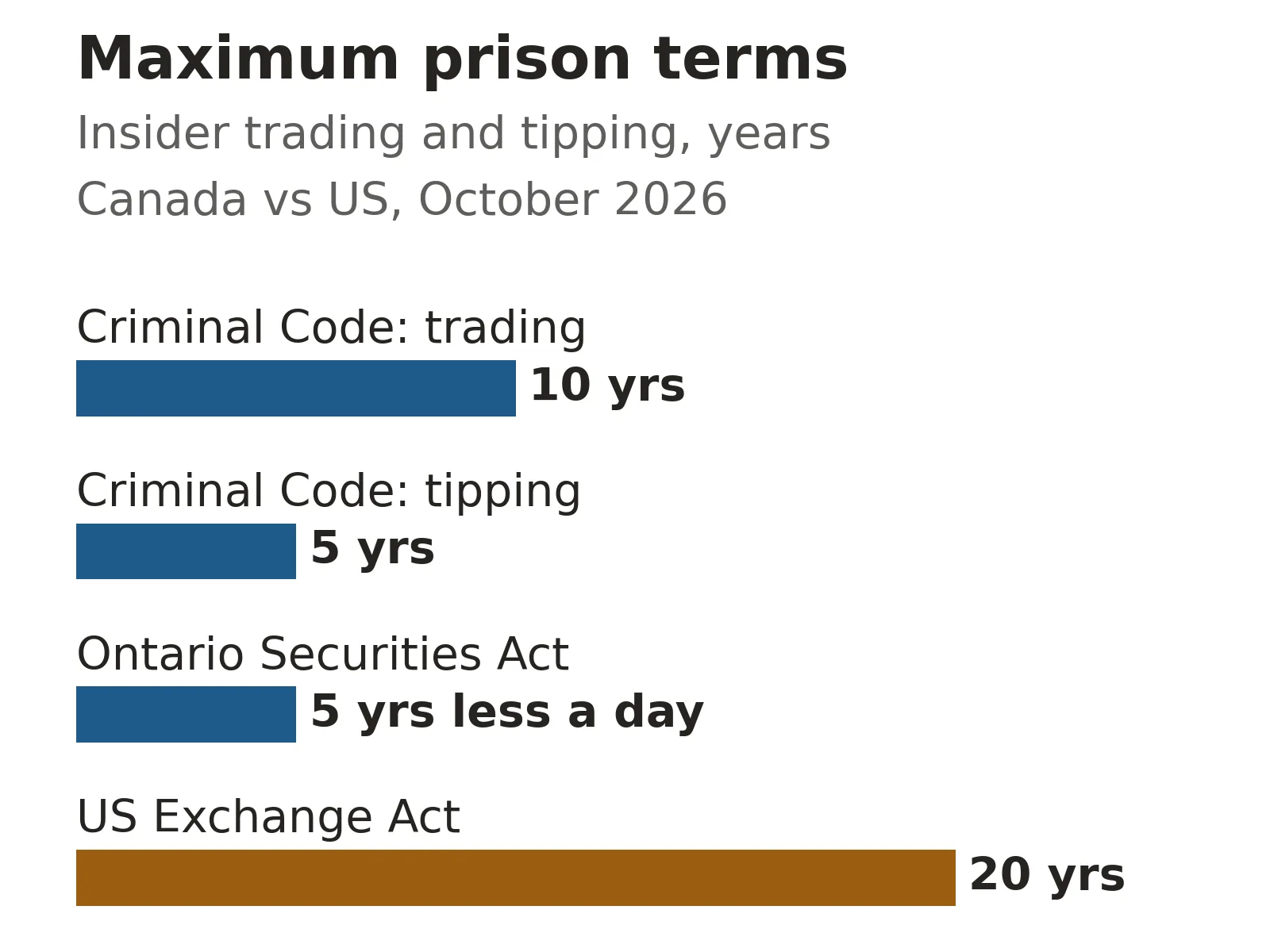
Under section 382.1, insider trading is an indictable offence punishable by up to 10 years in prison, and tipping by up to 5 years. The Crown may instead proceed by summary conviction for either. At sentencing, section 380.1 requires the court to treat certain facts as aggravating, including harm or potential harm to investor confidence in a Canadian financial market, a large number of victims and, under section 380.1(1.1), a fraud value above one million dollars. Our guide to fraud charges in Canada explains how those sentencing rules work in fraud cases.
Securities Act offences in Ontario
Section 122(1) of the Ontario Securities Act makes a contravention of Ontario securities law an offence punishable by a fine of up to $10 million, imprisonment of up to five years less a day, or both. Those limits reflect a 2025 amendment (S.O. 2025, c. 10, Sched. 17). For insider trading and tipping under sections 76(1), (2) and (3), section 122(4) adds a profit-based fine: at least the profit made or loss avoided, and at most the greater of $10 million and triple that profit or loss avoided. Section 122(3) makes directors and officers who authorize, permit or acquiesce in a company's offence personally liable to the same maximum penalties.
Administrative orders from the Capital Markets Tribunal
Insider trading in Ontario can also be pursued through administrative proceedings instead of a prosecution, as it was in Finkelstein. Under section 127(1), the Capital Markets Tribunal may make orders in the public interest, including a trading ban, a ban on acting as a director or officer of an issuer, an administrative penalty of up to $5 million for each failure to comply, and disgorgement of amounts obtained through the breach.
Civil liability, including private companies
Section 134 of the Ontario Securities Act makes a person in a special relationship who trades with undisclosed material information liable to compensate the person on the other side of the trade, and makes tippers liable to people who later trade with their tippees. The same defences apply where the trader reasonably believed the information was public, or the other party knew or ought reasonably to have known it.
The federal corporate statute goes further for private companies. Section 131 of the Canada Business Corporations Act applies to any corporation under that Act, not only public ones. An insider who buys or sells a security of the corporation with knowledge of confidential information that might reasonably be expected to affect the value of its securities materially must compensate the seller or buyer for damages (s. 131(4)) and account to the corporation for any benefit (s. 131(5)). Section 131(10) requires the action to be started within two years after discovery of the facts. This can matter when a founder buys out a co-founder or an early investor in a private federal company.
Insider reporting and SEDI
Separate from the prohibition, insiders of a reporting issuer must disclose their holdings and trades. In Ontario, section 107(1) of the Securities Act requires a new insider to file a report within 10 days of becoming an insider, and section 107(2) requires a report of any change in holdings within 10 days or such other period as may be prescribed. National Instrument 55-104 prescribes five days for changes in Ontario (section 2.2, read in the unofficial consolidation current to June 9, 2023). Reports are filed through the System for Electronic Disclosure by Insiders (SEDI), the system established under National Instrument 55-102.
A late or missing insider report is itself a contravention of Ontario securities law, which is one reason a company's compliance officer usually tracks insider filings alongside trading blackouts.
Canada vs US insider trading rules
Many Canadian companies raise money, list or trade in the United States, and US rules are broader in some respects and stricter in others. The comparison below uses only provisions we read this month.
| Issue | Ontario and Canada | United States |
|---|---|---|
| Core prohibition | Securities Act s. 76 | Exchange Act s. 10(b), Rule 10b5-1 |
| Report of a trade | 5 days (NI 55-104) | 2 business days (Form 4) |
| Maximum prison | 10 years (Criminal Code) | 20 years |
| Maximum fine, individual | $10M or triple profit (Ontario) | US$5 million (criminal) |
On the US side, 17 CFR 240.10b5-1 treats trading "on the basis of" material nonpublic information as a violation of section 10(b) of the Securities Exchange Act of 1934 and Rule 10b-5 (eCFR, up to date as of October 6, 2026). Criminal penalties under 15 U.S.C. 78ff(a) for willful violations reach fines of up to $5,000,000 for an individual and $25,000,000 for a company, and up to 20 years in prison. The SEC can also seek a civil penalty of up to three times the profit gained or loss avoided under 15 U.S.C. 78u-1(a)(2), and a controlling person can face up to the greater of $1,000,000 or three times that profit (s. 78u-1(a)(3)).
US directors and officers often trade through prearranged Rule 10b5-1 plans. For them, trading under a new plan cannot begin until the later of 90 days after adoption or two business days after the company discloses results for the quarter in which the plan was adopted, capped at 120 days. Other persons face a 30-day cooling-off period. Section 16 of the Exchange Act also requires directors, officers and holders of more than 10 percent to report changes in ownership before the end of the second business day after the trade, and section 16(b) lets the company recover profits from a purchase and sale within any period of less than six months. Our overview of US federal wire fraud penalties covers another charge that often accompanies securities cases in the US.
How companies and executives reduce the risk
Insider trading risk often starts with ordinary conversations rather than planned schemes, so a written approach helps both the company and its people:
- Step 1: Adopt an insider trading policy. Name who is covered, define material information in the company's own context and require pre-clearance of trades by directors and officers.
- Step 2: Use blackout periods. Close the trading window before earnings releases and during any deal, and keep a list of everyone who knows about the deal.
- Step 3: Control the flow of information. Share deal information only in the necessary course of business and record who received it and when.
- Step 4: File insider reports on time. Diarize the 10-day and 5-day deadlines and confirm SEDI profiles are current.
- Step 5: Train people about tipping. Remind staff that telling a spouse or friend, or simply recommending a trade, can be an offence even if they never trade themselves.
- Step 6: Check the US rules. If the company's securities trade in the US, or its executives hold US-listed shares, review the Form 4 and Rule 10b5-1 requirements as well.
Insider trading also overlaps with anti-money laundering obligations when proceeds move through financial institutions. Our guide to FINTRAC explains the reporting side of that system, and our compliance practice page describes the policies we help companies put in place.
Frequently asked questions
Is insider trading illegal in Canada?
Trading by an insider is not illegal in itself. Directors, officers and employees may buy and sell their company's shares if they are not trading on undisclosed material information and they file any insider reports required. It becomes illegal when a person in a special relationship trades while knowing an undisclosed material fact or material change, or tips another person about it.
What is insider dealing, and is it the same as insider trading?
Insider dealing is not a term used in the Canadian statutes discussed here. People generally use it to mean the same conduct as insider trading: dealing in securities while holding undisclosed price-sensitive information. Canadian statutes use different words. The Criminal Code heading is prohibited insider trading, and Ontario's Securities Act calls it trading where undisclosed change, with tipping as a separate prohibition.
Can I be liable if I only heard the tip from a friend?
Yes. Under section 76(5)(e) of the Ontario Securities Act, a person who learns a material fact from someone in a special relationship becomes a person in a special relationship if they knew or ought reasonably to have known about the source's connection. The Court of Appeal for Ontario applied that test to remote tippees in Finkelstein v. Ontario Securities Commission in 2018.
What is the maximum penalty for insider trading in Canada?
Under the Criminal Code, insider trading carries up to 10 years in prison and tipping up to 5 years. Under Ontario's Securities Act, a court can impose a fine of up to $10 million or triple the profit made, whichever is greater, and up to five years less a day in prison. The Capital Markets Tribunal can add administrative penalties and trading bans.
Do insider trading rules apply to private companies?
The Ontario prohibition in section 76 covers reporting issuers and other issuers whose securities are publicly traded. For corporations under the Canada Business Corporations Act, section 131 creates civil liability for insiders who trade with material confidential information, and it applies to any corporation under that Act, including private ones. The claim must be started within two years of discovering the facts.
How quickly must an insider report a trade in Ontario?
A new insider of an Ontario reporting issuer must file an initial report within 10 days of becoming an insider under section 107(1) of the Securities Act. Changes in holdings must be reported within five days under section 2.2 of National Instrument 55-104. Reports are filed electronically through SEDI. In the US, Form 4 reports are due within two business days.
Is sharing information with the company's advisers tipping?
Not if it is done in the necessary course of business. Section 76(2) of the Ontario Securities Act and section 382.1(2) of the Criminal Code both exclude disclosures that are necessary in the course of business. An adviser working with or on behalf of the issuer is itself in a special relationship under section 76(5)(b), so the same trading and tipping rules bind the adviser.
Conclusion
Insider trading in Canada is regulated in layers: a provincial securities act, the Criminal Code and, for federal corporations, the Canada Business Corporations Act. The common thread is simple. If you know something material about a company that the market does not know yet, do not trade, do not tip and do not recommend a trade until it is generally disclosed. Companies with a US connection should also plan for the stricter US reporting deadlines and the Rule 10b5-1 framework. Because the Ontario penalties changed in 2025, any policy or training material written earlier should be checked against the current statute.
How Mayo Law can help
Mayo Law advises companies, directors and executives on both sides of the border, with offices in Toronto and New York. Joseph Mayo is licensed in Ontario and New York. We help companies draft insider trading and disclosure policies, review trading plans and insider reporting, and respond when a regulator or prosecutor asks questions. Our white collar defense practice handles investigations and charges, and our white collar defense guides cover related offences.
Disclaimer
This article is for general information only and is not legal advice. Reading it does not create a solicitor-client or attorney-client relationship. Securities laws differ between provinces and between Canada and the United States, and they change; get advice on your own situation before acting. Mayo Law provides legal services in Ontario and New York.