

Contents
- Quick answer
- What does termination without cause mean in Ontario?
- What notice or termination pay does the ESA require?
- How is severance pay calculated in Ontario?
- When does common-law reasonable notice apply?
- What should the termination letter say?
- When is a termination without cause still unlawful?
- What must an employer pay and file after the last day?
- Frequently asked questions
- Conclusion
- How Mayo Law can help
- Disclaimer
Termination without cause in Ontario means ending an employee's employment for a business reason rather than for misconduct. Ontario employers are allowed to do it, and they do not have to give a reason, but they do have to pay for it: at least the notice or termination pay the Employment Standards Act requires, severance pay for some employees, and often much more under the common law unless a valid termination clause limits it.
This guide walks an Ontario employer through the process: what the ESA requires, how severance pay is calculated, when common-law reasonable notice applies, what the termination letter should say, when a without-cause termination is still unlawful, and what must be paid and filed after the last day. The statute, regulation, Ministry guide and court decisions below were checked against official sources as of October 2026.
Quick answer
An Ontario employer can terminate without cause by giving written notice or termination pay under the ESA, one to eight weeks depending on service, plus ESA severance pay if the employee qualifies. Unless a valid termination clause limits it, the employee is also entitled to common-law reasonable notice, which is often far longer.
What does termination without cause mean in Ontario?
A termination without cause is a dismissal that does not rely on the employee's misconduct. The reason may be restructuring, a lost contract, performance that falls short of misconduct, or simply a decision that the role is no longer needed. Ontario's guide to the ESA's termination rules (updated July 23, 2026) states that the ESA does not require an employer to give an employee a reason why their employment is being terminated.
The contrast is with a termination for cause. Under section 2(1) of O. Reg. 288/01, an employer owes no ESA notice or termination pay to an employee who has been guilty of wilful misconduct, disobedience or wilful neglect of duty that is not trivial and has not been condoned by the employer. The Ministry's guide explains that "wilful" includes intended or reckless conduct, and that poor work conduct that is accidental or unintentional is generally not considered wilful. That is a high bar, which is why most dismissals that employers think of as "for cause" are handled, and paid, as without cause.
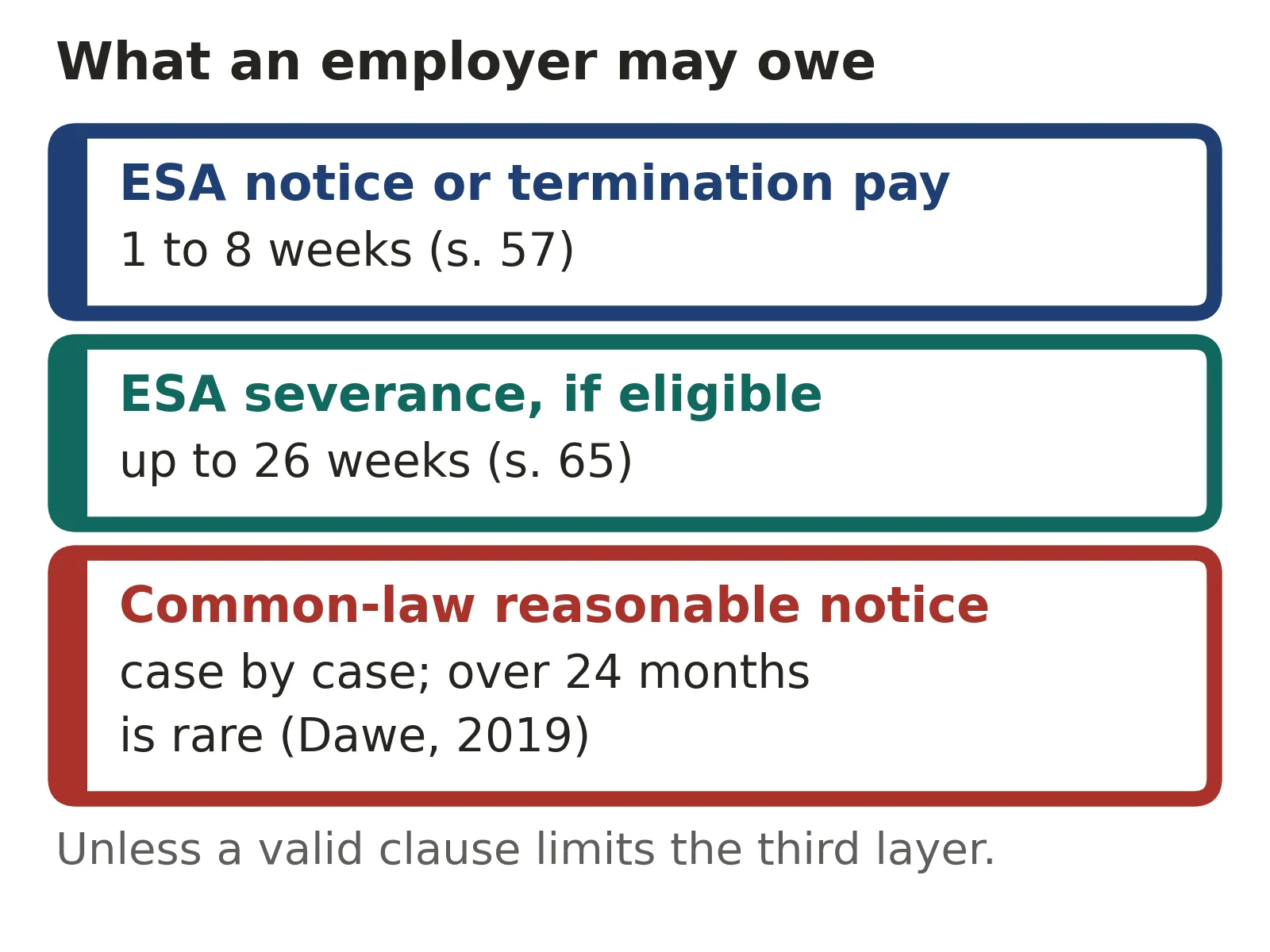
For a termination without cause, Ontario law layers three sources of entitlement on top of each other: ESA notice or termination pay, ESA severance pay, and common-law reasonable notice. Figure 1 shows how they relate.
What notice or termination pay does the ESA require?
Section 54 of the Employment Standards Act, 2000 prohibits terminating an employee who has been continuously employed for three months or more unless the employer has given written notice under section 57 or 58 and the notice has expired, or has paid termination pay under section 61. Section 57 sets the individual notice period by length of employment: one week for less than one year, two weeks for one year to under three, then one more week for each additional year of service, up to eight weeks for eight years or more.
The Ministry's guide confirms the employer may combine the two, giving some working notice and paying the rest, as long as the notice and the weeks of termination pay together equal the required period. Each option comes with rules:
- Working notice: during the notice period, section 60(1) bars the employer from reducing the wage rate or altering any other term of employment, requires at least regular wages each week, and requires benefit plan contributions to continue until the end of the notice period.
- Termination pay: under section 61(1), pay in lieu is a lump sum equal to what the employee would have earned during the notice period, and the employer must also continue benefit plan contributions for that period. The guide notes that the employee earns vacation pay on termination pay.
- Written and served: section 4(1) of O. Reg. 288/01 requires the notice to be in writing, addressed to the employee and served in accordance with section 95 of the Act. The guide says it can be delivered in person or by mail, fax or email, as long as delivery can be verified.
Larger reductions follow a different rule. When 50 or more employees at an establishment are terminated in the same four-week period, section 58 applies, and section 3(1) of O. Reg. 288/01 sets notice of 8 weeks for 50 to 199 employees, 12 weeks for 200 to 499, and 16 weeks for 500 or more. Since October 26, 2023, section 53.2 of the ESA counts an employee's home as part of the establishment when the employee works only from home, so remote staff are included in that count.
How is severance pay calculated in Ontario?
Severance pay is separate from termination pay and only some employees qualify. Under section 64(1), the employee must have worked for the employer for five years or more, and either the employer has a payroll of $2.5 million or more, or the employee is one of 50 or more employees severed within six months because of a permanent discontinuance of all or part of the business at an establishment. Ontario's severance pay guide describes the payroll test as a global payroll.
Section 65(1) calculates it as regular wages for a regular work week multiplied by completed years of employment plus completed months divided by 12, and section 65(5) caps it at 26 weeks. An employee with 10 years and 6 months of service therefore receives 10.5 weeks of regular wages. Under section 66, severance may be paid in instalments only with the employee's agreement or the Director's approval, over no more than three years.
The table below compares the two statutory payments.
| Item | Termination pay | Severance pay |
|---|---|---|
| Who qualifies | 3+ months' service | 5+ years, plus a test |
| Amount | 1 to 8 weeks | 1 week per year served |
| Maximum | 8 weeks | 26 weeks |
| When paid | Later of 7 days or payday | Same timing |
When does common-law reasonable notice apply?
The ESA amounts are minimums. The Ministry's guide states that the ESA rules are minimum requirements and that some employees may have greater rights under the common law. In Ontario, an employee hired for an indefinite term is entitled to reasonable notice at common law unless a valid written termination clause limits the entitlement to something lower. Under the Supreme Court of Canada's decision in Machtinger v. HOJ Industries and the Court of Appeal's decision in Waksdale v. Swegon North America, a clause that falls below the ESA in any respect is unenforceable, and reasonable notice applies.
Courts set reasonable notice case by case. In Love v. Acuity Investment Management Inc., 2011 ONCA 130, the Court of Appeal for Ontario quoted the classic test from Bardal v. Globe and Mail (1960): notice is decided with reference to each particular case, having regard to the character of the employment, the length of service, the employee's age and the availability of similar employment (para. 13). The court also warned that length of service can take on a disproportionate weight (para. 19).
There is no fixed maximum. In Dawe v. Equitable Life Insurance Company of Canada, 2019 ONCA 512, the court repeated that while there is no absolute upper limit, generally only exceptional circumstances will support a base notice period above 24 months (para. 31), and it reduced the award for a 62-year-old senior executive with 37 years of service to 24 months (paras. 1, 35, 44).
The manner of the dismissal matters too. In Honda Canada Inc. v. Keays, 2008 SCC 39, the Supreme Court of Canada confirmed the expectation that, in the course of dismissal, employers will be candid, reasonable, honest and forthright with their employees (para. 58), and that a failure to act in good faith in the manner of dismissal can lead to compensable damages.
Our guide to employment compliance covers drafting termination clauses for cross-border employers, and our contract review services page explains what a review of an existing employment agreement involves.
What should the termination letter say?
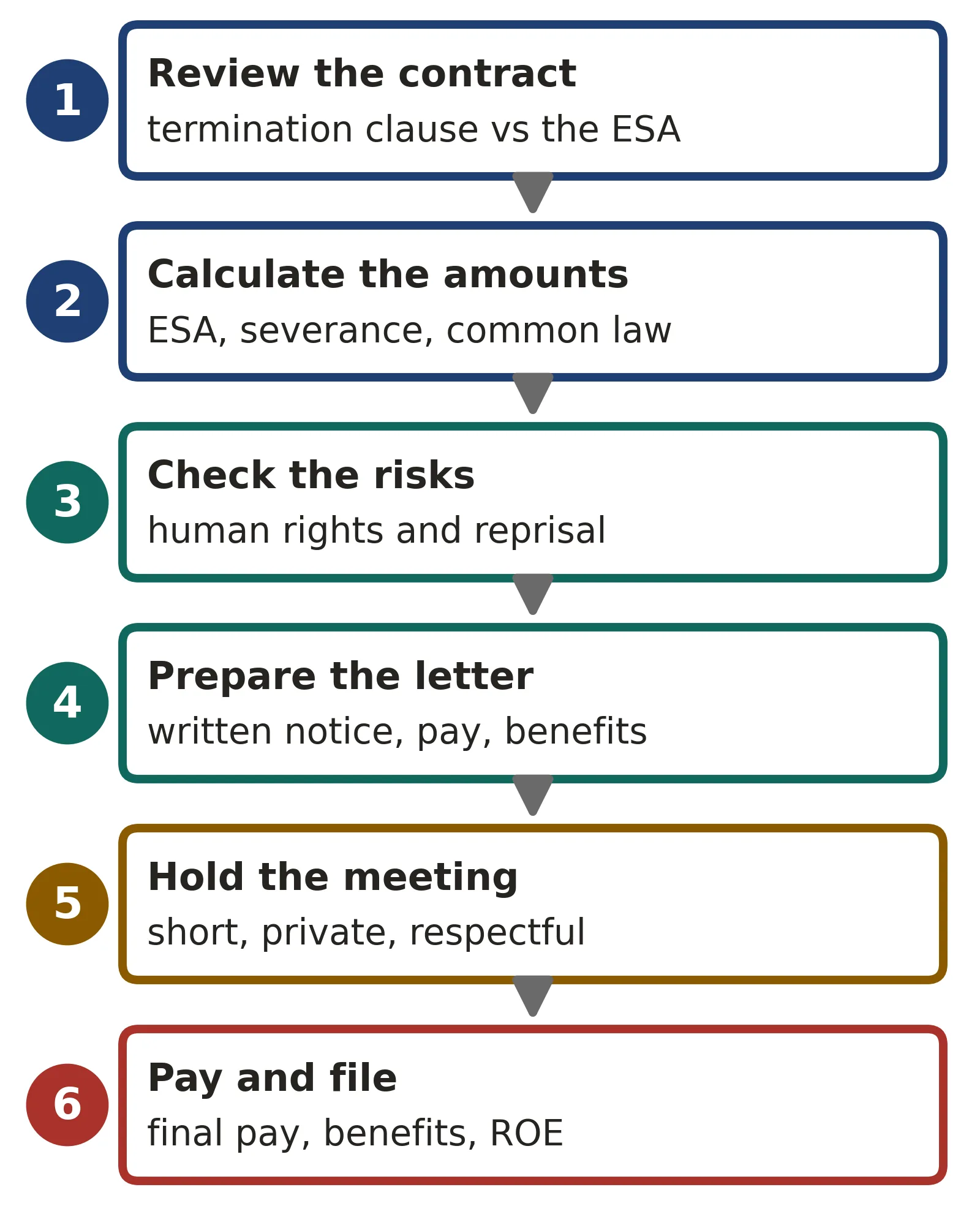
The ESA requires written notice, so a without-cause termination in Ontario is documented in a letter. The statute does not prescribe its contents beyond the notice itself. In our practice, a clear letter covers these points:
- The decision and the date: that employment is ending without cause, and the last day of work or the end of the working notice period.
- ESA amounts: termination pay and, if applicable, severance pay, with how each was calculated and when it will be paid.
- Benefits: how long benefit coverage continues, which must be at least the ESA notice period.
- Accrued amounts: outstanding wages and vacation pay.
- Any offer above the minimum: the additional amount offered, the release it is conditional on, and a reasonable time to obtain advice.
- Return of property: laptops, keys, documents and confidential information, and the employee's continuing confidentiality obligations.
Because section 5 of the ESA bars contracting out of an employment standard, the statutory amounts should be paid whether or not the employee signs a release. A release is normally tied to the amount offered above the ESA minimum. Where the employee is subject to restrictive covenants, our guide to non-compete agreements in Ontario explains which ones survive the statutory ban.
When is a termination without cause still unlawful?
"Without cause" does not mean "for any reason". Two statutes limit the reasons an employer may act on, whatever it pays:
- Human rights: section 5(1) of Ontario's Human Rights Code gives every person the right to equal treatment with respect to employment without discrimination because of race, ancestry, place of origin, colour, ethnic origin, citizenship, creed, sex, sexual orientation, gender identity, gender expression, age, record of offences, marital status, family status or disability. The Ontario Human Rights Commission's guidance on ending the employment relationship says a key consideration when ending employment is that it is not linked to, based on or tainted by discrimination.
- Reprisal: section 74(1) of the ESA prohibits an employer from dismissing or otherwise penalizing an employee because the employee asked the employer to comply with the Act, asked about their rights, filed a complaint, or exercised or tried to exercise a right under the Act, among other protected acts.
The Ministry's guide gives examples of terminations that are prohibited even with proper notice or termination pay: any termination where part of the reason is that the employee asked questions about the ESA or exercised an ESA right, such as refusing to work beyond the hours-of-work maximums or taking a leave of absence specified in the ESA. Timing a termination close to a leave, a complaint or a disclosed medical condition is where most of the risk sits, and the employer should be able to show the business reason independently.
What must an employer pay and file after the last day?
The work does not end with the meeting. Several deadlines run from the last day of employment:
- Final wages: under section 11(5) of the ESA, wages owing when employment ends must be paid no later than seven days after it ends or the employee's next regular pay day, whichever is later. The Ministry's guides apply the same timing to termination pay and severance pay.
- Benefits: section 62(1) deems employees actively employed for benefit plan purposes during any notice period they did not receive, so benefits cannot simply stop on the last day.
- Record of employment: Service Canada's ROE guide (modified September 15, 2026) says an employer issuing ROEs electronically with weekly, biweekly or semi-monthly pay periods has up to 5 calendar days after the end of the pay period in which the interruption of earnings occurs to issue it. A paper ROE is due within 5 calendar days of the first day of the interruption or of the day the employer becomes aware of it.
An employee who disagrees with the amounts can file a claim with the Ministry or sue for wrongful dismissal, but the guide notes the employee cannot do both for the same termination. Our compliance page describes how we support employers through that process.
Frequently asked questions
Can an employer in Ontario fire someone without a reason?
Yes. The Ministry's guide states that the ESA does not require an employer to give a reason for terminating employment. The employer must still provide written notice or termination pay, severance pay where the employee qualifies, and any greater common-law or contractual entitlement, and the real reason must not be discriminatory under the Human Rights Code or a reprisal under section 74 of the ESA.
How much notice is required for termination without cause in Ontario?
Under section 57 of the ESA, the minimum is one week for less than one year of employment, two weeks for one to under three years, and one more week for each additional year up to eight weeks for eight years or more. Common-law reasonable notice can be much longer unless a valid termination clause limits it.
Is termination pay the same as severance pay in Ontario?
No. Termination pay replaces the ESA notice period and applies to most employees with three months or more of service. Severance pay is an additional ESA payment for employees with five or more years of service whose employer has a payroll of $2.5 million or more, or who are among 50 or more employees severed within six months because all or part of the business at an establishment permanently closed.
When must termination pay be paid in Ontario?
Termination pay must be paid seven days after the employment ends or on the employee's next regular pay day, whichever is later. This follows section 11(5) of the ESA, and the Ministry's guides apply the same timing to severance pay. Benefit plan contributions must also continue for the statutory notice period.
Can an employer require a release before paying the ESA minimum?
Section 5 of the ESA makes any attempt to contract out of or waive an employment standard void, so the statutory termination and severance amounts should be paid whether or not the employee signs a release. Employers commonly offer an additional amount above the ESA minimum in exchange for a signed release of other claims.
Is the 24-month notice limit a rule in Ontario?
Not a strict rule. In Dawe v. Equitable Life, the Court of Appeal for Ontario said there is no absolute upper limit on reasonable notice, but generally only exceptional circumstances will support a base notice period above 24 months. The amount in each case depends on the employee's role, length of service, age and the availability of similar work.
Conclusion
A termination without cause in Ontario is lawful and common, but it is never free. The ESA sets the floor for notice, termination pay and severance, the common law often sets a much higher figure, and the Human Rights Code and the ESA's reprisal rule limit the reasons an employer can act on. A reviewed termination clause, a careful calculation, a clear letter and on-time payments are what keep a business decision from becoming a claim. When the facts are unusual, such as long service, a recent leave or a contested clause, the calculation is worth checking before the meeting rather than after it.
How Mayo Law can help
Mayo Law advises employers in Ontario and New York from offices in Toronto and New York. Joseph Mayo, our principal attorney, is licensed in Ontario and New York. We review termination clauses before they are needed, calculate statutory and common-law entitlements, prepare termination letters and release terms, and advise on terminations that touch human rights or reprisal risk. For employers with staff in both countries, we align the Ontario process with the very different New York rules, so that one decision does not create two different kinds of exposure.
Disclaimer
This article provides general information about Ontario employment law as of October 2026. It is not legal advice, and reading it does not create a solicitor-client or attorney-client relationship. Employment standards, regulations and case law change, and every termination depends on its facts, so get advice before acting. Mayo Law provides legal services in Ontario and New York.