

Contents
- Quick Answer
- What is the TN visa for Canadians, and where does it come from?
- Do Canadian citizens need a TN visa stamp?
- Which professions qualify, and what credentials do they require?
- What must the TN employer support letter contain?
- Should you apply at the border, or should your employer file Form I-129?
- What does a TN application cost as of September 2026?
- How long is TN status granted, and how do renewals work?
- Can your spouse and children join you, and can they work?
- Does the TN category allow dual intent?
- Frequently asked questions about the TN visa for Canadians
- Conclusion
- How Mayo Law can help
- Disclaimer
The TN visa for Canadians is usually the fastest route from a Canadian job offer to lawful US employment, and the decision is made on the spot, by one officer, on the documents in your hand. It is not really a visa. A Canadian citizen with a qualifying offer and the right paperwork can be inspected and admitted the same day, with no consulate appointment and no petition in a queue.
Speed cuts both ways. There is no file sitting with an agency to correct later, and under 8 CFR 235.4 an applicant who is not admitted either withdraws the application, if the officer allows it, or is referred into removal proceedings. This guide covers what the category requires under USMCA and 8 CFR 214.6, what the employer letter must say, what each route costs as of September 2026, and the intent question.
Quick Answer
The TN category lets Canadian citizens work in the United States in one of the professions listed in USMCA Appendix 2. Canadians need no visa stamp: they apply at a port of entry or preclearance with proof of citizenship, credentials, and an employer letter. Admission runs up to three years and is renewable.
What is the TN visa for Canadians, and where does it come from?
TN is a nonimmigrant classification created by treaty, written into US law at INA 214(e), with the operating rules at 8 CFR 214.6. It began under NAFTA in 1994. USCIS states that the USMCA entered into force on July 1, 2020 and replaced NAFTA, and that “the USMCA list of professionals that govern TN admissions is identical to the NAFTA list.”
The obligation sits in Annex 16-A, Section D of USMCA Chapter 16. Each country grants temporary entry to a business person engaging in a professional-level activity in a listed profession, on proof of citizenship and documentation describing the purpose of entry. Section D then bars the receiving country from requiring “prior approval procedures, petitions, labor certification tests or other procedures of similar effect,” and from imposing any numerical restriction. That is why TN has no cap, no lottery and no labor market test.
One recent change matters because most guidance predates it. On June 4, 2025, USCIS issued Policy Alert PA-2025-05, adding a new Part P, USMCA Professionals (TN), to Volume 2 of its Policy Manual. It supersedes Chapter 30 of the old Adjudicator’s Field Manual, so advice still citing the AFM is out of date.
Do Canadian citizens need a TN visa stamp?
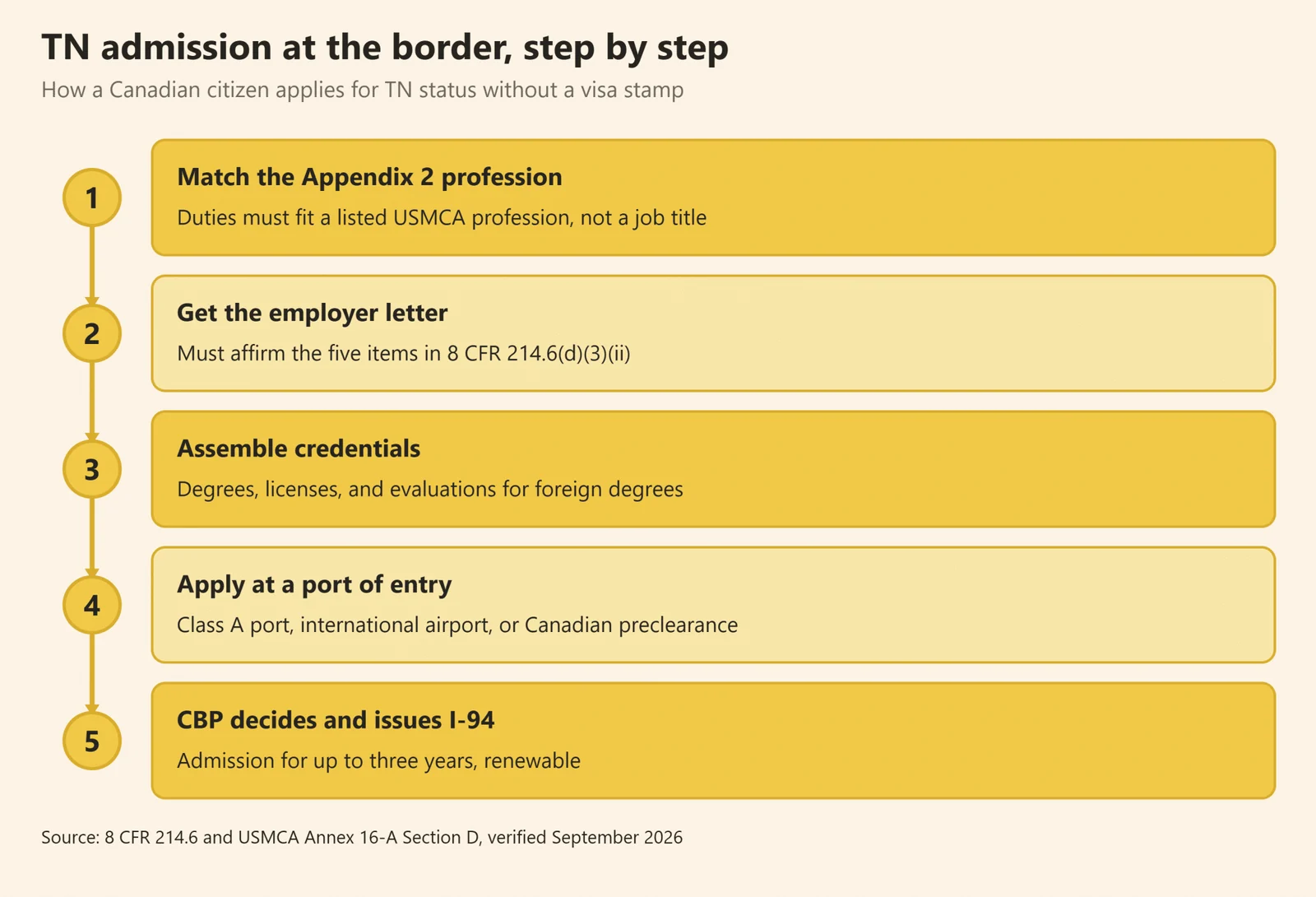
No. Under 8 CFR 214.6(d)(2), a Canadian citizen “shall make application for admission with a Department officer at the United States Class A port-of-entry, at a United States airport handling international traffic, or at a United States pre-clearance/pre-flight station.” A Mexican citizen, under paragraph (d)(1), must present a valid passport and a valid TN visa. The State Department agrees at 9 FAM 402.17-6(a)(1): because Canadians need no nonimmigrant visa outside the E and K categories, “the issuance of a TN or TD visa should be rare.”
Citizenship is the qualifier, not residence, so Canadian permanent residents do not qualify. Paragraph (d)(3)(i) says Canadians need not present a passport unless traveling from outside the Western hemisphere, but must still establish citizenship. Carry it anyway. CBP also designates ports for optimized processing of first-time Canadian TN and L-1 applicants, a program dating to September 2014 that includes preclearance at Calgary, Toronto Pearson, Montreal Trudeau and Vancouver. Using them is optional. Our guide on how to move from Canada to the USA sets TN beside the L-1, E-2 and H-1B alternatives.
Which professions qualify, and what credentials do they require?
Appendix 2 to Annex 16-A is a closed list, reproduced in annotated form at 8 CFR 214.6(c). Counted from the official USTR text of Chapter 16 in September 2026, it holds 63 entries under four headings: 25 General, 12 Medical/Allied Professional, 23 Scientist and 3 Teacher. The qualifiers in parentheses are part of the entry, not commentary, and they decide cases.
- General: Accountant, Architect, Computer Systems Analyst, Disaster Relief Insurance Claims Adjuster, Economist, Engineer, Forester, Graphic Designer, Hotel Manager, Industrial Designer, Interior Designer, Land Surveyor, Landscape Architect, Lawyer (including Notary in the Province of Quebec), Librarian, Management Consultant, Mathematician (including Statistician), Range Manager/Range Conservationist, Research Assistant (working in a post-secondary educational institution), Scientific Technician/Technologist, Social Worker, Sylviculturist (including Forestry Specialist), Technical Publications Writer, Urban Planner (including Geographer), Vocational Counsellor.
- Medical and allied: Dentist, Dietitian, Medical Laboratory Technologist, Nutritionist, Occupational Therapist, Pharmacist, Physician (teaching or research only), Physiotherapist/Physical Therapist, Psychologist, Recreational Therapist, Registered Nurse, Veterinarian.
- Scientist: Agriculturist (including Agronomist), Animal Breeder, Animal Scientist, Apiculturist, Astronomer, Biochemist, Biologist, Chemist, Dairy Scientist, Entomologist, Epidemiologist, Geneticist, Geochemist, Geologist, Geophysicist (including Oceanographer in Mexico and the United States), Horticulturist, Meteorologist, Pharmacologist, Physicist (including Oceanographer in Canada), Plant Breeder, Poultry Scientist, Soil Scientist, Zoologist.
- Teacher: College, Seminary and University only.
The duties decide the match, not the job title
A product lead or a solutions consultant is not automatically a Management Consultant or a Computer Systems Analyst. USCIS is specific in places: an Engineer cannot fill computer-related jobs without credentials as a computer or software engineer, and a Scientific Technician/Technologist must work in direct support of a supervisory professional, with PA-2025-05 clarifying that people providing patient care do not qualify there. Self-employment is out entirely: 8 CFR 214.6(b) says the category does not authorize establishing a business in which the professional is, in substance, self-employed.
The credential column, and where experience counts
Most entries require a baccalaureate or Licenciatura degree, but the exceptions are wide enough that qualified people talk themselves out of applying. Accountant takes a C.P.A., C.A., C.G.A. or C.M.A. with no degree at all. A state or provincial license substitutes for several entries, including Engineer, Architect, Pharmacist and Physiotherapist. Registered Nurse and Psychologist are license or Licenciatura. Lawyer accepts an LL.B., J.D., LL.L., B.C.L., a five-year Licenciatura, or bar membership.
Seven entries accept a Post-Secondary Diploma or Post-Secondary Certificate plus three years of experience: Computer Systems Analyst, Graphic Designer, Hotel Manager, Industrial Designer, Interior Designer, Technical Publications Writer and Medical Laboratory Technologist. For Hotel Manager the diploma or certificate and the three years must all be in hotel or restaurant management. Two more entries reach the standard on experience alone: Management Consultant, on five years as a consultant or in the specialty related to the consulting agreement, and Disaster Relief Insurance Claims Adjuster, on three years in claims adjustment with the appropriate disaster relief training. Outside those entries, where the appendix requires a baccalaureate, experience alone does not substitute.
Where you earned the degree matters, and so does where you plan to work. Under 8 CFR 214.6(d)(3)(ii), a degree from outside Canada, Mexico or the United States needs an evaluation by a reliable credentials evaluation service. And licensing is decided state by state: USCIS says an applicant must meet the license requirements of the US state where they intend to practice. An Ontario license is not a US license, and a New York license is not a national one.
What must the TN employer support letter contain?
The letter is the case. 8 CFR 214.6(d)(3)(ii) requires documentation, usually a letter from the prospective US employer supported by diplomas, degrees or membership in a professional organization, that “shall fully affirm” five things: the profession under Appendix 2 to Annex 16-A of Chapter 16 of the USMCA; a description of the professional activities, including a brief summary of daily job duties where appropriate; the anticipated length of stay; the educational qualifications or appropriate credentials showing professional-level status; and the arrangements for remuneration.
Three habits separate letters that work from letters that draw questions. Name the profession in the appendix’s own words, not the internal job title. Write the duties so a reader with no industry knowledge sees why the work needs that credential. And give a definite length of stay, because “indefinite” reads as permanent. Our note on employment-based immigration support covers how employers build a standard file.
Should you apply at the border, or should your employer file Form I-129?
Both routes are open to Canadians. Applying in person is the default: because Section D bars requiring a petition as a condition of entry, you can hand the file to a CBP officer and get a decision the same day. The alternative is a Form I-129 petition filed by the US employer.
| Question | Port of entry or preclearance | Employer files Form I-129 |
|---|---|---|
| Who submits it | You, in person | Your US employer |
| Where | Class A port, international airport, or Canadian preclearance | USCIS, on paper or online |
| Timing | Usually the same day | USCIS processing times; premium processing available |
| Evidence | Originals handed to the officer | Same letter and credentials, as a petition |
| Fee position | $50 under 8 CFR 103.7(d)(11), plus $30 for the Form I-94 on a land crossing only | Form I-129 fee plus Asylum Program Fee |
| Better fit when | First entry, clean match, firm start date | Already in the US, or you want certainty before resigning |
In practice the regulation decides more often than preference does. An extension of stay under 8 CFR 214.6(h)(1) requires the beneficiary to be physically present in the United States when it is filed, so people already working there normally use the petition. And under paragraph (i)(1), a TN holder changing or adding a US employer must have the new employer file Form I-129, with work not authorized before approval. Our business immigration page walks a US employer through building that petition, and if permanent residence is on your horizon, read our explainer on the cap-exempt H-1B before the intent section below, because H-1B is the dual intent alternative that TN is not.
What does a TN application cost as of September 2026?
Start with what you do not pay. Canadians are visa-exempt for TN, so there is no consular visa fee, and 8 CFR 214.6(j)(3) states that “there shall be no fee required for admission of the spouse and unmarried minor children.”
The border route has two figures, and the second one depends on how you arrive. 8 CFR 214.6(e) directs Canadian citizens to remit the prescribed fee on admission, and the DHS fee schedule prices it at 8 CFR 103.7(d)(11): $50.00 for a “Request for Classification of a citizen of Canada to engage in professional business activities under section 214(e) of the Act.” That paragraph was last amended on April 29, 2026, so $50 is the amount in force as of September 2026.
The arrival record is the second figure. CBP began assessing the fee required by Public Law 119-21 on September 30, 2025, taking an application for CBP Form I-94 at a land border port of entry to $30: the $24 statutory fee plus the separate $6 land border fee at 8 CFR 103.7(d)(4)(i). The FY 2026 inflation notice published November 19, 2025 left it unchanged at $30. Scope matters more than the number. Both notices say CBP “will not assess a fee for aliens arriving at an air or sea port of entry because such aliens are not required to submit an application for a CBP Form I-94,” so the $30 never applies at Calgary, Toronto Pearson, Montreal Trudeau or Vancouver preclearance, or at a US airport. Driving across costs $80. Flying or preclearing costs $50. Pages still quoting $6 alone describe the position before September 30, 2025.
The petition route has published numbers. Using the USCIS fee schedule Form G-1055, edition 05/29/26 and current as of September 2026, a TN petition on Form I-129 costs $1,015 on paper or $965 online, or $510 for a small employer or nonprofit. The Asylum Program Fee is added: $600 for a regular petitioner, $300 for a small employer, $0 for a nonprofit. Premium processing under Form I-907 is $2,965. Adding those gives the real employer cost:
| Filing profile | Form I-129 | Asylum Program Fee | Total | With premium processing |
|---|---|---|---|---|
| Regular petitioner, paper | $1,015 | $600 | $1,615 | $4,580 |
| Regular petitioner, online | $965 | $600 | $1,565 | $4,530 |
| Small employer | $510 | $300 | $810 | $3,775 |
| Nonprofit | $510 | $0 | $510 | $3,475 |
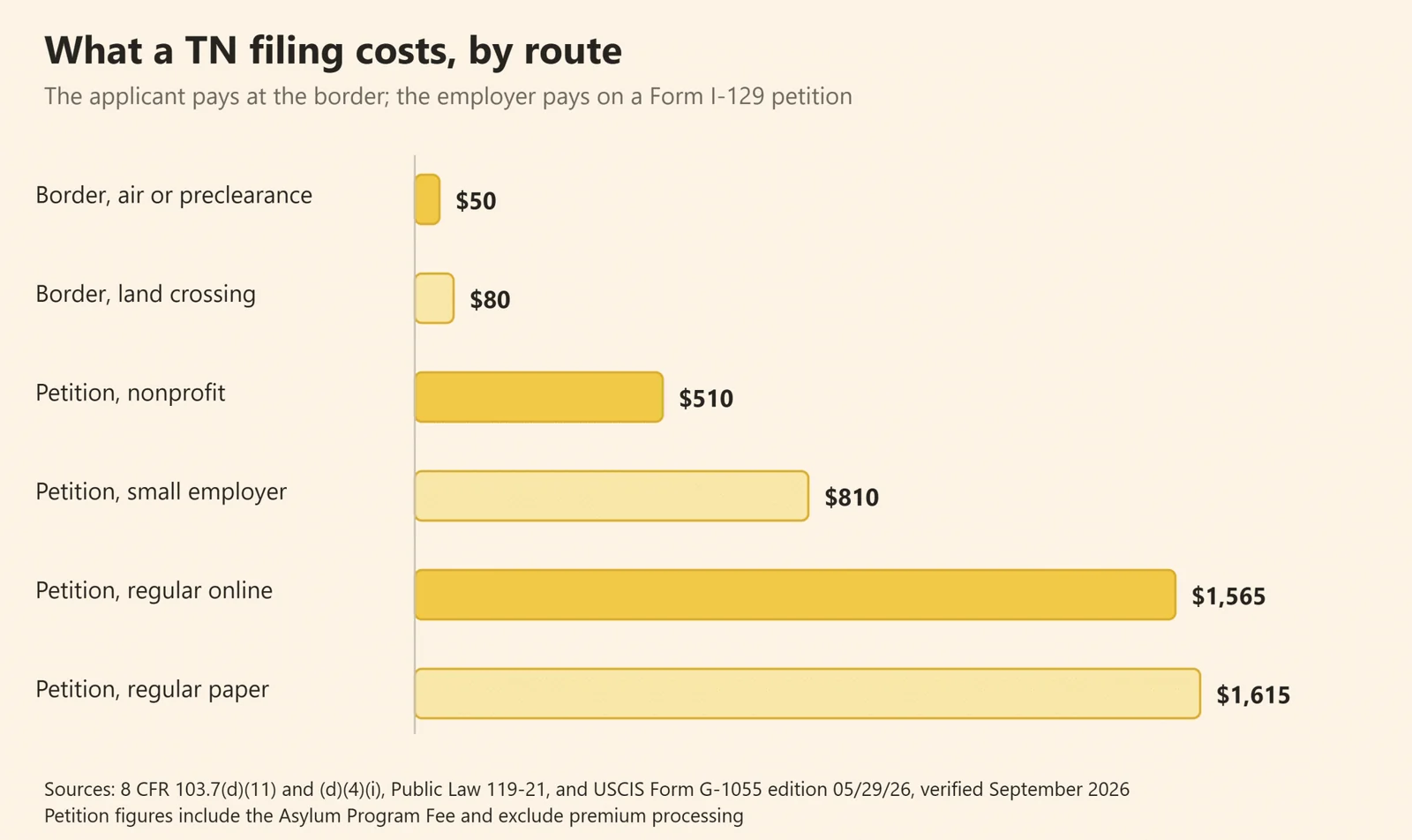
These figures exclude legal fees and credential evaluations, and each changes by rulemaking or statute. Check the current schedule on the day you file.
How long is TN status granted, and how do renewals work?
USCIS states that Canadian and Mexican citizens can be admitted, granted extensions of stay, or granted a change of status as a TN or TD nonimmigrant “in increments of up to 3 years.” 8 CFR 214.6(h)(1)(iii) allows an extension “for a maximum period of three years,” and paragraph (h)(1)(iv) adds that “there is no specific limit on the total period of time an alien may be in TN status” so long as the professional keeps performing TN business activities and maintains status.
Renewal runs either through USCIS or through the border. Your employer files the extension with USCIS while you are inside the United States. Or, under paragraph (h)(2), you apply at a designated port of entry before your admission expires for a fresh three-year period, with a new employer letter and the appropriate filing fee. There is a cheaper middle case: readmission for the remainder of an unexpired Form I-94 period without the letter and without the fee, provided the intended professional activities and employers have not changed. Long consecutive runs engage US tax residency rules, which our note on the tax implications of moving from Canada to the US covers.
Can your spouse and children join you, and can they work?
Yes to joining, no to working. Under 8 CFR 214.6(j)(1), the spouse and unmarried minor children of a TN nonimmigrant may be admitted, readmitted, or granted a change of status or extension “for the same period of time granted to the TN nonimmigrant,” and are classified as TD nonimmigrants. Paragraph (j)(3) provides that their documentation bears the legend “multiple entry” and that no fee is required for their admission. Canadian family members are themselves visa-exempt.
The employment bar is categorical. Paragraph (j)(4) says they “shall not accept employment in the United States unless otherwise authorized under the Act.” USCIS puts it plainly: TD dependents may not work, but they are permitted to study. The State Department agrees at 9 FAM 402.17-10, adding that a TD holder may apply to DHS for employment authorization if a separate basis exists. There is no TD equivalent of the H-4 work authorization available to certain H-1B spouses, so a two-earner household usually gives the second spouse an independent status.
Does the TN category allow dual intent?
No, and this is where careful applicants get careless. USMCA Article 16.1 defines temporary entry as “entry into the territory of a Party by a business person of another Party without the intent to establish permanent residence.” The State Department is direct at 9 FAM 402.17-7: “The agreement encompasses only business persons coming to the United States temporarily. INA 214(b), therefore, is fully applicable to TN visa applicants.”
TN is not a designated dual intent category the way H-1B and L-1 are. Nothing in 8 CFR 214.6 disqualifies an applicant by reason of a pending PERM or Form I-140 on its own, but nothing in it protects one either, and the burden runs against you. The regulation’s own definition of temporary entry puts the question in the officer’s hands: the applicant “must demonstrate to the satisfaction of the inspecting immigration officer that his or her work assignment in the United States will end at a predictable time and that he or she will depart upon completion of the assignment.” That showing falls due at every entry and never shifts, and a permanent-residence case in progress is a fact the officer can weigh against it. If a permanent move is genuinely on the table, work out the sequencing with counsel before the next crossing rather than at the booth. Our US and Canada immigration lawyer page sets out how we run that sequencing review for professionals holding TN status alongside a green card case.
Frequently asked questions about the TN visa for Canadians
Is the TN visa for Canadians a visa or a status?
For Canadian citizens it is a status, not a visa. Canadians are visa-exempt here, so nothing goes in the passport. You are inspected at a port of entry or preclearance station and, if admitted, receive TN classification recorded on a Form I-94. Mexicans need a consular visa.
Can a permanent resident of Canada apply for TN status?
No. The category is limited to citizens of Canada and Mexico. Permanent residence in Canada does not qualify a person for TN classification, and neither does a Canadian work permit or employer. A permanent resident of another nationality must look at other US work categories.
Can I hold two TN jobs at the same time?
Concurrent TN employment is possible, but each employer needs its own authorization. Under 8 CFR 214.6(i)(1), a TN nonimmigrant adding a US employer during a period of admission must have that employer file Form I-129, and work for the additional employer is not authorized before approval.
Is a signed contract enough, or do I need an employer letter?
You need documentation that fully affirms the five items in 8 CFR 214.6(d)(3)(ii): the Appendix 2 profession, the activities and daily duties, the anticipated length of stay, the qualifying credentials, and the remuneration arrangements. A standard contract rarely covers all five, so a purpose-drafted letter is the usual answer.
What happens if a CBP officer refuses my TN application?
There is no petition on file to appeal, because the decision is made at inspection. Under 8 CFR 235.4 an officer may permit you to withdraw the application for admission in lieu of removal proceedings, though that regulation gives no right to withdraw, and the encounter is recorded either way. The usual next steps are to identify what was questioned, fix the document problem, then reapply or have the employer file a petition instead.
Can my TD spouse study while we are in the United States?
Yes. USCIS states that TD dependents are not permitted to work in the United States but are permitted to study, so study is open without changing to a student category. Employment is the line that cannot be crossed: 8 CFR 214.6(j)(4) bars TD holders from accepting employment unless otherwise authorized.
Conclusion
The TN visa for Canadians rewards precision. The eligibility question is narrow and answerable before you travel: is the role genuinely one of the 63 professions in Appendix 2, do your credentials meet that entry’s own standard, and does the employer letter affirm all five regulatory items. Get those right and the process is unusually fast. Get them wrong and a same-day decision becomes a same-day refusal.
How Mayo Law can help
Mayo Law is a cross-border firm built around the Canada and United States corridor, with offices in Toronto and New York. Principal attorney Joseph Mayo is licensed in Ontario and in New York, so one file can cover the Canadian side of a move and the US side of the work authorization. We advise Canadian professionals and their US employers on profession matching, credential and licensing evidence, employer letters, and the choice between a port-of-entry application and a Form I-129 petition.
Disclaimer
This article is informational only and is not legal advice. Reading it or contacting the firm does not create an attorney-client relationship, and immigration rules, fees and official guidance change. Mayo Law provides legal services in Ontario and New York. For advice on your own circumstances, speak with a lawyer licensed in the relevant jurisdiction.