A common H-1B family timeline looks like this. One spouse starts work after arrival. The other enters on H-4 status, has employers asking about start dates, and then learns that work permission may depend on a separate filing, long processing times, and whether the H-1B case stays on track.
That is the practical problem with the H-4 EAD. The legal question is only part of it. Families also need to know how stable that work authorization will be, what happens during renewal gaps, and how a job offer or career move lines up with USCIS processing.
For families splitting life between the United States and Canada, those details matter even more. I regularly see couples in Toronto and the GTA trying to coordinate U.S. filings with Canadian residence, travel plans, border crossings, and employer deadlines. A spouse may be fully qualified to work once the card is approved, but the primary pressure point is often timing. Can they accept an offer now, keep working through renewal, or leave the U.S. for Canada while an application is pending without creating a new delay?
At Mayo Law, we advise on those cross-border employment issues with licensing in both Ontario and New York. Families who need help with case strategy, maintenance of status, or work authorization timing can review our U.S. employment immigration attorney services.
The starting point is simple. H-4 status does not by itself authorize employment, and many of the hardest problems arise after a spouse becomes eligible on paper but before the new EAD card is in hand.
What Is an H-4 Visa EAD?
An H-4 visa EAD is a separate work permit available to some H-4 spouses. The H-4 visa gives dependent status. It does not by itself authorize employment. The EAD, once approved, is the document that lets an eligible H-4 spouse work in the United States.
That distinction causes more confusion than almost anything else in this area. Think of the H-4 as the key that lets you live in the house. The EAD is the key that lets you enter the office and start working. Having one doesn't automatically give you the other.
The H-4 category itself is significant. It covers spouses and unmarried children under 21 of H-1B workers, and its size follows the H-1B system. U.S. data discussed by the Cato Institute show H-4 visas issued rising from 24,756 in FY 1992 to 125,999 in FY 2019, with 79,000 H-4 spouses issued visas in 2019 and 106,162 H-4 visas going to Indian nationals that year, showing how central this category has become in skilled-worker family migration (Cato Institute on H-4 visa facts).
Two legal paths matter
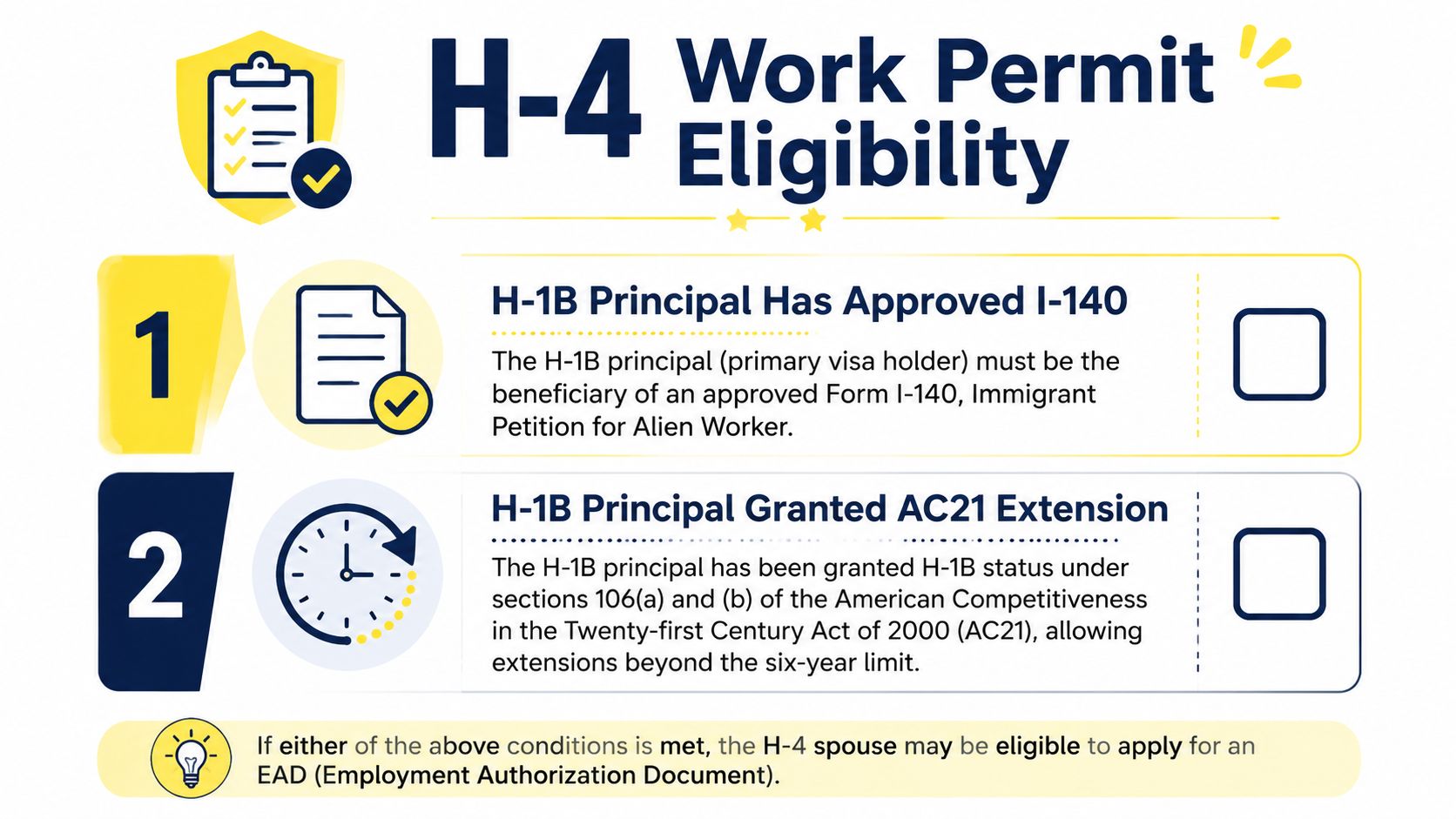
Only certain H-4 spouses can apply for an EAD. In practical terms, there are two main paths:
- Approved I-140 path. The H-1B spouse has an approved Form I-140 in the employment-based green card process.
- AC21 extension path. The H-1B spouse has obtained H-1B time beyond the usual limit under AC21 because the green card process is already underway.
Why families need to check this early
A common scenario is a couple relocating for a U.S. tech or healthcare role. The H-1B worker assumes the spouse can work after arrival because the family has valid visas. Then they discover the H-4 spouse can't start until USCIS approves a separate filing.
Practical rule: Don't job search on the assumption that H-4 status alone is enough. First confirm whether the H-1B spouse's immigration history creates EAD eligibility at all.
Who Qualifies for an H-4 Work Permit?
A common call goes like this: one spouse has just landed in the United States on H-1B status, the family has a lease, school plans, and often a Canada backup plan if timing slips, and the H-4 spouse wants to know when work can start. The answer turns on a narrow legal test. H-4 status by itself does not give work authorization, and children in H-4 status are not eligible at all.
The H-4 EAD is available only to certain spouses of H-1B workers. The H-1B principal must already be far enough along in the employment-based green card process to meet one of two rules. The American Immigration Council summarizes those rules this way: the H-1B principal either has an approved Form I-140 or qualifies for extended H-1B status under AC21. If USCIS approves the EAD, the H-4 spouse can work for any employer, work in more than one role, or be self-employed, but that authorization remains dependent on the principal worker keeping valid H-1B status and the spouse keeping valid H-4 status (American Immigration Council H-4 classification fact sheet).
Approved I-140 cases
This is usually the stronger and cleaner eligibility path.
If the H-1B spouse has an approved I-140 immigrant petition, the H-4 spouse can generally file for an EAD. In practice, this is the point where many families first get some planning stability. The underlying green card case may still take years because of immigrant visa backlogs, especially for Indian-born professionals, but the approved I-140 often creates a workable basis for H-4 employment authorization during that wait.
For families still trying to place that approval in the larger timeline, our guide to getting a green card through employment explains where the I-140 fits and why it matters so much for dependent work authorization.
AC21 extension cases
The second path is less intuitive and often missed by families reading basic summaries online.
An H-4 spouse may also qualify if the H-1B principal has H-1B time beyond the usual limit under AC21. That usually means the green card process started early enough to preserve the worker's ability to remain in H-1B status while the permanent residence case continues. For the spouse, the practical point is simple: eligibility can exist even without an approved I-140 if the H-1B extension itself is based on the right AC21 rule.
This is where file review matters. I often see families assume any H-1B extension will support an H-4 EAD. It does not. The extension has to be the kind tied to the qualifying green card process, not just an ordinary approval notice with extra time attached.
What does not create eligibility
These facts, by themselves, are not enough:
- H-4 status alone
- A pending PERM case or early employer sponsorship discussions
- A job offer for the H-4 spouse
- A recent H-1B transfer, amendment, or new employer, without the qualifying I-140 or AC21 basis
That last point causes real problems in cross-border families. A spouse may be ready to commute from Canada, reenter after stamping, or accept a remote role with a U.S. employer, but none of that fixes the threshold issue. First confirm the legal basis for eligibility. Then build the work plan around filing and timing.
Filing Form I-765 without the qualifying I-140 or AC21 basis usually leads to a denial and lost time. For many families, the bigger risk is not the filing fee. It is the work gap created by assuming eligibility too early.
Applying for Your H-4 EAD Step by Step
A common family timeline looks like this: the H-1B spouse starts work in the U.S., the H-4 spouse enters later or changes status inside the country, and everyone assumes work authorization will follow quickly. That assumption causes trouble. The H-4 EAD filing is usually manageable, but only if the packet matches the family's current immigration record exactly.
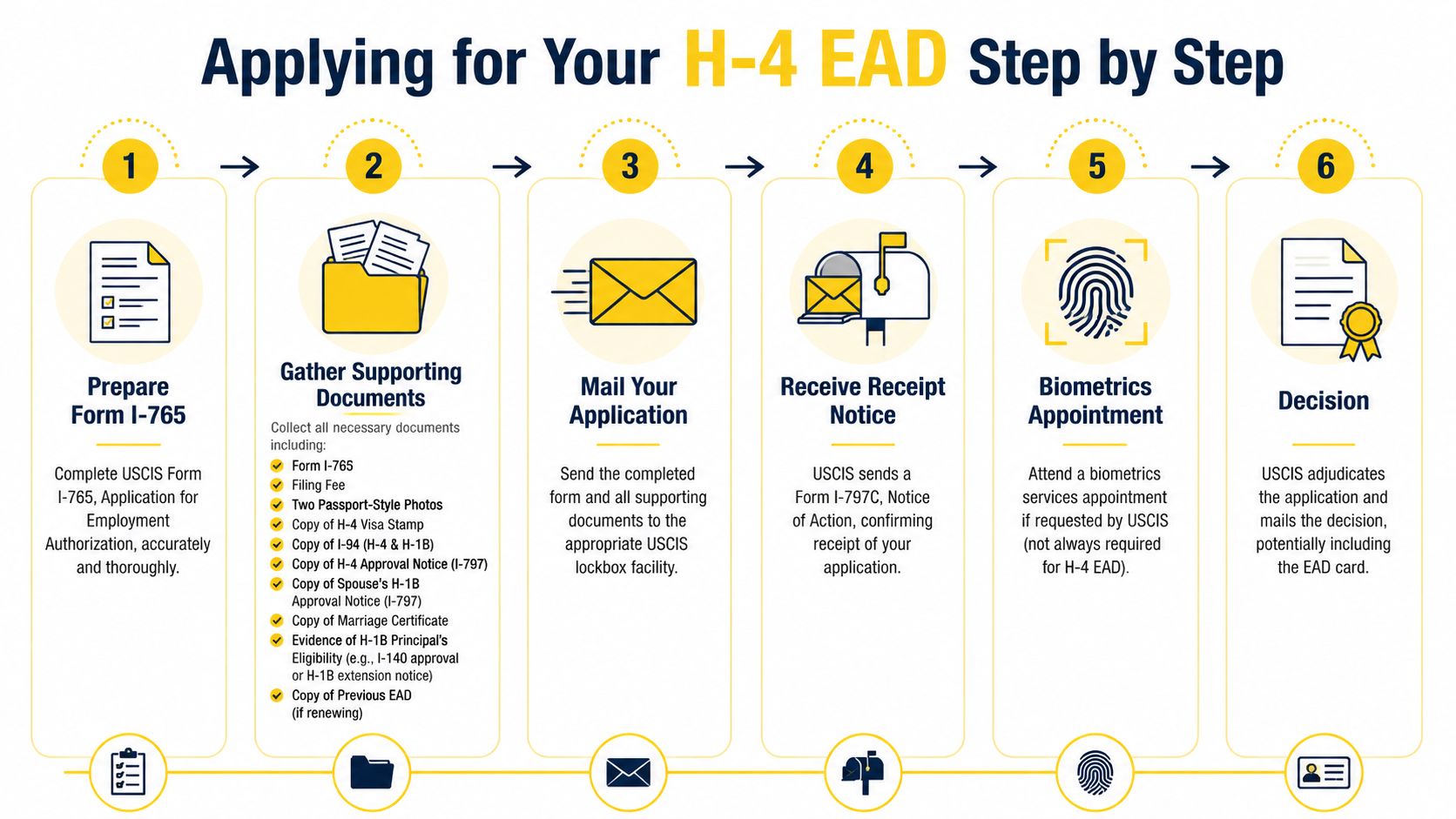
The filing itself is centered on Form I-765. USCIS expects a package that proves identity, the marriage, valid H-4 status, and the H-1B spouse's qualifying basis for H-4 work authorization. If one of those pieces is missing, inconsistent, or out of date, the result is often a rejection, a request for evidence, or a longer period without work authorization.
A practitioner summary of common filing requirements points to the usual supporting records: proof of H-4 status, the H-1B spouse's approval notice, the approved I-140 or AC21-based evidence, passport and I-94 records, and prior EADs for renewals. It also notes that the separate biometric-services fee tied to certain Form I-539 filings was removed as of October 1, 2023, which matters because old filing checklists still circulate online (Papagikos Law on H-4 EAD filing basics).
The core filing package
A strong filing answers four practical questions. Who is the applicant. What is the applicant's current status. What is the relationship to the H-1B principal. Why does the principal's case create H-4 EAD eligibility.
A typical package includes:
- Form I-765 completed to match the applicant's current status documents
- Proof of H-4 status, such as the approval notice and most recent I-94
- Marriage evidence that clearly connects the spouses
- Identity documents, usually passport biographic pages and related records
- Current H-1B approval evidence for the principal spouse
- Qualifying basis evidence, usually the approved I-140 or the specific AC21-related documentation
- Prior EAD copy, if this is a renewal
The goal is consistency, not volume. Sending extra pages that do not match the current status history often creates more questions, not fewer.
Where cases go sideways
The filing problems I see most often are not legal gray areas. They are timing and record problems.
One spouse files with an old I-94 after a recent trip. Another includes the H-1B approval notice but not the document that proves H-4 EAD eligibility. Another files after an H-1B job change and forgets to update the packet to reflect the new employer, new receipt, or new approval notice. USCIS may still sort that out, but families lose time while the case sits.
Cross-border families run into a separate problem. They mix up visa processing and status processing. An H-4 visa foil issued at a U.S. consulate in Canada lets the spouse seek admission in H-4 status. It does not give work authorization by itself. The EAD is still a separate USCIS process unless the spouse already holds another basis to work.
Before filing, line up every immigration event on one timeline: marriage, entries to the U.S., H-1B approvals, H-4 approvals, I-94 updates, and any employer change. If the timeline does not read cleanly, fix that first.
A practical filing order that reduces mistakes
In most cases, this sequence works better than rushing the paperwork:
- Confirm the H-4 spouse is in valid H-4 status on the filing date
- Confirm the H-1B spouse's eligibility document is the right one, not just any approval notice
- Pull the latest I-94 records after any travel, especially after U.S.-Canada trips
- Check that names, dates, and class of admission match across the forms and supporting documents
- Use the current USCIS form edition and fee instructions on the day of filing
- Save a full copy of the exact package submitted, including payment confirmation and delivery proof
That third step matters more than many families expect. A short trip to Canada can change the controlling I-94 record. If the filing package relies on an older status document, USCIS can question whether the applicant was in the right status when Form I-765 was filed.
U.S.-Canada planning points families often miss
For families splitting time between the U.S. and Canada, the issue is often stability, not basic eligibility. A spouse may be physically in Ontario while waiting for U.S. status approval, then enter the U.S. later in H-4 status, then file the EAD after entry. Others file from inside the U.S. and then need to travel to Canada while the case is pending. Each version changes the paperwork strategy.
That is why document review should happen before travel is booked, not after. If the family expects commuting, temporary stays in Canada, or consular processing in Toronto or another post, it helps to review the sequence with a cross-border immigration lawyer near you before filing.
Mayo Law works with professionals and their families across the GTA and on cross-border matters. Joseph Mayo is licensed in Ontario and New York, which helps families coordinate U.S. and Canadian planning in one place.
For current filing instructions and form-specific requirements, applicants should verify details directly with USCIS Form I-765 guidance and USCIS fee information.
H-4 EAD Renewals, Processing Times, and Fees
A family often feels the strain here, not at first approval. One spouse is working, income is built into the household budget, and then the card expiration date starts getting closer while the next approval is still pending. That is where the H-4 EAD feels less like a benefit and more like a timing problem.
A recent policy-focused discussion of H-4 work authorization continuity makes the same practical point. Renewals require a new Form I-765 filing, and processing delays can interrupt employment even when the family remains otherwise eligible (Norris McLaughlin on H-4 work authorization continuity).
How much does it cost to apply for an H-4 EAD
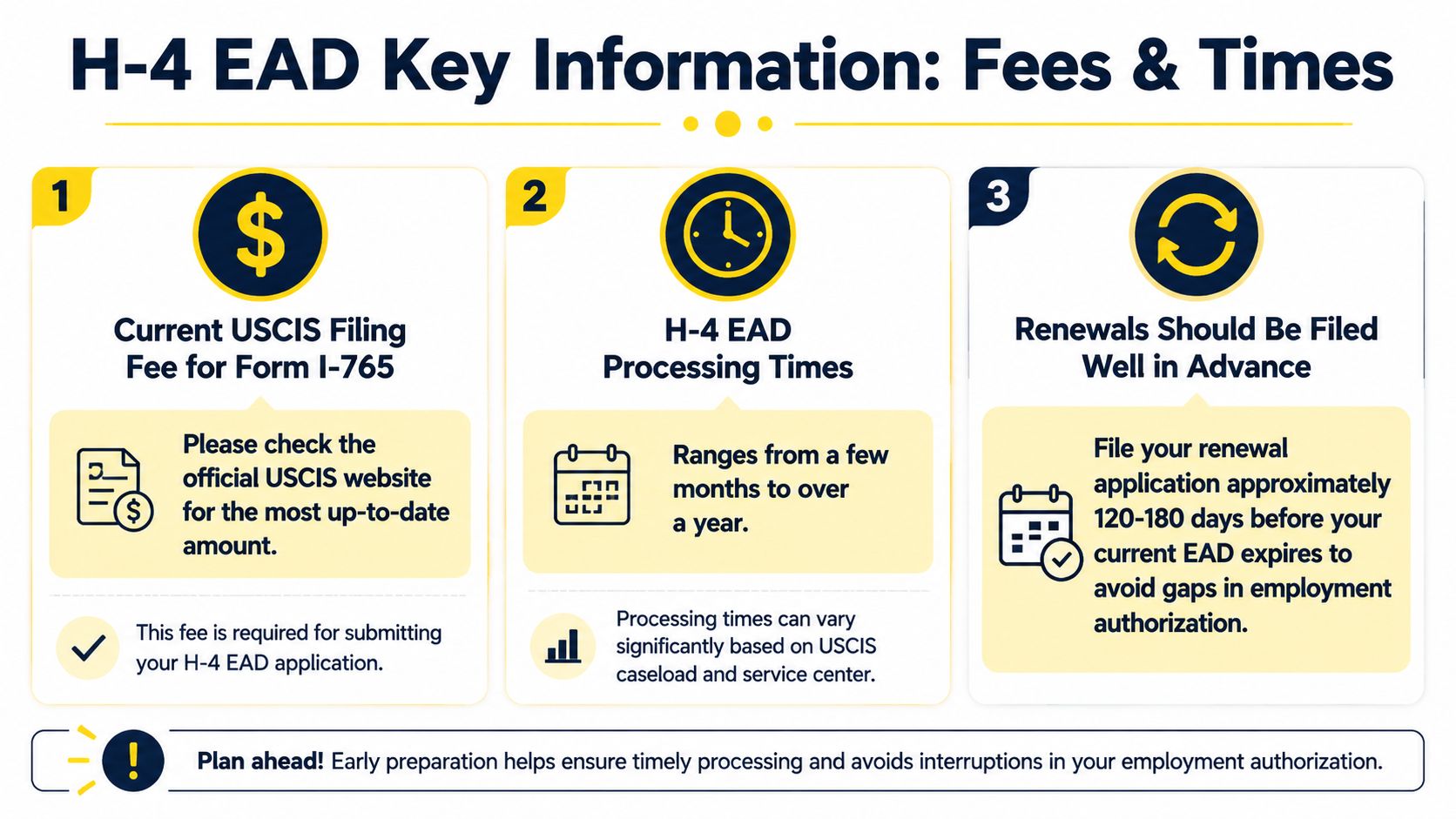
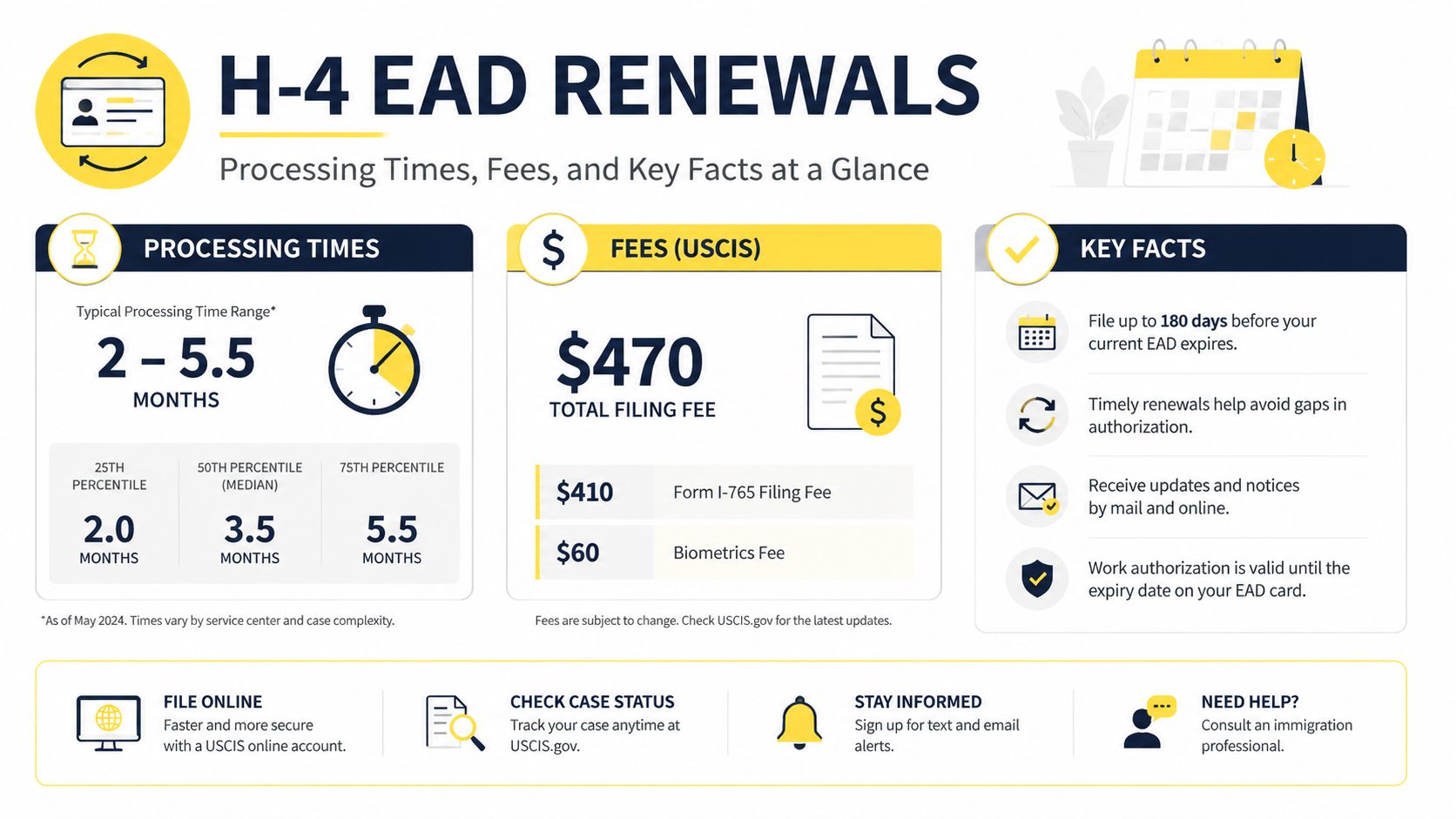
The filing fee for Form I-765 can change. Check the current amount before filing and make sure the payment method, filing category, and edition of the form all match current USCIS instructions.
Fee errors still cause avoidable rejections. If USCIS rejects the packet for a payment or form issue, the case does not proceed smoothly. The family loses time, and that lost time matters much more when work authorization is already tied to a card expiration date.
How do you check processing times
USCIS posts case time estimates on the official USCIS processing times page. Use the correct form and adjudicating location. Then compare that estimate against the current EAD expiration date, not against your ideal timeline.
That comparison is what matters in practice.
For U.S.-Canada families, I also tell clients to look at the calendar around travel, not just the USCIS estimate. A trip to Canada for family reasons, visa stamping, or a temporary stay can complicate document access and planning if USCIS issues a request for evidence or if updated status records are needed during the renewal window.
Renewal friction is the primary challenge
If the H-4 spouse is already employed, a short gap can affect payroll, start dates, client work, and employer confidence in the renewal process. Some HR teams handle expiring EADs well. Others become cautious quickly, especially if the employee cannot give a clear answer about renewal timing.
A careful renewal plan usually includes:
- Tracking the expiration date well in advance. Final-month filing leaves little room for delays.
- Reviewing the H-1B spouse's timeline at the same time. Extensions, amendments, and employer changes can all affect the renewal strategy.
- Preparing for HR questions early. The employee should know what documents are available and what the employer may ask to see for I-9 purposes.
- Accounting for cross-border logistics. If the family expects time in Canada, confirm who will receive mail, how original documents will be handled, and whether travel could change the sequence of filings.
The main cost is often the interruption, not only the filing fee.
Families should also look at the longer arc. If the H-1B spouse is approaching an immigrant visa stage, an approved I-140, or a broader permanent residence strategy, the H-4 EAD may feel more stable on paper than it does in day-to-day planning. That is why renewal timing should be reviewed alongside the principal worker's employment-based green card strategy.
Employment Options and Portability Issues
A common scenario is this. The H-1B spouse gets a better offer, the family plans a short trip to Canada, and the H-4 spouse is about to start a new job or sign an independent contractor agreement. The H-4 EAD still offers broad work flexibility, but the practical question is whether the underlying H-1B foundation will stay clean enough to avoid disruption.
The employment authorization itself is unrestricted. A valid H-4 EAD generally allows work for any employer, full-time or part-time work, self-employment, and business ownership. That gives families real room to adjust income plans, childcare, and career pacing without filing a new petition for each role.
Can I work for any employer with an H-4 EAD
Yes. The card is not employer-specific.
That matters in several ways. An H-4 spouse can accept a salaried role, consult for multiple clients, work remotely for a U.S. company, or build a small business. The trade-off is that payroll flexibility does not remove immigration dependency. The right to work still depends on the principal H-1B spouse maintaining the qualifying status that supports the H-4 spouse's EAD eligibility.
For employer-side planning, job structure still matters even if the immigration authorization is open. A new employer may need to decide whether the role is salaried or hourly, exempt or nonexempt, and how to complete onboarding correctly. Our guide on exempt vs. nonexempt employee classification is often useful when an H-4 EAD holder is starting work in a less conventional role.
What happens if my spouse changes jobs
Families get into trouble. They assume the H-4 spouse's work permission is portable in the same way the H-1B spouse's employment may be portable under AC21 rules. It is not the same analysis.
If the H-1B spouse changes employers and remains in valid H-1B status without a break that affects the dependent status history, the H-4 spouse may continue working without interruption. But the details matter. I usually review at least four points before I tell a family the move looks safe:
- Whether the H-1B worker is staying in valid status through the change
- Whether an extension or amendment is also being filed
- Whether the H-4 status and EAD expiration dates still line up sensibly after the move
- Whether any travel plans could complicate the sequence of filings or reentry documents
A fast job change can be workable. A fast job change with pending dependent filings, expiring documents, and travel plans is where avoidable gaps appear.
Stability is better than many people assume, but it is still conditional
The H-4 EAD is more stable than some online guides suggest. The rule has survived years of litigation and remains a real work option for eligible spouses. That said, families should not treat it as independent from the principal worker's case. If the H-1B spouse loses status, changes strategy, or hits a filing problem, the H-4 spouse can feel that impact quickly.
That practical instability matters more than the policy debate in many households. A family may have a valid EAD card today and still face hard choices about whether the H-4 spouse should accept a role that depends on uninterrupted authorization for onboarding, client access, licensing, or bonus timing.
Cross-border families should plan more carefully than local commuters
U.S.-Canada families often deal with a layer of friction that basic H-4 EAD articles miss. Travel itself is not unusual. The problem is timing.
If the family expects to spend time in Canada while the H-1B spouse is changing employers, extending status, or coordinating dependent filings, confirm who will receive USCIS mail, whether original approval notices will be needed for reentry or I-9 updates, and how quickly each spouse can return if an employer or officer asks for documents. I also tell cross-border families to map the sequence on paper first. Which filing happens first, who travels when, and what document each person will carry can determine whether the H-4 spouse starts work on schedule or loses a pay period.
The H-4 EAD gives broad employment freedom. Its weak point is not job choice. Its weak point is that renewal timing, principal-worker changes, and cross-border logistics can interrupt that freedom at exactly the moment the family is relying on it most.
Frequently Asked Questions
Can I travel outside the U.S. while my H-4 EAD application is pending?
Travel needs case-specific review because the EAD filing may interact with your underlying H-4 status history, any pending status application, and your reentry plan. The work permit and the visa/status side are not identical. Before booking travel, confirm what is pending, where it was filed, and whether leaving the U.S. could affect the overall strategy.
What should I do if my I-765 application receives a Request for Evidence
Read the request closely and answer exactly what USCIS asked for. Most RFEs in this area come from missing relationship proof, incomplete status evidence, or weak proof of the H-1B spouse's qualifying basis. Don't respond with extra documents just to appear thorough. A focused, consistent response is usually better than an oversized packet.
Does my H-4 EAD automatically renew?
No. You should expect to file again for each renewal cycle. That means tracking expiration dates, confirming the H-1B spouse still has the required underlying basis, and planning far enough ahead to reduce the chance of a work interruption. Many families assume one approval solves the issue for years. In practice, renewals require active management.
What happens if my EAD expires before my renewal is approved?
Usually, you may have to stop working until valid work authorization is in place again. That can affect payroll, start dates, and employer onboarding. This is why renewal timing matters so much. If your job is time-sensitive, don't treat the expiration date as an administrative footnote. Build your filing calendar around it.
Can I start my own business on an H-4 EAD?
In general, valid unrestricted work authorization gives more flexibility than employer-specific categories. That can include self-employment. But business formation, compensation structure, and tax treatment still need careful review. Immigration permission to work and business-law compliance are related issues, not the same issue.
Conclusion
For many families, the hardest part isn't understanding that an H-4 spouse may be able to work. It's understanding when, how, and how stable that right to work really is. The H-4 visa and work permit process can absolutely support a real second career in the U.S., but only if the filing sequence, renewal planning, and H-1B spouse's status are managed carefully.
If you're making relocation, hiring, or dual-income decisions, treat the EAD as a living part of the family's immigration plan, not a one-time form.
If you need advice on an H-4 spouse's work authorization, underlying H-1B status strategy, or a cross-border U.S.-Canada immigration plan, Mayo Law assists families and professionals with business immigration matters in Ontario, New York, and across the border.