
Contents
- First 3 Things to Do if Contacted by Federal Agents
- The First 24 Hours Your Immediate Priorities
- Are You a Witness Subject or Target
- Engaging Legal Counsel for a Federal Case
- The Investigation Process Unpacked
- Special Considerations for Businesses and Executives
- Frequently Asked Questions
- Conclusion
- How Mayo Law Can Help
- Disclaimer
- Related Articles
You open the door to federal agents before work. Or a subpoena hits your desk at 8:12 a.m. and the day changes on the spot. What you do next can protect you or hand the government evidence it did not have an hour earlier.
The first mistake is talking. The second is trying to fix the record by deleting emails, editing messages, or coaching coworkers. The third is missing the question that drives the entire defense from day one: are you a witness, a subject, or a target?
That distinction gets ignored in a lot of articles. It should not be. A witness may need protection and careful communication. A subject faces real exposure and needs immediate strategy. A target is in the danger zone and should act as if charges are being built now. Your status changes how your lawyer deals with agents, subpoenas, document collection, employee interviews, and any decision about whether you speak at all.
Mayo Law represents clients in Toronto, the GTA, and cross-border matters involving U.S. federal scrutiny, with licensing in both Ontario and New York. If you are under federal investigation, start here. Do not explain. Do not clean anything up. Protect yourself, preserve evidence, and get defense counsel involved immediately.
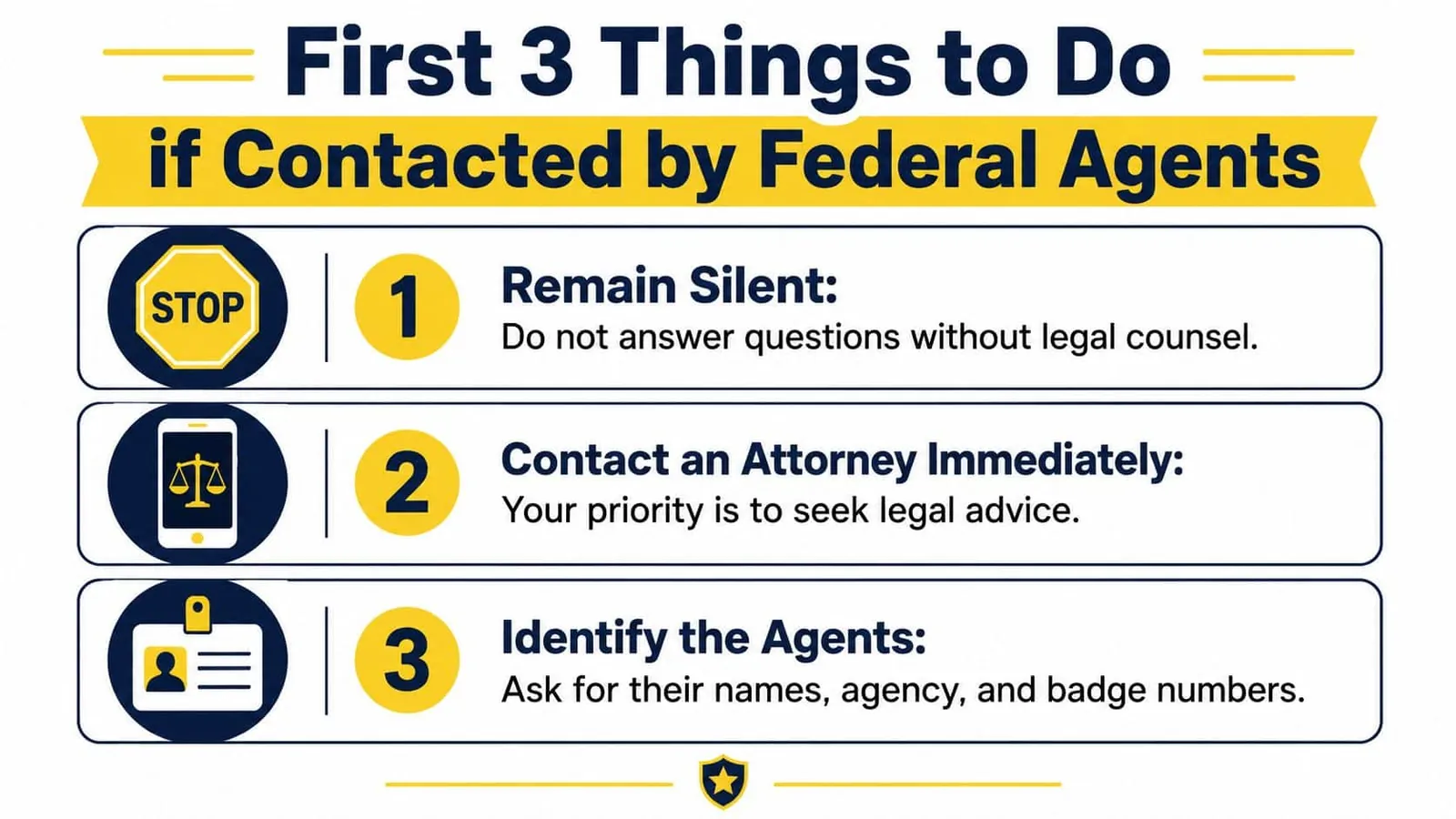
First 3 Things to Do if Contacted by Federal Agents
- Stay silent and say you want a lawyer.
- Do not consent to any search you aren’t required to allow.
- Get the agents’ names, agency, and badge numbers.
These steps protect your rights and stop you from creating evidence against yourself in the first minutes of contact. If your business has compliance staff, this is also where clear internal escalation matters, especially for teams already thinking about compliance officer responsibilities.
| Action | Reason |
|---|---|
| Remain silent | Informal statements can be used later |
| Decline consent searches | You shouldn’t expand the government’s access voluntarily |
| Identify the agents | Your lawyer needs accurate details immediately |
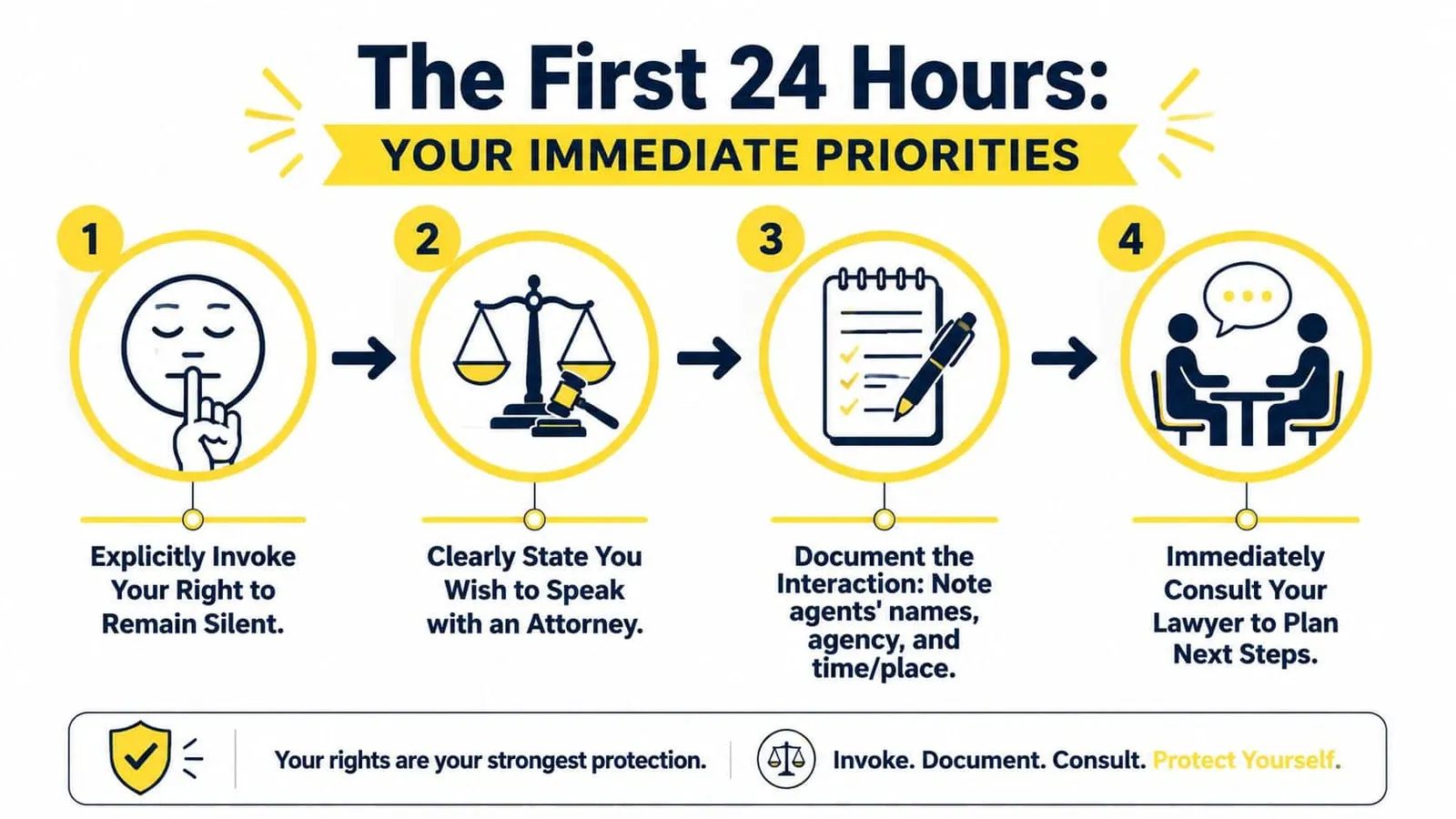
The First 24 Hours Your Immediate Priorities
The first day matters more than your first explanation. Once investigators make contact, you should assume every word and every document choice matters.
According to guidance on federal investigations and legal rights, you do not have to answer investigators without a lawyer present, and what you say informally can later be used in testimony, subpoenas, or charging decisions. That is why the safest first response is simple: assert your right to remain silent and route all contact through counsel.
What to say to agents
Keep it short. Polite is fine. Conversation is not.
Say something like this: you're invoking your right to remain silent, and you want to speak with your lawyer before answering questions. Then stop talking.
Practical rule: If you feel the urge to explain, don't. Federal investigators compare statements against records, messages, and other witnesses later.
If agents try to keep the conversation casual, treat it as formal anyway. Hallway talk, lobby talk, and “we're just trying to understand” talk can all become evidence.
What not to touch
Your next move is preservation. Not organization. Not cleanup. Not “just deleting personal stuff.”
Under 18 U.S.C. § 1519, enacted as part of the Sarbanes-Oxley Act, knowingly destroying, altering, or falsifying records to obstruct a federal matter can carry a maximum penalty of 20 years in prison. That is why evidence preservation is the single most important initial step.
That means:
- Keep emails intact: Don't delete, archive, or “tidy up” inboxes.
- Preserve chats and texts: Slack, Teams, WhatsApp, Signal, SMS, and similar systems all matter.
- Leave devices alone: Don't wipe phones, reset laptops, or reformat storage.
- Stop auto-deletion if possible: Work with counsel and IT, carefully and deliberately.
- Tell others to preserve too: Employees, assistants, family members, and contractors should not touch relevant records.
A routine cleanup can become an obstruction issue. I've seen people do real damage by trying to look organized.
Consent search or warrant
These are not the same.
If agents ask, “Do you mind if we take a look?” that is a request for consent. You generally should not consent without your lawyer. You can say you do not consent to any search and that all requests should go through counsel.
If agents have a warrant, don't obstruct. Ask to see it. Get a copy if possible. Note what locations, devices, and categories of records it covers. Your lawyer will want the warrant, the return, and a clear record of what was taken.
Use this checklist during a search:
- Ask for the lead agent's information: Name, agency, badge number.
- Request the warrant copy: Your lawyer needs the exact scope.
- Observe, don't interfere: You can watch and take notes.
- Record what agents seize: Devices, boxes, files, and accounts.
- Separate privileged material issues: Tell your lawyer immediately if legal communications may be involved.
Do not lie, do not obstruct, and do not volunteer.
Two common first-day scenarios
A startup CFO gets a call from an agent asking for “just a few background details.” He thinks cooperation will make him look innocent. Instead, he gives an imprecise timeline that later conflicts with company records. That inconsistency becomes its own problem.
A business owner learns of an inquiry and tells IT to clear old chats to reduce clutter. That instruction may look like an attempt to destroy evidence, even if the owner claims it was routine.
The first 24 hours are about discipline. Silence, preservation, and counsel. Everything else comes after that.
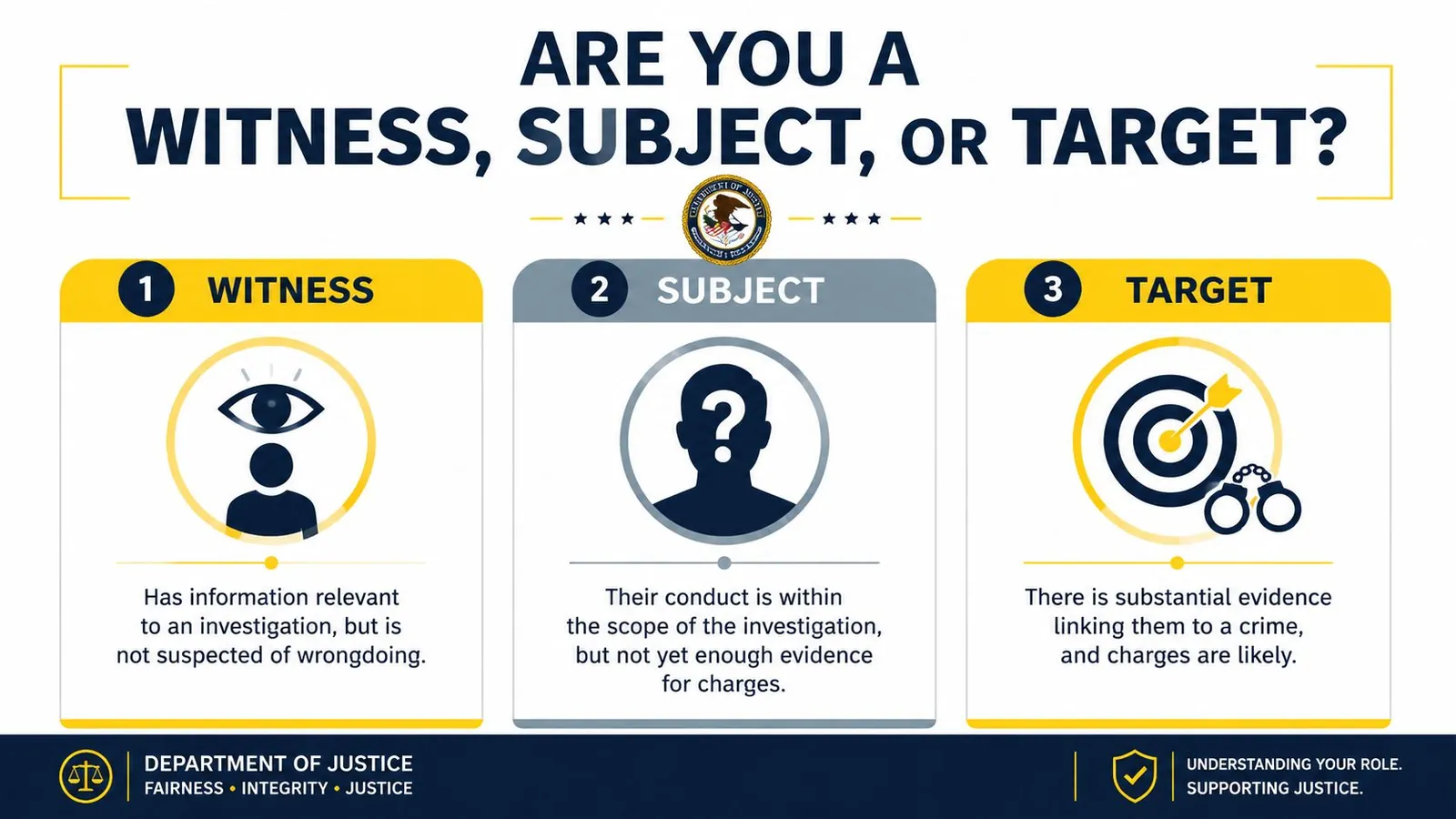
Are You a Witness Subject or Target
Most articles flatten everyone into one category. That's a mistake. Your legal strategy changes depending on whether you are a witness, subject, or target.
The Department of Justice defines a target as a person to whom the prosecutor has substantial evidence linking them to a crime, and a subject as a person whose conduct is within the scope of the grand jury's investigation, as stated in the Justice Manual on grand jury practice. A witness is someone with information but no indication of criminal conduct.
Why this distinction matters
If you are a witness, counsel may focus on truthful record production, testimony preparation, and limiting unnecessary exposure.
If you are a subject, the risk profile changes. Your conduct is already inside the investigation's scope. Counsel has to think about self-protection, document strategy, privilege, and whether any interview serves your interests.
If you are a target, the posture is defensive from day one. The government likely sees you as chargeable. Voluntary statements become especially dangerous.
| Status | What it usually means | Main legal focus |
|---|---|---|
| Witness | You have information | Prepare carefully and avoid drifting into self-incrimination |
| Subject | Your conduct is under review | Protect yourself while managing records and contact |
| Target | Prosecutors believe they have substantial evidence | Build defense strategy immediately |
How people misread their status
Agents may not tell you your exact status. Even when they do, status can change over time.
A founder receives a subpoena for company documents and assumes he is “just helping.” But if the records concern his own decisions, he may be a subject. A controller is told she is not a target “right now.” That phrase matters. It isn't comfort. It's a warning to proceed carefully.
If the matter involves data theft, internal documents, or confidential business information, parallel issues such as trade secret misappropriation can complicate the picture fast.
Ask your lawyer to press for status early. Don't assume that silence from the government means safety.
Engaging Legal Counsel for a Federal Case
Federal work is not general litigation with a different label. It has its own pressure, its own sequencing, and its own traps.
You need counsel who understands how federal investigations are built. That includes subpoenas, warrants, privilege fights, proffer risks, witness sequencing, and the practical difference between negotiating and volunteering. A lawyer who mainly handles local criminal court or general business disputes may be perfectly competent and still be the wrong fit for this problem.
What your lawyer should do immediately
The right lawyer takes control of communication. Fast.
According to guidance on federal investigations, once you are implicated, anything you say or write can be used against you, and counsel should immediately manage communications and assess whether you are a witness, subject, or target because that status dictates the response strategy.
That means your lawyer should be ready to:
- Contact agents or prosecutors: So you stop speaking for yourself.
- Assess your status: Witness, subject, or target.
- Review subpoenas or warrants: Scope matters.
- Protect privilege: Especially for executives and companies.
- Advise on internal messaging: So employees don't create fresh problems.
How to choose counsel
Ask direct questions.
Have you handled federal investigations before? Have you dealt with the agency involved? How do you approach early contact from prosecutors? Who reviews seized documents and privilege issues? Will you personally lead strategy?
Those are not rude questions. They are basic due diligence.
Mayo Law works with business owners, executives, and professionals across the GTA and on cross-border matters. Joseph Mayo is licensed in Ontario and New York, so clients with U.S. ties coordinate their legal work in one place rather than juggling two firms. If your matter sits inside the broader field of white-collar crimes defense, that cross-border coordination can reduce confusion when records, personnel, or immigration issues span both countries.
Don't hire based on comfort alone
People under investigation often pick the lawyer who sounds the most reassuring. That's understandable, but dangerous. You want clarity, not theater.
A good federal defense lawyer should give you a plan for the next week, not vague confidence. They should tell you what to stop doing immediately, what documents to preserve, who should stay silent, and whether your company needs separate counsel from its officers or employees.
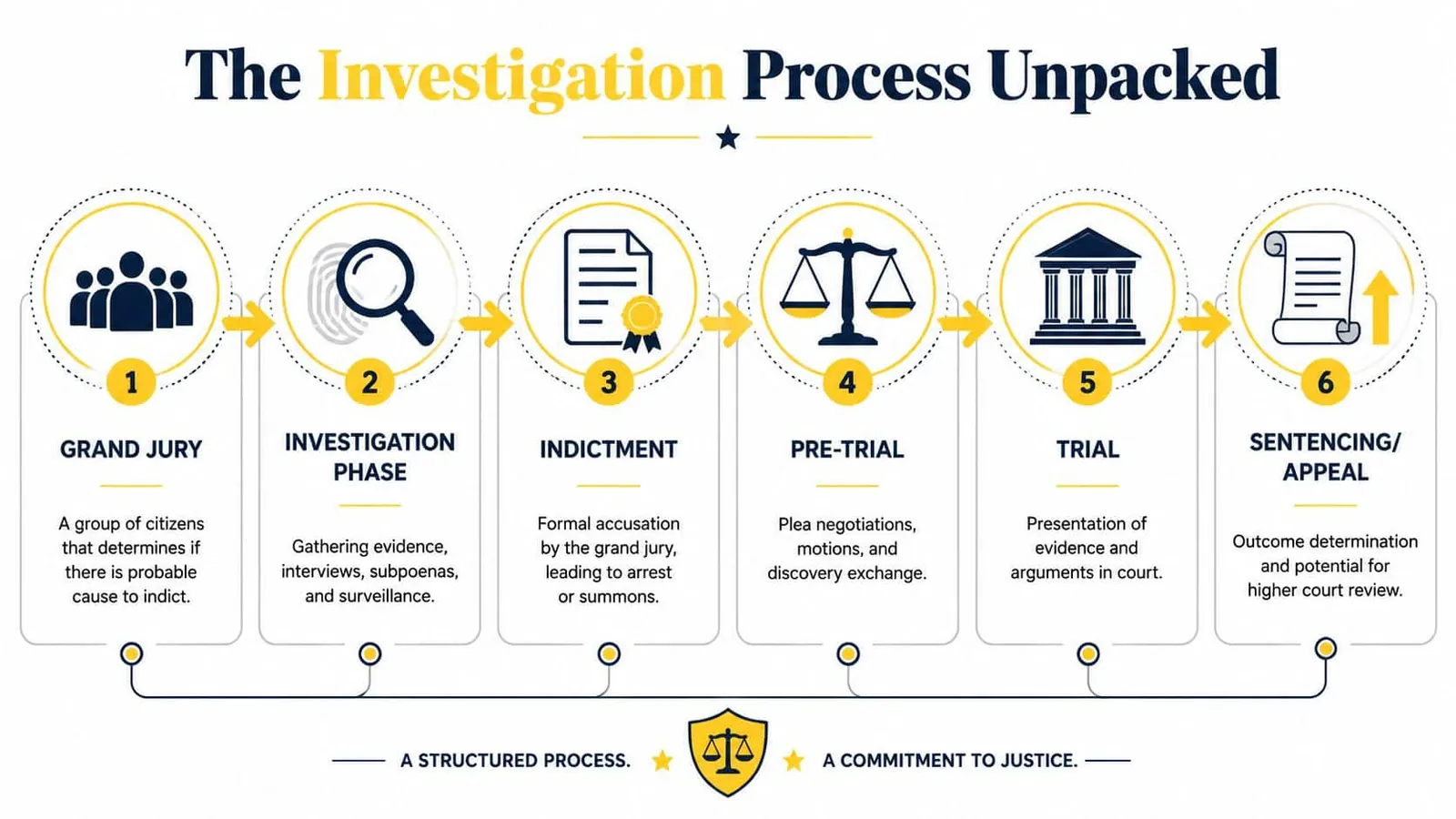
The Investigation Process Unpacked
Federal investigations often feel opaque because they are built that way. They can progress with little outward indication for a long time, then become urgent without much warning.
The government's objective is to determine whether a federal crime occurred, who was responsible, and what evidence exists. That usually means records first, witnesses second, and charging decisions later.
What is a grand jury subpoena
A grand jury subpoena is a compulsory demand connected to a federal criminal investigation. It may require documents, testimony, or both.
A subpoena for documents is often called duces tecum. A subpoena for testimony requires a person to appear and answer questions. Both need careful legal review before any response. The issue is not just compliance. The issue is scope, privilege, burden, and exposure.
Can you negotiate a subpoena
Often, yes. You should not ignore it, but you also should not assume the first draft is the final scope.
Counsel may seek more time, narrow date ranges, clarify definitions, protect privileged materials, and organize production in a way that avoids confusion. That is ordinary legal work, not obstruction.
The wrong response to a subpoena is panic production. The right response is disciplined review.
What is a proffer session
A proffer session is a meeting where a person provides information to prosecutors under limited protections negotiated in advance. People sometimes call this a “queen for a day” discussion.
This can be useful in the right case, but it is never casual. The government may use leads derived from what you say, and a bad proffer can lock you into a damaging version of events. That's one reason counsel must first determine your posture and whether speaking serves any real purpose.
A common scenario: an executive wants to “tell his side” before prosecutors hear only from lower-level employees. Sometimes that instinct helps. Sometimes it hands the government a roadmap. Without a tight agreement and thorough preparation, it is often a mistake.
How a case usually develops
Federal cases tend to follow a recognizable pattern:
- Initial inquiry: Agents contact witnesses, serve requests, or execute warrants.
- Evidence gathering: Records, devices, emails, and testimony are collected.
- Status assessment: Counsel tries to determine whether you are a witness, subject, or target.
- Strategic response: Document production, motions, negotiation, or silence.
- Charging decision: The government decides whether to indict, defer, or close.
If the allegations involve financial communications, invoices, or electronic transmissions, related issues such as wire fraud penalties in the United States may shape the risk analysis.
Why timelines feel so uneven
Investigations can sit while prosecutors assemble records and witness statements. That delay causes many people to make a fatal assumption that the matter has gone away.
It often hasn't. It may be maturing.
That is why early legal intervention matters. Not because it guarantees a result. Because it lets counsel manage contact, preserve defenses, and avoid avoidable mistakes before the government hardens its theory.
Special Considerations for Businesses and Executives
When a company is under scrutiny, the legal problem spreads quickly. It becomes a records problem, an HR problem, a governance problem, and often a reputation problem too.
Executives make a serious mistake when they treat the matter as purely personal or purely corporate. It is usually both.
Put an internal hold in place
A business needs an immediate preservation plan. That includes email, chat platforms, cloud storage, shared drives, phones, laptops, expense systems, and messaging apps used for work.
The instruction must be clear and narrow enough to be followed. It should come through counsel where appropriate, and technical steps should be taken carefully so the company preserves data without creating fresh confusion.
For companies that already have risk controls in place, broader reputational risk management also plays a significant role. Loose internal gossip and inconsistent public messaging can turn a legal issue into a business crisis.
Should the company run an internal investigation
Often, yes. But it should be structured properly.
Outside counsel usually directs the process so the company can gather facts, advise decision-makers, and protect privilege where available. Interviews, document review, and forensic work should not become an unplanned free-for-all run by whoever is available in HR or finance.
A familiar scenario: the board wants answers immediately, so internal managers start interviewing employees before counsel sets the rules. Employees then compare notes, speculate in writing, and create inconsistent accounts. That makes everything worse.
Can an employee get a separate lawyer
Yes, and sometimes they should.
If an employee's interests may diverge from the company's, separate representation becomes important. That is common when multiple people touched the same transaction, approval chain, or reporting line. A company lawyer does not automatically represent every employee personally.
Consider these conflict points:
- Different exposure levels: One employee may be a witness, another a subject.
- Blame shifting: Accounts may conflict once interviews begin.
- Privilege confusion: Employees often assume corporate counsel is their personal lawyer when that isn't true.
- Cross-border implications: A statement in one country may affect licensing, immigration, or parallel regulatory risk in another.
Manage communications like evidence
Every internal email about the investigation may become important. So may every public statement.
Tell employees not to discuss the matter casually. Do not instruct anyone to coordinate stories. Do not send a company-wide message trying to sound confident while guessing at facts. Communications should be factual, limited, and vetted.
This is also where compliance infrastructure matters. A company with clear document retention, escalation protocols, and role discipline responds better under pressure than a company making it up in real time.
Frequently Asked Questions
How much does a federal defense lawyer cost
Federal defense fees usually start with a retainer and then follow hourly billing or a defined phase of work. Price goes up fast when the government has already issued subpoenas, seized devices, or scheduled interviews.
Ask three questions before you hire anyone: What does the initial scope cover, who will do the work, and what events will increase the bill? If a lawyer cannot answer those plainly, keep looking.
How long does a federal investigation take
Longer than clients expect. Federal investigations often run for months and sometimes much longer because agents build cases through records, cooperating witnesses, and parallel agency work before they show their full hand.
Do not treat a quiet period as good news. It often means the investigation is still active.
Can a federal investigation affect my immigration status
Yes. A charge is not the only problem. The facts being investigated, the statements you make, and the way the matter is resolved can all affect visas, travel, admissibility, and future applications.
If you have any immigration exposure, tell defense counsel immediately so your response is coordinated from the start.
What is the difference between a state and federal crime
Federal cases are brought by the United States government under federal law. They often involve federal agencies, interstate conduct, financial records, digital evidence, or activity that crosses national borders.
That usually means more documents, more procedure, and more pressure to respond correctly the first time.
What are the risks of representing myself in a federal case
The biggest risk is making a decision before you understand your status. A witness can talk themselves into becoming a subject. A subject can hand prosecutors evidence they did not have. A target can make admissions that close off defense options early.
Self-representation also creates avoidable mistakes with subpoenas, document preservation, privilege, and agent contact. In federal matters, that is an expensive way to learn the rules.
If federal agents contacted you, or you received a subpoena and do not know whether you are a witness, subject, or target, speak with Mayo Law. That answer drives the strategy from day one.
Conclusion
If you're under federal investigation, your first job is not persuasion. It is protection. Stay silent, preserve everything, and get experienced counsel involved before you answer questions or produce anything substantial. The most important strategic question early on is where you stand in the case: witness, subject, or target. That distinction shapes almost every smart move that follows.
How Mayo Law Can Help
Federal investigations reward speed and punish sloppy first moves. Mayo Law represents businesses, executives, and professionals facing federal scrutiny in Toronto, the GTA, and cross-border matters.
The firm focuses on the decisions that matter early: controlling contact with agents, preserving records without creating new problems, assessing whether you are a witness, subject, or target, and setting a defense strategy that fits that status from the start.
If agents have called, served a subpoena, or asked for an interview, get counsel involved before you respond. Early intervention can limit avoidable exposure and keep a manageable problem from becoming a charging decision.
Disclaimer
This article is for informational purposes only and does not constitute legal advice. Every situation is different. Consult a licensed lawyer about your specific circumstances. Mayo Law provides legal services in Ontario and New York.
Related Articles
If federal agents have contacted you, read next based on the problem you need to solve first. Start with compliance if your company needs to preserve records, control internal communications, and reduce the risk of making the investigation worse.
If your case touches a company, executive role, or cross-border staffing issue, review the business side separately and keep your investigation strategy focused on one question from day one. Are you a witness, a subject, or a target. That distinction drives every decision.