

Contents
- Quick answer
- What are articles of incorporation in Ontario?
- What do Ontario articles of incorporation contain?
- How should you set up the share structure?
- Why do share transfer restrictions matter?
- Who can be a director or incorporator?
- Which later changes need articles of amendment?
- Articles of incorporation: Ontario vs federal and New York
- Frequently asked questions
- Conclusion
- How Mayo Law can help
- Disclaimer
Articles of incorporation, Ontario's founding document for a business corporation, are the form an incorporator files to create a company under the Business Corporations Act. When the Ministry endorses the articles with a certificate, the corporation exists. The articles fix the name, the registered office and the size of the board, and they set the share structure and any limits on transferring shares, which are the parts founders and investors live with for years.
This guide explains what the articles contain, how to set up share classes and transfer restrictions, who can be a director or incorporator, and which later changes need articles of amendment. It also compares an Ontario filing with a federal one and with a New York certificate of incorporation. The statutes, forms and fees below were checked against official sources as of September 2026.
Quick answer
Ontario articles of incorporation are the filing, made online or on Form 5351 by mail, that creates a business corporation under the Business Corporations Act. They set the name or number name, the Ontario registered office, the number of directors, the first directors, the share classes and their rights, and any share transfer restrictions. The government fee is $300.
What are articles of incorporation in Ontario?
Under section 4(1) of Ontario's Business Corporations Act (the OBCA), one or more individuals or corporations may incorporate a corporation by signing articles of incorporation and sending them to the Director. An individual cannot be an incorporator if they are under 18, have been found incapable of managing property, or have the status of a bankrupt (s. 4(2)). The articles must be in the form the Director approves (s. 5(1)). In practice that means the online application in the Ontario Business Registry or, for a mail filing, Form 5351, Articles of Incorporation.
The articles and the certificate are two different things. Once the Director receives complete articles, the required documents and the fee, the Director endorses the articles with a certificate, and that endorsement is the certificate of incorporation (ss. 6 and 273(2)). The certificate is conclusive proof that the corporation was incorporated on the date it shows (s. 7). Our guide on what a certificate of incorporation is covers that document in more detail.
The certificate is dated the day the Ministry receives an acceptable filing, or a later date the Director accepts (s. 273(3)). The Ministry's instructions for Form 5351 (version 2025/01) let you pick a date up to 30 calendar days in the future, but never a past date. After a successful filing, the Ministry's Notice on incorporating a business corporation (effective February 1, 2025) says you receive by email the certificate, a copy of the endorsed articles, a payment receipt and a company key for future filings.
Ontario's fee page for business registry services (updated April 1, 2026) lists $300 for an incorporation, processed immediately online or in 15 business days by mail. The Form 5351 instructions make the mail fee payable to Ontario's Minister of Finance, so the amount is in Canadian dollars. This guide focuses on the document itself. For the full filing sequence, see our Ontario incorporation checklist.
What do Ontario articles of incorporation contain?
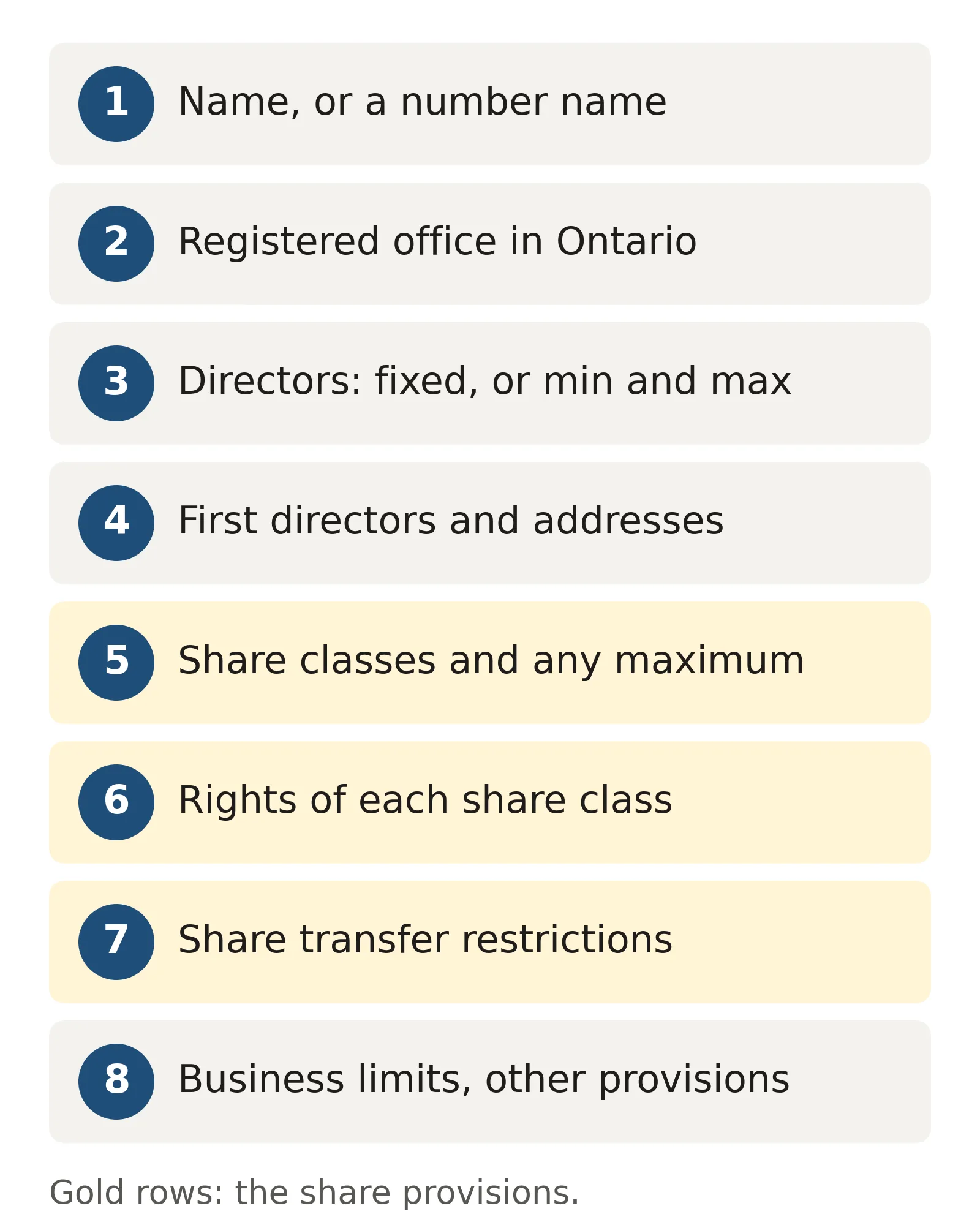
The form follows a fixed order. According to the Form 5351 instructions and the Ministry's Notice, Ontario articles of incorporation set out:
- Name: a proposed name, which must include a legal element such as Limited, Incorporated or Corporation or their short forms (s. 10(1)), or a number name. A proposed name needs an Ontario Nuans report dated no more than 90 days before you file, kept at the registered office. Our Ontario Nuans report guide explains that step.
- Registered office: a full street address in Ontario. A post office box alone is not accepted, and the corporation must keep a registered office in Ontario at all times (s. 14(1)).
- Number of directors: either a fixed number or a minimum and a maximum, never both.
- First directors: each director's full name, address for service, and whether the director is a resident Canadian.
- Share classes: the classes and any maximum number of shares the corporation may issue. This item is mandatory.
- Class rights: the rights, privileges, restrictions and conditions of each class, or "Not Applicable" if there is only one class.
- Share restrictions: any restrictions on the issue, transfer or ownership of shares, or "none".
- Business restrictions and other provisions: any limits on what the corporation may do, plus any other provisions, or "none".
- Incorporators: the name and address for service of each incorporator, all of whom sign.
The form also collects administrative details that the instructions say are not shown on the public record: a contact person, an official email address for the corporation and a NAICS code for its main activity.
Articles, by-laws or a shareholder agreement?
The articles may contain anything the OBCA allows in the by-laws (s. 5(3)), and a higher voting threshold in the articles or in a unanimous shareholder agreement overrides the lower one in the Act (s. 5(4)). That does not mean everything belongs in the articles. Unless the articles, the by-laws or a unanimous shareholder agreement say otherwise, the directors can make, amend or repeal by-laws by resolution, and the shareholders confirm, reject or amend the change at their next meeting (s. 116). Changing the articles usually takes a special resolution and a filing with the Ministry. Put the rules that should be hard to change in the articles, and keep day-to-day governance in the by-laws. Our comparison of a shareholder agreement vs by-laws explains where private deals between owners belong.
How should you set up the share structure?
Every Ontario business corporation must be authorized to issue shares. Shares are in registered form and have no nominal or par value (s. 22(1)). If the articles create only one class, the holders have equal rights, including the right to vote at every shareholders' meeting and to receive the remaining property on dissolution (s. 22(3)).
If the articles create more than one class, they must set out the rights, privileges, restrictions and conditions of each class, and the voting right and the right to remaining property must each attach to at least one class, though not necessarily the same one (s. 22(4)). Every share within a class is the same as every other share of that class (s. 22(6)), unless the class is issued in series. The articles can authorize the directors to fix the number and terms of each series (s. 25(1)(b)), and the directors can then file the matching amendment on their own resolution (ss. 168(2) and 168(5)).
The Ministry's Notice offers predefined text for the simplest case: an unlimited number of common shares. That can suit a sole founder or equal partners. It is a poor fit when you already expect a second founder with different rights, a family holding company, an employee equity plan or an investor who will want a preferred return. Adding a class later requires a special resolution and articles of amendment (s. 168(1)(e)), and holders of an affected class may be entitled to vote separately as a class (s. 170(1)).
The articles fix what can be issued. Who actually receives shares, when and for what price is decided by the directors (s. 23(1)), and a share cannot be issued until it is fully paid in money, or in property or past services worth at least the money equivalent (s. 23(3)).
Why do share transfer restrictions matter?
The item on restrictions on the issue, transfer or ownership of shares looks optional, and the form accepts "none". Choosing "none" has consequences, because Ontario securities law ties a key exemption to transfer restrictions, which can sit in the articles or in a security holders' agreement. Before you file articles of incorporation, Ontario founders who expect to bring in investors should decide this item deliberately rather than by default.
Section 2.4 of National Instrument 45-106 Prospectus Exemptions (Ontario Securities Commission unofficial consolidation current to December 4, 2025) defines a private issuer. Among other conditions, the issuer is not a reporting issuer or an investment fund, and its securities, other than non-convertible debt, are subject to restrictions on transfer contained in its constating documents or security holders' agreements and are beneficially owned by no more than 50 persons, not counting employees and former employees. A private issuer can then sell securities to the people listed in section 2.4(2) without a prospectus.
The Ministry's Notice offers predefined "private issuer" provisions for corporations that do not offer shares to the public. The predefined share restriction says no shareholder may transfer shares without approval by majority resolution of either the directors or the shareholders, whichever the filer selects. A separate provision requires the same kind of approval, or compliance with a security holders' agreement, before the corporation's other securities are transferred. The Notice itself suggests asking a lawyer about private issuer requirements. A corporation that skipped the restriction can add it later by articles of amendment (s. 168(1)(n)).
Who can be a director or incorporator?
Incorporators can be individuals, Ontario corporations or corporations from outside Ontario (s. 4(1)). The Form 5351 instructions ask a corporate incorporator for its Ontario Corporation Number, or for a corporation not registered in Ontario its registered head office, plus the name and position of the person signing.
Directors must be individuals. A person under 18, a person found incapable of managing property and a person with the status of a bankrupt cannot serve (s. 118(1)), and a director does not need to hold shares unless the articles say so (s. 118(2)). A corporation needs at least one director, and an offering corporation, meaning one that offers its securities to the public, needs at least three (s. 115(2)). The first directors named in the articles hold office until the first shareholders' meeting (s. 119(1)). A first director who is not also an incorporator signs a Consent to Act as a First Director (Form 5260), which the corporation keeps at its registered office (s. 5(2)).
No resident Canadian director is required in Ontario
Section 118(3) of the OBCA, which governed how many directors had to be resident Canadians, was repealed by Schedule 1, section 5 of the Better for People, Smarter for Business Act, 2020, in force July 5, 2021. The Ministry's Notice now states that the requirement for at least 25 percent of directors to be resident Canadian has been eliminated. The form still asks whether each director is a resident Canadian, but an Ontario corporation may now have a board with no resident Canadian director.
A federal corporation is different. Section 105(3) of the Canada Business Corporations Act (current to September 3, 2026) still requires at least 25 percent of directors to be resident Canadians, or at least one if the board has fewer than four. For a founder based in the United States with no Canadian director, that difference can decide the choice between an Ontario and a federal corporation. Our guide to Ontario business structures covers the wider choice.
A board with a minimum and maximum gives room to grow: within that range, the number of directors is set by special resolution or, if the special resolution allows it, by the directors (s. 125(3)), with no amendment to the articles.
Which later changes need articles of amendment?
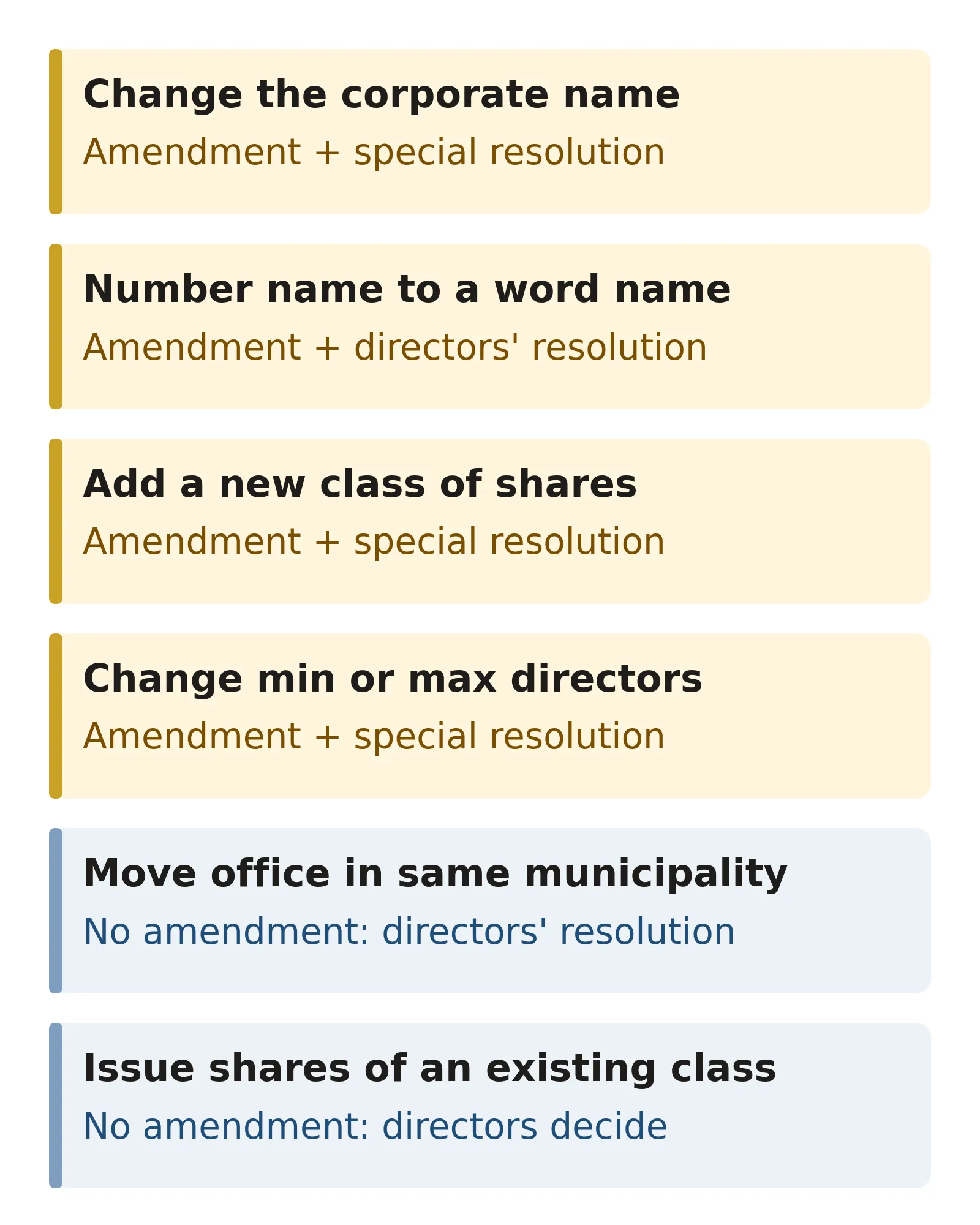
Section 168(1) lets a corporation amend its articles to add, change or remove anything the Act permits in them, including changing its name, creating new classes of shares, changing share rights, changing the number or the minimum and maximum number of directors, and adding or removing share transfer restrictions. Most amendments need a special resolution (s. 168(5)), meaning at least two-thirds of the votes cast at a shareholders' meeting called for that purpose, or the written consent of every voting shareholder (s. 1(1)).
Two changes need only a directors' resolution: replacing a number name with a word name (s. 168(4)) and filing the terms of a new series that the articles already allow the directors to set (s. 168(2)). A corporation cannot change its name while it is unable to pay its debts as they fall due, or while its assets are worth less than its liabilities (s. 171(3)).
Other common changes do not touch the articles at all:
- Moving the registered office within the same municipality: a directors' resolution (s. 14(3)). A move to another municipality in Ontario needs a special resolution (s. 14(4)), but no articles of amendment.
- Changing the board size within the minimum and maximum: a special resolution, or a directors' resolution if one allows it (s. 125(3)).
- Issuing more shares of an existing class: a decision of the directors (s. 23(1)), unless the articles set a maximum that would be exceeded.
Articles of amendment are sent to the Director (s. 171(1)), who endorses them with a certificate of amendment (s. 172). Ontario's fee page lists $150 for an amendment, online or by mail.
Articles of incorporation: Ontario vs federal and New York
When you compare articles of incorporation, Ontario, federal and New York filings ask for similar building blocks, but the fee, the office rule and the treatment of par value differ, as the table shows.
| Point | Ontario (OBCA) | Federal (CBCA) | New York (BCL) |
|---|---|---|---|
| Document filed | Articles of incorporation | Articles of incorporation | Certificate of incorporation |
| Government fee | $300 CAD | $200 CAD online | $125 USD |
| Office stated | Address in Ontario | Province of the office | County in New York |
| Par value | None allowed | None allowed | Par or no par stated |
Federally, section 6(1) of the Canada Business Corporations Act requires the articles to name the province where the registered office will be, and section 24(1) makes shares without nominal or par value, as in Ontario. Corporations Canada's page on services, fees and processing times lists $200 for an online incorporation with a one-day standard service, plus $100 for express service in four hours.
New York uses a certificate of incorporation under section 402 of the Business Corporation Law. Each incorporator signs it, and it states the name, the purposes (the section allows a general statement that the corporation may engage in any lawful act or activity), the county where the office will be, the number of shares and their par value or a statement that they have none, any classes and series, and a designation of the Secretary of State as agent for service of process. An Ontario form has no purpose clause: an Ontario corporation has the capacity and powers of a natural person (s. 15), and its articles list restrictions only if there are any. The New York Department of State lists a $125 filing fee for the certificate.
A company that already exists in the United States does not always need a new Ontario corporation. It may be able to register its existing corporation instead, as explained in our guides on extra-provincial registration in Ontario and on how a US company does business in Canada.
Whichever route you take, the paperwork continues after the certificate. Under section 2 of Ontario's Corporations Information Act, a new Ontario corporation files an initial return within 60 days after the date of incorporation.
Frequently asked questions
Do I need a lawyer to file articles of incorporation in Ontario?
No law requires a lawyer to file the articles. Incorporators can apply online through the Ontario Business Registry or by mail with Form 5351. A legal opinion is required only in the narrow case of a proposed name identical to another corporation's name. The Ministry's own instructions suggest legal advice when you are unsure about share classes or provisions.
How much does it cost to file Ontario articles of incorporation?
Ontario's fee page, updated April 1, 2026, lists $300 for an incorporation, whether filed online, where it is processed immediately, or by mail, where it takes 15 business days. A Nuans report for a proposed name is a separate cost. For comparison, Corporations Canada lists $200 for a basic online federal incorporation.
Can I incorporate in Ontario with a number name?
Yes. If the articles do not propose a name, the corporation is assigned a number name made of its assigned number, the word Ontario and the legal element you choose (s. 8(2)). No Nuans report is needed for a number name. The directors can later replace it with a word name by resolution and articles of amendment (s. 168(4)).
Do Ontario corporations need a resident Canadian director?
No. The OBCA rule on how many directors had to be resident Canadians was repealed effective July 5, 2021, and the Ministry's Notice confirms the former 25 percent requirement has been eliminated. The form still asks about each director's residency. A federal corporation under the CBCA still needs at least 25 percent resident Canadian directors, or at least one.
Can a US company be the incorporator of an Ontario corporation?
Yes. Section 4(1) of the OBCA allows bodies corporate to incorporate, and the Form 5351 instructions accept corporations that are not registered in Ontario. The articles must give the corporation's name, its registered head office, and the name and position of the person who signs for it, such as a director or the president.
Can Ontario articles of incorporation be backdated or post-dated?
They cannot be backdated. The certificate is dated the day the Ministry receives an acceptable filing, and the Form 5351 instructions allow a requested date up to 30 calendar days in the future. The Nuans report behind a proposed name must be no more than 90 days old when the articles are submitted.
What happens after the articles are endorsed?
The Ministry emails the certificate of incorporation, a copy of the endorsed articles, a payment receipt and a company key to the corporation's official email address, and the documents other than the company key also go to the person named in the application. The corporation then files an initial return within 60 days under the Corporations Information Act, and the directors hold their first meeting, where they may make by-laws, authorize the issue of shares and appoint officers (s. 117(1)).
Conclusion
Filing articles of incorporation in Ontario is quick and the fee is fixed, but the articles are the one document that is hard to change later. The share classes and their rights, the transfer restriction that keeps a private company inside the private issuer exemption, and a minimum and maximum board are the choices worth thinking through before you file. For founders outside Canada, Ontario's lack of a resident director rule is a real difference from a federal corporation, and a New York comparison shows how differently the same building blocks are handled across the border.
How Mayo Law can help
Mayo Law is a cross-border firm with offices in Toronto and New York. Joseph Mayo, our principal attorney, is licensed in Ontario and New York and advises Canadian and US founders on incorporating and structuring companies. We can draft the share structure and provisions in your articles of incorporation, compare an Ontario, federal or New York entity for your plans, and prepare the documents that follow incorporation. Learn more about our incorporation lawyer services and our international business law practice.
Disclaimer
This article is for general information only and is not legal advice. Reading it does not create a solicitor-client or attorney-client relationship. Corporate and securities rules change, and the right structure depends on your facts, so obtain advice on your specific situation before filing articles of incorporation. Mayo Law provides legal services in Ontario and New York.