

Contents
- Quick answer
- What is a Nuans report?
- When is a Nuans Canada report required?
- Ontario's Nuans report and the 90-day rule
- Federal incorporation: the search is built in
- What a Nuans search costs in 2026
- How to read the report and what it does not prove
- How a Nuans search compares with New York
- Frequently asked questions
- Conclusion
- How Mayo Law can help
- Disclaimer
If you are incorporating a company under a real name rather than a number, you will run into Nuans, Canada's government-owned search system for corporate names, business names and trademarks. The Nuans Canada rules are not the same in every jurisdiction. Ontario requires an Ontario-biased or weighted Nuans report for a named corporation. The federal government builds its name search into online incorporation. Most other provinces and territories do not ask for a separate report at all.
This guide explains what a Nuans report is, when you need one, how the Ontario 90-day rule works, what the searches cost and how the Canadian system compares with a New York name check. It is written for founders, for US companies opening a Canadian subsidiary, and for Canadian owners who also operate in New York. Every rule and fee below was checked against the government source named beside it in September 2026.
Quick answer
A Nuans report lists existing corporate names, business names and trademarks that resemble the name you want. In Ontario, articles for a named corporation must be supported by an Ontario-biased or weighted Nuans report dated no more than 90 days before filing. Federally, the search is built into online incorporation. Numbered companies need no report.
What is a Nuans report?
Nuans is owned by Innovation, Science and Economic Development Canada (ISED). ISED describes it as the Government of Canada's business name and trademark search tool, which uses a search algorithm to list Canadian corporate names and trademarks that are similar or identical to the name searched. Corporations Canada's guidance on how to get a corporate name puts it more plainly: a Nuans name search lists existing corporate names, business names and trademarks similar or identical to the one you are proposing.
The report is a list, not a decision. Nobody at Nuans tells you whether your name is safe. The registry you file with, or in Ontario you yourself, must read the list and decide whether any entry is close enough to cause confusion.
Why the report has to match the jurisdiction
A Nuans report is ordered for a specific jurisdiction. Ontario's own filing notice says a Canada (federal) biased Nuans name search is not acceptable for an Ontario incorporation. Federally, the search runs inside the online filing, and Corporations Canada tells applicants not to order a report before they file. Decide where you will incorporate before you pay for any search. Our guide to Ontario business structures covers that choice.
Who can order one
Registered Nuans members, usually corporate search houses, can order reports for several jurisdictions and run pre-searches before a report is generated, according to ISED's Nuans membership page. A pre-search is a quick look at likely conflicts. It is not the report a registry asks for.
When is a Nuans Canada report required?
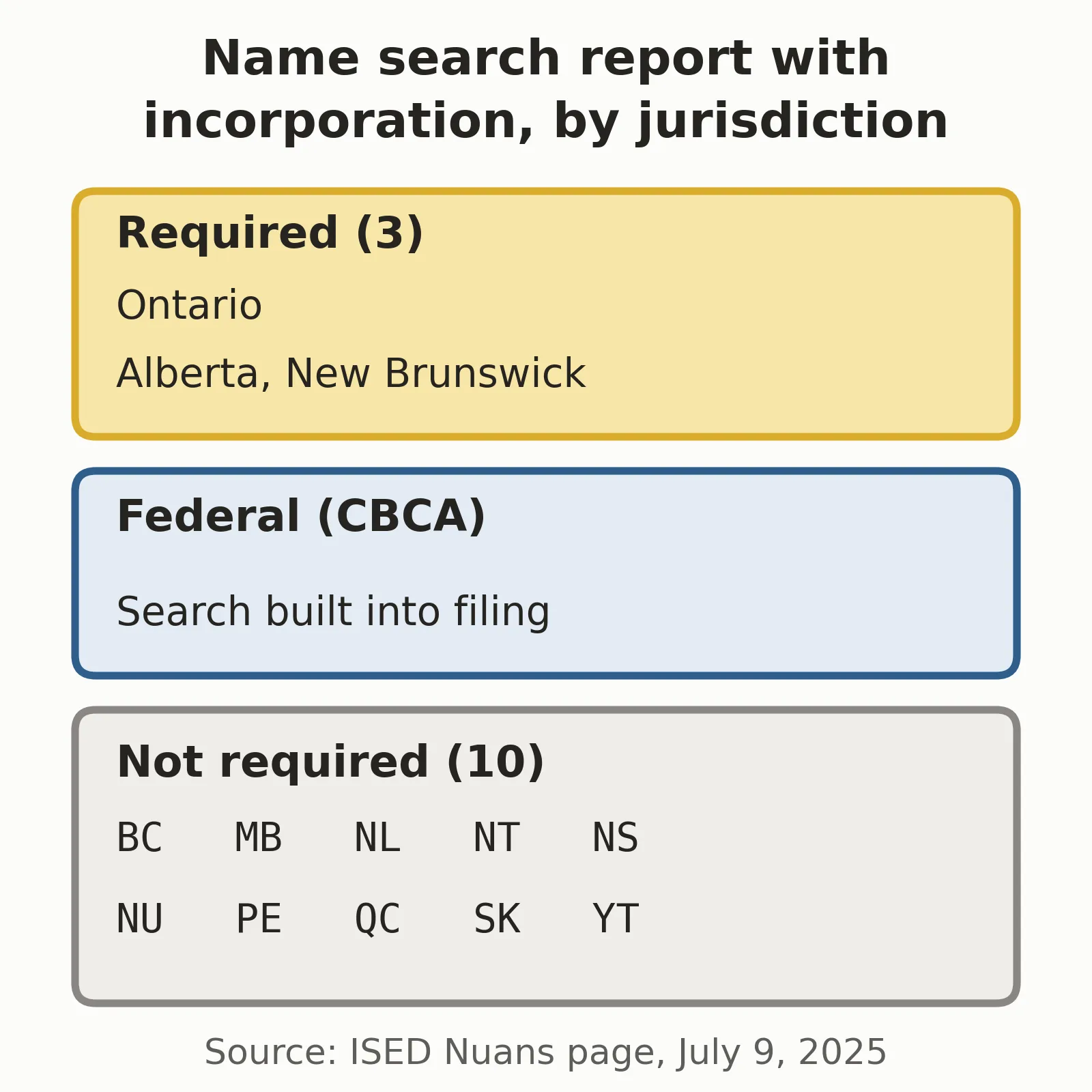
The short version is that it depends on where you incorporate and whether you want a word name. ISED's page on provincial and territorial name search requirements (last modified July 9, 2025) sorts the thirteen provinces and territories into two groups:
- Name search required, but not ordered on the Nuans website: Alberta, New Brunswick and Ontario. Alberta and New Brunswick point applicants to private sector name search firms. Ontario points them to service providers authorized by the Ontario government.
- No separate name search required with the application: British Columbia, Manitoba, Newfoundland and Labrador, the Northwest Territories, Nova Scotia, Nunavut, Prince Edward Island, Quebec, Saskatchewan and Yukon. For Manitoba, Nova Scotia, Prince Edward Island, Saskatchewan and Yukon, ISED notes that the name search is included in the application process.
That is three of thirteen, plus the federal system, which works differently again. Several private providers still list Nova Scotia, Prince Edward Island or the Northwest Territories as report jurisdictions, so check the government page rather than a sales page before you order.
Ontario filings that need a report
Ontario's Names and Filings Regulation under the Business Corporations Act, O. Reg. 398/21, section 18, requires articles that contain a proposed corporate name or a change of corporate name to be supported by an Ontario biased or weighted Nuans report. In practice that covers articles of incorporation for a named company and articles of amendment that change the corporate name. The Ontario Business Registry's terms also refer to Extra-Provincial Corporations Act filings that must be supported by the same kind of report; our extra-provincial registration guide explains which outside corporations that affects.
When you do not need one
You do not need a Nuans report for a numbered company. Ontario's incorporation notice says that if you choose a number name, the Ministry assigns a number followed by "Ontario" and no report is required. Federally, Corporations Canada assigns a number name such as 12345678 Canada Inc. The Ontario notice for registering a business name under the Business Names Act does not list a Nuans report among its required documents either, although that notice also warns that a business name registration does not protect the name's exclusivity.
Ontario's Nuans report and the 90-day rule
Ontario spells out its Nuans rules in a published filing notice. The Ministry's Notice on incorporating a business corporation (effective February 1, 2025) sets out the working rules:
- An Ontario-biased or weighted Nuans report is required unless the corporation will have a number name.
- The report must come from a private name search company. The Ministry does not provide the search.
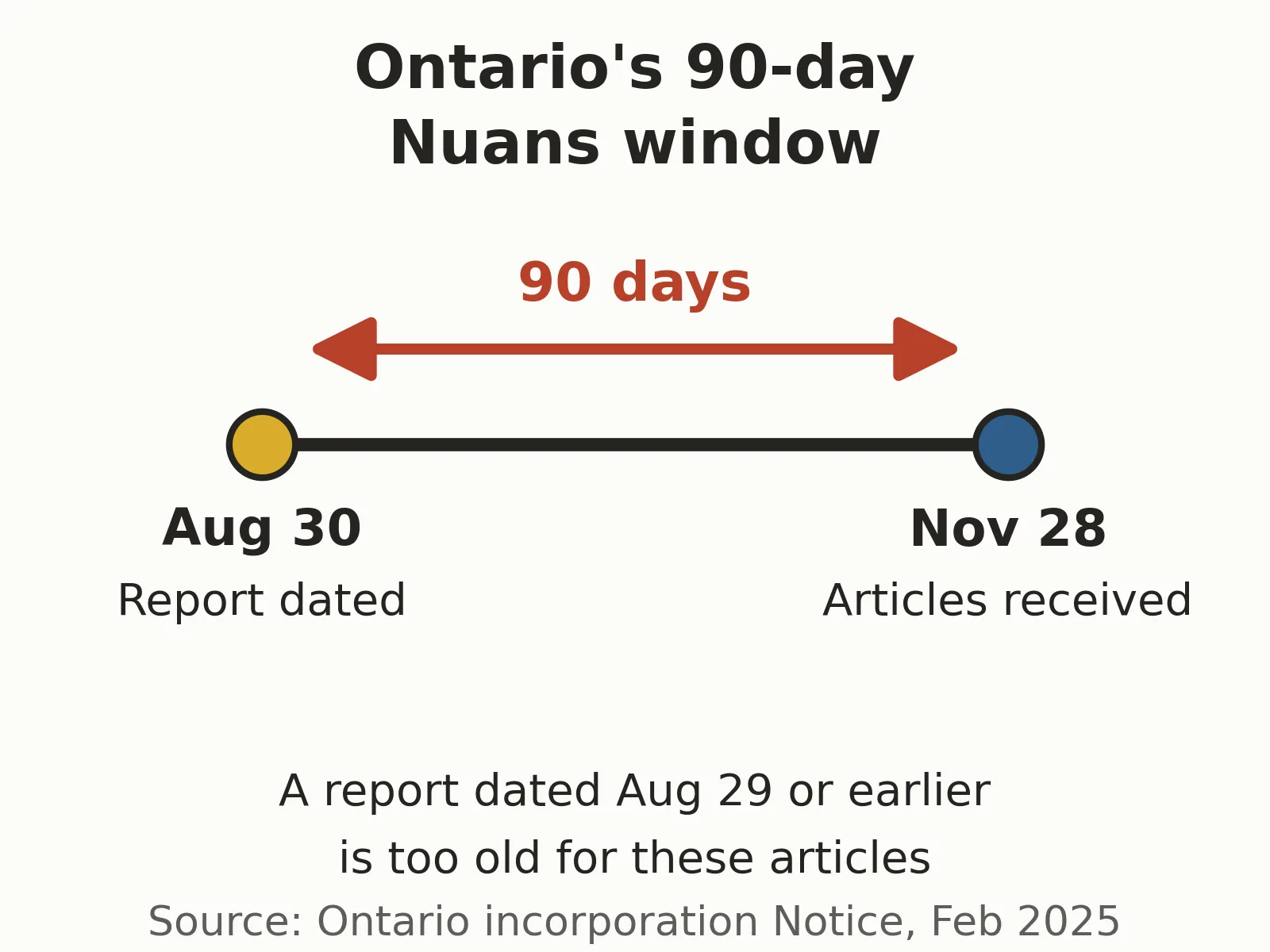
- The report cannot be dated more than 90 days before the articles are filed.
- When you file, you give the proposed name searched, the Nuans reference number and the date of the report. The Ministry retrieves the report itself.
- The corporation keeps a copy of the report at its registered office.
- A name with an English form and a French form needs a separate report for each form.
The 90 days run backward from the day the Ministry receives your articles, not forward from the day you ordered. The Notice gives its own example: articles received on November 28 can be supported by a report dated as early as August 30, but not earlier. That is exactly 90 days. The Ministry also warns that saving a draft online does not stop the clock, and that if the report expires before the articles are endorsed, a new report is needed.
Ontario does not screen your name for you
This point is easy to miss. The Notice states that the Ministry does not review proposed names for similarity to any other name, and that incorporators are responsible for choosing a name that is not identical or confusingly similar to another corporation, business name or trademark. A corporation that takes a similar name can face a names hearing under section 12 of the Business Corporations Act, or a lawsuit. Section 10 of O. Reg. 398/21 adds that a name shown in a Nuans report as proposed cannot be used by someone else without the first proposer's written consent.
Identical names are handled more strictly. Under section 5 of the regulation, a new corporation generally cannot take the name or former name of another body corporate unless, for example, at least ten years have passed since that body corporate dissolved or changed its name, or a lawyer authorized to practise in Ontario gives the legal opinion the regulation describes. Our Ontario incorporation checklist walks through the rest of the filing.
Federal incorporation: the search is built in
Corporations Canada works differently. Its federal Nuans report page (last modified September 16, 2026) says the name search is integrated into most Canada Business Corporations Act (CBCA) and not-for-profit online applications, and that for a federal incorporation or a corporate name preapproval you should not order a report before filing. A separate federal Nuans report is still required before filing for a CBCA revival or amalgamation and for certain not-for-profit and cooperative filings.
Three federal points matter for planning:
- Corporations Canada reviews your name. Unlike Ontario, the federal registry examines proposed names against its requirements, and it says a Nuans search does not mean the name will be approved.
- The search is valid for 90 days. Corporations Canada says a Nuans search is valid for 90 days only.
- You can preapprove a name. A corporate name preapproval is valid for 90 days from the date you apply, and an approved name is reserved for 90 days, retroactive to the date of the request.
Corporations Canada also says a word name approved federally gives the corporation the legal right to use it across Canada. Its incorporation guidance still points federal corporations to a separate step, registering in the provinces or territories where they operate, which is where our extra-provincial registration guide picks up.
What a Nuans search costs in 2026
Nuans Canada pricing comes in two parts. The government fees are easy to confirm. The price of an Ontario report is not, because no Ontario schedule sets it.
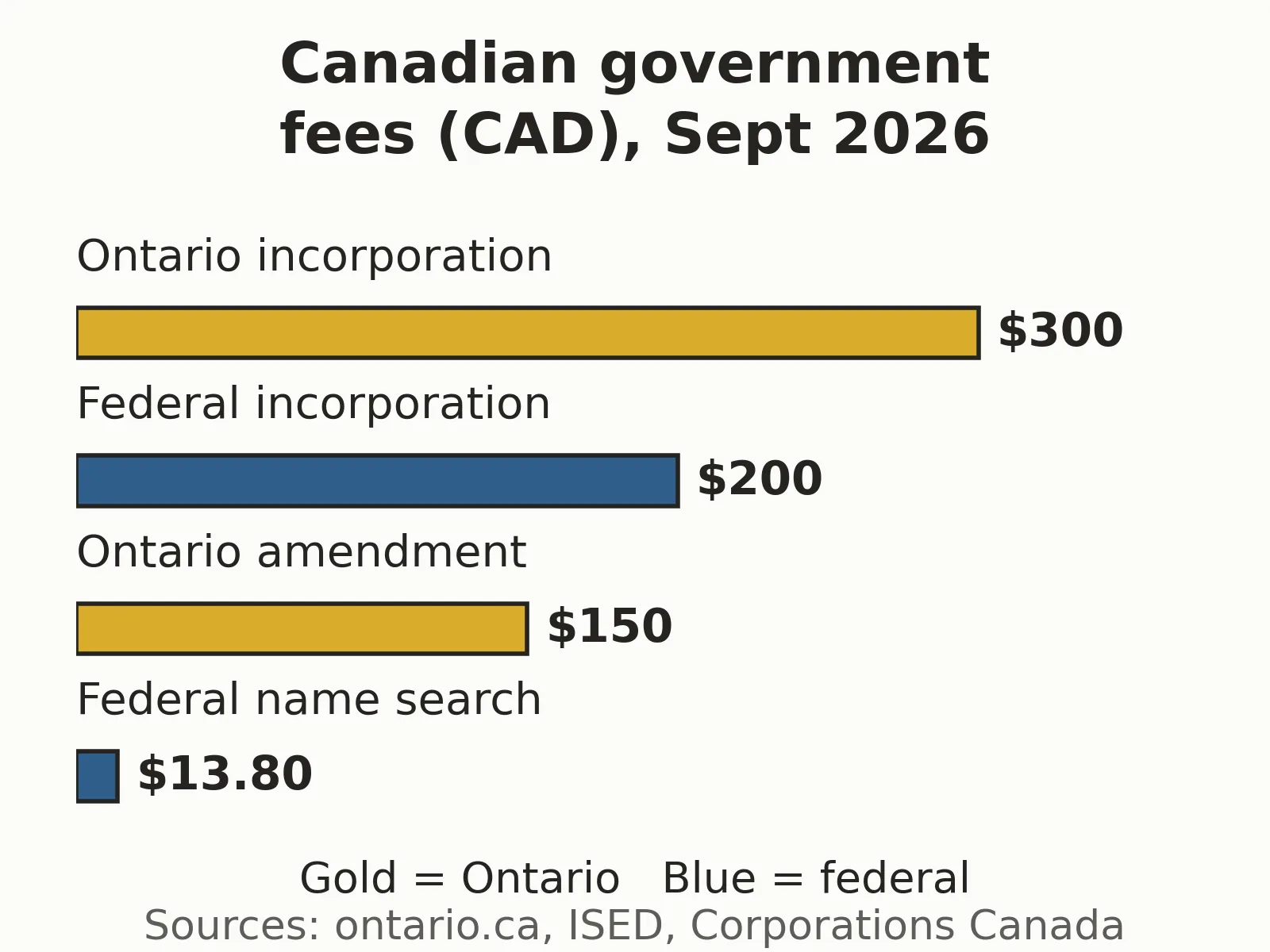
- Federal name search: ISED lists the cost of a federal name search at $13.80.
- Federal online incorporation: Corporations Canada's start a business page lists basic online incorporation at $200.
- Ontario articles of incorporation: $300 on Ontario's fee page (updated April 1, 2026), with the same fee listed for immediate and 15-business-day processing.
- Ontario articles of amendment: $150 on the same page. A name change by amendment also needs a fresh Ontario Nuans report.
- Ontario Nuans report: priced by each private search provider. Ontario publishes no government fee for it.
These are Canadian government fees, paid in Canadian dollars. One correction worth making: the $13.80 figure is the federal search cost and does not apply to an Ontario filing, even though it is often quoted as "the" Nuans price.
How to read the report and what it does not prove
A Nuans Canada report is only useful if someone reads it critically. Before you file, work through it like this:
- Step 1: Check identical and near-identical names. An exact match to an active corporation, or to one that dissolved or changed its name less than ten years ago, is an Ontario problem unless an exception applies.
- Step 2: Do not rely on punctuation. Adding or deleting punctuation marks or other symbols does not make a name different under section 6 of O. Reg. 398/21, and a name that is not identical can still be confusingly similar.
- Step 3: Check trademarks in your field. A registered trademark close to your name is a risk even where no corporation uses it.
- Step 4: Check old Ontario business names with care. For federal filings, Corporations Canada's name granting policy notes that Ontario business names expire after five years unless renewed but may remain in the Nuans database, and it treats Ontario registrations under five and a half years old as active.
- Step 5: Keep the report. Ontario requires the corporation to keep it at its registered office.
What the report does not do matters just as much. It is not an approval: Corporations Canada says getting a Nuans search does not mean it automatically approves your name, and Ontario does not review similarity at all. It is not a trademark clearance search, and it gives you no trademark rights. Ontario's Business Names Act notice makes a related point: registering a business name does not protect its exclusivity, and owners are pointed to trademark registration under the federal Trademarks Act.
How a Nuans search compares with New York
For a company that will operate in both countries, the name check is two separate exercises. New York does not use Nuans. The New York Department of State's page on reserving a corporate name explains that the Division of Corporations must reject a name that is not "distinguishable" from names already on file, that a name availability inquiry costs $5 per name under section 96 of the Executive Law, and that a reservation under Business Corporation Law section 303 costs $20 and holds the name for 60 days. Its extension page adds that two 60-day extensions are available, each for a $20 fee. The Department also cautions that a finding of availability is not an approval of the name.
The table below sets the three systems side by side. The takeaway: federal Canada and New York both examine names, while Ontario leaves the similarity judgment to you.
| Issue | Federal (CBCA) | Ontario (OBCA) | New York (BCL) |
|---|---|---|---|
| Name search | Built into filing | Ontario Nuans report | DOS availability inquiry |
| Search fee | $13.80 CAD | Set by provider | $5 USD per name |
| Time limit | 90 days | Dated within 90 days | Date of search only |
| Registry reviews name | Yes | No | Yes, distinguishable test |
| Reservation | Preapproval, 90 days | First proposer consent rule | $20 USD, 60 days |
If you are also choosing the US entity, our comparison of an LLC and a corporation in New York covers that decision, and our guide to how to start a business in both Canada and the US sets out the order of steps.
Frequently asked questions
What is a Nuans report in Canada?
A Nuans report is a list of existing Canadian corporate names, business names and trademarks that are similar or identical to a name you propose. It comes from the Nuans system owned by Innovation, Science and Economic Development Canada. Registries, and in Ontario the incorporators themselves, use it to judge whether a new corporate name could be confused with an existing one.
Is a Nuans Canada report required to incorporate in every province?
No. ISED's provincial and territorial page lists only Alberta, New Brunswick and Ontario as requiring a name search report with an incorporation application. The other ten provinces and territories do not require a separate name search, and federal online incorporation builds the search into the application, so you should not order one first.
How long is an Ontario Nuans report valid?
Ontario requires the report to be dated no more than 90 days before the Ministry receives your articles. The Ministry's own example is that articles received on November 28 can rely on a report dated as early as August 30. If the report expires before the articles are endorsed, you need a new report to complete the filing.
Can I use a federal Nuans report for an Ontario incorporation?
No. Ontario's Notice on incorporating a business corporation says a Canada (federal) biased Nuans name search is not acceptable. Ontario requires an Ontario-biased or weighted report obtained from a private name search company, and the filing must give the name searched, the Nuans reference number and the date of the report.
How much does a Nuans report cost?
ISED lists the federal name search at $13.80. Ontario publishes no government fee for an Ontario-biased report, so the price depends on the private search provider you use. The report is separate from the filing fee, which is $300 for Ontario articles of incorporation and $200 for basic federal online incorporation.
Does a Nuans report reserve my corporate name?
Not in the way a formal reservation does. In Ontario, section 10 of O. Reg. 398/21 says a name shown as proposed in a Nuans report cannot be used by another person without the first proposer's written consent. Federally, a name preapproval is valid for 90 days, and New York offers a 60-day reservation for a $20 fee.
Do I need a Nuans report for a numbered company?
No. Ontario's incorporation Notice says a Nuans report is not required for a number name, and the Ministry assigns a number followed by "Ontario". Federally, Corporations Canada assigns a numbered name such as 12345678 Canada Inc. You can later register an operating name or amend the articles to adopt a word name.
Does a clean Nuans report mean my name is safe to use?
No. The report only lists what the database finds. Corporations Canada says a Nuans search does not mean a name will be approved, and Ontario's Ministry does not review names for similarity at all. A clean report is also not trademark clearance, so a separate trademark search is sensible before you invest in a brand.
Conclusion
Nuans, Canada's name search system, gives a jurisdiction-specific answer. In Ontario, a named corporation needs an Ontario-biased or weighted report dated within 90 days of filing, from a private provider, and the Ministry will not check your name for similarity on your behalf. Federally, the search sits inside the online filing and Corporations Canada reviews the name. Ten provinces and territories do not ask for a separate report at all. If the company will also trade in New York, the name has to clear a separate state check. Settle the jurisdiction first, run the search close to your filing date, and read the report before you file.
How Mayo Law can help
Mayo Law is a cross-border law firm with offices in Toronto and New York. Joseph Mayo, our principal attorney, is licensed in Ontario and New York. We help founders and US companies choose between Ontario and federal incorporation, review name search results before filing, prepare articles and organizational documents, and coordinate the matching New York or extra-provincial filings. You can read more about our incorporation services and our cross-border business law practice, or see whether you need a lawyer to incorporate at all.
Disclaimer
This article is for general information only and is not legal advice. Reading it does not create a solicitor-client or attorney-client relationship. Name search rules, fees and filing requirements change, so confirm the current position with the relevant registry or a licensed professional before you act. Mayo Law provides legal services in Ontario and New York.