

Contents
- Quick Answer
- What qualifying relationship must the Canadian and US companies have?
- What does the one year of employment abroad actually require?
- L-1A or L-1B: how do the two standards differ?
- How does a new office L-1 work, and what has to be shown to extend it?
- How long can someone stay on an L-1 visa from Canada?
- Can a Canadian citizen file the L petition at a port of entry?
- When is a blanket L worth setting up?
- What happens to the family in L-2 status?
- What does an L-1 visa from Canada cost in government fees?
- Frequently asked questions about the L-1 visa from Canada
- Conclusion
- How Mayo Law can help
- Disclaimer
A Canadian company expanding into the United States has to move people, not just capital. The L-1 visa from Canada is the category built for that. It lets a qualifying organization transfer an executive, a manager, or an employee with specialized knowledge out of its Canadian entity into a related US entity, with no annual cap and no lottery.
The rules are narrow, and in our experience most refusals turn on three issues: the corporate relationship, the year of employment abroad, and whether the US job is really what the petition claims. What follows is the framework as it stands in September 2026, with every figure taken from USCIS, the Department of State and CBP.
Quick Answer
The L-1 visa moves an employee from a Canadian company to a related US parent, branch, subsidiary or affiliate. The employee must have worked abroad for that group for one continuous year in three. L-1A managers and executives get up to seven years, L-1B staff five. Canadians are visa exempt and file at the border or Canadian preclearance.
What qualifying relationship must the Canadian and US companies have?
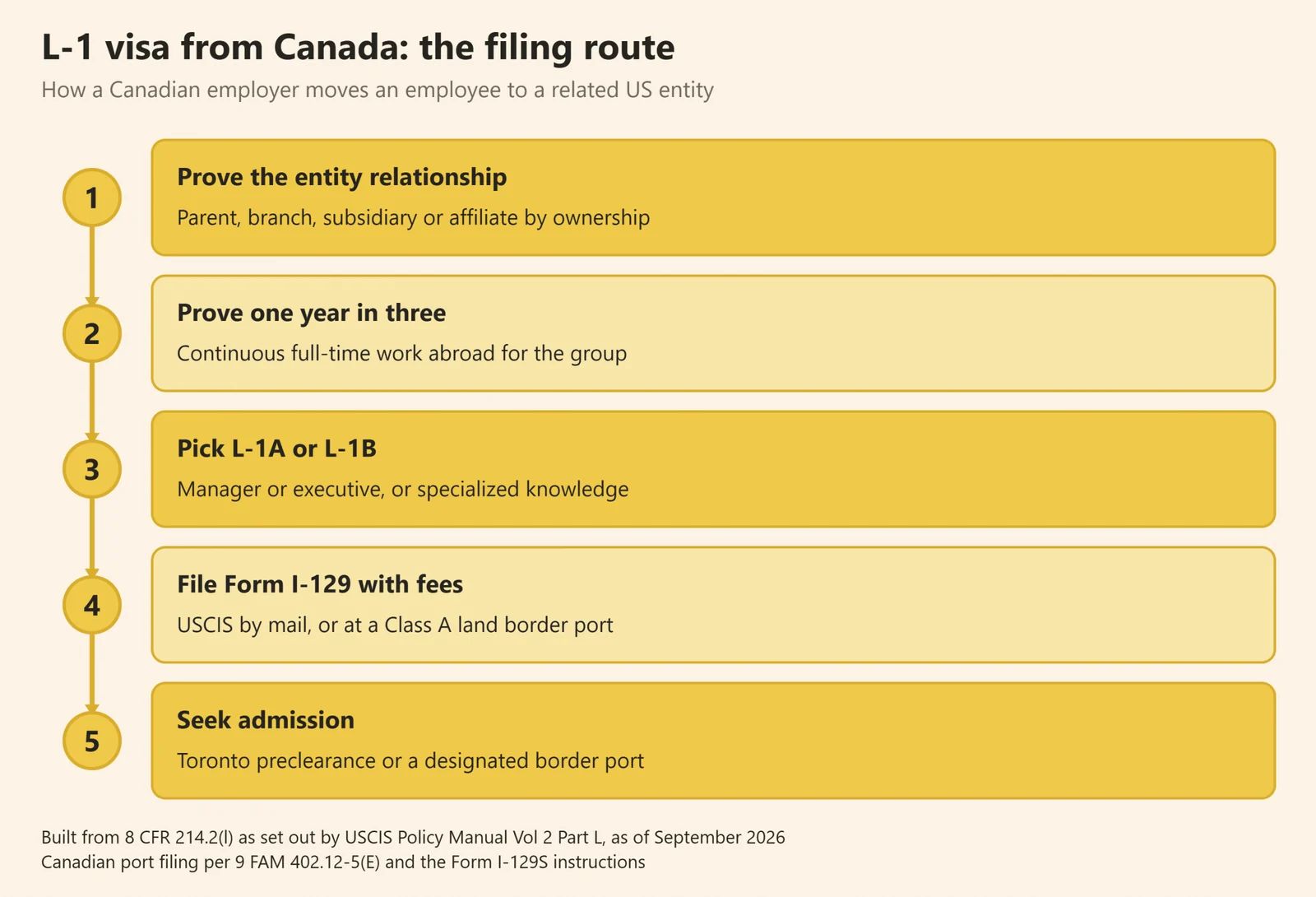
The L category rests on a corporate relationship, not on the individual. USCIS requires the US employer to have a qualifying relationship with a foreign company: a “parent company, branch, subsidiary, or affiliate, collectively referred to as qualifying organizations.” Ownership and control are tested in defined ways. Per the USCIS Policy Manual, and tracking 8 CFR 214.2(l)(1)(ii)(K), a parent owns a subsidiary in any of four ways: it owns more than half of the entity and controls it; owns half of the entity and controls it; owns 50 percent of a 50-50 joint venture and has equal control and veto power; or owns less than half but in fact controls it. The second limb is easy to miss and matters to Canadian groups that hold exactly half of a US company. Control there is enough on its own, with no need to dress the arrangement up as a joint venture. A branch is “an operating division or office of the same organization housed in a different location.” Affiliates sit under a common parent, or under the same person or group.
Both sides also have to be trading. USCIS defines doing business as “the regular, systematic, and continuous provision of goods or services by a qualifying organization,” and adds that “the mere presence of an organization’s office or agent in the United States does not, in and of itself, constitute doing business.” That catches founders who incorporated a Delaware or New York company years earlier and left it dormant. A shelf company with a registered agent will not carry an L petition. The exception is the new office petition, covered below, where the US entity is not yet doing business and the initial approval is capped at one year rather than three. A Canadian company standing up a genuinely new US entity does not have to wait for US revenue before filing, and should not manufacture activity to look as though it has.
Evidence that actually proves the relationship
The Form I-129 instructions ask for evidence “based on ownership and control, such as: an annual report, articles of incorporation, financial statements, or copies of stock certificates,” and warn that sufficiency depends on “the quality and probative value of the evidence submitted.” For a private Ontario corporation that means the share register and subscription documents, not a registry printout.
What does the one year of employment abroad actually require?
The employee must generally have worked for a qualifying organization abroad “for one continuous year within the three years immediately preceding his or her admission to the United States.” The Foreign Affairs Manual is more exact: the year must be continuous full-time employment earned wholly outside the United States (9 FAM 402.12-11). The rule that governs US time during that year is 8 CFR 214.2(l)(1)(ii)(A), not the readmission rule at (l)(12)(i) that is often cited for it. Two kinds of US time are non-interruptive: periods spent in lawful status working for a branch of the same employer or a parent, affiliate or subsidiary, and brief trips for business or pleasure. Neither breaks the year, and neither counts toward it.
In our experience Canadian files fail here more often than people expect. A Toronto sales engineer who spent much of two years at US client sites has a harder problem than it first looks: the US months are not disqualifying, but they do not count, so the twelve months has to be built from what is left. The same goes for a founder running the Canadian company while living in New York. The fix is timing: hold the transfer until a clean twelve months is on the record, documented with payroll records, T4 slips and an employer letter. For a new office L-1A, the year abroad must itself have been executive or managerial.
L-1A or L-1B: how do the two standards differ?
L-1A covers managers and executives, and the definitions at INA 101(a)(44) turn on what the person does. A manager manages the organization or a department, subdivision, function or component and exercises discretion over its day-to-day operations. An executive directs the management of the organization or a major component, sets its goals and policies, and exercises wide latitude in decisions. USCIS focuses on primary duties, and its Policy Manual is blunt that “first-line supervisors, such as those who plan, schedule, and supervise the day-to-day work of nonprofessional employees, are not employed in an executive or managerial capacity.”
L-1B covers specialized knowledge: special knowledge of the organization’s “product, service, research, equipment, techniques, management, or other interests and its application in international markets,” or an advanced level of knowledge of its processes and procedures. The USCIS Policy Manual states the concessions with their limits attached, and the limits are the operative half. “Although specialized knowledge ordinarily cannot be knowledge generally possessed or easily transferrable, it need not be proprietary or unique to the petitioning organization.” Comparisons with colleagues may be useful, but “such knowledge need not be narrowly held within the petitioning organization.” One or more of those factors, “when assessed in the totality of the circumstances,” may then be enough to establish specialized knowledge by a preponderance of the evidence. Knowledge that is common in the industry or quickly taught to a replacement still fails.
| Feature | L-1A | L-1B |
|---|---|---|
| Who it covers | Managers and executives | Specialized knowledge employees |
| Core test | Primary duties are managerial or executive | Special knowledge of the organization, or advanced knowledge of its processes |
| Initial period of stay | Up to 3 years, or 1 year for a new office | Up to 3 years, or 1 year for a new office |
| Extension increments | Up to 2 years at a time | Up to 2 years at a time |
| Maximum period of stay | 7 years | 5 years |
| New office proof | Premises secured, executive or managerial year abroad, role supported within one year | Premises secured, and ability to pay the employee and commence business |
| Under a blanket L | Manager or executive | Specialized knowledge professional |
Because neither sub-category is capped, the L route gets compared with H-1B by Canadian employers who missed the lottery. The comparison is inexact, and some roles are better served by a cap-exempt H-1B than by being forced into a managerial shape they do not fit.
How does a new office L-1 work, and what has to be shown to extend it?
Where the US entity is brand new, USCIS grants “a maximum initial stay of one year” rather than three. For an L-1A new office, the Form I-129 instructions require evidence of three things.
- Sufficient physical premises to house the new office have been secured.
- The beneficiary spent a qualifying year abroad in an executive or managerial capacity, and the proposed employment involves that authority over the new operation.
- The US operation will support an executive or managerial position within one year, backed by the office’s proposed scope and structure, the size of the US investment, and the foreign entity’s ability to pay the employee and commence business.
For an L-1B new office the showing is shorter: premises secured, plus financial ability to pay the employee and start doing business.
The first extension is the real test. Under 8 CFR 214.2(l)(14)(ii), it needs evidence that both entities are still qualifying organizations, that the US entity has been doing business, a statement of the duties performed and those proposed, a description of staffing including headcount and positions with evidence of wages paid, and evidence of the financial status of the US operation.
Read plainly, the twelve-month window is a hiring deadline. In our experience a Canadian parent that sends a manager to New York with no plan to build a team underneath rarely survives the extension, because there is no structure left to manage. Anyone preparing to start a business in both Canada and the US should set the hiring plan against that one-year clock before the first petition is filed, not after the extension notice arrives.
How long can someone stay on an L-1 visa from Canada?
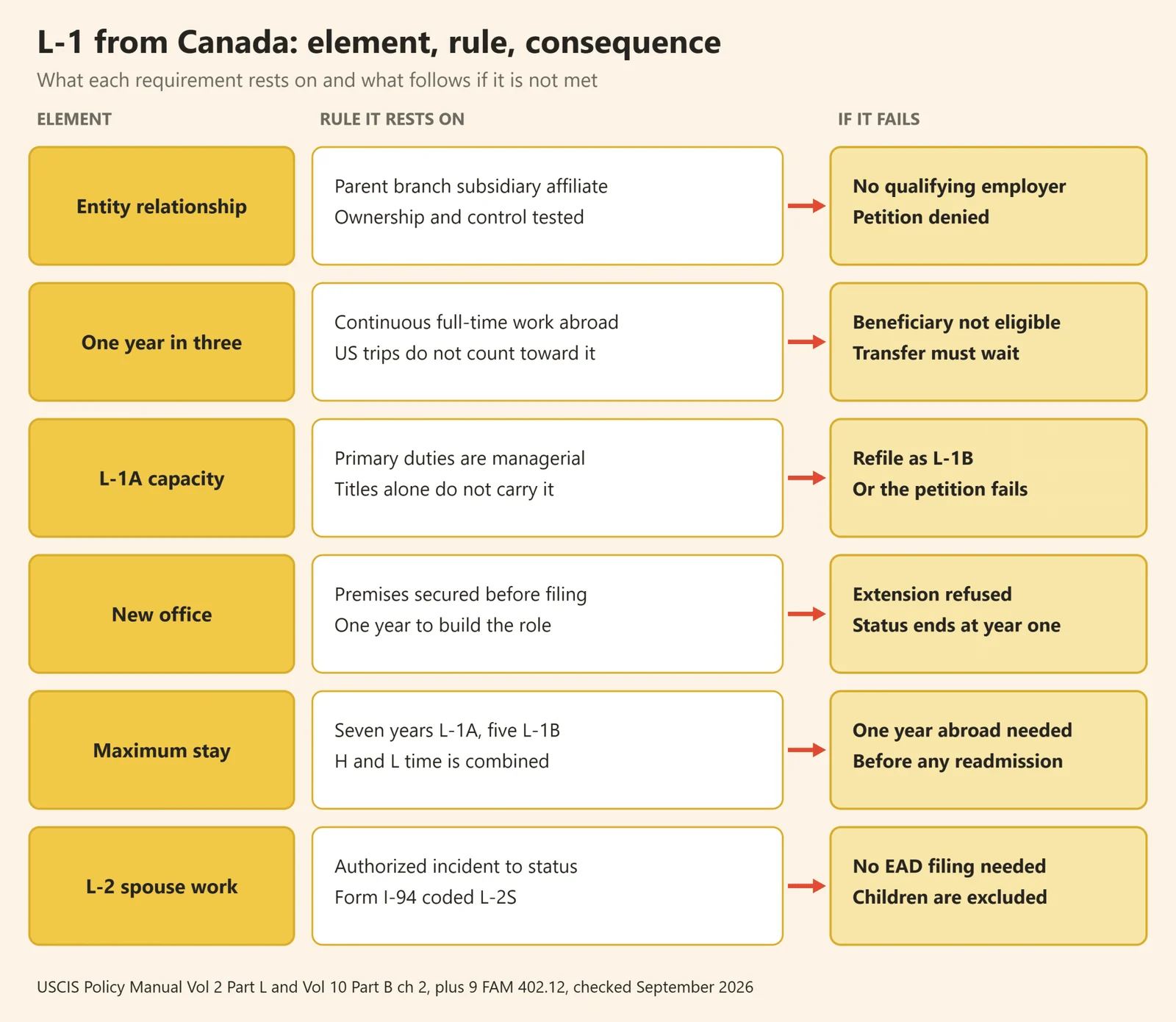
Outside the new office scenario the initial stay is up to three years, with extensions in increments of up to two years. The ceiling is seven years for L-1A and five for L-1B, per the USCIS Policy Manual and 8 CFR 214.2(l)(12)(i). Time in H and L categories is added together, including time with previous employers, so an engineer who spent four years on an H-1B has already used part of the runway. Once the maximum is reached the person cannot be readmitted as a temporary worker “unless and until the beneficiary has resided and been physically present outside the United States for the immediate prior year.”
The commuter exception most people miss
8 CFR 214.2(l)(12)(ii) carves out an exception that fits the Canadian border unusually well. The five and seven year limits do not apply to someone who does not reside continually in the United States and whose US employment is seasonal or intermittent, or six months or less per year in aggregate, nor to someone who lives abroad and regularly commutes for part-time work. A Toronto executive who spends two or three days a week in a Buffalo or Manhattan office and keeps a Canadian home may sit inside it. The evidentiary bar is the part to plan for. The regulation requires the petitioner and the employee both to provide clear and convincing proof of the exception, and it names the evidence it expects: arrival and departure records, copies of tax returns, and records of employment abroad. Clear and convincing is a heavier standard than the preponderance test that governs an ordinary specialized knowledge claim, the exception is read narrowly, and it is tested at every admission rather than settled once.
Can a Canadian citizen file the L petition at a port of entry?
Yes, and this is the practical advantage Canadians hold. Canadian citizens are visa exempt, so there is no consular interview and no visa foil. They still need a petition. Under 9 FAM 402.12-5(E), a Canadian citizen may present Form I-129 with supporting documentation to an immigration officer at a Class A port of entry located on the United States-Canada border, or at a US preclearance station in Canada, when applying for admission. Both limbs are open on the individual petition, which matters because preclearance is often assumed to be a blanket-only privilege. It is not. Where the employer does hold an approved blanket L, the Form I-129S instructions confirm the same two options for that form.
CBP publishes a list of designated ports for optimized processing of first-time Canadian TN and L-1 applicants: fourteen designated ports in total, four of which are Canadian preclearance sites at Toronto Pearson, Calgary, Montreal Trudeau and Vancouver. The designated land ports include the Peace Bridge, Lewiston, Rainbow Bridge, Champlain and Alexandria Bay crossings in New York. That list was last updated in May 2024, so confirm it before travelling. Any port along the Canadian border may still be used, but CBP encourages the designated ones. For an Ontario company the draw of Pearson is geographic rather than procedural: the adjudication happens on Canadian soil, before the flight, so a refusal does not strand anyone.
The trade-off is that a border adjudication is one conversation with an officer who will not issue a request for evidence the way a service center would. The package has to be complete and consistent on the day it is presented. Employers new to the format often run the file past a US and Canada immigration lawyer before anyone books travel.
When is a blanket L worth setting up?
A blanket L lets a large group establish the qualifying relationship once, in advance, so individual transfers move faster. Per 9 FAM 402.12-7(A), the petitioner must be engaged in commercial trade or services, have a US office doing business for one year or more, and have three or more domestic and foreign branches, subsidiaries or affiliates. It must also meet one of three thresholds: approval of petitions for at least ten L “managers, executives, or specialized knowledge professionals” during the past twelve months; US subsidiaries or affiliates with combined annual sales of at least $25 million; or a US workforce of at least 1,000. Managers and executives count toward the ten, so a group whose L filings have been mostly L-1A is not shut out of that limb.
An approved blanket is valid initially for three years and may be extended indefinitely where the organizations comply. Note the narrower rule inside a blanket: the Form I-129 instructions state the L-1B beneficiary must be a specialized knowledge professional, though the person need not have acted in a professional capacity abroad. Most Canadian SMEs will not clear the thresholds, so the individual petition remains their route.
What happens to the family in L-2 status?
A spouse and unmarried children under 21 may accompany or follow the transferee in L-2 status and receive the same period of stay. As of November 12, 2021, USCIS considers L-2 spouses employment authorized incident to status, so they may work without first obtaining an Employment Authorization Document. As of January 30, 2022, USCIS and CBP issue Forms I-94 coded L-2S, and an unexpired I-94 with that annotation is acceptable evidence of employment authorization under List C of Form I-9.
Spouses may still file Form I-765 for a physical card, at $520 on paper or $470 online, but are not required to. Children in L-2 status are not employment authorized incident to status, a distinction USCIS says the new codes were designed to make visible. Getting that I-9 verification wrong creates exposure an employment immigration attorney can head off before the first payroll run.
What does an L-1 visa from Canada cost in government fees?
Every figure below comes from Form G-1055, the USCIS fee schedule, edition 05/29/26, checked in September 2026. The base fee for an L petition on Form I-129 is $1,385, or $695 for a small employer or nonprofit. The Asylum Program Fee is $600 for a regular petitioner, $300 for a small employer with 25 or fewer full-time equivalent employees, and $0 for a nonprofit. The Fraud Prevention and Detection Fee of $500 applies on an initial grant of L status, on a change of L employer, or, under a blanket, on moving an L worker to a different entity. For visa-exempt petitions G-1055 says the fee is collected by DHS, which includes CBP, so a Canadian filing at the border pays it there.
| Fee on a first L-1 petition | Regular petitioner | Small employer (25 or fewer FTE) | Nonprofit |
|---|---|---|---|
| Form I-129, L classification | $1,385 | $695 | $695 |
| Asylum Program Fee | $600 | $300 | $0 |
| Fraud Prevention and Detection Fee | $500 | $500 | $500 |
| Total government filing cost | $2,485 | $1,495 | $1,195 |
Two further fees sit outside that table. The Public Law 114-113 fee of $4,500 is the 9-11 Response and Biometric Entry-Exit Fee. As G-1055 states it, the fee applies where the petitioner must pay the fraud fee, employs 50 or more people in the United States, and more than half of them hold H-1B, L-1A or L-1B status. Read the timing carefully here: a DHS final rule effective September 9, 2026 decouples the fee from the fraud fee, so a covered employer pays it on all H-1B and L-1 petitions, with one carve-out for an amended petition that does not seek to extend currently authorized H-1B or L-1 status. The covered-employer test itself is unchanged, and almost no Canadian small or mid-sized business meets it. Premium processing on Form I-907 is optional at $2,965 for L-1 and blanket L-1, for a 15 business day timeframe. A dependent already in the United States files Form I-539 at $470 on paper or $420 online.
Note what the tiering does. The small employer rate cuts the government cost of a first transfer by about 40 percent, from $2,485 to $1,495, a real difference for a twenty-person Ontario company sending its first manager south. None of it includes legal fees or the corporate work behind the US entity.
Frequently asked questions about the L-1 visa from Canada
Do Canadians need an L-1 visa stamp before travelling?
No. Canadian citizens are visa exempt for L classification, so there is no consular interview and no visa foil in the passport. A petition is still required. Under 9 FAM 402.12-5(E) a Canadian may present Form I-129 with supporting documentation to an immigration officer at a Class A port of entry located on the United States-Canada border, or at a US preclearance station in Canada. Form G-1055 confirms that on a visa-exempt petition the $500 fraud fee is collected by DHS, so it is paid at that counter rather than mailed to a service center.
Can a start-up Canadian company use the L-1 to open a US office?
Yes, through the new office L-1, but the Canadian entity must be a real operating business and the initial approval is capped at one year rather than three. USCIS wants physical premises secured before filing, a qualifying year abroad, and a credible plan showing the US operation will support the managerial position within twelve months.
Does time spent in the United States count toward the one year abroad?
No. The Foreign Affairs Manual requires the qualifying year to be continuous full-time employment earned wholly outside the United States. The governing rule is 8 CFR 214.2(l)(1)(ii)(A), which shelters two kinds of US time: periods spent in lawful status working for a branch of the same employer or a parent, affiliate or subsidiary, and brief trips for business or pleasure. Neither breaks the year and neither counts toward it, so an employee who spent four of the last twelve months on US assignment has to rebuild the balance abroad before the petition is filed.
Can an L-1B be converted to an L-1A later?
A change from L-1B to L-1A is possible through a new petition where the role genuinely becomes managerial or executive, and USCIS confirms the $500 Fraud Prevention and Detection Fee is not charged again on a petition that only moves a beneficiary between L-1A and L-1B. Timing decides whether it is worth anything. Under 8 CFR 214.2(l)(15)(ii) the person must have held the managerial or executive position for at least six months to be eligible for the seven year total, and the change must have been approved in an amended, new or extended petition at the time it occurred. A late conversion filed near the five year cap does not buy two more years. The seven year ceiling still counts all prior L and H time.
How long can my spouse work in the United States on L-2 status?
An L-2 spouse holds the same period of stay as the principal transferee and has been employment authorized incident to status since November 12, 2021. No Employment Authorization Document is needed first. An unexpired Form I-94 annotated L-2S is acceptable evidence of work authorization for Form I-9. Children in L-2 status are not covered.
Do the seven year and five year limits ever not apply?
There are two situations where they do not apply. These are eligibility characterizations tested at every admission, not workarounds an employer can elect. One is a full year residing and physically present outside the United States, which resets eligibility. The other is the exception at 8 CFR 214.2(l)(12)(ii), and its first limb is conjunctive: it reaches someone who does not reside continually in the United States and whose US employment is seasonal, intermittent, or an aggregate of six months or less per year. Seasonal work alone will not do it for someone living in the United States. A separate limb covers someone who resides abroad and regularly commutes for part-time work. The petitioner and the employee must both provide clear and convincing proof, such as arrival and departure records, tax returns and records of employment abroad.
Conclusion
An L-1 visa from Canada succeeds or fails on three pieces of evidence: the corporate relationship, the clean year abroad, and a US role that matches the classification claimed. Canadians get a real procedural advantage at the land border and at Toronto Pearson, but it compresses the timeline rather than lowering the standard. Build the file as though an officer will read it once and cannot ask for more.
How Mayo Law can help
Mayo Law is a cross-border US and Canada firm with offices in Toronto and New York. Principal attorney Joseph Mayo is licensed in Ontario and in New York, so the corporate structuring on the Canadian side and the petition on the US side can be handled together rather than passed between two firms. The team works with Canadian companies on entity formation, qualifying relationship documentation, new office planning and the evidence behind L petitions. You can read more about the firm’s business immigration practice or contact either office.
Disclaimer
This article is informational only and is not legal advice. Reading it does not create an attorney-client relationship, and immigration outcomes depend on facts this article cannot know. Rules, fees and agency guidance change, so verify anything time-sensitive against the official source before acting. Mayo Law provides legal services in Ontario and New York.