

Contents
- Quick answer
- What is the E-2 visa, and what law creates it?
- Who can get an E-2 visa?
- What counts as a qualifying E-2 investment?
- Can employees get an E-2 visa too?
- How long does E-2 status last, and how often can you renew it?
- What can your spouse and children do on an E-2?
- How do you apply for an E-2 visa?
- What the E-2 visa does not do
- How does the E-2 compare with the other treaty visas?
- Frequently asked questions
- Conclusion
- How Mayo Law Can Help
- Disclaimer
If you have been told that buying a business in the United States is a way to move there, the visa people usually mean is the E-2. So what is the E-2 visa? There is a short answer and a long one. The short answer is that it is a temporary work visa for investors from certain countries. The long answer is a set of tests written into a statute, a regulation and a State Department manual, and those tests are where most cases are actually won or lost. This guide sets out each one, quotes the source it comes from, and says plainly which rule belongs to which authority. Every citation below was read from the official source in September 2026.
Quick answer
The E-2 visa lets a citizen of a treaty country risk a substantial amount of their own money in a real American business and come to run it. It can be renewed in two-year increments with no set cap, for as long as the investor and the business keep meeting every requirement. It grants no permanent residence.
What is the E-2 visa, and what law creates it?
The E-2 visa comes from section 101(a)(15)(E)(ii) of the Immigration and Nationality Act, codified at 8 U.S.C. 1101(a)(15)(E)(ii). The statute covers a person entitled to enter the United States under a treaty of commerce and navigation between the United States and the foreign state of which that person is a national, coming “solely to develop and direct the operations of an enterprise in which the alien has invested, or of an enterprise in which the alien is actively in the process of investing, a substantial amount of capital.”
That sentence carries more weight than most summaries admit. The visa exists because of a treaty, not because of the money, so no investment, however large, creates E-2 eligibility for a national of a country that has no qualifying treaty. It also reaches a person who is still in the process of investing, which is why the regulation goes on to define what an in-progress investment has to look like.
The detail sits in two places. The Department of Homeland Security regulation is 8 CFR 214.2(e). The State Department instructions that consular officers follow are 9 FAM 402.9. They cover the same ground in different words, and both were read for this guide. The E-2 visa is one of three E categories: E-1 for treaty traders, E-2 for treaty investors, and E-3 for Australian nationals in specialty occupations.
Who can get an E-2 visa?
You need the nationality of a treaty country
The Department of State publishes a single official treaty country table. Read on September 6, 2026, it carries 82 entries under the E-2 classification, one of which is a legacy line for the former Yugoslavia, and Canada has been listed since January 1, 1994. Nationality is the first gate and it is binary. We keep the full list of E-2 treaty countries and the footnotes that limit two of them on a separate page, because the table changes and the footnotes matter.
There is a statutory qualification that rarely appears in general guides. Where a person acquired the relevant nationality through a financial investment and has not previously held E status, 8 U.S.C. 1101(a)(15)(E) requires that they have been domiciled in that state for a continuous period of not less than three years at some point before applying. Buying a passport does not by itself buy an E-2 visa.
The business must carry the same treaty nationality
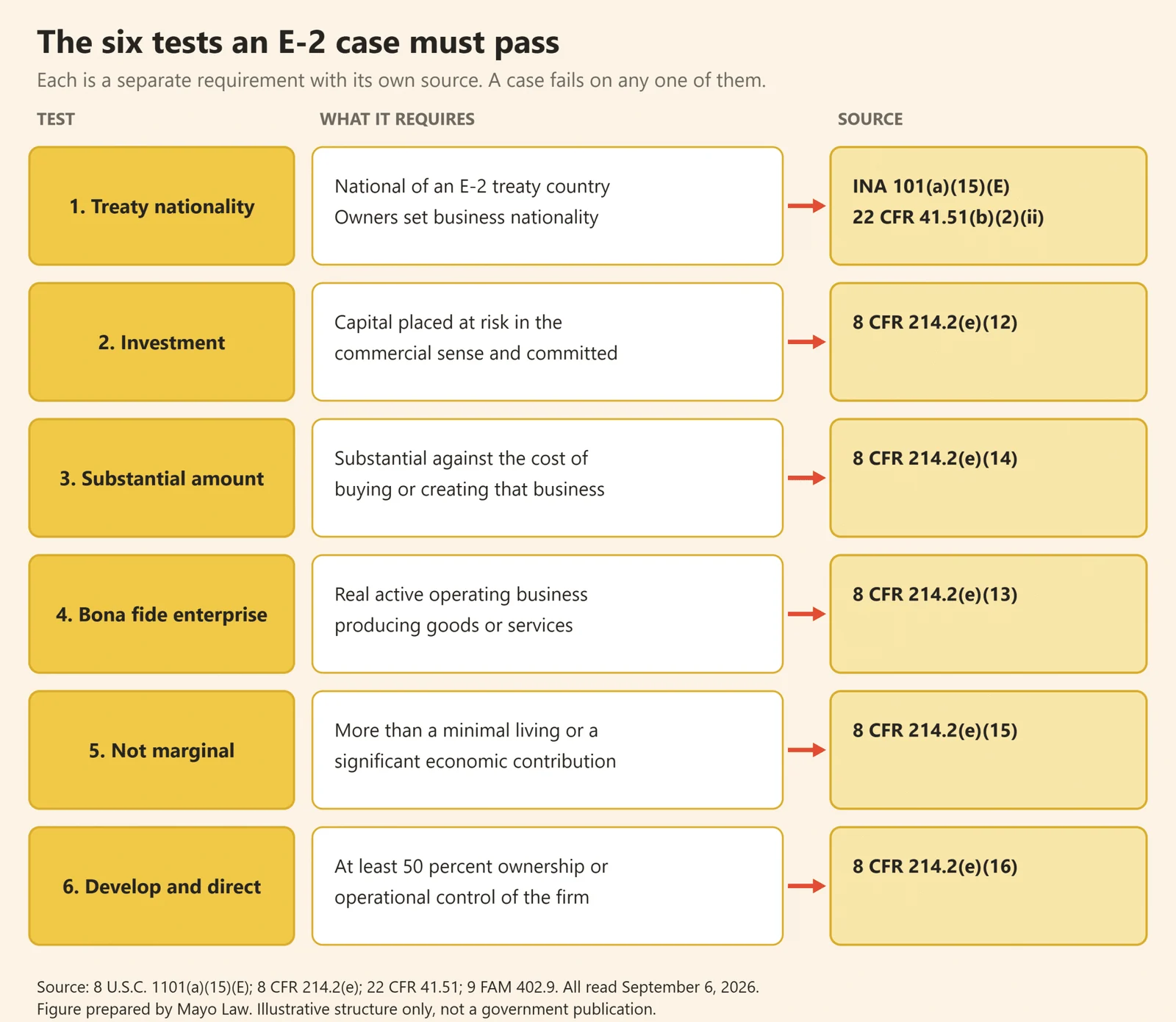
Under 9 FAM 402.9-4(B), the nationality of a business is determined by the nationality of its individual owners, and the country of incorporation is irrelevant. Where the investor is an organization and the applicant is an employee, 22 CFR 41.51(b)(2)(ii) requires that nationals of the treaty country own at least 50 percent of the business. If one company owns another, officers trace ownership through each layer.
Two traps in that section catch cross-border families in particular. A business may claim only one qualifying nationality unless it is owned exactly 50/50 by nationals of two treaty countries, so a dual national owner has to pick one and stay consistent. And a treaty country national who holds U.S. lawful permanent resident status cannot bring in employees under the E category at all, with their shares excluded when the nationality of the business is calculated.
You must control the enterprise
Control is the test that ties the other five together. 8 CFR 214.2(e)(16) requires the applicant to show that they do or will develop and direct the enterprise, established by ownership of at least 50 percent, by operational control through a managerial position or other corporate device, or by other means. The FAM adds the point that occupying a managerial title is not enough on its own if the applicant does not actually control the business.
What counts as a qualifying E-2 investment?
An investment, for this purpose, is defined at 8 CFR 214.2(e)(12) as placing capital at risk in the commercial sense with the objective of generating a profit. The regulation attaches several conditions that are easy to read past:
- The funds must not have been obtained, directly or indirectly, through criminal activity.
- The investor must possess and control the capital invested or being invested.
- The capital must be subject to partial or total loss if investment fortunes reverse.
- It must be the investor’s unsecured personal business capital, or capital secured by personal assets.
- Capital being invested must be irrevocably committed to the enterprise, and the applicant carries the burden of proving that commitment.
The same paragraph names escrow as an example of a legal mechanism that both commits the funds and can protect the investor personally if E classification is refused. That single sentence is why conditional purchase structures are workable at all, and it is worth reading in full before signing anything. If you are buying an existing business for an E-2, the escrow point is usually the hinge of the deal.
Substantial does not mean a fixed number
Substantial is defined at 8 CFR 214.2(e)(14) as an amount that is substantial in relationship to the total cost of either purchasing an established enterprise or creating the type of enterprise under consideration, sufficient to ensure the investor’s financial commitment, and of a magnitude that supports the likelihood of success. It closes with the proportionality rule: generally, the lower the cost of the enterprise, the higher, proportionately, the investment must be. There is no published minimum. We set out how much you realistically need to invest for different business types on a separate page.
The business must be real, and it must not be marginal
Under 8 CFR 214.2(e)(13) the enterprise must be a real, active and operating commercial or entrepreneurial undertaking that produces services or goods for profit, and it must meet the legal requirements for doing business in its jurisdiction. Under 8 CFR 214.2(e)(15) it may not be marginal, meaning it must have the present or future capacity to generate more than a minimal living for the investor and their family. A business without that present capacity is still acceptable if it has a present or future capacity to make a significant economic contribution, and the regulation says the projected income capacity should generally be realizable within five years of the start of normal business activity.
One practical footnote from 9 FAM 402.9-4(D): an applicant does not necessarily need physical office space. Having premises can be relevant evidence, but the manual states plainly that it is not a requirement. That matters for the services and technology businesses that Canadian founders most often bring across. If you are weighing business models, we cover which business types tend to win approval separately.
Can employees get an E-2 visa too?
Yes, and this is the part of the category that SMEs underuse. An employee of a treaty investor qualifies if they share the nationality of the principal employer and are either coming in an executive or supervisory capacity, or coming in a lesser capacity with special qualifications. 8 CFR 214.2(e)(17) says an executive or supervisory position must be principally and primarily that, not incidentally, and must carry ultimate control and responsibility for the enterprise or a major component of it.
Special qualifications are narrower than the phrase sounds. 8 CFR 214.2(e)(18) defines them as skills or aptitudes essential to the efficient operation of the treaty enterprise. Knowledge of a foreign language and culture does not by itself meet that standard. Essentiality can also expire: a skill needed to start up an enterprise may stop qualifying once operations are running, which is why the regulation presumes that start-up specialists should finish within two years and will not normally get an extension.
How long does E-2 status last, and how often can you renew it?
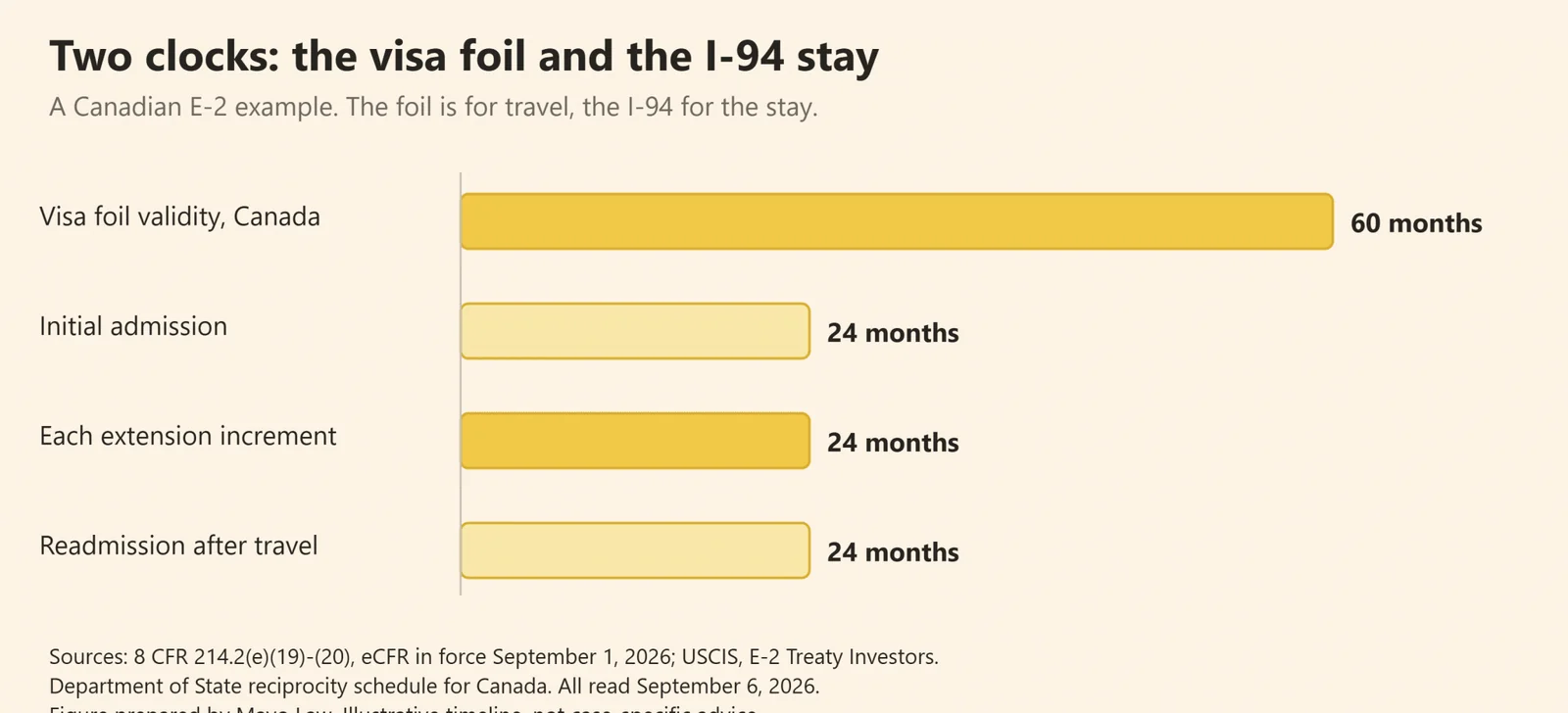
This is where the single most common misunderstanding lives. The visa in your passport and the status you hold inside the United States are two different things with two different clocks.
The visa is a travel document with a validity period set by the reciprocity schedule for your nationality. The Department of State reciprocity schedule for Canada, read on September 6, 2026, lists the E-2 at no reciprocity fee, multiple entries, and a 60-month validity period. That is how long the foil can be used to seek entry, not how long you may stay.
The stay is governed by the regulation, and the subparagraphs matter. Under 8 CFR 214.2(e)(19)(i) a treaty investor may be admitted for an initial period of not more than two years. A different subparagraph, 8 CFR 214.2(e)(19)(iii), adds that unless otherwise provided for in that chapter, an alien shall not be admitted in E classification for a period extending more than six months beyond the expiration date of their passport. Under 8 CFR 214.2(e)(20), extensions may be granted in increments of not more than two years.
The renewal rule is the one most often overstated. At 8 CFR 214.2(e)(20)(iii) the regulation says there is no specified number of extensions a treaty trader or investor may be granted, and it makes that sentence expressly subject to the nonimmigrant intent requirement in paragraph (e)(5) and to a presumption elsewhere in the section. It removes a numerical ceiling. It does not create a right to keep renewing. Each extension is a fresh discretionary decision, in a two-year increment, on which every test set out above still has to be satisfied.
USCIS describes the same structure from the other side, adding that an E-2 nonimmigrant who travels abroad will generally be granted an automatic two-year period of readmission on return if a CBP officer finds them admissible. In practice a Canadian investor can hold a five-year visa, keep receiving two-year admissions, and stay for many years, provided every condition still holds. We go through renewing an E-2 visa and E-2 visa processing time in detail elsewhere.
What can your spouse and children do on an E-2?
Spouses and unmarried children under 21 may accompany or follow the treaty investor, and USCIS confirms their nationalities need not match the investor’s. They are generally granted the same period of stay. If the family is already in the United States and needs a change or extension, USCIS accepts a single Form I-539 with fee for them.
That grant is derivative, and for children it is age-limited. 8 CFR 214.2(e)(19)(ii) admits the spouse and minor children for the period during which the principal alien is in valid treaty trader or investor status, and USCIS puts the ceiling for children at under 21 years of age. A child therefore loses E-2 dependent status on turning 21, however much of the parent’s stay is left and however many extensions the parent goes on to receive. A family moving with a teenager should have the child’s own status planned well before that birthday rather than in the year it arrives.
On work, the rule changed in 2022 and the change is favorable. USCIS states that spouses of E-2 workers in valid E-2 or E-2S status are employment authorized incident to status, with the narrow exception of spouses of long-term investors in the Commonwealth of the Northern Mariana Islands. Since January 30, 2022, USCIS and CBP have issued Forms I-94 with the E-2S admission code, and an unexpired I-94 with that code is acceptable evidence of employment authorization under List C of Form I-9. Filing Form I-765 for a card is optional, not required. The mechanics are set out in our guide to E-2 spouse work authorization.
How do you apply for an E-2 visa?
There are two routes, and they are not interchangeable.
The consular route runs through a U.S. embassy or consulate. The Department of State requires Form DS-160 online, a photo, and the nonimmigrant visa application fee, listed at 315 dollars for the E category as of September 2026. Form DS-156E, the Nonimmigrant Treaty Trader/Treaty Investor Application, is required for all E-1 applicants and for E-2 applicants who are executives, managers or essential employees. Interviews are generally required, and the State Department is explicit that it cannot specify the exact documentation because circumstances vary greatly by applicant.
The domestic route runs through USCIS. A person already in the United States in a lawful nonimmigrant status may file Form I-129 to request a change of status to E-2, and 8 CFR 214.2(e)(21) routes that request through 8 CFR part 248. USCIS is explicit that a request for E-2 classification may not be made on Form I-129 by someone physically outside the United States. A change of status gives you E-2 status, not an E-2 visa, so the next trip abroad still means a consular application. For the full sequence see the E-2 application process, and for what happens in the room, what officers ask at the interview.
The 315 dollar consular fee is the predictable part. What drives the rest is the shape of the case. A consular application carries the DS-160, the DS-156E where the applicant is an executive, manager or essential employee, and an interview. A domestic change of status carries a Form I-129 instead, with its own filing fee. Buying an existing business adds the escrow and valuation work that a start-up does not need. We keep a full 2026 cost breakdown rather than repeat figures here, and the published issuance and refusal statistics give a sense of how the category performs overall.
What the E-2 visa does not do
The E-2 is a nonimmigrant category and it creates no path to permanent residence on its own. The Department of State states the requirement directly: you must intend to depart the United States when your E-2 status expires. USCIS puts it the same way, that all E-2 nonimmigrants must maintain an intention to depart when status expires or is terminated.
That requirement is narrower than people assume, and 9 FAM 402.9-4(C) is worth quoting because it corrects a widespread misreading. An E applicant “need not establish intent to proceed to the United States for a specific temporary period, nor does an applicant for an E visa need to have a residence in a foreign country which the applicant does not intend to abandon. The applicant may sell their residence and move all household effects to the United States.” An unequivocal statement of intent to depart when E status ends is normally sufficient. Selling the house in Toronto does not, by itself, defeat an E-2 application. It does have Canadian tax consequences that run on their own track, and the visa is not certain until it is issued.
Three further limits are worth knowing. A treaty investor or employee may only work in the activity approved at the time classification was granted. A substantive change in the enterprise, such as a merger, an acquisition or the sale of the division where an employee works, has to be approved by USCIS through a new Form I-129. And under 8 CFR 214.2(e)(22), a citizen of Canada or Mexico may be denied E status where the Secretary of Labor certifies that a strike or other labor dispute involving a work stoppage in that occupational classification is in progress, a rule that traces to Annex 16-A of the USMCA and applies to no other nationality.
Investors who want to stay permanently usually plan a separate route. We compare the options in moving from an E-2 to a green card and in how the E-2 compares with the EB-5. Either route has to be planned alongside the tax side of moving from Canada to the U.S., which is a separate analysis with its own timing.
How does the E-2 compare with the other treaty visas?
The three E categories are often discussed as one thing. They are separate classifications with separate country lists and separate tests, all set out on the same State Department page.
| Category | Who it is for | Core test (Department of State) |
|---|---|---|
| E-1 treaty trader | Nationals of an E-1 treaty country | Substantial and continuing trade, more than 50 percent of it between the United States and the treaty country |
| E-2 treaty investor | Nationals of an E-2 treaty country | Substantial investment in a real and operating enterprise the applicant will develop and direct |
| E-3 specialty occupation | Nationals of Australia only | An approved Labor Condition Application and a specialty occupation role |
A country can appear on one list and not the other, which is why the country table has to be read by classification rather than by name. For anything outside the treaty categories, our business immigration page sets out the other routes into the United States.
Frequently asked questions
What is the E-2 visa in simple terms?
It is a temporary United States work visa for a citizen of a country that has a qualifying commercial treaty with the United States, who has put a substantial amount of their own money at risk in a real American business and is coming to run it. It can be renewed for as long as the business and the investor keep meeting the conditions, but it does not lead to a green card by itself.
How much money do I need for an E-2 visa?
There is no published minimum. 8 CFR 214.2(e)(14) measures the investment against the total cost of buying or creating that type of enterprise, and states that the lower the cost of the enterprise, the higher the proportion of it your investment must represent. A modest consultancy and a manufacturing plant are therefore judged on completely different scales.
Can Canadians get an E-2 visa?
Yes. Canada has appeared on the Department of State treaty country table under the E-2 classification since January 1, 1994. Canadian nationals apply at a U.S. consular post in the normal way, and the reciprocity schedule for Canada shows the E-2 at 60 months validity, multiple entries, with no reciprocity fee.
How long can I stay in the United States on an E-2?
An initial admission is for not more than two years under 8 CFR 214.2(e)(19)(i). Extensions come in increments of not more than two years under 8 CFR 214.2(e)(20), and that regulation says there is no specified number of extensions. Returning from a trip abroad generally brings a fresh two-year admission if CBP finds you admissible.
Does an E-2 visa lead to a green card?
Not directly. The category requires an intention to depart when status ends, and no provision converts E-2 status into permanent residence. Investors who want to remain permanently move onto a separate immigrant path, which needs its own eligibility analysis and its own timeline.
Can my spouse work on an E-2?
Yes. USCIS treats spouses in valid E-2 or E-2S status as employment authorized incident to status, with a narrow CNMI exception. An unexpired Form I-94 carrying the E-2S code is acceptable evidence of employment authorization under List C of Form I-9, so an Employment Authorization Document is optional rather than necessary.
Do I need an office in the United States before I apply?
Not necessarily. 9 FAM 402.9-4(D) states that an applicant does not necessarily need physical office space to qualify, and that while premises may be relevant to the assessment they are not a requirement. The enterprise still has to be real, active and operating under 8 CFR 214.2(e)(13).
Do I have to keep a home in Canada to prove I will leave?
No. 9 FAM 402.9-4(C) states that an E applicant does not need a residence in a foreign country which they do not intend to abandon, and may sell their residence and move all household effects to the United States. What is normally required is an unequivocal expression of intent to depart when E status terminates.
Conclusion
Precision is what decides an E-2 case, and it is tested one requirement at a time. A treaty, a nationality traced through the ownership of the business, capital that is genuinely at risk and irrevocably committed, an enterprise that is real and not marginal, and an applicant who will actually control it. Each of those is a separate test with its own source, and a case usually fails on one of them rather than on all of them. Read the requirements against your own facts before you commit money, and treat any figure quoted without a citation as a starting point for a question. The rules above are current as of September 2026 and every one of them was read from the official source.
How Mayo Law Can Help
Mayo Law is a cross-border firm with offices in Toronto and New York. Joseph Mayo, the principal attorney, is licensed in both Ontario and New York, which means an E-2 matter, the Canadian corporate side that sits behind it, and the U.S. entity being invested in can be handled without handing the file between two firms. Our practice is built around small and mid-sized enterprises and their owners, and business immigration with the E-2 at its center. If you want to test a plan against the tests in this guide, you can work with an E-2 visa lawyer at either office, and our E-2 visa requirements page is the natural next read. Canadians starting from scratch usually begin with applying for an E-2 from Canada.
Disclaimer
This article is for general information only and is not legal advice. Reading it does not create a solicitor-client or attorney-client relationship. Immigration rules change, and the application of any rule depends on the particular facts of a case. Mayo Law provides legal services in Ontario and New York.