If you’re trying to plan a move, accept a job, keep a family together, or decide whether to renew a lease, the hardest part of the green card process is often the uncertainty. Clients usually don’t ask for an abstract average. They want to know when their case will move, whether a delay is normal, and what can be done about it.
That is why the better version of the question isn’t just how long does green card process take. It’s: which part of the process is causing the wait in your case? At Mayo Law’s immigration practice, we help individuals, families, and employers in Toronto, the GTA, and across the border understand where a case stands and what timing signals matter. If citizenship is also part of your long-term plan, this guide on how to get U.S. citizenship can help you think a step ahead.
Published: June 19, 2026
Updated: June 19, 2026
Read time: 11 minutes
Introduction
A green card case usually has two separate clocks running at once.
The first is government processing. That means USCIS, the Department of Labor, the National Visa Center, or a consulate reviewing forms, documents, medicals, and background checks. The second is visa availability. In many categories, you can be fully eligible and still wait because no immigrant visa number is available for your category and country of birth.
Most online guides flatten those two waits into one number. That leads people to make bad assumptions. Someone hears that a marriage case can move relatively quickly and assumes all family-based cases do. An employee sees an I-140 can be premium processed and assumes the green card itself can be rushed the same way. Neither is necessarily true.
Practical rule: If you don’t know whether your delay is caused by adjudication or visa availability, you don’t yet know your real timeline.
That distinction changes strategy. It tells you whether it makes sense to monitor the Visa Bulletin, upgrade a petition where allowed, prepare for an interview, or recognize that no amount of faster paperwork will solve a quota problem.
Green Card Processing Time at a Glance
The shortest useful answer is this: your green card timeline depends on which of the two waits is controlling your case.
| Green Card Category | Typical Total Time Range |
|---|---|
| Family-based immediate relative of a U.S. citizen | Often shorter because there is no visa-number queue |
| Family-based preference category | Often much longer because annual limits and country caps can create long waits |
| Employment-based | Often years because timing may include PERM, petition adjudication, and visa availability |
Many applicants are told a single average and assume it applies to them. That usually creates more confusion than clarity. A marriage-based case for the spouse of a U.S. citizen can move on a very different timeline from a sibling petition, even though both are called "family-based." The same problem shows up in work cases. Fast action on one filing step does not mean the green card itself will arrive quickly.
A practical way to estimate timing is to separate the case into two questions:
- How long will the government take to process the filings in my case?
- Will I have to wait for a visa number after those filings are approved?
Those are different delays, with different solutions.
If you are an immediate relative of a U.S. citizen, the main timeline issue is often case processing. If you are in a family preference category or many employment-based categories, visa availability may be the longer wait by far. In employment cases, published analyses have noted that total timelines can stretch for years because they combine multiple stages rather than one simple application review.
That is why broad averages only help at a high level. The better forecast comes from identifying which clock is running in your case, and whether that clock is agency processing, visa backlog, or both.
The Three Core Stages of the Green Card Journey
A client calls after getting an approval notice and asks the question I hear all the time: “If USCIS approved it, why am I still waiting?” The answer is that a green card case usually runs on two separate clocks. One is government processing. The other is visa availability. If you do not separate those two, the timeline will never make sense.
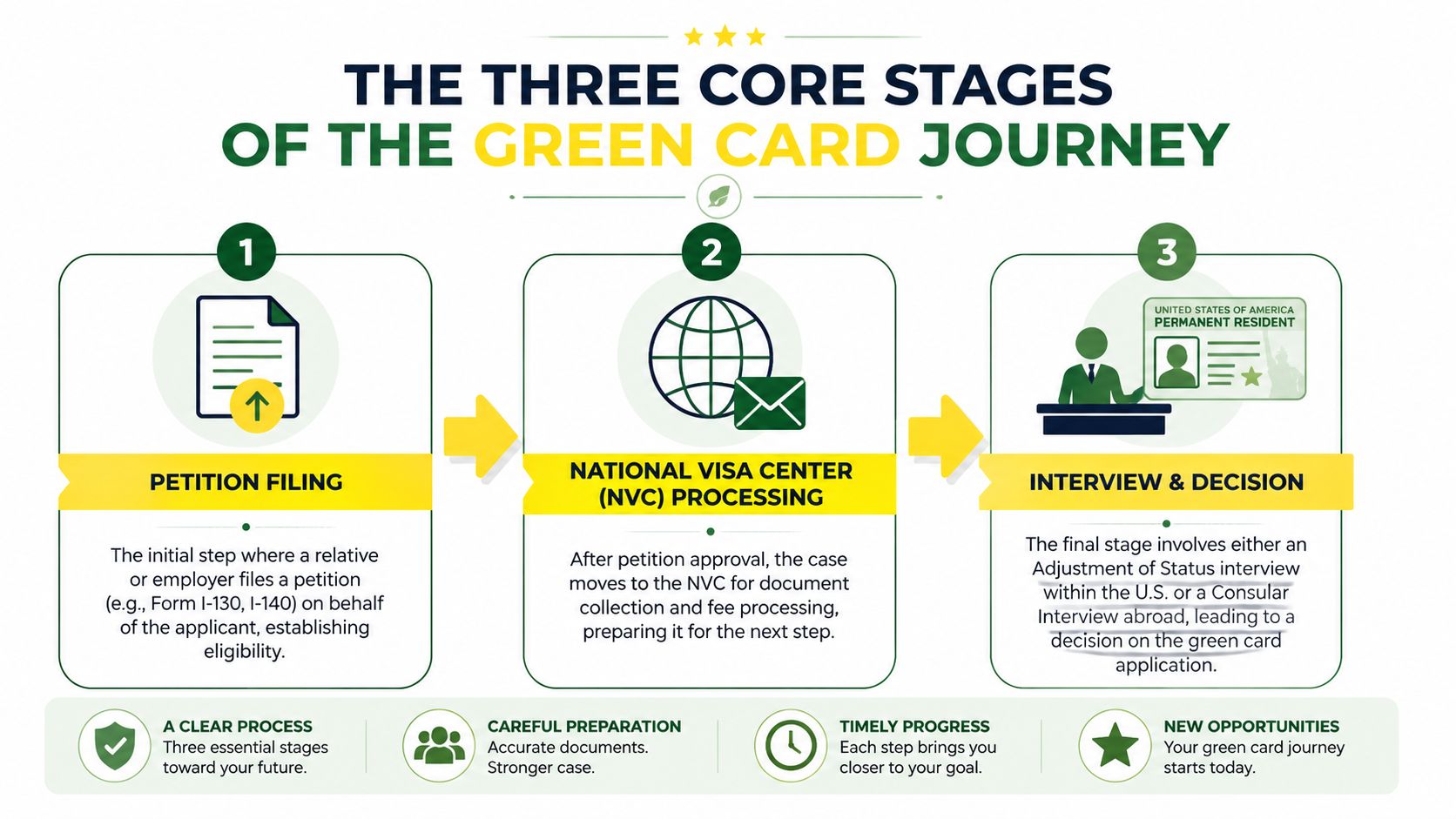
Petition filing
The first stage is proving that you qualify for the category at all.
In a family case, that often means filing Form I-130. In an employment case, it may mean a PERM labor certification first, followed by Form I-140. This stage is about eligibility, not the green card itself. The government is deciding whether the family relationship or job offer fits the law. If you are exploring a work-sponsored case, this guide on getting a green card through employment explains how that process is built.
A fast approval here can help. It does not always shorten the total wait.
Visa availability
This is the second clock, and it is often the one applicants were never warned about.
Some categories can move to the final filing stage as soon as the petition is approved. Others cannot, because Congress limits how many immigrant visas are available each year in certain family and employment categories, and country caps can slow things even more. That is where the priority date matters. A case can be fully approvable on the merits and still sit still because no visa number is available yet.
In plain English, the petition stage answers whether you qualify. The visa-availability stage answers whether the government can give you a green card slot now.
That difference drives strategy. If the actual delay is USCIS processing, the focus is case preparation, filing choice, and response time. If the actual delay is the visa line, no amount of calling USCIS will make the case current sooner.
Final application and decision
Once a visa is available, the case moves into the last stage. At this point, the person applying for permanent residence files the actual green card application.
That final step is usually one of two paths:
- Adjustment of status through Form I-485 if the applicant can complete the case inside the United States
- Consular processing through a U.S. consulate abroad, usually after National Visa Center document collection
This stage includes background checks, the medical exam, document review, interview scheduling when required, and card production after approval. It can feel like the finish line, but timing still depends on details that clients often underestimate, such as interview backlogs, requests for evidence, or whether the file is processed inside the United States or at a consulate abroad.
Here is the practical takeaway. Two people can both say, “My petition was approved,” and still be in completely different positions. One may be ready to file the final application immediately. The other may be stuck waiting for visa availability with nothing to submit yet. That is why a single average is so misleading. The better way to forecast your case is to identify which stage you are in, and which of the two waits is controlling the timeline.
How Long Does a Family-Based Green Card Take
Family-based timing depends first on who is sponsoring whom. That matters more than the phrase "family case."
Immediate relatives move differently
Immediate relatives of U.S. citizens do not face a visa-number wait based on annual category limits. That group generally includes a U.S. citizen's spouse, unmarried child under 21, or parent. In those cases, the timeline is mainly administrative. You are waiting on filing, review, interview scheduling, and final production, not a preference-category queue.
That is why two marriage-based cases can look similar at first and still move on very different timelines. A spouse of a U.S. citizen may avoid the quota line entirely. A spouse of a permanent resident is in a different category.
Preference categories can take far longer
For the F2A category, which covers spouses and minor children of permanent residents, processing is currently relatively short, averaging about 2 years, according to the U.S. Department of State Visa Bulletin. But that does not mean all family cases are close to that range.
Other preference categories are much slower:
- F1 cases take about 9 years for most countries and about 19 years for Mexico
- F3 and F4 cases often take 14 to 17 years for most countries
- Mexico can face about 25 years in F3 or F4
- The Philippines can face about 19 to 21 years in F3 or F4
Those waits exist because of category limits and the 7% per-country cap.
The form timeline is only one piece
A common point of confusion is mixing up petition processing with total case time.
For example, Form I-130 petitions for spouses in the F2A category take 35 months to process, and family-based I-485 adjustment applications average 8.2 months. Those are useful reference points, but they do not replace the visa-availability analysis. They sit inside the larger case timeline.
A family case can be "slow" for two completely different reasons. The petition may be moving slowly, or the category itself may be backlogged.
One practical example: a permanent resident files for a spouse and assumes the case will track with a U.S. citizen marriage case because both involve spouses. It won't. The sponsor's status changes the queue. Another example is a sibling petition. The filing can be perfectly prepared and still remain a long-term process because the category itself is heavily oversubscribed.
If you're preparing for a spousal interview, this guide to the marriage interview for a green card may help you focus on the part you can control.
How Long Does an Employment-Based Green Card Take
Employment-based cases are where the "two waits" issue becomes impossible to ignore.
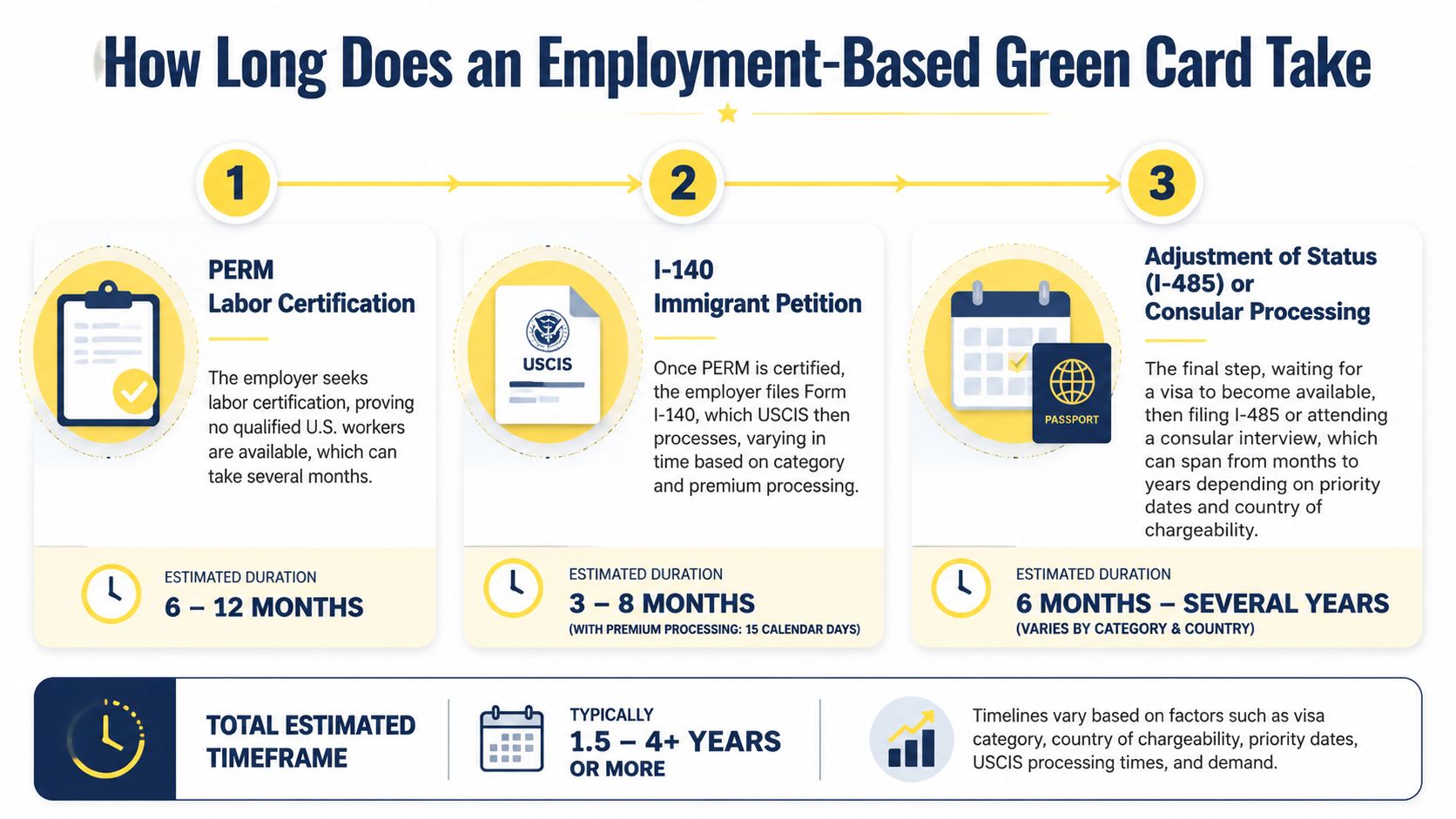
The cleanest benchmark is this: employment-based green card processing now averages 3.4 years, or 1,256 days, based on USCIS data analyzed by the Cato Institute. That average already tells you something important. Even a strong employer-sponsored case is rarely quick from start to finish.
PERM is often the first major delay
Many EB-2 and EB-3 cases start with PERM labor certification through the Department of Labor. That step requires the employer to test the labor market and document the recruitment process before moving to the immigrant petition.
According to the U.S. Department of Labor foreign labor program information, PERM takes 8 to 10 months for regular processing and 12 to 18 months if audited. The total PERM process from start to approval averages 16 to 21 months for normal cases and can stretch to 24 to 30 months with audits.
That means a case can consume well over a year before USCIS even starts reviewing the immigrant petition.
The I-140 can sometimes be sped up
After PERM, the employer typically files Form I-140.
This is one place where strategy can matter. Premium processing can reduce I-140 processing from 8.1 months to 15 business days for an additional $2,805 fee, but that option isn't available in every situation. However, it only accelerates the petition review stage. It does not solve the bigger queue problem if your priority date is not current.
That is one of the most common misconceptions in employment immigration. Employers pay for faster I-140 review and expect the entire permanent residence timeline to collapse with it. It won't if visa availability is the bottleneck.
Visa backlogs can dwarf adjudication time
As of September 2024, nearly 785,000 approved employment-based immigrant petitions were waiting for visa availability. In other words, a large number of applicants had already cleared a major merits stage and were still stuck.
Country caps are the main reason. No more than 7% of total green cards can go to any one country in a year. For high-demand countries such as India, that produces extremely long waits. In some employment categories, waits for India can exceed 10 years.
This is why two employees at the same company can start similar cases and finish years apart. Same employer. Same internal support. Same legal team. Different country of birth and different queue dynamics.
USCIS backlog pressure also matters
The system itself remains under strain. The American Immigration Council reported that USCIS received 2.6 million applications and petitions but processed only 1.7 million, adding 866,910 forms to the backlog over a three-month period, as discussed in its USCIS backlogs and processing trends dashboard.
That broader workload pressure affects employment and family cases alike. It doesn't replace the visa bulletin problem, but it adds friction to every step of the pipeline.
If your priority date isn't current, faster form handling won't finish the case.
If your category is current, filing quality and timing matter much more.
Mayo Law works with employers, founders, and professionals across the GTA and on cross-border matters. Joseph Mayo is licensed in Ontario and New York, so clients with U.S. ties coordinate their legal work in one place rather than juggling two firms. For a broader overview of employer-sponsored options, see our page on an employment immigration attorney.
What actually helps
In practice, the useful questions are specific:
- Is PERM required for this category
- Is premium processing available and worth using
- Is the priority date current or likely to remain backlogged
- Should the case proceed by adjustment of status or consular processing
- Has the employer prepared clean job-description and recruitment records
What doesn't help is chasing a single average and assuming it applies to everyone in EB-1, EB-2, or EB-3 the same way. It doesn't.
What Causes Green Card Processing Delays
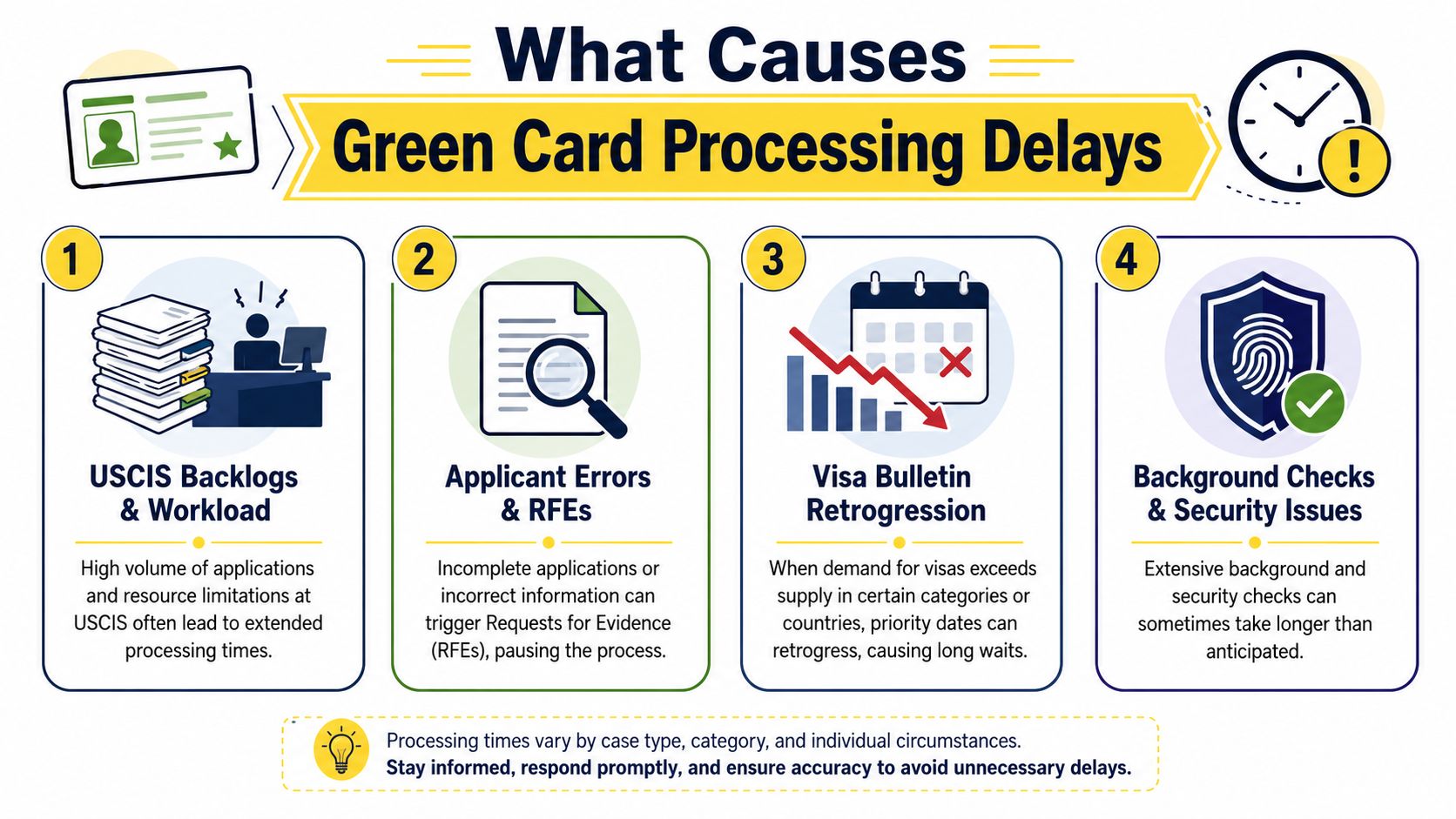
A common client scenario looks like this. USCIS cashes the filing fee, sends the receipt notice, and then the case seems to disappear into a black box for months. The first step is figuring out which delay you are dealing with. In green card cases, there are usually two separate waits: government processing of the paperwork, and visa-number availability. If you do not separate those two, the timeline will feel random when it is not.
Requests for evidence
A request for evidence, or RFE, means the officer wants more proof before deciding the case. Sometimes the issue is minor, such as a missing civil document or an incomplete medical exam. Sometimes it is more serious, such as inconsistent job records, weak proof of a bona fide marriage, or an employer filing that does not clearly support the offered position.
Either way, an RFE usually adds months, not days. It slows the case because USCIS stops to wait for your response, then places the file back in line for review. It can also create avoidable risk if the original filing was rushed or poorly documented.
Agency backlogs and workload spikes
Some delays have nothing to do with the strength of your case. USCIS has faced heavy pending caseloads, staffing pressure, interview bottlenecks, and shifting internal priorities. Those problems can affect receipt notices, biometrics scheduling, transfers between offices, interview dates, and final decisions.
This is why comparing your timeline to a friend's old case often leads to the wrong conclusion. Two applicants in the same category can enter very different systems depending on filing date, office workload, and overall demand.
Visa retrogression and quota limits
This is the delay many applicants miss.
USCIS can be ready to approve a case, but the law still requires an immigrant visa number to be available in that category. If the priority date is not current, the case cannot finish, even if every form is complete and the interview went well. In practice, this is often the actual reason a case feels stuck.
That distinction matters. If the delay comes from visa retrogression, faster document review will not solve it. If the category is current, then filing quality, response timing, and case strategy have a much bigger effect on how long the case takes.
Final production delays
Approval does not always mean the physical card is in hand right away. After approval, there can still be a separate wait for card production and mailing. That final stage matters for people who need proof of status for work, travel planning, or I-9 updates.
As noted earlier, one source discussing green card timing says an RFE can add about 90 to 120 days, and card production and mailing can add another 3 to 4 weeks, according to Fayad Law's discussion of green card timelines.
A practical way to reduce avoidable delay is to treat the filing like a file that may be questioned at every step. Use complete civil documents. Keep names, dates, and addresses consistent across forms. Match supporting evidence to the legal standard for the category. That will not fix quota backlogs, but it can prevent your own paperwork from becoming the reason the case slows down.
How to Check Your Green Card Case Status
Once the case is filed, people often refresh the wrong sources. The most reliable starting point is the official USCIS Case Status Online tool at uscis.gov.
What you need
You usually need your receipt number from the USCIS notice. Enter that in the case-status tool exactly as shown on the notice.
If your matter involves a consular stage, you may also need to track National Visa Center messages and interview notices separately. USCIS won't show every consular development.
What common status messages usually mean
Here are the updates clients ask about most often:
- Case Was Received means USCIS accepted the filing and opened the file.
- Case Is Being Actively Reviewed means the file is in process, but it does not tell you how close you are to a decision.
- Request for Evidence Was Sent means USCIS needs more information before it will move forward.
- Interview Was Scheduled means the case has advanced to a major final-stage step.
- Case Was Approved means the adjudication is finished, but you may still be waiting for production and delivery.
- Card Was Mailed To Me means the final physical document has entered the mailing stage.
How to read status updates without overreacting
Don't assume every long silence means trouble. Some stretches are normal. Also don't assume "actively reviewed" means approval is close. It can remain there for a while.
The status becomes much more useful when you pair it with the core issue in your case:
- If your category is not current, status checks won't change the visa wait.
- If your file is current and document-complete, a sudden RFE or interview notice matters a lot.
- If nothing is moving, compare the case stage against official USCIS and State Department tools before drawing conclusions.
If you need legal help reviewing a stalled file, interview preparation, or category strategy, you can also speak with a green card attorney.
If you're stuck between conflicting timelines, Mayo Law helps clients identify whether the delay is coming from USCIS processing, visa availability, or a case-specific issue that can be fixed before it gets worse.
Frequently Asked Questions
Is there one average green card timeline that applies to everyone
No. The most useful answer depends on the category, country of birth, and whether the actual wait is agency processing or visa availability. Immediate relatives of U.S. citizens usually avoid the visa-number queue. Family-preference and many employment-based applicants often do not. That is why one headline average is usually misleading.
How long does a spouse-based green card take
It depends on the sponsor's status. Immediate-relative spouse cases for U.S. citizens are different from spouse cases for permanent residents. The permanent-resident spouse category, F2A, currently averages about 2 years, while immediate-relative cases do not face the same visa-number limits. The relationship category matters as much as the paperwork itself.
Can premium processing speed up the whole employment green card case
No. It can speed up the I-140 petition stage where available, but it does not remove PERM timing, adjustment timing, or visa-number backlogs. That is the key trade-off. Premium processing helps most when adjudication is the bottleneck. It does much less when the main delay is a backlogged priority date.
What if my case seems similar to someone else's but is moving much slower
That is common. Two similar cases can separate because of country of birth, category, a request for evidence, interview scheduling, background checks, or ordinary workload differences between agencies and posts. Similar facts do not always produce similar timelines. The part of the process causing the delay has to be identified first.
Does approval mean I will get the physical green card right away
Not always. After approval, card production and mailing can still take additional time. That gap matters if you need evidence of status for work, travel, or identification purposes. A case should be treated as fully complete only once the final document or other proof of status has been issued and received.
Conclusion
If you're asking how long the green card process takes, you're usually asking a deeper question: when can I plan my life with some confidence. The best answer comes from separating processing time from visa-availability time and identifying which one controls your case. Once you know that, the process becomes less mysterious, even if it still requires patience. Clear expectations won't shorten every line, but they do help you make better decisions while you wait.
How Mayo Law Can Help
A green card case often feels stalled for one reason when the underlying problem is another. We help clients identify whether the delay is coming from USCIS processing, visa availability, or a filing issue that can be corrected before it costs more time.
That distinction matters in practice. If USCIS is the bottleneck, the strategy may involve cleaner evidence, tighter responses to government requests, and careful case tracking. If the wait is driven by a visa backlog, the focus shifts to priority dates, category choices, timing, and planning around what can and cannot be done while the line moves.
Mayo Law assists clients in Toronto, across the GTA, and in cross-border U.S. immigration matters, including family-based and employment-based cases. We give clients a realistic timeline assessment, explain the trade-offs in plain English, and help them avoid delays caused by preventable filing mistakes.
Disclaimer
This article is for informational purposes only and does not constitute legal advice. Every situation is different. Consult a licensed lawyer about your specific circumstances. Mayo Law provides legal services through Mayo Law PC in Ontario and Joseph Mayo PLLC in New York.
Related Articles
If your timeline turns on a job offer, company sponsorship, or cross-border business planning, these may be the most useful next reads: