

Contents
- Quick answer
- What are articles of amendment in Ontario?
- Who must approve an amendment?
- How do you file articles of amendment in Ontario?
- What does an amendment cost and when is it effective?
- How do you change a corporation's name in Ontario?
- Articles of amendment: Ontario vs federal and New York
- What should you update after the amendment?
- Frequently asked questions
- Conclusion
- How Mayo Law can help
- Disclaimer
Articles of amendment, Ontario's filing for changing what a corporation's articles say, are how an Ontario business corporation changes its name, its share structure, the size of its board or the limits written into its articles. The change does not exist until the Ministry endorses the articles of amendment with a certificate, and most changes need shareholder approval by special resolution before anything is filed.
This guide covers which changes need articles of amendment, who has to approve them, the separate class votes and dissent rights that can apply, how to complete Form 5261 or the online filing, the fee and the effective date, and what to update afterwards, including a New York filing that Ontario corporations authorized in that state need to make after a name change. It also compares the Ontario process with a federal amendment and a New York certificate of amendment. The statutes, forms and fees below were checked against official sources as of September 2026.
Quick answer
An Ontario corporation changes its articles by passing a special resolution, or a directors' resolution for a few changes, and then filing articles of amendment online through the Ontario Business Registry or on Form 5261 by mail. The fee is $150. The change is effective on the certificate's date, which you can set up to 30 days ahead.
What are articles of amendment in Ontario?
Articles of amendment are the document an Ontario business corporation sends to the Director under the Business Corporations Act (the OBCA) to add, change or remove a provision in its articles. Section 168(1) lets a corporation amend anything the Act permits in its articles, and lists the common cases:
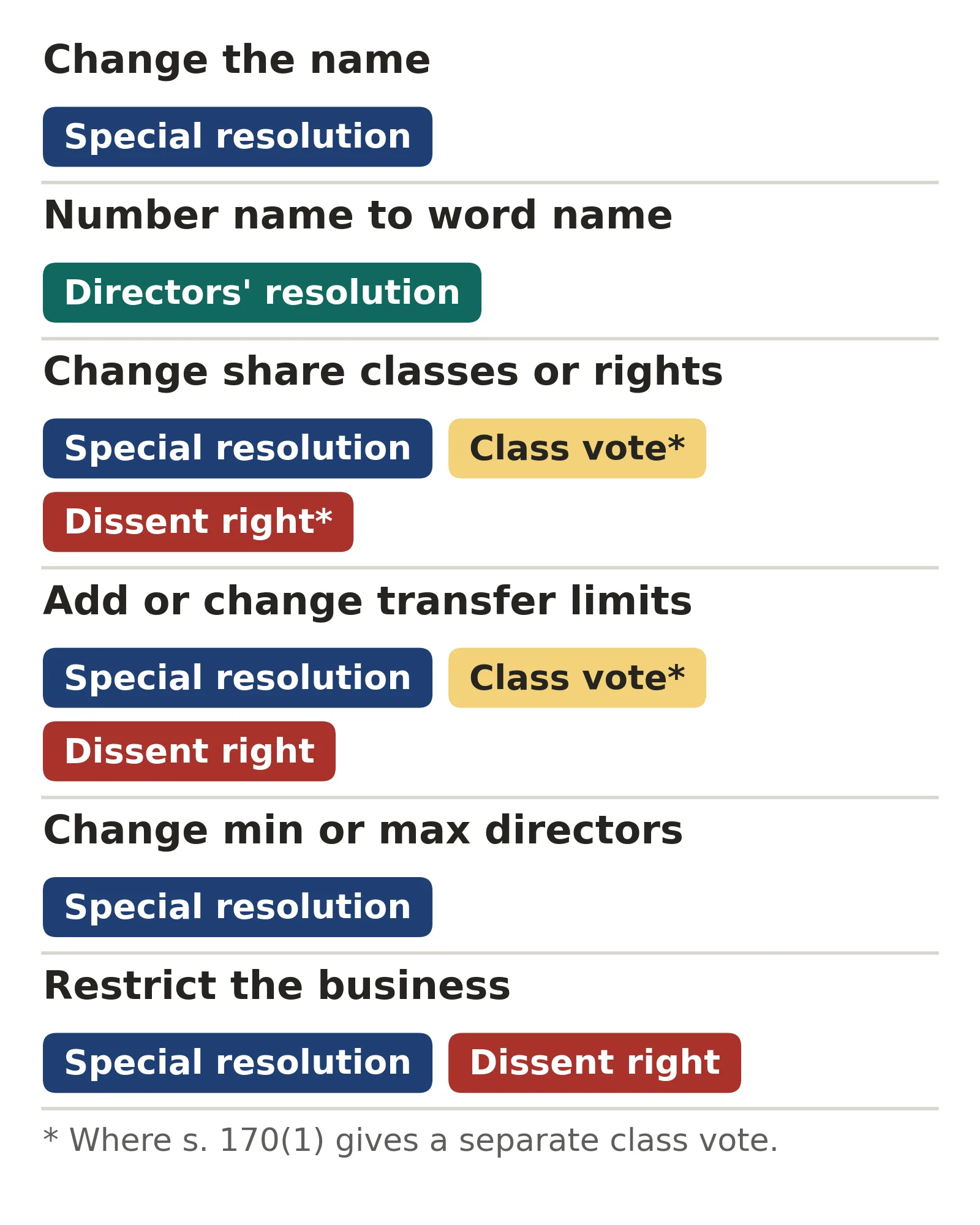
- Name: change the corporate name (s. 168(1)(a)).
- Business limits: add, change or remove restrictions on the business the corporation may carry on or the powers it may exercise (s. 168(1)(c)).
- Share capital: add, change or remove a maximum number of shares, create new classes, change the designation or rights of shares, or change shares of one class into another (s. 168(1)(d), (e), (g) and (h)).
- Series: divide a class into series, or authorize the directors to do so and later change or revoke that authority (s. 168(1)(i) to (l)).
- Board size: increase or decrease the number, or the minimum or maximum number, of directors (s. 168(1)(m)).
- Share restrictions: add, change or remove restrictions on the issue, transfer or ownership of shares (s. 168(1)(n)).
Some changes that look similar do not need articles of amendment. The Ministry's instructions for Form 5261 say the form cannot be used to update directors, officers, the corporation's address or administrative details such as its official email address. Those go on a notice of change (Form 5284) under the Corporations Information Act, which section 4(1) of that Act requires within 15 days after the change. Moving the registered office within the same municipality takes a directors' resolution (OBCA s. 14(3)), and moving it to another municipality in Ontario takes a special resolution (s. 14(4)), but neither needs articles of amendment. The registered office must stay in Ontario (s. 14(1)).
Rules that live in the by-laws are changed through the by-law process instead; our guide to what company by-laws are explains the difference. For how the certificate and the articles fit together, see our guide to what a certificate of incorporation is, and for the original filing, our Ontario incorporation checklist.
Who must approve an amendment?
Before anyone signs articles of amendment, Ontario law requires the right approval, and most amendments need a special resolution (OBCA s. 168(5)). Under section 1(1), a special resolution is either passed by at least two-thirds of the votes cast at a special meeting of shareholders called to consider it, or consented to in writing by every shareholder entitled to vote at that meeting. The written route avoids a meeting, but it needs the signature of every voting shareholder, not two-thirds of them.
Two amendments need only a directors' resolution (s. 168(5)): replacing a number name with a name that is not a number name (s. 168(4)), and setting the terms of a series when the articles already authorize the directors to divide a class into series (s. 168(2)). The shareholders can also give the board a way out. If the special resolution says so, the directors may revoke it without going back to the shareholders at any time before the certificate of amendment is endorsed (s. 168(3)).
When the amendment is proposed at a meeting, the notice of the meeting must set out the proposed amendment and, where it applies, state that a dissenting shareholder is entitled to be paid the fair value of their shares (s. 169(2)). Leaving that statement out does not invalidate the amendment.
When does a class of shares vote separately?
Section 170(1) gives the holders of a class, and in some cases a series, a separate class vote on amendments that affect them, whether or not their shares otherwise carry a vote (s. 170(3)). The list includes:
- increasing or decreasing the maximum number of authorized shares of the class (s. 170(1)(a));
- exchanging, reclassifying or cancelling the shares of the class (s. 170(1)(b));
- adding to, removing or changing the rights attached to the class, such as dividend, redemption, conversion, voting or transfer rights (s. 170(1)(c));
- creating a new class or series equal or superior to it (s. 170(1)(e));
- adding, removing or changing restrictions on the issue, transfer or ownership of the shares of the class (s. 170(1)(h)).
When a separate vote applies, the amendment is adopted only when the holders of each class or series entitled to vote approve it by special resolution (s. 170(4)). The articles can remove the separate vote for the changes in clauses (a), (b) and (e), but not for the others. So a founder who holds most of the common shares cannot change the dividend rights of a separate preferred class on the common shareholders' vote alone.
Which amendments give shareholders dissent rights?
Section 185 gives dissent rights to a shareholder entitled to vote on an amendment that adds, removes or changes restrictions on the issue, transfer or ownership of shares (s. 185(1)(a)), or restrictions on the business or powers of the corporation (s. 185(1)(b)). The right also covers the class amendments listed in section 170(1) (s. 185(2)), even where the corporation has only one class of shares (s. 185(2.1)), unless the articles exclude dissent for the changes in clauses (a), (b) or (e).
A shareholder who dissents properly is entitled to be paid the fair value of the shares, determined as of the close of business on the day before the resolution was adopted (s. 185(4)). The shareholder must dissent for all the shares of a class held for one beneficial owner (s. 185(5)) and must send a written objection at or before the meeting, unless the corporation did not give notice of the purpose of the meeting or of the right to dissent (s. 185(6)). Adding share transfer restrictions before bringing in investors is one of the amendments that triggers this right, so plan the resolution with it in mind.
How do you file articles of amendment in Ontario?
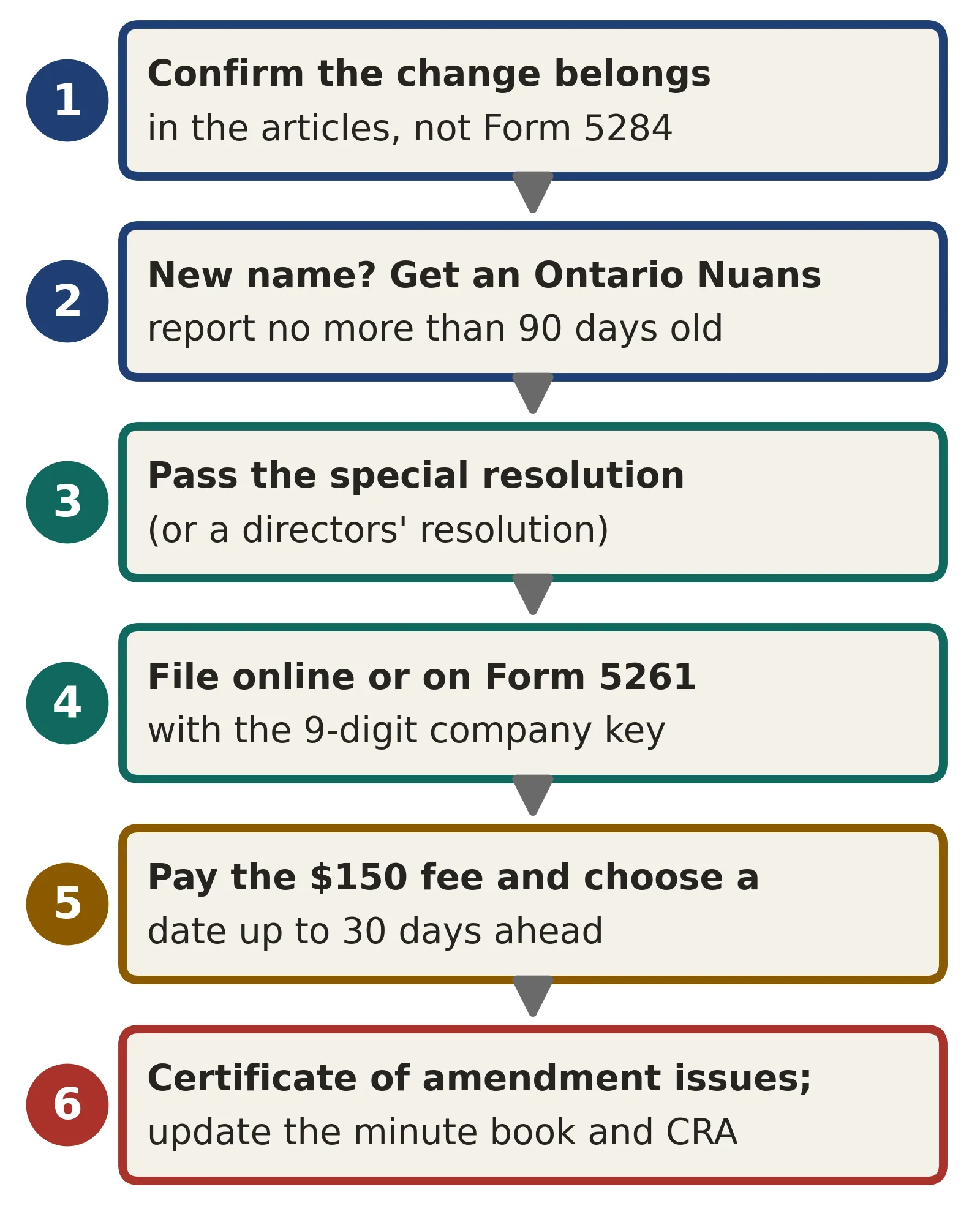
To file articles of amendment, Ontario corporations can apply online through the Ontario Business Registry or mail Form 5261. The Ministry's instructions encourage the online route, which they describe as faster and which gives immediate notice that the application was received. The sequence the form and the Act set out:
- Step 1: Confirm the change belongs in the articles. Director, officer and address changes go on Form 5284 instead.
- Step 2: For a new name, get an Ontario Nuans report dated no more than 90 days before you file, unless the new name will be a number name. Keep the report at the registered office; our Ontario Nuans report guide explains how the report works.
- Step 3: Pass the resolution: a special resolution in most cases, or a directors' resolution for a number name change or a series set under existing authority. The form asks for the resolution date, which cannot be in the future.
- Step 4: Gather the corporation's name, its Ontario Corporation Number, the official email address already on record and its 9-digit company key, which the Ministry uses to confirm you are authorized to file.
- Step 5: Complete only the sections you are changing: the new name, the number of directors (a fixed number, or a minimum and maximum, never both) or the shares and provisions.
- Step 6: Choose the effective date, pay the $150 fee and have a director or officer sign. A paper form must bear that signature, and an electronic filing must meet the authorization requirements the Director sets (s. 273(1)).
The share and provision sections need the most care. The instructions say to state whether the amendment adds, removes, replaces or changes a provision, to identify the section of the articles being amended, and to describe the change rather than restate the amended article. Their own example starts: "the authorized capital of the corporation described in section 3 is amended by". The same instructions tell filers to seek legal advice if they are not sure.
A mailed form that is handwritten, missing the company key, the payment or the email addresses, or on the wrong form, is returned by regular mail. A form with other errors is returned by email with a link to finish the filing online, at no extra fee. Either way, the earliest effective date becomes the day the Ministry receives an acceptable filing.
What does an amendment cost and when is it effective?
Ontario's fee and service standards page (updated April 1, 2026) lists articles of amendment at $150, processed immediately online or within 15 business days by mail, and restated articles at the same $150. The fees are payable to Ontario's Minister of Finance, so they are in Canadian dollars. The page shows government fees only; service providers set their own charges on top, and the page notes that processing times can change.
The three filings a changing corporation meets most compare as follows: two cost $150 and the notice of change is free.
| Filing | Online | By mail |
|---|---|---|
| Articles of amendment | Immediate, $150 | 15 business days, $150 |
| Restated articles | Immediate, $150 | 15 business days, $150 |
| Notice of change (Form 5284) | Immediate, $0 | 15 business days, $0 |
Under section 172 of the OBCA, the Director endorses the articles of amendment with a certificate, which is the certificate of amendment. Section 273(3) dates the certificate on the day the Director receives a complete filing with the fee, or on a later date that the filer specifies and the Director accepts, and section 273(4) makes the articles effective on the date shown in the certificate. The Form 5261 instructions allow a requested date up to 30 calendar days ahead, never a past date, as long as the Nuans report, if one is needed, is still valid. A future date can line a change up with a closing or a new fiscal year, but it cannot be used to backdate one.
How do you change a corporation's name in Ontario?
A corporate name change uses the same filing, with extra rules from the Form 5261 instructions. The new name must include a legal element: Limited, Limitée, Incorporated, Incorporée or Corporation, or the short forms Ltd., Ltée, Inc. or Corp. It must be identical to the name searched in the Nuans report. A corporation cannot switch to a number name if it already has one, unless it is changing only the legal element.
The instructions also bar a name identical to the current or former name of another corporation, whether or not it still exists, unless that corporation dissolved or changed its name more than 10 years ago, or was incorporated outside Ontario and has not carried on business in Ontario. A narrower exception, for a corporation that changed its name or dissolved and meets the regulation's requirements, needs a legal opinion that the corporation keeps at its registered office.
Section 171(3) of the OBCA adds a financial test. A corporation cannot change its name while it is unable to pay its liabilities as they become due, or while the realizable value of its assets is less than the total of its liabilities.
A name can have an English form, a French form, a combined form, or equivalent English and French forms used separately. A Nuans search is needed for each form unless the English and French forms are identical. Once the certificate issues, the corporation does not file a notice of change for the new name: section 4(4) of the Corporations Information Act says an Ontario corporation that changes only its name does not need one.
Articles of amendment: Ontario vs federal and New York
The same change runs differently depending on where the corporation was formed. A federal corporation under the Canada Business Corporations Act (the CBCA, current to September 3, 2026) amends its articles by special resolution under section 173, which the CBCA defines as two-thirds of the votes cast or the signature of every voting shareholder. Unlike an Ontario corporation, a federal corporation can use an amendment to move its registered office to another province (s. 173(1)(b)). Corporations Canada charges $200 for an online amendment, processed in one business day, with no fee when the online amendment changes only the province of the registered office or the minimum and maximum number of directors. The amendment is effective on the date in the certificate (CBCA s. 179(1)).
In New York, a business corporation amends its certificate of incorporation. Under Business Corporation Law section 803(a), the board votes first and then a majority of all outstanding shares entitled to vote approves the change at a shareholders' meeting. That is a different test from the Ontario and federal two-thirds of the votes cast. The certificate of amendment under section 805 must set out each amendment and, for a change of shares, the number, par value and class of shares before and after the change. The Department of State lists a $60 filing fee.
The table sets the three side by side. The biggest practical differences are the approval test and where the registered office can be.
| Item | Ontario | Federal (CBCA) | New York |
|---|---|---|---|
| Main sections | OBCA s. 168 | CBCA s. 173 | BCL ss. 803, 805 |
| Document filed | Articles of amendment | Articles of amendment | Certificate of amendment |
| Shareholder approval | Two-thirds of votes cast | Two-thirds of votes cast | Majority of outstanding shares |
| Government fee | $150 CAD | $200 CAD online | $60 USD |
| Office in another province | Not allowed | By amendment | Not applicable |
A federal corporation that carries on business in Ontario also deals with Ontario's registry; our guide to extra-provincial registration in Ontario covers that side. For the wider choice between an Ontario and a federal corporation, see our guide to Ontario business structures.
What should you update after the amendment?
Once the Director endorses the articles of amendment, Ontario's public record shows the change, but several other records need their own update:
- Minute book: section 140(1) of the OBCA requires the corporation to keep its articles and all amendments, and the minutes and resolutions of shareholders, at its registered office or another place in Ontario the directors designate. File the certificate of amendment with the resolution that approved it.
- Canada Revenue Agency: the CRA says changes to a corporation must first be updated with the incorporating authority, and once they are visible on the corporate registry, the corporation sends the CRA supporting documents to update its business information.
- New York authority: an Ontario corporation authorized to do business in New York that changes its name must deliver a certificate of amendment of its application for authority within 20 days after the change takes effect in Ontario, under Business Corporation Law section 1309(c). If it does not, its authority to do business in New York is suspended when the 20 days run out; a filing within 120 days of the change annuls the suspension. The Department of State lists a $60 fee.
- Other registrations and contracts: check every registration, licence, bank mandate and contract that names the corporation. The Ontario certificate does not file anything in those places for you.
- Restated articles: after several amendments, the directors may restate the articles at any time (s. 173(1)). Restated articles supersede the original articles and every amendment (s. 173(4)), so investors, banks and buyers can read one document.
For US companies with an Ontario subsidiary, the New York step is the one most easily missed, because it is triggered by an Ontario filing. Our guide for a US company doing business in Canada covers which registrations and business numbers a US company needs in Ontario.
Frequently asked questions
How long does it take to process articles of amendment in Ontario?
Ontario's fee page lists online articles of amendment as processed immediately and mailed ones within 15 business days, and notes that processing times can change. The certificate is dated the day the Ministry receives a complete filing unless you request a later date, which the Form 5261 instructions cap at 30 calendar days ahead.
Can one filing make several changes to the articles?
Yes. Form 5261 has separate sections for a new name, the number of directors and the share and other provisions, and the instructions say to complete only the sections you are changing. Ontario's fee page lists one $150 amendment fee. The resolution must approve every change in the filing, and any change that triggers a class vote needs that class's approval too.
Do I need articles of amendment to change directors or the registered office?
No. The Form 5261 instructions send changes to directors, officers, the corporation's address and its official email address to a notice of change on Form 5284, filed within 15 days of the change. Moving the registered office within the municipality takes a directors' resolution, and moving it to another Ontario municipality takes a special resolution. Only the number or range of directors is set in the articles.
Can directors change a numbered company to a named one without a shareholder vote?
Yes. Section 168(4) of the OBCA lets the directors amend the articles to replace a number name with a name that is not a number name, and section 168(5) allows that amendment by directors' resolution. The new name still needs an Ontario Nuans report no more than 90 days old and a legal element such as Inc. or Ltd., and the $150 fee applies.
What happens if a shareholder votes against an amendment?
A special resolution passes with two-thirds of the votes cast, so a minority can be outvoted. For some amendments the statute gives that minority another option. A shareholder entitled to vote may dissent from changes to share transfer restrictions, business restrictions or the class rights listed in section 170, and be paid the fair value of the shares as of the close of business on the day before the resolution was adopted.
Can a corporation cancel an amendment after the shareholders approve it?
Yes, if the special resolution allows it. Section 168(3) of the OBCA lets the directors revoke the resolution without further shareholder approval at any time before the Director endorses the certificate of amendment. The section gives the directors that power only when the special resolution authorizes it, so the wording is worth including when the timing of a deal is uncertain.
What are restated articles of incorporation in Ontario?
Restated articles consolidate the original articles and every amendment into one document. The directors may restate the articles at any time and must do so when the Director directs (s. 173(1)). Once endorsed, the restated articles supersede the original articles and all amendments to them (s. 173(4)). Ontario's fee page lists restated articles at $150, the same as an amendment.
Conclusion
For articles of amendment, Ontario's rules reward preparation more than speed. The filing itself is quick online and costs $150, but the work sits before it: deciding whether the change belongs in the articles at all, passing the right resolution, spotting a class vote or a dissent right, and describing the change in the form the Ministry expects. After the certificate issues, the minute book, the CRA and any New York authority need their own updates, and the New York one has a 20-day clock. Build those steps into the plan for a rename, a financing or a share reorganization, and the certificate of amendment becomes the last step rather than the first problem.
How Mayo Law can help
Mayo Law works with corporations and founders on both sides of the Canada-US border from offices in Toronto and New York. Joseph Mayo, our principal attorney, is licensed in Ontario and New York. We prepare special resolutions and articles of amendment, review how a share-structure change affects existing classes and dissent rights, and coordinate the New York filings that follow an Ontario name change. Our incorporation lawyer page describes our incorporation and restructuring work, and our international business law page covers cross-border corporate matters more broadly.
Disclaimer
This article provides general information about Ontario, federal Canadian and New York corporate law as of September 2026. It is not legal advice, and reading it does not create a solicitor-client or attorney-client relationship. Fees, forms and processing times change, so check the official sources before you file. Mayo Law provides legal services in Ontario and New York.