

Contents
- Quick answer
- What counts as a breach of employment contract?
- What does Ontario's ESA require when employment ends?
- When does reasonable notice replace the contract?
- How does New York handle an employment contract breach?
- What if the employee breaches the contract?
- How does mitigation reduce what an employer owes?
- How can employers lower the risk of a claim?
- Frequently asked questions
- Conclusion
- How Mayo Law can help
- Disclaimer
A breach of employment contract happens when the employer or the employee fails to do what the employment agreement, or the law that sits underneath it, requires. For employers, the costly breaches are usually not dramatic. They are a termination clause that quietly falls below the statutory minimum, a pay cut imposed without consent, or a final paycheque that arrives late. Each of those can turn a routine exit into a damages claim.
This guide is written for employers with staff in Ontario, New York or both. It explains what counts as a breach on each side of the relationship, the Ontario Employment Standards Act minimums that no contract can go below, when a court replaces the contract with common-law reasonable notice, how New York's at-will rule changes the picture, what an employer can do when an employee is the one in breach, and how mitigation limits damages. The statutes and decisions below were checked against official sources as of October 2026.
Quick answer
A breach of employment contract is a failure to honour an express or implied term of the employment relationship. In Ontario, the most common employer breach is ending employment without the notice the contract or the law requires. In New York, employment is presumed at will, so claims usually turn on wages, a fixed term or a contractual promise.
What counts as a breach of employment contract?
An employment contract is more than the signed offer letter. In Ontario it also includes terms implied by law, such as the employer's obligation to give reasonable notice of termination unless the contract validly says otherwise, and every minimum standard in the Employment Standards Act, 2000 (the ESA). Section 5(1) of the ESA says that no employer or employee may contract out of or waive an employment standard, and that any attempt to do so is void. Section 5(2) lets a contract give an employee more than the standard, never less.
With that in mind, a breach can come from either side.
Common breaches by an employer
- Termination without proper notice: dismissing an employee without cause and without the notice or pay in lieu that the contract, the ESA or the common law requires. This is the claim usually called wrongful dismissal.
- Unpaid wages or benefits: withholding earned pay, commissions, vacation pay or benefits the contract promises.
- Unilateral changes: cutting pay, demoting, relocating or restructuring a role without the employee's agreement.
- Unlawful deductions: taking money from wages in a way the governing statute does not allow.
Common breaches by an employee
- Leaving without reasonable notice: quitting abruptly when the contract or the common law requires notice.
- Misusing confidential information: taking client lists, pricing or other confidential records.
- Breaching a valid restrictive covenant: soliciting clients or staff in breach of an enforceable non-solicitation clause.
When does a change become constructive dismissal?
Ontario's guide to the ESA's termination rules says that constructive dismissal may occur when an employer makes a significant change to a fundamental term or condition of employment without the employee's actual or implied consent. Under ESA section 56(1)(b), an employer terminates employment for ESA purposes if it constructively dismisses the employee and the employee resigns in response within a reasonable period.
At common law, the Supreme Court of Canada set out a two-branch test in Potter v. New Brunswick Legal Aid Services Commission, 2015 SCC 10. Under the first branch, the employer's unilateral change must be a breach of the contract, and it must substantially alter an essential term, judged by whether a reasonable person in the employee's situation would have felt that the essential terms were being substantially changed (paras. 34 and 39). Under the second branch, a course of conduct can amount to constructive dismissal when it would lead a reasonable person to conclude that the employer no longer intended to be bound by the contract (para. 42).
What does Ontario's ESA require when employment ends?
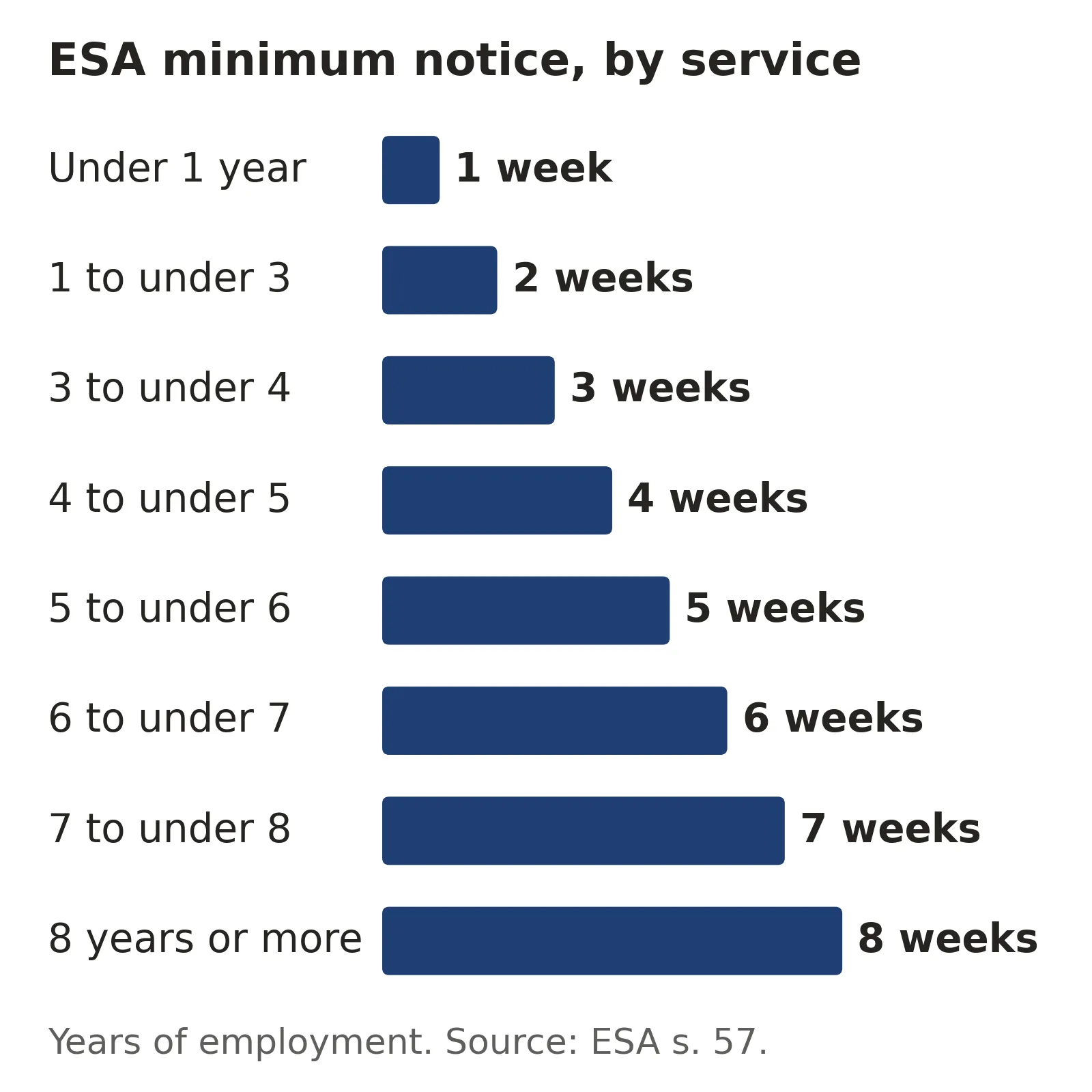
Under ESA section 54, an employer may not terminate an employee who has been continuously employed for three months or more unless it gives written notice under section 57 or 58 and the notice has expired, or it pays instead of notice under section 61. Section 57 sets the individual notice periods by length of employment, from one week for less than one year to eight weeks for eight years or more. Section 58 sets a separate notice rule when 50 or more employees at an establishment are terminated in the same four-week period, and section 55 excludes some prescribed employees from notice and termination pay.
An employer that prefers not to have the employee work through the notice period can pay termination pay in a lump sum instead, but section 61(1) also requires it to continue whatever benefit plan contributions would have been needed to keep the employee's benefits during the notice period. Paying salary in lieu while cutting off benefits on the last day is a common way employers fall short.
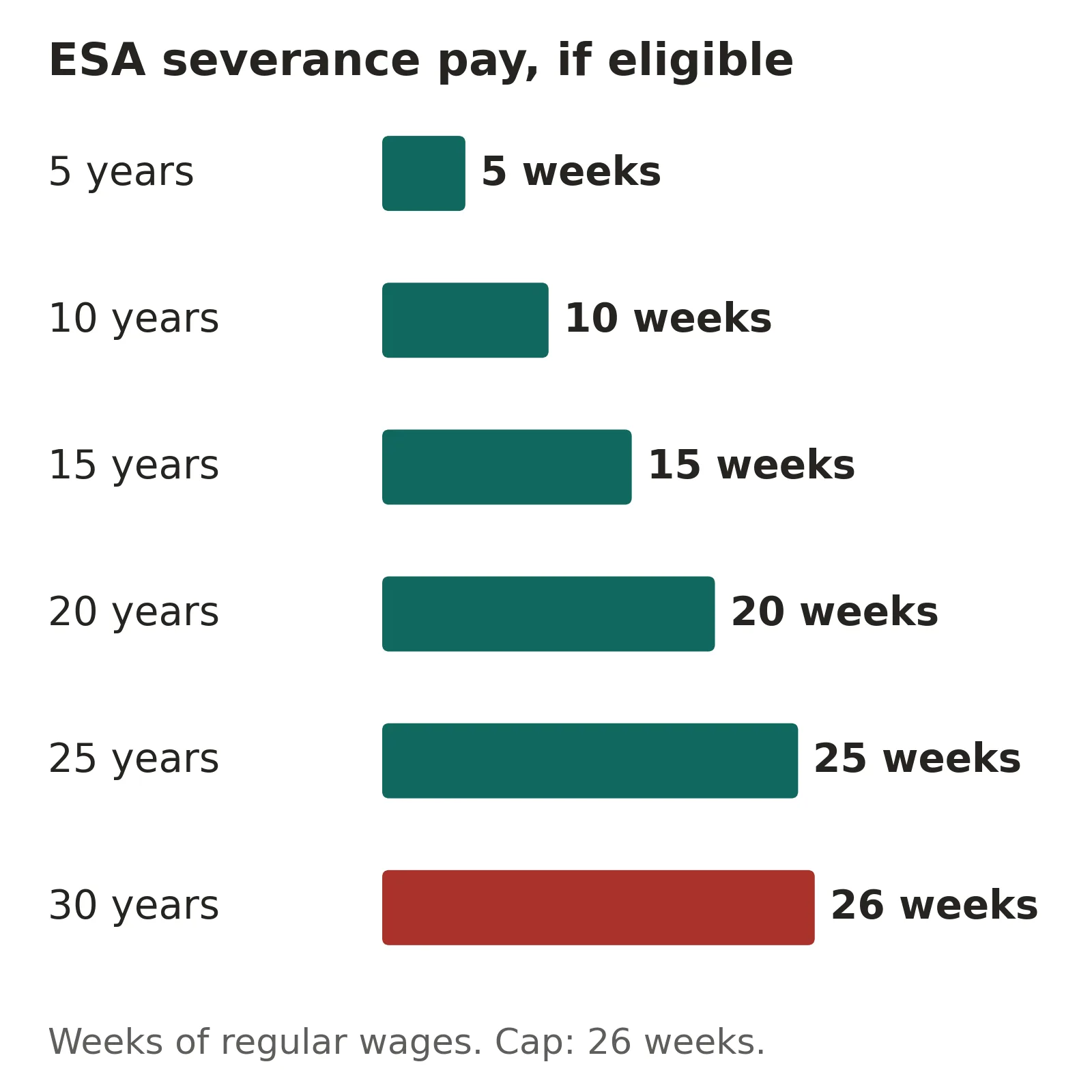
Severance pay is a separate entitlement. Under section 64(1), an employee who has worked for the employer for five years or more is entitled to severance pay if 50 or more employees are severed within six months because of a permanent discontinuance of all or part of the business at an establishment, or if the employer has a payroll of $2.5 million or more. Ontario's severance pay guide describes the payroll test as a global payroll of at least $2.5 million. Section 65(1) calculates severance as regular wages for a regular work week multiplied by completed years plus completed months divided by 12, and section 65(5) caps it at 26 weeks.
These are floors. The Ministry's termination guide states that the ESA rules are minimum requirements and that some employees may have greater rights under the common law. For many employees, that common-law entitlement is much larger than the ESA amount.
When does reasonable notice replace the contract?
In Ontario, an employee hired for an indefinite term is presumed to be entitled to reasonable notice of termination at common law. A written termination clause can limit that entitlement, but only if it is lawful and clear. Three decisions set the rules employers draft around.
A clause below the ESA minimum is void
In Machtinger v. HOJ Industries Ltd., [1992] 1 S.C.R. 986, an Ontario case, the contracts allowed termination with no notice or with two weeks' notice when the statute required four. The Supreme Court of Canada held that where an employment contract fails to comply with the minimum notice periods in the Act, the employee can only be dismissed without cause if given reasonable notice of termination. A void term is void for all purposes and cannot be used as evidence of what the parties intended.
One illegal termination provision can sink the others
In Waksdale v. Swegon North America Inc., 2020 ONCA 391, the Court of Appeal for Ontario held that an employment agreement must be interpreted as a whole, not piecemeal, and that courts will not enforce termination provisions that are illegal in whole or in part (para. 10). The employer's non-reliance on the illegal provision was irrelevant (para. 11), and a severability clause cannot rescue clauses made void by statute (para. 14). In practice, a for-cause clause that goes beyond what the ESA allows can take a carefully written without-cause clause down with it.
Bonus and incentive limits must be unambiguous
In Matthews v. Ocean Nutrition Canada Ltd., 2020 SCC 26, the Supreme Court of Canada asked two questions: would the employee have been entitled to the bonus as part of their compensation during the reasonable notice period, and if so, do the contract or plan terms unambiguously take away or limit that right (para. 55)? The limiting language must be absolutely clear and unambiguous, and wording that requires the employee to be "full-time" or "active" will not suffice (para. 65).
Our guide to non-compete agreements in Ontario covers the separate statutory ban on non-competes, which works in a similar way: a prohibited clause is void, and the employer is left with whatever other protections were drafted properly.
How does New York handle an employment contract breach?
New York starts from the opposite presumption, known as at-will employment. The New York Attorney General's job termination guidance states that a private-sector employer in New York is not required to have good cause to fire an employee, but it cannot fire someone for an illegal reason. New York's courts describe the same rule: in Minovici v. Belkin BV (App. Div. 2d Dept. 2013), the court said that New York adheres to the traditional common-law rule that, absent an agreement establishing a fixed duration, an employment relationship is presumed to be a hiring at will, terminable at any time by either party.
So a New York breach of contract claim usually needs something more than the termination itself. Common sources are a written fixed term, an express limit on the grounds or process for termination, or a promised payment that was not made. Wage obligations are where many New York employers are exposed:
- Final pay: Labor Law section 191(3) requires an employer to pay wages no later than the regular pay day for the pay period in which the termination occurred.
- Deductions: Labor Law section 193 prohibits deductions from wages except those required by law, those expressly authorized in writing by the employee for the employee's benefit within listed categories, and certain recoveries of overpayments and wage advances under Department of Labor rules.
- Remedies: under Labor Law section 198, an employee who wins a wage claim recovers the underpayment, reasonable attorney's fees and prejudgment interest and, unless the employer proves a good faith basis, liquidated damages equal to 100% of the wages found due. Section 198(3) allows claims going back six years.
- Mass layoffs: the New York Department of Labor's WARN Act page says the state WARN Act applies to private businesses with 50 or more full-time employees in New York and requires 90 days' notice before a plant closing, mass layoff or relocation, among other events (Labor Law section 860-b).
The comparison below shows why a single contract template rarely works for both offices.
| Issue | Ontario | New York |
|---|---|---|
| Default on termination | Reasonable notice presumed | At will |
| Group terminations | Special notice (ESA s. 58) | 90 days (NY WARN) |
| Employee non-competes | Banned, two exceptions | No general ban |
On the last row: as of October 2026, New York has no general statute banning employee non-competes; Labor Law section 202-k covers only broadcast employees. Senate bill S9759 passed the State Senate on June 3, 2026 and is in an Assembly committee, so it is not law.
What if the employee breaches the contract?
Employers have claims too, although they are narrower than many expect. In RBC Dominion Securities Inc. v. Merrill Lynch Canada Inc., 2008 SCC 54, a British Columbia case, the Supreme Court of Canada accepted that an employee terminating employment may be liable for failing to give reasonable notice and for breach of specific residual duties, and that subject to those duties the employee is free to compete (para. 19). The trial judge had fixed a notice period of 2.5 weeks for investment advisors who left together, taking into account the simultaneous departure of virtually the entire branch staff (para. 23), and awarded a total of $40,000 for the failure to give notice (para. 14). An award based on a general duty not to compete after departure was wrong in law (para. 20).
The practical lessons for an employer are these:
- Put the resignation notice in writing: a clear contractual notice period is easier to enforce than an argument about what was reasonable.
- Protect information, not the market: confidentiality and non-solicitation terms do work that an Ontario non-compete cannot, because ESA section 67.2 bars most employee non-competes, with exceptions for executives and for a seller who joins the buyer after a sale of business.
- Act quickly on records: in RBC, the misuse of confidential client records was dealt with separately from the notice claim.
In New York, an at-will employee can generally leave at any time unless a contract says otherwise, so the employer's protection lies in properly drafted confidentiality and restrictive covenant terms rather than in notice.
How does mitigation reduce what an employer owes?
A dismissed employee who sues for reasonable notice damages must take reasonable steps to replace the lost income, which courts call the duty to mitigate. In Evans v. Teamsters Local Union No. 31, 2008 SCC 20, the Supreme Court of Canada held that in some circumstances a dismissed employee must mitigate by returning to work for the same employer. The employer bears the onus of showing both that the employee failed to make reasonable efforts to find work and that work could have been found (para. 30).
The central question when an employer offers re-employment is whether a reasonable person would accept it. The Court pointed to the same salary, working conditions that are not substantially different or demeaning, and personal relationships that are not acrimonious, and said an employee is not obliged to mitigate by working in an atmosphere of hostility, embarrassment or humiliation (para. 30). For an employer, that means a genuine, documented offer of working notice or re-employment can reduce exposure, while a token offer made after a hostile exit usually will not.
How can employers lower the risk of a claim?
Most breach of contract employment agreement disputes trace back to a handful of drafting and process decisions. A review before the next hire or exit is cheaper than a claim after it.
- Step 1, audit the termination clause: check both the with-cause and without-cause provisions against the current ESA, because after Waksdale one defect can void both.
- Step 2, address bonuses and incentives expressly: say plainly what happens to a bonus or incentive plan during any notice period, in the language Matthews requires.
- Step 3, get consent before changing terms: a pay cut, demotion or relocation without agreement invites a constructive dismissal claim.
- Step 4, continue benefits during the ESA notice period: section 61 requires it when paying in lieu.
- Step 5, separate the Ontario and New York templates: an Ontario clause drafted on at-will assumptions is likely to fail, and a New York agreement drafted on Ontario assumptions may give away more than New York law requires.
- Step 6, pay final wages on time: in New York, section 191(3) sets the deadline and section 198 sets the price of missing it.
Our guide to employment compliance covers the wider compliance picture for cross-border employers, and our page on contract review services explains what a review of an employment agreement involves. If the agreement includes a dispute resolution clause, our guide to arbitration agreements in employment contracts explains what those clauses can and cannot do.
Frequently asked questions
Is a breach of employment contract the same as wrongful dismissal?
Wrongful dismissal is one type of breach of employment contract. It describes an employer ending employment without the notice or pay in lieu that the contract or the law requires. A breach can also involve unpaid wages, unilateral changes to essential terms, an employee leaving without reasonable notice, or misuse of confidential information, so the broader term covers more situations.
Can an employer change an employee's pay or duties without breaching the contract?
Only within limits. Ontario's ESA guide says constructive dismissal may occur when an employer makes a significant change to a fundamental term without the employee's actual or implied consent. Under the Potter test, a unilateral change that breaches the contract and substantially alters an essential term can amount to constructive dismissal, which the law treats as a termination.
Does an Ontario employee have to give notice before quitting?
The duty usually comes from the employment contract and the common law. In RBC Dominion Securities v. Merrill Lynch, the Supreme Court of Canada accepted that an employee who terminates employment may be liable for failing to give reasonable notice. A written resignation notice period in the contract makes the obligation clearer and easier to enforce.
Can a New York employer fire an employee who has a written contract?
It depends on what the contract says. New York presumes employment is at will unless an agreement establishes a fixed duration, so a contract that only sets pay and duties usually leaves the at-will rule in place. A fixed term or an express limit on the grounds for termination can create a breach of contract claim if the employer ignores it.
How much notice does the ESA require in Ontario?
Section 57 of the ESA requires individual notice of one week for less than one year of employment, two weeks for one to under three years, then one more week for each additional year up to eight weeks for eight years or more. An employer may pay termination pay instead under section 61 but must continue benefit plan contributions for the notice period.
Does one illegal termination clause void the others?
In Ontario, it can. In Waksdale v. Swegon North America, the Court of Appeal for Ontario held that termination provisions are read as a whole, that courts will not enforce them if they are illegal in whole or in part, and that a severability clause cannot save a provision made void by statute. The employee then falls back on reasonable notice.
Who has to prove that a dismissed employee failed to mitigate?
The employer does. In Evans v. Teamsters Local Union No. 31, the Supreme Court of Canada confirmed that the employer bears the onus of showing both that the employee failed to make reasonable efforts to find work and that work could have been found. An offer of re-employment is judged by whether a reasonable person would accept it.
Conclusion
A breach of employment contract is rarely a single dramatic event. In Ontario it is usually a gap between what the contract says and what the ESA and the common law require, and courts resolve that gap in the employee's favour. In New York the at-will presumption gives employers more room on termination, but wage rules carry real penalties. An employer with staff in both places needs two sets of terms, a process that follows them, and a habit of checking both before an exit rather than after one.
How Mayo Law can help
Mayo Law advises employers on both sides of the Canada-US border from offices in Toronto and New York. Joseph Mayo, our principal attorney, is licensed in Ontario and New York. We review and draft employment agreements and termination clauses for Ontario and New York staff, plan terminations so they meet the applicable minimums, and help employers respond when an employee leaves in breach of their obligations. Where an exit has already gone wrong, we assess the exposure on both the statutory and the contractual side before the next step is taken. Our compliance page describes our employer compliance work.
Disclaimer
This article provides general information about Ontario and New York employment law as of October 2026. It is not legal advice, and reading it does not create a solicitor-client or attorney-client relationship. Statutes, regulations and case law change, and the outcome of any dispute depends on its facts, so speak with a licensed professional about your situation. Mayo Law provides legal services in Ontario and New York.