

Contents
- Quick answer
- What is the Ontario annual return?
- Which corporations must file an Ontario annual return?
- When is the Ontario annual return due?
- How do you file an annual return in Ontario?
- What happens if you do not file?
- Do federal and extra-provincial corporations file?
- Frequently asked questions
- Conclusion
- How Mayo Law can help
- Disclaimer
The Ontario annual return is a short yearly filing that most Ontario corporations must make on the Ontario Business Registry, confirming or updating the information on the public record. It is not a tax return, it carries no government fee, and it takes minutes to file. It is also easy to forget, and a corporation that keeps forgetting it can be barred from suing in an Ontario court without the court's leave and, eventually, be dissolved.
This guide explains which corporations must file, when the return is due, how to file it with a company key, what the return contains, what happens if a corporation does not file, and how federal and extra-provincial corporations, including US companies licensed in Ontario, fit in. The statutes, regulation and Ministry notices below were checked against official sources as of October 2026.
Quick answer
Ontario business corporations, not-for-profit corporations and licensed foreign corporations must file an annual return under the Corporations Information Act each year, within six months after the end of the tax year. It is filed on the Ontario Business Registry with the company key, there is no government fee, and it is separate from the T2.
What is the Ontario annual return?
Section 3.1(1) of Ontario's Corporations Information Act (the CIA) requires every corporation, other than a corporation of a class exempted by the regulations, to file a return each year with the Minister. The details are in Ontario Regulation 400/21. Under section 4 of that regulation, the annual return sets out the year of the return, the corporation's name, its Ontario corporation number, and whether the information in the most recent return or notice has changed and, if so, every change.
In practice, the annual return is a yearly check of the public record: such as the registered office address and the directors and officers. If nothing has changed, the corporation says so. If something has changed, the annual return records it, although a change of directors, officers or address should already have gone on a notice of change, which section 4(1) of the CIA requires within 15 days after the change.
It is no longer filed with the T2
Ontario annual returns used to travel with the corporate income tax return. The Canada Revenue Agency announced in a 2021 tax tip that as of May 15, 2021, Ontario Corporations Information Act annual returns would no longer be filed through the CRA, while the CRA would continue to process T2 returns. Ontario's corporations tax page says corporations with an annual return due after October 18, 2021 must file directly in the Ontario Business Registry. Filing the T2 does not file the annual return.
Which corporations must file an Ontario annual return?
Section 11(2) of O. Reg. 400/21 exempts all corporations from the annual return except four classes:
- Ontario business corporations: corporations subject to the Business Corporations Act.
- Corporations Act corporations: corporations subject to the Corporations Act.
- Licensed foreign corporations: foreign corporations that have a licence endorsed under the Extra-Provincial Corporations Act.
- Not-for-profit corporations: corporations subject to the Not-for-Profit Corporations Act, 2010.
Section 11(3) adds a narrow exemption: a corporation that is required to file a tax return under section 150 of the Income Tax Act, but is not required to file one in a particular year, is exempt from the annual return in that year.
The table below shows how the main types of corporation doing business in Ontario are treated.
| Corporation | Ontario return? | Other annual filing |
|---|---|---|
| Ontario business corporation | Yes | None federally |
| Ontario not-for-profit | Yes | None federally |
| Federal (CBCA) corporation | No | Federal return, $12 |
| Other-province corporation | No | Check home law |
| Licensed foreign corporation | Yes | Check home law |
The other-province and foreign rows depend on the Extra-Provincial Corporations Act classes, explained below. "Check home law" means the filings required by the corporation's own governing law, which this guide does not cover.
When is the Ontario annual return due?
The deadline follows the tax return. Section 3(3) of O. Reg. 400/21 requires a corporation that files a tax return under section 150 of the Income Tax Act to deliver the annual return within the time period for delivering its tax return for its last completed taxation year. The Ministry's notice on filing an annual return (effective February 1, 2025) puts it plainly: the return is due within six months after the end of the corporation's taxation year, and Ontario's Ontario Business Registry page (updated September 28, 2026) says the same. For a corporation with a December 31 year-end, that means filing by June 30 of the following year.
Registered charities follow their information return instead: section 3(4) ties their annual return to the deadline for the information return under section 149.1(14) of the Income Tax Act.
The annual return is one of several clocks an Ontario corporation runs on. Figure 1 compares it with the others.
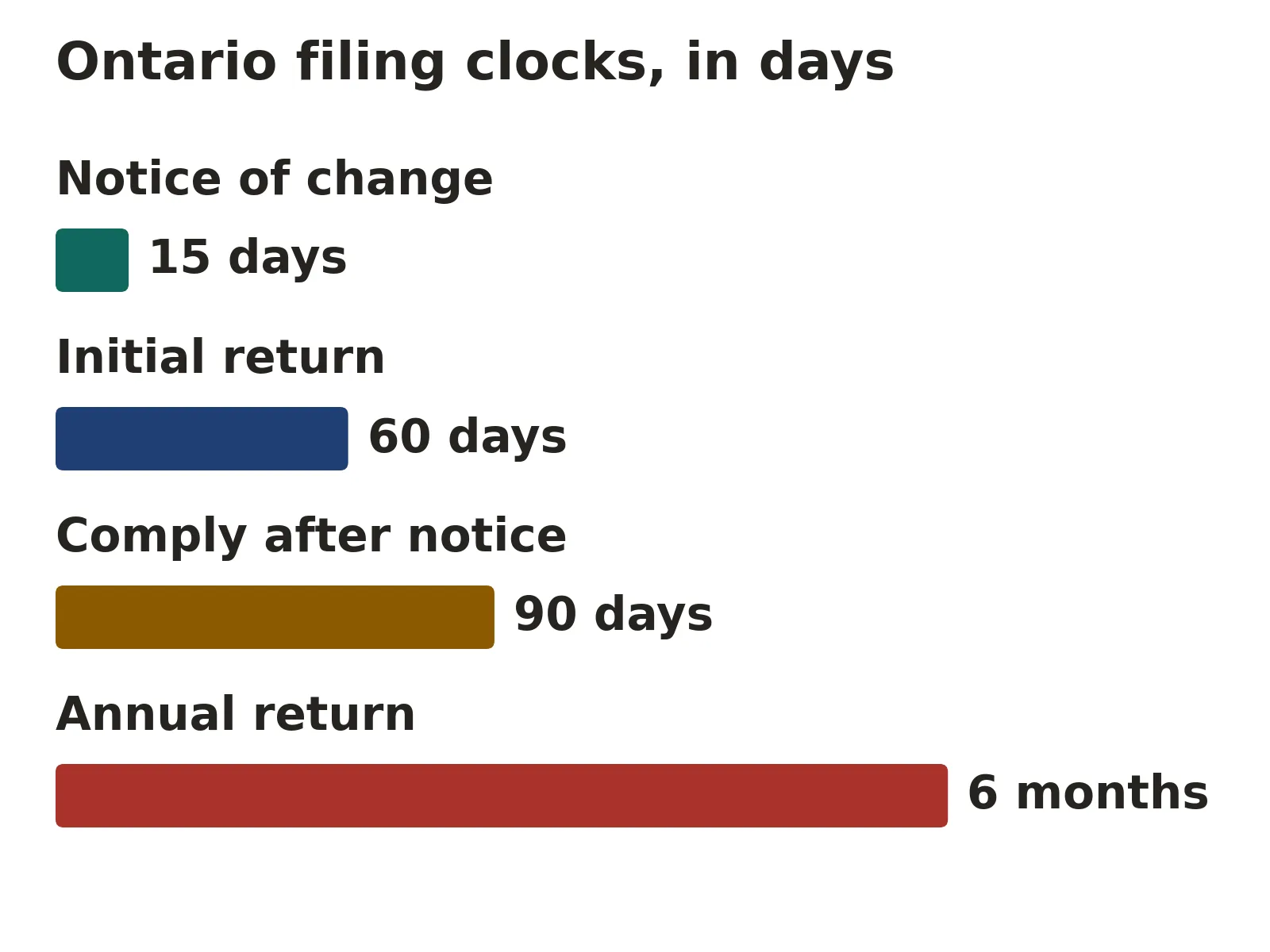
The initial return is a separate, one-time filing. Section 2(2) of the CIA requires it within 60 days after the date of incorporation, amalgamation or continuation. Our guide to articles of incorporation in Ontario covers that first step, and our Ontario incorporation checklist places the annual filings in the full sequence of setting up a corporation.
How do you file an annual return in Ontario?
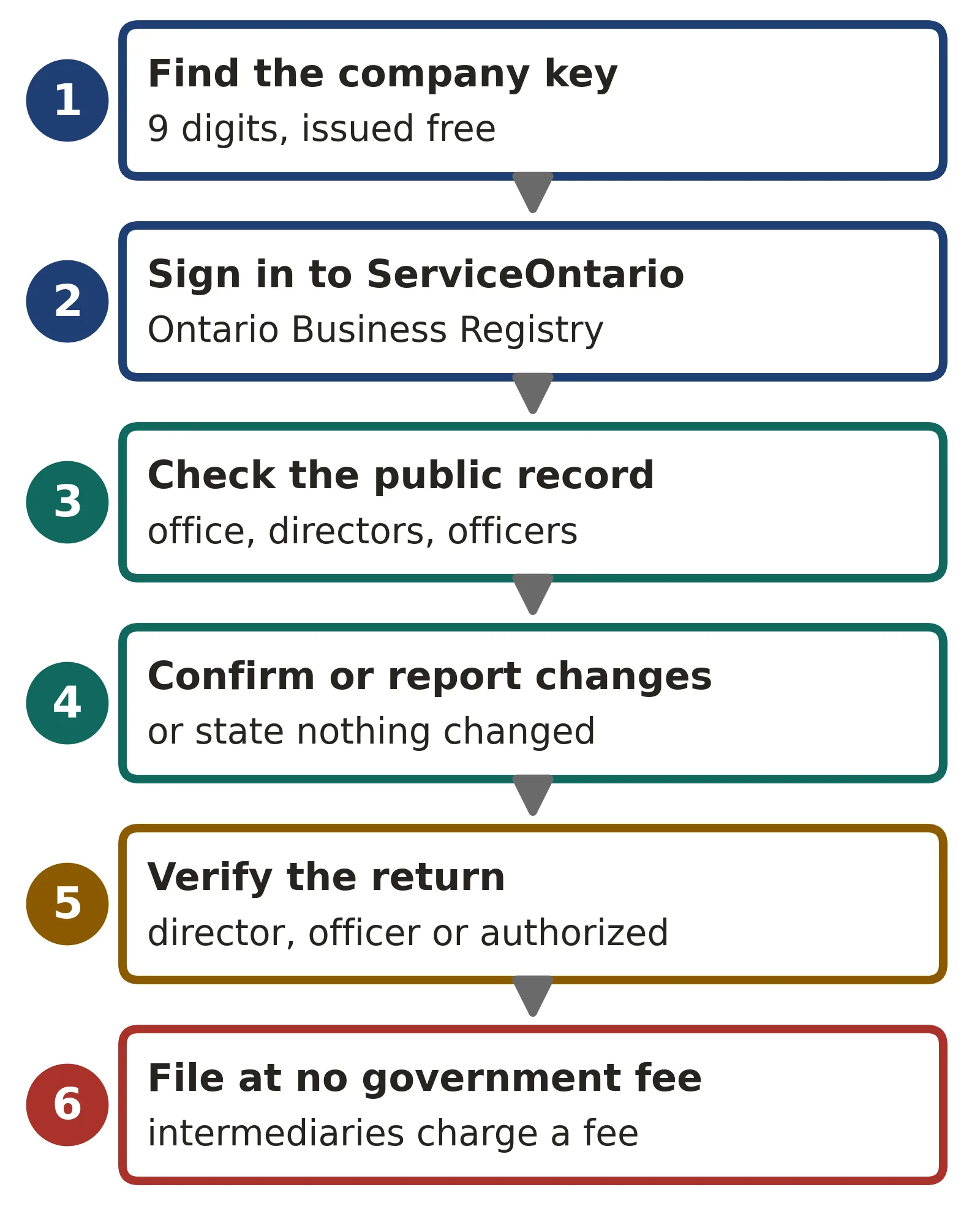
The Ministry's notice describes two ways to file online, both of which need the corporation's company key, plus a paper option:
- Directly through ServiceOntario: on the Ontario Business Registry, using a ServiceOntario online account. The notice says there is no statutory fee.
- Through an intermediary: a service provider files on the corporation's behalf. The notice says intermediaries charge an additional fee.
- By mail: on the approved form, completed on a computer and printed, with the company key. A handwritten form, a form without the company key or email address, or the wrong form is returned unprocessed.
The company key is a nine-digit code. The Ontario Business Registry page says the Ministry issues it free, and that every entity in the registry must use it to transact, whether filing directly, through an intermediary or through a service provider.
What information do you need?
The Ministry's notice lists what to have ready:
- Identity: the corporate name and Ontario Corporation Number.
- Administrative details: a contact name and email address, the corporation's official email address and its NAICS industry code if not already provided. These are not shown on the public record.
- The year: the year of the annual return.
- Changes: any change since the last return or notice, or a statement that nothing has changed.
- Verifier: the name and address for service of the person verifying the return.
Under section 5(1) of the CIA, the return must be verified by an officer or director, or by an individual authorized by the directors who has knowledge of the corporation's affairs. The notice also recommends checking the public record, for example through a profile report, before filing.
What does the annual return cost?
Nothing in government fees. Ontario's fee and processing-time page (updated September 29, 2026) lists the CIA annual return for an Ontario corporation at $0, immediate online or 15 business days by mail, and the same $0 for an extra-provincial foreign corporation. An intermediary's service fee is a separate charge.
What happens if you do not file?
A missed annual return puts the corporation in default under the CIA, and the consequences escalate from there:
- Fines: under section 14(1) of the CIA, contravening the Act is an offence punishable by a fine of up to $2,000, or up to $25,000 for a corporation. Section 14(2) extends liability to directors and officers who authorized, permitted or acquiesced in the offence. A false or misleading statement in a filing is a separate offence under section 13.
- Late filing fee: section 17 requires a corporation that files late to pay the prescribed late filing fee. Ontario's current fee page lists the annual return itself at $0.
- No access to the courts: under section 18(1), a corporation in default of a filing is not capable of maintaining a proceeding in an Ontario court in respect of its business except with leave of the court. Section 18(2) requires the court to grant leave if the failure was inadvertent, there is no evidence the public was deceived or misled, and the corporation has since filed everything.
- Dissolution: under section 241(3) of the Business Corporations Act, if a corporation fails to comply with a filing requirement under the CIA, the Director may give notice that a dissolution order will issue unless the corporation complies within 90 days. If it does not, section 241(4) lets the Director cancel the certificate of incorporation and dissolve the corporation.
A dissolved corporation can be revived. Under section 241(9), the Director may revive it on the application of any interested person, and on revival it is deemed never to have been dissolved, subject to conditions and to rights others acquired in the meantime. The application is made as articles of revival (s. 241(13)) and cannot be made more than 20 years after the dissolution (s. 241(12)). The fee page lists Business Corporations Act revival at $330. Our guide to articles of amendment in Ontario covers the related rules for changing a corporation's articles once it is in good standing.
Do federal and extra-provincial corporations file?
A federal corporation incorporated under the Canada Business Corporations Act does not file the Ontario annual return. Corporations Canada's page on provincial registration of federal business corporations tells federal corporations registered in Ontario: "You do not have to file annual returns with the Government of Ontario." They file a federal annual return instead, which Corporations Canada says costs $12 online and is due within 60 days after the anniversary of incorporation, amalgamation or continuation, together with information on individuals with significant control.
Extra-provincial corporations are sorted into classes by section 2(1) of Ontario's Extra-Provincial Corporations Act: class 1 corporations are incorporated under the law of another province, class 2 under federal or territorial law, and class 3 outside Canada. Only class 3 corporations with an endorsed licence are in the classes that file the Ontario annual return. That captures a Delaware or New York corporation licensed to carry on business in Ontario, a filing US companies can easily miss. Our guide to extra-provincial registration in Ontario explains the licence and the other filings that follow it, and our guide for a US company doing business in Canada covers the wider picture.
Frequently asked questions
Is the Ontario annual return the same as the corporate tax return?
No. The annual return is a Corporations Information Act filing on the Ontario Business Registry that confirms or updates the corporation's public information. The T2 is the corporate income tax return filed with the Canada Revenue Agency. Since 2021, the CRA no longer accepts Ontario annual returns, so filing a T2 does not satisfy the annual return.
Does an inactive Ontario corporation still file an annual return?
Generally, yes. The regulation exempts a corporation only in a narrow case: where it is required to file a tax return under section 150 of the Income Tax Act but is not required to file one in that year. A corporation that still has to file a T2 for the year should expect to file the annual return as well.
Can an accountant or service provider file the annual return?
Yes. The Ministry's notice allows filing through an intermediary acting on the corporation's behalf, and the Ontario Business Registry page confirms that intermediaries and service providers use the company key to transact. The return must still be verified by a director, an officer or an individual authorized by the directors who knows the corporation's affairs.
What if the information has not changed since last year?
The corporation still files. The Ministry's notice says that if there has not been a change in the information, the return must indicate that. Changes that did happen during the year, such as a new director or a new registered office address, should already have been reported on a notice of change within 15 days.
Do US corporations licensed in Ontario file an Ontario annual return?
Yes, if they hold an endorsed licence. A corporation incorporated outside Canada is a class 3 extra-provincial corporation, and O. Reg. 400/21 lists foreign corporations with a licence endorsed under the Extra-Provincial Corporations Act among the classes that must file. Corporations from other provinces and federal corporations do not file it.
Is Ontario adding a filing on individuals with significant control?
Ontario has enacted a new section 6.1 of the Corporations Information Act that would require certain corporations to file a return about individuals with significant control, if the regulations require it. As of October 2026, e-Laws shows the section as coming into force on a day to be named by proclamation, so it does not yet apply.
Conclusion
The Ontario annual return is one of the cheapest filings in corporate law and one of the easiest to let slip. It costs nothing in government fees, takes minutes with a company key, and is due on the same six-month clock as the tax return, but it is filed separately on the Ontario Business Registry. Missing it can leave a corporation unable to sue without leave and, after a 90-day notice, dissolved. A calendar entry tied to the year-end, and a check of the public record when it is filed, prevent nearly all of that.
How Mayo Law can help
Mayo Law works with Ontario corporations and with US companies operating in Ontario from offices in Toronto and New York. Joseph Mayo, our principal attorney, is licensed in Ontario and New York. We keep minute books and annual filings current, file notices of change and annual returns, bring corporations back into good standing, and handle revivals of dissolved corporations. For US companies licensed in Ontario, we coordinate the Ontario filings with the company's obligations at home. Our compliance page describes our corporate compliance work, and our incorporation lawyer page covers setting up and maintaining a corporation.
Disclaimer
This article provides general information about Ontario corporate filings as of October 2026. It is not legal or tax advice, and reading it does not create a solicitor-client or attorney-client relationship. Filing rules, fees and forms change, so check the official sources before you file. Mayo Law provides legal services in Ontario and New York.