

Contents
- Quick answer
- What are articles of dissolution in Ontario?
- Who must approve a voluntary dissolution?
- What must the corporation confirm before it files?
- How do you file articles of dissolution?
- What tax steps come before and after dissolution?
- What happens after the certificate of dissolution?
- Articles of dissolution: Ontario vs federal corporations
- Frequently asked questions
- Conclusion
- How Mayo Law can help
- Disclaimer
Articles of dissolution, Ontario's filing for voluntarily ending a business corporation, are how an Ontario corporation's legal existence comes to an end by choice. Filing them is the last step, not the first: by the time the articles go in, the shareholders must have approved the dissolution, the debts must be paid or provided for, the remaining property must be distributed, and the Ministry of Finance must be satisfied that the corporation's tax filings and payments are in order.
This guide explains how to dissolve a corporation in Ontario voluntarily: who must approve it, what the corporation must confirm in its articles of dissolution, how to file online or on Form 5268, the fee, timing and Ministry of Finance consent, the federal tax steps before and after, and what happens once the certificate of dissolution issues, including why a voluntarily dissolved Ontario corporation generally cannot be revived. The statute, Ministry notice, forms and fees below were checked against official sources as of October 2026.
Quick answer
To dissolve an Ontario corporation, the shareholders pass a special resolution, the corporation pays or provides for its debts and distributes its remaining property, and it files articles of dissolution online or on Form 5268. The fee is $25. The Ministry of Finance must consent, and a voluntarily dissolved corporation cannot simply be revived later.
What are articles of dissolution in Ontario?
Articles of dissolution are the document an Ontario business corporation files under the Business Corporations Act (the OBCA) to dissolve itself voluntarily. When the Director receives them, section 239(1) requires the Director to endorse them with a certificate, which is the certificate of dissolution. For paper filings, the Ministry publishes the articles of dissolution (Ontario Form 5268) as Articles of Dissolution, Business Corporations Act, described as the form to voluntarily dissolve an Ontario business corporation whether or not it has commenced business.
Voluntary dissolution is different from the involuntary kind. Under section 241, the Director can dissolve a corporation that fails to meet its filing obligations, for example under the Corporations Information Act, after giving 90 days' notice. That route is a penalty, and it leaves loose ends: the corporation's remaining property still forfeits to the Crown, and the shareholders have not decided anything. Voluntary dissolution is the orderly way to close a corporation the owners no longer need.
Not-for-profit corporations use a separate form under the Not-for-Profit Corporations Act, 2010, and federal corporations dissolve through Corporations Canada, covered further below.
Who must approve a voluntary dissolution?
Section 237 of the OBCA allows a corporation to be dissolved on the authorization of one of three groups:
- A special resolution: passed at a shareholders' meeting called for the purpose (s. 237(a)). Under section 1(1), a special resolution needs at least two-thirds of the votes cast. Section 237(a) lets a corporation that is not an offering corporation set a different proportion in its articles, but not less than 50% of the votes of all shareholders entitled to vote.
- Written consent of all voting shareholders: the consent in writing of all the shareholders entitled to vote at such a meeting (s. 237(b)). For a closely held company this is the usual route.
- The incorporators: all the incorporators or their personal representatives, if the corporation has not commenced business and has not issued any shares (s. 237(c)).
The approval should be in the minute book before anything is filed. The Ministry's notice on articles of dissolution says the person filing must be ready to confirm that the dissolution has been duly authorized, and that the articles are signed by an officer or director where the shareholders authorized the dissolution, or by all the incorporators or their personal representatives where the corporation never started business.
What must the corporation confirm before it files?
Section 238(1) sets out what articles of dissolution must state for a corporation that has operated. Each statement has to be true on the day of filing:
- Debts: it has no debts, obligations or liabilities, or they have been duly provided for, or its creditors consent to the dissolution (s. 238(1)(c)).
- Property: after satisfying its creditors, it has no property to distribute, or it has distributed its remaining property rateably among its shareholders according to their rights (s. 238(1)(d)).
- Land: if it ever owned land in Ontario, it is no longer a registered owner of land in Ontario (s. 238(1)(d.1)). Under section 239(1.1), the Director may refuse to endorse the articles if the corporation still owns Ontario land.
- Lawsuits: there are no proceedings pending in any court against it (s. 238(1)(e)).
Where a creditor or shareholder cannot be found, sections 238(3) and (4) allow the corporation to pay the amount owed to the Public Guardian and Trustee by agreement. A corporation that never commenced business and never issued shares follows section 238(2) instead, which requires statements to that effect and that it has no debts, obligations or liabilities.
The Ministry's Form 5268 instructions add a filing requirement: the person filing confirms that all notices and returns required under the Corporations Information Act have been filed. A corporation that is behind on its annual returns or notices of change has to catch up before it can dissolve.
How do you file articles of dissolution?
The Ministry's notice says a corporation can file articles of dissolution online through the Ontario Business Registry if it has a company key giving authority over the corporation, or by mail on Form 5268. Figure 1 shows the sequence.
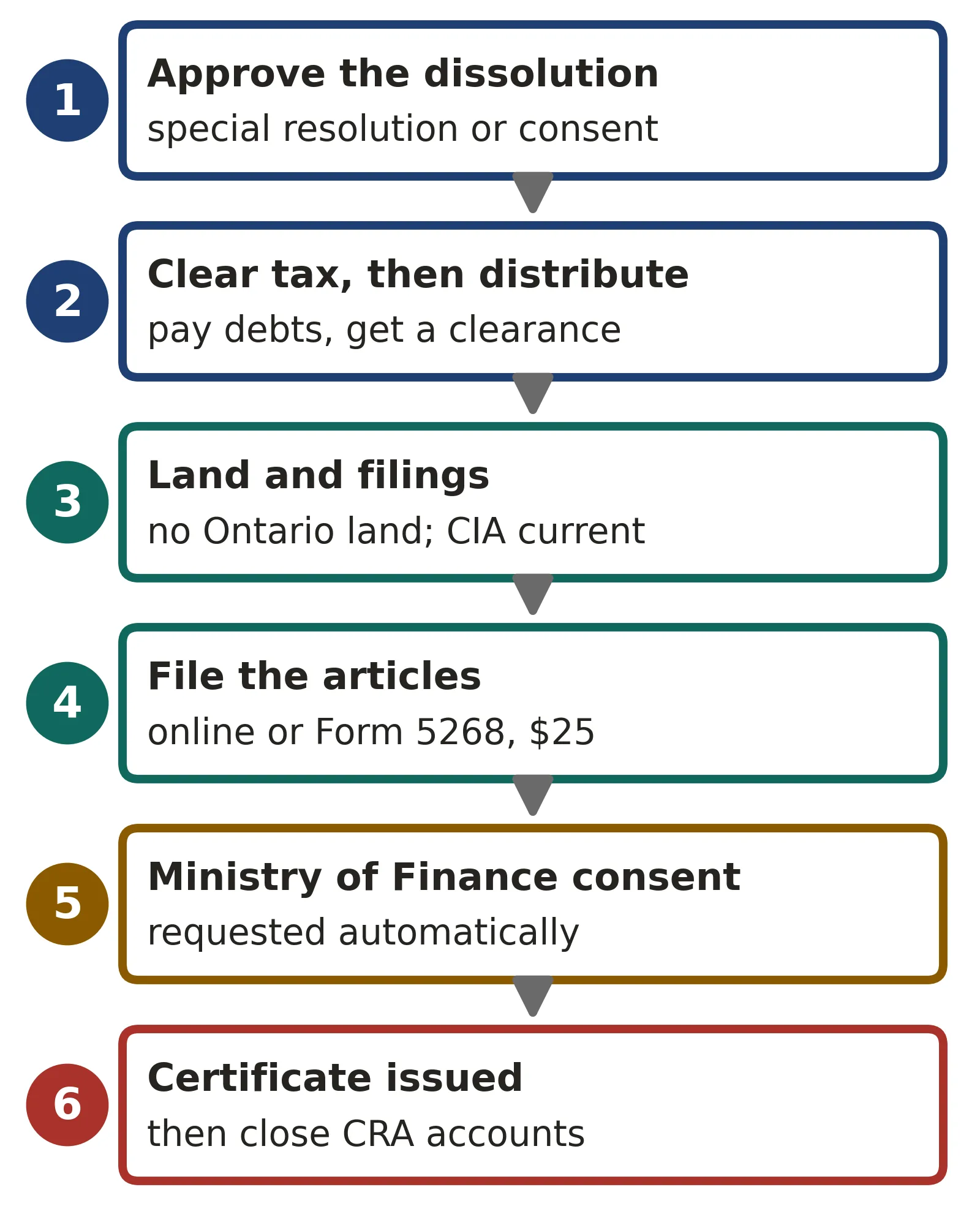
Four practical rules govern the filing itself:
- Ministry of Finance consent: the notice states that Minister of Finance consent is required to dissolve the corporation and that a request for consent is forwarded automatically. The Form 5268 instructions say the Ministry of Finance will verify compliance with all tax statutes, such as payments and returns, and will contact the corporation if there are compliance issues.
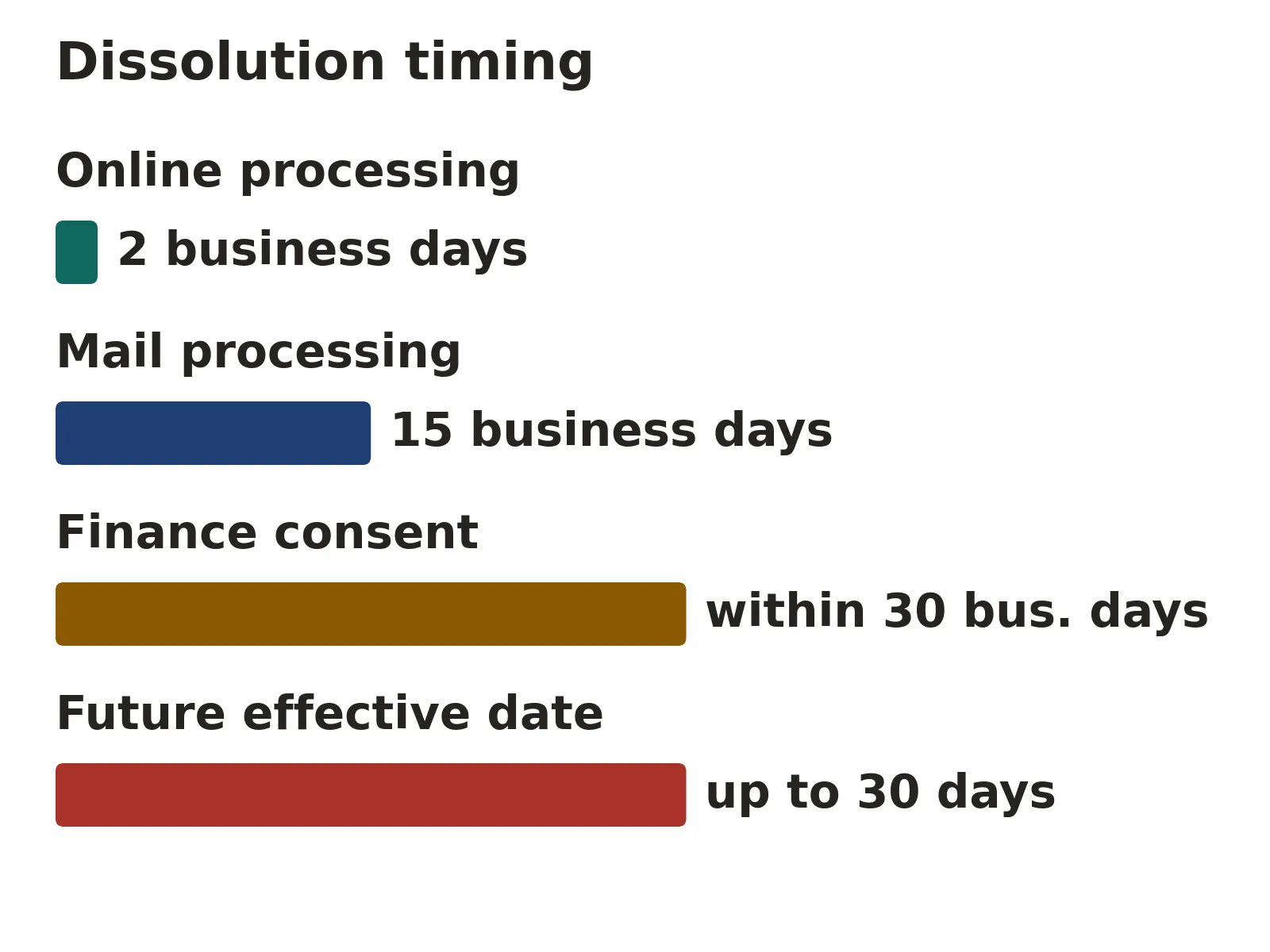
- Fee: Ontario's fee and processing-time page (updated September 29, 2026) lists Business Corporations Act dissolution at $25, with a 2-business-day service standard online and 15 business days by mail. The same page says the Ministry of Finance provides its consent electronically within 30 business days of receiving the request from the registry.
- Effective date: the notice allows a requested date up to 30 days after the articles are submitted, provided Minister of Finance consent has been obtained by then. The Form 5268 instructions say a past date cannot be chosen.
- Records: the notice requires the corporation to keep a properly executed version of the articles at its registered office address, in paper or electronic form.
Figure 2 compares the time each part of the process can take.
What tax steps come before and after dissolution?
The Ontario filing does not close the corporation's federal tax accounts, and the order of steps matters:
- Clearance before distributing: the CRA's T2 Corporation Income Tax Guide (T4012) says the corporation's legal representative has to get a clearance certificate to avoid being personally liable for unpaid taxes, interest and penalties, and that only after receiving the clearance certificate can the property be distributed.
- Final T2: the same guide covers the final return for the tax year ending on the date of dissolution, which is shown on the articles of dissolution.
- Close the accounts: the CRA's page on closing business accounts says that once the corporation has been dissolved, it should consult Form RC145; otherwise the CRA considers that the corporation still exists and it will have to file a return even if no tax is payable. Payroll accounts need final remittances and information returns.
- GST/HST: the CRA's page on closing a GST/HST account requires notice to the CRA with the reason for closing, a final return and payment of any amount owing.
- Refunds: the CRA's page on requesting a refund after dissolution says remaining overpayments generally become the property of the Crown on dissolution. A voluntarily dissolved corporation can request a refund on Form RC278 with its certificate of dissolution, but an involuntarily dissolved corporation cannot.
Tax planning for the final distribution, such as how the remaining property is paid out to shareholders, is a question for the corporation's accountant before the special resolution is passed.
What happens after the certificate of dissolution?
Dissolution ends the corporation, but not every obligation connected to it:
- Lawsuits continue: under section 242(1), a proceeding started by or against the corporation before dissolution may continue, and a new proceeding may be brought against it, as if it had not been dissolved.
- Shareholders can be liable: under section 243(1), each shareholder who received property on the distribution is liable to a person claiming under section 242 to the extent of the amount the shareholder received.
- Leftover property goes to the Crown: under section 244(1), any property not disposed of on the date of dissolution immediately forfeits to and vests in the Crown. A bank account, a trademark or a receivable left in the corporation's name is lost to the owners.
- No revival: the Ministry's notice states that there is no provision under the OBCA to file articles of revival for a corporation that voluntarily dissolved, and that the only way to revive it would be a Special Act of the Legislature. Revival under section 241(9) is limited to corporations dissolved by the Director's order.
That last point is the strongest reason to check everything before filing. A corporation dissolved for failing to file can usually be revived; one dissolved on purpose, with an asset left behind, generally cannot. Our guide to articles of amendment in Ontario covers the alternative of changing a corporation rather than ending it, for example to repurpose a dormant company.
Articles of dissolution: Ontario vs federal corporations
A federal corporation incorporated under the Canada Business Corporations Act does not file Ontario articles of dissolution; it dissolves through Corporations Canada. Corporations Canada's guide to dissolving a business corporation says a corporation can apply to dissolve when it has no property or liabilities, and its fee page lists online dissolution as free and taking one day. The comparison below shows the main differences.
| Item | Ontario (OBCA) | Federal (CBCA) |
|---|---|---|
| Government fee | $25 | Free online |
| Online processing | 2 business days | 1 day |
| Revival later | Special Act only | Possible |
Corporations Canada's guide says reviving a federal corporation is possible after a certificate of dissolution has been issued. For the set-up side of the same choice, see our guides to articles of incorporation in Ontario and the Ontario incorporation checklist.
Frequently asked questions
How much does it cost to dissolve a corporation in Ontario?
The government fee for articles of dissolution under the Business Corporations Act is $25, whether filed online or by mail, according to Ontario's fee page updated September 29, 2026. Service providers charge their own fees on top, and the corporation's accountant will usually charge for the final tax returns and the clearance certificate request.
How long does it take to dissolve an Ontario corporation?
Ontario's service standard is 2 business days online and 15 business days by mail, but the filing also needs Ministry of Finance consent, which the fee page says is provided within 30 business days. The CRA clearance certificate and final returns can take longer, and they should be completed before the property is distributed.
Can a dissolved Ontario corporation be revived?
It depends on how it was dissolved. A corporation dissolved by the Director for failing to file can apply for revival under section 241 of the OBCA within 20 years. The Ministry's notice says a corporation that voluntarily filed articles of dissolution can only be revived by a Special Act of the Legislature.
Do all shareholders have to agree to dissolve the corporation?
Not necessarily. Section 237 allows dissolution by a special resolution passed at a shareholders' meeting, which needs at least two-thirds of the votes cast, or by the written consent of all voting shareholders. A corporation that never started business and never issued shares can be dissolved by all of its incorporators.
What happens to property left in a dissolved corporation?
Under section 244 of the OBCA, any property not disposed of on the date of dissolution immediately forfeits to and vests in the Crown. Bank balances, receivables, domain names and intellectual property should be distributed or transferred before the articles are filed, after the creditors have been paid or provided for.
Can creditors still sue after the corporation is dissolved?
Yes. Section 242 lets proceedings continue or be brought against the dissolved corporation as if it had not been dissolved, and section 243 makes each shareholder who received property on the distribution liable to a claimant up to the amount that shareholder received. Paying or providing for debts before dissolving protects the shareholders.
Conclusion
Articles of dissolution, Ontario's $25 filing, are a short form, but they sit at the end of a sequence that has to be done in order: approval, debts, a tax clearance, distribution, land and filings, then the articles themselves, then the CRA accounts. The reason the order matters is that a voluntary dissolution is effectively permanent. Property left behind goes to the Crown, claims can still reach shareholders, and revival takes an Act of the Legislature, so the checking happens before the filing.
How Mayo Law can help
Mayo Law helps Ontario corporations and their owners close companies cleanly from offices in Toronto and New York. Joseph Mayo, our principal attorney, is licensed in Ontario and New York. We prepare the shareholder approvals, review debts, land and contracts before dissolution, coordinate with the corporation's accountant on clearance and final returns, file the articles of dissolution, and advise on whether a dormant corporation should be dissolved, amalgamated or kept. Our incorporation lawyer page covers corporate set-up and maintenance, and our international business page describes our cross-border corporate work.
Disclaimer
This article provides general information about dissolving an Ontario business corporation as of October 2026. It is not legal or tax advice, and reading it does not create a solicitor-client or attorney-client relationship. Fees, forms and Ministry procedures change, so check the official sources before you file. Mayo Law provides legal services in Ontario and New York.