

Contents
- Quick answer
- What does a lawyer do when you sell a business?
- Asset sale vs share sale: which are you selling?
- What happens to employees when a business is sold?
- Which tax and filing steps create liability?
- What changes when the buyer is Canadian or on an E-2 visa?
- How do you decide whether you need a lawyer?
- Frequently asked questions
- Conclusion
- How Mayo Law can help
- Disclaimer
Do I need a lawyer to sell my business? For most owners of an established company, the honest answer is yes, even though in most private sales using a lawyer is a choice rather than a legal requirement. The sale itself is a contract, but the steps around it are not: tax notices with fixed deadlines, employee rights that follow the business to the buyer, and filings where the buyer can end up paying the seller's tax bill. Those are the places where an unadvised sale goes wrong.
This guide is written for owners selling a business in Ontario or New York, and for buyers on the other side, including Canadian buyers and investors using the E-2 visa to buy a US business. It covers what a lawyer actually does at each stage, the asset sale vs share sale decision, what happens to employees, the tax and filing steps that create liability, and how to decide whether your sale needs one. The rules below were checked against official sources as of October 2026.
Quick answer
Usually, yes. A small sale of equipment between people who trust each other can close without a lawyer, but selling an operating company involves a binding purchase agreement, tax notices, employee obligations and liability allocation. A lawyer drafts and negotiates those terms, runs or answers due diligence, and makes sure the filings with deadlines are made.
What does a lawyer do when you sell a business?
A business sale moves through the same stages on both sides of the border, and the lawyer's job changes at each one. The seller's lawyer protects the price and limits what the seller is still on the hook for after closing. The buyer's lawyer makes sure the buyer gets what it is paying for and does not inherit problems it did not price in.
The table below sets out the split by stage.
| Stage | Seller's lawyer | Buyer's lawyer |
|---|---|---|
| Preparation | Tidies records and contracts | Reviews deal structure |
| Letter of intent | Limits binding terms | Secures exclusivity |
| Due diligence | Prepares disclosure | Reviews records and risks |
| Purchase agreement | Narrows warranties | Seeks indemnities |
| Filings and consents | Seller tax notices | Bulk sale and investment notices |
| Closing | Delivers clean title | Releases funds on conditions |
The letter of intent sets the deal's shape before either side spends heavily on due diligence. Our guide to the letter of intent to purchase a business explains which terms in it are binding and which are not, and how it becomes the definitive agreement. The purchase agreement is where most of the money is actually protected: the representations and warranties the seller gives, the indemnity if they turn out to be wrong, any holdback or escrow, and the conditions that must be met before closing.
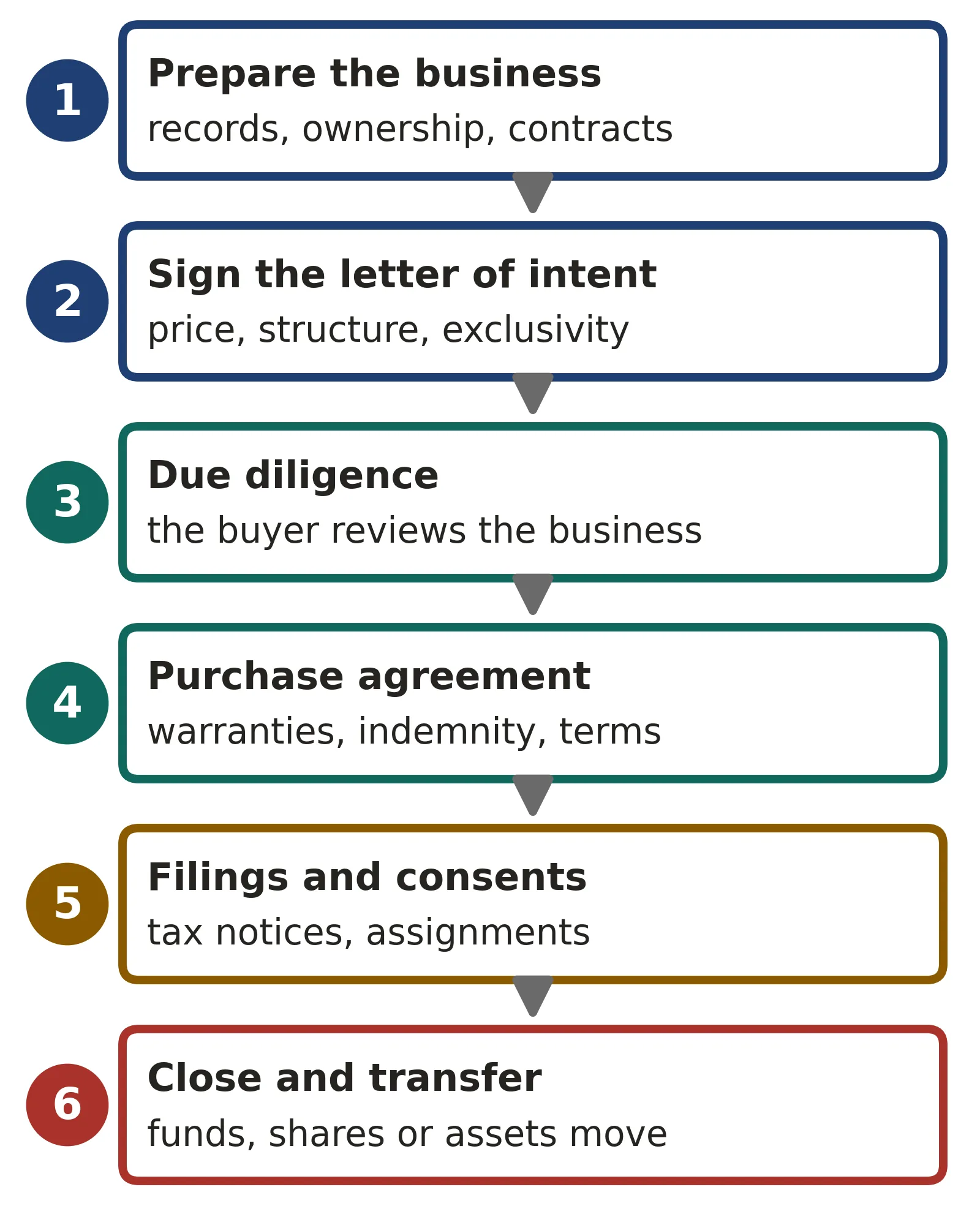
Preparation is the stage owners skip most often. Before a buyer arrives, a seller's lawyer can tidy the minute book, confirm who owns the shares and the intellectual property, and check which customer and supplier contracts need consent before they can be assigned. Problems found early can be fixed. Problems a buyer finds in due diligence become price reductions.
Asset sale vs share sale: which are you selling?
The first legal question is what is being sold. In a share sale, the owner sells the shares of the corporation, and the corporation keeps everything it already has: its contracts, its employees, its permits and its liabilities, known and unknown. In an asset sale, the corporation sells selected assets, such as equipment, inventory, customer lists and goodwill, and the buyer takes only the liabilities it agrees to take. Buyers often prefer assets for that reason. Sellers often prefer shares, for the clean exit and, in Canada, for tax reasons.
The tax difference can be large. The Canada Revenue Agency's guide to the capital gains deduction lists dispositions of qualified small business corporation shares among the gains eligible for the lifetime capital gains exemption, and states that under proposed changes the exemption is $1,250,000 for 2025 dispositions of qualifying property. The federal Report on Federal Tax Expenditures 2026 says Budget 2025 confirmed the government intends to maintain that amount and that indexation would resume in 2026. The exemption attaches to shares, so assets sold by the corporation itself do not qualify. Whether a particular company's shares meet the tests is a question for your tax adviser, and the structure has to be settled before the letter of intent fixes it.
Two rules also change with the structure:
- GST/HST on an asset sale: under Excise Tax Act section 167, the seller and buyer can jointly elect so that no GST/HST is payable on the supplies made under the sale agreement, subject to three exceptions the CRA lists, if the buyer acquires all or substantially all of the property needed to carry on the business. The CRA's GST/HST Memorandum 14-4 explains that this generally means 90% or more, and that if the seller is a GST/HST registrant the buyer must be one too. The election is made on Form GST44.
- New York bulk sales: New York's Tax Department states in Tax Bulletin ST-70 that a buyer of business assets from a seller required to collect New York sales tax must file Form AU-196.10 at least 10 days before paying for or taking possession of the assets, whichever happens first, or may be held liable for the seller's unpaid sales and use taxes. The same bulletin says a purchase of all of a corporation's stock is not a bulk sale, because the business assets are not transferred.
Ontario no longer has a bulk sales statute: Ontario's e-Laws records that the Bulk Sales Act was repealed on March 22, 2017 (S.O. 2017, c. 2, Sched. 3, s. 1). Our guide to stock purchase agreements covers the share-sale contract in more depth.
What happens to employees when a business is sold?
In Ontario, employees do not simply start over with the buyer. Section 9(1) of the Employment Standards Act, 2000 provides that if an employer sells a business or part of a business and the purchaser employs an employee of the seller, the employee's employment is deemed not to have been terminated or severed, and service with the seller counts as service with the purchaser for later calculations of length of employment. Under section 9(2), that continuity does not apply if the buyer hires the employee more than 13 weeks after the earlier of the employee's last day with the seller and the date of the sale.
That has a direct price effect. A buyer who keeps a long-serving team inherits their years of service for notice and severance purposes, and a seller who terminates staff before closing owes them their ESA entitlements. The purchase agreement should say who bears which cost.
A second Ontario rule matters when the owner stays on. Section 67.2 of the ESA bars most employee non-compete agreements, but section 67.2(3) excepts an agreement made as part of a sale of a business that prohibits the seller from competing with the purchaser, where the seller becomes an employee of the purchaser immediately after the sale. Our guide to non-compete agreements in Ontario explains the rule and its other exception.
Which tax and filing steps create liability?
Several of the steps around a sale carry deadlines, and missing them can shift the seller's liability onto the buyer. Figure 2 places the main ones relative to the closing date.
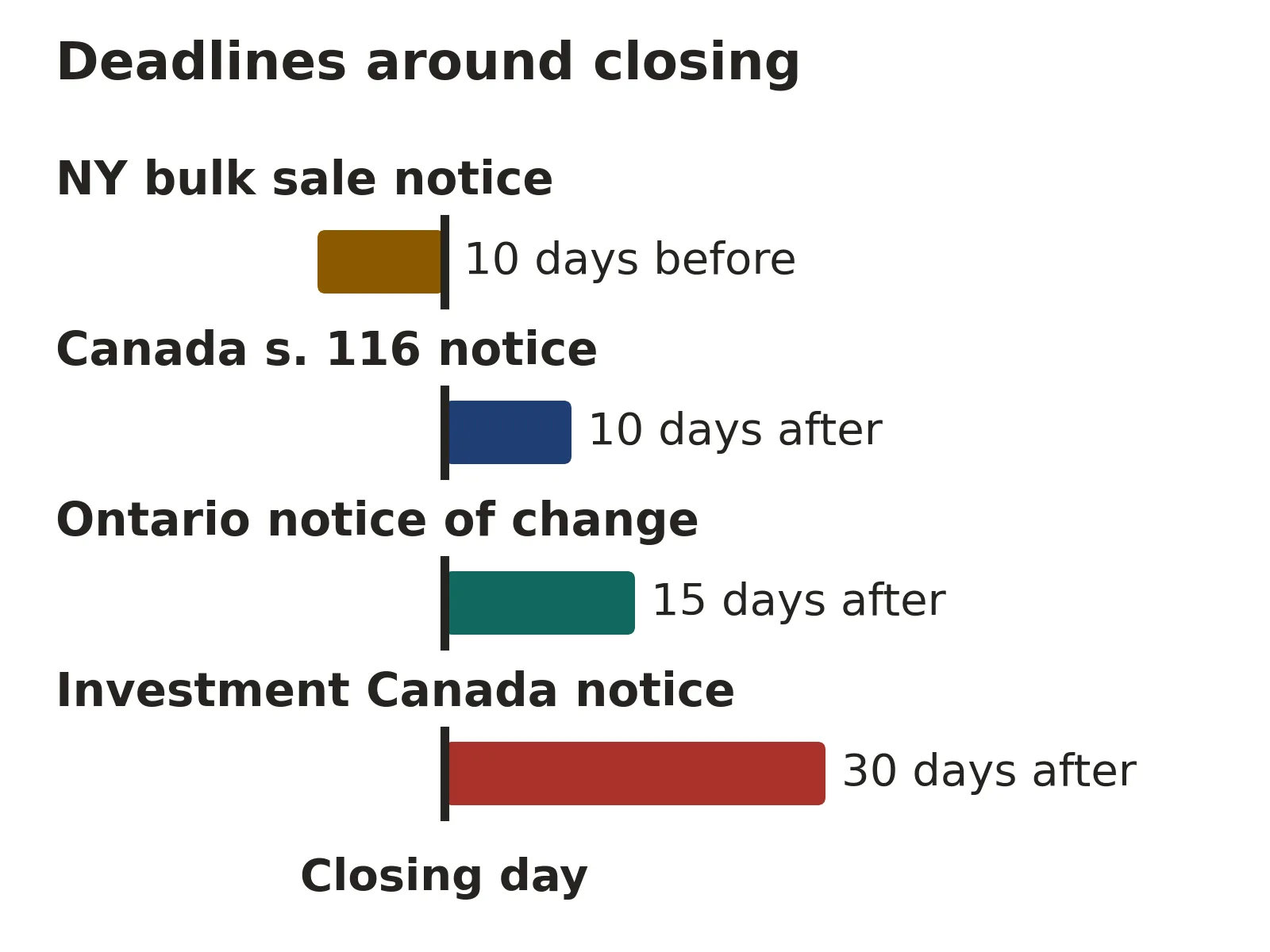
- Non-resident sellers in Canada: the CRA's guidance on disposing of or acquiring certain Canadian property says a non-resident must notify the CRA within 10 days of disposing of taxable Canadian property, on Form T2062. If no certificate of compliance is issued, the purchaser may become liable and is entitled to withhold 25% (50% on certain property) of the proceeds, less the certificate limit. For shares, the guidance says no withholding is required if the shares do not derive their value, currently or within the previous 60 months, principally from real property in Canada.
- New York asset buyers: the AU-196.10 bulk sale notice described above, at least 10 days before payment or possession.
- Ontario corporations: after a share sale that changes the board or officers, the corporation files a notice of change under section 4(1) of the Corporations Information Act within 15 days after the change.
- Foreign buyers of Canadian businesses: under sections 11 and 12 of the Investment Canada Act, a non-Canadian acquiring control of a Canadian business must give notice at any time before implementing the investment or within 30 days after, unless the investment is reviewable. Review thresholds for 2026 are far higher, for example $2.179 billion in enterprise value for trade-agreement investors, which include United States investors.
- US asset sales: the IRS Instructions for Form 8594 say both the purchaser and the seller generally must file Form 8594 with their income tax returns when a group of assets that makes up a trade or business is transferred.
Our letter of intent guide places these filings in a deal timetable, so the purchase agreement can assign each one to a party.
What changes when the buyer is Canadian or on an E-2 visa?
Canadian investors often buy an existing US business to qualify for the E-2 treaty investor visa, and that turns the purchase agreement into part of the visa case. The State Department's Foreign Affairs Manual at 9 FAM 402.9 says the funds invested must be committed to the investment, and the commitment must be real and irrevocable. It also says a purchase conditioned on the issuance of the E-2 visa may still qualify, and would be a solid commitment, if the assets are held in escrow for release or transfer once the condition is met. Mere intent to invest, or uncommitted funds in a bank account, will not suffice. For an established business, the same chapter treats its cost as generally the purchase price, which is normally the fair market value.
For a buyer, that means the escrow terms, the visa condition and the closing mechanics all need to be drafted with the visa in mind, not just the commercial deal. For a seller dealing with an E-2 buyer, it means agreeing to a timetable that allows for the consular process and an escrow release that protects the seller if the visa is refused. Our guide to finding an E-2 visa business for sale covers what makes a target qualify, and our E-2 visa lawyer page describes our E-2 work.
How do you decide whether you need a lawyer?
A lawyer to sell a business earns the fee where the risk is. The more of the following that apply, the stronger the case for one:
- You are selling shares: the buyer will ask for warranties and an indemnity that can follow you after closing.
- The business has employees: Ontario's continuity rule and termination costs need to be allocated.
- Key contracts need consent: leases, licences and customer contracts often cannot be assigned without it.
- Someone is non-resident or cross-border: section 116, the Investment Canada Act or an E-2 condition may apply.
- Part of the price is deferred: an earn-out, holdback or vendor take-back note needs security and clear terms.
- The buyer will rely on a lender: financing conditions and lien searches change the closing mechanics.
On the last point, a buyer of Ontario business assets can check whether a lien has been registered against the seller in the Personal Property Security Registration system. Ontario's lien search page lists an online search response at $8 (updated May 12, 2025). A search is quick and cheap. Reading what it shows, and getting registrations discharged at closing, is lawyer work.
If none of the points apply, for example a sole proprietor selling equipment and a customer list for a modest price to a buyer they know, the case for a lawyer is weaker. Even then, a short written agreement reviewed by a lawyer costs far less than a dispute over what was sold.
Frequently asked questions
Do I need a lawyer to sell my business if I use a broker?
A broker and a lawyer do different jobs. A business broker markets the business, finds buyers and helps negotiate price. A lawyer drafts and negotiates the binding purchase agreement, the warranties and indemnities, and the closing documents, and identifies filings with legal deadlines. Many sales use both, with the broker introducing the buyer and the lawyer papering the deal.
Do I need a lawyer to buy a business?
A buyer usually carries more legal risk than the seller, because the buyer inherits whatever it did not find. In Ontario, the employees' service follows the business under the ESA, and in New York an asset buyer who skips a required bulk sale notice may become liable for the seller's unpaid sales tax. A buyer's lawyer runs due diligence and negotiates protection for those risks.
Can the buyer and seller use the same lawyer?
It is generally not advisable. The buyer and seller want opposite things on price adjustments, warranties, indemnities and conditions, and a lawyer acting for both cannot push either side's position. Each side normally retains its own lawyer, so that someone is negotiating its position on every disputed term, from the purchase price adjustment to the survival period of the warranties.
Is an asset sale or a share sale better for the seller?
Sellers in Canada often prefer a share sale, because the lifetime capital gains exemption applies to qualifying shares and the buyer takes over the corporation's liabilities. Buyers often prefer an asset sale for the opposite reason. The right answer depends on the company's tax position, its contracts and the price, so the structure is usually negotiated before the letter of intent.
What is due diligence in a business sale?
Due diligence is the buyer's investigation of the business before it commits to close. It typically covers corporate records and share ownership, financial statements and tax filings, material contracts, employees, intellectual property, litigation, permits and registered liens. The seller's preparation shapes how smoothly it goes, and its findings often lead to price adjustments or specific indemnities.
What happens if a non-resident sells a Canadian business without a certificate?
The CRA says a non-resident disposing of taxable Canadian property must notify it within 10 days on Form T2062. If no certificate of compliance is issued, the purchaser may become liable and is entitled to withhold 25% of the proceeds, or 50% on certain property, less the certificate limit. That is why a buyer will often hold back part of the price until the certificate arrives.
Conclusion
For most owners, the question is not whether the law requires a lawyer but whether the sale can afford to go without one. The price is negotiated once, but the warranties, the indemnity, the employee obligations and the tax notices decide how much of it the seller keeps and how much risk the buyer takes on. Ontario, New York and federal rules each add their own steps, and cross-border and E-2 buyers add more. Bringing a lawyer in before the letter of intent is signed is usually cheaper than bringing one in after something goes wrong.
How Mayo Law can help
Mayo Law acts for sellers and buyers of businesses on both sides of the Canada-US border from offices in Toronto and New York. Joseph Mayo, our principal attorney, is licensed in Ontario and New York. We prepare businesses for sale, draft and negotiate letters of intent and purchase agreements, run or respond to due diligence, coordinate the Canadian and New York filings around closing, and structure E-2 purchases so the commercial terms and the visa case work together. Our international business page describes our cross-border transaction work.
Disclaimer
This article provides general information about selling and buying a business in Ontario and New York as of October 2026. It is not legal or tax advice, and reading it does not create a solicitor-client or attorney-client relationship. Tax amounts, thresholds and filing rules change, so check the official sources and get advice on your own transaction. Mayo Law provides legal services in Ontario and New York.