

Contents
- Quick Answer
- Why do treaty investors choose New York for an E-2 enterprise?
- LLC or corporation: which entity fits an E-2 enterprise in New York?
- What are the New York Department of State formation steps and fees?
- What is the New York LLC publication requirement and why does it matter to an E-2 file?
- How do you get an EIN and register for New York taxes?
- What do licences, permits and a commercial lease actually prove?
- How does a consular officer read your New York setup?
- Frequently asked questions about starting an E-2 business in New York
- Conclusion
- How Mayo Law can help
- Disclaimer
Starting an E-2 business in New York puts a treaty investor in one of the largest commercial markets in the United States and in one of the more procedural ones. New York has no single registry that handles everything. Company formation sits with the Department of State, tax registration sits with the Department of Taxation and Finance, and a limited liability company has to run a newspaper publication process that most other states abandoned long ago.
None of that is administrative noise for a treaty investor. Federal regulation ties the visa to it. The bona fide enterprise standard at 8 CFR 214.2(e)(13) asks whether the business is genuinely operating and whether it meets the legal requirements for doing business in the jurisdiction where it sits. In New York, that second half has a specific and checkable meaning. This article walks the sequence, the fees verified as of September 2026, and how each step reads to a consular officer.
Quick Answer
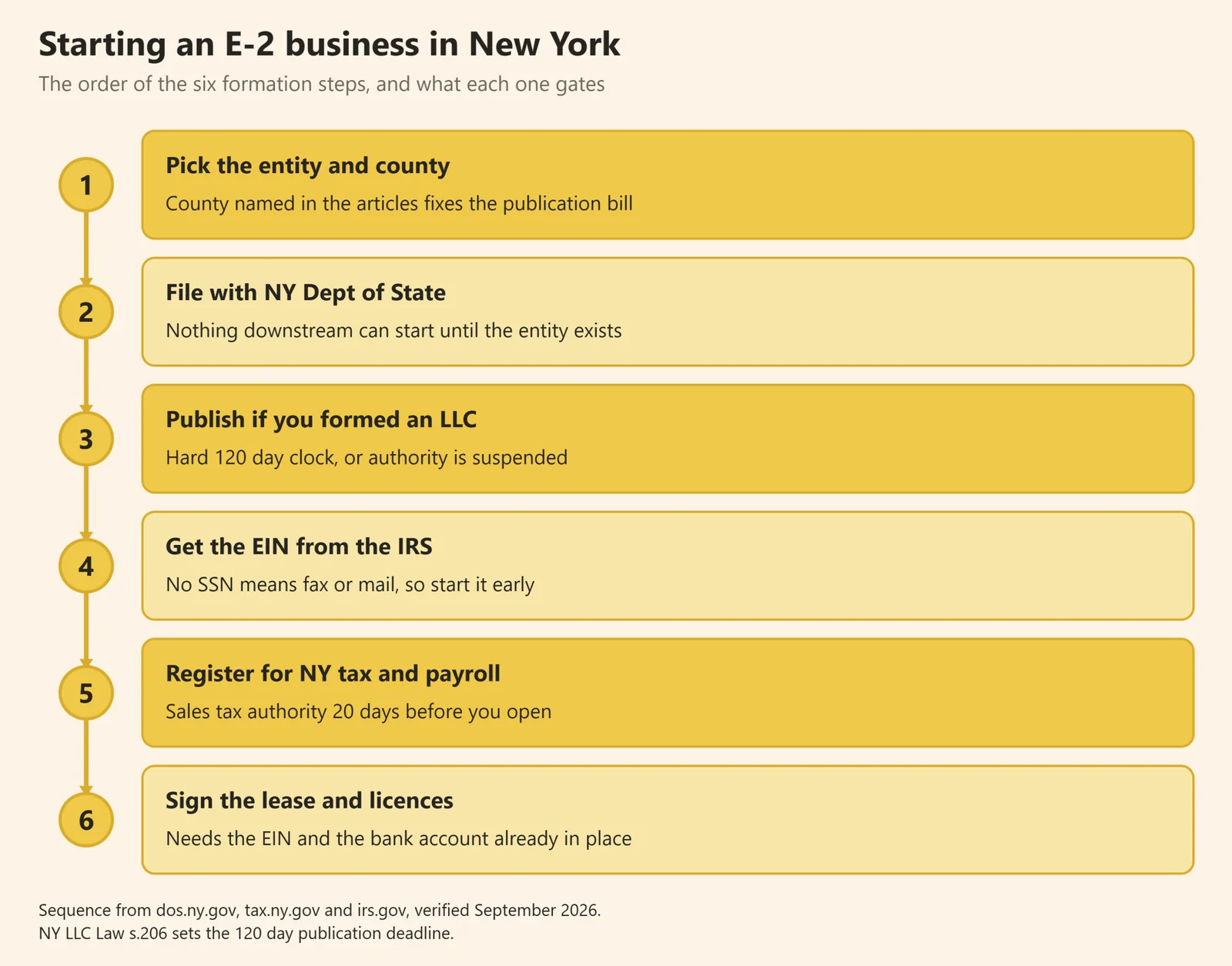
Set up in New York by choosing an entity, filing with the Department of State, completing the LLC publication rule within 120 days if you formed an LLC, obtaining a free EIN, registering for state tax, and signing a real lease. As of September 2026 the LLC filing fee is $200 and the corporation fee is $125.
Why do treaty investors choose New York for an E-2 enterprise?
For a Canadian, starting an E-2 business in New York is usually the shortest commercial jump available. Toronto to Manhattan is a short flight, the customer base is familiar, and supplier markets are deep in food service, logistics, construction trades, media and consulting. Canada has been an E-2 treaty country since the treaty entered into force on 1 January 1994, according to the treaty country table in 9 FAM 402.9, so nationality is rarely the obstacle. Our note on the E-2 visa route from Canada covers consular processing in more detail.
The trade-off is cost and compliance density. City rents, city-level business taxes and licensing rules for regulated trades are heavier than in most states. That is not automatically bad for an E-2 file. The substantiality test works proportionally: 8 CFR 214.2(e)(14) says that “generally, the lower the cost of the enterprise, the higher, proportionately, the investment must be to be considered a substantial amount of capital.” An enterprise with a genuine lease and real payroll is easier to evidence than a cheap virtual business somewhere quieter.
LLC or corporation: which entity fits an E-2 enterprise in New York?
Both work. The immigration regulation is neutral on entity type and cares about control: 8 CFR 214.2(e)(16) requires the applicant to establish control “by demonstrating ownership of at least 50 percent of the enterprise, by possessing operational control through a managerial position or other corporate device, or by other means.” What differs in New York is cost, paperwork, tax treatment, and how cleanly you can show that ownership on paper.
A corporation gives you a share register and share certificates, the easiest evidence package for the 50 percent test. An LLC is more flexible but needs an operating agreement and a membership ledger you keep current yourself, and it carries the publication requirement discussed below. Our longer comparison of an LLC versus a corporation in New York works through the governance and tax questions for founders generally. The table below covers the points that move for a treaty investor.
| Point | New York LLC | New York corporation |
|---|---|---|
| Formation document and Department of State fee | Articles of Organization, $200 | Certificate of Incorporation, $125 |
| Newspaper publication | Required in two newspapers for six weeks | Not required |
| Biennial Statement | $9 every two years | $9 every two years |
| Entity-level New York State charge | Annual filing fee on Form IT-204-LL. Flat $25 if the LLC is a disregarded entity for federal tax purposes; $25 to $4,500 by New York source gross income if it is treated as a partnership | Article 9-A franchise tax, fixed dollar minimum starting at $25 |
| New York City charge if you operate in the five boroughs | Unincorporated Business Tax at 4 percent of income allocated to the city, but only where the LLC is treated as a partnership or a disregarded entity for federal tax purposes | Business Corporation Tax, 8.85 percent general rate. An LLC that is taxable as a corporation federally pays this instead of the Unincorporated Business Tax |
| Proving the E-2 ownership test | Operating agreement plus membership ledger | Bylaws, share register and share certificates |
All figures above were verified in September 2026 from the New York Department of State, the New York Department of Taxation and Finance, and the New York City Department of Finance. Two cautions go with the city row. First, the charge follows federal tax classification rather than the letters in the company name: the New York City Department of Finance treats the corporation tax as reaching “any entity that is taxable as a corporation for federal tax purposes, by election or otherwise,” which expressly includes limited liability companies. Second, 4 percent and 8.85 percent are not a like-for-like ranking. They sit on different tax bases and different structures, and the corporation carries a second layer when profits reach the shareholder, so the effective load depends on your own numbers.
There is also a visa consequence that ranking pages leave out. City-level tax load reduces the income the enterprise can actually deliver to the investor, and that income is what a consular officer weighs under the marginal enterprise test at 8 CFR 214.2(e)(15). Entity choice in the five boroughs is therefore a marginality question as well as a tax question, and it should be modelled before you file.
What are the New York Department of State formation steps and fees?
Formation runs through the Division of Corporations at the New York Department of State. You clear the name, prepare the formation document, name a county, and file. As of September 2026 the Department of State states that “the fee for filing the Articles of Organization is $200” for a domestic LLC, and lists a “$125 filing fee for Certificate of Incorporation” for a domestic business corporation. Both entity types then owe a $9 Biennial Statement every two years, due in the calendar month in which the original formation document was filed. The Department of State charges $25 for processing within 24 hours, and states that expedited handling is not available for Biennial Statements. Our breakdown of the overall E-2 visa cost sets these formation charges next to the government fees on the immigration side.
The county field is a decision, not a formality
Section 203(e) of the New York Limited Liability Company Law requires the articles to state “the county within this state in which the office of the limited liability company is to be located,” and to designate the secretary of state as agent for service of process. That entry controls which newspapers you must use, because section 206 requires publication in newspapers “of the county in which the office of the limited liability company is located,” and the statute leaves the actual choice of titles to the county clerk. Rates vary widely by county and are set by publishers rather than the state, so no official source publishes a price and we quote none here. The county you name changes the bill, and defaulting to New York County is a choice with a cost attached.
| Step | Agency | Fee as of September 2026 | Timing |
|---|---|---|---|
| Articles of Organization (LLC) | NY Department of State | $200 | $25 more for 24 hour handling |
| Certificate of Incorporation (corporation) | NY Department of State | $125 | $25 more for 24 hour handling |
| Certificate of Publication (LLC only) | NY Department of State | $50 plus newspaper charges | Within 120 days of formation |
| EIN | IRS | No fee | Online if the responsible party has an SSN or ITIN. Otherwise fax, generally about 4 business days, or mail, about 4 weeks |
| Certificate of Authority for sales tax | NY Department of Taxation and Finance | No fee stated on tax.ny.gov | Apply at least 20 days before you open |
| Employer registration, Form NYS-100 | NY Business Express | No fee stated | Before the first payroll |
| Biennial Statement | NY Department of State | $9 | Every two years, in the formation month |
What is the New York LLC publication requirement and why does it matter to an E-2 file?
This is the step foreign investors most often miss, and it is the one with a hard consequence. Section 206 of the New York Limited Liability Company Law requires that “within one hundred twenty days after the effectiveness of the initial articles of organization” a copy or a notice of the substance of them “shall be published once in each week for six successive weeks” in “two newspapers of the county in which the office of the limited liability company is located, one newspaper to be printed weekly and one newspaper to be printed daily, to be designated by the county clerk.” You then file a Certificate of Publication with the affidavits of publication annexed, with a $50 filing fee.
Miss the deadline and the statute is explicit: “the authority of such limited liability company to carry on, conduct or transact any business in this state shall be suspended, effective as of the expiration of such one hundred twenty day period.” A suspended LLC is a poor answer to an officer applying the bona fide enterprise test at 8 CFR 214.2(e)(13). Six successive weeks of publication plus newspaper lead time means the clock has to start within days of formation. Investors who leave it until month three, or until the week they book the interview, have usually already lost the window.
How do you get an EIN and register for New York taxes?
The employer identification number comes from the IRS and, in the agency’s own words, “you never have to pay a fee for an EIN.” The friction for a foreign investor is the application channel. The IRS online tool sets two separate conditions that both have to hold: your principal place of business must be in the United States or its territories, and you must “have the responsible party’s Social Security number (SSN) or individual taxpayer ID number (ITIN).” A New York E-2 entity satisfies the first. A Canadian founder who has never worked in the United States fails the second, and that rules out the online tool.
It does not open the telephone line, and this is where foreign founders lose weeks. The Instructions for Form SS-4 make the telephone route available to international applicants only, and gate it on having “NO legal residence, principal place of business, or principal office or agency in the United States or U.S. territories.” An enterprise with a New York office and a signed New York lease has a United States principal place of business, so that number is not for it. The route is fax or mail on Form SS-4. The instructions state that under the Fax-TIN program “you can receive your EIN by fax generally within 4 business days,” and that by mail “you will receive your EIN in the mail in approximately 4 weeks.” Build the fax timeline into the calendar, because the EIN gates the bank account, and the bank account gates the evidence that your capital is genuinely at risk. Our explainer on when a business actually needs an EIN covers the underlying rules.
State and city registrations
If you will make taxable sales, the New York Department of Taxation and Finance requires a Certificate of Authority, and its guidance states that “you must apply for your certificate at least 20 days before you begin operating your business or before purchasing assets of another business.” You must also “prominently display your Certificate of Authority at your place of business, including additional locations.” If you will hire, you register through New York Business Express on Form NYS-100, the Employer Registration for Unemployment Insurance, Withholding, and Wage Reporting for Business Employer, and separately you have 20 days from an employee’s hiring date to report the new hire.
Two ongoing charges are worth pricing before you choose the entity, and every figure in this paragraph is as of September 2026. An LLC or LLP that is treated as a partnership for federal income tax purposes and has New York source income files Form IT-204-LL and pays an annual filing fee that starts at $25 for New York source gross income up to $100,000 and rises to $4,500 above $25 million. Federal classification changes that answer entirely. The Department of Taxation and Finance states that the fee “for an LLC that is treated as a disregarded entity for federal income tax purposes, and that has any income, gain, loss or deduction from New York Sources, is $25,” a flat charge that never climbs the scale. That is the likely outcome for a solo treaty investor who forms a single-member New York LLC, so check your classification before you price the graduated table. Either way the filing is due on or before the 15th day of the third month after the tax year closes, with no extension available. A general business corporation is taxable under Article 9-A and owes a fixed dollar minimum that starts at $25 where New York receipts are not more than $100,000.
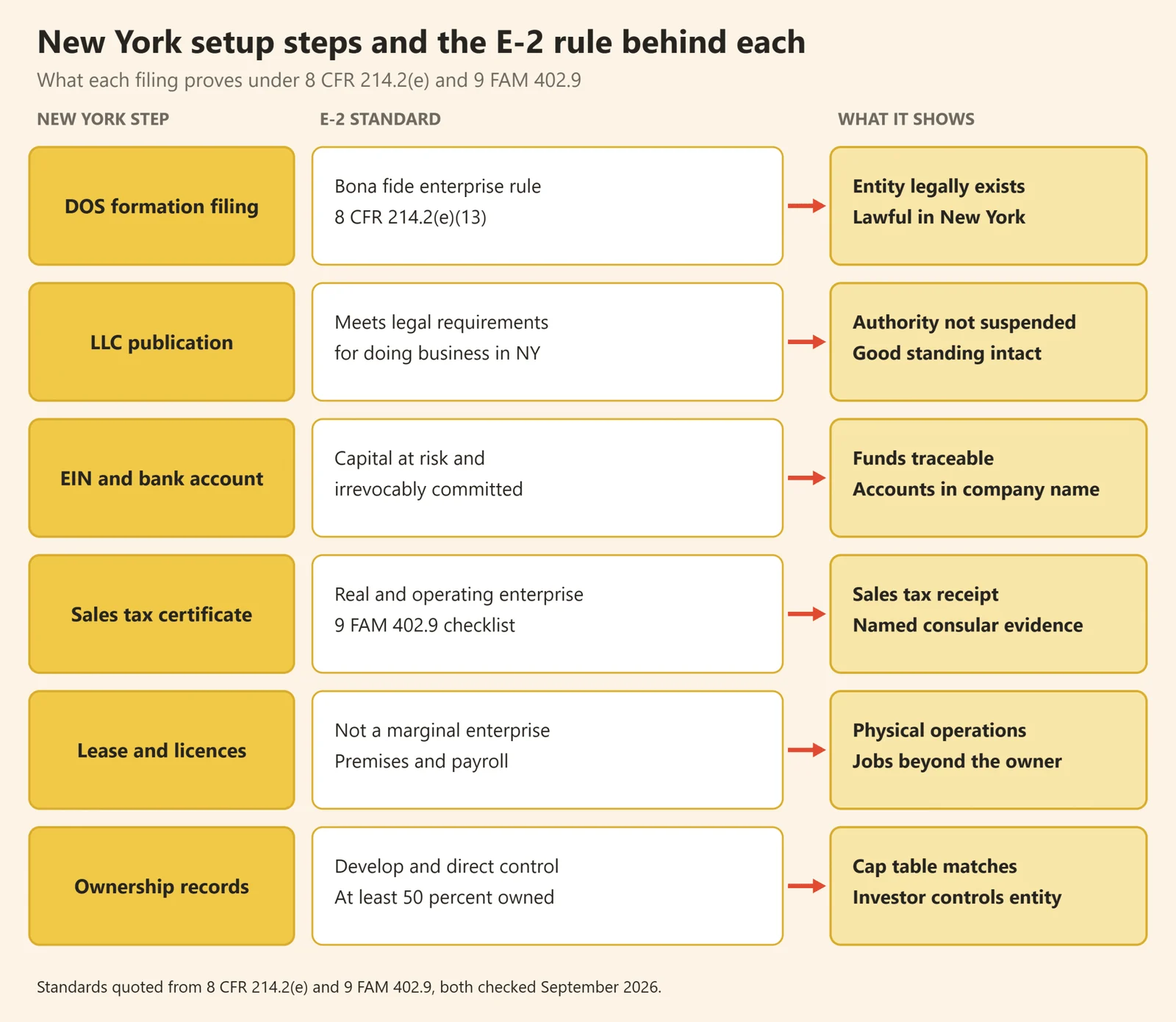
| New York step | E-2 standard it answers | What it shows the officer |
|---|---|---|
| Department of State formation filing | Bona fide enterprise, 8 CFR 214.2(e)(13) | The entity legally exists and is lawfully formed in New York |
| LLC publication and Certificate of Publication | Meets applicable legal requirements for doing business, 8 CFR 214.2(e)(13) | Authority to transact business is not suspended |
| EIN and company bank account | Capital at risk and irrevocably committed, 8 CFR 214.2(e)(12) | Funds are traceable and held in the company’s name |
| Certificate of Authority for sales tax | Real and operating enterprise, 9 FAM 402.9 evidence checklist | A sales tax receipt, named in the consular checklist |
| Commercial lease and trade licences | Not a marginal enterprise, 8 CFR 214.2(e)(15) | Physical premises, permits and jobs beyond the owner |
| Operating agreement, ledger or share register | Develop and direct, at least 50 percent ownership, 8 CFR 214.2(e)(16) | The ownership record matches the investor named on the application |
What do licences, permits and a commercial lease actually prove?
They prove the enterprise exists in the physical world. The Department of State’s consular guidance in 9 FAM 402.9 lists, among suggested evidence for establishing a real and operating commercial enterprise, an occupational licence, business licences and permits, and a sales tax receipt. Those are New York artefacts. A restaurant needs its food service permit, a contractor needs its trade licensing, a retailer needs the Certificate of Authority described above. A file holding a formation certificate and a projection but no licence, no permit and no premises asks the officer to take the business on trust.
The lease does the same job with more weight. A signed multi-year commercial lease in the company’s name, with a deposit paid from the company account, commits capital irrevocably in the sense required by 8 CFR 214.2(e)(12), demonstrates a fixed place of operations, and makes a marginality argument concrete. A month-to-month desk in a shared office is not fatal, but it carries far less evidential weight in Manhattan than a leased unit or storefront. Supporting your projections is a separate discipline, and our guide to E-2 business plan requirements sets out what the plan has to carry.
How does a consular officer read your New York setup?
The officer applies a small number of regulatory tests, and each New York filing maps onto one. On the enterprise, 8 CFR 214.2(e)(13) requires “a real, active, and operating commercial or entrepreneurial undertaking which produces services or goods for profit,” and adds that the enterprise “must meet applicable legal requirements for doing business in the particular jurisdiction in the United States.” Your Department of State filing receipt, your Certificate of Publication, your licences and your tax registrations answer that second sentence directly. On capital, 8 CFR 214.2(e)(12) requires funds placed at risk and irrevocably committed, which is where the bank account, the lease, equipment invoices and fit-out spend do their work.
On scale, 8 CFR 214.2(e)(15) states that “a marginal enterprise is an enterprise that does not have the present or future capacity to generate more than enough income to provide a minimal living for the treaty investor and his or her family,” and that projected future income capacity “should generally be realizable within 5 years.” A New York payroll registration and a real staffing plan speak to that, and so does household income, since an E-2 spouse is employment authorized incident to status, as our note on E-2 spouse work authorization explains. The full eligibility picture sits in our overview of the E-2 visa requirements, and proportionality in our piece on the E-2 minimum investment amount. The visa fee itself is fixed by regulation: 22 CFR 22.1 sets the processing fee for an E category nonimmigrant visa at $315 per person, current to 3 September 2026.
Read together, those tests mean the New York paperwork is not a workstream that finishes before the immigration one starts. The filing receipt, the Certificate of Publication, the EIN, the sales tax certificate and the lease are the exhibits, and the order in which you obtain them decides what the file can prove on the day of the interview. Where that sequencing and the treaty tests have to be assessed as a single matter, that is the work our E-2 treaty visa practice does.
Frequently asked questions about starting an E-2 business in New York
Do I have to form the New York company before I apply for the E-2 visa?
In practice yes, because the regulation asks for an enterprise that is real, active and operating, and because 8 CFR 214.2(e)(12) requires the capital to be irrevocably committed rather than merely intended. You cannot show a lease, a licence, a payroll registration or a bank balance without an entity to hold them. Formation is normally where the whole sequence starts.
Is a New York LLC or a New York corporation better for an E-2 visa?
Neither is preferred by the regulation, which looks only at control and at least 50 percent ownership under 8 CFR 214.2(e)(16). A corporation produces a share register that evidences ownership cleanly and avoids the publication requirement. An LLC is more flexible but must publish under section 206, and, as of September 2026, if it is treated as a partnership or a disregarded entity for federal tax purposes it faces the New York City Unincorporated Business Tax at 4 percent when it operates in the five boroughs. An LLC that is taxable as a corporation federally pays the Business Corporation Tax instead. Model both against your projected income rather than your revenue, because these are taxes on profit.
What happens if I miss the 120 day LLC publication deadline?
Section 206 of the New York Limited Liability Company Law suspends the company’s authority to carry on, conduct or transact any business in the state as of the expiration of the 120 day period. The same section says the failure does not “limit or impair the validity of any contract or act” of the company and does not make any member, manager or agent personally liable, so existing deals survive. The suspension is cured by completing publication and filing the Certificate of Publication with the $50 fee, but a suspended entity sitting in a visa file is a problem worth avoiding rather than fixing.
Can I get an EIN without a Social Security number?
Yes, but not through the two fastest channels. The IRS online tool requires the responsible party to hold a Social Security number or an individual taxpayer identification number. The telephone route does not fill the gap either, because the Instructions for Form SS-4 restrict it to applicants with no legal residence, principal place of business or principal office in the United States, which a New York enterprise with a New York office is not. Apply by fax or by mail on Form SS-4. The IRS says fax generally produces the EIN within 4 business days and mail takes approximately 4 weeks. The EIN itself is free in every channel.
Who chooses the two newspapers for the New York LLC publication?
Not you. Section 206 of the New York Limited Liability Company Law requires one weekly and one daily newspaper of the county in which the office of the limited liability company is located, “to be designated by the county clerk.” That is why the county you name in the Articles of Organization controls the bill. Rates are set by the publishers rather than by the state, so no official source publishes a price, and the designated titles and their charges differ sharply from one county to the next.
Does the investment amount need to be higher because the business is in New York?
There is no statutory minimum and no New York specific figure. The test in 8 CFR 214.2(e)(14) is proportional: the investment must be substantial in relation to the total cost of purchasing or creating the type of enterprise under consideration. New York costs tend to raise that total cost, which usually raises the sum you need to commit, but the analysis is driven by your business, not by your state.
Do I need a New York City licence as well as the state registrations?
It depends entirely on the trade. Many activities in the five boroughs need a city licence or permit in addition to state formation and state tax registration, and regulated sectors such as food service, construction, home improvement and personal care are the usual examples. Confirm the licensing position for your specific activity before you sign a lease, because some permits are tied to the premises.
Can my spouse work in the United States while I hold E-2 status?
Yes, and no separate permit is required first. USCIS states that spouses of E-2 workers in valid E-2 or E-2S status “are considered employment authorized incident to status,” so the spouse may take a job with any employer rather than waiting on an Employment Authorization Document, though one can still be requested. USCIS also confirms that the nationality of the spouse and children need not match the treaty investor’s. Second household income is worth planning for, because it changes what the family needs the enterprise itself to produce.
Conclusion
The New York steps are not separate from the visa case. They are the visa case, expressed in filings. Starting an E-2 business in New York means a Department of State receipt, a completed publication, a free EIN, a sales tax certificate, a payroll registration and a signed lease that together answer the question 8 CFR 214.2(e)(13) asks: is this a genuine operating enterprise that meets the legal requirements for doing business in this jurisdiction. Sequencing them properly, and pricing the entity choice against state and city taxes before you file, saves more than it costs.
How Mayo Law can help
Mayo Law is a cross-border United States and Canada firm with offices in Toronto and New York. Joseph Mayo is licensed in Ontario and in New York, which means the New York formation work and the treaty investor analysis can be handled by the same firm rather than split across two jurisdictions. That matters for a Canadian founder incorporating on one side of the border and applying on the other. If you are working through E-2 treaty investor representation, we can look at the entity choice, the New York filings and the evidence package together.
Disclaimer
This article is informational only and is not legal advice. Reading it does not create an attorney-client relationship, and you should not act on it without advice about your own circumstances. Fees, forms and procedures change, so verify current figures with the relevant agency before relying on them. Mayo Law provides legal services in Ontario and New York.