

Contents
- Quick Answer
- What is the TN category and who does it actually fit?
- When does the L-1 intra-company transfer win?
- Who is the E-2 treaty investor route built for?
- How does the H-1B cap work, and is it worth entering?
- Is the O-1 realistic, or only for famous people?
- Can a Canadian work in the US as a B-1 business visitor?
- How do the main US work visas for Canadians compare?
- How does the choice get made in practice?
- Frequently asked questions about US work visas for Canadians
- Conclusion
- How Mayo Law can help
- Disclaimer
There is no single best answer among the US work visas for Canadians, because the categories were written for different people. A Toronto engineer with a Chicago job offer, a manufacturer opening a Buffalo subsidiary and a founder buying a Florida business reach the same border with different problems, and the route that solves one fails badly for the others.
What follows is a route by route comparison: what each category is, who it fits, the requirement that decides eligibility, and the limitation that usually ends it. Every figure was checked against USCIS, the Federal Register, the Foreign Affairs Manual and the Code of Federal Regulations in September 2026.
Quick Answer
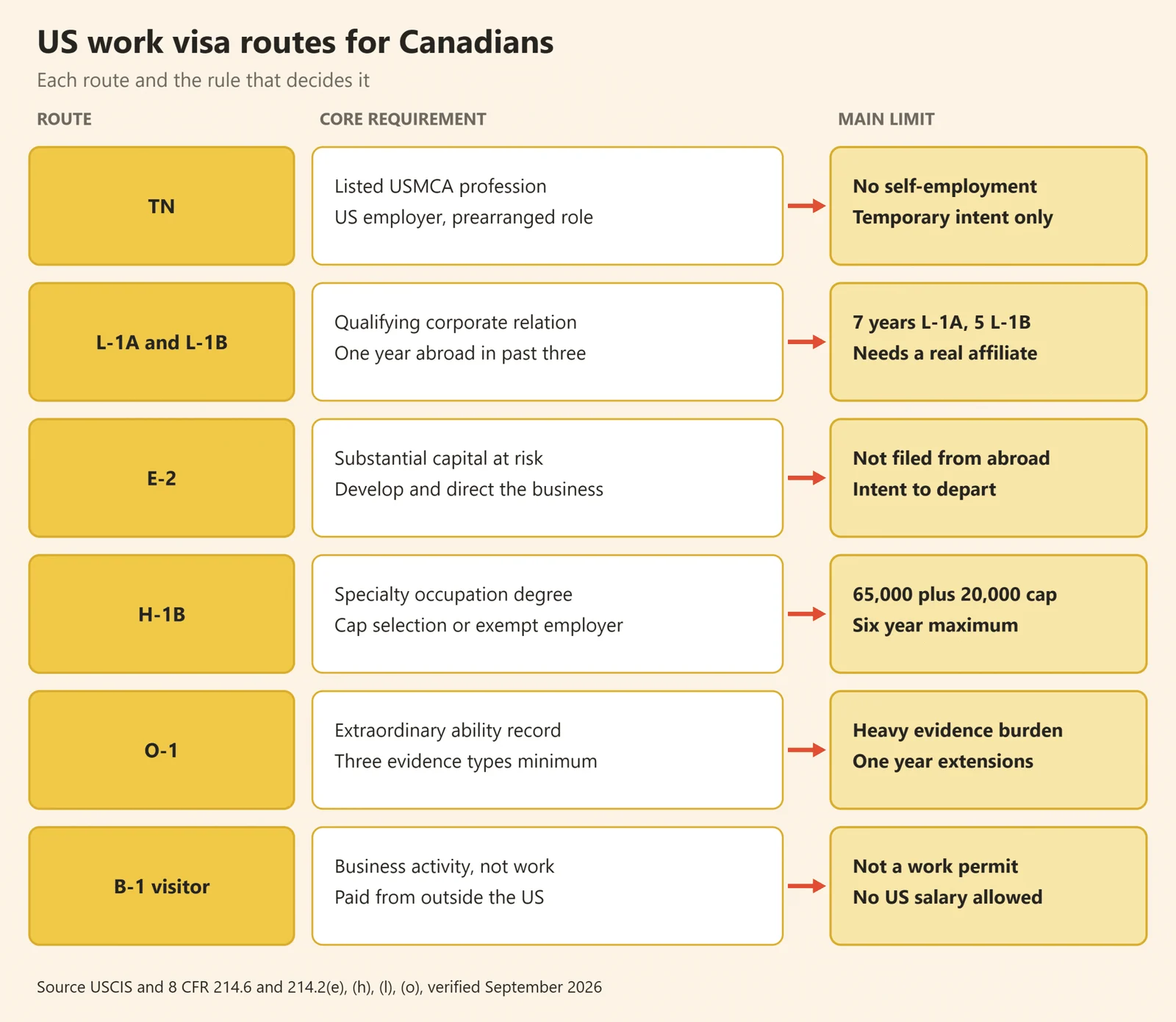
Canadian citizens are visa exempt, and TN and L-1 can both be decided at a port of entry or pre-clearance station with no consular appointment. TN fits listed professionals, L-1 internal company transfers, E-2 investors who control a business, H-1B capped specialty roles, and O-1 proven records. B-1 covers meetings, never employment.
What is the TN category and who does it actually fit?
TN exists because Canada is a party to the USMCA, and for most Canadian employees it is the first route to test. There is no cap, no lottery and no consular appointment. Under 8 CFR 214.6(d)(2) a Canadian applies at a US Class A port of entry, an airport handling international traffic, or a pre-clearance station, and is then “admitted under the classification symbol TN for a period not to exceed three years” under 8 CFR 214.6(e). There is no regulatory maximum on the number of TN extensions, taken at the border or by an employer filing Form I-129, but each renewal is judged afresh against the temporary entry test rather than rubber stamped.
Which professions qualify?
Eligibility is a list check, not a judgment call. The occupation must appear in Appendix 2 to Annex 16-A of Chapter 16 of the USMCA, reproduced at 8 CFR 214.6(c). Counting that appendix as published by the Government Publishing Office in September 2026, it holds 63 professions: 25 General, 12 Medical and Allied, 23 Scientist and 3 Teacher. Each carries its own minimum credential, ranging from a baccalaureate or provincial licence to a specific degree, or a post-secondary diploma plus three years of experience. Software developer is not listed, which is why technology hires so often run through Computer Systems Analyst, and why the job description then has to genuinely describe analysis work.
The two limits that catch people out
The first is self-employment. The regulation is unusually specific: the category “does not authorize the establishment of a business or practice in the United States in which the professional will be, in substance, self-employed,” and deems a professional self-employed where they render services to a corporation “of which the professional is the sole or controlling shareholder or owner.” A Canadian consultant who incorporates a US company and bills it for their own services has walked into that bar.
The second is intent. “Temporary entry” under 8 CFR 214.6(b) means “entry without the intent to establish permanent residence,” and the applicant must show the assignment “will end at a predictable time.” TN is not a dual intent category. A pending green card process does not automatically end a TN, but it makes each new crossing harder to defend.
When does the L-1 intra-company transfer win?
The L-1 moves an existing employee from a foreign entity to a related US entity. L-1A covers managers and executives, to a seven year maximum. L-1B covers specialized knowledge, meaning special knowledge of the organization’s products, services, techniques or management “and its application in international markets,” or advanced expertise in its processes, and runs to five years.
Canadians get a procedural advantage here that general L-1 guidance tends to skip. Under 8 CFR 214.2(l)(17)(i) the employer may file the petition itself at a Class A port on the United States and Canada land border, or at a US pre-clearance station in Canada, “in conjunction with an application for admission” of the Canadian citizen, so the petition and the admission can be dealt with in one visit. What cannot be improvised on the day is the structure underneath. The companies must have a qualifying relationship, meaning parent, branch, subsidiary or affiliate, and the employee must “generally have been working for a qualifying organization abroad for one continuous year within the three years immediately preceding” admission. Neither can be papered over afterwards, which is why the L-1 rewards planning a year ahead.
The main limitation is the new office rule: a transferee coming to establish a new US office gets one year, not three. A Canadian company then has twelve months to show real premises, staffing and activity before the first extension is adjudicated, and thin new-office files are where these cases fail. What offsets that risk is dual intent. Under 8 CFR 214.2(l)(16) an L-1 holder may come temporarily and “at the same time, lawfully seek to become a permanent resident.” Employers weighing a transfer against a local hire often work this through with an employment immigration attorney before fixing the corporate structure.
Who is the E-2 treaty investor route built for?
E-2 is the usual answer for a founder or buyer with no qualifying foreign affiliate, because the TN self-employment bar rules TN out. Where a Canadian company already exists, test L-1 new office first, since it carries dual intent and E-2 does not. Canada qualifies for both treaty categories: the Department of State table at 9 FAM 402.9-10 lists Canada for E-1 and for E-2, each with effect from 1 January 1994. For E-2, USCIS requires a treaty country national who has “invested, or [is] actively in the process of investing, a substantial amount of capital in a bona fide enterprise,” entering “solely to develop and direct the investment enterprise,” shown by “at least 50% ownership of the enterprise or possession of operational control through a managerial position or other corporate device.”
E-1 is the treaty category most Canadian founders never hear about, and it turns on trade rather than capital. USCIS requires a treaty trader to “Carry on substantial trade” and to “Carry on principal trade between the United States and the treaty country,” the second of which exists “when over 50% of the volume of international trade of the treaty trader is between the United States and the treaty country of the treaty trader’s nationality.” A Canadian business whose revenue already moves goods or services across the border may be a more natural fit for E-1 than for E-2, and it is worth testing before capital is committed.
There is no minimum dollar figure in the regulation, and any threshold quoted as a hard number is a rule of thumb rather than law. The test is whether the capital is substantial relative to the cost of the business and irrevocably committed and at risk. Status runs two years initially, with extensions “in increments of up to two years each” and “no limit to the number of extensions.” Applying from Toronto is covered in our guide to the E-2 visa from Canada.
The procedural quirk is that E-2 does not use the border at all. A Canadian outside the United States cannot request E-2 classification on Form I-129, so the application goes to the Department of State, and the one-visit speed that defines TN and L-1 for Canadians does not carry over. Intent is the other constraint. 8 CFR 214.2(e)(5) requires an E holder to “maintain an intention to depart the United States upon the expiration or termination of E-1 or E-2 status.” That is narrower than usually reported. The same paragraph says an application “may not be denied solely on the basis of an approved request for permanent labor certification or a filed or approved immigrant visa preference petition.” An immigrant petition is not automatically fatal to an E-2, but it is not the shield H-1B, L-1 and O-1 holders enjoy.
How does the H-1B cap work, and is it worth entering?
H-1B covers specialty occupations: work requiring “theoretical and practical application of a body of highly specialized knowledge” plus a bachelor’s or higher degree in a directly related specialty as a minimum for entry. Status runs up to three years, extendable by three more, for a six year total.
The cap, and where it stands now
The annual limit is 65,000 new statuses, plus “an additional 20,000 petitions filed on behalf of beneficiaries who have earned a master’s degree or higher from a U.S. institution of higher education.” Two things shifted in 2026. A DHS final rule effective 27 February 2026 replaced the random lottery with a weighted selection which, in the words USCIS uses to describe it, “prioritizes allocating visas to higher-skilled and higher-paid aliens,” applying first to the fiscal year 2027 season. That season’s registration window then ran only from 4 March to 19 March 2026 at $215 per registration, and USCIS announced on 17 July 2026 that both caps had been reached. If you are cap subject and did not register in March, H-1B is not a route to a start date in the coming months. USCIS has opened recent registration windows in March, but as of September 2026 the FY 2028 window has not been announced.
Cap-exempt employers change the answer
The cap does not reach everyone. USCIS states that workers “petitioned for or employed at an institution of higher education or its affiliated or related nonprofit entities, a nonprofit research organization, or a government research organization, are not subject to this numerical cap.” For a researcher, clinician or academic, a petition can be filed at any point in the year with no lottery. If the employer sits in one of those buckets, start with our guide to the cap-exempt H-1B.
What happened to the $100,000 payment, and what may replace it
A proclamation issued on 19 September 2025 required new H-1B petitions filed on or after 21 September 2025 to carry an additional $100,000 payment as a condition of eligibility. It is not currently being enforced. USCIS records that on 8 June 2026 the US District Court for the District of Massachusetts vacated the guidance implementing it, that the First Circuit denied a stay on 24 July 2026, and that DHS “will comply with the court’s order while DHS considers next steps.”
The litigation is not the only live variable, and this is the part most current coverage misses. On 25 August 2026 DHS published a notice of proposed rulemaking, Fee for Certain H-1B Petitions, at 8 CFR Part 106 under RIN 1615-AD20 and DHS Docket No. USCIS-2026-0298. Its summary proposes “to establish a $103,265 fee, payable at the time of filing, for all H-1B cap-subject petitions, including those eligible for the advanced degree exemption, which would be imposed in addition to all other applicable fees or payments.” That rule is proposed and not in effect, written comments are due on or before 24 September 2026, and a proposed rule can be withdrawn or changed before it is finalized. But a cap-subject H-1B priced today on the fee schedule alone is being priced against a figure a pending rule would multiply many times over, so treat neither the vacated payment nor the current fee total as settled when budgeting.
Is the O-1 realistic, or only for famous people?
O-1 carries a reputation for being reserved for household names, and in our files that reputation is what turns away Canadians whose records would in fact support a petition. O-1A covers extraordinary ability in “the sciences, education, business, or athletics”; O-1B covers the arts, or extraordinary achievement in film and television. There is no cap. The requirement is evidentiary rather than structural: the record “must include at least three different types of documentation corresponding to those listed in the regulations, or comparable evidence in certain circumstances.” Read the closing qualifier carefully, because comparable evidence is a conditional route and not a general alternative, so the listed categories are where a file is normally built: judging others’ work, membership requiring outstanding achievement, published material about you, original contributions of major significance and a critical role for a distinguished organization.
The real cost of an O-1 is preparation. The evidence burden sits with the applicant and takes months to assemble, and extensions are narrow, because USCIS grants the time needed to accomplish the initial event or activity “in increments, up to one year,” so after the first three years renewals come annually. Against that, the green card door stays open. Under 8 CFR 214.2(o)(13) an approved labor certification or filed preference petition “shall not be a basis for denying an O-1 petition.”
Can a Canadian work in the US as a B-1 business visitor?
No, and in our files it is the most common expensive mistake. B-1 is a business visitor category, not a work permit. The Foreign Affairs Manual is direct: at 9 FAM 402.2-5(A)(a), “the issuance of a B-1 visa is not appropriate for applicants who intend to obtain and engage in employment while in the United States,” and at 9 FAM 402.2-5(F)(1) a person in B-1 status “may not receive a salary from a U.S. source for services rendered in connection with their activities in the United States.” What it does permit is useful: negotiating contracts, consulting with business associates, litigating, attending professional or business conventions, and independent research, so long as the work is principally performed outside the country. The Canadian-specific risk is that with no visa stamp there is no paper record. Admission is a conversation at the port, and delivering paid services to a US client for weeks is unlawful employment however it is labelled, unless it falls within a recognized B-1 activity where the work is principally performed outside the United States and the pay comes from a foreign source.
How do the main US work visas for Canadians compare?
The table sets the routes against the five factors that usually decide the choice, drawn from USCIS and from 8 CFR 214.6 and 214.2 as they stood in September 2026.
| Route | Best fit | Core requirement | Typical duration | Dual intent | Annual cap |
|---|---|---|---|---|---|
| TN | Employee whose job title is on the USMCA list | Listed profession, with the matching credential | Up to 3 years. No regulatory maximum on renewals | No. Temporary entry required | None |
| L-1A | Manager or executive moving within a corporate group | Qualifying relationship plus 1 year abroad in the past 3 | 3 years, or 1 for a new office. 7 year cap | Yes, 8 CFR 214.2(l)(16) | None |
| L-1B | Specialized knowledge employee in the same group | Same relationship and year abroad, plus specialized knowledge | 3 years, or 1 for a new office. 5 year cap | Yes, 8 CFR 214.2(l)(16) | None |
| E-2 | Founder or buyer who will run the business | Substantial capital at risk, plus 50 percent ownership or control | 2 years, extensions of up to 2 years, no limit | No, but denial cannot rest solely on an immigrant petition | None |
| H-1B | Specialty occupation hire, especially cap-exempt | Bachelor’s degree or equivalent in a directly related specialty | 3 plus 3 years. 6 year cap | Yes, 8 CFR 214.2(h)(16)(i) | 65,000 plus 20,000 master’s, unless cap-exempt |
| O-1 | Documented record of extraordinary ability | At least 3 types of qualifying evidence, or comparable evidence | Up to 3 years, then 1 year extensions | Yes, 8 CFR 214.2(o)(13) | None |
| B-1 | Meetings, negotiation, conferences. Not employment | Work performed mainly outside the US, and no US salary | Per admission, at the officer’s discretion | No | None |
How does the choice get made in practice?
The analysis is a sequence, not a menu, and most files resolve in the first two steps. Start with the job title: if the role sits on the USMCA list and there is a genuine US employer, TN is usually fastest and cheapest. If it is not listed, ask whether a qualifying corporate relationship and a year of employment abroad already exist, which points to L-1. Capital at risk plus control of the business means E-2. A specialty occupation at a university, affiliated nonprofit or research organization means an H-1B that can be filed today with no lottery. Only when those fail does the O-1 evidence project become the front runner, though it is also the right answer for a genuinely strong record.
The second filter reorders that list: the green card question. L-1, H-1B and O-1 carry express regulatory protection, so filing or approving an immigrant petition cannot by itself sink the case. TN requires temporary intent and E-2 an intention to depart. If permanent residence is the real objective, that column often outweighs speed, so map the sequence against employment-based green card options before choosing a first status rather than after.
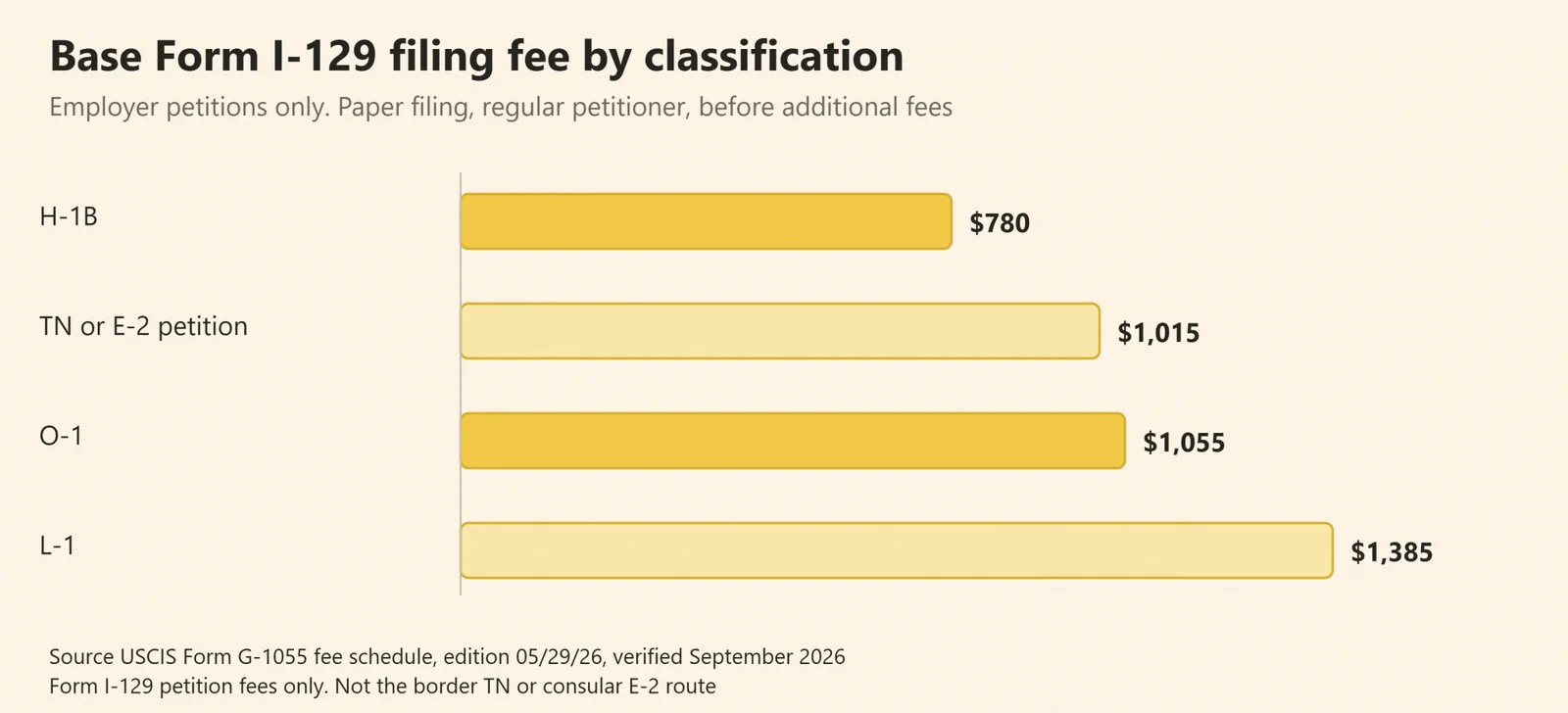
Cost is the third filter, and every figure in this section is a Form I-129 petition fee, payable where an employer petitions USCIS. On the USCIS fee schedule, Form G-1055, edition 05/29/26, the base Form I-129 paper filing fee is $780 for H-1B, $1,015 for a TN or E-2 petition, $1,055 for an O petition and $1,385 for an L petition. Additional fees stack on top, including a $600 Asylum Program Fee for a regular petitioner, a $500 Fraud Prevention and Detection fee on initial H-1B and L petitions, and an H-1B ACWIA fee listed as “$1,500 or $750, depending on number of workers the petitioner employs.” Adding those lines for a first-time beneficiary at a regular paper-filing petitioner, with no 50-employee surcharge, gives roughly $3,380 for an H-1B, $2,485 for an L-1, $1,655 for an O-1 and $1,615 for a TN or E-2 petition.
Two of those four lines rarely describe what a Canadian actually pays, which is the trap in every cost comparison of these routes. A Canadian admitted at a port of entry files no Form I-129 for TN, so none of the petition fees above apply. What applies instead is a single charge at admission: 8 CFR 214.6(e) provides that “the fee prescribed under 8 CFR 103.7(b)(1) shall be remitted by Canadian Citizens upon admission to the United States pursuant to the terms and conditions of the USMCA.” That cross-reference points at a fee provision USCIS has since restructured, and the current schedule at 8 CFR 106.2 carries no TN port-of-entry line, so confirm the amount with CBP at the port rather than reading it off Form G-1055. The $1,615 above is the employer-petition figure only.
E-2 is the mirror image. Because a Canadian outside the United States cannot request E-2 classification on Form I-129, a founder applying from Canada does not pay the $1,615 either. That application goes to the Department of State and carries consular fees instead. So the spread between the cheapest and dearest employer petition is under $2,000, but the two most Canada-specific routes sit outside that comparison altogether, and the H-1B end of it is the figure a pending fee rule would change most. Either way, the numbers are small next to the cost of picking the wrong category and losing a hiring quarter.
Finally, the visa is half of a cross-border move. Canadian tax residency, deemed disposition on departure and the treatment of registered accounts turn on facts that are cheaper to fix beforehand, and our guide on how to move from Canada to the USA covers that side. Companies building a US presence around a transferred employee usually need the corporate structure and the immigration route designed together, which is the core of our business immigration practice.
Frequently asked questions about US work visas for Canadians
Do Canadians need a visa to work in the United States?
Canadian citizens are visa exempt for most nonimmigrant categories, but exemption from the visa stamp is not permission to work. You still need a work-authorizing status such as TN, L-1, H-1B or O-1. E-2 is the outlier, because it cannot be requested on Form I-129 from outside the United States.
Which is faster for a Canadian, TN or H-1B?
TN, usually by many months, because it can be decided in a single visit to the border with no cap and no lottery. A cap-subject H-1B depended on a registration window that closed on 19 March 2026, and USCIS confirmed on 17 July 2026 that the fiscal year 2027 caps had been reached.
Can a Canadian founder use the TN category for their own company?
Generally no. 8 CFR 214.6(b) deems a professional self-employed where they render services to an entity of which they are the sole or controlling shareholder or owner, and the category does not authorize self-employment. Minority founders working for a company they do not control can sometimes qualify, but most founders are better served by E-2.
Does the TN category lead to a green card?
Not by itself, and it is not a dual intent status, because TN requires entry without the intent to establish permanent residence. People do move from TN to permanent residence, but the usual approach is to switch first into a category with express regulatory protection, such as H-1B, L-1 or O-1.
How much does an L-1 petition cost in government fees?
On the USCIS fee schedule, Form G-1055, edition 05/29/26, the base Form I-129 fee for an L petition is $1,385, or $695 for a small employer or nonprofit. A regular petitioner also pays a $600 Asylum Program Fee and a $500 Fraud Prevention and Detection fee on an initial petition, giving about $2,485.
Does a Canadian pay the $1,015 TN filing fee at the border?
No. The $1,015 is the base Form I-129 fee on Form G-1055 for a TN petition filed with USCIS by an employer. A Canadian admitted at a port of entry files no Form I-129, and 8 CFR 214.6(e) instead directs that the fee prescribed under 8 CFR 103.7(b)(1) be remitted upon admission. The current USCIS fee schedule at 8 CFR 106.2 carries no TN port-of-entry line, so confirm the amount with CBP at the port you plan to use.
Can I attend meetings in the US without a work visa?
Yes, within limits. A B-1 business visitor may negotiate contracts, consult with business associates, litigate, attend professional or business conventions and undertake independent research. What you cannot do is take up employment or receive a salary from a US source for services performed in the United States.
Is the H-1B $100,000 payment still being collected?
Not as of September 2026. USCIS records that a Massachusetts federal court vacated the implementing guidance on 8 June 2026 and that the First Circuit denied a stay on 24 July 2026, so DHS is complying with the order. The litigation is unresolved, and it is not the only variable: on 25 August 2026 DHS published a proposed rule that would impose a $103,265 fee on all H-1B cap-subject petitions. That proposal is not in effect, so confirm the current position before budgeting.
Conclusion
Choosing among the US work visas for Canadians is less about ranking the categories than about the order in which you test them, and that order changes with the goal. If the goal is a start date, the routes decided at a port of entry win, and TN or L-1 usually gets there first. If the goal is permanent residence, the ranking inverts, because the categories carrying express regulatory protection are a different set and the fastest route is the weakest one to sit in while an immigrant petition is pending. A file that opens on the quickest category and then has to reverse into a dual intent one has paid twice for the same job. Deciding which of those two objectives the move is really for, before a first status is chosen rather than after, is what keeps a start date intact.
How Mayo Law can help
Mayo Law is a cross-border US and Canada firm with offices in Toronto and New York. Principal attorney Joseph Mayo is licensed in Ontario and in New York, so the corporate and immigration questions in a move north or south are handled on both sides of the border rather than split between two firms. We advise Canadian professionals, founders and employers on choosing among the US work visas for Canadians, on preparing the route selected, and on the entity and contract work beneath it. Read more about our business immigration work, or how we act as a US and Canada immigration lawyer.
Disclaimer
This article is provided for general information only and is not legal advice. Reading it does not create an attorney-client relationship, and you should not act or refrain from acting on the basis of anything here without advice on your own facts. Immigration rules, fees and litigation positions change, and the figures cited were current as of September 2026. Mayo Law provides legal services in Ontario and New York.