

Contents
- Quick Answer
- What does an E-2 visa denial actually mean?
- What is the difference between an INA 214(b) refusal and an INA 221(g) refusal?
- What does a 221(g) slip actually require you to do?
- Why do E-2 cases fail on the merits?
- Is there an appeal after an E-2 visa denial?
- How do you rebuild an E-2 case before reapplying?
- What should Canadian applicants know after an E-2 visa denial?
- Frequently asked questions about E-2 visa denial
- Conclusion
- How Mayo Law can help
- Disclaimer
An E-2 visa denial almost never arrives with an explanation of the law behind it. Most applicants leave the interview window holding a printed slip, a statute number, and no sense of whether the case is finished or merely paused. That distinction is the whole game, because the two sections an officer can refuse under mean different things and call for different responses.
This guide sets out the mechanics as they stand in September 2026. Every rule below comes from the statute, the regulations, or the Foreign Affairs Manual, and where a source says something narrower than the advice in general circulation, the article says so.
Quick Answer
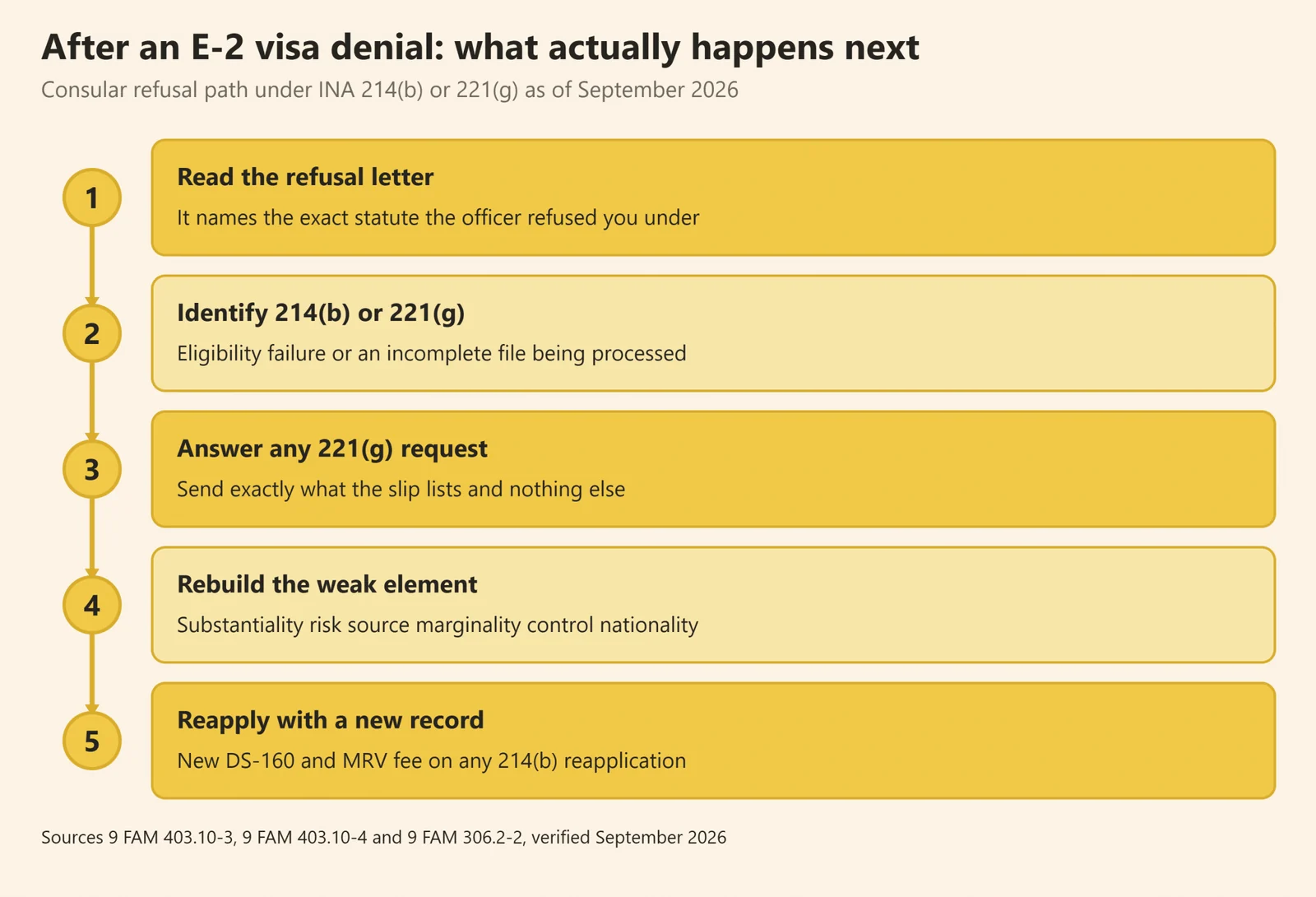
An E-2 visa denial is almost always a consular refusal, not a final judgment. Officers refuse under INA 214(b) when eligibility is not established, or under INA 221(g) when the application is incomplete or in administrative processing. No appeal exists, so you correct the weakness and reapply.
What does an E-2 visa denial actually mean?
At a consulate, “denial” and “refusal” describe the same event. In any nonimmigrant case involving a refusal, the officer must give the applicant and any attorney of record a written refusal (9 FAM 403.10-3(A)(2)), “providing a citation of the legal section relied upon” (9 FAM 403.10-3(A)(1)(d)).
Two lines matter most. The first is blunt: “Today’s decision cannot be appealed.” It appears in both of the prescribed 214(b) refusal letters (9 FAM 403.10-3(A)(3)(a) and (b)). The second is the one applicants miss, because every 221(g) letter must carry the sentence “for U.S. visa purposes, including ESTA, this decision constitutes a denial of a visa” (9 FAM 403.10-3(A)(2)(2)(d)). A slip that reads like a document request is still a refusal, and it must be declared as a visa denial on any future ESTA application.
None of that makes it permanent. A 214(b) refusal “is not a permanent ineligibility,” and an applicant may qualify later by showing a change in circumstances (9 FAM 403.10-2(B)(1)(a)(2)). Refused applicants “may reapply any time, using the same procedures as first-time applicants” (9 FAM 403.10-4(A)(a)). If the interview went badly rather than the evidence, reread our guide to E-2 visa interview questions first.
What is the difference between an INA 214(b) refusal and an INA 221(g) refusal?
INA 214(b), at 8 U.S.C. 1184(b), provides that every applicant “shall be presumed to be an immigrant until he establishes to the satisfaction of the consular officer” that he is entitled to nonimmigrant status. The officer “must make a finding that an applicant does or does not meet the eligibility requirements for the classification sought” (9 FAM 403.10-2(B)(1)(a)(1)). It is a merits decision: on the record in front of the officer, you did not carry your burden.
There is a trap here. For most categories, 214(b) is shorthand for weak ties to home. For E visas it is not. An E applicant does not “need to have a residence in a foreign country which the applicant does not intend to abandon” (9 FAM 402.9-4(C)); what is required instead is “an unequivocal intent to depart the United States upon termination of E status.” So a 214(b) refusal of an E-2 is a finding against one of the nine E-2 elements an officer must work through at 9 FAM 402.9-6(A), not a finding about whether you kept a house in Toronto. Those elements include the investment, but they also include treaty nationality, control of the enterprise, its earning capacity, and that departure intent.
INA 221(g), at 8 U.S.C. 1201(g), is structural. No visa shall be issued where the applicant appears ineligible on the papers, where “the application fails to comply with the provisions of this chapter, or the regulations issued thereunder,” or where the officer has reason to believe the applicant is ineligible. That middle limb is the one E-2 applicants meet most often in our practice: officers refuse under 221(g) where admissibility “cannot be established without additional evidence, further clearance, a namecheck, or some other reason” (9 FAM 403.10-3(B)).
| What differs | INA 214(b) refusal | INA 221(g) refusal |
|---|---|---|
| Statute | 8 U.S.C. 1184(b) | 8 U.S.C. 1201(g) |
| What was decided | Eligibility not established | File incomplete or clearance needed |
| Typical trigger | Any of the nine E-2 elements unproven | Missing documents, administrative processing |
| What clears it | A materially better record | The listed documents, or processing ending |
| Fee and form effect | New DS-160 and MRV fee on any reapplication, whenever you go back | Documents branch: nothing new inside one year, new DS-160 and MRV fee after it. Administrative processing: no new fee where the delay is US Government action or error |
| Appeal | None exists | Same for both |
What does a 221(g) slip actually require you to do?
Read it literally. Send what it lists, in the format requested, to the address or portal named on the paper, and send nothing else. Volunteering a redesigned business plan alongside the two bank statements you were asked for invites fresh questions about why the plan changed.
If the slip says administrative processing instead of naming documents, there is nothing to file. The manual gives an endpoint rather than a clock: a 221(g) refusal entered for administrative processing “may be overcome once you can determine administrative processing is completed and you receive any required AO response or other needed information” (9 FAM 306.2-2(A) paragraph (a)(2)(a)). Duration varies case by case.
The one-year rule is not the deadline most articles claim
Nearly every page on this topic says you have one year from a 221(g) refusal to submit documents or lose the case. That rule is real, but it belongs to immigrant visas. It sits at 22 CFR 42.81(e): if the applicant “within one year from the date of refusal adduces further evidence tending to overcome the ground of ineligibility on which the refusal was based, the case shall be reconsidered,” with no additional application fee.
The nonimmigrant refusal regulation, 22 CFR 41.121, has no equivalent paragraph. Its four paragraphs cover grounds for refusal, refusal procedure, supervisory review, and review of refusal by the Department. The manual is explicit, and its middle sentence carries as much weight as the two around it: “For NIV cases, Department regulations do not set a time limit on accepting additional evidence to overcome a refusal. Consular managers may use discretion in setting an appropriate policy, but no additional evidence provided one year or more after the refusal should be considered without requiring a new application and fee” (9 FAM 306.2-2(A) paragraph (a)(1)(c)(ii)).
So the Department sets no deadline, but your post may set one of its own. Ask the consulate what its local policy is rather than assuming the file stays open indefinitely. What the one-year mark does fix is paperwork and money, and the paragraph that fixes it is narrower than almost every article on this topic reports.
That paragraph is headed “Reactivation of Case Refused Under INA 221(g),” and the heading is doing real work. An applicant refused under 221(g) “need not complete a new NIV application form or pay the machine readable visa (MRV) fee again if less than one year has elapsed since the latest refusal,” while “if one year or more has elapsed since the latest refusal, the applicant must submit a new Form DS-160 and pay the MRV fee again for the case to proceed” (9 FAM 403.10-4(A)(b)). The fee bar is repeated at 9 FAM 403.4-2(b), which tells officers they “may not charge an additional MRV fee to applicants refused under INA 221(g) who reapply within one year of that refusal.”
None of that grace reaches a 214(b) refusal. The prescribed 214(b) letter for the classes that carry no residence abroad requirement, which is the letter an E applicant receives, says that on reapplication you “must submit a new application form and photo, pay the visa application fee again, as applicable, and be interviewed by a consular officer” (9 FAM 403.10-3(A)(3)(b)), and the manual tells the officer to “create a new case in the system” (9 FAM 403.10-4(B)(d)). A new DS-160 and a new fee are due whether you go back in a month or in two years.
One carve-out runs the other way, and it matters most in the cases that wait longest. The same 221(g) paragraph continues: “If the cause of the delay leading to the 221(g) refusal is a lack of U.S. Government action or U.S. Government error the period of reapplication is extended indefinitely. Hence, the MRV fee is not charged again when the application is pursued” (9 FAM 403.10-4(A)(b)). A file held in administrative processing is waiting on U.S. Government action, so crossing the twelve month mark there does not by itself create a new form or a new fee.
The difference is real money, because E visas carry their own fee line. Under 22 CFR 22.1, item 21(c), the E category application fee is $315 per person as of September 2026, against $185 for most non-petition-based categories at item 21(a). An investor with a spouse and one child reapplying after a 214(b) refusal pays three E fees, $945, plus three new DS-160 forms, in month one and in month thirteen alike. The same family on a 221(g) document request pays nothing inside the year and $945 after it. The same family held in administrative processing on U.S. Government delay pays nothing at all. Worth costing out against the wider E-2 visa cost picture.
Why do E-2 cases fail on the merits?
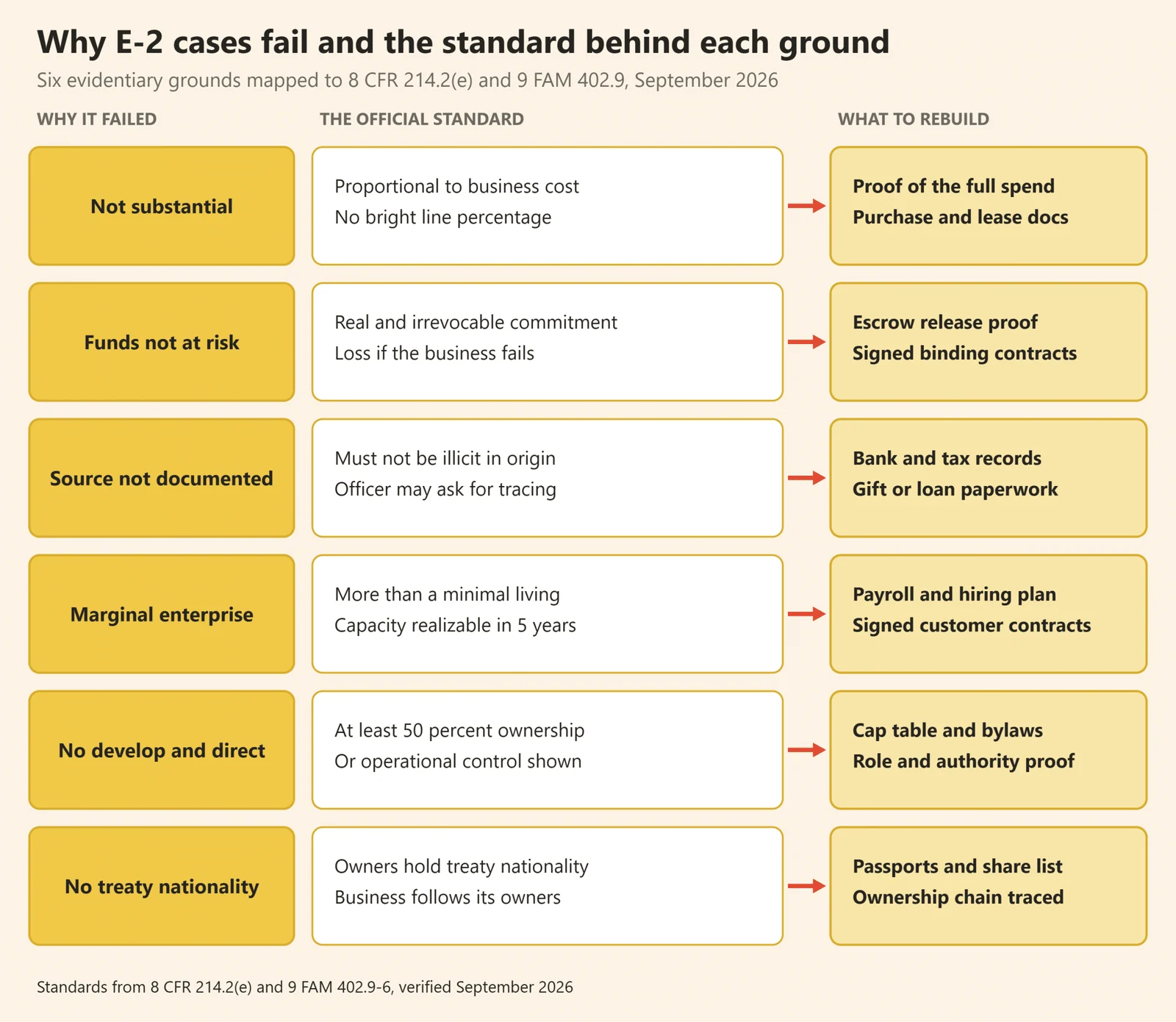
A refusal under 214(b) means one of a short list of elements did not hold up. Each has a written standard, so each can be answered with evidence rather than argument. The elements below track 8 CFR 214.2(e) and 9 FAM 402.9, and follow our walkthrough of the E-2 visa application process.
The investment is not substantial
Capital must be “substantial in relationship to the total cost of either purchasing an established enterprise or creating the type of enterprise under consideration,” and “generally, the lower the cost of the enterprise, the higher, proportionately, the investment must be” (8 CFR 214.2(e)(14)). The proportionality test weighs qualifying funds against the cost of the business, and “no bright line percentages” exist (9 FAM 402.9-6(D)(c)).
The funds are not at risk or not irrevocably committed
An investment is the placing of capital “at risk in the commercial sense with the objective of generating a profit” (8 CFR 214.2(e)(12)). To be in the process of investing, “the funds or assets to be invested must be committed to the investment, and the commitment must be real and irrevocable” (9 FAM 402.9-6(B)). In practice the failure here is usually technical rather than substantive: the money exists but still sits in a personal account, so nothing has yet been placed at risk. Escrow released to a seller, a signed lease with rent already paid, or settled equipment invoices all read differently.
The source of the funds is not documented
Capital may come from savings, gifts, inheritance, contest winnings, or loans collateralized by the applicant’s own personal assets, and it “need not be outside the United States.” What it must not be is “the result of illicit activities,” and an officer may “request whatever documentation is needed to properly assess the source of the funds” (9 FAM 402.9-6(B)).
The enterprise is marginal
A marginal enterprise “does not have the present or future capacity to generate more than enough income to provide a minimal living for the treaty investor and his or her family” (8 CFR 214.2(e)(15)). Future capacity “should generally be realizable within five years from the date the applicant commences normal business activity” (9 FAM 402.9-6(E)). Projections rarely carry this; signed contracts and live payroll do.
You cannot develop and direct
The applicant “must demonstrate that he or she does or will develop and direct the investment enterprise,” through ownership of at least 50 percent or operational control (8 CFR 214.2(e)(16)). The manual requires ownership of at least half and, through it “or by other means, develops and directs the activities of the enterprise” (9 FAM 402.9-6(F)(a)). Cap tables that dilute the applicant below control fail here.
Treaty nationality is not established
The investor “must, whether an individual or business, possess the nationality of the treaty country,” and “the nationality of a business is determined by the nationality of the individual owners of that business” (9 FAM 402.9-4(B)(a)). Behind holding companies, the officer traces ownership to individuals. Canada has held E-1 and E-2 treaty status since 1 January 1994 (9 FAM 402.9-10). Outcomes by category sit in our note on the E-2 visa approval rate.
Intent to depart when E status ends is not established
The last item on the officer’s E-2 checklist is that the applicant “intends to depart the United States when the E-2 status terminates” (9 FAM 402.9-6(A)(a)(9)). The test is lighter than the ties test other categories face. An E applicant “may sell their residence and move all household effects to the United States,” and an “expression of an unequivocal intent to depart the United States upon termination of E status is normally sufficient” (9 FAM 402.9-4(C)). It stops being sufficient where the rest of the file points the other way, and the manual names the case: an applicant “who is the beneficiary of an IV petition will need to satisfy you that their intent is to depart the United States at the end of their authorized stay, and not stay in the United States to adjust status.” A pending green card petition and an unrehearsed answer about long-term plans are enough to lose an otherwise sound E-2 file.
Is there an appeal after an E-2 visa denial?
No. The letter says so in one sentence. An E applicant receives the 214(b) letter written for “those visa classes subject to 214(b), but not the residence abroad requirement” (9 FAM 403.10-3(A)(2)(1)), and it reads “Today’s decision cannot be appealed” (9 FAM 403.10-3(A)(3)(b)). No tribunal reviews the officer’s judgment about whether your capital was substantial. Anyone offering to appeal a consular refusal is describing something that does not exist. What does exist is narrower:
- Supervisory review. This is the only mechanism in the scheme that can reverse a refusal without a new application, and the reviewing officer is not limited to a conversation. Nonimmigrant refusals “must be reviewed… by consular supervisors” (22 CFR 41.121(c)), and under the same paragraph, “if the reviewing officer disagrees with the decision and he or she has a consular commission and title, the reviewing officer can assume responsibility and readjudicate the case.” The manual matches it: Overcome/Waive “may be appropriate for INA 214(b) cases when a supervisor believes the INA 214(b) refusal was in error,” and a supervisor who overcomes such a case should “discuss it with the refusing officer and take personal responsibility for readjudicating the case” (9 FAM 403.10-4(B)(e)). You cannot file for it. What you can do, if you think the officer misapplied the classification standard rather than weighed the evidence differently, is say so at the window, because officers are told to raise an unusual case of that kind with a supervisor (9 FAM 306.2-2(A) paragraph (b)(1)).
- Departmental review. “The Department may request a consular officer in a specific case… to submit a report if a visa has been refused” (22 CFR 41.121(d)). Oversight, not a remedy you file.
- Reapplication. The real remedy. Refused applicants “may reapply any time, using the same procedures as first-time applicants” (9 FAM 403.10-4(A)(a)).
- Motions, if you filed inside the United States. A USCIS denial on Form I-129 can be met with a motion to reopen, which “must state the new facts… and be supported by affidavits or other documentary evidence,” or a motion to reconsider showing the decision “was based on an incorrect application of law or Service policy.” Both are due within 30 days, but a late motion to reopen is not automatically dead: failure to file in time “may be excused in the discretion of the Service where it is demonstrated that the delay was reasonable and was beyond the control of the applicant or petitioner” (8 CFR 103.5(a)(1)(i)). No equivalent excuse is written for a late motion to reconsider.
How do you rebuild an E-2 case before reapplying?
Reapplying with the same file and a better attitude is how second refusals happen. The officer sees the same record, plus a note that someone already said no.
- Start from the statutory citation. It tells you whether you are fixing a merits problem under 214(b) or a completeness problem under 221(g).
- Reconstruct the interview. Note what was asked and in what order. Officers probe the element they doubt, so the questioning is a diagnosis.
- Map every element to a document. Substantiality, at risk, source of funds, non-marginality, develop and direct, and treaty nationality each need a named exhibit. Intent to depart when E status ends needs something else: a stated position you can hold under questioning, reconciled with any immigrant petition already on file.
- Fix the defect, not the presentation. If funds were not irrevocably committed, sign the lease, close the purchase, run payroll. New binders around old facts change nothing.
- Reconcile every number. Business plan, tax filings, bank records and the DS-160 must agree. Inconsistency reads as a credibility problem.
Where the structure is the problem rather than the paperwork, the fix is corporate: changing the ownership chain, recapitalising, or restructuring the US entity so control sits where the treaty nationality does. That is where an E-2 visa lawyer earns their place, because the corporate work and the immigration record have to be built together.
What should Canadian applicants know after an E-2 visa denial?
Canadians who cross regularly often treat a refusal as an inconvenience. For E visas it is a wall. Under 8 CFR 212.1(a)(1), “a visa is generally not required for Canadian citizens, except those Canadians that fall under nonimmigrant visa categories E, K, S, or V.” The E category is carved out by name, so a Canadian cannot request E-2 admission at a port of entry the way a TN professional can. The carve-out is category specific, though, and that is worth saying plainly. The same paragraph leaves Canadians visa exempt for everything outside E, K, S and V, so an E-2 refusal does not by itself end visitor travel or a TN application. Admissibility at the port of entry is still decided there, on the day, by CBP.
Nationality is where Ontario structures come apart. A business holds the nationality of its individual owners (9 FAM 402.9-4(B)(a)), so an Ontario corporation is not Canadian for E-2 purposes merely because it was incorporated under Ontario law. It is Canadian only to the extent Canadian citizens own it, and founders who took money from a US fund can drop below the threshold without noticing.
The evidence is split across two countries as well. The source-of-funds trail sits in Canadian bank statements and Canada Revenue Agency filings, while the at-risk evidence sits in a New York or Delaware entity’s lease, purchase agreement and payroll records. In our practice, refused files are frequently built on one side of the border and never reconciled with the other, and a review that covers both sides is where those mismatches surface. That is the work a US Canada immigration lawyer does on a cross-border file.
Frequently asked questions about E-2 visa denial
Can I appeal an E-2 visa denial at a consulate?
No. The refusal letter states that today’s decision cannot be appealed (9 FAM 403.10-3(A)(3)(b)). There is no tribunal, no fee and no form for it. What exists instead is supervisory review inside the post under 22 CFR 41.121(c), where a reviewing officer who holds a consular commission and title can assume responsibility and readjudicate the case, a Departmental power to request a report under 22 CFR 41.121(d), and your right to reapply.
How long do I have to respond to a 221(g) request for documents?
For nonimmigrant visas, Department regulations do not set a time limit on accepting additional evidence, though consular managers may use discretion in setting an appropriate policy, so ask your post what its local rule is. What changes at the one-year mark is process rather than eligibility: evidence provided a year or more after the refusal should not be considered without a new application and fee (9 FAM 306.2-2(A) paragraph (a)(1)(c)(ii)).
Do I have to pay the visa fee again if I reapply?
That depends on the section you were refused under. The one-year grace belongs to INA 221(g): inside a year no new application form and no new machine readable visa fee are required, and after a year both are (9 FAM 403.10-4(A)(b)). After a 214(b) refusal a new DS-160 and a new fee are due on any reapplication, however soon you go back. In the E category that fee is $315 per person under 22 CFR 22.1, item 21(c), as of September 2026.
Does a 221(g) refusal count as a visa denial on future forms?
Yes. Every 221(g) refusal letter must include the line that for U.S. visa purposes, including ESTA, the decision constitutes a denial of a visa (9 FAM 403.10-3(A)(2)(2)(d)). It stays a recorded refusal even where documents later overcome it. The manual does not make that refusal a bar to visa waiver travel; it makes it a fact you must declare on any future ESTA application, and the determination there belongs to CBP.
Does my refusal affect my spouse’s and children’s applications?
Their status is derivative, so it moves with yours. The spouse and children of an E visa applicant are “entitled to derivative status in the same classification as the principal,” and “like principal E visa applicants, the spouse and children are also subject to INA 214(b)” (9 FAM 402.9-9(a)). There is nothing for them to derive from until the principal qualifies, and each of them must still satisfy the officer separately and pay the E category fee separately.
How do I answer the prior refusal question on my next DS-160?
Truthfully, and on every application after this one. A 221(g) refusal counts as a visa denial even where documents later overcome it, and the case notes attached to a refusal “reside in the CCD and are accessible to consular sections worldwide, as well as to certain partner agencies, such as CBP at POE” (9 FAM 403.10-3(A)(4)(d)). The officer at your next interview can already see it, so a refusal you fail to disclose creates a credibility problem the refusal itself did not.
Conclusion
An E-2 visa denial is a finding about a file, made on one day, by one officer, under a section printed on the slip in your hand. Read the section first. A 221(g) refusal usually asks for something specific. A 214(b) refusal says one of the nine E-2 elements was not proven, and each of them has a written standard you can build evidence against. There is no appeal. The one-year mark governs forms and fees rather than eligibility, it belongs to 221(g) and not to 214(b), and your post may set a shorter policy of its own.
How Mayo Law can help
Mayo Law is a cross-border US and Canada law firm with offices in Toronto and New York. Principal attorney Joseph Mayo is licensed in Ontario and in New York, so the corporate side of an E-2 file and the immigration side are handled together rather than passed between firms. On a refused case that means reading the refusal against the section cited and rebuilding the ownership chain and source-of-funds record across both jurisdictions. Our E-2 visa lawyer page sets out how the firm works.
Disclaimer
This article is general information only and is not legal advice. Reading it does not create an attorney-client relationship, and you should not act or refrain from acting on it without advice on your own circumstances. Immigration rules, fees and Foreign Affairs Manual guidance change, and the position stated here is as of September 2026. Mayo Law provides legal services in Ontario and New York.