

Contents
- Quick answer
- What does New York law say about non-competes?
- How do New York courts test a non-compete?
- What happens to an overbroad non-compete in New York?
- Does it matter if the employee quit or was fired?
- Is New York about to ban non-competes?
- How does New York compare with Ontario?
- What should employers in New York do now?
- Frequently asked questions
- Conclusion
- How Mayo Law can help
- Disclaimer
Are non-competes enforceable in NY? Yes, but only some of them, and only to the extent a court finds them reasonable. New York has no general statute that bans or approves employee non-competes. Instead, its courts apply a strict common-law test, and the employer carries the burden of proving every part of it.
That answer has stayed the same for decades, even as the politics around it changed. A ban passed both houses of the Legislature in 2023 and was vetoed. Two more bills have passed the Senate since then, and the latest, S9759, is sitting in an Assembly committee as of October 3, 2026. At the federal level, the Federal Trade Commission's rule is not in effect. This guide explains the test New York courts use today, what happens to a clause that goes too far, how the pending bill would change things, and how New York compares with Ontario for employers with staff on both sides of the border.
Quick answer
Non-competes are enforceable in New York only if the employer proves the restraint is no greater than needed to protect a legitimate interest, imposes no undue hardship on the employee, and does not harm the public. Courts read them strictly. An overbroad clause may be partly enforced. No general statutory ban exists as of October 2026.
What does New York law say about non-competes?
A non-compete is a promise by an employee not to work for a competitor, or start a competing business, for a period after the job ends. New York has no general statute that bans employee non-competes. One narrow statutory rule applies: section 202-k of the New York Labor Law stops a broadcasting industry employer from requiring a broadcast employee to stay out of a geographic area, a time period, a particular employer or an industry after the job ends. Management employees are excluded from that protection. For everyone else, the answer comes from case law.
For a non-compete, New York courts start from suspicion. The Court of Appeals, New York's highest court, has said that covenants not to compete "should be strictly construed" because of the "powerful considerations of public policy which militate against sanctioning the loss of a [person's] livelihood." It repeated that language in Brown & Brown, Inc. v Johnson, 25 NY3d 364 (2015), quoting Gramercy Park Animal Ctr. v Novick (1977), which in turn quoted Purchasing Assoc. v Weitz (1963).
New York courts also sort restrictive covenants by the kind of contract they sit in. The Appellate Division, Second Department, summarized the three categories in 2024 in Twitchell Technical Products, LLC v Mechoshade Systems, LLC: contracts for the sale of a business, employment contracts, and ordinary commercial contracts. Employment covenants get the strictest treatment, because no goodwill is being sold and a person's ability to earn a living is at stake.
How do New York courts test a non-compete?
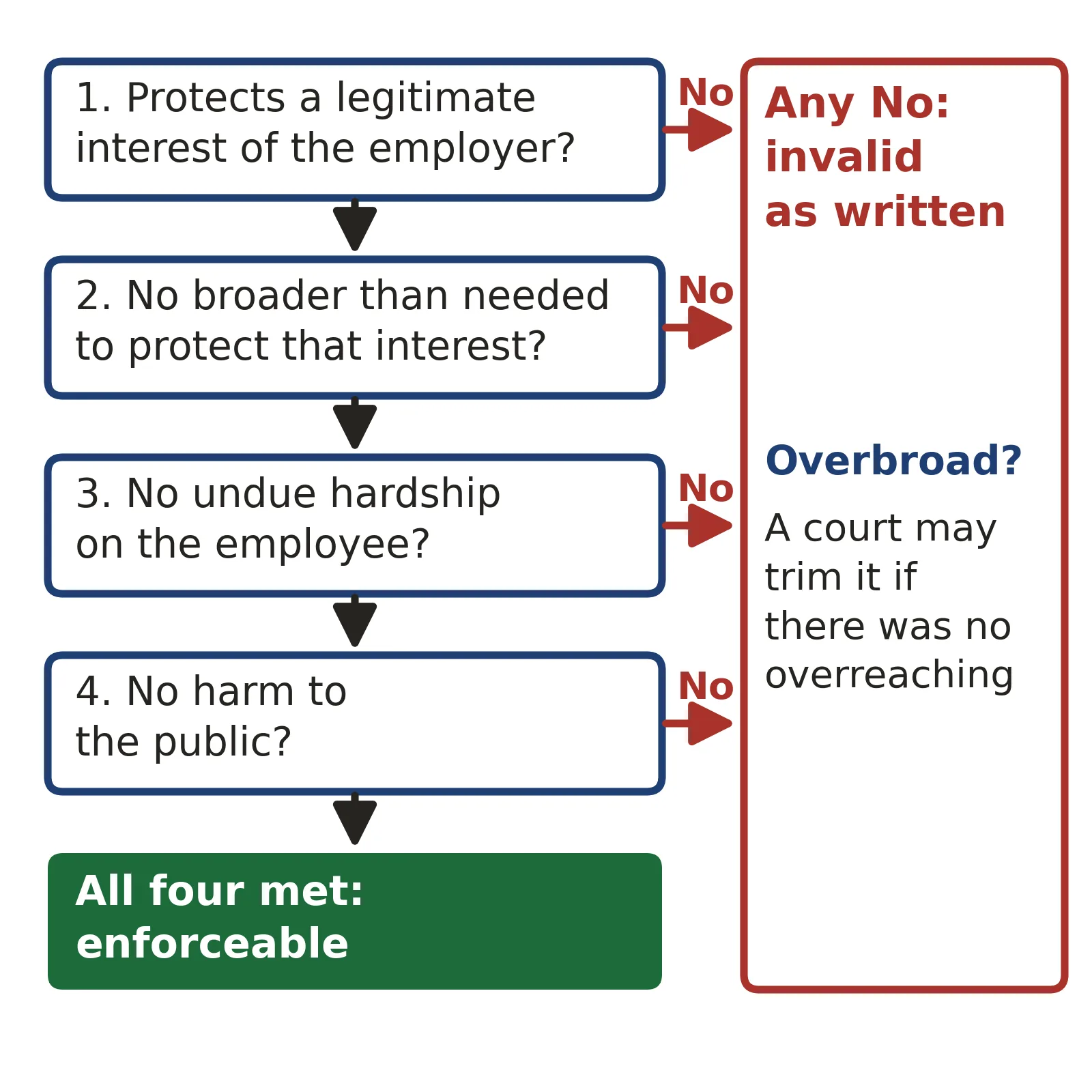
The test comes from BDO Seidman v Hirshberg, 93 NY2d 382 (1999). As the Court of Appeals restated it in Brown & Brown, a restraint is reasonable only if it "(1) is no greater than is required for the protection of the legitimate interest of the employer, (2) does not impose undue hardship on the employee, and (3) is not injurious to the public." A violation of any prong renders the covenant invalid, and New York requires the employer to prove all three prongs.
What counts as a legitimate interest?
The list is short. Quoting BDO Seidman, the Appellate Division explained in Arthur J. Gallagher & Co. v Marchese (2d Dept 2012) that an employer's interests are limited "to the protection against misappropriation of the employer's trade secrets or of confidential customer lists, or protection from competition by a former employee whose services are unique or extraordinary." BDO Seidman added one more: an employer may prevent former employees from exploiting the goodwill of a client "which had been created and maintained at the employer's expense."
The courts describe these interests as limited, so a clause that does not protect one of them fails the first prong before time or distance is even considered.
How long and how far can it reach?
New York sets no statutory maximum for duration or geography. As the Second Department noted in Twitchell, a commercial-contract case, the reasonableness of a covenant's geographic scope and duration "depends upon the facts of each case." Under BDO Seidman, the restraint can be no greater than needed to protect the employer's legitimate interest. A covenant tied to clients the employee actually served is easier to defend than one covering every customer of the business. In Brown & Brown, the Court of Appeals held that a two-year non-solicitation clause was overbroad to the extent it barred the employee from working with any of the employer's New York customers, including customers she had never met and for whom she had done no work.
Do non-solicits and sale-of-business covenants follow the same rules?
A customer non-solicitation clause is a restrictive covenant too. Brown & Brown assessed one under the BDO Seidman standard and found it overbroad to the extent it reached customers the employee never served. A non-solicit can be drawn around the client goodwill the employee built with the employer's resources, which BDO Seidman recognized as a legitimate interest. Confidentiality terms protect trade secrets and confidential information directly; our guide to trade secret misappropriation covers what happens when that information walks out the door.
Covenants given by the seller of a business are treated more leniently. The Court of Appeals explained in Purchasing Assoc. v Weitz, as quoted in Twitchell, that a buyer "should be permitted to restrict [its] seller's freedom of trade" so the seller cannot recapture the goodwill it was paid for. A founder who sells a company and agrees not to compete is in a different position from an employee who signed an offer letter. If you are on either side of that deal, our guide on whether you need a lawyer to sell a business walks through where the covenant fits.
What happens to an overbroad non-compete in New York?
New York courts can partially enforce an overbroad clause, but they do not do it automatically. The Court of Appeals has "expressly recognized and applied the judicial power to sever and grant partial enforcement for an overbroad employee restrictive covenant." Where the overbroad part is not an essential part of the bargain, the answer depends on the employer's conduct.
Under BDO Seidman, as quoted in Brown & Brown, partial enforcement may be justified "if the employer demonstrates an absence of overreaching, coercive use of dominant bargaining power, or other anti-competitive misconduct, but has in good faith sought to protect a legitimate business interest, consistent with reasonable standards of fair dealing."
The facts of Brown & Brown show what courts look at. The employee was handed the agreement on her first day of work, after she had already left a job she had held for over 20 years. The parties disputed whether she understood it, whether anyone explained it, whether she had to sign that day, and whether she could have sought advice or negotiated. The Court held that those disputes raised questions about overreaching that could not be resolved on an early summary judgment motion. For employers, the lesson is practical: how and when a covenant is presented can decide whether a court will save any of it.
Does it matter if the employee quit or was fired?
It can. Post v Merrill Lynch, Pierce, Fenner & Smith, 48 NY2d 84 (1979), involved the forfeiture of pension benefits after a discharge without cause. In a 2006 decision discussed below, the Court of Appeals described an essential element of that rule, known as the employee choice doctrine, as the employer's "continued willingness to employ" the employee, and where the employer ends the relationship without cause, its action "necessarily destroys the mutuality of obligation on which the covenant rests."
The Appellate Division, First Department, carried that principle over to a request for an injunction to enforce non-competes in Buchanan Capital Mkts., LLC v DeLucca, 144 AD3d 508 (2016). Affirming the denial of a preliminary injunction, it said such covenants "are not enforceable if the employer (plaintiff) does not demonstrate 'continued willingness to employ the party covenanting not to compete.'" An employer that lays off a covenanted employee should expect this argument.
The employee choice doctrine
The employee choice doctrine applies when the restriction is tied to a benefit rather than enforced by an injunction. As described by the Court of Appeals in Morris v Schroder Capital Mgt. Intl., 7 NY3d 616 (2006), an employer can condition post-employment benefits, such as deferred compensation, on the employee not competing. If the employee leaves voluntarily, the forfeiture can be enforced without regard to reasonableness. If the employee was terminated involuntarily and without cause, a court must decide whether the forfeiture is reasonable. Morris held that whether a resignation was truly voluntary is decided with the constructive discharge test, which asks whether the employer deliberately made working conditions so intolerable that a reasonable person would feel compelled to quit.
Is New York about to ban non-competes?
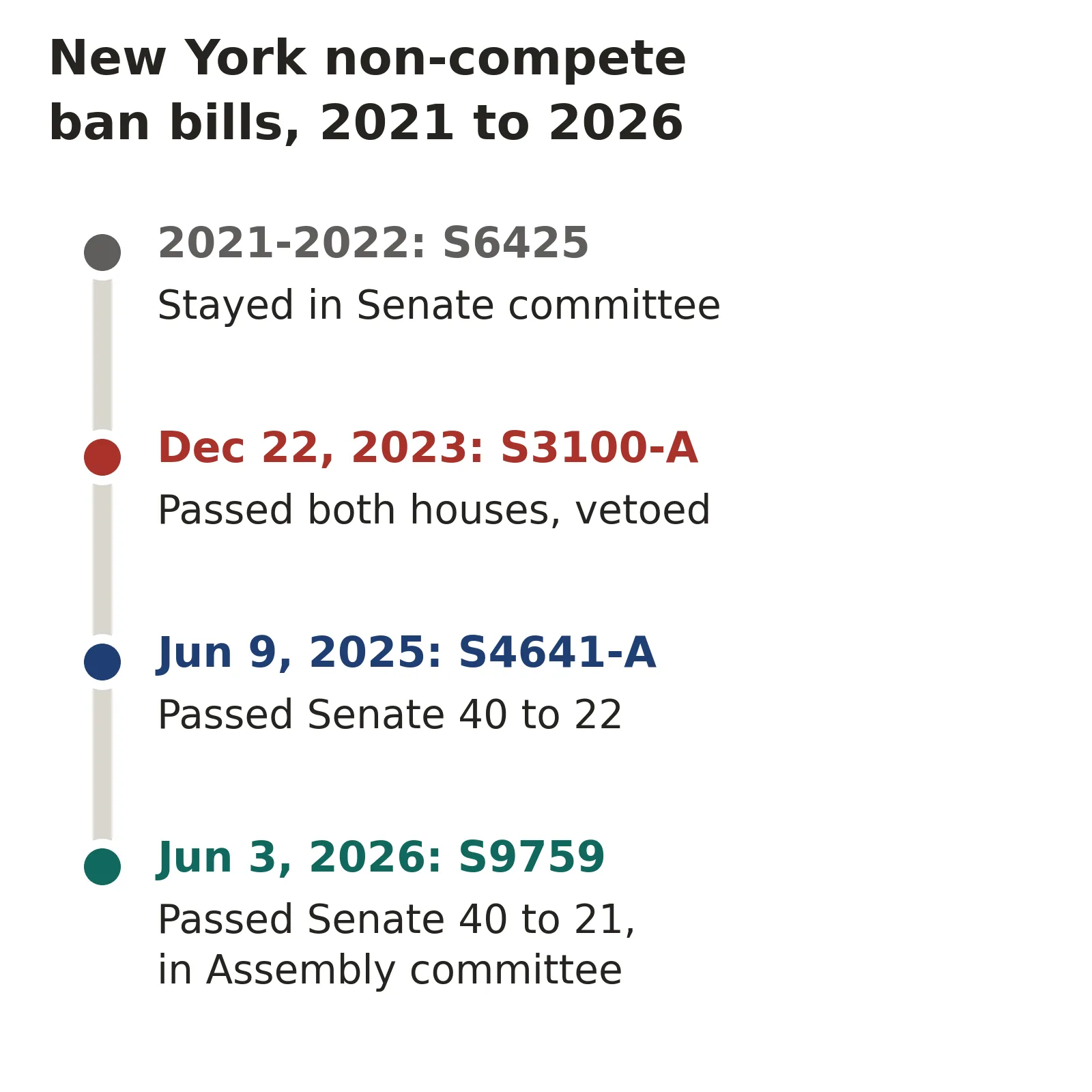
Not yet. The New York State Senate's bill records show a pattern of near misses.
- 2021 to 2022: S6425 did not advance past the Senate Labor Committee.
- 2023: S3100-A passed the Senate on June 7, 2023 (40 to 21) and the Assembly on June 20, 2023. The Governor vetoed it on December 22, 2023 (veto memo 133).
- 2025: S4641-A passed the Senate on June 9, 2025 (40 to 22) and was referred to the Assembly Labor Committee.
- 2026: S9759 passed the Senate on June 3, 2026 (40 to 21). Both it and its Assembly version, A10023, are in the Assembly Labor Committee as of October 3, 2026.
What S9759 would change if it became law
The bill is narrower than the 2023 version. Based on the bill text published by the Senate, it would:
- Ban most new non-competes: employers could not seek, require, demand or accept one from a covered individual or a listed health professional.
- Exclude high earners: people averaging $500,000 or more a year in cash compensation, adjusted for inflation from 2027, would not be covered (health professionals are covered at any income).
- Cap permitted covenants: any non-compete still allowed would have to meet the common-law test, last no more than one year, and pay salary during the restriction.
- Keep sale-of-business covenants: owners of at least a 15 percent interest could still give a non-compete when selling the business's goodwill or a majority ownership interest.
- Override choice-of-law clauses: including choice-of-venue clauses, for people who lived or worked in New York for at least 30 days before their employment ended, including remote workers in another state who report to a New York worksite, office or supervisor.
- Add remedies and a notice: a private right to sue within two years, liquidated damages of up to $10,000 per covered individual or health professional, and a workplace notice developed by the Department of Labor.
The bill would apply only to contracts entered into or modified on or after its effective date, 30 days after it became law. None of this is in force today, and a bill can change before it passes.
What about the FTC rule?
The Federal Trade Commission's final Noncompete Rule set out what the FTC called "a comprehensive ban on new noncompetes with all workers, including senior executives." The FTC's own rule page now states that the rule "is not in effect and it is not enforceable." A district court stopped enforcement on August 20, 2024, and on September 5, 2025 the FTC took steps to dismiss its appeal in the Fifth Circuit. The same page lists a Federal Register notice dated February 12, 2026 on the "Removal of the Non-Compete Rule To Conform These Rules to Federal Court Decisions." For a New York employer, state law is the rule to plan around.
How does New York compare with Ontario?
For a business with staff in Toronto and New York, the two systems point in opposite directions. Ontario has a statutory ban with two narrow exceptions; New York has no general ban but a demanding court test.
| Issue | Ontario | New York |
|---|---|---|
| Source of the rule | ESA s. 67.2 | Case law (BDO Seidman) |
| General ban on employee clauses | Yes, since Oct 25, 2021 | No (bills pending) |
| Time or area limits | Do not save it | Must be reasonable |
| Executives | Statutory exception | Same court test |
| Sale of a business | Narrow exception | Treated more leniently |
Ontario's Employment Standards Act guide states that, effective October 25, 2021, employers are prohibited from entering into employment contracts or other agreements with an employee that include a non-compete, whether or not the clause is time-limited or geographically restricted. Under section 67.2 of the Act, a non-compete made in breach of that rule is void. The two statutory exceptions cover a sale (including a lease) of a business where the seller becomes the buyer's employee immediately afterward, and executives holding a chief executive office such as chief executive officer, president or chief financial officer. Our guide to non-compete agreements in Ontario covers both exceptions in detail.
Two cautions for cross-border employers. First, one template for both offices can fail in both: a clause that is acceptable in New York may be prohibited in Ontario, and an Ontario-style clause may give up protection a New York court would have allowed. Second, a choice-of-law clause is not a safe workaround. In Brown & Brown, the Court of Appeals refused to apply a Florida choice-of-law clause to a New York employee's covenant because Florida's statute focused almost exclusively on the employer's interests, barred narrow construction and barred courts from considering the harm to the employee, which together offended a fundamental public policy of New York.
What should employers in New York do now?
A New York non-compete holds up best when it is built around a specific interest and presented fairly. These steps follow from the cases above:
- Step 1: Name the interest. Tie the clause to trade secrets, confidential client information, unique services or client goodwill built at your expense.
- Step 2: Draw it narrowly. Limit it to clients and work the employee actually handled, for a period and area you can explain.
- Step 3: Consider the lighter tools. A client non-solicit or a confidentiality term may protect the same interest with less risk.
- Step 4: Present it early. Put the covenant in the offer, give the candidate time to read it, and do not spring it on the first day.
- Step 5: Plan for terminations. If you dismiss without cause, expect the continued willingness to employ argument.
- Step 6: Watch Albany. If S9759 or a similar bill passes, new and modified agreements will need to follow it.
Covenants are only one part of an employment agreement. Our guide to a breach of employment contract in Ontario and New York covers notice, severance and the other terms that come into play when a working relationship ends.
Frequently asked questions
Are non-competes enforceable in NY in 2026?
Yes, within limits. As of October 2026, New York has no general statutory ban, so courts apply the common-law test from BDO Seidman v Hirshberg. The employer must prove the restraint is no greater than needed to protect a legitimate interest, imposes no undue hardship on the employee, and does not harm the public. Courts construe these covenants strictly.
Is there a maximum length for a New York non-compete?
No statute sets one today. Courts decide reasonableness case by case, measured against the interest the clause protects, so a period that works for one role may fail for another. The pending bill, S9759, would cap any non-compete it still allows at one year and require salary during the restriction, but it has not become law.
Can a New York employer enforce a non-compete after a layoff?
It may not be able to. Post v Merrill Lynch, a pension forfeiture case, treated termination without cause as destroying the mutuality on which a covenant rests, and the First Department in Buchanan Capital Mkts. v DeLucca (2016) applied that idea in refusing a preliminary injunction to enforce non-competes. Expect the covenant to be challenged on that basis.
Are non-solicitation agreements enforceable in New York?
Often, if they are drawn narrowly. In Brown & Brown v Johnson, the Court of Appeals measured a customer non-solicit against the BDO Seidman standard and found it overbroad because it covered customers the employee had never met or served. It left open whether a narrower version could be partly enforced, which depended on disputed facts.
Does the FTC non-compete ban apply to New York employers?
No. The Federal Trade Commission's own rule page states that the Noncompete Rule is not in effect and is not enforceable. A federal district court stopped enforcement on August 20, 2024, the FTC took steps on September 5, 2025 to dismiss its appeal, and a February 12, 2026 notice addressed removing the rule. New York employers are governed by New York law.
Can a company choose another jurisdiction's law for its New York staff?
Not reliably. In Brown & Brown, the Court of Appeals refused to apply a Florida choice-of-law clause to a New York employee's non-solicitation covenant because Florida's rules offended a fundamental New York public policy. S9759, if enacted, would also make choice-of-law clauses unenforceable against its protections for people who lived or worked in New York for at least 30 days before leaving.
Conclusion
So, are non-competes enforceable in NY? Yes, but only the ones an employer can justify clause by clause: a real interest, a restraint no wider than that interest, no undue hardship and no harm to the public. Overbroad clauses may be trimmed rather than struck, but only for an employer that acted in good faith. A statutory ban has passed the Senate three times since 2023 and been vetoed once, so the rules could change. Employers with Ontario staff face a stricter statutory ban there, which makes one cross-border template a risky shortcut.
How Mayo Law can help
Mayo Law is a cross-border law firm with offices in Toronto and New York. Joseph Mayo is licensed in Ontario and New York, so we can review employment agreements, non-competes, non-solicits and confidentiality terms for staff in both jurisdictions and explain where each clause stands under each set of rules. Our compliance practice works with employers on restrictive covenants, hiring documents and the workplace policies around them. For a Canadian company hiring its first New York employee, we can also explain how a covenant fits with the rest of the offer letter and the employee's other terms.
Disclaimer
This article is for general information only and is not legal advice. Reading it does not create a solicitor-client or attorney-client relationship. Laws, bills and court decisions change, and the right answer depends on the facts of each case. Mayo Law provides legal services in Ontario and New York.