

Contents
- Can a Canadian own a business in the US outright?
- What is the difference between owning a US business and working in it?
- Can a Canadian company operate in the US without a US entity?
- Which status lets a Canadian owner work in their own US business?
- Do Canadians need a visa for the E-2, or can they apply at the border?
- How long can each route keep you in the United States?
- What does a Canadian owner have to file with the IRS?
- Where do Canadian owners most often get this wrong?
- Conclusion
- How Mayo Law Can Help
Can a Canadian own a business in the US? Yes. United States law sets no citizenship or residency test for holding shares in a US corporation or a membership interest in an LLC. Working in that business on US soil is a separate question, and it requires an immigration status such as E-2 or L-1.
A Canadian founder asks some version of this question at almost every first meeting. She has customers in Buffalo and Chicago, an accountant telling her to set up a Delaware company, and a nagging worry that forming one commits her to moving. The worry is misplaced, but the instinct behind it is sound.
Ownership and work authorization are two different legal systems in the United States, and they are administered by different agencies under different rules. Corporate law decides who may hold shares. Immigration law decides who may perform work inside the country. Confusing the two produces both of the expensive mistakes we see: founders who delay a profitable US entity because they think they need a visa first, and founders who form the entity and then start working in the United States on a visitor status that does not permit it.
This guide separates the two. It covers what ownership gives a Canadian, what it does not, which statuses let an owner work in the business, and the filings that follow a foreign owner around at tax time. Every rule below is cited to the regulation or agency page it comes from, with the date it was verified.
Can a Canadian own a business in the US outright?
Yes. No provision of US federal law conditions the ownership of a corporation or a limited liability company on the owner’s citizenship or immigration status. Company formation is a matter of state law, and the general incorporation statutes do not impose a nationality test on shareholders or LLC members. A Canadian citizen living in Toronto can hold 100 percent of a Delaware, New York or Texas company without ever setting foot in the United States.
Three practical constraints sit beside that rule, and they are constraints rather than prohibitions.
A few regulated sectors restrict foreign ownership. Broadcast licences, some defence and maritime work, and certain federally regulated industries carry ownership limits. These are sector rules, not general rules, and they do not touch the ordinary consulting firm, software company, distributor or restaurant.
An S corporation is off the table. The subchapter S election requires shareholders who are US citizens or resident aliens, so a non-resident Canadian cannot hold S corporation stock. A C corporation or an LLC remains available, and the choice between them has real tax consequences on both sides of the border. We work through that decision in choosing the right entity for your U.S. business.
Banking is where the friction actually appears. US financial institutions apply customer identification rules that assume a domestic principal with a domestic identifier. The legal right to own the company is rarely the obstacle. Opening the account for it frequently is.
What is the difference between owning a US business and working in it?
Ownership is a property right. Work authorization is a permission to perform services inside the United States. A Canadian can hold the first without the second, and the practical question is which activities fall on which side of the line.
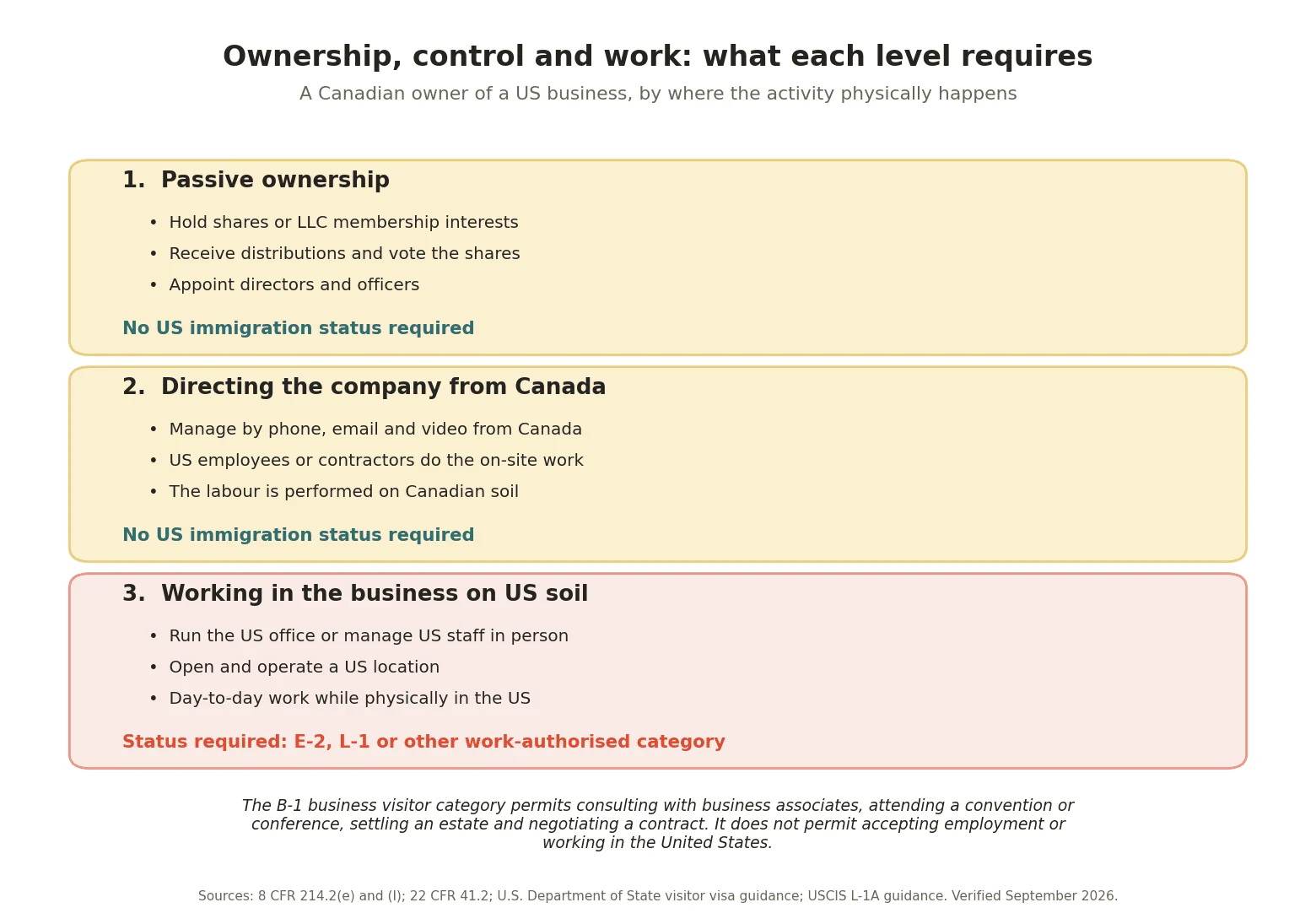
Three positions cover almost every founder we advise.
Passive ownership. Holding shares, receiving distributions, voting them, and appointing directors. None of this is work performed in the United States, and none of it requires any immigration status.
Directing the company from Canada. Running the business by email, video call and phone from an office in Ontario, while US-based employees or contractors do the work on the ground. The labour is performed in Canada. This is the arrangement most Canadian owners actually use in the first year or two, and it is available without any US status.
Working in the business on US soil. Managing staff in the US office, meeting customers as the operator rather than the negotiator, opening a location, or doing the day-to-day work of the company while physically present. This is where an immigration status becomes necessary.
The B-1 business visitor category sits awkwardly between the second and third positions, and it is where owners most often overstep. The Department of State lists the permitted activities plainly: consulting with business associates, attending a scientific, educational, professional or business convention or conference, settling an estate, and negotiating a contract. The same page states that a person on a visitor visa is not permitted to accept employment or work in the United States (travel.state.gov, verified September 2026). Signing a lease for the new office is a negotiation. Staffing and running that office is not.
Can a Canadian company operate in the US without a US entity?
Often, yes, at least at the start. A Canadian corporation can sell to US customers, ship goods across the border and invoice in US dollars without forming anything in the United States. What a US entity does is change the tax, liability and credibility picture once the operation stops being occasional.
The pressure to incorporate usually arrives from one of four directions. Holding inventory in a US warehouse, hiring employees who live in the United States, signing customer contracts that require a US counterparty, and state-level sales tax registration triggered by economic nexus thresholds all push towards a US entity. So does anything that creates a permanent establishment for treaty purposes, because at that point the Canadian company is filing in the United States regardless.
A Canadian corporation that carries on a trade or business in the United States has its own reporting obligation, which is covered in the tax section below. The cross-border tax consequences of the move are set out in moving from Canada to the US tax implications, and the sequencing question, which entity to form first and in which country, is worked through in start a business in both Canada and the US.
One point is worth stating clearly because it is the source of a common misunderstanding. Forming a US subsidiary does not give its Canadian parent’s officers the right to work in the United States. The entity and the status are separate applications. What the subsidiary does do is create the corporate relationship that an L-1 transfer depends on.
Which status lets a Canadian owner work in their own US business?
Two routes carry most Canadian owner-operators, and they answer different facts.
E-2 treaty investor. Canada has been an E-1 and E-2 treaty country since January 1, 1994 (Department of State, Treaty Countries table, verified September 2026). The governing regulation, 8 CFR 214.2(e)(2), classifies a person as a treaty investor where the applicant has invested or is actively in the process of investing a substantial amount of capital in a bona fide enterprise in the United States, as distinct from a relatively small amount of capital in a marginal enterprise solely for the purpose of earning a living, is seeking entry solely to develop and direct the enterprise, and intends to depart on expiration or termination of status. The enterprise itself must be at least 50 percent owned by treaty country nationals, under 8 CFR 214.2(e)(3)(ii).
Two phrases in that regulation do most of the work in practice. Develop and direct means the applicant must actually control the business, which is why ownership percentage and voting control get scrutinised. Marginal enterprise means a business that produces no more than a living for the investor and family will not qualify. Neither concept has a dollar figure attached, which is why the minimum investment question has no single answer. We set out how adjudicators approach it in E-2 visa minimum investment amount, and the full eligibility picture in E-2 visa requirements.
L-1 intracompany transfer. Where a Canadian company already exists and wants to open a US office, the L-1 route moves an executive or manager into it. USCIS requires a qualifying relationship between the foreign and US entities, and that the employer be doing business in the United States and at least one other country. Doing business is defined as the regular, systematic and continuous provision of goods or services, and USCIS states expressly that it does not include the mere presence of an agent or office (uscis.gov, page last reviewed August 31, 2026).
For a new US office specifically, 8 CFR 214.2(l)(3)(v) adds three conditions: the employer has secured sufficient physical premises to house the new office, the employee has worked as an executive or manager for one continuous year in the three years before the petition is filed, and the intended US office will support an executive or managerial position within one year of approval. That last condition is the one that ends new-office L-1s at the extension stage, because the business has to have grown into the job description. The route is covered in the L-1 visa from Canada.
Neither route fits a founder who simply wants to attend meetings. For that, the B-1 category above is usually sufficient, and Canadians do not need a visa to use it. The wider set of options, including TN for professionals, is compared in US work visas for Canadians.
Do Canadians need a visa for the E-2, or can they apply at the border?
This is the single point most often reported incorrectly, including by sources that are otherwise reliable, and it changes how a Canadian owner plans the timeline.
Canadian citizens are generally exempt from the US visa requirement. The exemption is not universal. Under 22 CFR 41.2(a), a visa is not required for Canadian citizens except for those who apply for admission in the E, K, V or S classifications. The same regulation states the point again at 22 CFR 41.2(l): notwithstanding the general exemption, a visa is required of a Canadian national who is classified, or who seeks classification, under INA 101(a)(15)(E). The eCFR text was current as of September 11, 2026 when verified for this article.
The consequence is concrete. A Canadian cannot present an E-2 case to a Customs and Border Protection officer at a land crossing or preclearance hall the way a TN or L-1 applicant can. The E-2 case goes to a US consulate, with Form DS-160 and, for executives, managers and essential employees, Form DS-156E. The nonimmigrant visa application fee for the E category is $315 (travel.state.gov, verified September 2026). The detailed adjudication standards sit in 9 FAM 402.9.
L-1 is the opposite case. Because L is not in the E, K, V or S list, a Canadian remains visa-exempt, which is why an L-1 petition can be presented at a port of entry. Two routes, two entirely different procedural paths, for the same person. The Canada-specific E-2 process is covered in the E-2 visa from Canada, and the fee breakdown in E-2 visa cost.
One more consequence worth planning around: because the E-2 requires a consular appointment, the timeline is driven by appointment availability at the Toronto, Montreal, Calgary, Vancouver, Halifax, Ottawa or Quebec City post, not by a filing receipt date.
How long can each route keep you in the United States?
The authorised periods are set by regulation and they differ more than most founders expect. The figures below come from the Code of Federal Regulations and the USCIS L-1A page, verified September 2026.
A B-1 business visitor may be admitted for not more than one year, with extensions in increments of not more than six months each, under 8 CFR 214.2(b)(1). In ordinary practice a Canadian arriving at the border for meetings is admitted for a much shorter period than the regulatory maximum.
A treaty trader or treaty investor may be admitted for an initial period of not more than two years under 8 CFR 214.2(e)(19)(i), and extensions may be granted in increments of not more than two years under 8 CFR 214.2(e)(20). There is no cumulative cap. An E-2 business that keeps qualifying can keep renewing, which is why the category suits an owner who intends to run the company for a long time without pursuing permanent residence.
An L-1A transferee entering to establish a new office is allowed a maximum initial stay of one year. Other L-1A employees get three years. Extensions come in increments of up to two years, to a ceiling of seven years. The one-year new-office period is short on purpose, and it is why the business plan behind a new-office L-1 has to be credible on its own timeline.
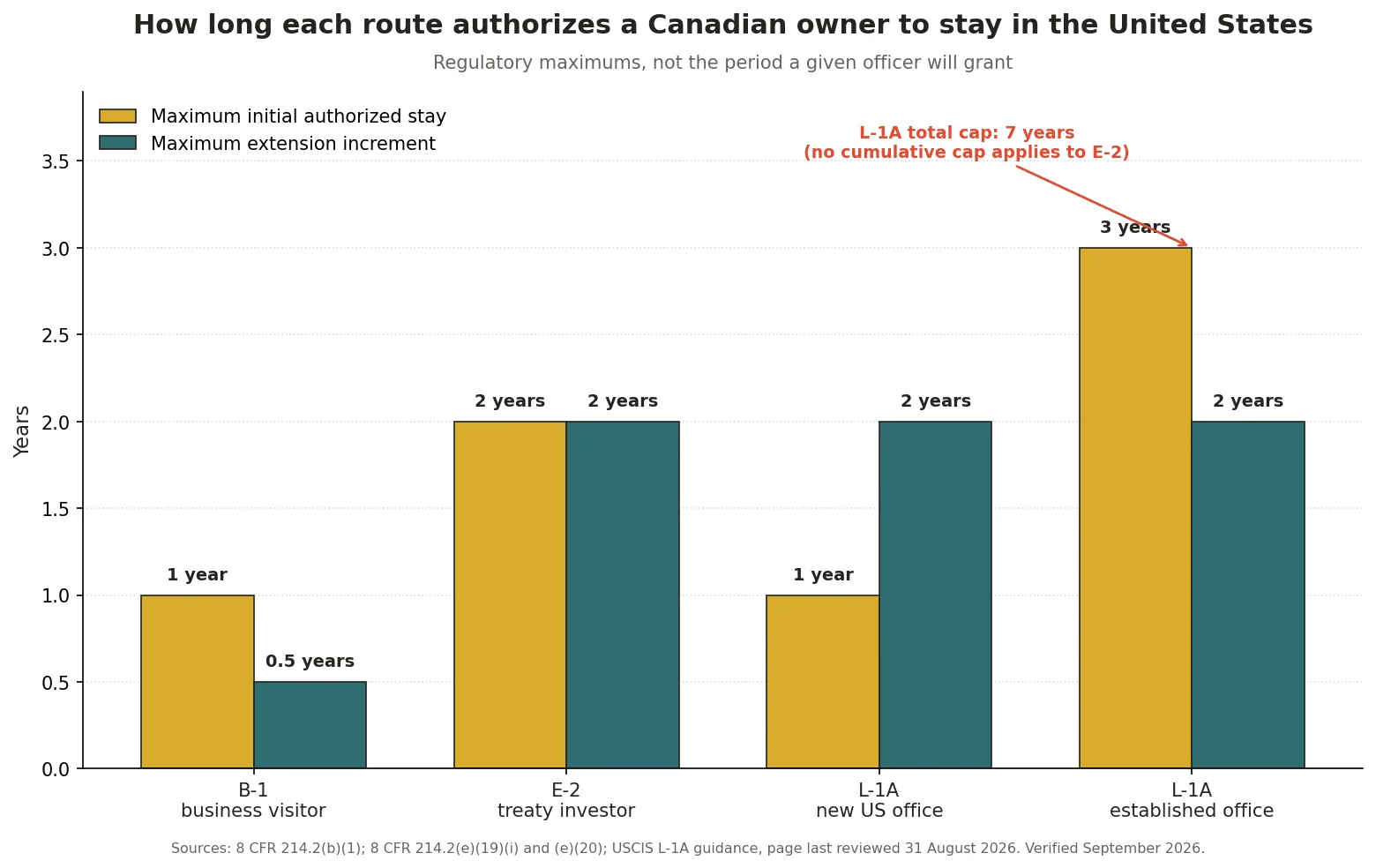
The contrast between the uncapped E-2 and the seven-year L-1A ceiling is the reason many Canadian owners who start on an L-1 look at other options well before year seven.
What does a Canadian owner have to file with the IRS?
Foreign ownership triggers US reporting that has nothing to do with immigration status, and the penalties are not proportionate to the size of the business.
An EIN comes first. The employer identification number is the entity’s tax account number and it is needed before most banks will open an account. A Canadian owner without a Social Security number can still get one. The Instructions for Form SS-4 (Rev. December 2025) direct the applicant to enter “foreign” or N/A on line 7b where the responsible party does not have and is ineligible to obtain an SSN or ITIN, and note that an entry is required. The responsible party must be an individual rather than an entity. The online application is not available to an applicant with no legal residence, principal place of business or principal office in the United States, but international applicants may apply by telephone on 267-941-1099, between 6:00 a.m. and 11:00 p.m. Eastern, Monday through Friday.
Form 5472 follows foreign ownership. A reporting corporation is a 25 percent foreign-owned US corporation, which includes a foreign-owned US disregarded entity, or a foreign corporation engaged in a trade or business within the United States. A corporation is 25 percent foreign owned if it has at least one direct or indirect 25 percent foreign shareholder at any time during the tax year. The Instructions for Form 5472 (Rev. December 2024) set the penalty for failure to file at $25,000, with a further $25,000 if the failure continues more than 90 days after IRS notification, and treat a substantially incomplete form as a failure to file.
That second rule catches single-member LLCs hard. A Canadian-owned single-member LLC is a disregarded entity that may owe no US income tax at all, and it still has to file. The owner who assumes no tax means no filing is the owner who receives the $25,000 notice.
None of this is legal advice on a specific structure, and the Canadian side has its own consequences that a US-only analysis will miss. The cross-border picture is set out in moving from Canada to the US tax implications.
Where do Canadian owners most often get this wrong?
Four patterns account for most of the remedial work that reaches us.
Treating the company formation as the immigration plan. Incorporating in Delaware in January and assuming a visa follows in February inverts the order. An E-2 case is built around an investment that is already substantial and at risk, so the corporate and financial work comes first and the application documents it.
Working on a business visitor admission. The distance between negotiating a contract, which the B-1 permits, and running the US operation, which it does not, is smaller than it looks from the Canadian side of the border and is treated seriously on the US side.
Structuring the ownership without reading 8 CFR 214.2(e)(3)(ii). Bringing in a US partner who takes 55 percent can extinguish the E-2 eligibility of the Canadian founder, because the enterprise no longer meets the 50 percent treaty-nationality requirement. The cap table and the visa strategy have to be designed together, and the same applies to a share purchase, where the letter of intent to purchase a business should be drafted with the status question already settled.
Forgetting the family. An E-2 spouse’s ability to work in the United States is a separate analysis with its own recent history, covered in E-2 visa spouse work authorization.
Ontario and New York rules are not interchangeable, and neither generalises to the rest of its country. A structure that works for an Ontario corporation with a New York subsidiary is not automatically right for a British Columbia company selling into Texas. We work on both sides of that line as a cross-border business and immigration practice.
Frequently asked questions
Can a Canadian own a business in the US without living there?
Yes. Ownership carries no residency requirement. A Canadian can hold all of the shares in a US corporation or all of the membership interests in an LLC while living in Canada full time, receive distributions, vote the shares and appoint directors. What residency in the United States would add is the ability to perform work for the business on US soil, and that comes from immigration status rather than from ownership.
Does forming a US company give a Canadian the right to work in it?
No. Company formation is governed by state corporate law and work authorization by federal immigration law, and the two are decided separately. A Canadian who forms a Delaware corporation has acquired a company and nothing else. Performing the work of that company while physically in the United States requires a status such as E-2 or L-1, applied for on its own facts and its own timeline.
Can a Canadian company sell into the United States without forming a US entity?
Usually yes at the outset. A Canadian corporation can invoice US customers and ship across the border without a US entity. The pressure to incorporate typically comes from holding inventory in the United States, hiring US-based employees, customer contracts that require a US counterparty, or state sales tax registration triggered by economic nexus. A US trade or business also brings its own federal filing obligations.
Do Canadians need a visa for the E-2, or can they apply at the border?
A visa is required. Canadians are generally visa-exempt, but 22 CFR 41.2(a) excludes the E, K, V and S classifications from that exemption, and 22 CFR 41.2(l) states specifically that a visa is required of a Canadian national seeking classification under INA 101(a)(15)(E). An E-2 case therefore goes to a US consulate rather than to a port of entry, unlike an L-1 or TN application.
How much does a Canadian have to invest for an E-2?
No dollar minimum appears anywhere in the statute or the regulation. 8 CFR 214.2(e)(2)(i) requires a substantial amount of capital in a bona fide enterprise, as distinct from a relatively small amount in a marginal enterprise existing solely to earn the investor a living. Adjudicators read substantiality against the cost of the particular business, so the figure that satisfies a consultancy differs from the figure that satisfies a restaurant.
Can a Canadian own a US business and still keep a Canadian corporation?
Yes, and the two-entity structure is common. A Canadian parent with a US subsidiary is one of the standard cross-border shapes, and it is also the corporate relationship that an L-1 transfer requires. The choice between a parent-subsidiary structure, sister companies and a single entity turns on tax, liability and where the management actually sits, and it should be settled before either company is formed.
What happens if a Canadian-owned LLC does not file Form 5472?
The Instructions for Form 5472 set the penalty at $25,000 for failing to file when due, with a further $25,000 if the failure continues more than 90 days after IRS notification. A substantially incomplete form counts as a failure to file. The rule applies to a foreign-owned US disregarded entity even where the entity owes no US income tax, which is how dormant single-member LLCs accumulate penalties.
Can a Canadian buy an existing US business instead of starting one?
Yes, and an acquisition can support an E-2 case provided the purchase price reflects a substantial investment, the funds are at risk, and the buyer will develop and direct the business rather than hold it passively. The ownership structure matters from the first draft of the deal documents, because the enterprise must remain at least 50 percent owned by treaty country nationals.
Conclusion
A Canadian can own a business in the US with no citizenship test, no residency requirement and no visa. That part is settled. The question that actually shapes the plan is what the owner intends to do inside the business, because the moment the work happens on US soil the analysis moves from corporate law to immigration law and the answer changes.
Get the order right and the two fit together. Decide where the work will physically happen, choose the entity and the ownership split with the E-2 fifty percent rule in view, build the investment record as it happens rather than reconstructing it later, and treat the IRS reporting as a standing obligation rather than a year-end surprise.
How Mayo Law Can Help
Mayo Law is a cross-border practice serving US and Canadian businesses from offices in Toronto and New York. Joseph Mayo, the firm’s principal attorney, is licensed in both Ontario and New York, which means the corporate structuring and the immigration strategy can be worked through together rather than split between two firms in two countries.
We advise Canadian owners on US entity selection and formation, E-2 and L-1 planning, acquisitions of US businesses, and the compliance obligations that follow foreign ownership. If you are weighing a US entity, a move, or an acquisition, our E-2 visa lawyers and our business immigration and international business teams can look at the whole picture at once.
Disclaimer
This article is provided for general information only and is not legal advice. Reading it does not create an attorney-client relationship with Mayo Law or with any of its lawyers. Immigration and tax rules change, and the application of any rule depends on the specific facts of your situation. Figures, fees and regulatory text cited here were verified in September 2026 and may have changed since. You should obtain advice on your own circumstances before acting.
Mayo Law provides legal services in Ontario and New York.