

Contents
- Quick answer
- Is there an E-2 rule written for franchises?
- Which franchise costs count toward the E-2 investment?
- When should you sign and fund an E-2 visa franchise?
- Which FDD items matter most for an E-2 file?
- Can a franchise pass the marginality test?
- Does franchisor control affect "develop and direct"?
- What franchise law protects a Canadian buyer?
- Frequently asked questions
- Conclusion
- How Mayo Law can help
- Disclaimer
An E-2 visa franchise is a US franchise unit that a treaty investor buys or opens and then uses as the investment behind an E-2 treaty investor application. Canadians qualify for E-2 status, and a franchise unit is one way to build the business the visa requires. The E-2 rules, though, say nothing specific about franchises. The State Department's manual and the USCIS regulation apply the same tests to a franchise as to any other enterprise, so the question is how the franchise paperwork answers those tests.
This E-2 visa franchise guide explains how the franchise disclosure document, the franchise fee, the build-out budget and the timing of the franchise agreement fit the E-2 rules on investment, substantial capital, marginality and control. It also covers which franchise laws protect a Canadian buyer of a US unit, including New York's registration rules and why Ontario's franchise statute usually does not apply. The legal sources are current as of September 2026.
Quick answer
A franchise can support an E-2 visa if Canadian nationals own at least 50 percent, the investor has placed personal capital at risk in the unit, and the business can earn more than a minimal living. No E-2 rule is written for franchises. The Franchise Disclosure Document, especially Item 7, supplies much of the evidence.
Is there an E-2 rule written for franchises?
No. The State Department's guidance to consular officers, 9 FAM 402.9 (revision CT:VISA-2190, dated February 17, 2026), does not use the word franchise anywhere in its treaty trader and treaty investor chapter. The USCIS regulation, 8 CFR 214.2(e), is the same: the only mention of franchises in section 214.2 sits in the rules for a different visa category. We checked both texts in September 2026.
That matters because some marketing pages describe an "E-2 franchise visa" as if it were its own program. It is not. A franchise unit is judged on the nine points the manual lists for every E-2 investor case, including whether the applicant has invested or is actively investing, whether the enterprise is real and operating, whether the investment is substantial, whether the enterprise is more than marginal, and whether the investor is in a position to develop and direct it (9 FAM 402.9-6(A)). The treaty table in 9 FAM 402.9-10 lists Canada's E-2 provisions as entered into force on January 1, 1994, so Canadian citizens start from an eligible nationality. The full list of E-2 visa requirements applies to a franchise exactly as it applies to a startup.
What a franchise changes is the evidence. A franchisor has to give buyers a disclosure document with 23 standard items under the Federal Trade Commission's Franchise Rule (16 CFR Part 436), and several of those items line up closely with what an E-2 file has to prove. A franchise also comes with a signed agreement, a published cost estimate and a set opening process, which can make the investment easier to document than an independent concept.
Which franchise costs count toward the E-2 investment?
The regulation defines an investment as the investor's capital placed at risk in the commercial sense, with the objective of generating a profit, and it must be capital the investor possesses and controls (8 CFR 214.2(e)(12)). The manual adds that funds must be subject to partial or total loss if the business fails (9 FAM 402.9-6(B)). Applied to a franchise budget, the manual's own examples sort most cost lines, and Figure 1 shows how each common line is treated.
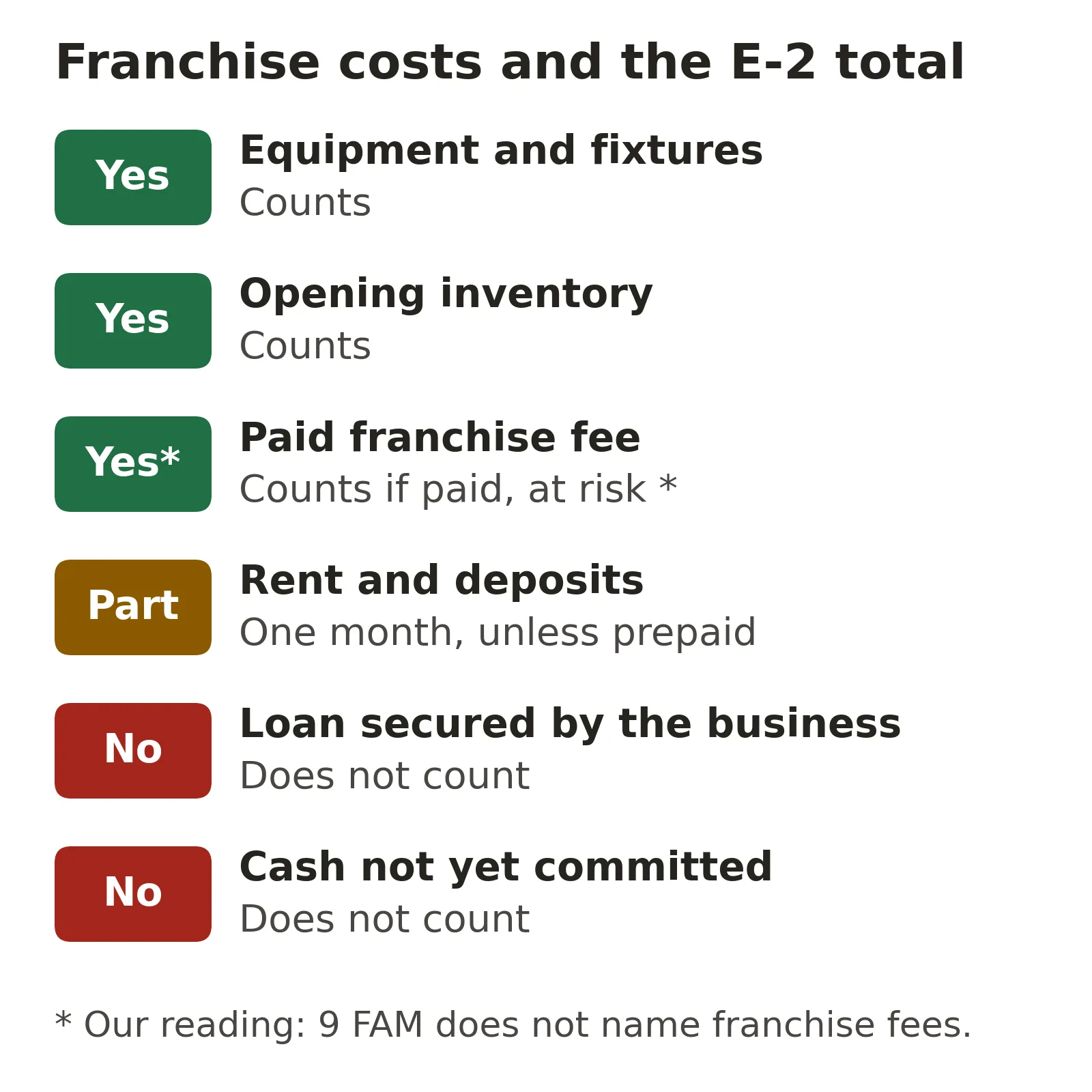
Here is the reasoning behind each line in Figure 1:
- Equipment, fixtures and opening inventory: the manual says the amount spent to buy equipment and the inventory on hand may be counted in the investment total, as long as the items are used in the business and not for personal purposes (9 FAM 402.9-6(B)(g)).
- Initial franchise fee: the manual does not mention franchise fees by name. In our reading, a fee that has been paid and cannot be refunded is capital the investor would lose if the unit failed, which is the risk test the manual applies. A fee that is still refundable is harder to present as at risk. Item 5 of the disclosure document states whether and when the initial fee is refundable.
- Rent and deposits: lease or rent payments count only up to the amount devoted to that item in any one month. The annual rent does not count unless it has been paid in advance (9 FAM 402.9-6(B)(f)).
- Loans: a mortgage or commercial loan secured by the assets of the business cannot count, because the investor is not personally at risk. A loan secured by the investor's own assets, such as a second mortgage on a home, or an unsecured personal loan, can be included (9 FAM 402.9-6(B)(c)).
- Cash sitting in an account: mere intent to invest, or uncommitted funds in a bank account, will not do (9 FAM 402.9-6(B)(e)).
Franchisor financing deserves a closer look. Item 10 of the disclosure document describes any financing the franchisor or its affiliate offers, and Item 7 must state in a footnote whether the franchisor finances part of the initial investment (16 CFR 436.5(g)). If that financing is secured by the unit's own assets, the manual's rule on business-secured debt means the financed portion should not be counted as the investor's capital.
Is the investment substantial for this franchise?
There is no minimum dollar figure for an E-2 investment. The manual says so directly and applies a proportionality test that weighs the qualifying funds against the cost of the business: the lower the cost, the higher the percentage the investor is expected to put in (9 FAM 402.9-6(D)). For a newly created business, cost is the actual amount needed to bring it to the point of being operational (9 FAM 402.9-6(D)(c)(3)). For a new franchise unit, the franchisor's Item 7 table is a published estimate of that figure, and we use it as the starting point for the proportionality analysis of an E-2 franchise investment. Our E-2 minimum investment guide explains the proportionality test in more detail, and the E-2 franchise petition cost section of our cost guide covers the professional and government fees.
New unit or resale?
Buying an existing franchised location changes the measurement. The manual treats the cost of an established business as its purchase price, which is normally fair market value (9 FAM 402.9-6(D)(c)(2)). A resale also depends on the transfer terms in the franchise agreement, which Item 17 of the disclosure document summarizes along with renewal and termination. Our guide to buying an E-2 business for sale covers purchase agreements, escrow and the evidence an existing business needs.
When should you sign and fund an E-2 visa franchise?
Two sets of rules control the timing, and they pull in different directions. The franchise rules protect the buyer by slowing the sale down. The E-2 rules require the buyer to be committed before applying.
On the franchise side, the FTC Franchise Rule makes it an unfair or deceptive practice for a franchisor to fail to give a prospective franchisee its current disclosure document at least 14 calendar days before the buyer signs a binding agreement or makes any payment to the franchisor or an affiliate (16 CFR 436.2(a)). If the franchisor unilaterally and materially changes the agreement, the buyer must receive the revised agreement at least 7 calendar days before signing it (16 CFR 436.2(b)). The rule applies to franchises to be located in the United States. The FTC's own consumer guide to buying a franchise restates the 14-day rule in plain language.
On the E-2 side, being "in the process of investing" requires funds that are committed to the investment, and the commitment must be real and irrevocable. A purchase conditioned on visa issuance can still qualify if the assets are held in escrow for release once the condition is met (9 FAM 402.9-6(B)(d)). The regulation names escrow pending approval of E classification as one acceptable mechanism (8 CFR 214.2(e)(12)). The manual also warns that the investor must be close to the start of actual operations, not simply at the stage of signing contracts or scouting locations (9 FAM 402.9-6(B)(e)).
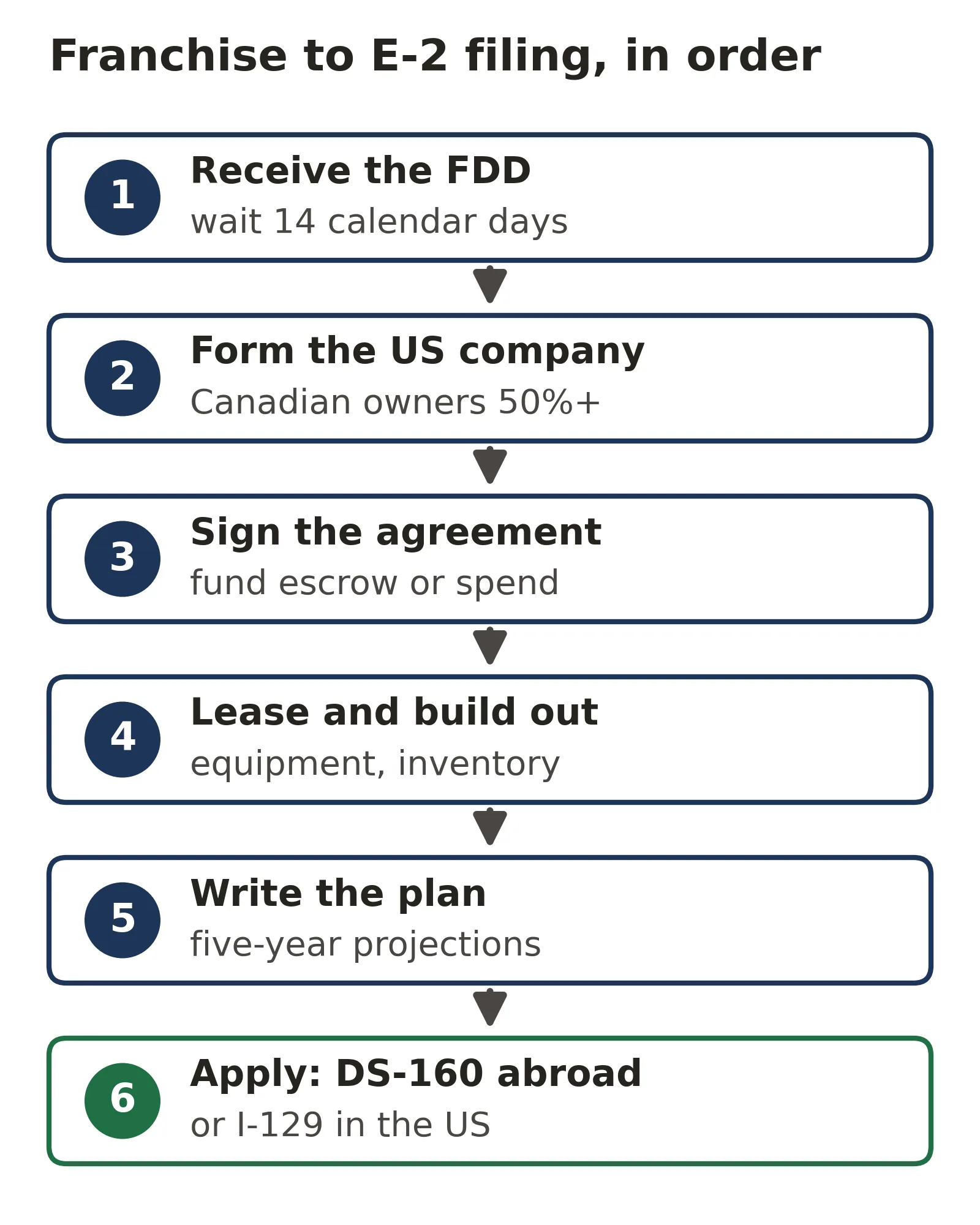
Figure 2 shows one workable order. The gap between the franchise agreement and opening day needs planning, because a signed agreement with no lease, build-out or equipment may not show an investor close to operating. Item 11 of the disclosure document must state the typical length of time between signing the agreement (or first payment) and opening the business, and the factors that affect it, such as obtaining a lease, financing or building permits (16 CFR 436.5(k)). That number is a useful planning input for the E-2 filing date.
Where you file also depends on where you are. A Canadian investor outside the United States applies for E-2 classification through the consular process, using Form DS-160 (9 FAM 402.9-11(A)). An investor already in the United States in lawful nonimmigrant status may file Form I-129 with USCIS to request a change of status to E-2, according to the USCIS E-2 Treaty Investors page. Our guides to applying for the E-2 visa from Canada and E-2 change of status explain both routes.
Which FDD items matter most for an E-2 file?
The FTC rule requires 23 disclosure items in a set order (16 CFR 436.5). Neither the State Department manual nor the USCIS regulation mentions the disclosure document, so the mapping below is our own reading of where each item helps an E-2 visa franchise file.
| FDD item | What it discloses | E-2 use |
|---|---|---|
| Item 5 | Initial fees, refund terms | Is the fee at risk? |
| Item 6 | Royalties and other fees | Cash flow, marginality |
| Item 7 | Estimated initial investment | Cost of the business |
| Item 10 | Franchisor financing terms | Which funds count |
| Item 11 | Time from signing to opening | Close to operating? |
| Item 17 | Renewal, transfer, termination | Resale and term |
| Item 19 | Financial performance, if given | Five-year projections |
| Item 20 | Outlets opened and closed | Plan credibility |
Item 7 carries the most weight. The rule requires it to be a table titled "YOUR ESTIMATED INITIAL INVESTMENT" that lists the initial franchise fee, training, real property, equipment and fixtures, construction and leasehold improvements, opening inventory, deposits and business licenses, and a category called "Additional funds" for the initial period of operations, which the rule says is at least three months or a reasonable period for the industry. Each line shows the amount (or a low-high range), how it is paid, when it is due, to whom, and whether it is refundable (16 CFR 436.5(g)). Read against Figure 1, that table tells you which lines will count as qualifying capital and which will not.
Item 19 needs care. A franchisor may include financial performance figures only if it has a reasonable basis for them, and a franchisor that makes no such representation must say so (16 CFR 436.5(s)). If Item 19 is empty, the five-year projections in the E-2 business plan have to be built from other support, such as the investor's own market work.
Can a franchise pass the marginality test?
An E-2 enterprise may not be marginal. A marginal enterprise is one without the present or future capacity to generate more than enough income to provide a minimal living for the investor and family. An enterprise that makes a significant economic contribution is not marginal, and the projected capacity should generally be realizable within five years from the date normal business activity begins (8 CFR 214.2(e)(15); 9 FAM 402.9-6(E)).
An E-2 visa franchise does not pass this test on brand strength alone. Royalties and advertising contributions listed in Item 6 come off the top of revenue, so the projections have to show income after those payments. The manual's suggested document checklist for a new business lists payroll records and "financial projections for next 5 years, supported by a thorough business plan" (9 FAM 402.9-11(B)). Our guide to E-2 visa business plan requirements covers how to build that plan so it reflects the specific location rather than the franchisor's general materials.
Does franchisor control affect "develop and direct"?
The investor must be in a position to develop and direct the enterprise. Treaty-country nationals must own at least 50 percent of the enterprise, and the investor must show development and direction through ownership or, under the manual's control-by-management provision, through managerial control (9 FAM 402.9-6(F)). An equal two-party partnership generally gives control when each party keeps full management rights, but the manual says an equal partnership with more than two partners does not give any of them control based on ownership.
A franchise agreement gives the franchisor a say over how the unit runs: restrictions on sources of products and services, the franchisee's obligations, and limits on what the unit may sell are disclosed in Items 8, 9 and 16. The manual does not address whether franchisor standards weaken an investor's control, because it does not address franchises at all. What it does require is ownership of the US enterprise or managerial control of it. For an E-2 visa franchise, that means the Canadian investor or the investor's company should own the franchisee entity, and the file should show the investor making the hiring, budgeting and operating decisions. Our list of best businesses for E-2 approval discusses franchises alongside other business types, including how a passive ownership role can weaken a case.
The same point applies to the question of ownership as distinct from work. Owning a US franchise does not by itself authorize the investor to work in it; the E-2 status does. Our guide on whether a Canadian can own a business in the US explains that difference.
What franchise law protects a Canadian buyer?
A Canadian buying an E-2 visa franchise in the United States is protected mainly by US law, not Canadian law. The table below compares the three regimes a Toronto-based investor is most likely to meet.
| Point | FTC rule | New York | Ontario |
|---|---|---|---|
| Reaches a US unit | Yes, US units | If GBL 681(12) met | No, Ontario units |
| Disclosure timing | 14 calendar days | Earliest of three triggers | At least 14 days |
| Rescission in statute | None in Part 436 | If willful and material | 60 days or 2 years |
The FTC Franchise Rule applies to the offer or sale of a franchise to be located in the United States or its territories (16 CFR 436.2), and Part 436 contains no rescission right. New York adds its own layer through Article 33 of the General Business Law, titled Franchises. A franchise offered or sold in New York must first have its offering prospectus registered with the Department of Law (GBL section 683). New York treats an offer or sale as made in the state in the situations listed in GBL section 681(12), including an offer made in New York or an offer to buy accepted there. The buyer must receive the prospectus and proposed agreements at the earliest of the first personal meeting, 10 business days before signing a binding agreement, or 10 days before any payment (GBL section 683(8)). A seller who violates the registration or disclosure rules is liable for damages and, where the violation is willful and material, rescission with interest at six percent a year, subject to a three-year limit on suits (GBL section 691).
Ontario's Arthur Wishart Act (Franchise Disclosure), 2000 applies where the franchised business is to be operated partly or wholly in Ontario (s. 2(1)). Its protections are strong: disclosure at least 14 days before signing or paying (s. 5(1)), and rescission within 60 days of receiving a late or deficient disclosure document, or within two years if none was provided (s. 6). A unit located only in the United States falls outside that application section, so a Canadian buyer should not assume those rights come along. If you plan to open in New York, our guide to starting an E-2 business in New York covers the state filings.
Frequently asked questions
Does an E-2 visa franchise need a business plan?
Yes, in practice. The State Department's suggested checklist for a new E-2 business lists financial projections for the next five years supported by a thorough business plan, and the marginality test looks at income capacity within five years. The franchisor's materials help, but the plan should reflect the specific location, staffing and costs.
Is there a minimum investment for an E-2 franchise?
No. Neither 8 CFR 214.2(e) nor 9 FAM 402.9 sets a dollar minimum for any E-2 business, franchise or not. The investment is judged by proportionality against the cost of the business, so a lower-cost franchise needs a higher share of the total cost paid from the investor's own at-risk capital.
Can I use franchisor financing for the E-2 investment?
Only in part, and it depends on the security. Debt secured by the assets of the business itself does not count toward the E-2 investment. Personal loans secured by the investor's own assets, or unsecured personal loans, may count. Item 10 of the disclosure document describes any financing the franchisor offers and its terms.
Can I sign the franchise agreement before the E-2 visa is approved?
Yes. The E-2 rules generally require the funds to be committed before you apply. The State Department accepts a purchase conditioned on visa issuance if the funds are held in escrow for release once the condition is met. The franchisor still has to give you its disclosure document at least 14 calendar days before you sign or pay.
What is an E-2 friendly franchise?
It is a marketing term, not a legal category. Some franchisors call their systems E-2 friendly because they have sold units to treaty investors before. The E-2 rules do not recognize any list of approved franchises, so each unit is assessed on the same investment, marginality and control tests as any other business.
Does the Ontario franchise law protect me if I buy a US franchise?
Generally not. The Arthur Wishart Act applies where the franchised business will be operated partly or wholly in Ontario. A unit that operates only in the United States relies on the FTC Franchise Rule and any state franchise law that applies, such as Article 33 of New York's General Business Law.
Does the franchise fee count toward the E-2 investment?
The State Department manual does not mention franchise fees by name. In our reading, a paid, non-refundable initial fee is capital at risk in the business and fits the manual's definition of investment. A refundable deposit is weaker evidence. Item 5 of the disclosure document states whether the initial fee can be refunded.
Conclusion
An E-2 visa franchise is an ordinary E-2 case with better paperwork. The investment, marginality and control tests are the same ones every treaty investor faces, and no rule treats a franchise differently. The advantage is that the disclosure document, especially Items 5, 7, 10, 11 and 19, turns many of those tests into documents you can read before committing. The risks sit in the details: business-secured financing that does not count, rent that counts only one month at a time, a long gap between signing and opening, and a Canadian buyer's assumption that Ontario's franchise protections travel south.
How Mayo Law can help
Mayo Law is a cross-border firm with offices in Toronto and New York. Joseph Mayo, our principal attorney, is licensed in Ontario and New York and advises Canadian investors on E-2 treaty investor applications. We can review the franchise agreement and disclosure document against the E-2 investment and control rules, plan the escrow and filing sequence, and prepare the E-2 application. Learn more about our E-2 visa lawyer services.
Disclaimer
This article is for general information only and is not legal advice. Reading it does not create a solicitor-client or attorney-client relationship. E-2 and franchise rules change, and the right approach depends on your facts, so obtain advice on your specific situation before signing a franchise agreement or filing an application. Mayo Law provides legal services in Ontario and New York.