

Contents
- Quick Answer
- Why is E-2 status attached to one treaty enterprise?
- What does it take to move to a different employer?
- Can an E-2 employee work for a parent company or a subsidiary?
- Can an E-2 investor be paid by a second business they own?
- Who in an E-2 family can work, and for whom?
- How is the E-2 spouse treated differently?
- What happens if an E-2 holder takes unauthorized employment?
- Can an E-2 visa holder get a Social Security number?
- Does working on an E-2 visa make you a US tax resident?
- Frequently asked questions about working for another company on an E-2 visa
- Conclusion
- How Mayo Law can help
- Disclaimer
Can E-2 visa holders work for another company? In almost every case the answer is no, and the reason is structural rather than discretionary. E-2 classification is granted for a named treaty enterprise and for a defined role inside it. The status does not follow the person around the labor market the way permanent residence does.
The door is not bolted shut, though. The regulation itself carves out work inside a documented parent and subsidiary structure, a fresh filing that moves the person to a different treaty employer, and the separate position of the E-2 spouse, who holds open market work authorization. This article sets out where each line sits.
Quick Answer
No. E-2 status is tied to the treaty enterprise behind the classification, and 8 CFR 214.2(e)(8)(i) limits the holder to employment consistent with that activity. Two exceptions are real: a treaty employee may work for a documented parent or subsidiary, and an E-2 spouse holds open market authorization. Any other employer needs approval first.
Why is E-2 status attached to one treaty enterprise?
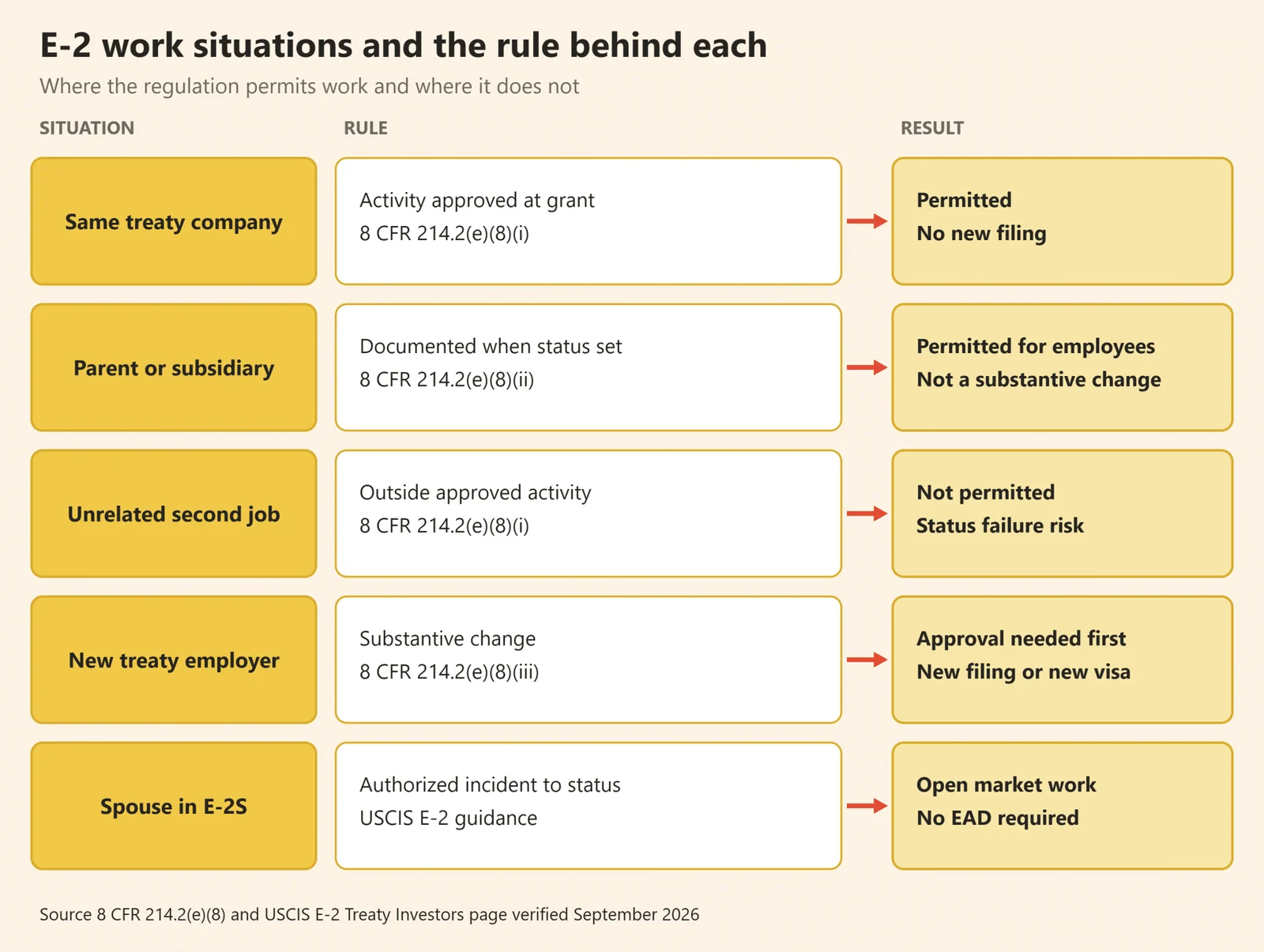
The tie is created by the regulation, not by an officer’s discretion. Under 8 CFR 214.2(e)(8)(i), headed “Limitations on employment,” the terms and conditions of E treaty status are fixed at admission or at approval of a change of status, and a “treaty trader, treaty investor, or treaty employee may engage only in employment which is consistent with the terms and conditions of his or her status and the activity forming the basis for the E treaty status.” USCIS says the same in plainer words on its E-2 Treaty Investors page: a treaty investor or employee “may only work in the activity for which he or she was approved at the time the classification was granted.” Both were current as of September 2026.
The reason sits in what the classification is for. The Department of State describes E-2 in 9 FAM 402.9-2(a) as admission to “develop and direct the operations of an enterprise in which the applicant has invested a substantial amount of capital,” or to work in that enterprise as an executive, supervisor, or essentially skilled employee. The approval is a finding about one investment, one business and one role. Change the business and you have changed the thing that was approved. Our explainer on the E-2 visa requirements covers what has to be proved in the first place.
What does it take to move to a different employer?
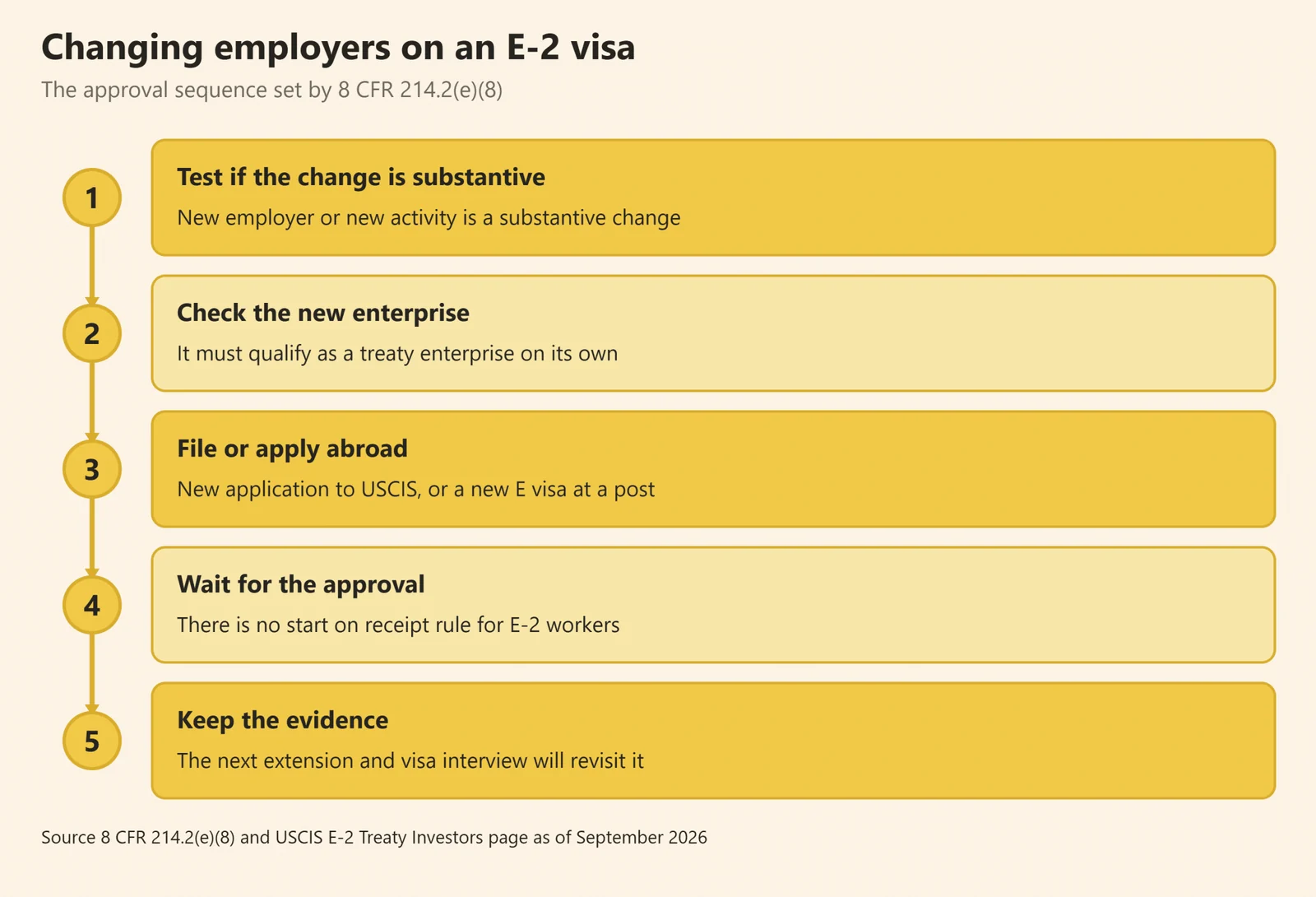
A move to a different treaty employer is treated as a substantive change, and substantive changes need approval before they happen. 8 CFR 214.2(e)(8)(iii) is direct: “Approval of USCIS must be obtained where there will be a substantive change in the terms or conditions of E status.” The same paragraph gives two routes: file a new application on the prescribed form requesting extension of stay, with “evidence of continued eligibility for E classification in the new capacity,” or “obtain a visa reflecting the new terms and conditions and subsequently apply for admission at a port-of-entry.” USCIS names the prescribed form on its E-2 Treaty Investors page: a change of status to E-2 and an extension of stay are both requested on Form I-129.
The new business has to qualify on its own
This is the part people underestimate. A new employer cannot simply absorb an existing E-2 worker. The new enterprise must itself be a treaty enterprise, and the employee must share the nationality of the principal employer and be coming to perform executive or supervisory duties, or to bring special qualifications that are essential to the enterprise. 8 CFR 214.2(e)(3) states the nationality point directly: “The employee must have the same nationality as the principal alien employer.” If the new company does not clear those tests, there is no filing that fixes it. Testing the prospective employer against those requirements before a resignation goes in is the first job in any change of employer, and it is the work an E-2 visa attorney should do before a single form is drafted.
Approval comes before the first day of work
There is no portability rule for E-2 comparable to the H-1B provision that lets a worker start on receipt of a filing. The regulation requires approval of the change, so the sequence is file, wait, then start. USCIS also treats corporate events as substantive changes where they alter the employing entity’s basic characteristics, naming “a merger, acquisition, or sale of the division where the alien is employed” as examples. The reverse case is in the regulation too. Under 8 CFR 214.2(e)(8)(iv), prior approval is not required for corporate changes that do not affect the previously approved employment relationship or are otherwise non-substantive, and the worker may instead present a letter from the treaty-qualifying company explaining the change, request a new approval notice, or apply to the Department of State for a new E visa reflecting it. If status is close to expiry while a change is planned, the timing interacts with the extension calendar, covered in our guide to E-2 visa renewal.
Can an E-2 employee work for a parent company or a subsidiary?
Yes, within a documented corporate family, and this is the one genuine exception in the text. 8 CFR 214.2(e)(8)(ii), “Subsidiary employment,” provides that “Treaty employees may perform work for the parent treaty organization or enterprise, or any subsidiary of the parent organization or enterprise.” It then says that performing work for subsidiaries of a common parent “will not be deemed to constitute a substantive change” if, at the time the E treaty status was determined, the applicant presented evidence establishing three things.
- The enterprise and any subsidiaries where the work will be performed, the requisite parent-subsidiary relationship, and that the subsidiary independently qualifies as a treaty organization or enterprise.
- For an employee of a treaty trader or treaty investor, that the work to be performed requires executive, supervisory, or essential skills.
- That the work is consistent with the terms and conditions of the activity forming the basis of the classification.
Two details in that text do a lot of work. First, the evidence had to be presented when the status was determined, not produced afterwards to justify a move that has already happened. Second, the paragraph speaks of a parent-subsidiary relationship. A sister company held by unrelated shareholders, or a loosely described “affiliate,” is not obviously inside the exception, and each subsidiary must qualify as a treaty enterprise in its own right. Groups expecting internal mobility should document the whole structure in the original filing.
Can an E-2 investor be paid by a second business they own?
Owning a second company and working in it are different acts, and the regulation governs the second one. 8 CFR 214.2(e)(8)(i) restricts employment to what is consistent with the activity forming the basis of the E status. An investor who forms an unrelated second entity and then performs services for it, whether or not a salary is drawn, is working outside the approved activity. Passive ownership and the receipt of distributions are not, on their face, employment, but the distinction turns on what the person actually does day to day, because the regulation is drafted around the employment engaged in rather than the label placed on it.
One point is worth stating plainly, because it is where a lot of planning goes wrong: the subsidiary provision is not written for the principal. 8 CFR 214.2(e)(8)(ii) opens “Treaty employees may perform work for the parent treaty organization or enterprise, or any subsidiary of the parent organization or enterprise,” and 8 CFR 214.2(e)(8)(i) treats the treaty trader, the treaty investor and the treaty employee as three separate persons. USCIS puts it the same way on its E-2 Treaty Investors page, that an E-2 employee may also work for the treaty organization’s parent company or one of its subsidiaries. An investor who wants to perform services in a second entity is therefore back inside (e)(8)(i) and (e)(8)(iii): the question is whether the new activity is a substantive change in the terms of the status, and where it is, the route is a new application or a new visa approved before the work begins, not the subsidiary carve-out.
The corporate structure still matters, just at a different stage. Where the group is built so that the second business is a subsidiary of the same parent, and that relationship and the subsidiary’s own treaty qualification were documented when status was determined, an E-2 employee of the group can be moved across it without a fresh filing. Investors who expect to run more than one entity are better served by getting the ownership chart right at the application stage than by looking for an exception afterwards.
Who in an E-2 family can work, and for whom?
The rules split sharply between the principal, the treaty employee, the spouse and dependent children. The table below sets the four side by side, drawn from 8 CFR 214.2(e), the USCIS E-2 Treaty Investors page and SSA program guidance, all as of September 2026.
| Person | May work for | Filing needed to change | Proof of work authorization |
|---|---|---|---|
| E-2 principal investor | The treaty enterprise they develop and direct | New application or new E visa before any change | I-94 showing E-2 class of admission |
| E-2 treaty employee | The treaty employer, plus a documented parent or subsidiary | New application if moving to a different employer | I-94 showing E-2 class of admission |
| Spouse in E-2 or E-2S | Any US employer, or self-employment | None to change jobs | I-94 showing E-2S, or an I-94 showing E-2 together with the USCIS notice on the new admission code, or an EAD |
| Child under 21 in E-2 | No employment authorization from the status itself | Separate classification required | Not applicable; an ITIN covers tax filing needs |
How is the E-2 spouse treated differently?
The spouse is the one member of the household with real freedom, and the source states the rule with an exception attached. USCIS says that spouses of E-2 workers in valid E-2 or E-2S status “are considered employment authorized incident to status, except for spouses of long-term investors in the Commonwealth of the Northern Mariana Islands (E-2 CNMI Investors) who are required to apply for employment authorization per 8 CFR 274a.12(c)(12).” That CNMI carve-out is narrow, and SSA keeps the same split by listing the CNMI long-term investor code separately from the E-2 and E2S spouse codes. Outside it, a spouse generally does not need to file Form I-765, although they may choose to obtain an Employment Authorization Document, and can take a job with an unrelated US employer, change jobs, work part time, or run their own business without any of the filings the principal would need.
The proof point matters for employers running I-9 verification, and it is where the detail bites. USCIS accepts four things. An unexpired Form I-94 noting E-2S status is List C evidence on its own. An unexpired Form I-94 noting E-2 status is List C evidence only when it is presented together with the USCIS notice about the new admission code. An unexpired Employment Authorization Document is List A evidence, and a facially expired EAD can serve where there is documentation of an automatic extension. SSA program guidance at POMS RM 10211.420, last updated 27 April 2026, describes the same combination, recording that USCIS “created a notice for those spouses already here and who were given an E-1, E-2, E-3, or L-2 COA so that the spouses could use the notice in combination with their I-94 as evidence of employment authorization.” A spouse holding an I-94 that says only E-2, with nothing alongside it, should not assume the document will clear an I-9. USCIS family guidance extends this authorization to spouses only, not to dependent children. The mechanics, documentation and common mistakes are covered in our article on E-2 visa spouse work authorization.
What happens if an E-2 holder takes unauthorized employment?
The regulation is unusually blunt about this. 8 CFR 214.2(e)(8)(vii) provides that “An unauthorized change of employment to a new employer will constitute a failure to maintain status within the meaning of section 237(a)(1)(C)(i) of the Act.” Failure to maintain status is a ground of deportability. It also undermines the next extension and the next visa interview, because both require the officer to be satisfied that the person complied with the classification already held.
There is a second consequence further down the road. The USCIS Policy Manual chapter on unauthorized employment under INA 245(c)(2) and INA 245(c)(8) bars an applicant from adjusting status if they accepted unauthorized employment before filing, or have ever engaged in it. The chapter lists exemptions, including immediate relatives, VAWA-based applicants, special immigrant juveniles and certain physicians, and notes the separate INA 245(k) exemption for some employment-based applicants. An investor planning a later move to permanent residence, a route covered in our piece on going from E-2 visa to green card, should treat side work as a threat to that plan rather than a technicality.
Can an E-2 visa holder get a Social Security number?
Yes, and the reason connects back to the same work authorization analysis. SSA’s position is that in general only noncitizens with permission to work from the Department of Homeland Security can apply for an original Social Security number. The E-2 principal and the E-2 or E-2S spouse are employment authorized incident to status, as set out above, so both fall inside that category without first obtaining an Employment Authorization Document.
The application itself is Form SS-5, and SSA states that there is no charge for a Social Security number and card. A dependent child in E-2 status holds no employment authorization from the classification, so does not meet the work-authorized test for a Social Security number. That is not the end of the question for the family’s tax filing, and the distinction is worth drawing carefully, because a child without a Social Security number is not a child without a US identifier. The IRS issues an Individual Taxpayer Identification Number, an ITIN, to a person who needs a US taxpayer identification number for federal tax purposes but is not eligible for a Social Security number, and it states that a resident alien, a nonresident alien, or their spouse or dependent can apply for one regardless of immigration status, where they can claim an allowable tax benefit or have to file their own return. A dependent child who needs a US identifier for a return is generally directed to Form W-7 and an ITIN rather than to Form SS-5. The SSN is a work document, not a residence document, and holding one says nothing about how you will be taxed.
Does working on an E-2 visa make you a US tax resident?
Often, yes, and this surprises Canadians in particular. The IRS substantial presence test treats a person as a US resident for tax purposes if they are present 31 days during the current year and 183 days across the current year and the two before it, counting all days in the current year, one third of the days in the first preceding year and one sixth of the days in the second preceding year (IRS, Substantial presence test, page updated 14 March 2026). E-2 is not among the exempt individual categories the IRS lists, which cover foreign government-related individuals, teachers and trainees in J or Q status, students in F, J, M or Q status, and certain professional athletes. An E-2 investor who relocates to run a business will usually meet the test in the first full year.
The Ontario and New York cross-border wrinkle
A Canadian who keeps a home, a spouse or dependents in Ontario is unlikely to stop being a Canadian tax resident just because a US business now occupies most of the week. The CRA treats a home in Canada, a spouse or common-law partner in Canada and dependents in Canada as significant residential ties, with secondary ties including provincial health insurance, a Canadian driver’s license and Canadian bank accounts (CRA, Determining your residency status, page modified 20 January 2026). Residency is a determination on the whole set of facts rather than a formula, and the treaty tie-breaker can land it either way, so nobody should read the tie list as an answer on its own. What it does show is that someone can satisfy the US substantial presence test and remain a Canadian factual resident at the same time, which is exactly when the tie-breaker rules matter. The CRA points individuals to Form NR73 or NR74 for an opinion.
The provincial and state layers then run on their own clocks, and this is where an Ontario to New York move gets missed. On the Canadian side, the CRA sets the provincial return by where you lived or were a factual resident on 31 December, so an investor who is still an Ontario resident at year end files Ontario tax for that year even though the enterprise is in New York (CRA, Your province or territory of residence, page modified 20 January 2026). On the US side, New York applies a residency test of its own that does not run off the IRS count at all. The New York State Department of Taxation and Finance treats you as a New York State resident if your domicile is New York State, or if you “maintain a permanent place of abode in New York State for substantially all of the taxable year and spend 184 days or more in New York State during the taxable year,” with any part of a day counting as a day (Income tax definitions, updated 6 May 2025). That is statutory residency, and it is measured in days in New York rather than days in the United States. A Canadian E-2 investor who keeps a year-round apartment near the business can meet it without ever having thought about state tax, and it is answered under New York’s own definition rather than the federal day count. State residency is worth putting to the cross-border adviser as its own question.
The IRS closer connection exception is narrower than people hope. It requires presence in the US of fewer than 183 days during the year, a tax home maintained in the foreign country for the entire year, a closer connection to that country, and no steps taken toward lawful permanent residence (IRS, Conditions for a closer connection to a foreign country, page updated 16 July 2026). It is claimed on Form 8840. An E-2 investor who is in the US most of the year to develop and direct the enterprise will rarely satisfy the day count. This is an outline only, and the numbers should be run with a cross-border tax adviser; our overview of moving from Canada to the US tax implications sets out the wider picture.
Frequently asked questions about working for another company on an E-2 visa
Can E-2 visa holders work for another company part time?
No. The limit in 8 CFR 214.2(e)(8)(i) is about the nature of the employment, not the hours. Work must be consistent with the activity forming the basis for the status, so a few hours a week for an unrelated business sits outside the approval just as a full-time role would.
Can I keep a remote job for a foreign employer while living in the US on an E-2?
There is no published carve-out in 8 CFR 214.2(e) for work performed remotely for a foreign payer, and the limit is drafted around the activity the person engages in rather than where the money comes from. Treat continued remote employment for an outside company as a live risk to E-2 status.
Does my E-2 status survive if my employer is acquired?
Not automatically. The test is whether the employing entity’s basic characteristics have fundamentally changed, so the useful question is whether the company that was approved still exists in the same form. Where it does not, a new application is needed before the work continues. Where the change is genuinely non-substantive, the lighter route in the regulation applies instead.
Can an E-2 employee move to a new company the same investor has started?
Only through the subsidiary route or a fresh filing. If the new company is a subsidiary of the same parent, and that relationship and the subsidiary’s treaty qualification were evidenced when status was determined, 8 CFR 214.2(e)(8)(ii) covers the work. Otherwise the move is a substantive change needing approval first.
Does an E-2 spouse need an EAD card to start a job?
Generally no. USCIS states that spouses in valid E-2 or E-2S status are employment authorized incident to status and need not file Form I-765, though they may elect to obtain an Employment Authorization Document. For the I-9 itself, an I-94 marked E-2S works on its own, while an I-94 marked only E-2 has to be presented together with the USCIS notice about the new admission code.
How long is an E-2 admission, and does changing jobs reset it?
USCIS states that the initial maximum period of stay is two years, that extensions may be granted in increments of up to two years with no limit on the number, and that a two-year readmission period is generally granted on return from foreign travel. An approved change of employer carries its own validity period.
Will unauthorized work block a later green card?
It can, and the risk is larger than the side job that caused it. Unauthorized employment engages adjustment of status bars, so an investor whose plan ends in permanent residence should treat outside work as a threat to the whole application rather than a technicality. Exemptions exist, but they are narrow and none of them is available on request.
Can a dependent child in E-2 status work?
The classification does not carry employment authorization for children. USCIS extends work authorization incident to status to spouses in E-2 or E-2S status, and its family guidance does not do the same for unmarried children under 21. A child who wants to work needs a separate classification.
Conclusion
So, can E-2 visa holders work for another company? Only inside the narrow structures the regulation itself names. It permits work inside a documented parent and subsidiary group, and a properly approved move to a new treaty employer, but not a second unrelated job, a side venture staffed by the investor, or a quiet continuation of a foreign role from a US desk. The spouse is the one member of the household the employer-specific rule does not reach, sitting on a different legal footing rather than inside an exception to it. Where the plan involves a second business or a change of employer, the sequence is always the same: document the structure, file, wait for approval, then work.
How Mayo Law can help
Mayo Law is a cross-border US and Canada firm with offices in Toronto and New York. Principal attorney Joseph Mayo is licensed in Ontario and in New York, so the corporate structure and the immigration filing can be handled together rather than as two disconnected files. That matters here, because most questions about working for a second company are really questions about how the entities are owned and documented. Our E-2 visa lawyer page explains how we work with investors and treaty employees on applications, changes of employer, subsidiary structures and renewals.
Disclaimer
This article is provided for informational purposes only and is not legal advice. Reading it does not create an attorney-client relationship, and you should not act on it without advice on your own facts. Immigration and tax rules change, and the position described here reflects official sources reviewed in September 2026. Mayo Law provides legal services in Ontario and New York.