

Contents
- Quick Answer
- Which green card category does an L-1A holder actually use?
- What does EB-1C actually require?
- How is the three-year lookback measured once you are already in the United States?
- What is the real L-1A visa to green card timeline?
- What does the EB-1C route cost in government fees?
- How does an L-1B holder get to a green card?
- Where did Canadians stand in the September 2026 Visa Bulletin?
- Does the seven-year L-1A clock leave enough room?
- Can you keep the L-1 while a green card is pending?
- Adjustment of status or a Canadian consulate?
- Frequently asked questions
- Conclusion
- How Mayo Law can help
- Disclaimer
Most Canadian managers who ask about the L-1A visa to green card route have already been told the short version: file an EB-1C, skip the labour certification, done. That version is true and incomplete. The rule that decides eligibility is measured from a date most people get wrong, and the government's own published processing figures look nothing like the "six to twenty-four months" that circulates online. What follows is built from the regulations, the current fee schedule, the September 2026 Visa Bulletin and the processing queues that USCIS and the Department of Labor publish themselves.
Quick Answer
The L-1A visa to green card route normally runs through EB-1C, the multinational manager or executive category, which requires no labour certification. The employer files Form I-140, then the employee files Form I-485 or processes at a consulate. For Canadians, EB-1C was current in the September 2026 Visa Bulletin.
Which green card category does an L-1A holder actually use?
The EB-1C category sits in the employment-based first preference at section 203(b)(1)(C) of the Immigration and Nationality Act. Its implementing regulation, 8 CFR 204.5(j), lets a United States employer file Form I-140 to classify a worker as a multinational executive or manager.
The reason it suits L-1A holders is structural rather than lucky. The L-1A test and the EB-1C test ask nearly the same question: did this person work abroad in a managerial or executive capacity for a qualifying related company, and will they do managerial or executive work in the United States? An employer that already assembled an L-1A petition has assembled most of an EB-1C petition.
One provision does the heavy lifting. Under 8 CFR 204.5(j)(5), no labour certification is required for this classification. The employer instead supplies a job offer letter describing the managerial or executive duties. That single sentence removes the Department of Labor entirely from the L-1A path, and as the timelines below show, it is worth more than any other advantage in the process.
L-1B holders do not get that sentence, and their route is covered further down.
What does EB-1C actually require?
Four elements have to be established, and 8 CFR 204.5(j)(3)(i) puts them in a statement from an authorized official of the petitioning employer.
| Element | What 8 CFR 204.5(j)(3)(i) requires |
|---|---|
| Qualifying employment abroad | One year in a managerial or executive capacity, within the relevant three-year window |
| Corporate relationship | The United States employer is the same employer, or a subsidiary or affiliate, of the entity abroad |
| Role in the United States | A managerial or executive position, described in an employer job offer letter |
| Employer maturity | The prospective United States employer has been doing business for at least one year |
Two adjudication rules sit behind that table and decide a meaningful share of cases.
First, 8 CFR 204.5(j)(4)(i) says a first-line supervisor is not managerial merely because they supervise, unless the employees supervised are professional. A team lead over a group of non-professional staff is not automatically a manager for EB-1C purposes.
Second, 8 CFR 204.5(j)(4)(ii) directs officers to weigh staffing levels against the reasonable needs of the organization, given its purpose and stage of development. Small headcount is not disqualifying on its own. The same subsection also says nobody is managerial merely because of how many people they supervise. Numbers cut both ways, and the petition has to explain the function, not count the reports.
The "doing business for at least one year" requirement in subparagraph (D) is the one that catches new-office L-1A cases. A company that opened its United States operation on a one-year new-office L-1A cannot file an EB-1C on day one. It has to trade for a year first.
How is the three-year lookback measured once you are already in the United States?
This is the detail that gets stated loosely almost everywhere, and getting it wrong can cost a case.
Where the beneficiary is outside the United States, 8 CFR 204.5(j)(3)(i)(A) measures the qualifying year abroad within the three years immediately preceding the filing of the petition.
Where the beneficiary is already in the United States working for the same employer or a related entity, subparagraph (B) applies instead. There the qualifying year has to fall within the three years preceding entry as a nonimmigrant.
For an L-1A holder, that second rule is the operative one, and it is a relief rather than a trap. The clock stops at the date of the L-1 entry. Years spent working in the United States afterwards do not erode the qualifying period. An executive who transferred in 2022 and files an EB-1C in 2026 is still measured against the three years before the 2022 entry.
The practical consequence is about evidence, not eligibility. The employment records that prove the qualifying year are Canadian records from several years back: payroll, organisation charts, board minutes, the letter of appointment. Canadian companies that have since restructured, changed payroll providers or been acquired should collect that file early. Our page on how to get a green card through employment sets out how the employment-based categories compare more broadly.
What is the real L-1A visa to green card timeline?
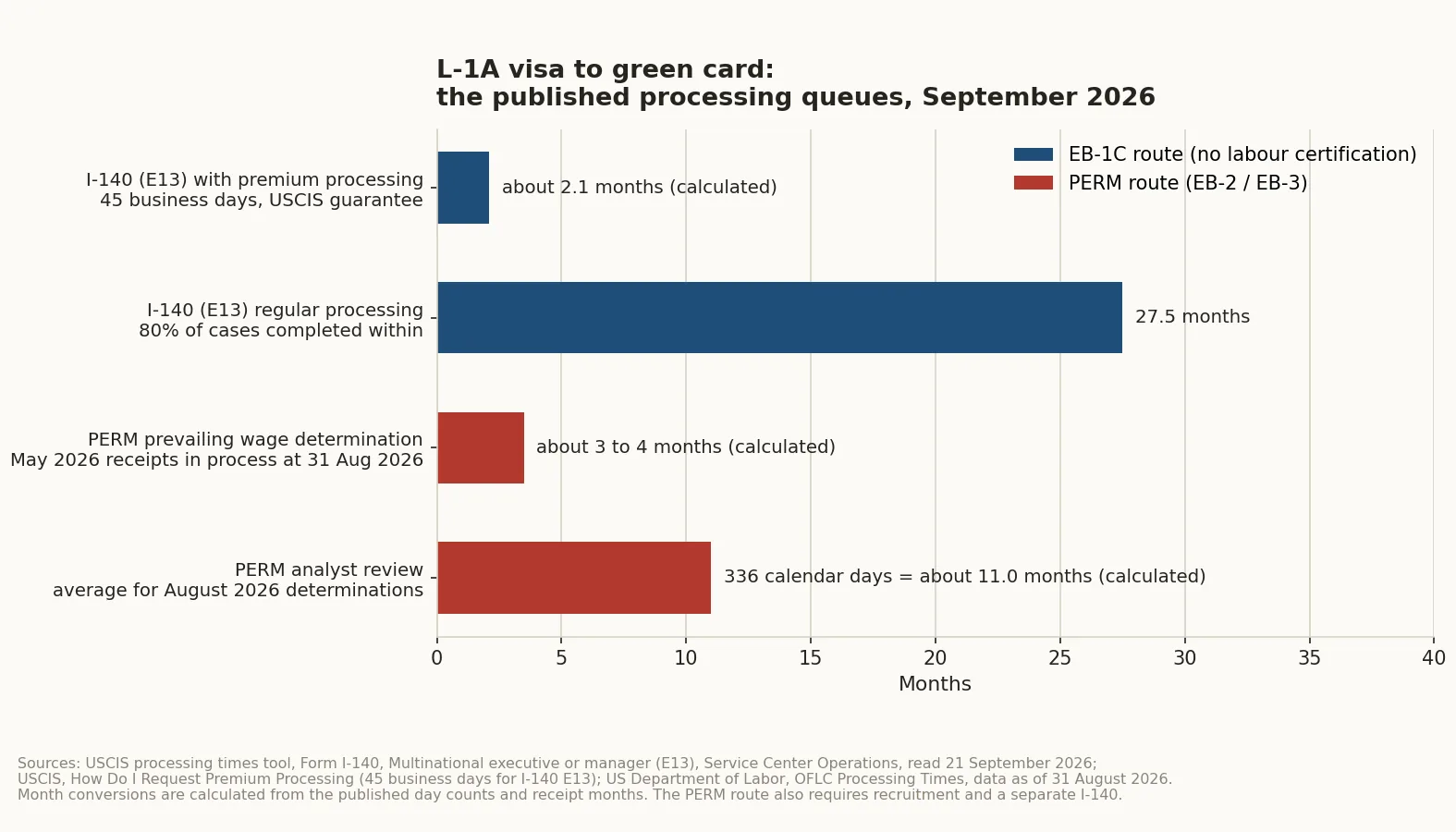
Here the published numbers and the common wisdom about the L-1A visa to green card timeline part company.
USCIS processes Form I-140 for the E13 multinational executive and manager classification at Service Center Operations. Read from the USCIS processing times tool on 21 September 2026, that queue reports that 80 percent of cases are completed within 27.5 months. The tool explains that the figure reflects how long it took to complete 80 percent of adjudicated cases over the preceding six months.
Premium processing changes that picture, and the size of the change is the point. USCIS guarantees adjudicative action within 45 business days for a Form I-140 in the E13 multinational executive and manager classification. That is a different tier from the 15 business days that applies to most classifications, including the L-1 petition itself. Anyone budgeting on a 15-day EB-1C turnaround has the wrong figure.
USCIS also notes that Service Center Operations prioritises I-140 adjudication when the Visa Bulletin shows an immigrant visa is available, and that this prioritisation does not affect premium-processed petitions, which are managed in the premium timeframe.
The second half of the timeline depends on where the applicant files, and that is treated below.
What does the EB-1C route cost in government fees?
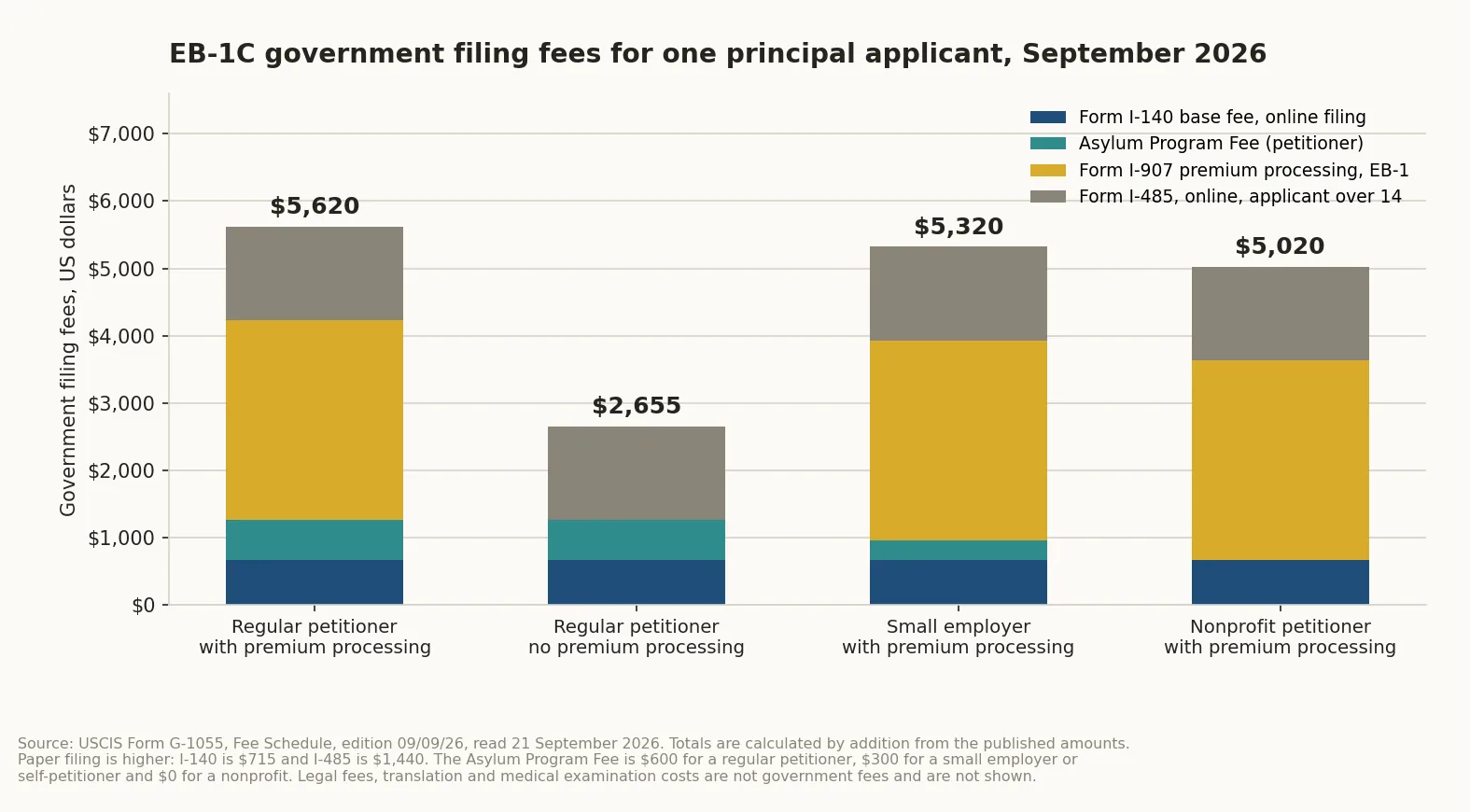
These figures come from Form G-1055, the USCIS fee schedule, edition 09/09/26, read on 21 September 2026. They are government fees only and exclude legal fees, translation, and medical examination costs.
| Filing | Paper | Online |
|---|---|---|
| Form I-140 base fee | $715 | $665 |
| Asylum Program Fee, regular petitioner | $600 | $600 |
| Asylum Program Fee, small employer or self-petitioner | $300 | $300 |
| Asylum Program Fee, nonprofit | $0 | $0 |
| Form I-907 premium processing, EB-1 | $2,965 | $2,965 |
| Form I-485, applicant over 14 | $1,440 | $1,390 |
A worked example, calculated from those published amounts: a regular corporate petitioner filing Form I-140 online with premium processing pays $665 plus $600 plus $2,965, which is $4,230 at the petition stage. Adding one adjustment application filed online at $1,390 brings the principal applicant's government total to $5,620. The arithmetic is ours; each input is a published USCIS figure.
Two notes on the fee stack. The Asylum Program Fee is a petitioner obligation, so the employer carries it, and the small-employer rate at $300 halves it for companies that qualify. The premium processing fee must be submitted separately from other filing fees, and Form I-907 cannot be filed by the beneficiary.
How does an L-1B holder get to a green card?
An L-1B specialised knowledge transferee has no EB-1C claim unless they are first promoted into a genuine managerial or executive role. Absent that, the route runs through EB-2 or EB-3, and both normally require a permanent labour certification from the Department of Labor.
That is where the timelines stop being comparable. The Department of Labor publishes its own queues, and as of 31 August 2026 they read as follows.
The prevailing wage determination queue for PERM was working on May 2026 receipts. PERM analyst review was adjudicating cases with a November 2025 priority date, and audit review cases from December 2025. For determinations issued in August 2026, the average time to process a PERM application at analyst review was 336 calendar days.
A prevailing wage determination has to be obtained before recruitment can be tested, recruitment then has to run, and only then is the PERM application filed and queued behind that 336-day average. The I-140 comes after all of it. Against a five-year maximum stay, an L-1B holder who waits until year three to start is working with very little slack.
There is a second problem for anyone who assumes EB-3 is the safe fallback, and it is set out in the next section.
Where did Canadians stand in the September 2026 Visa Bulletin?
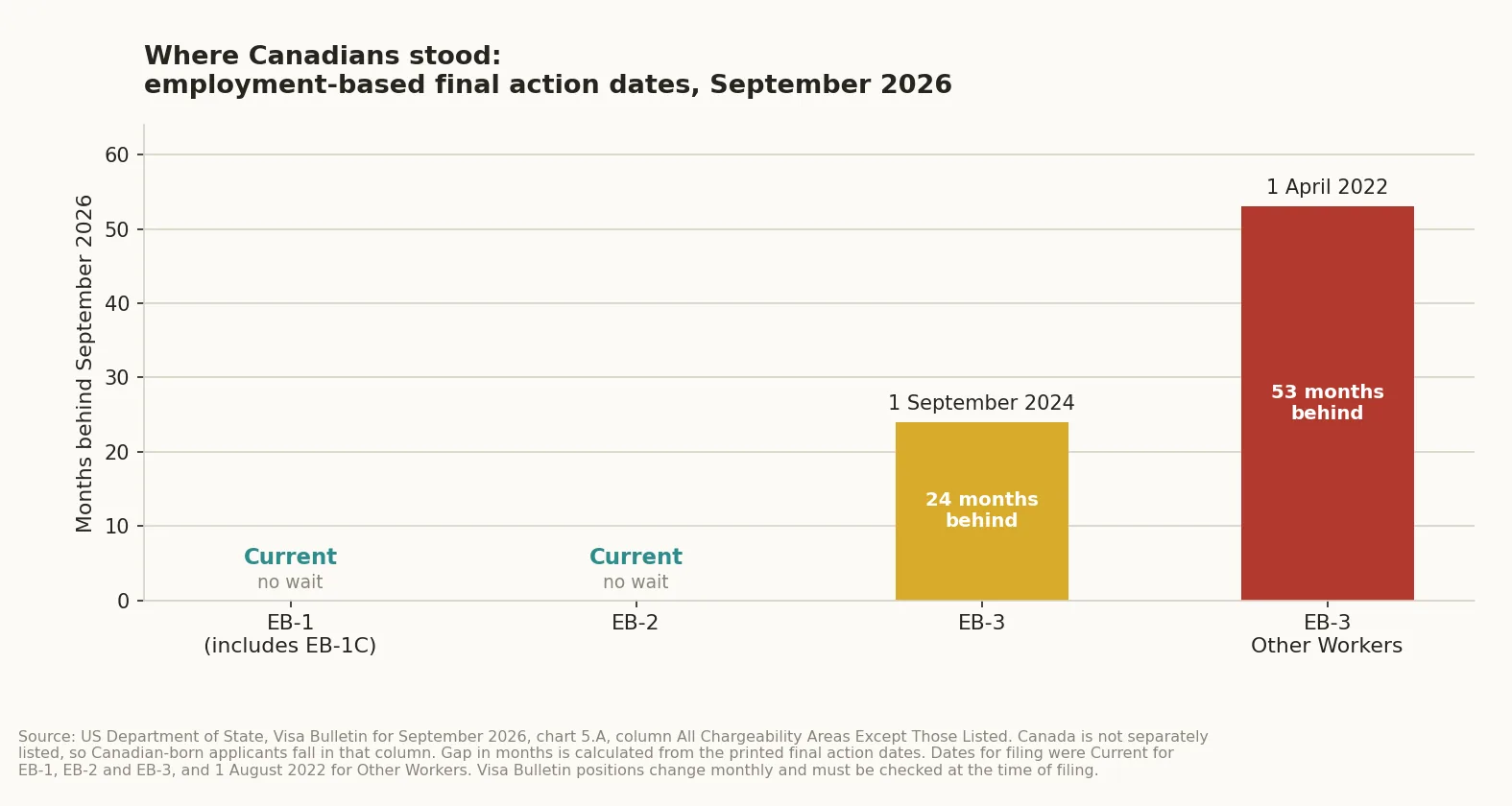
Canada is not separately listed in the Visa Bulletin, so Canadian-born applicants fall under "All Chargeability Areas Except Those Listed". In the Department of State Visa Bulletin for September 2026, the employment-based final action dates for that column were:
| Category | Final action date | Date for filing |
|---|---|---|
| EB-1 | Current | Current |
| EB-2 | Current | Current |
| EB-3 | 1 September 2024 | Current |
| EB-3 Other Workers | 1 April 2022 | 1 August 2022 |
EB-1 and EB-2 were current. EB-3 was not: the final action date had retrogressed to 1 September 2024, meaning a visa number was only available to applicants whose priority date preceded that day. The same bulletin warned that sufficient demand in EB-2 could force retrogression or unavailability before the fiscal year closed, and that the figures reflect demand reported to 10 August 2026.
For an L-1B holder, that combination is the whole argument against drifting into EB-3 by default. EB-3 carries the PERM burden and a backlogged final action date. EB-2 carries the PERM burden but was current. EB-1C carries neither. Visa Bulletin positions move month to month, so the category choice should be tested against the current bulletin at the time of filing, not against last year's.
Our guide to how long the green card process takes covers the mechanics of priority dates and the bulletin in more detail.
Does the seven-year L-1A clock leave enough room?
The maximum period of stay is seven years for an L-1A manager or executive and five years for an L-1B specialised knowledge transferee, under 8 CFR 214.2(l)(12)(i). Extensions come in increments of up to two years, under 8 CFR 214.2(l)(15).
Three points in the USCIS Policy Manual, current as of 18 September 2026, matter to green card planning and are regularly missed.
Time in H and L status is combined. Officers add periods of H and L stay together when applying the five- or seven-year limit, including time with previous employers. Someone who spent two years on an H-1B before switching to L-1B reaches the five-year ceiling three years into the L-1B.
Promotion from L-1B to L-1A does not automatically buy the extra two years. Under 8 CFR 214.2(l)(15)(ii), the beneficiary has to have been employed in the managerial or executive position for at least six months to be eligible for the seven-year total, and the change must have been approved by USCIS in an amended, new or extended petition at the time it occurred. A promotion recorded only in an internal organisation chart does not count.
Once the maximum is reached, readmission in H or L requires a full year of residence and physical presence outside the United States. Brief business or pleasure trips to the United States do not interrupt that year, but they do not count toward it either.
Set the 27.5-month I-140 figure against a seven-year ceiling and the planning point writes itself. An executive who begins the EB-1C in year five, without premium processing, may reach the L-1A limit before the petition is adjudicated. The background on the underlying status is on our page about the L-1 visa from Canada.
Can you keep the L-1 while a green card is pending?
Yes. The L-1 is a dual intent classification, and the regulation says so directly. Under 8 CFR 214.2(l)(16), a person may legitimately come to the United States temporarily as an L-1 nonimmigrant and at the same time lawfully seek permanent residence, provided they intend to depart voluntarily at the end of their authorized stay.
The same provision states that filing or approving a permanent labour certification, filing an immigrant visa preference petition, or filing an adjustment application is not a basis for denying an L-1 petition or a request to extend one.
This is a real structural advantage over the E-2 treaty investor visa, which carries no equivalent provision and where the intent question has to be managed carefully. The comparison is set out on our page covering the E-2 visa to green card pathways, which is also where the branch-and-subsidiary EB-1C option is treated for E-2 investors under the heading "EB-1C multinational manager or executive". Nothing in the dual intent rule removes the obligation to hold a bona fide temporary intent at each L-1 filing, and the two positions have to be presented consistently.
Adjustment of status or a Canadian consulate?
Once an immigrant visa number is available, the principal either files Form I-485 inside the United States or completes consular processing abroad. For a Canadian executive living in the United States on an L-1A, adjustment keeps the family in place and lets the work continue under the L-1 while the application is pending. It also produces the higher fee at $1,440 on paper or $1,390 online.
Consular processing suits an executive whose family is still in Canada, or who needs to travel freely while the case runs. It is handled by the Department of State rather than USCIS, and the fee structure differs from the I-485 figures above.
The choice is rarely made on fees. It is made on where the family lives, how much international travel the role demands, and whether the L-1 has enough validity left to carry a pending adjustment. Our green card application process guide walks through the filing mechanics on the adjustment side, and a cross-border immigration lawyer can weigh the two routes against a specific corporate structure. For companies still deciding which transfer route fits, our business immigration practice covers the full set of options.
Frequently asked questions
Can an L-1A holder self-petition for EB-1C?
No. 8 CFR 204.5(j)(1) provides that a United States employer files the Form I-140 petition, and 8 CFR 204.5(j)(5) requires that employer to furnish a job offer describing the managerial or executive duties. EB-1C has no self-petition mechanism. That distinguishes it from the EB-1A extraordinary ability category, where 8 CFR 204.5(h)(1) lets the person or anyone on their behalf file, and from the EB-2 national interest waiver, where 8 CFR 204.5(k)(1) lets the person or anyone on their behalf be the petitioner when a job-offer exemption is sought.
How long does premium processing take for an EB-1C petition?
USCIS guarantees adjudicative action within 45 business days for Form I-140 in the E13 multinational executive and manager classification, and for E21 national interest waiver cases. Most other classifications carry a 15 business day guarantee. If USCIS issues a request for evidence or a notice of intent to deny, the clock restarts when the response is received.
Does the year abroad have to be continuous?
8 CFR 204.5(j)(3)(i) requires employment abroad for at least one year in a managerial or executive capacity within the applicable three-year window. Note the difference from the L-1 nonimmigrant rule at 8 CFR 214.2(l)(1)(i), which requires one continuous year of employment abroad within the preceding three years. The two provisions are worded differently, and a gap that is harmless in one setting may not be in the other.
What happens to an EB-1C petition if the L-1A expires first?
An approved I-140 does not confer status or work authorization, so an expiring L-1A is a status problem even with the petition approved. The usual responses are a timely extension inside the maximum period of stay, a change to another classification, or departure with consular processing on the approved petition. This is the reason the seven-year ceiling and the 27.5-month I-140 queue have to be looked at together at the outset.
Is the EB-1C available if the Canadian parent company has closed?
The petition requires a qualifying relationship between the United States employer and the entity abroad. 8 CFR 204.5(j)(2) defines affiliate and subsidiary relationships by common ownership and control, and 8 CFR 204.5(j)(3)(i)(C) requires the prospective United States employer to be the same employer, or a subsidiary or affiliate, of the entity that employed the person overseas. A wound-up Canadian parent with no successor entity puts that relationship in question, and the structure should be reviewed before filing.
Can the spouse and children get green cards at the same time?
Spouses and children may be included as derivative applicants in the same employment-based case. USCIS states that spouses of L-1 workers in valid L-2S status are employment authorized incident to status, so in most cases the household's work authorization does not depend on the green card timeline. The derivative applications carry their own filing fees, and the Form I-485 fee for an applicant under 14 filing together with a parent is $950 on paper or $900 online.
Is the L-1A visa to green card route faster than PERM in practice?
On the published queues, yes, and by a wide margin. EB-1C requires no labour certification at all under 8 CFR 204.5(j)(5). The PERM route requires a prevailing wage determination, where the Department of Labor was processing May 2026 receipts as of 31 August 2026, followed by recruitment, followed by a PERM application whose analyst review averaged 336 calendar days for determinations issued in August 2026.
Conclusion
The L-1A visa to green card route is genuinely the most direct employment-based path available to a Canadian executive, and the reason is one regulatory sentence removing labour certification. The risks on the L-1A visa to green card route are not in eligibility. They are in timing. A 27.5-month I-140 queue, a seven-year ceiling that counts prior H time, and a Visa Bulletin that moved EB-3 backwards while EB-1 stayed current all argue for starting the analysis in year two or three rather than year six, and for budgeting the premium processing fee rather than treating it as optional.
For an L-1B holder the calculation is harder and the margin is thinner, which is why the promotion question and the six-month rule deserve attention long before the five-year mark.
How Mayo Law can help
Mayo Law is a cross-border firm with offices in Toronto and New York. Joseph Mayo, the principal attorney, is licensed in Ontario and in New York, which means the Canadian corporate side of an intracompany transfer and the United States immigration side are handled under one roof rather than split between two firms in two countries.
For a Canadian company moving an executive into a United States affiliate, that matters at the evidence stage: the qualifying relationship, the organisation charts, the corporate records that establish the affiliate structure, and the employment history that proves the year abroad are Canadian documents being read by a United States adjudicator. We work with small and mid-sized businesses on both sides of the border and can review a transfer plan against the L-1A timeline and the EB-1C requirements before a petition is filed.
Disclaimer
This article is for general information only. It is not legal advice, and reading it does not create a solicitor-client or attorney-client relationship. Immigration rules, government fees, processing times and Visa Bulletin dates change, and the figures here are stated as of September 2026 with their sources identified. Anyone relying on these matters should obtain advice on their own facts. Mayo Law provides legal services in Ontario and New York.