

Contents
- Quick answer
- Independent contractor vs employee Ontario: the ESA rule
- How do Ontario courts decide worker status?
- What is a dependent contractor in Ontario?
- How does the CRA decide for CPP, EI and tax?
- What does employee misclassification cost in Ontario?
- How does New York compare with Ontario?
- How should an Ontario business engage a contractor?
- Frequently asked questions
- Conclusion
- How Mayo Law can help
- Disclaimer
Many Ontario businesses bring people in on a contractor basis: a developer for a product launch, a sales agent paid by commission, a bookkeeper who works for several clients. The label on the agreement is where the question starts, not where it ends. When the independent contractor vs employee Ontario question reaches the Ministry of Labour, the Canada Revenue Agency or a court, each looks at how the work is actually done, and an employer that guessed wrong can owe back pay, statutory notice, payroll contributions and penalties.
This guide explains how Ontario law tells an independent contractor from an employee, what the courts mean by a dependent contractor, how the CRA decides status for CPP, EI and income tax, what misclassification costs an employer, and how New York's approach compares for companies that hire on both sides of the border. The statutes, government guidance and court decisions cited here were checked against official sources as of October 2026.
Quick answer
In Ontario, a worker is an employee or an independent contractor based on the real working relationship, not the contract's title. The question is whether the person is in business on their own account. The Employment Standards Act bars treating an employee as a non-employee, and economically dependent contractors are owed reasonable notice.
Independent contractor vs employee Ontario: the ESA rule
The Employment Standards Act, 2000 (ESA) sets Ontario's minimum standards for wages, overtime, vacation pay, public holidays, leaves, notice of termination and severance pay. Those standards protect employees only. A genuine independent contractor ontario businesses hire is outside the Act, which is why classification matters so much.
The ESA defines "employee" broadly. Under section 1(1) it includes a person, including an officer of a corporation, who performs work for an employer for wages, a person who supplies services to an employer for wages, certain trainees and homeworkers, and a person who was an employee. Two other provisions close the obvious loopholes:
- No treating an employee as a non-employee: section 5.1(1) says an employer "shall not treat, for the purposes of this Act, a person who is an employee of the employer as if the person were not an employee under this Act."
- No contracting out: section 5(1) makes any agreement to contract out of or waive an employment standard void. A signed statement that the worker gives up ESA rights does not remove them.
The Ontario government's guidance on the difference between an employee and an independent contractor (updated June 26, 2024) lists signs of employment: the work is important to the business, the business controls what, how much, where and when the work is done, the business supplies the tools, equipment or materials, the worker cannot subcontract, and the business can suspend, dismiss or discipline the worker. Signs of an independent contractor include a chance of profit and a risk of loss, control over how, when and where the work is done, and freedom to subcontract. The same guidance says an employment standards officer looks at the relationship itself, and that another government agency's decision that a person is not an employee does not settle the question under the ESA.
Older summaries of section 5.1 can be out of date. The section was added in 2017 (S.O. 2017, c. 22, Sched. 1, s. 5), and its second subsection was repealed in 2018 (S.O. 2018, c. 14, Sched. 1, s. 3). The consolidation on e-Laws, current to October 2, 2026, contains only the prohibition in section 5.1(1), so check any commentary that relies on section 5.1(2) against the current text.
How do Ontario courts decide worker status?
Outside the ESA, Ontario courts apply the common law test set by the Supreme Court of Canada in 671122 Ontario Ltd. v. Sagaz Industries Canada Inc., 2001 SCC 59. The Court held that there is no universal test, and that the central question is "whether the person who has been engaged to perform the services is performing them as a person in business on his own account."
The Court listed the factors that usually answer that question. Control over the worker's activities will always be a factor. The others are whether the worker provides their own equipment, whether the worker hires their own helpers, the degree of financial risk the worker takes, the worker's responsibility for investment and management, and the worker's opportunity for profit. The Court added that the list is not exhaustive and that the weight of each factor depends on the facts. Applying the test, the Court noted that the contract before it designated the consultant as an "independent contractor" but that this classification is not always determinative.
In practice, the independent contractor vs employee Ontario factors point the same way more often than employers expect. A person who works set hours on the company's laptop, under a manager's direction, for one client, with no staff, no business expenses and a fixed monthly fee looks like an employee, whatever the agreement says. A person who quotes a price for a defined project, uses their own equipment, hires an assistant when the work is heavy, carries their own insurance and serves other clients looks like a business.
What is a dependent contractor in Ontario?
Ontario law also recognizes a middle category. In McKee v. Reid's Heritage Homes Ltd., 2009 ONCA 916, the Court of Appeal for Ontario confirmed "an intermediate category" of non-employment work relationships that show "a certain minimum economic dependency, which may be demonstrated by complete or near-complete exclusivity." Workers in this group are called dependent contractors, and the Court held that "they are owed reasonable notice upon termination."
Two points from the decision matter for employers. First, the Court said the usual principles for telling an employee from an independent contractor apply equally to telling an employee from a dependent contractor, so the analysis starts with the Sagaz factors. Second, the dependent contractor category is carved out of the non-employment side. It does not narrow who counts as an employee.
The practical effect for a dependent contractor ontario business owners often overlook: ending a long, exclusive contractor relationship on short notice can produce a claim for reasonable notice even if the worker is correctly treated as a contractor for the ESA and for tax purposes. An exclusivity clause, years of continuous work and a contractor who earns all or nearly all of their income from one client are the warning signs.
How does the CRA decide for CPP, EI and tax?
For payroll purposes, the CRA applies its own two-step approach, set out in its guide RC4110, Employee or Self-Employed? (last updated October 6, 2023). Outside Quebec, the CRA first asks what the parties intended when they set up the arrangement, a contract of service (employment) or a contract for services (a business relationship). It then tests that intention against the facts, looking at control, tools and equipment, subcontracting and hiring helpers, financial risk, investment and management, and the opportunity for profit. The guide puts the limit plainly: workers and payers can choose how they set up their affairs, but the status they choose "must reflect their working relationship."
Quebec is different. The guide explains that Quebec cases follow the Civil Code of Québec, with a three-step approach. For an independent contractor canada employers engage in more than one province, the province where the work is done can change the analysis.
An employer that is unsure can ask the CRA for a CPP/EI ruling, using form CPT1 or My Business Account. The deadline in RC4110 is June 29 of the year after the year the question relates to. A ruling has value beyond certainty. Under section 21(3) of the Canada Pension Plan, an employer that a ruling tells in writing it need not deduct contributions is not liable for the missed deductions, or for interest or penalties, if a later decision finds the deductions were required, provided the ruling was not based on materially incorrect information from the employer.
What does employee misclassification cost in Ontario?
Employee misclassification ontario employers discover late tends to cost money on four fronts at once: ESA entitlements, common law notice, payroll remittances and penalties.
ESA entitlements. A worker found to be an employee is owed every applicable standard for the period worked, including vacation pay, public holiday pay and overtime. Vacation pay under section 35.2 is at least 4% of wages for an employee with less than five years of employment and at least 6% at five years or more. As a worked example, by our calculation a misclassified worker paid $80,000 in a year with no vacation pay is owed at least $3,200 for that year (4% of $80,000), before any other standard.
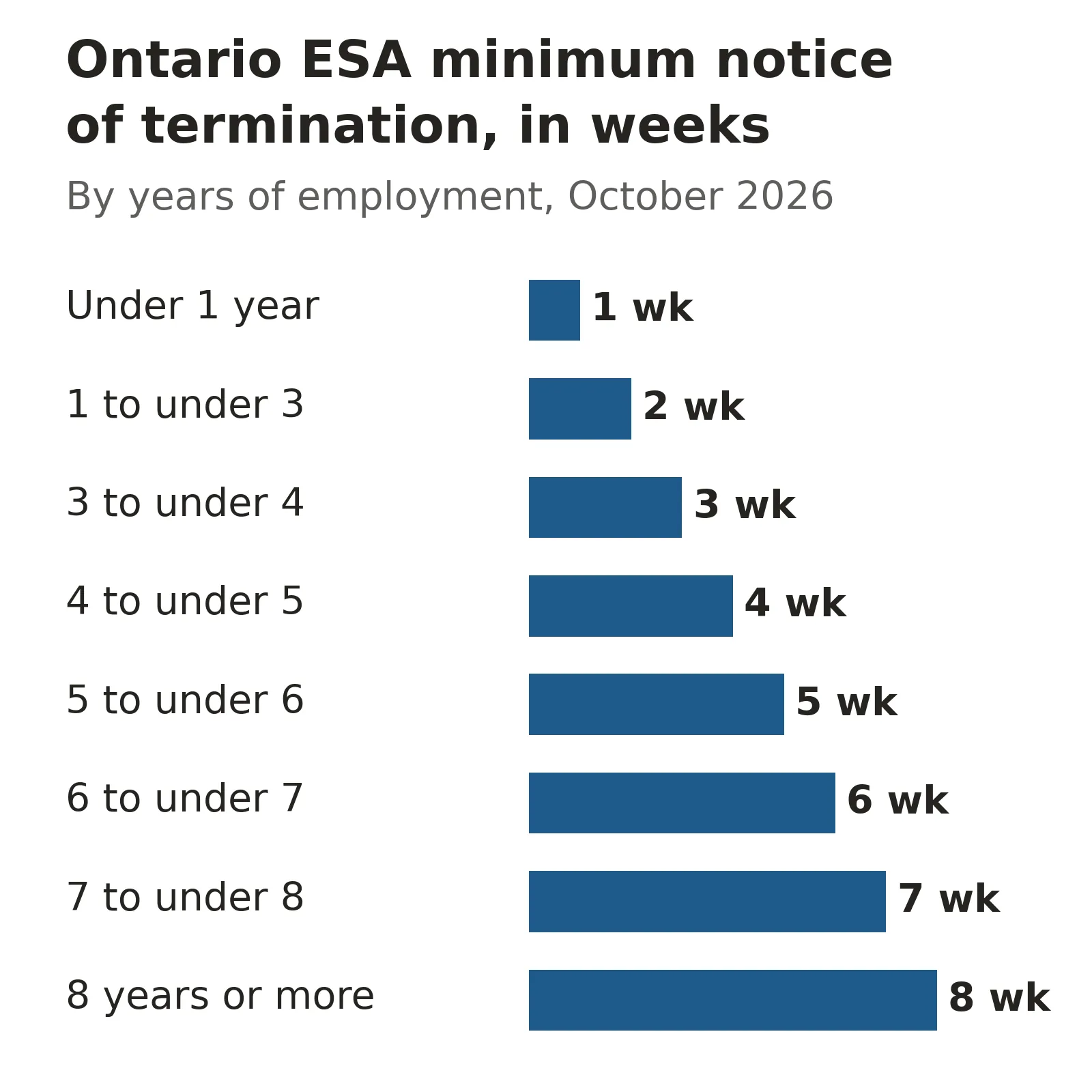
Notice of termination. Ending the relationship triggers ESA notice or termination pay. Section 57 sets the minimum notice by length of employment: one week under one year; two weeks from one year to under three years; three weeks from three to under four years; and one more week for each further year, up to eight weeks at eight years or more. Severance pay under section 64 is added for an employee with five or more years of employment where the employer has a payroll of $2.5 million or more, or where 50 or more employees are severed within six months because of a permanent discontinuance of all or part of the business at an establishment. Common law reasonable notice, often longer, can apply on top unless a valid termination clause limits it.
Payroll remittances. Under section 21(2) of the Canada Pension Plan, an employer that fails to deduct and remit is liable for the whole amount that should have been deducted, from the time it should have been deducted. Section 21(4) lets the employer recover a missed employee deduction from later pay only within 12 months after the payment it should have come from, so an older missed deduction cannot be recovered from the employee's pay that way. Under section 227(8) of the Income Tax Act, failing to withhold income tax carries a penalty of 10% of the amount that should have been withheld, or 20% for a repeat failure in the same year made knowingly or with gross negligence. Interest runs on top.
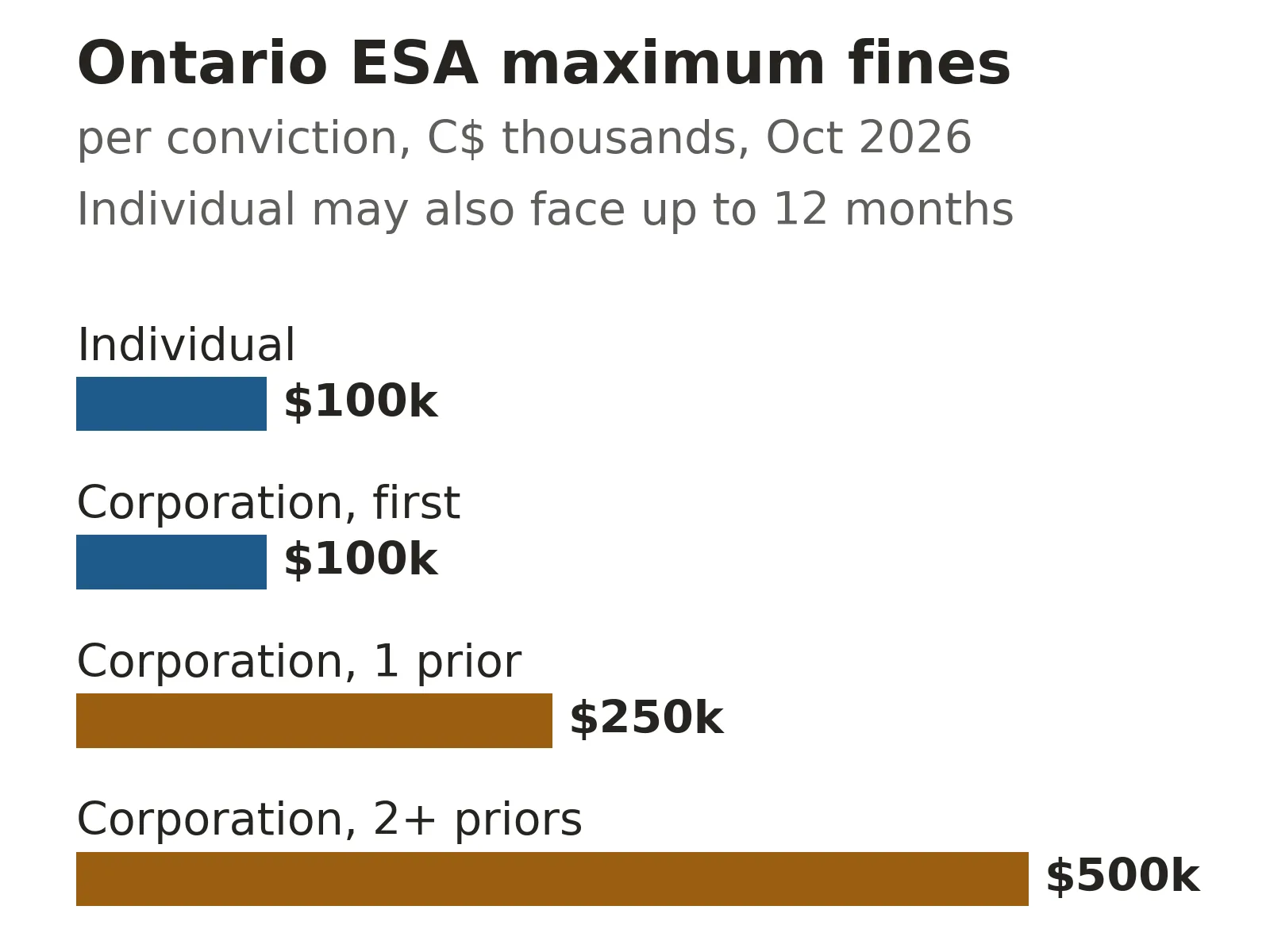
ESA offences. The Ontario guidance says that treating an employee as a non-employee can lead to a notice of contravention with a penalty, a prosecution, or both. Section 132 of the Employment Standards Act, 2000, as amended in 2024, sets the maximum fines on conviction: up to $100,000 or up to 12 months in prison, or both, for an individual; up to $100,000 for a corporation; up to $250,000 for a corporation with one previous conviction; and up to $500,000 for a corporation with more than one previous conviction.
How does New York compare with Ontario?
Companies that hire in Toronto and New York should not assume one classification works in both places. Both jurisdictions look past the label to the real relationship, but the details differ, as the table below shows.
| Point | Ontario | New York |
|---|---|---|
| Core question | In business on own account? | Who supervises and controls? |
| Contract label decides? | No | No |
| Special statutory rule | ESA s. 5.1 ban | Construction ABC test |
| Middle category | Dependent contractor | Not covered here |
For unemployment insurance, the New York State Department of Labor says status depends on the level of supervision, direction and control exercised by the person engaging the services. It lists signs of employment such as choosing when, where and how services are performed, providing facilities and tools, direct supervision, and setting the hours and the rate of pay. The Department also states that an employer-employee relationship may exist regardless of how the hiring party describes it, even if the worker signs a statement claiming to be an independent contractor.
New York adds industry and contract rules that Ontario does not mirror:
- Construction: under Labor Law section 861-c, a person performing services for a construction contractor is presumed to be an employee unless all three parts of an ABC test are met: freedom from control and direction, work outside the usual course of the contractor's business, and an independently established trade or business. A separate business entity test applies to contractors that operate through an entity.
- Freelancers: under New York's Freelance Isn't Free Act (General Business Law article 44-A), a "freelance worker" is a person or one-person organization hired as an independent contractor for $800 or more, alone or combined with all contracts between the same parties in the previous 120 days (section 1410). Section 1412 requires a written contract naming the parties, itemizing the services, their value and the rate and method of pay, and stating the date of payment or how it will be set, and the hiring party must keep it for at least six years.
For employers who also hire New York employees, our guides on exempt and non-exempt classification in the US and whether non-competes are enforceable in New York cover the next questions that usually arise.
How should an Ontario business engage a contractor?
No document can turn an employment relationship into a contracting one, but the way the relationship is set up and run can support a genuine contractor arrangement. These steps apply the independent contractor vs employee Ontario tests described above to day-to-day practice, following the factors the courts, the Ministry and the CRA all look at:
- Step 1, define a deliverable: engage the contractor for a project or a result with a price or a fee schedule, rather than for open-ended hours under a manager.
- Step 2, leave the method to the contractor: agree on the outcome and deadlines, and let the contractor decide how, when and where the work is done.
- Step 3, keep the business side real: the contractor supplies their own equipment, can hire helpers or subcontract, invoices for the work, and carries the cost of their own mistakes.
- Step 4, avoid exclusivity unless it is needed: a contractor who serves other clients is less likely to be found dependent. Where exclusivity is necessary, plan for reasonable notice when the relationship ends.
- Step 5, write a contract that matches the facts: a contractor agreement should describe the services, fees, term and termination, confidentiality and ownership of work product. An intellectual property assignment matters here, so that ownership of what the contractor creates is dealt with expressly in writing.
- Step 6, review it as the role changes: a relationship that started as a project can drift into employment as the contractor takes on regular duties, set hours and staff management. Revisit status at renewal.
- Step 7, get a ruling where the stakes are high: for a long or large engagement, a CPT1 ruling from the CRA can settle CPP and EI status in advance.
When the facts point to employment, the better course is usually to hire the person properly. Our guides on breach of an employment contract and termination without cause in Ontario explain what an Ontario employment relationship then requires, and our cross-border compliance page covers the wider employer picture.
Frequently asked questions
Does an independent contractor agreement make someone a contractor in Ontario?
No. A written agreement is evidence of what the parties intended, but the Supreme Court of Canada in Sagaz held that the label is not always decisive, and the Ontario guidance says an employment standards officer looks at the relationship itself. If the person works like an employee, the ESA treats them as one, and section 5(1) voids any waiver of ESA rights.
Does the Employment Standards Act cover independent contractors?
No. The ESA protects employees, so a genuine independent contractor has no ESA right to vacation pay, overtime, public holiday pay, notice or severance. The Act defines employee broadly, however, and section 5.1 prohibits treating an employee as if they were not one. Whether a worker is outside the Act depends on the facts of the working relationship, not on the job title.
What is a dependent contractor in Ontario?
A dependent contractor is a worker who is not an employee but is economically dependent on one client, often shown by complete or near-complete exclusivity. The Court of Appeal for Ontario confirmed the category in McKee v. Reid's Heritage Homes Ltd. in 2009 and held that dependent contractors are owed reasonable notice when the relationship is ended.
Who decides worker status for CPP and EI?
The Canada Revenue Agency decides status for CPP contributions, EI premiums and income tax withholding. It first looks at what the parties intended and then tests that against control, tools, subcontracting, financial risk, investment and the chance of profit. An employer can request a ruling with form CPT1, or through My Business Account, by June 29 of the year after the year in question.
Can a worker be a contractor for the CRA and an employee under the ESA?
It is possible, because each body applies its own law. The Ontario government's guidance says that a decision by another government agency that a person is not an employee under its legislation does not decide the person's status under the ESA. Employers should check each regime separately rather than relying on a single answer for every purpose.
What are the fines for misclassifying an employee in Ontario?
Treating an employee as a non-employee breaches section 5.1 of the ESA and can lead to a notice of contravention with a penalty, a prosecution or both. On conviction, section 132 allows fines of up to $100,000 for an individual or a first-time corporate offender, $250,000 after one previous conviction and $500,000 after more than one.
Do New York rules on independent contractors match Ontario's?
Not exactly. Both look past the contract label, but the New York State Department of Labor focuses on supervision, direction and control for unemployment insurance, New York construction work starts from a statutory presumption of employment, and the state Freelance Isn't Free Act requires a written contract for freelance work of $800 or more within 120 days.
Conclusion
The contractor vs employee ontario analysis turns on substance. The ESA bars treating an employee as anything else, the courts ask whether the worker is in business on their own account, the CRA tests the parties' intention against the facts, and long exclusive relationships can create a dependent contractor owed reasonable notice. Businesses that also hire in New York face a different set of tests and contract rules, so the independent contractor vs employee Ontario answer cannot simply be reused there. Getting independent contractor vs employee in Ontario decisions right at the start, and reviewing them as the work changes, costs far less than unwinding a misclassification later.
How Mayo Law can help
Mayo Law advises businesses on cross-border employment and contracting from offices in Toronto and New York. Joseph Mayo, our principal attorney, is licensed in Ontario and New York. We review worker classifications, draft contractor and employment agreements for each jurisdiction, and help companies restructure relationships that no longer fit the facts. Our contract work covers the agreements discussed in this guide.
Disclaimer
This article is for general information only and is not legal advice. Reading it does not create a solicitor-client or attorney-client relationship. Worker status depends on the specific facts of each relationship and the law of each jurisdiction, and the rules described here may change after October 2026. Mayo Law provides legal services in Ontario and New York.