

Contents
- Quick answer
- Who must register a business name in Ontario?
- What does the Act require on your documents?
- How do you register a business name in Ontario?
- Fees, the five-year term and renewal
- What happens if you do not register?
- Does registration protect your business name?
- How does Ontario compare with New York?
- Frequently asked questions
- Conclusion
- How Mayo Law can help
- Disclaimer
Business name registration in Ontario is a short online filing, but the rules behind it come from a statute that many owners never read: the Business Names Act, R.S.O. 1990, c. B.17. If you trade under any name other than your own legal name, or a corporation uses a brand that differs from its corporate name, Ontario expects that name on the public record. This guide explains business name registration in Ontario as of October 2026: who must register, what the $60 filing involves, how the five-year term and renewal work, what happens if you skip it, and how the rule compares with New York's assumed name certificate for owners working on both sides of the border.
We read the Act and its general regulation, O. Reg. 399/21, on e-Laws (current to October 6, 2026), together with ServiceOntario's fee chart and the Ontario Business Registry services page. Every fee and deadline below comes from those official sources.
Quick answer
Business name registration in Ontario is required when a sole proprietor uses a name other than their own, when a partnership carries on business, and when a corporation uses a name other than its corporate name. It costs $60 online, lasts five years and is renewed for another $60. Failing to register can bring fines and limit lawsuits.
Who must register a business name in Ontario?
Section 2 of the Ontario Business Names Act sets out the core duty in three parts. A corporation may not carry on business or identify itself to the public under a name other than its corporate name unless that name is registered by the corporation (s. 2(1)). An individual may not carry on business or identify their business to the public under a name other than their own name unless the name is registered by that individual (s. 2(2)). People associated in partnership may not carry on business or identify themselves to the public unless the partnership's firm name is registered by all of the partners (s. 2(3)), and any other name the partnership uses must also be registered by all of them (s. 2(3.1)).
There are a few exceptions in the same section. A general partnership whose name is composed of the partners' names is not caught by s. 2(3) (s. 2(4)). A limited partnership that files a declaration under the Limited Partnerships Act uses that regime instead (s. 2(3.3)). A name written in a non-Roman alphabet may be used alongside the registered name (s. 2(5)). Section 2.1 adds a separate rule for an extra-provincial limited liability company, such as a US LLC: it may not carry on business in Ontario unless it has registered its company name.
The word "corporation" in the Act means a corporation "wherever or however incorporated" (s. 1(1)). So the duty is not limited to Ontario corporations. A federal corporation or a US corporation that trades in Ontario under a brand name is in the same position as an Ontario company that does so. The table below sums up the common cases; the takeaway is that the trigger is always the use of a name other than the legal name, or the existence of a partnership.
| Business type | Register when | Who files |
|---|---|---|
| Sole proprietor | Using a name not your own | The individual |
| General partnership | Always, unless partners' names | All partners |
| Corporation (any) | Using a non-corporate name | The corporation |
| US LLC in Ontario | Before carrying on business | The company |
ServiceOntario's own guidance on starting a business makes the same point in plain words: you need to register a sole proprietorship if you are not using your own name as the business name. A sole proprietor who trades only as "Jane Smith" does not need to register. A sole proprietor who trades as "Smith Renovations" does.
What does the Act require on your documents?
Registration is not the end of the obligation for corporations. Under s. 2(6), a corporation carrying on business or identifying itself under a registered name must set out both the registered name and its own corporate name in all contracts, invoices, negotiable instruments and orders involving goods or services. The same rule reaches other persons that the regulations prescribe.
In practice, a numbered Ontario company that trades under a brand should not send invoices that show only the brand. Its contracts, invoices and orders should show both the registered business name and the corporate name. The rule helps customers and creditors identify the legal entity they are dealing with, and breaching it is one of the offences listed in s. 10.
O. Reg. 399/21, s. 25 contains one narrow exemption. Where at least two corporations carry on business together in a partnership or business association whose name is registered, the individual corporations do not have to list their own names, as long as the association's name appears with the words "Registered Name" or "Reg'd Name" on its contracts, invoices, negotiable instruments and orders.
How do you register a business name in Ontario?
Most owners now file through the Ontario Business Registry, which replaced the older system on October 19, 2021. The steps below follow the current regulation and ServiceOntario's published process.
- Step 1: Check the name against the rules. O. Reg. 399/21 requires the first character to be a letter, an Arabic numeral or one of the marks ! # @ (s. 1). The name cannot look like a corporate number name (s. 6), cannot suggest that you are a form of organization you are not (s. 7), and cannot include an individual's name unless that person has or had a material interest in the business and consents in writing (s. 8).
- Step 2: Search the registry. ServiceOntario lets anyone search the Ontario Business Registry for free to see whether a name is already in use. Neither the Act nor O. Reg. 399/21 contains a rule against registering a name similar to one already on the register, but a clash can expose you to a claim under s. 6 of the Act, discussed below.
- Step 3: Gather the required details. For an individual, s. 14 of the regulation requires the name, the principal place of business, a North American Industry Classification System (NAICS) code describing the activity, the owner's full name and an address for service. A corporation's form (s. 18) also asks for its corporate name and Ontario corporation number.
- Step 4: File and pay. Online filing with the ministry costs $60 and is processed immediately. A mailed filing costs the same $60 and has a service standard of 15 business days.
- Step 5: Keep your Business Identification Number. Registration issues a 9-digit Ontario Business Identification Number (BIN). ServiceOntario notes that the BIN is different from the Business Number issued by the Canada Revenue Agency, which is a separate registration.
An owner can also file through an intermediary such as an accountant or a licensed service provider. The government fee is the same, but intermediaries may add their own charges. If you plan to incorporate instead of using a sole proprietorship or partnership, the process is different: a named Ontario corporation needs an Ontario-biased or weighted Nuans report, which our guide on Nuans reports in Canada explains. For help choosing between these structures, see our guide to Ontario business structures.
Fees, the five-year term and renewal
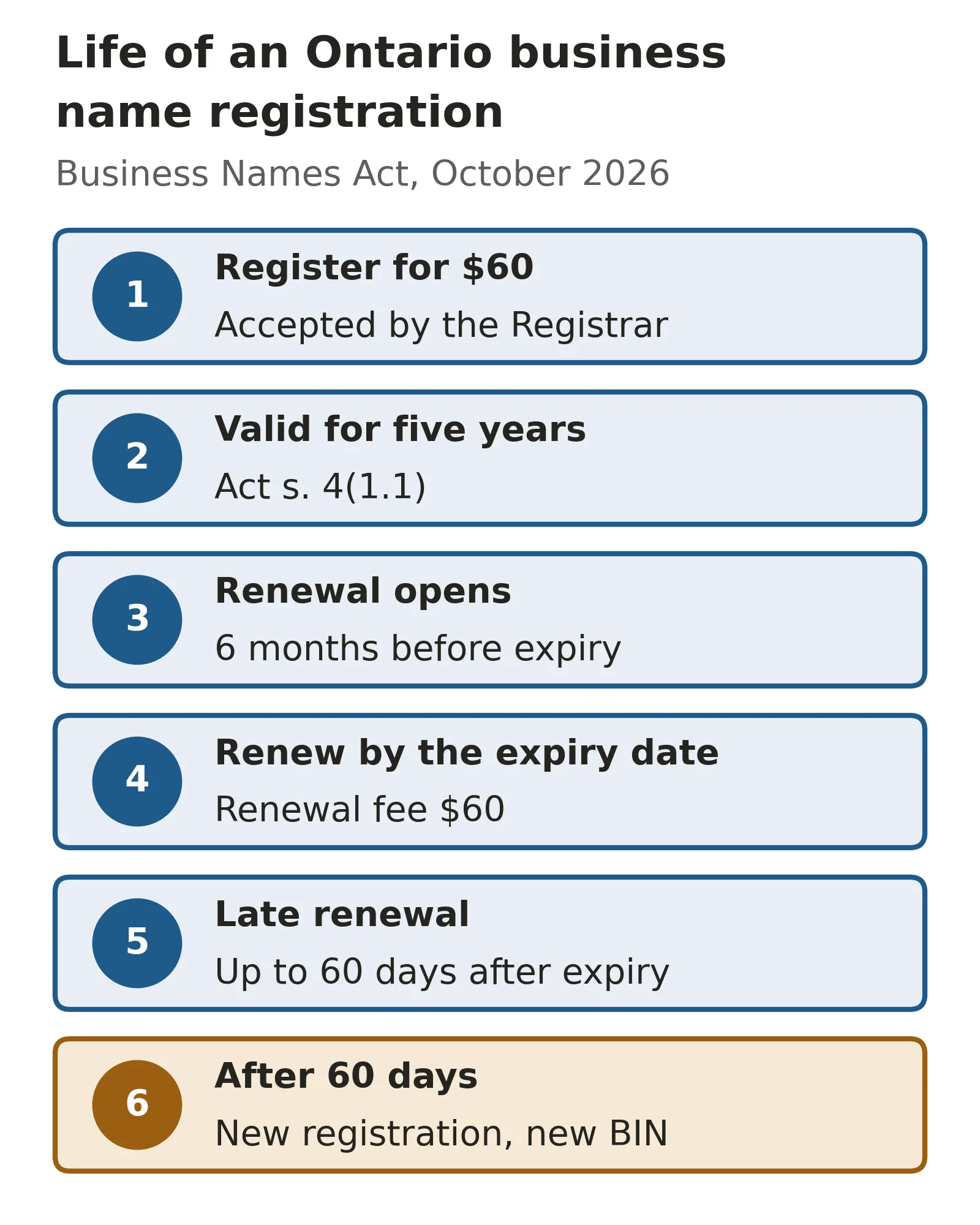
ServiceOntario's fee chart (updated September 29, 2026) lists the same figures for sole proprietorships, general partnerships and business names used by corporations or partnerships. A new registration is $60, a renewal is $60, and an amendment or cancellation costs nothing. Online filings are immediate and mailed filings take 15 business days. These are fees of the Province of Ontario; by mail they are paid by cheque to Ontario's Minister of Finance.
Under s. 4(1.1) of the Act, a registration is effective for five years from the date the Registrar accepts it. The registrant may renew before it expires (s. 5(1)), or within sixty days after it expires on paying the late renewal fee (s. 5(2)). A renewal takes effect on the day after the old registration expires (s. 5(3)). ServiceOntario's services page adds the practical detail: the option to renew appears in the Ontario Business Registry 6 months before the expiry date, and the cost to renew is the same as a new registration.
Miss the 60-day window and you cannot renew at all. The services page says that a registration expired for more than 60 days must be replaced by a new business name registration, which comes with a new BIN and a new company key. That can mean updating bank records and supplier accounts that were tied to the old number.
Changes during the term also matter. If information in a registration changes, such as the business address or the partners, s. 4(4) requires an amended registration within fifteen days after the change. ServiceOntario charges no fee for it. The Registrar can also demand corrections under s. 4(5) and may cancel a registration if the registrant does not respond (s. 4(8)), after giving twenty-one days' notice (s. 4(10)).
What happens if you do not register?
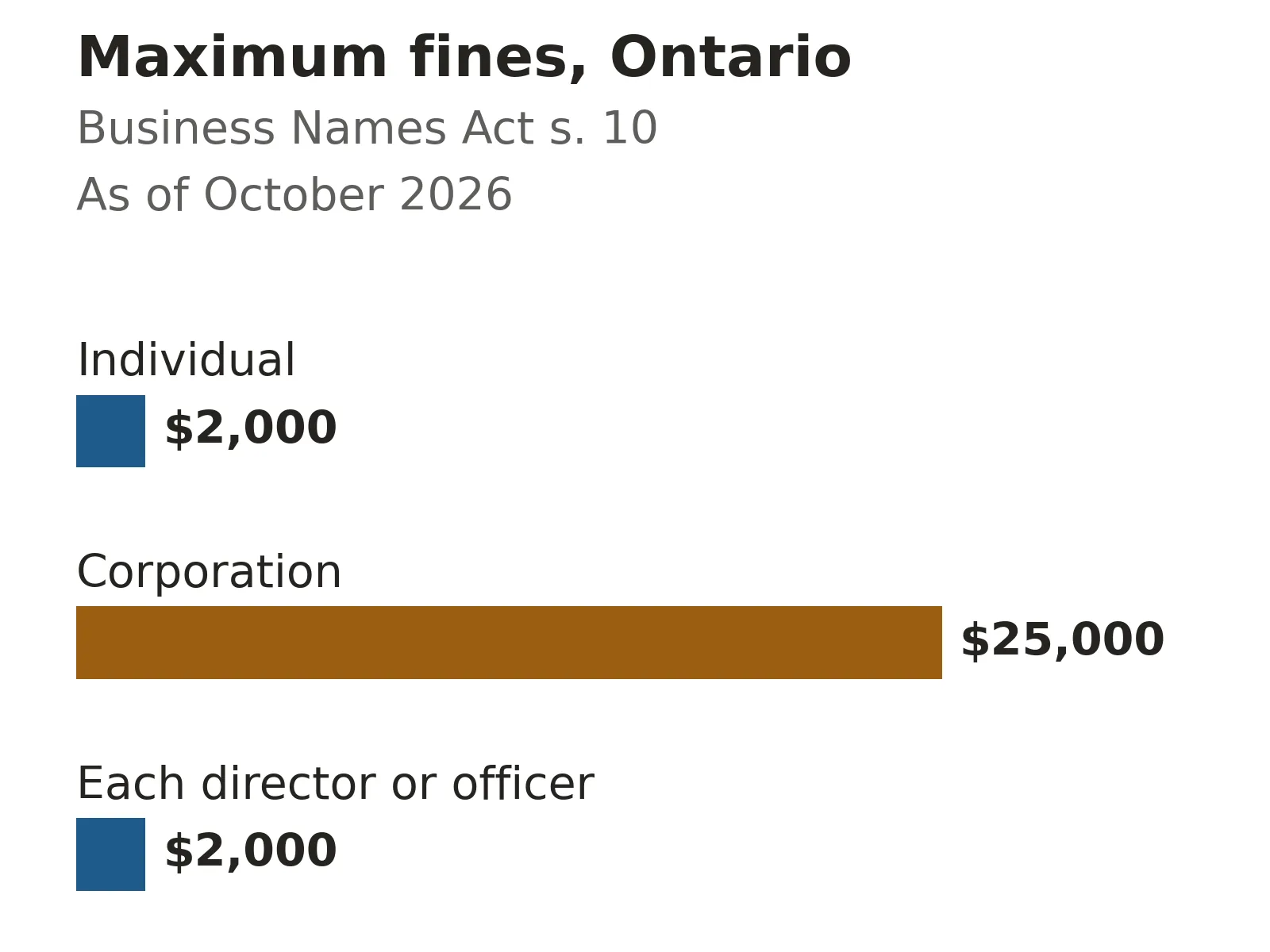
The Act uses two kinds of consequences: fines and limits on going to court. Under s. 10(1), anyone who, without reasonable cause, breaches s. 2 or 2.1, fails to file an amended registration under s. 4(4), fails to correct information under s. 4(6), or makes a false or misleading statement in an application is guilty of an offence. The maximum fine is $2,000 for an individual and $25,000 for a corporation. Under s. 10(2), every director or officer who authorized, permitted or acquiesced in a corporation's offence is also liable to a fine of up to $2,000.
The second consequence is often the more serious one for a business that is owed money. Section 7(1) says that a person carrying on business in breach of s. 2(1), (2) or (3), or s. 4(4) or (6), cannot maintain a proceeding in an Ontario court in connection with that business except with leave of the court. The court must grant leave if the person shows that the failure to register was inadvertent, that there is no evidence the public was deceived or misled, and that the person is now in compliance (s. 7(2)).
So an unregistered sole proprietor trying to collect an unpaid invoice may face a preliminary step, and some cost, before the claim can go ahead. Section 7(3) gives an important reassurance: no contract is void or voidable only because it was made by someone who was in breach of the Act at the time. Your contracts still stand. What you lose, until you fix the problem, is the easy route to enforcing them.
Does registration protect your business name?
No, not in the way most owners expect. Ontario's start-a-business guidance lists "your business name is not protected" among the drawbacks of a sole proprietorship. Registration records who is behind a name. It does not give you an exclusive right to use it, and neither the Act nor its general regulation tells the Registrar to refuse a name because someone else registered a similar one.
The Act does provide one remedy. Under s. 6(1), a person can recover compensation from a registrant who registered a name that is the same as, or deceptively similar to, a name the person registered, or the person's own name. Compensation is limited to the greater of $500 and the actual damages (s. 6(2)), and a court that rules for the plaintiff must order the Registrar to cancel the offending registration (s. 6(3)). That is a reason to search before you file, and a reason why a clash with an existing business can cost you the name.
Owners who want stronger protection usually look at two other tools. Incorporation gives the business a legal name of its own, and our incorporation lawyer page explains how that process works in Ontario and federally. Trademark registration under the federal Trademarks Act, R.S.C. 1985, c. T-13, is a separate federal process for rights in a brand. Neither is required for a business name registration, but both answer a question that the registration does not.
How does Ontario compare with New York?
Owners who run the same brand in Toronto and New York often ask whether one filing covers both. It does not. New York has its own rule in section 130 of the General Business Law, which requires a certificate of assumed name from anyone who carries on business in the state under a name other than their real name. The table shows the main differences we verified this month.
| Point | Ontario | New York |
|---|---|---|
| Governing law | Business Names Act | GBL section 130 |
| Individuals file with | Ontario registry | Each county clerk |
| Corporations file with | Ontario registry | Department of State |
| Government fee | $60 per name | $25 plus county fees |
| Display at premises | Not required | Required |
| Penalty | Fine up to $25,000 | Misdemeanor |
Under GBL s. 130(1)(a), an individual or general partnership files a certificate with the clerk of each county where the business is conducted. Under s. 130(1)(b), a corporation, limited partnership or LLC files with the Secretary of State. The Department of State's instructions for form DOS-1338-f list a $25 filing fee for LLCs and limited partnerships, and $25 plus a county fee for corporations: $25 for each county outside New York City and $100 for each of the five New York City counties. A corporation trading under an assumed name only in Manhattan would therefore pay $125 in government fees (our calculation: $25 plus $100).
New York also has two rules with no Ontario equivalent. Section 130(4) requires a certified copy of the certificate to be conspicuously displayed at each place where the business is conducted. And s. 130(9) makes a knowing failure to comply a misdemeanor, while barring a noncompliant business from maintaining any action in a New York court on a contract made in the assumed name until the certificate is filed. A Canadian corporation doing business in New York may also need to apply for authority, which our guide to foreign qualification covers, and a US company coming the other way should read extra-provincial registration in Ontario.
Frequently asked questions
Do I need to register a business name in Ontario if I use my own name?
No. Section 2(2) of the Business Names Act only requires an individual to register when they carry on business under a name other than their own name. A sole proprietor trading as "Jane Smith" does not register, but one trading as "Smith Renovations" or "Jane Smith Consulting Group" should check whether the added words make it a different name.
How much does business name registration in Ontario cost?
ServiceOntario's fee chart, updated September 29, 2026, lists $60 for a new registration of a sole proprietorship, general partnership or corporate business name, whether filed online or by mail. Renewal is also $60, and an amendment or cancellation is free. Intermediaries and service providers may charge their own fees on top of the government fee.
How long does an Ontario business name registration last?
Section 4(1.1) of the Act makes a registration effective for five years from the date the Registrar accepts it. You can renew before expiry, and s. 5(2) allows a late renewal within sixty days after expiry. ServiceOntario says that after more than 60 days you must register the name again and receive a new BIN.
Is a business name registration the same as a Master Business Licence?
Yes, in substance. ServiceOntario's Ontario Business Registry services page describes the business name registration as the document formerly known as a Master Business Licence. The older term still appears on many websites and bank forms, but the filing is now made and renewed through the Ontario Business Registry, which launched on October 19, 2021.
Does a corporation need to register its trade name in Ontario?
Yes, if it uses one. Section 2(1) of the Business Names Act bars a corporation from carrying on business or identifying itself to the public under a name other than its corporate name unless it registers that name. The corporation must then show both names on its contracts, invoices, negotiable instruments and orders under s. 2(6).
Can I sue a customer if my business name is not registered?
Not without first asking the court for leave. Section 7(1) of the Act stops a person in breach from maintaining a proceeding connected with the business unless the court grants leave, and s. 7(2) requires leave where the failure was inadvertent, nobody was misled and the business now complies. Contracts made while unregistered remain valid under s. 7(3).
Does registering a business name in Ontario stop others from using it?
No. Registration under the Business Names Act does not create an exclusive right, and Ontario's own guidance says a sole proprietorship's business name is not protected. The Act does let a person recover the greater of $500 and actual damages from someone who registers the same or a deceptively similar name, with the court ordering that registration cancelled.
Conclusion
Business name registration in Ontario is inexpensive and quick, but it carries real rules: register before you trade under the name, show both names on corporate paperwork, update changes within fifteen days and renew every five years before the 60-day grace period runs out. Skipping it can mean fines of up to $25,000 for a corporation and a court step before you can sue. Registration does not protect the name, so owners who care about the brand should look at incorporation and trademarks as well, and a business that also trades in New York needs a separate assumed name certificate there.
How Mayo Law can help
We advise owners and companies on setting up and running businesses across the Canada and US border, from Toronto and New York offices. Joseph Mayo is licensed in Ontario and New York, so we can look at an Ontario business name, an incorporation and a New York filing together. Our international business practice works with founders and growing companies, and you can find more guides in our business and startup law hub.
Disclaimer
This article is for general information only and is not legal advice. Reading it does not create a solicitor-client or attorney-client relationship. Laws, fees and government processes change, so confirm the current rules before you act. Mayo Law provides legal services in Ontario and New York.