

Contents
- Quick answer
- What is foreign qualification?
- When does a company have to qualify?
- Should you qualify or form a US subsidiary?
- How do you qualify a Canadian company in New York?
- How does Delaware compare with New York?
- What happens if you do business without qualifying?
- What filings continue after you qualify?
- Frequently asked questions
- Conclusion
- How Mayo Law can help
- Disclaimer
A Canadian corporation that opens a New York office, hires staff in the state or signs local leases becomes a "foreign corporation" in the eyes of New York law, and it has to register before it does business there. That registration is called foreign qualification. Every US state works from the same basic idea, but the forms, fees, deadlines and penalties differ, so a company moving south needs the rules of the specific state where it will operate.
This guide explains what foreign qualification is, when a Canadian company needs it, how the New York filing works step by step, how Delaware's rules compare, and what follows if a company skips it. Every fee and statute below was checked against official New York, Delaware and Canadian government sources in October 2026.
Quick answer
Foreign qualification is the registration a corporation files to do business in a US state other than the one where it was formed. A Canadian corporation is foreign in every state. In New York it files an Application for Authority under Business Corporation Law section 1304, with a home certificate dated within one year and a $225 fee.
What is foreign qualification?
US corporate law is state law. A corporation is domestic only in the state where it was formed and foreign everywhere else, and that includes a corporation formed in Ontario, in another province or under the Canada Business Corporations Act. New York's Business Corporation Law defines a foreign corporation as a corporation for profit "formed under laws other than the statutes of this state" (section 102(a)(7)). A Delaware corporation is a foreign corporation in New York in exactly the same way a Toronto company is.
Foreign qualification is the filing that gives a foreign corporation permission to do business in the state. The name of the filing changes from state to state. New York calls it an Application for Authority, and section 1301(a) of the Business Corporation Law is blunt about it: "A foreign corporation shall not do business in this state until it has been authorized to do so as provided in this article." Delaware uses a qualification filing under section 371 of its General Corporation Law. In New York, keep this separate from the sales tax Certificate of Authority issued by the Department of Taxation and Finance, which is a tax registration, not a corporate one. Our guide to starting a business in New York covers that tax step.
Qualifying does not create a new company. The Canadian corporation stays the same legal person, governed by its home statute, and the state records that it is entitled to operate there. Section 1305 says that once the Department of State files the application, the foreign corporation "shall be authorized to do in this state any business set forth in the application." That authority continues only while the corporation keeps its authority to do that business in its home jurisdiction and has not surrendered its New York authority or had it suspended or annulled.
Canada runs a parallel system for corporations that cross provincial lines. A corporation from outside Ontario that carries on business in Ontario has its own Ontario filings under the Extra-Provincial Corporations Act and the Corporations Information Act. Our guide to extra-provincial registration in Ontario covers that reverse trip, including what a US corporation must file before it operates in Ontario.
When does a company have to qualify?
The trigger is "doing business" in the state, and neither New York nor Delaware reduces that phrase to a single test. New York does not define it. Instead, section 1301(b) lists activities that, by themselves, do not count as doing business for the purposes of the Business Corporation Law:
- maintaining or defending a lawsuit, arbitration or other proceeding, or settling claims and disputes;
- holding meetings of its directors or shareholders;
- maintaining bank accounts;
- maintaining offices or agencies only for the transfer, exchange and registration of its securities, or appointing trustees or depositaries for its securities.
The list opens with the words "Without excluding other activities which may not constitute doing business," so it is a list of safe activities, not a complete map. The New York Department of State adds on its page for foreign business corporations that it "does not give opinions as to what activities constitute doing business in New York State for qualification purposes." That leaves the answer to the facts of each business, which is why it is one of the first questions we look at when a Canadian company plans a New York presence.
Delaware takes a different approach and lists situations in which a foreign corporation does not need to qualify. Section 373(a) of the Delaware General Corporation Law, subchapter XVI, exempts a corporation that only receives orders by mail or similar means, accepts them outside Delaware and ships the goods in; one whose salespeople solicit orders that are approved at offices outside the state and filled with goods shipped from outside; one whose operations in Delaware are "wholly interstate in character"; and insurance companies. A corporation is also exempt for creating or acquiring debts, mortgages or liens as a borrower or lender, and for collecting debts or enforcing rights in the property that secures them.
These differences in foreign qualification requirements by state are why a company cannot reuse one state's answer in another. A pattern of activity that fits a Delaware exemption is not automatically safe in New York, because New York's section 1301(b) does not contain the same mail-order or sales-solicitation exemptions.
Should you qualify or form a US subsidiary?
A Canadian company has two basic ways to operate in a US state. It can qualify the Canadian corporation itself, so that the Toronto company does business in New York directly, often described as operating through a branch. Or it can form a US corporation or LLC as a subsidiary and let that entity carry on the US business.
The choice matters well beyond the filing fee. When the Canadian corporation qualifies directly, it is the Canadian corporation that signs the New York contracts, employs the New York staff and answers New York lawsuits, because there is no separate US entity in between. A subsidiary is a separate legal person, which changes who is a party to the US contracts and how income is taxed on each side of the border. The tax treatment of a branch compared with a subsidiary is a question for a cross-border tax adviser and is outside this guide. Our guides on choosing a US business structure and on whether a Canadian can own a business in the US cover the structural side, and our article on starting a business in both Canada and the US sets out the order of steps.
A subsidiary does not avoid foreign qualification either. A subsidiary corporation formed in Delaware that runs its business from a New York office is a foreign corporation in New York under section 102(a)(7), and it files its own Application for Authority there. Forming the subsidiary in the state where it will actually operate avoids that second filing, although the choice of state has other consequences that should be weighed first.
How do you qualify a Canadian company in New York?
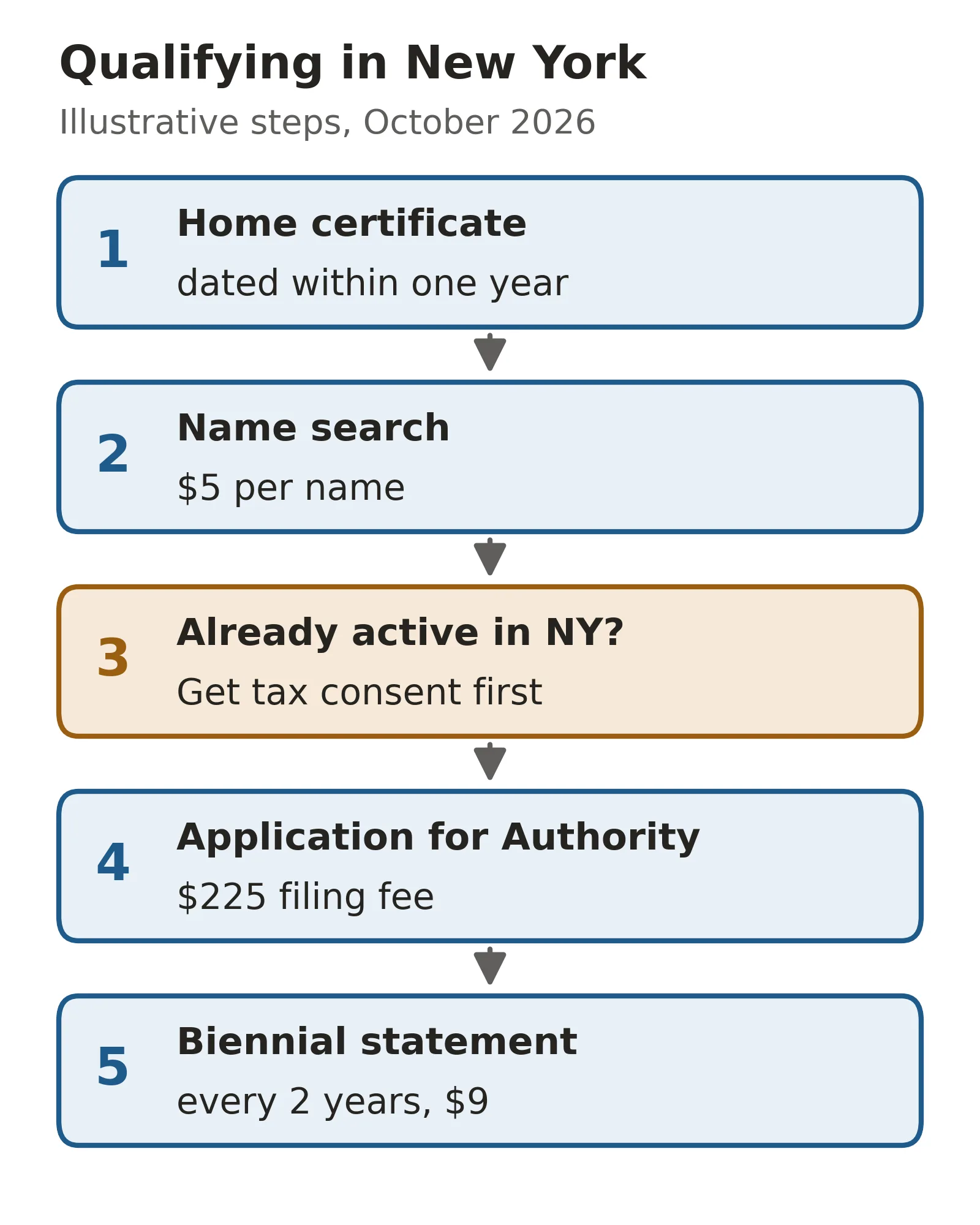
The New York filing is short, but a Canadian applicant meets two details that a US applicant rarely thinks about: where the home certificate comes from, and whether the company has already been active in New York. These are the steps as set out in section 1304 of the Business Corporation Law and on the Department of State's page, as of October 2026:
- Step 1: Get a certificate of existence from home. Section 1304(b) requires a certificate "by an authorized officer of the jurisdiction of its incorporation that the foreign corporation is an existing corporation," and the Department of State requires one dated within one year. An Ontario corporation orders a Certificate of Status, which Ontario's request form instructions describe as certification of the corporation's current status, active or inactive. A federal corporation can order a Certificate of Compliance or a Certificate of Existence from Corporations Canada; the Certificate of Compliance also confirms that annual filings are made and fees are paid. The corporate name and date of incorporation on the New York application must match the certificate exactly. If the certificate is in a language other than English, a translation under oath of the translator must be attached.
- Step 2: Check the name. New York must reject a name that is not distinguishable from names already on file. A written name availability search costs $5 per name under Executive Law section 96. If the Canadian name is not available, section 1301(d) requires the corporation to adopt a fictitious name for use in New York, and that fictitious name cannot contain a corporate indicator.
- Step 3: Get tax consent if the company has already been active. The application must state that the corporation has not done business in New York since its incorporation, apart from the safe activities in section 1301(b). A company that cannot make that statement must attach the consent of the State Tax Commission instead (section 1304(a)(8)). New York's Department of Taxation and Finance describes that consent as confirming "that all tax returns due are filed and all taxes due are paid."
- Step 4: File the Application for Authority. The application sets out the corporation's name, any fictitious name, its jurisdiction and date of incorporation, its purposes, the New York county where its office will be located, and a mailing address to which the Secretary of State will send legal papers served on it. It must designate the Secretary of State as agent for service of process; naming a registered agent in New York is optional (section 1304(a)(6) and (7)). The filing fee is $225, and the Department of State offers expedited handling for an additional $25 (within 24 hours), $75 (same day) or $150 (within 2 hours).
- Step 5: Calendar the recurring filings. Authority brings a biennial statement and tax filings with it, covered below.
Once the Department of State files the application, the corporation is authorized from that point. The authority is not open-ended: section 1303 lets the Attorney General act against a foreign corporation doing business in New York "not set forth in its application for authority," and against one that has been dissolved, or had its authority or existence terminated, in its home jurisdiction.
How does Delaware compare with New York?
Delaware is a useful comparison because its statute is more specific than New York's in several places. Under section 371(b), the home certificate must be dated no earlier than 6 months before the filing, not one year. The corporation must also file a statement signed by an authorized officer that names its registered agent in Delaware, sets out its assets and liabilities as of a date no earlier than 6 months before the filing, and describes the business it proposes to do in Delaware along with a statement that it is authorized to do that business at home. Like New York, Delaware requires a sworn translation of a certificate in a foreign language.
The table below sets the two side by side. The biggest practical difference for a Canadian company is the shorter life of the home certificate in Delaware and the financial statement that New York does not ask for.
| Requirement | New York | Delaware |
|---|---|---|
| Home certificate age | Within one year | Within 6 months |
| Foreign-language certificate | Sworn translation | Sworn translation |
| Assets and liabilities | Not in section 1304 | Statement required |
| Agent for service | Secretary of State | Registered agent |
| Filing fee | $225 | $245 |
| Recurring filing | Biennial statement, $9 | Annual report, June 30 |
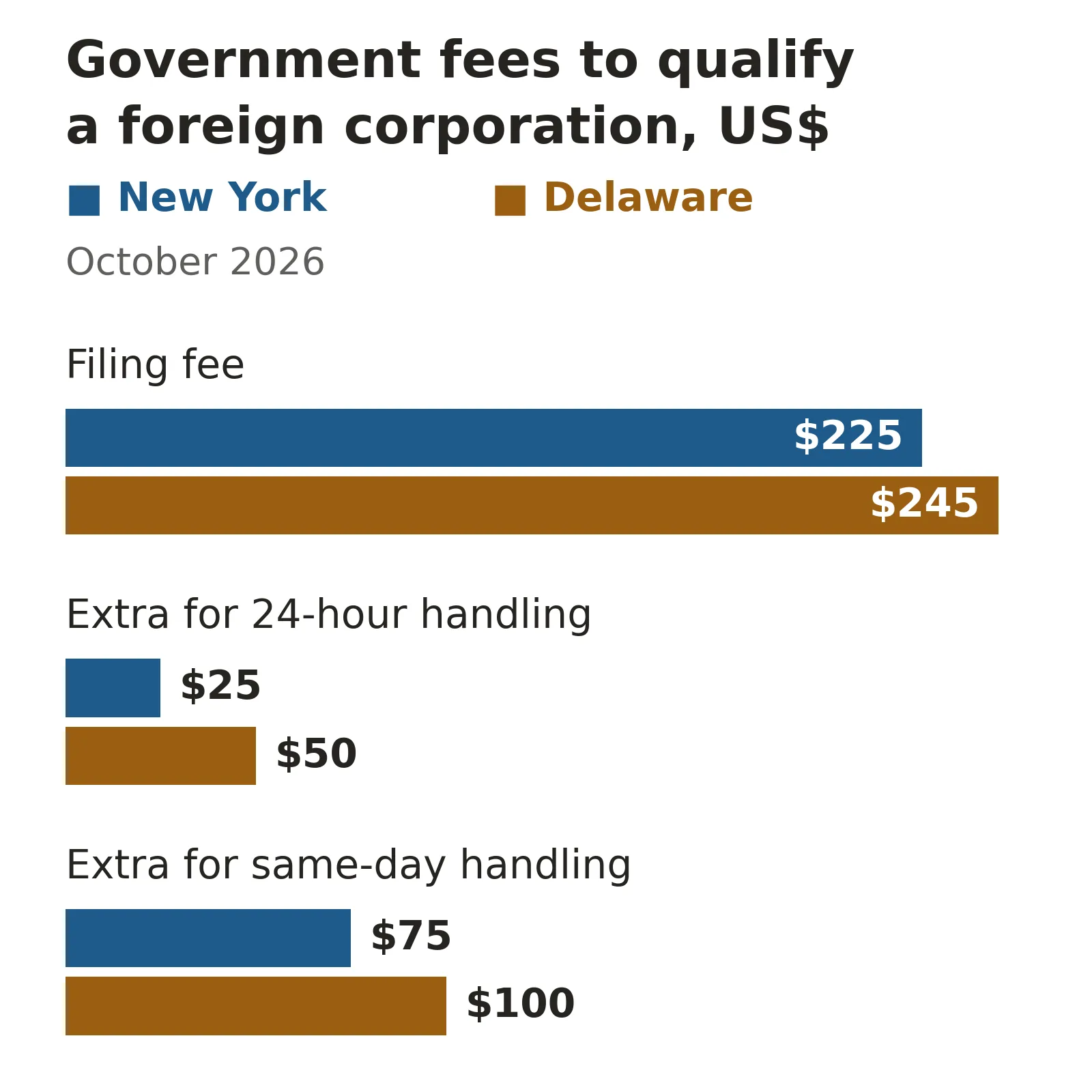
On fees, the Delaware Division of Corporations fee schedule, revised August 1, 2026, lists a state filing fee of $245 for the qualification of a foreign corporation, with $50 extra for 24-hour handling and $100 extra for same-day handling. Section 371(b) itself refers to a payment of $80 to the Secretary of State; the $245 figure is the filing fee the Division publishes. New York's standard fee is $225, with $25 extra for 24-hour handling and $75 extra for same-day handling. By our calculation, a standard Delaware filing costs $20 more than a standard New York filing, and same-day handling costs $25 more in Delaware than in New York.
What happens if you do business without qualifying?
The main consequence in both states is the loss of access to the state's courts as a plaintiff. Section 1312(a) of New York's Business Corporation Law says a foreign corporation doing business without authority "shall not maintain any action or special proceeding in this state unless and until" it has been authorized and has paid all fees and taxes imposed under the tax law, with related penalties and interest. The prohibition also applies to any successor in interest, so a buyer of the business can inherit the problem. Delaware's section 383(a) is similar, requiring payment of all fees, penalties and franchise taxes for the years the corporation did business without authority, but it expressly does not apply to a successor in interest.
Both states protect the contracts themselves. New York's section 1312(b) and Delaware's section 383(b) say that failing to qualify does not impair the validity of the corporation's contracts or acts, does not stop the other party from suing on the contract, and does not prevent the foreign corporation from defending a lawsuit. A company that has to collect a debt or enforce a contract in the state, though, has to qualify and pay up first.
| Consequence | New York | Delaware |
|---|---|---|
| Suing in state courts | Barred until authorized and paid | Barred until authorized and paid |
| Applies to successors | Yes | No |
| Validity of contracts | Not impaired | Not impaired |
| Fines in the statute | Not in section 1312 | $200 to $500 per offense |
| Who can stop it | Attorney General action | Court of Chancery injunction |
Delaware adds fines. Section 378 fines a foreign corporation that does business without complying between $200 and $500 for each offense, and fines an agent who does business for it between $100 and $500 for each offense. Section 384 gives the Court of Chancery jurisdiction to stop the corporation, or its agent, from transacting business in Delaware. In New York, section 1303 lets the Attorney General bring an action to restrain a foreign corporation from doing business without authority.
Taxes are a separate track. New York's Department of Taxation and Finance states that "a foreign corporation that is subject to tax in New York State must file and pay all state and local taxes even if it is not authorized by NYS Department of State." Skipping foreign qualification does not keep a company out of New York tax.
What filings continue after you qualify?
In New York, the main corporate filing is the biennial statement under section 408 of the Business Corporation Law. Every foreign corporation authorized to do business in New York files it every two years, in the calendar month in which its application for authority was filed. The statement gives the name and business address of the chief executive officer, the street address of the principal executive office, the address for service of process, and the number of directors on the board and how many are women. The fee is $9, most corporations can file online, and expedited handling is not available.
Tax filings carry their own risk to the corporate authority. The Department of Taxation and Finance says the Secretary of State may annul a foreign corporation's authority if, where it is required to file, it fails to file franchise tax returns for two or more consecutive years and does not surrender its authority voluntarily. Leaving New York is not automatic either: under section 1310, surrendering authority requires the consent of the State Tax Commission, and the tax department notes that surrender does not end any obligation to pay tax the corporation owes.
The home jurisdiction still matters after qualifying. Section 1305 ties New York authority to the corporation keeping its authority at home, so an Ontario corporation that falls behind on its Ontario annual return or is dissolved in Ontario puts its New York position at risk as well. In Delaware, section 374 requires a qualified foreign corporation to file an annual report on or before June 30 that lists its registered office, its agent for service, its principal place of business and the names and addresses of its directors.
Frequently asked questions
What is foreign qualification in simple terms?
Foreign qualification is permission from a US state for a corporation formed somewhere else to do business there. The corporation does not change or re-form. It files a registration with the state, usually with a certificate from its home jurisdiction and a fee. In New York the filing is an Application for Authority under section 1304 of the Business Corporation Law, with a $225 filing fee as of October 2026.
Does a Canadian company need foreign qualification to sell to US customers?
It depends on the state and on what the company does there. New York lists activities that by themselves are not doing business, such as holding board meetings, keeping bank accounts and defending lawsuits, but the list is not complete and the Department of State gives no opinions. Delaware exempts mail-order sales filled from outside the state, and orders taken by salespeople that are approved and filled from outside the state.
How much does foreign qualification cost in New York?
As of October 2026 the Department of State charges $225 to file the Application for Authority. Optional expedited handling adds $25 for 24 hours, $75 for same day or $150 for 2 hours. A written name availability search costs $5 per name. The home certificate has its own cost in the home jurisdiction, and the biennial statement filed every two years costs $9.
How recent must the home certificate be?
New York's Department of State requires the certificate of existence from the home jurisdiction to be dated within one year. Delaware's section 371(b)(1) is stricter and requires a certificate dated no earlier than 6 months before the filing date. For an Ontario corporation the usual document is a Certificate of Status, and for a federal corporation a Certificate of Compliance or Certificate of Existence from Corporations Canada.
Can a company qualify after it has already done business in New York?
Yes, but the application must then include the consent of the State Tax Commission under section 1304(a)(8), which New York's tax department describes as confirming that all tax returns due are filed and all taxes due are paid. Until the company is authorized and has paid the fees, taxes, penalties and interest owed, section 1312(a) bars it from bringing a lawsuit in New York.
Is foreign qualification the same as registering for taxes?
No. Foreign qualification is a corporate filing with the Department of State. Tax registration is separate, and New York's tax department states that a foreign corporation subject to New York tax must file and pay state and local taxes even if it is not authorized. A business that makes taxable sales also needs a sales tax Certificate of Authority from the Department of Taxation and Finance, a different document.
Does a US subsidiary of a Canadian company also need to qualify?
Only in states other than the one where the subsidiary was formed, and only where it does business. A subsidiary corporation formed in Delaware that operates from a New York office is a foreign corporation under New York's section 102(a)(7) and files its own Application for Authority. A subsidiary formed in New York is domestic there and does not qualify in New York.
Conclusion
Foreign qualification is a small filing with outsized consequences. For a Canadian corporation entering New York, the work comes down to a current home certificate, a name that New York will accept, tax consent if the company has already been active, and a $225 Application for Authority, followed by a $9 biennial statement every two years. Delaware asks for more paper, a fresher certificate and an annual report. Getting the order right, and deciding first whether the Canadian company or a US subsidiary should be the one doing business, avoids the court bar and the tax-consent step that come with qualifying late.
How Mayo Law can help
Mayo Law focuses on cross-border business between Canada and the United States, with offices in Toronto and New York. Joseph Mayo, the firm's principal attorney, is licensed in Ontario and New York, so one file can cover the Ontario corporation's records and its New York Application for Authority. We review whether planned activities amount to doing business, prepare the filings and coordinate the home-jurisdiction documents. See our international business law services and our work as an incorporation lawyer for Canadian and US entities.
Disclaimer
This article is general information only and is not legal advice. Reading it does not create a solicitor-client or attorney-client relationship. Statutes, fees and filing rules change, and each state applies its own law to the facts of each business. Speak with a lawyer about your own situation before acting on anything in this article. Mayo Law provides legal services in Ontario and New York.