

Contents
- Quick answer
- Can a real estate investment support an E-2 visa?
- Why does a passive rental property usually fail?
- Which real estate businesses can qualify?
- How is the investment counted in a property deal?
- Which Canadian real estate plans can pass the E-2 tests?
- What does the source-of-funds rule require?
- What can a Canadian owner do without an E-2 visa?
- Frequently asked questions
- Conclusion
- How Mayo Law can help
- Disclaimer
If you own a condo in Florida or Arizona, or plan to buy one, the question comes naturally: can the property carry a visa? An E-2 visa real estate investment can work, but only when the money goes into an operating business. A house, a condo or a parcel of land that you simply hold usually does not get there, whatever it cost. It is the first point our E-2 visa lawyers check when a Canadian investor brings us a property plan.
The line between passive and active comes from two official texts: volume 9 of the U.S. Department of State's Foreign Affairs Manual (FAM), section 402.9, and title 8 of the Code of Federal Regulations (CFR), section 214.2(e). We checked every rule below against its official source in November 2026. The Canadian examples use invented facts and round numbers.
Quick answer
An E-2 visa real estate investment can qualify only when the property is part of a real, active business that you own and direct, such as a property management, hospitality or development company. Property that you simply hold usually fails the E-2 tests, and a mortgage secured on the property does not count toward the investment.
Can a real estate investment support an E-2 visa?
Yes, a real estate investment can support an E-2 visa when it funds an operating business that the investor owns and directs, and it usually cannot when the property is only held. Neither 9 FAM 402.9 nor 8 CFR 214.2(e) bans real estate as an industry. They look at what the enterprise does, not at what it owns.
U.S. Citizenship and Immigration Services (USCIS) states the general test on its E-2 Treaty Investors page, last reviewed on August 20, 2026. The investor must be a national of a treaty country. The investor must have invested, or be actively in the process of investing, a substantial amount of capital in a bona fide enterprise in the United States. And the investor must be coming solely to develop and direct that enterprise. Canada is on the treaty list: the table in 9 FAM 402.9-10 shows the E-2 provision for Canada in force since January 1, 1994.
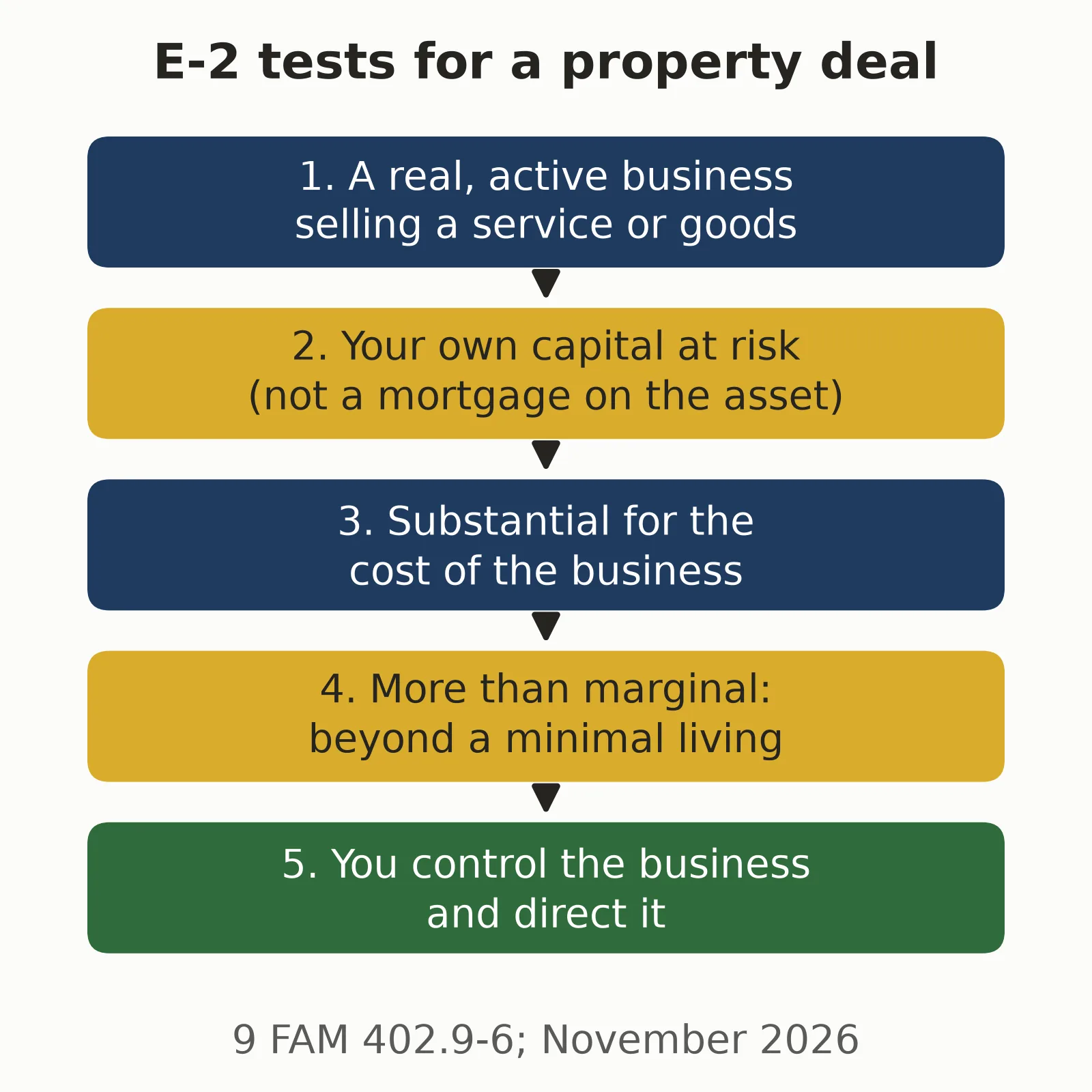
Consular officers work from 9 FAM 402.9, dated February 17, 2026 in the version we read. Section 402.9-6(A) lists nine points the officer must decide. Five of them decide most property files:
- Real and active enterprise: the business must be a commercial undertaking that produces a service or a commodity.
- Capital at risk: you must have invested, or be actively in the process of investing, your own funds.
- Substantial investment: the amount is weighed against the cost of the business.
- More than marginal: the business must be able to do more than support you and your family.
- Develop and direct: you must control the enterprise, through ownership of at least 50 percent or through operational control, and run it.
The other four cover the treaty itself, nationality, the applicant's role and the intent to leave when E-2 status ends. Our guide to the E-2 visa requirements walks through all of them. The sections below apply the five property-sensitive tests to real estate.
Why does a passive rental property usually fail?
A passive rental property usually fails because the rules require an active business that sells a service, is run by the investor and can earn more than a minimal living. A property that is only held shows little of that. Three tests do the work.
The enterprise must be real and active
Section 402.9-6(C) of the FAM says the enterprise must be "a real and active commercial or entrepreneurial undertaking, producing some service or commodity." It then says what the enterprise cannot be: "a paper organization or an idle speculative investment held for potential appreciation in value, such as undeveloped land or stocks held by an investor without the intent to direct the enterprise."
The regulation that USCIS applies inside the United States says the same thing in other words. Under 8 CFR 214.2(e)(13), a bona fide enterprise is "a real, active, and operating commercial or entrepreneurial undertaking which produces services or goods for profit."
Undeveloped land held for appreciation is named in the FAM as an example of what does not count. A rented house or condo is not named. In our reading it meets the same problem, because collecting rent on one or two units through a local agent is ownership of an asset, with very little undertaking for the investor to run.
You must develop and direct it
An E-2 investor comes to the United States "solely to develop and direct" the enterprise. Under 8 CFR 214.2(e)(16), you show control through ownership of at least 50 percent of the enterprise, or through operational control in a managerial position or another corporate device, or by other means. A property that an agent rents out for you gives you ownership but very little to direct.
It must be more than marginal
Under 8 CFR 214.2(e)(15), a marginal enterprise is one without the present or future capacity to generate more than enough income to provide a minimal living for the investor and the investor's family. The regulation adds that the projected capacity should generally be realizable within 5 years of starting normal business activity. An enterprise that falls short on income can still pass if it has the capacity to make a significant economic contribution. Neither that paragraph nor 9 FAM 402.9-6(E) sets a required number of employees.
Net rent from one home rarely clears that bar, and a holding with no employees and no customers has little economic contribution to point to. An E-2 visa rental property plan therefore tends to fail at this test even when the first two are argued well.
Which real estate businesses can qualify?
Real estate businesses that sell a service or a product, such as property management, hospitality and development or renovation companies, can qualify when they are operating and the investor directs them. Neither 9 FAM 402.9 nor 8 CFR 214.2(e) lists approved industries, so the table below is our reading of 9 FAM 402.9-6(C) applied to common models.
| Model | What it produces | E-2 fit |
|---|---|---|
| Rental home or condo | Rent only | Weak: passive holding |
| Undeveloped land | Nothing yet | Named as excluded |
| Company that only holds title | Nothing | Weak: paper organization |
| Property management firm | Services to owners | Can fit if operating |
| Inn, motel or hotel | Lodging for guests | Can fit if operating |
| Development or renovation firm | Built or renovated property | Can fit if operating |
Property management
An E-2 visa property management company works on the same logic as any service business. It signs management agreements with property owners, finds and screens tenants, collects rent, arranges repairs and reports to its clients, and it earns fees for that work. The stronger files show clients beyond the investor's own units, an office, employees and a pipeline of contracts. A company that manages only the founder's condo is hard to tell apart from the condo.
Hospitality
An inn, a motel or a small hotel sells lodging and guest services every day, with front-desk, housekeeping and maintenance staff. The building is a tool of the business in the way an oven is a tool of a bakery. Buying one that is already trading also gives you a track record to show, a point we cover in our guide to buying an E-2 visa business for sale.
Development and renovation
A company that buys, renovates and resells homes, or that builds on land it has bought, produces a commodity: finished property. What separates it from the excluded land holding is activity. Crews, contractors, permits, equipment and a schedule of projects show an undertaking; a lot with a plan to build one day does not.
Licenses, staff and revenue
Under 8 CFR 214.2(e)(13), the enterprise must also meet the legal requirements for doing business in its jurisdiction. The U.S. Embassy and Consulates in Canada note in their E-visa questions and answers that licensing and permit requirements fall mainly under state and local law and vary with the type of business. Check the rules for property managers, brokers and contractors in the state where you will operate before you commit funds.
Payroll and financial records are what the FAM lists for marginality. Its suggested document checklist in 9 FAM 402.9-11(B) names payroll registers and W-2 and W-4 tax forms for an existing business. For a new one it lists financial projections for the next 5 years, supported by a thorough business plan. Our guide to the E-2 visa business plan explains how those projections are built. Managers and essential staff who share the investor's nationality may qualify for their own status, covered in our E-2 employee visa guide. For how real estate compares with other sectors, see our guide to which businesses suit an E-2 visa application.
How is the investment counted in a property deal?
In an E-2 visa real estate investment, only your own capital placed at risk in the business counts. Cash and loans secured on your personal assets count; a mortgage secured on the property or the business itself does not. That rule changes the arithmetic of almost every property purchase.
At risk and irrevocably committed
Under 8 CFR 214.2(e)(12), an investment is capital placed at risk in the commercial sense with the objective of generating a profit, and it must be subject to partial or total loss if the business fails. The funds must also be irrevocably committed. The FAM accepts funds held in escrow for release once the visa is issued, and it says that money sitting uncommitted in a bank account does not suffice. It adds that the investor must be close to the start of actual business operations, not simply signing contracts or scouting for locations and property.
Mortgages and loans
Section 402.9-6(B) of the FAM states that mortgage debt or commercial loans secured by the assets of the enterprise cannot count toward the investment, because the element of risk is missing. Debt secured on your own personal assets is treated differently. The FAM gives a second mortgage on a home and an unsecured personal loan as examples of borrowing that may be included.
The table shows the effect on an illustrative purchase of a 20-room inn for US$1,200,000. In Plan A the investor pays US$480,000 in cash and mortgages the inn for the rest. In Plan B the investor also borrows US$300,000 against a home in Ontario and takes a smaller mortgage on the inn.
| Funding piece | Plan A (US$) | Plan B (US$) | Counts? |
|---|---|---|---|
| Investor's own cash | $480,000 | $480,000 | Yes |
| Loan on Ontario home | $0 | $300,000 | Yes |
| Mortgage on the inn | $720,000 | $420,000 | No |
| Qualifying funds | $480,000 | $780,000 | Sum of yes rows |
| Share of the price | 40% | 65% | Calculated |
The price is the same in both plans, but the qualifying investment rises from 40% to 65% of it (our calculation: 480,000 and 780,000 divided by 1,200,000). Whether either share is enough is for the officer to judge.
The proportionality test
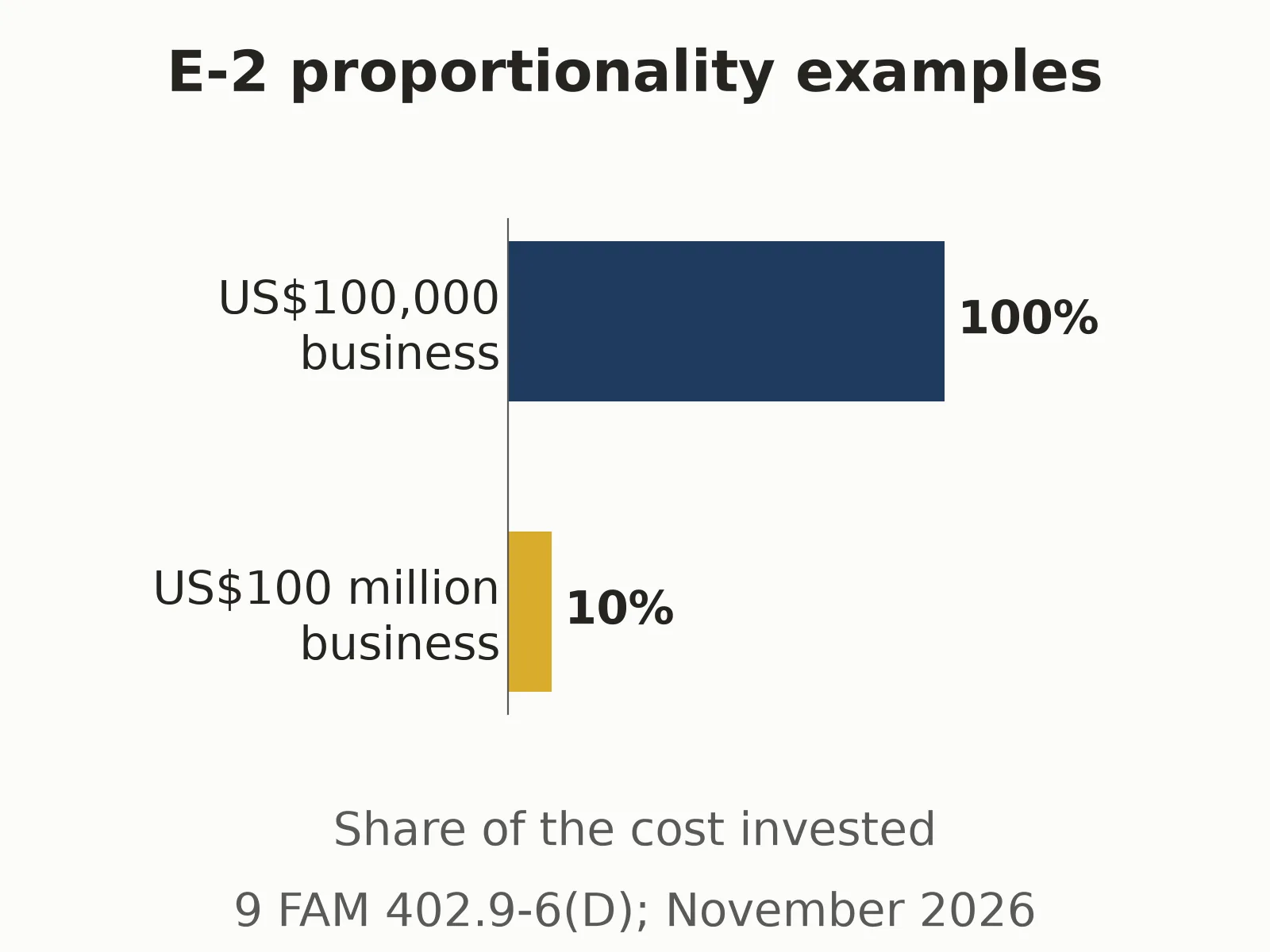
The FAM says no set dollar figure is a minimum. Under section 402.9-6(D), the officer weighs the qualifying funds against the cost of the business on what the FAM calls an inverted sliding scale: the lower the cost of the business, the higher the percentage that must be invested. It gives two reference points. The FAM prints them with a plain dollar sign; as amounts in a U.S. government manual about investing in a U.S. business, they are U.S. dollars. An investment of 100 percent would normally qualify for a business with a start-up cost of US$100,000. At the other extreme, US$10 million invested in a US$100 million business may be considered substantial because of its sheer size. That second example works out to 10 percent by our calculation. There are no bright-line percentages in between.
For an established business, the FAM generally treats the purchase price, normally the fair market value, as the cost. For a new business, the cost is what it takes to become operational, and appraisals of the market value of land and buildings are among the documents the FAM names for proving it. Our guide to the E-2 visa minimum investment amount looks at typical ranges by business type.
Rent and lease payments
If the business leases its premises, the FAM counts only one month's rent toward the investment. A full year of rent counts only when it has been paid in advance. A long lease on a building therefore adds little to the investment total by itself.
Which Canadian real estate plans can pass the E-2 tests?
Canadian real estate plans follow the same pattern each time: holding property usually fails the active-enterprise test, and running a property business can pass it when the money is at risk and the investor is in charge. The five worked examples below are illustrative. The people and numbers are invented, and a real file turns on its documents and on the officer's assessment.
| Case | Investor's role | Likely result |
|---|---|---|
| Florida condo | Owner, agent rents it | Weak: passive holding |
| Arizona land | Holds for appreciation | Named as excluded |
| Units in a holding company | Owner, no operations | Weak: paper organization |
| Management company | Runs staff and contracts | Can fit if operating |
| 20-room inn | Runs daily operations | Can fit if operating |
- The Florida condo: an Ottawa couple pay US$400,000 in cash for a condo and a local agent rents it out. Their money is at risk, but there is very little undertaking that produces a service, very little for them to direct, and the net rent would be unlikely to support a family.
- The Arizona land: a Calgary investor buys an undeveloped parcel near Phoenix to hold until prices rise. Undeveloped land held for appreciation is the example the FAM itself gives of an idle speculative investment.
- The holding company: a Montreal owner moves three rental units into a limited liability company (LLC) that has no staff and no clients, and an agent lets the units. In our reading a company wrapper does not create an enterprise, and the FAM says the enterprise cannot be a paper organization.
- The management company: a Toronto property manager opens a company in Florida, leases an office, hires two employees and signs management agreements with 40 unit owners. The business sells a service, the funds spent on set-up are at risk, and payroll and fee revenue speak to marginality.
- The 20-room inn: a Hamilton hotelier buys an operating inn for US$1,200,000 under Plan B above, keeps the staff and runs it day to day. The enterprise is active, 65% of the price is qualifying capital, and the existing payroll helps on marginality.
The last two cases are not approvals in waiting. They are structures that give the officer something to assess under each test, which the first three give little room for.
What does the source-of-funds rule require?
The source-of-funds rule requires you to show that the invested capital came from a lawful source and that you possess and control it. Section 402.9-6(B) of the FAM lists savings, gifts, inheritance, contest winnings and loans secured on the applicant's own personal assets as acceptable sources, alongside other legitimate ones. The money does not have to come from outside the United States, and it must not be the result of illicit activities. The rule is the same for an E-2 visa real estate investment as for any other E-2 business.
The officer may request whatever documentation is needed to assess the source. The FAM also gives a suggested checklist, which it describes as a guide only and not a list of required documents. It includes a statement of net worth prepared by an accountant, records of the sale of a property or business with proof of ownership, lease agreements showing rental income and bank statements crediting the proceeds.
For a Canadian investor, that usually means a paper trail that starts in Canada. If the capital comes from selling a home, the sale documents and the path of the proceeds into the U.S. business account are the record. If it comes from borrowing against a home, the loan is the kind of personally secured debt the FAM allows, and the loan documents show both the source and the risk you carry.
What can a Canadian owner do without an E-2 visa?
Without an E-2 visa, a Canadian owner can generally enter the United States as a visitor to explore an investment and set it up, but cannot perform productive labor or actively manage a business there. Owning property is not itself a basis for E-2 status, because the classification attaches to an investor who develops and directs an enterprise.
Under 22 CFR 41.2, Canadian citizens do not need a visa for most kinds of entry, but the E classification is one of the listed exceptions. 9 FAM 402.2-5(C)(7) confirms that a person seeking an investment, including one that would qualify for E-2 status, is not barred from visitor status for that reason alone. The same passage says visitors are precluded from performing productive labor and from actively participating in the management of the business. The embassy's E-visa questions and answers put it in practical terms: meetings, visits to premises and set-up steps are possible in B-1 status, but running daily operations is not.
Applying from Canada and length of stay
When the business is ready, the application goes through a consulate. The U.S. Embassy and Consulates in Canada state on their Treaty Trader and Investor Visas page that first-time E-visa applicants must apply in Toronto and submit their documents electronically before any interview is set. Our guide to the E-2 visa from Canada covers that process step by step.
USCIS says on its E-2 Treaty Investors page that an E-2 investor is allowed a maximum initial stay of two years. Extensions may be granted in increments of up to two years, with no limit on their number, as long as the investor keeps the intention to depart when the status ends.
Other rules to know: EB-5 and U.S. tax
The EB-5 immigrant investor program is a separate route with its own rules. USCIS describes it on its EB-5 Immigrant Investor Program page as requiring the necessary investment in a commercial enterprise and a plan to create or preserve 10 permanent full-time jobs for qualified U.S. workers. We compare the two in our guide to the E-2 visa and the EB-5 visa.
U.S. federal tax is also a separate question from visa status. The Internal Revenue Service (IRS) says on its page for nonresident aliens with real property in the United States (last reviewed July 23, 2026) that income from such property is in general taxed at 30%, or a lower treaty rate. That general rule applies when the income is not effectively connected with a U.S. trade or business. Its withholding page for the Foreign Investment in Real Property Tax Act (FIRPTA) (last reviewed July 21, 2026) says buyers must generally withhold 15% of the amount realized when a foreign person disposes of a U.S. real property interest. Canadian tax and state tax are outside this summary.
Frequently asked questions
Does buying a rental property qualify for an E-2 visa?
Usually not. The rules require a real and active business that produces a service or a commodity, directed by the investor and able to earn more than a minimal living. A rental unit that an agent lets for you is ownership of an asset. The Foreign Affairs Manual names undeveloped land held for appreciation as an excluded example. A rented house or condo is not named, and in our reading a lone rental meets the same objections.
Can a property management company support an E-2 visa?
It can, when it is a real operating business. A management company sells a service to property owners and earns fees for it, which is the kind of undertaking the rules describe. The file is stronger with clients beyond the investor's own units, employees, an office and signed management agreements. The officer still applies every E-2 test to the facts.
Does an E-2 visa real estate investment have a minimum amount?
No. The Foreign Affairs Manual says no set dollar figure is a minimum. The officer applies a proportionality test that weighs your qualifying funds against the cost of the business, and the lower that cost, the higher the share you must invest. Its two reference points are 100 percent of a US$100,000 business and US$10 million of a US$100 million business.
Does a mortgage count toward the E-2 investment?
Not when it is secured on the business or its property. The Foreign Affairs Manual says mortgage debt or commercial loans secured by the assets of the enterprise cannot count, because those funds are not at risk for the investor. Borrowing secured on your personal assets, such as a second mortgage on your own home, may be included in the investment.
Do short-term rentals count as an active business?
Only when they amount to an operating hospitality business. Neither the Foreign Affairs Manual section on E visas nor the E-2 regulation mentions short-term rentals by name, so the general tests apply. One unit listed online and looked after by an outside manager resembles a passive holding. An operation with several units, guest services, cleaning and maintenance staff and an owner who directs it day to day looks more like a hospitality business. The outcome depends on the evidence.
Can a Canadian manage a U.S. rental property as a visitor?
Not if managing means running it day to day. The Foreign Affairs Manual says visitors are precluded from performing productive labor and from actively participating in the management of a business. A Canadian citizen can generally enter the United States as a visitor without a visa, and exploring or setting up an investment is compatible with visitor status.
Does putting the property in an LLC change the answer?
Not by itself. A limited liability company that only holds title has no operations, and the Foreign Affairs Manual says the enterprise cannot be a paper organization. The tests look at what the business does: the service or product it sells, the capital at risk, the income it can produce and who directs it. The legal form of the owner does not supply any of those.
How long can an E-2 investor stay in the United States?
USCIS says on its E-2 Treaty Investors page that a qualified treaty investor is allowed a maximum initial stay of two years. Extensions may be granted in increments of up to two years each, and there is no limit on the number of extensions. The investor must keep the intention to depart the United States when E-2 status expires or is terminated.
Conclusion
Neither 9 FAM 402.9 nor 8 CFR 214.2(e) favors or bans real estate. An E-2 visa real estate investment turns first on one question: are you running a business or holding an asset? A rental home, a condo or a piece of land held for its value usually falls on the wrong side of that line. An operating management company, inn or renovation business can fall on the right side, provided your own capital is at risk and you are the one directing the work. Before you buy, map the plan against each test, and count the investment without the mortgage on the property.
How Mayo Law can help
Mayo Law is a cross-border law firm with offices in Toronto and New York. Joseph Mayo, our principal attorney, is licensed in Ontario and New York. Our lawyers advise Canadian investors on structuring a U.S. business for an E-2 application, on documenting the source and path of funds from Canada, and on preparing the filing for the consulate. Our E-2 visa lawyer page describes that work. A first meeting is a paid one-hour consultation, because a lawyer reviews your plan and documents in depth. We do not promise outcomes: each application is decided by a consular or immigration officer on its own facts.
Disclaimer
This guide provides general information only. It is not legal advice, and reading it does not create a solicitor-client or attorney-client relationship. Immigration rules and their interpretation change, and the result of any application depends on its own facts. Speak with a licensed lawyer about your situation before you act. Mayo Law provides legal services in Ontario and New York.