

Contents
- Quick answer
- Which nationality rule applies to E-2 employees?
- Which jobs qualify as executive, supervisory or essential?
- How does a Canadian company file for an E-2 employee?
- How long does E-2 employee status last?
- What can the employee's spouse and children do?
- When does an E-2 employee need new approval?
- E-2 employee, TN or L-1: which fits?
- Frequently asked questions
- Conclusion
- How Mayo Law can help
- Disclaimer
The E-2 employee visa lets a U.S. company that is at least half owned by Canadian citizens bring Canadian staff to the United States to run it, supervise it or do work the business cannot do without. The employee invests nothing. The visa rests on the company's own E-2 standing, the employee's nationality and the job. Once the company is registered, later files can focus on whether each employee qualifies, so the company records an owner prepares with an E-2 visa lawyer also serve its staff.
This guide is for the owner or manager of a Canadian business with a U.S. company, open or planned, that needs Canadian employees there. It covers who qualifies, the two filing paths in Canada, how long the status lasts, the family rules and how the visa compares with TN and L-1 status. The owner's own visa is covered in our guide to the E-2 visa from Canada.
Quick answer
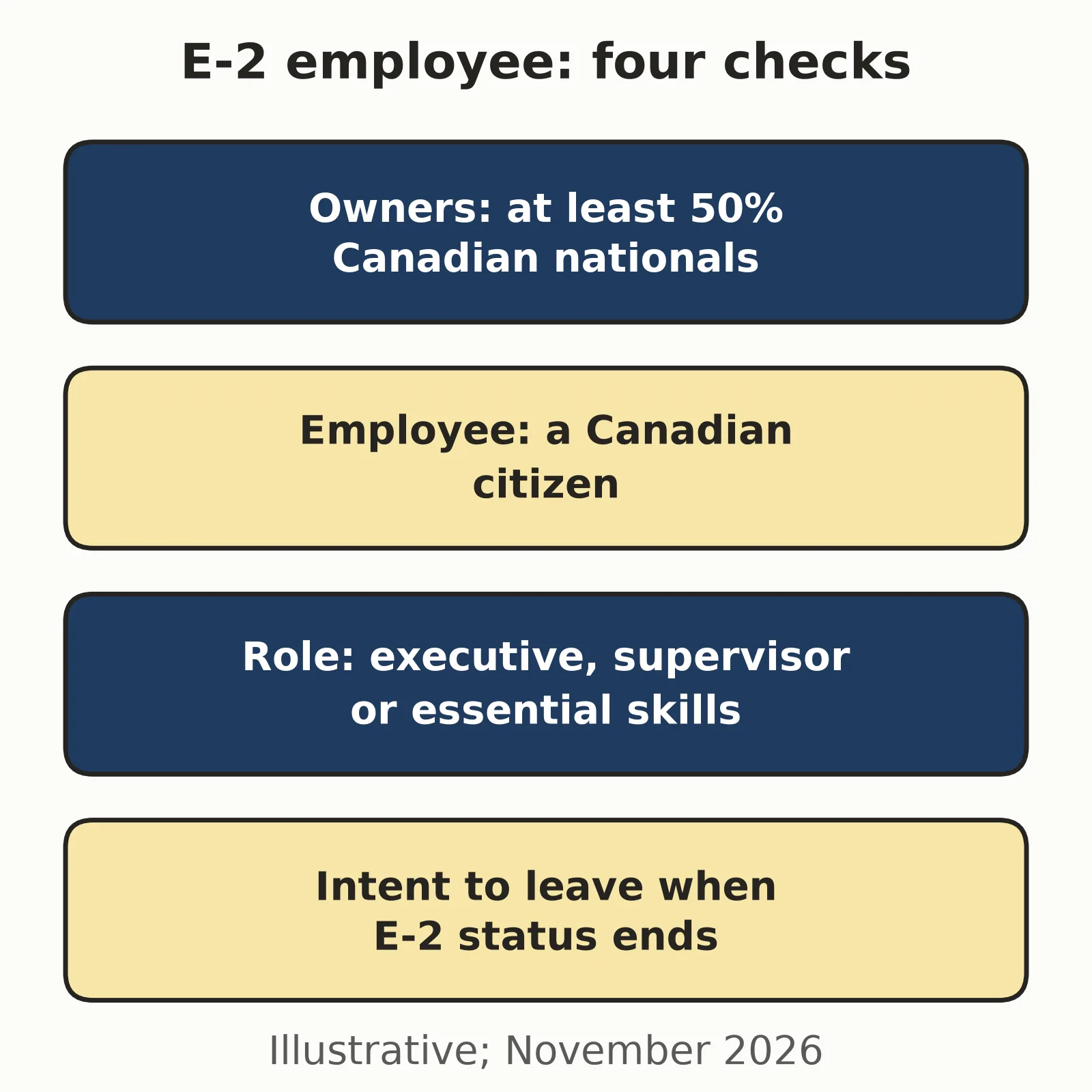
A Canadian citizen can get an E-2 employee visa to work for a U.S. company that is at least 50 percent owned by Canadian nationals who hold, or would qualify for, E-2 treaty investor status. The job must be executive or supervisory, or need essential skills. The first applicant files in Toronto; employees of a registered company book an interview.
Which nationality rule applies to E-2 employees?
An E-2 employee must hold the same treaty nationality as the employer, so a company that qualifies through Canadian owners can bring in Canadian citizens under this visa. Canada has been an E-2 treaty country since January 1, 1994, according to the treaty table in the State Department's Foreign Affairs Manual (FAM) at 9 FAM 402.9-10.
The rule comes from the federal regulation on treaty investors, 8 CFR 214.2(e)(3) in the Code of Federal Regulations (CFR). The employer is either a treaty national or a company at least 50 percent owned by treaty nationals, and those owners must hold E status in the United States or, if they are outside it, be classifiable as treaty investors under the regulation. The Foreign Affairs Manual adds four points that often decide a Canadian company's file:
- Owners, not the place of incorporation: the FAM says the country of incorporation is irrelevant. A company takes its nationality from the people who own it.
- Each layer of ownership: when one business owns another, the officer reviews the ownership of each layer to see whether treaty nationals hold the 50 percent.
- One nationality per company: a company may have only one qualifying nationality, and the owner and every E employee must use it. When nationals of two treaty countries own and control a company equally, employees of either nationality may qualify.
- U.S. green card holders: an owner with treaty nationality who holds U.S. permanent residence cannot bring in E employees, and shares owned by U.S. permanent residents do not count toward the 50 percent.
Nationality means citizenship, not residence. The published answers of the U.S. Embassy and Consulates in Canada (Mission Canada) put it in those terms: employees qualify when they have the same citizenship as the owners of the company. Because the regulation requires the employer's nationality, a permanent resident of Canada who is not a Canadian citizen does not share a Canadian company's nationality, and the Toronto document checklist asks separately for proof of nationality and for evidence of legal status in Canada. That person may still qualify through a company owned by nationals of their own country if it is on the list of E-2 treaty countries.
Which jobs qualify as executive, supervisory or essential?
The job must be principally executive or supervisory, or the employee must have special qualifications that make the work essential to the efficient operation of the U.S. business. A job title alone settles neither question; the officer looks at the duties, the reporting lines and the business itself.
Executive and supervisory roles
Under 8 CFR 214.2(e)(17), executive and supervisory duties give the employee ultimate control and responsibility for the enterprise's overall operation or a major component of it, and they must be the main function of the job rather than an incidental one. The FAM lists what officers weigh: the title, the job's place in the organizational chart, its duties, the degree of control, the number and skill of the staff supervised, the pay and the applicant's own executive or supervisory experience. It also warns that a title such as vice president or manager means little in a small two-person office.
Essential skills roles
An employee in a lesser role qualifies only with specialized skills that the business needs. The FAM factors are the experience and training behind the skills, how unusual they are, whether U.S. workers have them, the salary they command, the applicant's proven expertise and the job's function. U.S. Citizenship and Immigration Services (USCIS) adds that knowledge of a foreign language and culture does not meet the test on its own. Two points matter for a Canadian company opening a U.S. operation:
- Start-up and training staff: the FAM says ordinarily skilled workers can sometimes qualify for a short time when a new business needs them for start-up or training, because they know how the overseas operation works. Its example of a short-term need is about one or two years.
- No prior service required: apart from those start-up workers, the FAM says an essential employee need not have worked for the company before. The employer must show, at each application, how long the skills will be needed.
How does a Canadian company file for an E-2 employee?
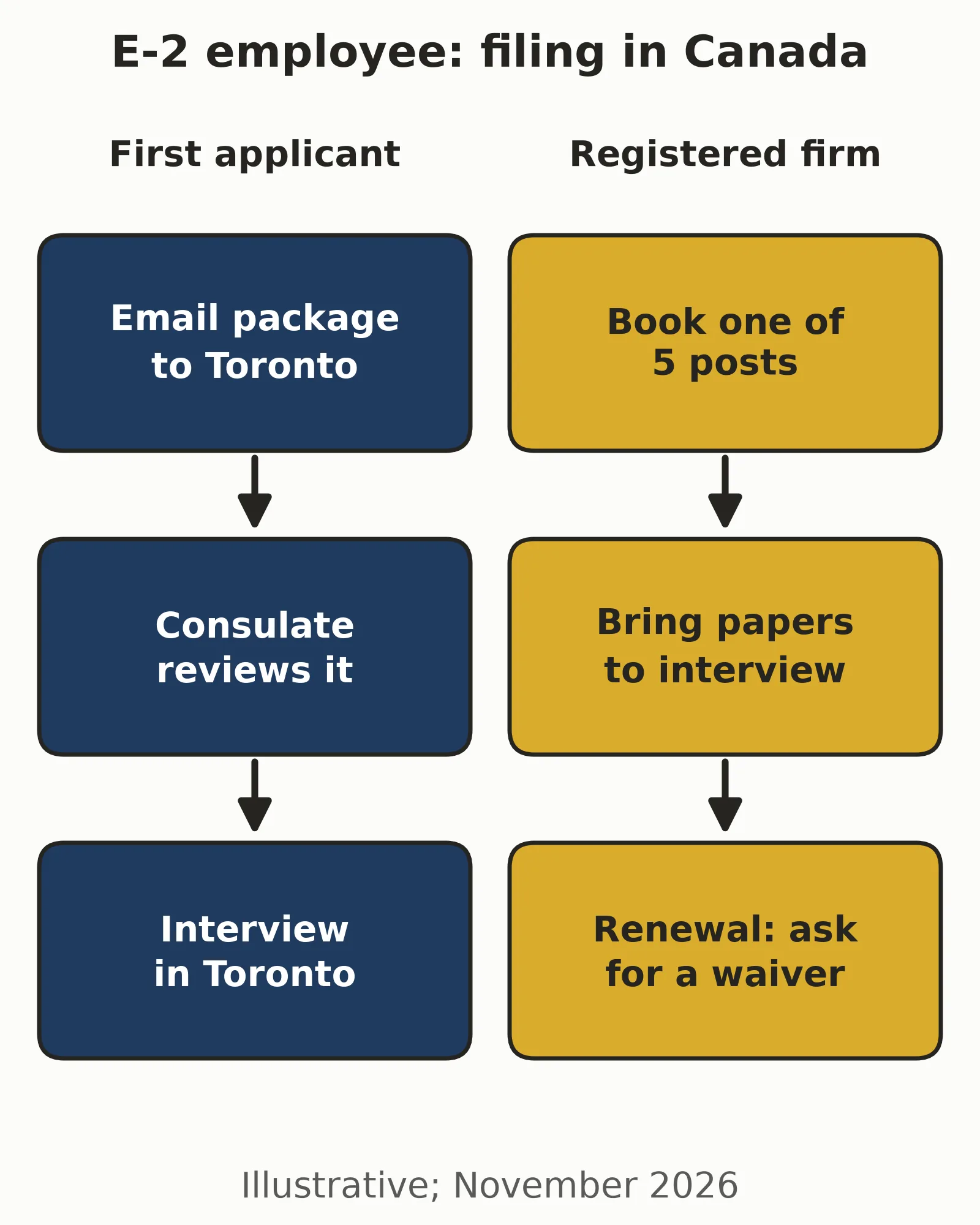
In Canada the path depends on whether the company is already registered with Mission Canada: the first applicant from a company sends a full package to the U.S. Consulate General in Toronto, while employees of a registered company book an interview and bring their documents.
The steps on the Mission Canada treaty trader and investor visa page, as of November 2026, are:
- Step 1: gather the documents for the application type.
- Step 2: complete the online DS-160 with a photo and print its confirmation page.
- Step 3: complete Form DS-156E, signed by an officer who can act in the company's name.
- Step 4: create a profile and pay the visa application fee on the appointment service site.
- Step 5: attend the interview at the consulate; the passport comes back by courier.
For a first applicant, the interview in Step 5 is booked only after the consulate has reviewed the emailed package, as set out below. Mission Canada says processing is normally 7 to 10 business days after the interview, with no guarantee. USCIS also notes that a strike or other labor dispute involving a work stoppage at the intended place of employment may affect a Canadian or Mexican employee's ability to obtain E-2 status.
The first applicant from the company
When no one from the company has received an E visa, or its registration has lapsed, the applicant files as a new case in Toronto. The package goes by email as one attached file of no more than 50 pages and 20 megabytes, with the forms and civil documents outside the page count, and a paper copy goes to the interview. The applicant does not book an appointment until the consulate finishes its review and sends instructions. The employee part of the checklist asks for a letter from the company on the employee's role, duties, education, experience and the reasons for the assignment, a letter from the U.S. company on the need for the employee, an organizational chart and proof of the employee's qualifications. For a role that is not managerial or supervisory, the letter must explain why a U.S. citizen or permanent resident cannot fill it.
Employees of a registered company
A company is registered once an investor or employee has been issued an E visa through it, and the registration is typically valid for five years. Its later employees do not email documents in advance. Those who are Canadian residents or nationals book the next available appointment at any of the five posts, in Calgary, Montreal, Ottawa, Vancouver or Toronto, and bring the company's registration notice, an updated DS-156E, the company letter with a resume and a signed statement that the ownership and operations have not changed in a way that affects the registration. Residence only decides where they may book; the employee still needs the company's nationality, as set out above. The consulate's page for employees of registered companies also lets an employee renewing with the same registered company ask to be considered for an interview waiver.
An employee who is already in the United States in another lawful status can instead have the employer file Form I-129 with USCIS to change status to E-2. For the interview itself, our guide to E-2 visa interview questions covers the questions E-2 employees face.
How long does E-2 employee status last?
An E-2 employee is admitted for up to two years at a time, and extensions of up to two years each have no set limit, as long as the employee still qualifies and intends to leave the United States when the status ends.
The USCIS page on E-2 treaty investors and employees says an E-2 nonimmigrant who travels abroad and is found admissible on return is generally granted a new two-year period of admission. The intent to leave does not require a home kept in Canada: under 9 FAM 402.9-4(C), an applicant may sell a residence and move household goods, and a clear intent to depart when status ends is normally enough. An employee who is the beneficiary of an immigrant petition must satisfy the officer on that intent. Visa renewals follow the steps in our guide to E-2 visa renewal.
What can the employee's spouse and children do?
The employee's spouse and unmarried children under 21 can come as E-2 dependents, whatever their nationality; the spouse is allowed to work, and the children can study but cannot work.
USCIS treats spouses in E-2 or E-2S status as authorized to work incident to status. Since January 30, 2022, USCIS and U.S. Customs and Border Protection (CBP) have issued Forms I-94 with the E-2S code to certain spouses of E-2 workers, a form an employer can accept as proof of work authorization, and an employment authorization document (EAD) is optional. Children receive the E-2Y code, which does not allow work. The employee's new two-year admission after a trip does not carry over to family members who did not travel, so each family member must watch their own period of stay and extend it before it ends. Our guide to E-2 spouse work authorization covers the spouse's options in detail.
When does an E-2 employee need new approval?
An E-2 employee may work only in the activity approved when status was granted, so work for a related company needs the conditions in the regulation, and a substantive change in the employer needs USCIS approval before the employee carries on.
- Parent and subsidiary work: under 8 CFR 214.2(e)(8)(ii), an E-2 employee may work for the parent treaty enterprise or one of its subsidiaries if the relationship and the subsidiary's own E qualification were shown when status was granted. The work must also need executive, supervisory or essential skills, and the terms of employment must be unchanged.
- Substantive changes: USCIS names a merger, an acquisition and the sale of the division where the employee works. The enterprise files a new Form I-129 with the fee and may ask for an extension of stay at the same time. Under 8 CFR 214.2(e)(8)(iii), the employee may instead obtain a visa reflecting the new terms and conditions and then apply for admission at a port of entry.
Work for an unrelated employer is a different question, and our guide on whether E-2 visa holders can work for another company sets out the limits.
E-2 employee, TN or L-1: which fits?
For a Canadian employee, the E-2 employee visa fits when the U.S. company is Canadian-owned and the role is senior or essential; TN status fits a profession listed under the United States-Mexico-Canada Agreement (USMCA) at any U.S. employer, and L-1A fits an executive or manager who has already worked a year for a related company abroad.
The table sets the three side by side on the points that most often decide the choice, from the USCIS pages for each category as of November 2026.
| Point | E-2 employee | TN | L-1A |
|---|---|---|---|
| Nationality | Same as the owners | Canadian or Mexican | Not a USCIS criterion |
| Role | Executive, supervisor or essential | Listed USMCA profession | Executive or manager |
| How to apply | Consulate interview | Port of entry or I-129 | Employer files I-129 |
| Initial stay | Up to 2 years | Up to 3 years | 3 years; 1 if new office |
The USCIS page on TN professionals says a Canadian citizen who lives outside the United States does not need a TN visa and can apply at a designated port of entry or preclearance station, under the USMCA. The USCIS page on L-1A transferees requires one continuous year with a qualifying related company abroad within the three years before admission, and L-1A stays reach at most seven years. For E-2 essential employees, the FAM says no earlier service with the company is required, but the route only works when the U.S. company has Canadian E-2 nationality. Our guides to the TN visa for Canadians and the L-1 visa from Canada cover those routes in full.
Frequently asked questions
Does an E-2 employee have to invest money?
No. An E-2 employee qualifies through the employer, not through an investment of their own. Under 8 CFR 214.2(e)(3), the employee needs the same nationality as the treaty employer, an executive or supervisory role or special qualifications, and an intent to depart when E-2 status ends. The investment is the owners' part of the case.
Can a permanent resident of Canada be an E-2 employee of a Canadian-owned company?
Not on Canadian nationality alone. The regulation requires the employee to have the same nationality as the employer, and Mission Canada says employees need the same citizenship as the company's owners. A permanent resident of Canada who holds another citizenship may qualify only for a company that takes its E-2 nationality from owners of that same treaty country.
Is there an annual cap on the E-2 employee visa?
No. The annual limits in section 214(g) of the Immigration and Nationality Act cover H-1B and H-2B workers and the E-3 category for Australians, which is capped at 10,500 a year. The E-1 and E-2 categories are not in that list, so there is no lottery or yearly count for E-2 employees.
Can an E-2 employee also work for the Canadian parent company?
Yes, within limits. Under 8 CFR 214.2(e)(8)(ii), an E-2 employee may work for the parent treaty enterprise or its subsidiaries when the relationship and the subsidiary's own E qualification were shown when status was granted, the work needs executive, supervisory or essential skills and the terms are unchanged.
Does the company need to be registered before the first employee applies?
No. Mission Canada registers a company only in the context of a visa application, and a company is registered once an investor or an employee has been issued an E visa through it. The first applicant from the company files as a new case in Toronto, and later employees use the registered company process.
How long does the E-2 employee visa take after the interview?
Mission Canada says processing is normally 7 to 10 business days after the interview, with no guarantee that the visa will be ready in that time. Some cases need administrative processing after the interview, and the Mission Canada answers say most of it is resolved within 60 days of the interview.
Can an ordinary skilled worker qualify as an essential employee?
Sometimes, for a short time. The Foreign Affairs Manual says ordinarily skilled workers can qualify when a new business, or a business expanding into a new field, needs them for start-up or training because they know the overseas operation. It gives about one or two years as an example of that short-term need.
Does an E-2 employee have to keep a home in Canada?
No. Under 9 FAM 402.9-4(C), an E visa applicant does not need a foreign residence they intend to keep and may sell their home and move household goods to the United States. A clear intent to depart the United States when E status ends is normally enough.
Conclusion
The E-2 employee visa works for a Canadian company in one situation: its U.S. business takes Canadian E-2 nationality from owners who are Canadian citizens, and the person it needs there is a Canadian citizen in a senior or essential role. The ownership records, the employee letter and the organizational chart do most of the work, and the first file from the company sets up its registration, typically for five years. When the ownership or the role does not fit, the TN and L-1 routes are the next ones to check.
How Mayo Law can help
Mayo Law is a cross-border firm with offices in Toronto and New York. Our lawyers prepare E-2 company registrations and employee files for Canadian-owned U.S. companies, from the ownership records and the company letter to the Toronto package. Our E-2 visa practice also handles the owners' own treaty investor visas and renewals. Mayo Law offers a paid one-hour consultation, because a lawyer reviews your company's ownership and the employee's role in depth during that session.
Disclaimer
This article provides general information only and is not legal advice. Reading it does not create a solicitor-client or attorney-client relationship. Immigration rules, consular procedures and agency guidance change, and each case turns on its own facts. Mayo Law provides legal services in Ontario and New York.