

Contents
- Quick answer
- What are B-1 permissible activities?
- Can you work on a B-1 visa?
- Which activities does the State Department list?
- Can a technician install or repair equipment?
- How do the rules apply to Canadian citizens?
- What is B-1 in lieu of H-1B?
- What does a B-1 visa not allow?
- Frequently asked questions
- Conclusion
- How Mayo Law can help
- Disclaimer
A sales call in Chicago, a board meeting in New York, a week installing a machine your company sold to a plant in Ohio: each is a business trip, and each raises the same question at the border. B-1 permissible activities are the things a temporary business visitor may do in the United States without a work visa. The line sits where visiting ends and working begins, and the officer in front of you draws it.
Canadian citizens generally need no visa and have a trade agreement list of business activities, but the same B-1 rules apply to them, so they get a section of their own. Where a trip is really a job, our business immigration lawyers look at work classifications instead. This guide follows the official texts, including the statute, the State Department's Foreign Affairs Manual (FAM), the Code of Federal Regulations (CFR) and a U.S. Customs and Border Protection (CBP) handout titled B-1 Permissible Activities. Every rule below was checked in November 2026, and the sources differ in force: the statute and the regulations are U.S. federal law; the trade agreement sets obligations for its three parties (the United States, Mexico and Canada); and the manual, the handout and a U.S. Citizenship and Immigration Services (USCIS) web page are agency guidance.
The handout describes itself as "not all-inclusive": it is an undated, three-page set of 21 questions, the copy on cbp.gov is a scan whose file data shows July 2014, and its last answer still contains a blank left for a contact name. We treat it as a useful plain-language summary, check its points against the regulations and the manual where they address them, and name the handout wherever a point rests on it alone.
Quick answer
A B-1 visa does not allow local employment or labor for hire. B-1 permissible activities are business tasks usually tied to work based abroad: meetings, contract talks, conferences, litigation, independent research and some after-sales service. A U.S. source may generally pay expenses but not a salary. Canadians usually need no visa, yet a border officer still decides each entry.
What are B-1 permissible activities?
B-1 permissible activities are the commercial and professional tasks a visitor for business may carry out in the United States while, in most cases, the job itself, the employer and the pay stay abroad. The law defines them mostly by what they are not: they are not skilled or unskilled labor, and they are not local employment.
The definition starts in the Immigration and Nationality Act (INA). Section 101(a)(15)(B) describes a person with a residence in a foreign country that they have no intention of abandoning, who is "visiting the United States temporarily for business or temporarily for pleasure". The same sentence leaves out anyone coming "for the purpose of study or of performing skilled or unskilled labor", and representatives of foreign media coming to do that work.
A State Department regulation, 22 CFR 41.31(b)(1), fills in the word business. It "refers to conventions, conferences, consultations and other legitimate activities of a commercial or professional nature. It does not include local employment or labor for hire." The regulation text was current on the Electronic Code of Federal Regulations (eCFR), a continuously updated online version of the CFR that is not an official legal edition, as of November 18, 2026.
How does the manual draw the line?
The Foreign Affairs Manual draws it with Matter of Hira, a Board of Immigration Appeals decision that 9 FAM 402.2-5(A) names as the source of the clearest legal definition. The case involved a tailor who measured customers in the United States for suits made and shipped from abroad. In the manual's words, that was proper B-1 activity "because the principal place of business and the actual place of accrual of profits, if any, was in the foreign country." The manual admits that the line is hard to draw, and adds that most of its B-1 examples involve activities "incidental to work that will principally be performed outside of the United States."
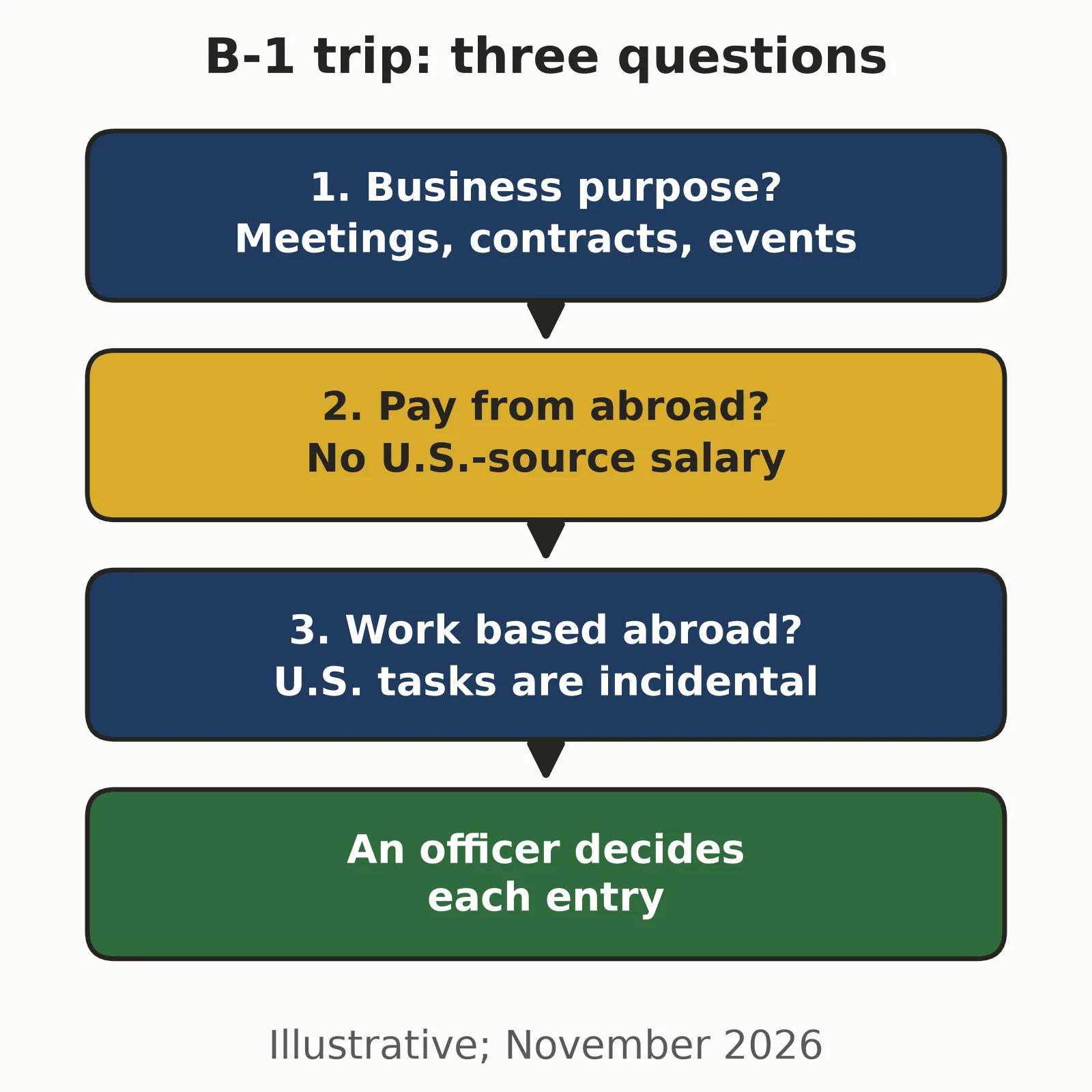
Three questions sum up most B-1 visa activities: is the purpose commercial or professional, does the pay come from outside the United States, and does the real work stay abroad. Figure 1 shows them in order as a reading aid, not a test an officer must follow.
How long does B-1 status last?
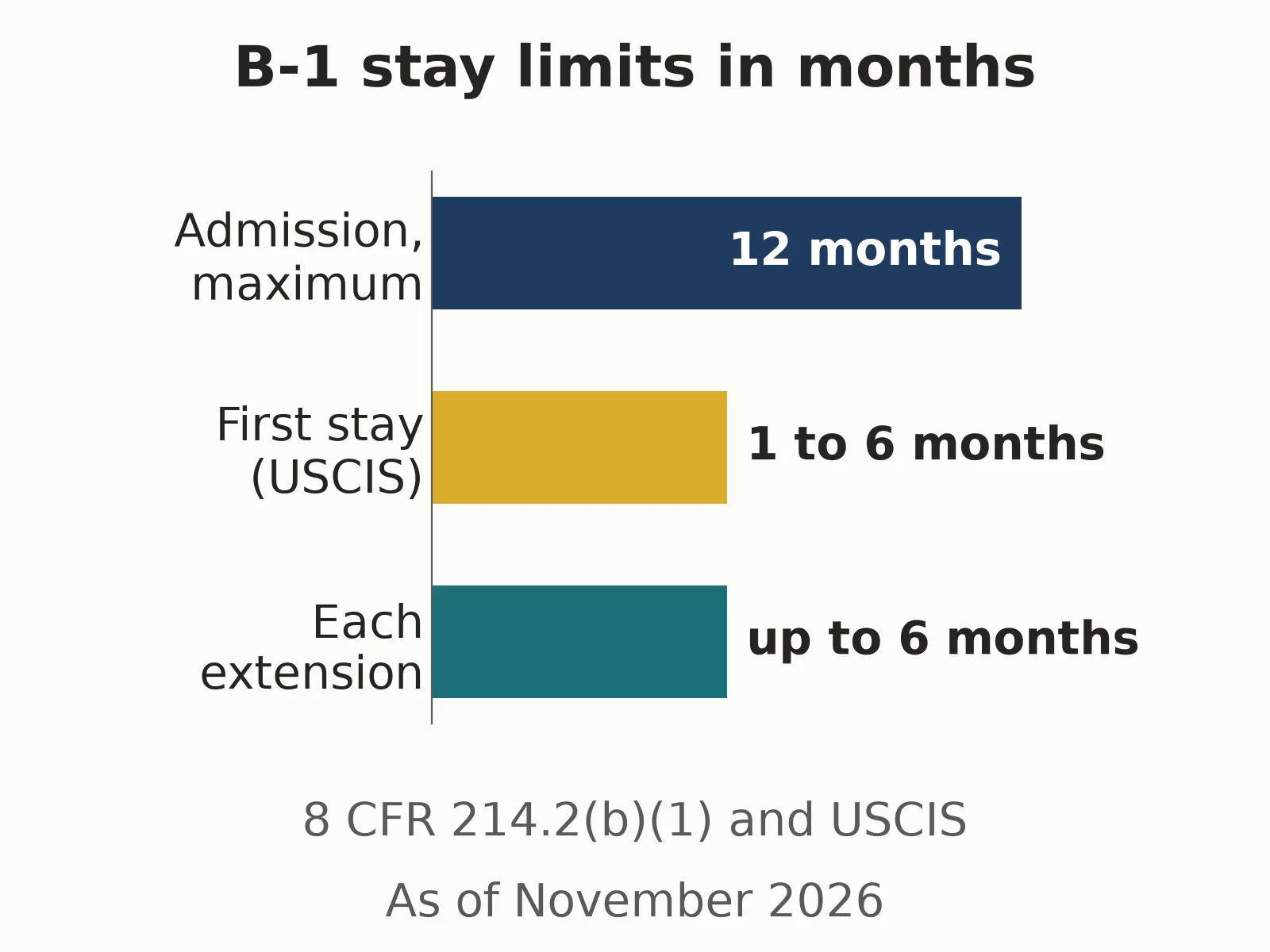
Under 8 CFR 214.2(b)(1), a B-1 visitor "may be admitted for not more than one year", with extensions "in increments of not more than six months each". USCIS, on its B-1 Temporary Business Visitor page, last reviewed on January 25, 2025, gives an initial stay of 1 to 6 months, an extension of up to 6 months, and a total on any one trip that is generally 1 year. The officer at the port of entry sets the actual period.
Can you work on a B-1 visa?
No, not in the ordinary sense: a B-1 visitor may carry on business for an employer abroad but may not take local employment or perform labor for hire in the United States. The Foreign Affairs Manual says a B-1 visa "is not appropriate for applicants who intend to obtain and engage in employment while in the United States."
The answer has two parts: the activities the State Department lists for B-1 visitors, and the rule that a U.S. source may generally pay a visitor's expenses but not a salary.
Who may pay a B-1 visitor?
A U.S. source may cover a B-1 visitor's reasonable expenses but may not pay a salary. The manual states the rule in 9 FAM 402.2-5(F)(1): a person in B-1 status "may not receive a salary from a U.S. source for services rendered in connection with their activities in the United States." An expense allowance or reimbursement is allowed for expenses incidental to the stay, and those "may not exceed the actual reasonable expenses" of travel, meals, lodging, laundry and other basic services.
A statutory exception covers academics. Under INA 212(q), as the manual summarizes it, a B-1 visitor may accept an honorarium and incidental expenses for usual academic activities if:
- the activities last no longer than nine days at any single institution;
- the payer is a qualifying institution;
- the services benefit that institution; and
- the visitor has not accepted such payments from more than five institutions over the last six months.
What happens if a visitor works anyway?
Under the Department of Homeland Security regulation at 8 CFR 214.1(e), "Any unauthorized employment by a nonimmigrant constitutes a failure to maintain status", and a nonimmigrant may not engage in employment unless their classification authorizes it or permission has been granted. A person who needs to work in the United States needs a classification that allows it. Our guide to U.S. work visas for Canadians compares those routes.
Which activities does the State Department list?
The Foreign Affairs Manual lists six core activities for B-1 visitors in 9 FAM 402.2-5(B): commercial transactions that do not involve gainful employment in the United States, negotiating contracts, consulting business associates, litigation, participating in scientific, educational, professional or business conventions, conferences or seminars, and independent research, followed by special cases with their own conditions. For the six, it says applicants "should be classified B-1 visitors for business, if otherwise eligible", and a consular or border officer still has to be satisfied on the facts.
Table 1 sets out the six core activities and two of the special cases. The takeaway: beyond the general rules above, the six core activities carry no extra condition in the manual (the first only restates the bar on gainful U.S. employment), while board meetings and observation each add one.
| Activity | Added condition | Manual section |
|---|---|---|
| Commercial transactions | No gainful U.S. employment | 402.2-5(B)(1) |
| Negotiating contracts | None listed | 402.2-5(B)(2) |
| Consulting business associates | None listed | 402.2-5(B)(3) |
| Litigation | None listed | 402.2-5(B)(4) |
| Conventions, conferences, seminars | None listed | 402.2-5(B)(5) |
| Independent research | None listed | 402.2-5(B)(6) |
| Board of directors meetings | Member of a U.S. board | 402.2-5(C)(3) |
| Observing a business | Pays own expenses | 402.2-5(E)(4) |
The manual covers commercial transactions that "do not involve gainful employment in the United States", and its own example is "a merchant who takes orders for goods manufactured abroad". Its board entry, 9 FAM 402.2-5(C)(3), covers members of the board of directors of a U.S. corporation who come to attend a meeting of the board or perform "other functions resulting from membership on the board". That entry says nothing about pay, and the manual's general pay rule, above, bars a salary from a U.S. source for services rendered in connection with the visitor's activities in the United States.
Observation is narrow: the manual covers a person coming "merely and exclusively to observe" how a business or profession is conducted who pays their own expenses. It sends applicants, often students, who seek practical experience through on-the-job training or clerkships to the H or L classifications, or to J where an exchange program exists.
Can an investor look for a deal on B-1?
Yes, within limits. Under 9 FAM 402.2-5(C)(7), a person seeking investment in the United States, including one that could later support E-2 status, "is not ineligible for a B visa on that basis alone." The same paragraph says such travelers "are precluded from performing productive labor or from actively participating in the management of the business" while in B status. The CBP handout gives the same answer and points to the E-2 visa for running the business. The scouting trip is a visit, and operating the company is not; our E-2 visa lawyers handle that second step. The requirements are in our guide to E-2 visa requirements.
What about athletes, entertainers and other special cases?
The CBP handout B-1 Permissible Activities and the State Department's Foreign Affairs Manual, in the special cases that follow 9 FAM 402.2-5(B), cover several narrower groups. Each entry below is a summary of a longer rule, so read the source before relying on it.
- Professional athletes: under 9 FAM 402.2-5(C)(4), they may receive prize money for a tournament or event but no salary or payment from a U.S. source. Their principal place of business or activity must be in a foreign country and their salary must principally accrue abroad. In a team sport, the foreign-based team must also be a member of an international sports league, or the sporting activities must have an international dimension. The handout adds that a person may not, in effect, live and work in the United States on prize money, and that, in general, for players on a foreign-based team, the team's income and the players' salaries must be primarily earned in a foreign country.
- Amateur try-outs: under the same entry, an amateur invited to brief try-outs with a professional team during the regular professional season or playoffs may come if the team covers only incidental expenses such as round-trip fare, hotel room and meals. Once the athlete is hired to play for the team, B-1 is no longer appropriate for competing with it.
- Entertainers: under 9 FAM 402.2-5(G), B status is generally not appropriate for professional entertainers. Among the exceptions are a cultural program sponsored by the sending country before a nonpaying audience with all expenses paid by the performer's government, and a competition with no remuneration other than a prize and expenses.
- Yacht crew: under 9 FAM 402.2-5(C)(5), crew serving on a recreational vessel who keep a residence abroad are classifiable B-1 regardless of the yacht's country of registration. The handout's answer is narrower: the yacht must be sailing out of a foreign home port and cruising in U.S. waters, and the crew's duties must be directly related to their foreign employment on the yacht.
- Trade fairs: under 9 FAM 402.2-5(E)(7), employees of foreign exhibitors at international fairs or expositions ordinarily are classified B-1, while employees of U.S. exhibitors are not eligible. The handout is more guarded: it says this may be permissible in certain circumstances, for an employee of a foreign exhibitor whose employment responsibilities are primarily abroad.
- Volunteers: under 9 FAM 402.2-5(C)(2), people who are members of, and committed to, a specific recognized religious or nonprofit charitable organization may take part in a voluntary service program benefiting U.S. local communities, with no salary or remuneration from a U.S. source other than expenses. Under (C)(2)(b), the program may not involve the selling of articles or the solicitation and acceptance of donations. The handout adds that a volunteer may not come to live in the United States or provide labor for the organization, and that construction is not a permitted volunteer service.
Under 9 FAM 402.2-5(H), the manual also requires a consular officer to request an advisory opinion from the Department before issuing a B-1 visa in any case involving temporary employment that does not fit its listed categories. That step exists, it says, to avoid giving a B-1 to someone who belongs in a petition-based worker category.
Can a technician install or repair equipment?
Yes, if the technician performs no building or construction work and the after-sales conditions are met: commercial or industrial equipment bought from a company outside the United States, a contract of sale that specifically requires the seller's service or training, unique knowledge essential to that obligation, no pay from a U.S. source and, under the CBP handout, equipment made abroad.
The rule is in 9 FAM 402.2-5(E)(1). It covers a person coming "to install, service, or repair commercial or industrial equipment or machinery purchased from a company outside the United States or to train U.S. workers to perform such services." The manual then sets the conditions: "the contract of sale must specifically require the seller to provide such services or training", the applicant "must possess unique knowledge that is essential to the seller's contractual obligation", and they "must receive no remuneration from a U.S. source." The CBP handout adds a fourth point: the machinery or equipment must have been manufactured outside the United States.
Each condition is something a document can show. A technician who carries the sales contract and its service clause can point to them, and one who arrives without it is asking the officer to rely on an oral account.
What is a specialized trainer?
A newer entry, 9 FAM 402.2-5(E)(2), dated December 4, 2025, covers specialized trainers. It applies to a person traveling for a temporary period to train U.S. workers or transfer knowledge on specialized or proprietary techniques for industrial equipment, machinery or processes "acquired or ... sourced from a company outside the United States, in support of a qualifying project." The trainer must have unique knowledge "not widely available in the United States" and receive no remuneration from a U.S. source. Visas issued this way are annotated "B-1 SPECIALIZED TRAINER". The public text of the entry does not define a qualifying project, and one of its paragraphs is marked unavailable.
Why is construction different?
Building work is carved out by name. Under 8 CFR 214.2(b)(5), people seeking to enter "to perform building or construction work, whether on-site or in-plant, are not eligible" for B-1. The one opening is supervision or training of others doing that work, "but not for the purpose of actually performing any such building or construction work themselves." The State Department regulation and the manual repeat the point.
How do the rules apply to Canadian citizens?
Canadian citizens generally do not need a visa to enter as business visitors, and a trade agreement gives them a defined list of business activities, but they must still qualify as B-1 visitors each time they cross. The visa exemption removes the consulate step, not the rules.
The exemption is in 8 CFR 212.1(a)(1): "A visa is generally not required for Canadian citizens", except for a few categories such as E visas. A valid passport is required on arrival, with exceptions that include NEXUS program cards at certain crossings. Because there is usually no visa interview, the first official to assess the trip is the immigration official who inspects the traveler for admission. The phrase "business visitor visa" is therefore a loose fit for Canadian citizens, who are generally admitted in B-1 status without a visa in their passport.
What does the trade agreement add?
The Agreement between the United States of America, the United Mexican States, and Canada (USMCA) has a business visitor section in Chapter 16. Under Annex 16-A, Section A, each country grants temporary entry to a business person engaging in a listed activity "without requiring that person to obtain an employment authorization", as long as the person otherwise complies with that country's measures applicable to temporary entry and presents:
- proof of citizenship;
- documents showing the activity and the purpose of entry; and
- evidence that the activity "is international in scope and that the business person is not seeking to enter the local labor market."
A country may not require prior approval procedures, petitions or labor certification tests for this entry.
The U.S. regulation that carries this out is 8 CFR 214.2(b)(4). A Canadian citizen who otherwise meets the B-1 requirements, "including but not limited to requirements regarding the source of remuneration", shall be admitted on showing three things: proof of Canadian citizenship, a description of the purpose of the trip, and evidence of being engaged in one of the listed occupations or professions. The regulation groups them under twelve headings, summarized here; each carries its own conditions:
- Research and design: technical, scientific and statistical researchers doing independent research or research for an enterprise in the other country.
- Growth, manufacture and production: harvester owners supervising a harvesting crew, for agricultural crops only, and purchasing and production management personnel conducting commercial transactions for an enterprise in the other country.
- Marketing: market researchers and analysts conducting independent research or analysis, or research or analysis for an enterprise in the other country, and trade fair and promotional personnel attending a trade convention.
- Sales: sales representatives and agents taking orders or negotiating contracts for an enterprise in the other country but not delivering goods or supplying services, and buyers purchasing for such an enterprise.
- Distribution: transportation operators carrying goods or passengers into the United States from the other country or out of it to the other country, with no purely domestic service, and customs brokers handling exports from the United States to or through Canada.
- After-sales services: installers, repair and maintenance personnel and supervisors with specialized knowledge essential to the seller's contractual obligation.
- General service: professionals in a listed profession who receive no salary or other remuneration from a U.S. source.
- Commercial transactions: management and supervisory personnel, and financial services personnel, engaging in commercial transactions for an enterprise in the other country.
- Public relations and advertising: personnel consulting with business associates or attending or participating in conventions.
- Tourism: tour and travel agents, tour guides and tour operators attending or participating in conventions or conducting a tour that began in the other country, or one that starts in the United States but ends abroad with a significant portion abroad.
- Tour bus operation: operators on bus tours that begin in and return to the other country, that will end and mostly take place there, or whose passengers are unloaded in the United States, with the bus returning empty or reloading the group for the other country.
- Translation: translators and interpreters employed by an enterprise in the other country.
The after-sales entry is worded differently from the general rule. It covers service or training "pursuant to a warranty or other service contract incidental to the sale of commercial or industrial equipment or machinery, including computer software", during the life of the warranty or service agreement, and the equipment or software "must have been manufactured outside the United States."
A Canadian whose work is not on the list is not shut out. The regulation says nothing in it precludes a business person in another occupation from temporary entry as a B-1 visitor if they otherwise meet the requirements. Canadians whose trip is really a job have other routes, which our guides on whether a Canadian can work in the U.S. and the TN visa for Canadians cover.
What is B-1 in lieu of H-1B?
B-1 in lieu of H-1B is a State Department practice under which, in certain circumstances, a consular officer may classify a person who qualifies for an H-1 or H-3 visa as a B-1 visitor instead, if a foreign firm with an office and payroll abroad keeps paying them and no salary comes from a U.S. source.
The rule is 9 FAM 402.2-5(F), in the version dated April 1, 2024 that was on the State Department site in November 2026. It says there are cases where applicants who qualify for H-1 or H-3 visas "may more appropriately be classified as B-1 visa applicants in certain circumstances". The applicant "must not receive any salary or other remuneration from a U.S. source other than an expense allowance", and the manual sets conditions for the employer: the foreign firm must have an office abroad, its payroll must be disbursed abroad, and the employee must customarily be employed by it. Visas issued this way are annotated "B-1 IN LIEU OF H, PER 9 FAM 402.2-5(F)".
The manual applies the same idea to H-3 trainees who are already employed abroad and keep their foreign salary. It draws a hard line at H-2 work: an applicant classifiable as H-2 "must be classified as such" even if paid from abroad. The entry is addressed to consular officers who issue visas; admission at the port of entry is a separate decision by an immigration official.
What does a B-1 visa not allow?
A B-1 visa does not allow local employment, labor for hire, performing building work yourself, study, or running a U.S. business, and the CBP handout names several trips that need a different classification altogether. Table 2 sets out B-1 visa prohibited activities that the official texts name.
The takeaway from Table 2: where the official texts say no, they often name the classification that fits instead.
| Purpose of trip | B-1 answer | Route named |
|---|---|---|
| Job at a new U.S. branch | No | L-1 |
| Managing your investment | No | E-2 |
| Doing building work yourself | No | None named |
| Enrolling in a course | No | F-1 or M-1 |
| On-the-job training | Generally no | H, L or J |
| Emergency response crews | No | CBP procedures |
Some detail on three of the rows. The CBP handout asks whether a visitor may be admitted "to start or be employed in a new branch, subsidiary, or affiliate" of a foreign employer and answers no, adding that an L-1 visa may be available for that; our L-1 visa lawyers handle those transfers. Study is barred by 8 CFR 214.2(b)(7), under which a B-1 or B-2 visitor "violates the conditions" of status by enrolling in a course of study and must first obtain F-1 or M-1 status. On emergency crews, the handout says responders "are not admissible as visitors for business" and that CBP has other entry procedures for federally declared natural disasters.
One more limit comes from the same handout: a person admitted on a B-2 visa for pleasure may not engage in business activities, although a B-1 visitor may do B-2 things.
Frequently asked questions
What are B-1 permissible activities in plain terms?
They are business tasks a visitor may do in the United States, usually while employed and paid abroad: attending meetings, negotiating contracts, consulting with business associates, taking part in conferences, litigating and doing independent research. A State Department regulation, 22 CFR 41.31(b)(1), defines business to exclude local employment and labor for hire, and an officer decides each case on its facts.
Can you work on a B-1 visa?
Not in the sense of holding a job in the United States. The Foreign Affairs Manual, at 9 FAM 402.2-5(A), says a B-1 visa is not appropriate for applicants who intend to obtain and engage in employment in the United States, and 8 CFR 214.1(e) treats unauthorized employment as a failure to maintain status. Business activity of a commercial or professional nature, such as the listed categories, is what the classification covers.
Can a U.S. company pay a B-1 visitor?
It may cover expenses but not pay a salary. The Foreign Affairs Manual, at 9 FAM 402.2-5(F)(1), says a B-1 visitor may not receive a salary from a U.S. source for services rendered in connection with their activities in the United States, while an expense allowance or reimbursement is permitted up to the actual reasonable cost of travel, meals, lodging, laundry and other basic services. A limited honorarium exception under INA 212(q) covers usual academic activities of no more than nine days at a single institution, among other conditions.
Do Canadians need a B-1 visa for a business trip?
Generally no. Under 8 CFR 212.1(a)(1), a visa is generally not required for Canadian citizens, apart from a few categories such as E visas. A Canadian business visitor must still be admitted in B-1 status by a border officer and has to show citizenship, the purpose of the trip and, for the trade agreement categories, evidence of the occupation.
Can a B-1 visitor install or repair equipment in the U.S.?
Possibly, if the after-sales conditions in 9 FAM 402.2-5(E)(1) are met. The equipment must have been purchased from a company outside the United States, the contract of sale must specifically require the seller to provide the service or training, the visitor must have unique knowledge essential to that obligation, and no remuneration may come from a U.S. source. The U.S. Customs and Border Protection handout adds that the equipment must have been manufactured outside the United States. Under 9 FAM 402.2-5(E)(1)(b), performing building or construction work is excluded; the exception is supervising or training other workers who do that work, without doing any of it.
Can a B-1 visitor attend board meetings?
Yes, that is a listed activity. The Foreign Affairs Manual, at 9 FAM 402.2-5(C)(3), covers a member of the board of directors of a U.S. corporation coming to attend a board meeting or perform other functions resulting from board membership. That entry says nothing about pay. The manual's general rule, at 9 FAM 402.2-5(F)(1), bars a salary from a U.S. source for services rendered in connection with the visitor's activities in the United States. Neither that rule nor the board entry says whether a director's fee counts as a salary. A U.S. source may provide an expense allowance or reimbursement for incidental expenses, but these may not exceed the actual reasonable cost of travel, meals, lodging, laundry and other basic services.
Can you do business on a B-2 visa?
No, according to the U.S. Customs and Border Protection handout B-1 Permissible Activities. It says a person may engage in B-2 activities while admitted as a B-1 visitor, but may not engage in business activities while admitted on a B-2 visa for pleasure. The State Department's Foreign Affairs Manual allows consular officers to issue a combined B-1/B-2 visa to applicants whose trips fall into both categories at various times.
How long can a B-1 visitor stay?
Under 8 CFR 214.2(b)(1), admission is for not more than one year, with extensions in increments of not more than six months each. USCIS describes an initial stay of 1 to 6 months and says the total time on any one trip is generally 1 year. The officer at the port of entry sets the period for each admission.
Conclusion
B-1 permissible activities cover the business around a job, not the job itself. For most trips, three questions sit behind the answer: whether the purpose is commercial or professional, whether the pay comes from abroad, and whether the real work stays abroad. The official texts then add specific conditions for technicians, athletes, investors and others. Canadians skip the visa but not the questions. When a trip starts to look like employment in the United States, the texts point to another classification, and it is better to learn that before the trip than at the border.
How Mayo Law can help
Mayo Law is a cross-border firm with offices in Toronto and New York, and Joseph Mayo is licensed in Ontario and New York. Our lawyers advise Canadian and other foreign businesses on U.S. entry for staff: whether a planned trip fits business visitor status, what documents a traveler should carry, and when a work classification such as TN, L-1 or E-2 is the right tool instead. Our TN visa lawyers and business immigration team handle those filings. We offer a paid one-hour consultation, because a lawyer reviews the situation in depth before giving a view. We do not promise outcomes: admission is always the officer's decision.
Disclaimer
This guide is for general information only and is not legal advice. Reading it does not create a solicitor-client or attorney-client relationship. Immigration rules and agency guidance change, and each case turns on its own facts. Mayo Law provides legal services in Ontario and New York.