

Contents
- Quick answer
- How long does an NIW take for a Canada-born applicant?
- Can you wait in TN, L-1 or E-2 status?
- How long does the I-140 take without premium?
- How does NIW premium processing work?
- What does the visa bulletin add to the NIW timeline?
- Adjustment of status or consular processing?
- What does an RFE do to the timeline?
- Frequently asked questions
- Conclusion
- How Mayo Law can help
- Disclaimer
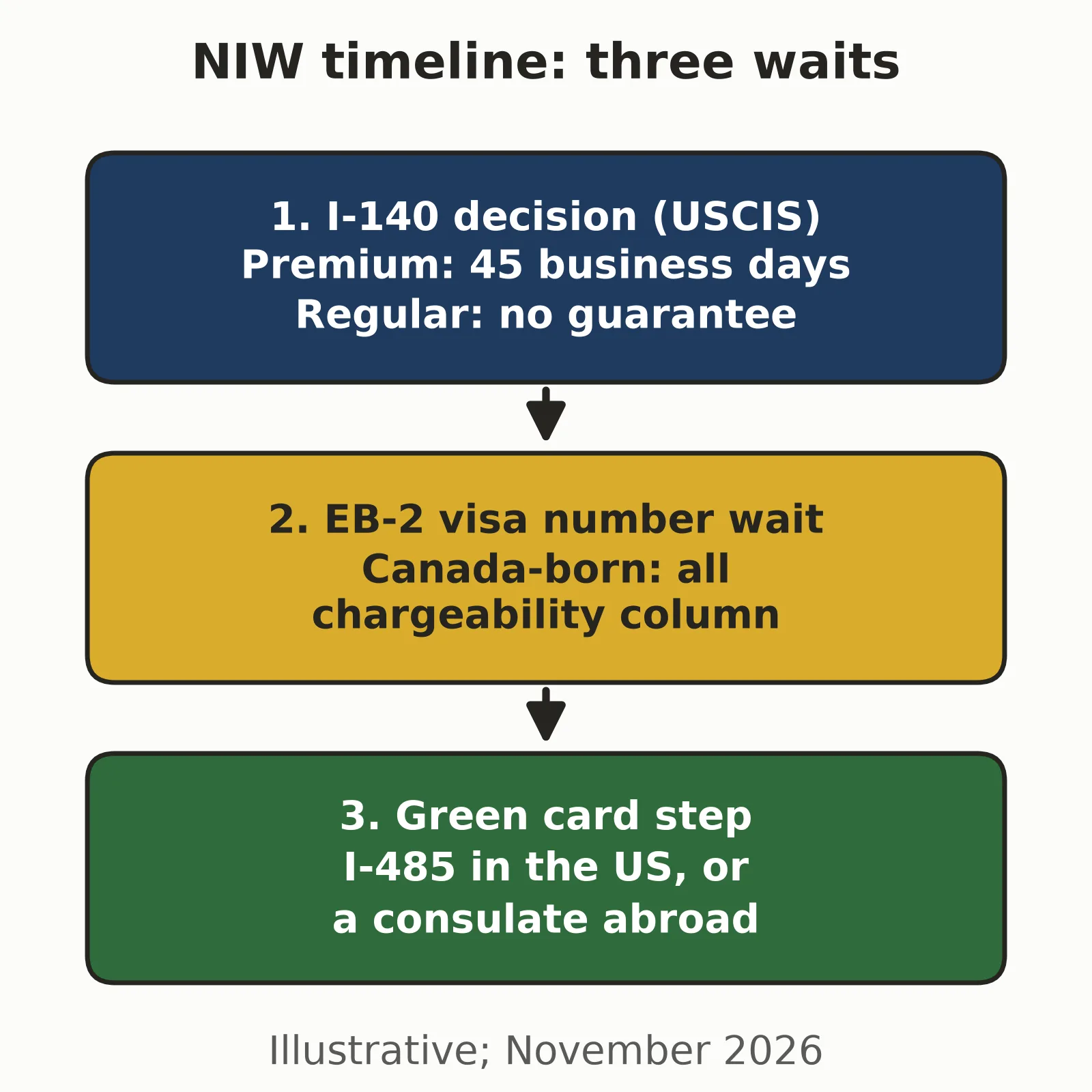
For a Canadian, the NIW processing time, meaning the time a national interest waiver (NIW) green card case takes, is three waits in a row, not one. First comes the decision by U.S. Citizenship and Immigration Services (USCIS) on Form I-140. Next is the wait for a visa number in the EB-2 category. Last is the green card step itself, either Form I-485 in the United States or an immigrant visa at a consulate. An NIW case is generally charged to your country of birth, not your passport, so a Canada-born applicant reads the Visa Bulletin column called "All Chargeability Areas Except Those Listed".
Our lawyers handle US business immigration for Canadians, and this guide sets out what each wait looks like as of November 2026, using figures published by USCIS. It starts with the Canadian questions: which visa queue applies to you, and what happens to your TN, L-1 or E-2 status while the petition is pending. People also search for this topic as the national interest waiver processing time or the EB2 NIW processing time. It is the same question.
Quick answer
As of November 2026, USCIS guarantees action on an NIW Form I-140 within 45 business days if you pay $2,965 for premium processing. Without it there is no guaranteed time, and 96,297 NIW petitions were pending on June 30, 2026. A Canada-born applicant then waits for an EB-2 visa number before the green card step.
How long does an NIW take for a Canada-born applicant?
For a Canada-born applicant, the NIW processing time is the I-140 decision, plus the EB-2 visa wait in the all chargeability column, plus the green card step, and only the first of those can be put on a guaranteed clock.
Start with the queue, because it is the part Canadians most often get wrong. Under the State Department's chargeability rule, 22 CFR 42.12, an immigrant is charged to the numerical limit of the foreign state of birth, with narrow exceptions written to keep families together. One of those exceptions lets a spouse be charged to the other spouse's country when that is needed to prevent separation. USCIS describes the same idea on its visa availability and priority dates page: the limits apply by country of chargeability, which is usually the country of birth.
Canada has no column of its own. The November 2026 chart reprinted by USCIS has five columns: All Chargeability Areas Except Those Listed, China (mainland born), India, Mexico and the Philippines. So:
- Born in Canada: in general you use the all chargeability column, whatever other citizenship you hold.
- Canadian citizen born in India or mainland China: you are generally charged to that country and use its column, where the EB-2 dates are years earlier.
- Married to a spouse born elsewhere: the spouse exception in 22 CFR 42.12 may let one of you use the other's country when you immigrate together.
The second Canadian question is the status you hold while you wait. A TN professional must show that the stay is temporary, an L-1 transferee may lawfully seek permanent residence at the same time, and an E-2 investor must keep an intention to depart but cannot be refused solely because an immigrant petition was filed. The next section gives the regulation behind each rule.
The table below puts the three waits side by side, with the official figure for each and the date it was published.
| Stage | Official figure | As of |
|---|---|---|
| I-140 with premium processing | 45 business days | November 2026 |
| I-140 without premium | No guaranteed time | November 2026 |
| EB-2 filing cut-off, Canada-born | March 15, 2026 | November 2026 chart |
| EB-2 final action date, Canada-born | April 1, 2025 | November 2026 bulletin |
| I-485, employment-based | 6 month median | April to June 2026 |
None of these figures is a promise for one person's file. The 45 business days are a commitment to act, not to approve. The March 15, 2026 and April 1, 2025 dates can change each month, when the State Department publishes a new bulletin. The 6 month figure is the median for employment-based I-485 applications that USCIS completed between April 1 and June 30, 2026, which means half of those cases took longer.
Can you wait in TN, L-1 or E-2 status?
Whether you can keep TN, L-1 or E-2 status while an NIW petition is pending depends on which status you hold, because the regulations treat a plan to immigrate differently for each one.
- TN: 8 CFR 214.6(b) defines the temporary entry that TN status requires as entry without the intent to establish permanent residence, and says you must satisfy the inspecting immigration officer that the proposed stay is temporary. An NIW petition is a self-petition for permanent residence, so a TN professional should plan border crossings and TN renewals before filing, not after. Our TN visa guide for Canadians covers the status itself.
- L-1: 8 CFR 214.2(l)(16) says a person may legitimately come to the United States for a temporary period as an L-1 nonimmigrant and, at the same time, lawfully seek to become a permanent resident. The condition is that he or she intends to depart voluntarily at the end of the authorized stay. See our guide to the L-1 visa from Canada.
- E-2: USCIS states on its E-2 page that all E-2 nonimmigrants must maintain an intention to depart the United States when their status expires or is terminated. 8 CFR 214.2(e)(5) adds that an application for E classification may not be denied solely on the basis of a filed or approved immigrant visa preference petition. Our guide on moving from an E-2 visa to a green card compares the permanent routes.
These are federal rules, the same in every state. They matter for an NIW because of the visa wait described below. A Canada-born applicant who files in late 2026 may need to keep a temporary status valid for a long stretch between the I-140 filing and the day a Form I-485 can be filed.
How long does the I-140 take without premium?
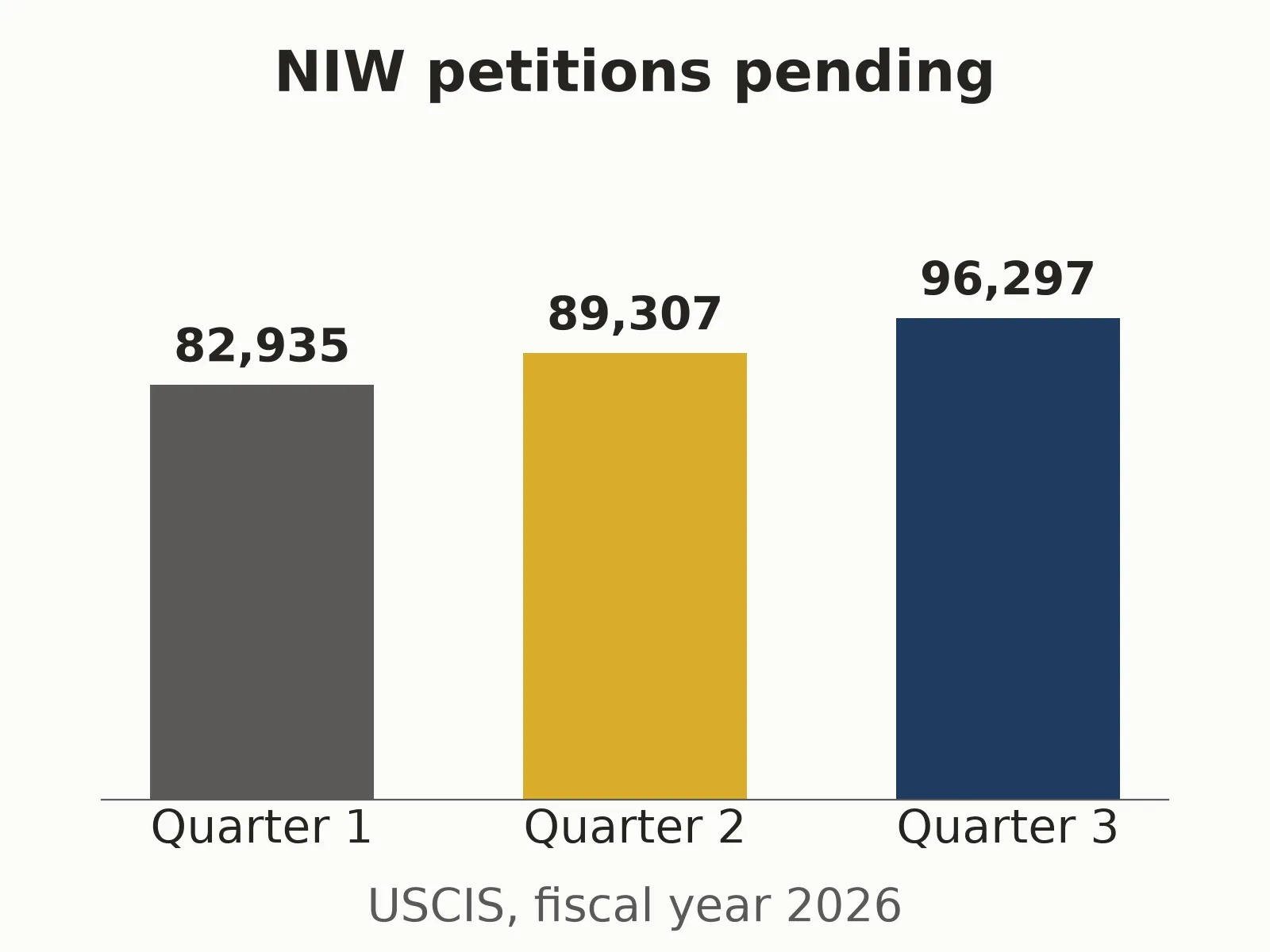
Without premium processing there is no guaranteed NIW processing time, and USCIS's own quarterly data shows the NIW queue growing by 13,362 petitions between the end of quarter 1 and the end of quarter 3 of fiscal year 2026.
The numbers below come from the USCIS report "Form I-140 by Fiscal Year, Quarter and Case Status" for fiscal year 2026, quarter 3, published in the agency's immigration and citizenship data library. USCIS queried the data in July 2026. The "Decided" column is our addition of approvals and denials.
| Fiscal 2026 quarter | Received | Decided | Pending at end |
|---|---|---|---|
| Quarter 1 | 13,884 | 5,565 | 82,935 |
| Quarter 2 | 12,648 | 6,320 | 89,307 |
| Quarter 3 | 13,831 | 6,938 | 96,297 |
Four things stand out in the USCIS figures for NIW petitions in fiscal year 2026.
- Intake runs at about twice the decisions: in quarter 3 (April 1 to June 30, 2026) USCIS received 13,831 NIW petitions and decided 6,938, made up of 3,835 approvals and 3,103 denials.
- The queue grew by 13,362 in two quarters: from 82,935 pending at the end of quarter 1 to 96,297 at the end of quarter 3.
- NIW is almost half of the I-140 backlog: 96,297 of the 203,204 I-140 petitions pending on June 30, 2026, about 47%, were NIW petitions.
- Denials are common: across the first three quarters of fiscal year 2026, USCIS approved 9,238 NIW petitions and denied 9,585.
A rough calculation shows the scale. At the quarter 3 pace of 6,938 decisions, the 96,297 pending petitions equal about 14 quarters of work. That is arithmetic on one quarter, not a forecast for any case: premium requests run on their own 45 business day clock, the number of decisions changed in each quarter shown above, and the report itself notes that one person can have more than one petition in the count.
Two other official numbers need care. The USCIS quarterly report for all form types gives a median of 3.9 months for Form I-140 in quarter 3, but that median covers every I-140 classification, including categories with a 15 business day premium option, so it is not the NIW figure. And the Canadian share is small: by country of birth, Canada accounted for 125 of the NIW petitions received in quarter 3 and 60 of the approvals.
USCIS also posts current estimates in its Check Case Processing Times tool on uscis.gov. Read the figure there for Form I-140 on the day you file, because it moves and a copied number goes stale.
How does NIW premium processing work?
NIW premium processing is a paid request on Form I-907 that commits USCIS to act on the I-140 within 45 business days of receiving the request, or to refund the premium fee.
The details below are from the USCIS premium processing page, last updated November 10, 2026, and the USCIS fee schedule, Form G-1055, edition 10/26/26.
- Who can use it: since January 30, 2023, every pending and new Form I-140 in the E21 national interest waiver classification. A self-petitioner may sign and file Form I-907, because the petitioner and the beneficiary are the same person.
- The clock: the NIW premium clock is 45 business days, which is nine five-day working weeks (45 divided by 5), a little over two calendar months. It starts when USCIS receives a properly completed Form I-907 at the correct address. Most other I-140 classifications get 15 business days.
- What counts as action: an approval notice, a denial notice, a notice of intent to deny, a request for evidence, or the opening of an investigation for fraud or misrepresentation. A request for evidence satisfies the guarantee, so premium processing buys a faster first response, not a faster approval.
- The fee: $2,965 for an I-140, on paper or online, paid separately from the other filing fees.
- Adding it later: if the I-140 is already pending, you file Form I-907 with the service center where it is pending, with a copy of the I-140 receipt notice.
- No free alternative: USCIS says discretionary expedite requests are in general no longer available for classifications that are eligible for premium processing, with an exception for petitioners that the Internal Revenue Service (IRS) has designated as not-for-profit entities.
The premium fee is added to the petition fees. As of November 2026, a self-petitioner filing Form I-140 on paper pays $715, or $665 online, plus a $300 Asylum Program Fee. Calculated from those figures, a paper-filed NIW petition with premium processing costs $3,980 in USCIS fees at the petition stage ($715 plus $300 plus $2,965).
The service is widely used. USCIS reports 34,563 premium requests on Form I-140 across all classifications between April 1 and June 30, 2026, of which 26,268 were filed together with the petition and 8,295 were upgrades of a pending petition.
Premium processing is the only part of the NIW processing time that carries a guarantee, and what it does not do matters just as much. It covers the I-140 decision only. It does not change your priority date, it does not move the Visa Bulletin, and Form I-485 is not on the list of forms that USCIS accepts for premium processing.
What does the visa bulletin add to the NIW timeline?
The Visa Bulletin adds the wait between your I-140 filing date and the month a visa number becomes available for that date in the EB-2 category, and a Canada-born applicant who files in November 2026 has a priority date later than the current EB-2 filing cut-off of March 15, 2026.
Your place in line is your priority date. Under 8 CFR 204.5(d), for a petition that does not require a labor certification, which is the case for an NIW, the priority date is the date the completed, signed petition is properly filed with USCIS. Premium processing therefore changes nothing about your place in line.
The bulletin has two charts for each category, and each month USCIS announces which one applicants in the United States must use to file Form I-485. For November 2026, USCIS says employment-based applicants must use the Dates for Filing chart. The EB-2 dates on the USCIS filing chart for November 2026 are:
| Country of birth | Column used | EB-2 filing cut-off |
|---|---|---|
| Canada | All chargeability | March 15, 2026 |
| Mexico or Philippines | Own column | March 15, 2026 |
| Mainland China | China | January 1, 2023 |
| India | India | January 15, 2015 |
Read the chart this way: if your priority date is earlier than the date shown, you may file Form I-485 this month, if you are otherwise eligible. A Canada-born applicant whose NIW petition was filed before March 15, 2026 is in that position in November 2026. A petition filed in November 2026 has a November 2026 priority date, which is later than the cut-off, so that applicant cannot yet file Form I-485 and cannot file it together with the I-140 this month.
Filing the I-485 is not the same as getting the green card. The Department of State's Visa Bulletin for November 2026 lists a separate final action date for EB-2 in the all chargeability column, April 1, 2025, and says visa numbers are authorized only for applicants whose priority date is earlier than the final action date. USCIS explains that a visa must be available before you can take the final step, and that the wait depends on your priority date, your preference category and the country the visa is charged to. Employment-based preference visas are limited to 140,000 a year in general, shared across all categories, with a further limit by country. The State Department's monthly Visa Bulletin sets the dates, and USCIS notes that a cut-off date can move backward to an earlier date, which it calls visa retrogression. This is why the NIW processing time differs so much by country of birth. Our guide to how long the green card process takes covers the other categories.
Adjustment of status or consular processing?
A Canadian who is in the United States in a valid status may be able to finish with Form I-485, while a Canadian living in Canada finishes with an immigrant visa interview at a United States consulate.
The two paths run on different clocks:
- Adjustment of status (Form I-485): the USCIS quarterly report for all form types gives a median of 6 months for employment-based I-485 applications completed between April 1 and June 30, 2026, with 268,408 such applications pending at the end of that quarter. The filing fee as of November 2026 is $1,440 on paper or $1,390 online for an applicant over the age of 14.
- Concurrent filing: USCIS allows most employment-based applicants to file Form I-485 together with the I-140, or while the I-140 is pending, but only when a visa number is immediately available. It is not possible in a consular case.
- Consular processing: according to the USCIS consular processing page, USCIS sends the approved petition to the State Department's National Visa Center (NVC), where it stays until a visa number is available. The NVC collects the fees and documents, and the consular office schedules the interview once the priority date is current.
No USCIS processing figure applies to the consular stage, because the State Department runs it. Our green card application process guide walks through both paths, and the guide to getting a green card through employment compares the employment categories.
What does an RFE do to the timeline?
A request for evidence (RFE) adds your response time to the case, and on a premium case it stops the 45 business day clock and starts a new one on the day the response arrives.
A federal regulation and the USCIS premium processing page set the outer limits. Under 8 CFR 103.2(b)(8)(iv), the response period given in a request for evidence may not exceed twelve weeks, the period given in a notice of intent to deny may not exceed thirty days, and additional time may not be granted. The USCIS premium processing page states that when a petition requires additional evidence, the premium period stops and resets, and a new period begins when USCIS receives the response.
Put together, the slowest NIW premium processing path with one RFE looks like this, as a calculation and not a prediction: up to nine working weeks for the first action, up to twelve weeks for your response, then up to nine more working weeks, about 30 weeks in all. Answering sooner shortens the middle part, which is the only part you control.
The quarterly data is a reason to take that time: USCIS denied 9,585 NIW petitions and approved 9,238 in the first three quarters of fiscal year 2026. Our EB-2 NIW guide for Canadians explains the test USCIS applies, and the EB-1A green card guide covers the other self-petition route, which has a 15 business day premium option.
Frequently asked questions
What is the NIW processing time in 2026?
As of November 2026, USCIS guarantees action on an NIW Form I-140 within 45 business days when premium processing is requested and gives no guaranteed time otherwise. USCIS data shows 96,297 NIW petitions pending on June 30, 2026. After the I-140, the wait for an EB-2 visa number and the green card step are added.
Does premium processing make the green card arrive sooner?
Only the I-140 decision is faster. Premium processing does not change the priority date, which for an NIW is the date the petition was properly filed, and it does not move the Visa Bulletin. Form I-485 is not among the forms USCIS accepts for premium processing, so the later stages run at their ordinary pace.
Can I add premium processing after filing my I-140?
Yes. USCIS says that if a Form I-140 is already pending, Form I-907 is filed with the service center where the petition is pending, together with a copy of the I-140 receipt notice. The 45 business day period for an NIW case starts when USCIS receives the properly completed Form I-907.
Is the wait different for a Canadian born in India or China?
Yes, in most cases. A green card applicant is generally charged to the country of birth, not citizenship, under 22 CFR 42.12. On the November 2026 chart, the EB-2 date for filing is January 15, 2015 for India and January 1, 2023 for mainland China, compared with March 15, 2026 for the column that covers Canada-born applicants.
Can I file Form I-485 with an NIW petition in November 2026?
Not if you are Canada-born and filing the I-140 now. USCIS allows concurrent filing only when a visa number is immediately available. In November 2026 the EB-2 date for filing in the all chargeability column is March 15, 2026, and a petition filed this month has a later priority date than that.
Does a pending NIW affect TN status?
It can. Under 8 CFR 214.6(b), TN status requires temporary entry, defined as entry without the intent to establish permanent residence, and the applicant must satisfy the inspecting officer that the stay is temporary. An NIW petition is a request for permanent residence, so a TN professional should think through travel and renewals before filing.
How long after NIW approval do you get a green card?
There is no fixed period. After approval, the green card step can start only when a visa number is available for your priority date in the EB-2 category. For employment-based I-485 applications completed between April and June 2026, USCIS reported a median of 6 months, and consular cases move at the State Department's pace.
Conclusion
The honest answer on NIW processing time for a Canadian is a set of separate clocks. Premium processing puts the first one on a 45 business day clock for USCIS action, for $2,965. The second, the EB-2 visa wait, is set by your country of birth and your filing date, and in November 2026 the filing cut-off for Canada-born applicants is March 15, 2026 and the final action date is April 1, 2025. The third is the I-485 or the consulate. Because the priority date is the filing date, an earlier complete filing puts you earlier in the EB-2 line, and it should come with a plan for the status you will hold while you wait.
How Mayo Law can help
Mayo Law is a cross-border firm with offices in Toronto and New York, and Joseph Mayo is licensed in Ontario and New York. Our lawyers work with Canadian professionals and founders on national interest waiver petitions and on the TN, L-1 and E-2 statuses that often come first, as part of our business immigration practice. We offer a paid one-hour consultation, because a lawyer reviews your situation in depth: your country of chargeability, your current status, your evidence and the timing of each filing.
Disclaimer
This guide is for general information only and is not legal advice. Reading it does not create a solicitor-client or attorney-client relationship. Processing times, fees and visa bulletin dates change, and the figures here are stated as of the dates shown. Mayo Law provides legal services in Ontario and New York.