

Contents
- Quick answer
- What is the TN management consultant category?
- What are the TN visa management consultant requirements?
- Does a contractor or an employee fit the category?
- What must the TN support letter show?
- Why are consultants refused at the port of entry?
- Where do Canadians apply, and what does it cost?
- Does it work for Americans heading to Canada?
- Frequently asked questions
- Conclusion
- How Mayo Law can help
- Disclaimer
A Canadian citizen working as a management consultant can ask for US work status at the border, with no petition filed in advance. That is the appeal of the TN visa management consultant category under the United States-Mexico-Canada Agreement (USMCA). It is also where many applications go wrong, because the category has conditions that a job title cannot satisfy. This guide sets out the rules as of November 2026 and where they sit in US business immigration planning for Canadians.
The rules come from three places: the USMCA profession list, the federal regulation at title 8 of the Code of Federal Regulations (8 CFR) section 214.6, and guidance that U.S. Citizenship and Immigration Services (USCIS) first added to its Policy Manual on June 4, 2025. Read together, they answer the questions consultants ask most: whether five years of experience can replace a degree, whether a contractor or an employee fits, what the support letter must say, and why an officer may refuse a consultant whose title looks right. For the wider category, see our guide to the TN visa for Canadians, and for the other statuses, our overview of US work visas for Canadians.
Quick answer
A Canadian citizen can qualify as a TN management consultant with a bachelor's degree, or five years of experience as a management consultant or in a specialty related to the consulting agreement. The work must be a prearranged, temporary engagement for a US entity that the consultant does not control. Duties decide the case, not the title.
What is the TN management consultant category?
The TN management consultant category is one of the professions listed in Appendix 2 to Annex 16-A of the USMCA, which lets a Canadian or Mexican citizen enter the United States temporarily to do prearranged professional work for a US entity. The United States Trade Representative publishes the list in Chapter 16 of the USMCA, and the same list appears in the federal regulation at 8 CFR 214.6.
USCIS describes the work in its Policy Manual, Volume 2, Part P, Chapter 6, current as of October 27, 2026. Management consultants, it says, provide services that improve the managerial, operating and economic performance of public and private entities by analyzing and resolving strategic and operating problems. The aim is to improve the entity's goals, objectives, policies, strategies, administration, organization and operation.
The USCIS definition is the test for a TN management consultant. A USMCA management consultant studies how an organization runs and advises on how to run it better. The same chapter opens with a warning for the occupations it covers: an applicant must show that he or she will perform the duties described, and a job title or the employer's categorization of the job does not establish eligibility.
Two US agencies apply the TN rules. The Policy Manual explains that U.S. Customs and Border Protection (CBP) has primary authority to decide TN applications for admission, because Canadians may apply directly at the border. USCIS decides petitions, extensions and changes of status filed inside the United States. The Policy Manual is USCIS guidance. The regulation, 8 CFR 214.6, governs both a petition filed with USCIS and an application for admission at the port of entry.
What are the TN visa management consultant requirements?
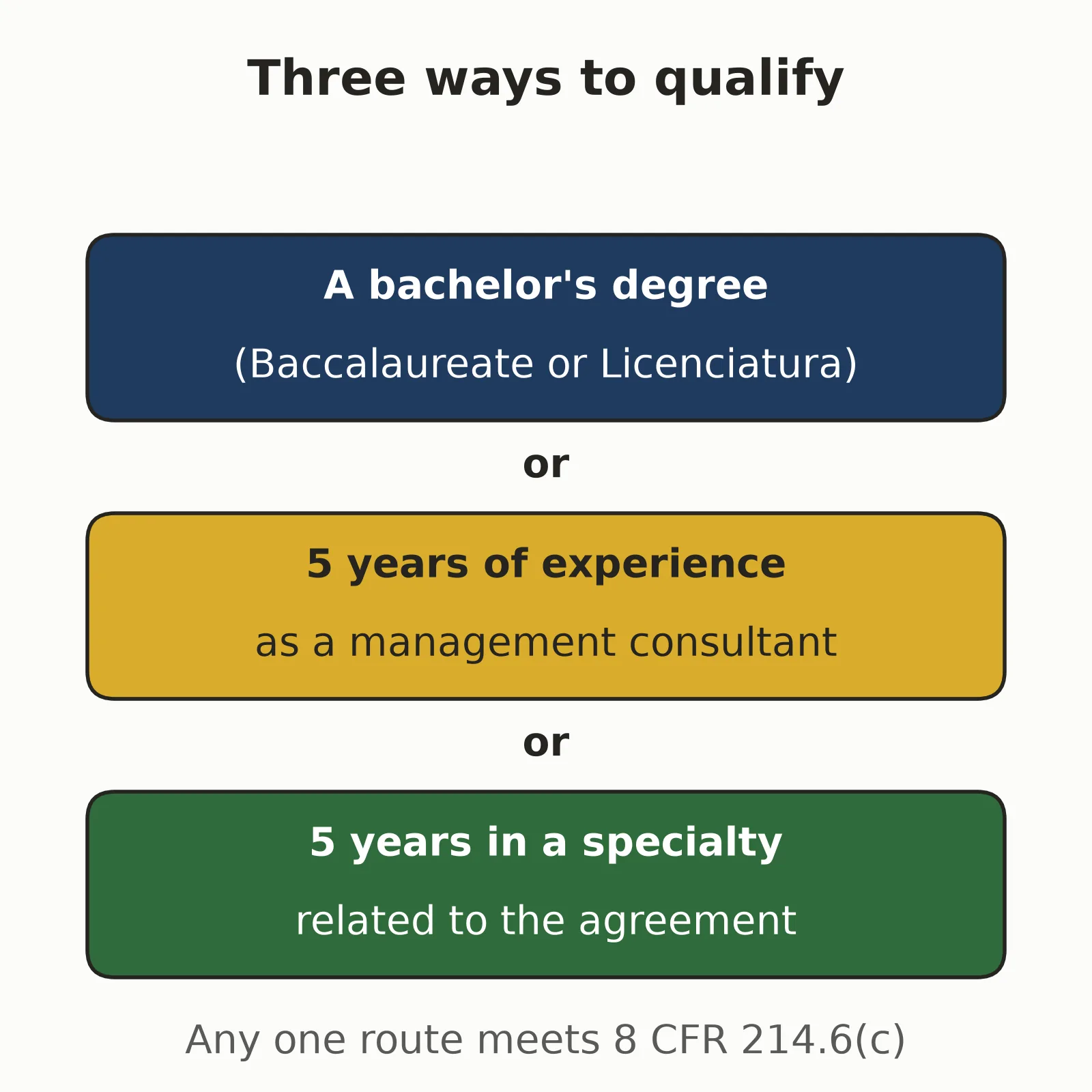
A management consultant must meet the five conditions that apply to every TN professional and hold one of three credentials: a bachelor's degree, five years of experience as a management consultant, or five years of experience in a specialty related to the consulting agreement. The five general conditions are listed on the USCIS page for TN USMCA Professionals, last reviewed June 4, 2025:
- You are a citizen of Canada or Mexico.
- Your profession is included in the USMCA.
- The position in the United States requires a USMCA professional.
- You will work in a prearranged full-time or part-time job for a US employer or entity.
- You have the qualifications to practice in the profession.
Permanent residents of Canada who are not citizens do not meet the first condition. Part-time work is allowed. Work that has not been arranged before you travel does not qualify.
Can five years of experience replace a degree?
The regulation at 8 CFR 214.6(c) sets the minimum for a management consultant as a Baccalaureate or Licenciatura Degree, or equivalent professional experience as established by a statement or professional credential attesting to five years of experience as a management consultant, or five years of experience in a field of specialty related to the consulting agreement. USCIS restates those three routes in its Policy Manual. Any one of them is enough.
Accepting experience instead of a degree is unusual among TN professions. The Department of State's Foreign Affairs Manual (FAM), at 9 FAM 402.17, notes that with certain exceptions each TN profession requires a bachelor's degree as an entry-level requirement, and that where a degree is required, experience cannot be substituted for it. The management consultant entry is one of the exceptions, because the list itself names experience as an alternative.
The third credential route, five years in a specialty related to the consulting agreement, matters for people who have never held the title of consultant. Someone with five years in supply chain operations, for example, could rely on that experience where the consulting agreement is about supply chain problems. The experience has to relate to the subject of the agreement, so the agreement should describe that subject plainly.
How do you prove five years of experience?
The USCIS Policy Manual, Volume 2, Part P, Chapter 3, says evidence of experience should be in the form of letters from former employers, and that a person who was formerly self-employed must submit business records attesting to that self-employment. The Foreign Affairs Manual gives consular officers a similar instruction, and lets them consider other satisfactory evidence where letters cannot be provided. For a consultant who has run a practice in Canada, those records can include contracts, invoices and corporate filings covering the five years, organized so an officer can follow them quickly.
If you rely on a degree instead, bring the diploma. Under 8 CFR 214.6(d)(3)(ii), a degree from a school outside Canada, Mexico and the United States must come with an evaluation from a reliable credentials evaluation service. The Foreign Affairs Manual adds that a degree does not have to be in the exact field where the subject of the degree overlaps significantly with the work.
Does a contractor or an employee fit the category?
Both can fit, but the USCIS Policy Manual treats them differently. Consultants are usually independent contractors or employees of consulting firms under contracts to US entities, and a consultant on the US client's own payroll may only fill an irregular or non-routine temporary position. One further rule helps consulting firms. If the employer is a US management-consulting firm, the consultant may be admitted temporarily to fill an otherwise permanent position.
The table below sorts the common engagement types by how the published guidance treats them.
| Engagement | TN fit | Key condition |
|---|---|---|
| Independent contractor for a US client | Usual case | Signed contract with the client |
| Employee of a consulting firm | Usual case | Firm's contract with a US entity |
| Hire by a US consulting firm | Allowed | Permanent position, filled temporarily |
| Salaried hire by the US client | Limited | Irregular or non-routine temporary role |
| A US company you control | Not allowed | Treated as self-employment |
A salaried hire by a US client that is not a consulting firm is where a TN visa consultant case needs the most care. A US company that is not a consulting firm can put a Canadian consultant on its payroll, but only into the kind of temporary role the Policy Manual describes. An ongoing operations role that has been retitled as consulting is hard to fit within that wording, because the position is regular and has no end.
A consultant employed by a Canadian firm can also qualify. The regulation accepts a letter from the prospective US employer or from the foreign employer, and the Policy Manual says the formal arrangement may be an employment relationship or a signed contract between the consultant, or the consultant's employer, and a person or enterprise in the United States. Whether you are a contractor or an employee for Canadian purposes is a separate question, which our guide to independent contractor vs employee status in Ontario covers.
Can a TN consultant be self-employed?
TN status does not allow self-employment in the United States. Under 8 CFR 214.6(b), a professional is deemed self-employed when rendering services to a corporation or entity of which the professional is the sole or controlling shareholder or owner. A Canadian who forms a US company, controls it, and then works through it is in that position.
The Policy Manual, in Volume 2, Part P, Chapter 2, lists the factors officers weigh: whether the US enterprise is a separate legal entity, whether the applicant has substantial control over it, and whether it was established to facilitate the applicant's self-employment. Control is judged on the facts, regardless of the percentage of shares held.
Chapter 2 of the Policy Manual also protects the ordinary independent consultant. A Canadian who is self-employed outside the United States may seek admission under a prearranged agreement with a US enterprise owned by someone else. Responding to unsolicited inquiries and establishing premises from which to deliver prearranged services are not treated as setting up a business. For self-employment in trade or investment activities in the United States, the Policy Manual points to the treaty trader and treaty investor classifications instead. Our guide explains what the E-2 visa is.
What must the TN support letter show?
The support letter must affirm five things listed in 8 CFR 214.6(d)(3)(ii): the profession, the professional activities, the anticipated length of stay, the qualifications, and the arrangements for pay. The letter may come from the prospective US employer or entity, or from the foreign employer, and it must be supported by diplomas, degrees or membership in a professional organization. In summary, the documentation must fully affirm:
- Profession: the applicant's profession under Appendix 2, here Management Consultant.
- Activities: a description of the professional activities, including a brief summary of daily job duties if appropriate.
- Length of stay: the anticipated length of stay.
- Qualifications: the educational qualifications or appropriate credentials that show professional-level status.
- Pay: the arrangements for remuneration for the services.
For a management consultant TN visa, each item should also speak to the category's own conditions. The activities should read as analysis and advice on a defined strategic or operating problem, because that is how USCIS defines the profession. The length of stay should tie to the project, because 8 CFR 214.6(b) requires a work assignment that will end at a predictable time. The qualifications paragraph should say which of the three credential routes applies.
A contract can support the letter. The Foreign Affairs Manual tells consular officers that the evidence may be an employment letter or a contract providing a detailed description of the business activities. A consultant can carry both: the signed consulting agreement and a letter from the US client that walks through the five items. The Foreign Affairs Manual also notes that, unlike the H-1B, the TN has no prevailing wage requirement, although officers are told to verify that the proposed pay is indicative of professional-level employment.
Why are consultants refused at the port of entry?
A TN visa management consultant applicant is refused when the documents describe something the rules exclude. This guide groups the published grounds into five: a title without the duties, a regular position at a company that is not a consulting firm, self-employment, no predictable end date, and experience that is not documented. Each ground comes from text an applicant can read in advance.
- Title without duties: the Policy Manual says a job title or the employer's categorization does not establish eligibility. The Foreign Affairs Manual tells consular officers to determine the actual profession from the duties in the job description. A letter that says "consultant" over a list of sales, coding or day-to-day management tasks is exposed on this ground.
- A regular position: under the Policy Manual, a salaried hire by a US company that is not a consulting firm may only fill an irregular or non-routine temporary position. Replacing a departed manager is hard to describe in those terms.
- Self-employment: under 8 CFR 214.6(b), a US entity of which the consultant is the sole or controlling owner cannot be the employer. The Foreign Affairs Manual adds that the US entity must not serve to disguise the applicant's self-employment.
- No end date: under 8 CFR 214.6(b), the applicant must satisfy the officer that the stay is temporary and that the assignment will end at a predictable time.
- Undocumented experience: under the Policy Manual, a consultant relying on five years of experience should have letters from former employers, or business records if self-employed.
The way to reduce the risk of a TN refusal follows from the list. Define the problem the client wants solved, describe the deliverables as findings, recommendations and help with implementation, state when the engagement ends, and bring proof of the credential route you rely on. Our TN visa eligibility self-check covers the general conditions.
Where do Canadians apply, and what does it cost?
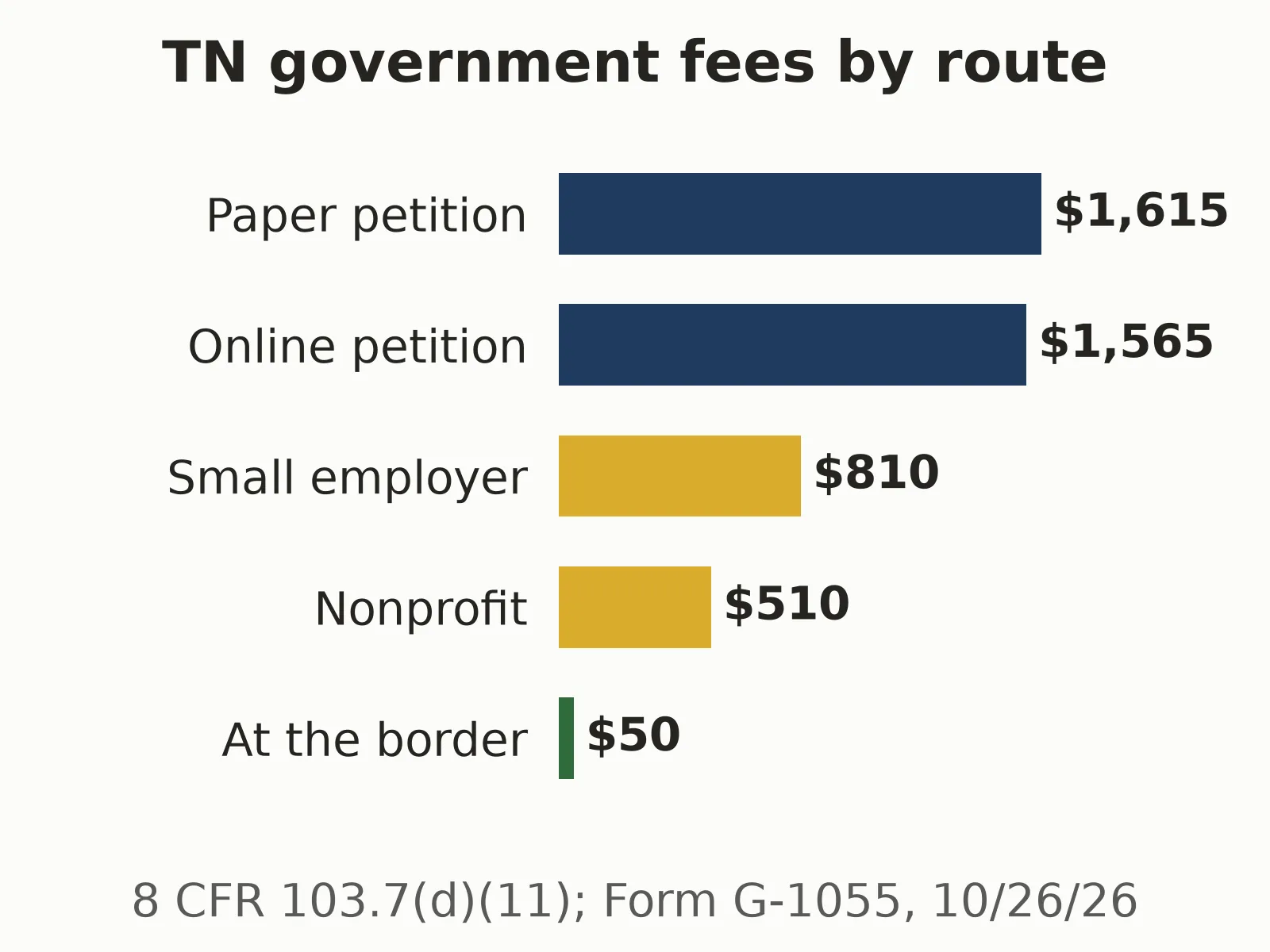
A Canadian citizen applies in person to a CBP officer at a Class A port of entry, a US airport handling international traffic, or a preclearance station in Canada, and pays a $50 fee on admission. Nothing has to be filed first. The Policy Manual confirms that Canadian TN professionals may apply for admission without first filing Form I-129 with USCIS or obtaining a visa. USCIS says Mexican citizens must obtain a TN visa from a US embassy or consulate before travelling.
CBP has designated certain ports for optimized processing of first-time Canadian TN applicants. Its page on travelling on a TN from Canada, last modified May 30, 2024, lists preclearance at Toronto Pearson, Montreal Trudeau, Calgary and Vancouver airports, and land ports that include the Peace Bridge, Rainbow Bridge and Lewiston Bridge in New York. Using a designated port is encouraged, not required, and the page lists hours or appointment times for most of them.
That $50 fee is set at 8 CFR 103.7(d)(11). A separate Form I-94 fee applies at a land border port of entry under 8 CFR 103.7(d)(4). Admission is for a period not to exceed three years under 8 CFR 214.6(e), and 8 CFR 214.6(h) sets no specific limit on the total time a person may hold TN status while the professional work continues.
The alternative to applying at the border is a petition on Form I-129. USCIS says a prospective TN employer may file Form I-129 for a Canadian who is outside the United States, and the consultant then presents the approval notice at the border. Under 8 CFR 214.6(h), the same form is used to extend TN status from inside the United States, for a maximum of three years at a time. The USCIS fee list, Form G-1055, edition 10/26/26, sets these amounts for a TN petition as of November 2026.
| Filing profile | Form I-129 | Asylum Program Fee | Total |
|---|---|---|---|
| Regular petitioner, paper | $1,015 | $600 | $1,615 |
| Regular petitioner, online | $965 | $600 | $1,565 |
| Small employer | $510 | $300 | $810 |
| Nonprofit | $510 | $0 | $510 |
As of November 2026, premium processing on Form I-907 costs a further $2,965 for a TN petition, according to the same Form G-1055. None of these figures includes legal fees or a credential evaluation.
Can you work for more than one US client?
Consultants often serve several clients, and TN status is tied to the employers or entities that were approved. Under 8 CFR 214.6(i), a TN professional who wants to change or add a US employer must have the new employer file Form I-129, or may leave and apply for readmission with documentation from the new employer. Work for the additional employer is not authorized until the request is approved. A transfer to another office of the same employer for the same services needs no new filing. Our guide on whether a Canadian can work in the US sets out what each status authorizes.
Does it work for Americans heading to Canada?
The agreement is reciprocal, so a US citizen who is a management consultant can work in Canada under the same profession list, in what Canada calls the Canada-United States-Mexico Agreement (CUSMA). The process differs. An American needs a Canadian work permit, which Immigration, Refugees and Citizenship Canada (IRCC) issues under paragraph 204(a) of the Immigration and Refugee Protection Regulations with an exemption from the Labour Market Impact Assessment (LMIA), under exemption code T36.
IRCC's program instructions for CUSMA professionals, last modified January 3, 2025, give Canadian officers detailed notes on management consultants. A management consultant, they say, is generally hired on contract to do project work on specific issues or problems. Consultants assist and advise in implementing recommendations but do not perform functional or operational work for clients or take part in the company's production.
Canada's CUSMA rules for management consultants track the US rules on the points that matter most. The credential is the same degree or five years of experience. Self-employment in Canada is not allowed, though an American who is self-employed outside Canada may enter for services prearranged with a Canadian employer. A management consultant can occupy a permanent position on a temporary basis with a Canadian management consulting firm. The initial work permit runs for a maximum of three years, and IRCC issues a separate work permit for each contract. These are federal Canadian rules that apply in Ontario and every other province.
Frequently asked questions
Can you get a TN visa as a management consultant without a degree?
Yes. The profession list in 8 CFR 214.6(c) accepts equivalent professional experience in place of a bachelor's degree. You need a statement or professional credential attesting to five years of experience as a management consultant, or five years of experience in a field of specialty related to the consulting agreement. USCIS guidance says experience should be shown with letters from former employers.
Does a TN management consultant have to work for a consulting firm?
No. The USCIS Policy Manual says management consultants are usually independent contractors or employees of consulting firms under contracts to US entities. A consultant may also be a salaried employee of the US entity receiving the services, but only in an irregular or non-routine temporary position. A US management-consulting firm may bring a consultant in temporarily to fill an otherwise permanent position.
Can you use your own US company to get TN status as a consultant?
No. Under 8 CFR 214.6(b), a professional is deemed self-employed when rendering services to a corporation or entity of which he or she is the sole or controlling shareholder or owner, and TN status does not authorize self-employment in the United States. A Canadian who is self-employed in Canada can still qualify by contracting with a US enterprise owned by someone else.
How long can a management consultant stay in TN status?
Each admission is for a period not to exceed three years under 8 CFR 214.6(e). USCIS may approve an extension for a maximum of three years, and 8 CFR 214.6(h) sets no specific limit on the total time in TN status. The stay must remain temporary each time, which means the assignment needs a predictable end and the consultant must intend to leave when it finishes.
Can a TN management consultant work for more than one US client?
Yes, but each US employer or entity has to be approved. Under 8 CFR 214.6(i), adding an employer requires a Form I-129 filed by the new employer, or a new application for readmission at the border with documentation from that employer. Work for the additional employer is not authorized until the request is approved by USCIS or the consultant is readmitted on that basis.
Is there a minimum salary for a TN visa management consultant?
No published minimum applies. The Department of State's Foreign Affairs Manual says that, unlike the H-1B, the TN has no prevailing wage requirement. It also tells consular officers to verify that the proposed pay is indicative of professional-level employment in the United States, and 8 CFR 214.6(d)(3)(ii) requires the support letter to state the arrangements for remuneration.
What does a TN visa management consultant application cost at the border?
A Canadian citizen pays $50 for the TN request under 8 CFR 103.7(d)(11), as of November 2026. A separate Form I-94 fee applies at a land border port of entry. No Form I-129 fee is due on this route, because no petition is filed with USCIS. A US employer that chooses the petition route instead pays the Form I-129 fee and the Asylum Program Fee listed on USCIS Form G-1055.
Conclusion
A TN visa management consultant application rewards precise paperwork. The credential is flexible, since a degree or five years of relevant experience will do. The engagement is where the limits sit: a prearranged, temporary project, for a US entity you do not control, with duties that are analysis and advice on a defined problem. Canadians can apply at the border for $50, plus any Form I-94 fee at a land border, and Americans have a mirror route into Canada. If the facts fit those conditions, the remaining work is to make the letter and the evidence say so clearly.
How Mayo Law can help
Mayo Law is a cross-border firm with offices in Toronto and New York. Joseph Mayo, our principal attorney, is licensed in Ontario and New York. Our lawyers advise Canadian consultants and the US companies that engage them on whether an engagement fits the category, how to structure the consulting agreement, and what the support letter and evidence should contain. We also advise US consultants and Canadian businesses on the Canadian side of the same agreement. Our first meeting is a paid one-hour consultation, because a lawyer reviews the engagement and the documents in depth. You can start from our TN visa lawyer page.
Disclaimer
This guide is for general information only and is not legal advice. Reading it does not create a solicitor-client or attorney-client relationship. Immigration rules, fees and agency guidance change, and each application is decided on its own facts by the officer who reviews it. Mayo Law provides legal services in Ontario and New York.