

Contents
- Quick answer
- What is the EB-5 source of funds requirement?
- What documents does USCIS require for EB-5 source of funds?
- Which records prove each source of money?
- How do you trace funds through Canadian accounts?
- Which gaps have led to EB-5 denials?
- What should Canadian investors do first?
- Frequently asked questions
- Conclusion
- How Mayo Law can help
- Disclaimer
The EB-5 source of funds requirement comes down to one question: can you prove, with documents, that the money you are investing is yours and that you obtained it lawfully? For a Canadian investor, most of that proof sits in Canada Revenue Agency (CRA) records, Canadian bank statements and provincial registries, so the file has to be built from Canadian paper for a U.S. reader.
This guide, from Mayo Law's business immigration lawyers, explains what U.S. Citizenship and Immigration Services (USCIS) requires, which records answer each requirement for salary, a business sale, a gift, a loan or a real-estate sale, how to trace money through Canadian accounts, and which gaps have caused problems in published decisions. It is one step inside the wider EB-5 visa process, and the same rule applies to a regional center investor and a standalone investor.
Quick answer
You must show that your EB-5 capital came from a lawful source and is yours. For petitions filed on or after May 14, 2022, the lawful-source rule also covers administrative costs and fees. You file, as applicable, tax returns from the past 7 years or another period the Secretary sets, records of each source, any judgments, and who transferred funds.
What is the EB-5 source of funds requirement?
The EB-5 lawful source of funds rule requires an investor to show that the capital, and any funds used to pay administrative costs and fees, were obtained from a lawful source and through lawful means. That wording comes from section 203(b)(5)(L) of the Immigration and Nationality Act (INA), published in title 8 of the United States Code as 8 U.S.C. 1153(b)(5)(L). The USCIS Policy Manual, Volume 6, Part G, Chapter 2, current as of October 2026, explains how USCIS applies it.
Two separate things have to be proven:
- Lawful source: how you came to have the money. USCIS does not consider as capital any assets acquired directly or indirectly by unlawful means, such as criminal activity.
- Ownership: that the money you invest is your own. The Policy Manual says you must be the legal owner of the capital and must document the path of the funds.
The EB-5 path of funds is shorthand, not a statutory term. In Voja v. Noem, decided in September 2026 by the U.S. District Court for the District of Columbia, the judge noted that the phrase appears in neither the statute nor the regulations and emerged as shorthand for one or both of the lawful-source and ownership rules. That is why a clean wire does not finish the job. It shows where the money went, not how you got it.
The standard of proof is a preponderance of the evidence. The Policy Manual says you do not need to remove all doubt, only to show that your claim is more likely than not true. A statement alone will not do that: in Matter of Ho, a 1998 precedent decision the Policy Manual still cites, "simply going on record without supporting documentary evidence" did not meet the burden of proof.
The EB-5 source of funds rule covers the full minimum investment. For petitions filed on or after March 15, 2022, the Policy Manual sets the minimum at US$1,050,000, or US$800,000 in a targeted employment area, as of October 2026. For regional center petitions filed on or after May 14, 2022, the US$800,000 figure also covers an infrastructure project, but a standalone investor cannot use that route. The Policy Manual says those amounts will automatically increase on January 1, 2027, and every 5 years after that.
USCIS may defer to an earlier finding on a regional center project, but that deference does not reach your funds. Chapter 3 of the same Part says USCIS still conducts a de novo, or fresh, review of each investor's lawful source of funds.
What documents does USCIS require for EB-5 source of funds?
For a petition filed on or after May 14, 2022, USCIS requires, as applicable, business and tax records, personal tax returns, evidence of any other source of capital, evidence of monetary judgments, and the identity of anyone who moved funds into the United States for you.
The statute and the Policy Manual set out EB-5 source of funds documentation in these groups:
- Business records: foreign business registration records, plus corporate or partnership tax returns filed in any country. The Policy Manual attaches the 7-year period to personal returns, but the statute's clause lists corporate returns with them, so we would plan on 7 years here too.
- Personal tax returns: income, franchise, property or any other tax returns of any kind filed during the past 7 years, or another period the Secretary of Homeland Security sets, with any taxing jurisdiction inside or outside the United States.
- Other sources: any other evidence identifying any other source of capital or administrative fees.
- Judgments: certified copies of any judgments, and evidence of pending government or private actions involving possible monetary judgments against you, from any court inside or outside the United States.
- Transfers: the identity of all persons who transfer funds into the United States on your behalf to meet the capital requirement.
The list depends on your filing date, so a summary that says five years for a petition filed on or after May 14, 2022 is using the older rule.
| Item | Before May 14, 2022 | From May 14, 2022 |
|---|---|---|
| Personal tax returns | Past 5 years | Past 7 years |
| Court matters | Past 15 years | No period in statute |
| Fees and costs | Not named | Must also be lawful |
| People moving funds | Not named | Must be identified |
| Gifts and loans | Gift instruments and secured-loan evidence listed | Expressly allowed, records required |
Two official texts have not caught up. The regulation in title 8 of the Code of Federal Regulations (CFR), at 8 CFR 204.6(j)(3), still says five years for tax returns and fifteen years for judgments, as of October 2026. The petition instructions (edition 01/20/25) ask for tax returns from the last seven years but still say judgments "within the past 15 years". A regional center investor files Form I-526E and a standalone investor files Form I-526, and the Form I-526E instructions and Form I-526 instructions read the same on every point this guide draws from them. We would plan to the longer period on each item, and treat 15 years as a floor for court records, since the statute's judgment clause states no period.
USCIS materials do not name Canadian forms, so the mapping in this guide is Mayo Law's:
- Personal returns: your income tax and benefit returns, with your notices of assessment, plus any property or other tax returns you filed. The CRA says it sends a notice of assessment after it processes and assesses a return, and it offers a proof of income statement, a simple generic version of your tax assessment for a specific tax year.
- Corporate returns: the T2 Corporation Income Tax Return for any corporation in your funds story.
- Registration records: for an Ontario corporation, a Corporation Profile Report, or the profile report sold through the Ontario Business Registry. A federal corporation's documents come from Corporations Canada.
- Other provinces: the provincial registries in this guide are Ontario's, so confirm where your own province keeps these records.
Anything in French needs a full English translation. Under 8 CFR 103.2(b)(3), the translator must certify that it is complete and accurate and that the translator is competent to translate. Legible photocopies are normally enough, but the form instructions warn that USCIS may ask for an original at any time.
Which records prove each source of money?
Each source needs two kinds of proof: a record of how you earned or received the money, and a bank record showing it reach your account. The table gives the short version of the EB-5 source of funds documents for each source, and the sections below explain what has gone wrong with each.
| Source of money | Core record | Canadian example |
|---|---|---|
| Salary and savings | Earnings statements, tax returns | T4 slips, notices of assessment |
| Sale of a business | Sales contract, ownership proof | Share sale agreement, T2 returns |
| Gift | Gift instrument, donor records | Donor's CRA returns, bank statements |
| Loan | Loan agreement, lender records | Line of credit agreement, security |
| Real-estate sale | Sales contract, deed | Ontario land registry records |
Salary and savings
To document salary and savings for EB-5, show the job, the pay and the deposits. The Policy Manual's list for older petitions includes earnings statements or official letters from employers stating when you worked and how much you received. For current petitions it asks for any other evidence identifying the source. In Canada, that points to employer letters, T4 slips, which identify the remuneration an employer paid during a calendar year, and CRA records. Savings may take more work, because on the stricter reading of how far tracing goes, a balance may need to be tied back to pay. In Matter of Ho, the investor said he built his money through a medical practice and investments, but he gave no evidence of that work or of his income.
Sale of a business
To document a business sale for EB-5, prove that you owned the business, what it sold for and that the money reached you. In Matter of Soffici (1998), money said to come from the sale of "our business" failed because no document, such as a sales contract, was filed to establish ownership and price. For a Canadian company, gather the signed share or asset sale agreement, corporate records showing your holding, T2 returns and the registry records above.
Watch who received the price. In Matter of Soffici, funds held by a corporation "do not belong to the petitioner, an individual", so if the buyer paid your corporation, show how the money lawfully reached you. Any dividend or other payment to you should then appear in the corporate records and in your own, for example on a T5 slip, the CRA form for reporting certain investment income. Tax treatment is outside this guide.
Gift
A gift can fund an EB-5 investment, but the donor's records become part of your file. For a petition filed on or after May 14, 2022, section 203(b)(5)(L)(iii) of the INA says gifted funds count toward the minimum only on two conditions. They must be given in good faith, and not to get around limits on permissible sources of capital, such as proceeds from illegal activity. Your petition must then include the same business, tax and judgment records from the donor.
A parent giving you money in Ontario would supply their own CRA returns and bank records, not just a letter. The form instructions also ask you to identify the donor and describe the documentation, and the Policy Manual's older list names gift instruments as evidence, so keep a signed one.
Loan
Borrowed money faces the same test as a gift: for a petition filed on or after May 14, 2022, the statute counts it only if it was loaned in good faith and not to get around limits on permissible sources of capital. The same business, tax and judgment records must then come from the lender, if other than a bank. The statute, the Policy Manual and the form instructions do not say whether a Canadian bank fits that exception, so confirm the point before you rely on it.
Since a July 2021 policy alert issued after Zhang v. USCIS, USCIS treats an investment of lawfully obtained loan proceeds as cash rather than indebtedness. It still decides whether the proceeds were lawfully acquired and whether the required capital is at risk.
The form instructions still describe evidence of borrowing that is secured by your own assets, other than those of the new commercial enterprise, and for which you are personally and primarily liable. We suggest keeping loan papers that cover both points, even though USCIS treats the proceeds as cash. For a line of credit from a Canadian bank against your home, that means the loan agreement, the security and the advance into your account. A private lender, a relative or a company lending to you has to supply its own records.
Real-estate sale
To document a real-estate sale for EB-5, show that you owned the property, what it sold for and what reached your account. In Matter of Soffici, money from the sale of "a house" failed the same way, with no sales contract or deed on file. In Ontario, the land registry holds the official records of property ownership and other legal interests such as mortgages, transfers and leases. Its OnLand service lets you search, view and download current and historical property records for a fee. Add the agreement of purchase and sale and the bank record of the proceeds.
A property you still own is not a source of cash. In Matter of Ho, the investor pointed to a condominium owned by the woman he said was his wife, but the decision noted that she appeared still to own it. It also noted that neither of them had sold any shares.
Investments, inheritance and other assets
To document investments, an inheritance or other assets for EB-5, use the same catch-all: evidence identifying the other source of capital. Voja v. Noem is the warning. The investor documented that his bonds were redeemed and that the proceeds reached his bank account, but he did not show how he obtained the bonds. The statute, the Policy Manual chapter and the form instructions do not mention inheritance, so we suggest treating it like any other source: show the entitlement, the amount and the deposit.
How do you trace funds through Canadian accounts?
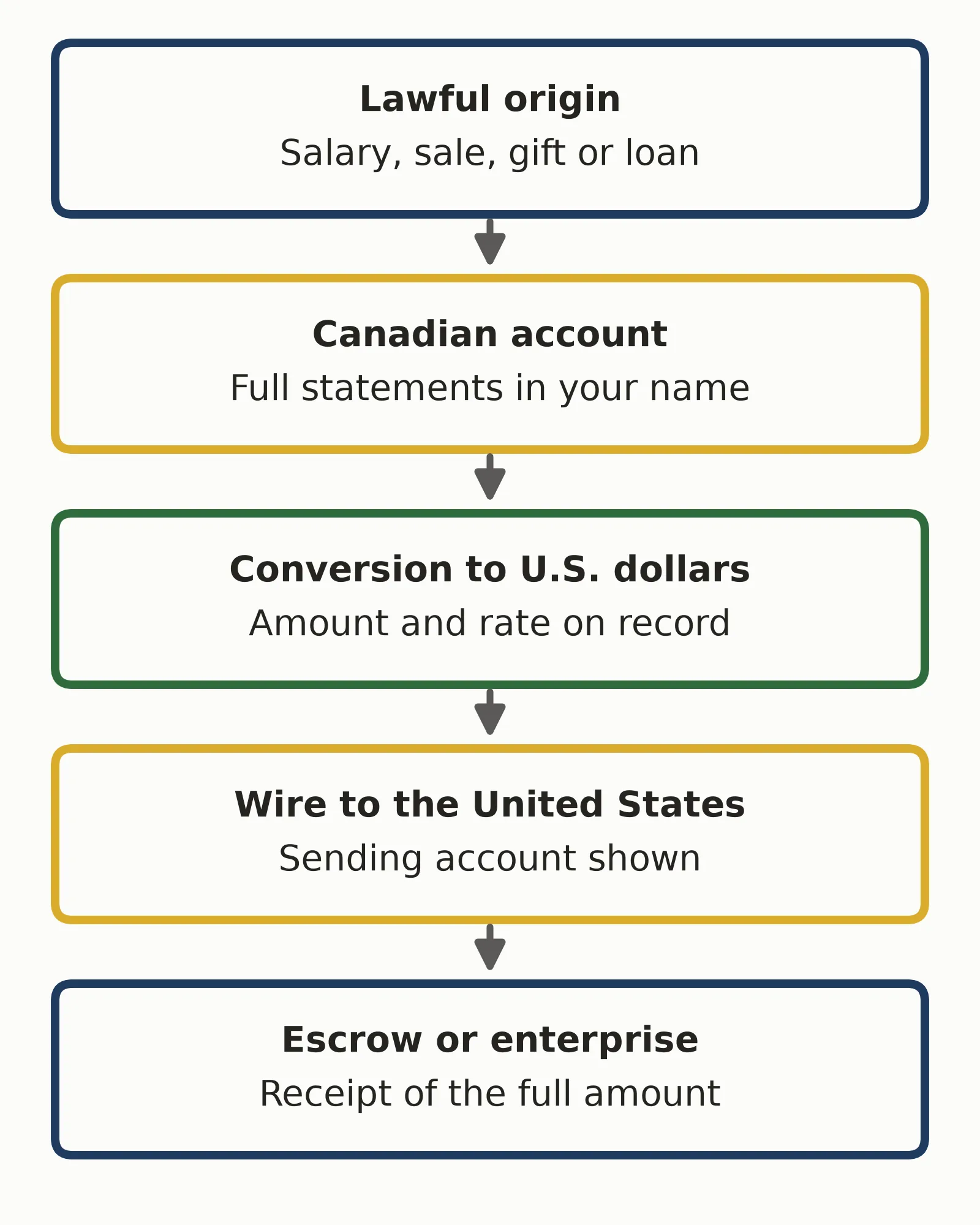
You trace funds by showing each step between the lawful source and the investment, using statements in your name for every account the money touched and transfer records that show where it came from. That chain is your EB-5 path of funds, and Figure 1 above shows its five links: lawful origin, Canadian account, conversion to U.S. dollars, wire, then escrow or the enterprise.
- Lawful origin: the statement showing the salary, sale price, gift or loan reaching your account in the amount your source records show.
- Canadian account: statements for each account in the chain, not only the first and the last. In Voja v. Noem, USCIS faulted the investor for filing no statements from his U.S. bank account, so it could not tell whether the funds were commingled with other money.
- Conversion to U.S. dollars: the record of Canadian dollars going out and U.S. dollars coming in. The form instructions tell you to identify any third party used to transfer capital, including a money-service business.
- Wire: a record that shows the sending account. In Matter of Ho, the wire receipt did not reveal which account the funds came from. In Matter of Izummi (1998), a bank letter acknowledging receipt failed for the same reason, and the decision named wire-transfer records as the kind of proof that was missing.
- Escrow or enterprise: proof the money arrived at the new commercial enterprise or its escrow account. In Voja v. Noem, USCIS also pointed to an unexplained three-month gap between the wire to the investor's attorney and the enterprise receiving the funds.
Keep the money in accounts in your own name if you can. Matter of Ho says bank statements do not prove ownership if they show someone else as the legal owner. Joint accounts need explaining: in Matter of Soffici, accounts held with the investor's father could not be split between them, and the decision said this differs from a husband and wife. If your spouse's name is on an account, file the marriage certificate, which the investor in Matter of Ho did not do.
How do exchange rates affect the amount?
Capital is valued in U.S. dollars at fair market value when it is invested, so a Canadian investor carries the exchange risk until the money converts. In the first 29 days of October 2026, the Bank of Canada's daily average rate for one U.S. dollar ranged from C$1.3985 to C$1.4271. At those two rates, US$800,000 is C$1,118,800 or C$1,141,680, a difference of C$22,880. US$1,050,000 is C$1,468,425 or C$1,498,455, a difference of C$30,030. Those are the bank's indicative rates, not the rate you would be quoted.
The Policy Manual says funds may be held in escrow in the United States to avoid evidentiary issues such as significant currency fluctuations. Where funds stay in escrow outside the United States, USCIS reviews exchange rates when it decides the petition, to determine if it is more likely than not that you will make the minimum investment. With Form I-829 it reviews the record again, including exchange rates at the time of transfer, to determine that you actually made the minimum investment when the funds were transferred to the United States, so a shortfall can appear later.
How far back must you trace?
As of October 2026, federal judges in Washington, D.C., disagree on how far back an EB-5 investor must trace funds: the 7-year period covers tax returns, the statute sets no period for other evidence, and we suggest planning for the stricter reading. In Battineni v. Mayorkas (October 2024), a judge of the D.C. federal court rejected the government's position that an investor must "trace every penny" beyond the immediate source of funds. Zhou v. Noem (February 2025) applied that reasoning to a Hong Kong currency exchanger.
In Voja v. Noem (September 2026), another D.C. federal judge went the other way, relying on the word "indirectly" in the regulation and reading it as allowing USCIS to inquire into the history of the capital. The judge added that USCIS could act arbitrarily by demanding tracing to an unreasonable extent. These are trial-level rulings on the regulation, and the petitions in all three cases predate the 2022 change, although the Voja judge saw nothing in that change that would alter the result.
Whichever reading prevails, the statute now requires records from a donor or a non-bank lender. A win in court may also mean only a remand: for the investor who won in Battineni, and in Zhou, the court sent the case back to USCIS and declined to order approval. Build the file to satisfy the stricter reading.
Why do older Canadian records go missing?
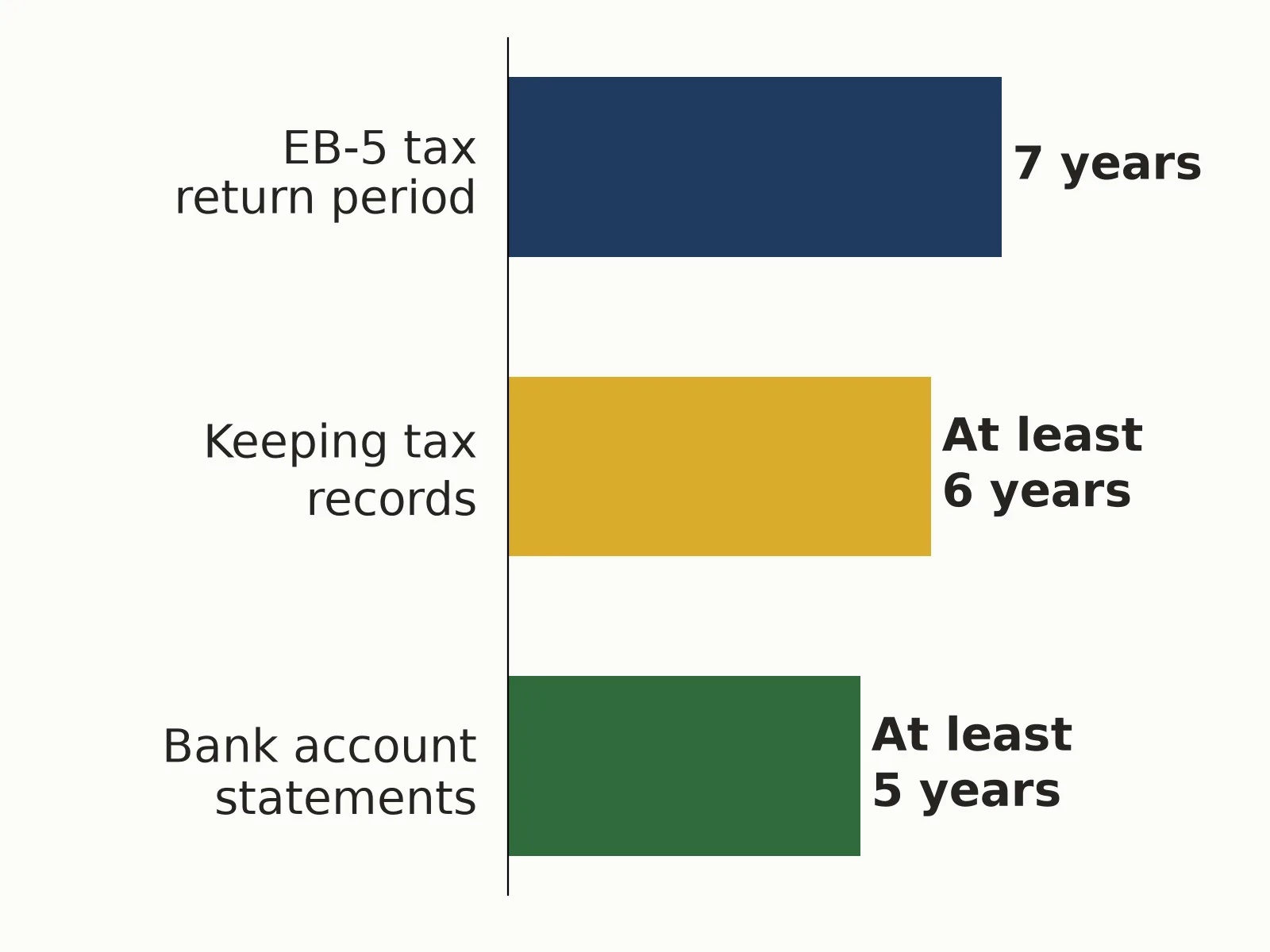
Canadian record-keeping periods are shorter than the U.S. look-back, so old records may need early requests. The CRA says to keep your tax records for at least six years. The Financial Transactions and Reports Analysis Centre of Canada (FINTRAC) requires financial entities to keep a copy of every account statement for at least five years from the date it was created. Both are minimums, and an institution may hold records longer, but a 7-year file can run past both.
Which gaps have led to EB-5 denials?
Published EB-5 decisions show denials resting on gaps such as statements in someone else's name, balances that do not add up, unsold assets, unproven income and sales with no paper. The Policy Manual's EB-5 eligibility chapter lists no triggers for a request for evidence (RFE), which is how USCIS asks for more evidence on whether you have met your burden of proof. The gaps below come from those denials. They are not an official list, and a court did not agree with USCIS on every one:
- Someone else's name: statements that show another person as the owner (Matter of Ho).
- Balances that do not add up: in Matter of Ho, the two bank accounts held less than US$250,000 before a transfer of US$515,000.
- Assets never sold: shares and property listed as wealth with no sale behind the cash (Matter of Ho).
- Income claimed but not shown: a stated career with no proof of work or pay (Matter of Ho).
- Sales with no paper: a house and a business with no contract or deed (Matter of Soffici).
- An unexplained large deposit: a cash deposit the court gave as $200,000, with no record of its origin (Voja v. Noem).
- Missing statements or a time gap: no statements for one account, and three months unaccounted for in another (Voja v. Noem).
- Redacted statements: USCIS said redactions left the nature of other transactions unclear (Battineni v. Mayorkas).
- Thin third-party proof: a letter and a photo of one cheque, for less than the amount sent, from someone the investor did not know. The court found that denial supported by substantial evidence, while sending his brother's petition back (Battineni v. Mayorkas).
Do not count on an RFE as a second chance. Volume 1, Part E, Chapter 6 of the Policy Manual says USCIS may deny a petition without one when required initial evidence is missing. It also says RFEs are not issued to cure an eligibility deficiency, because you must be eligible at filing. The maximum response time is 12 weeks, and officers cannot grant more time. Under 8 CFR 103.2(b)(13), a missed deadline can mean denial as abandoned, on the record, or both.
What should Canadian investors do first?
Start by listing every source of the money and its amount, then collect records for each source before any funds move, because the transfer itself is the part you cannot redo. These steps follow the rules above.
- Step 1: Map the money. Write down each source and how much it contributes, until the total covers the investment plus administrative costs and fees.
- Step 2: Pull CRA records. Gather 7 years of returns and notices of assessment. CRA My Account holds copies of your notices, and you may be able to view your tax slips there. Ask the employer or issuer for any missing slip.
- Step 3: Download every statement. Save statements for each account in the chain now, while your bank still has them.
- Step 4: Collect third-party files. Ask any donor or non-bank lender for their tax, business and judgment records before relying on their money.
- Step 5: Gather sale and corporate papers. Pull agreements, land registry records, corporate records and T2 returns.
- Step 6: Check court records. List any judgment or pending action against you, in any country.
- Step 7: Plan the transfer. Use accounts in your own name, a traceable wire and as few stops as possible, and avoid cash deposits you cannot explain.
- Step 8: Translate and explain. Prepare certified translations, then a short narrative and a chart that point to each document.
If you already hold E-2 status and hope to move to EB-5 later, our guide to the E-2 visa to green card options explains the routes, and our E-2 and EB-5 comparison sets out the differences. Moving money may also have tax consequences in Canada and the United States, so take tax advice on those before you act.
Frequently asked questions
Does the EB-5 source of funds rule cover fees as well as the investment?
Yes. Under the statute, the capital and any funds used to pay administrative costs and fees associated with your investment must come from a lawful source and through lawful means. The Policy Manual applies this to petitions filed on or after May 14, 2022, and the instructions for Form I-526E and Form I-526 ask you to identify the source of both.
How many years of tax returns do I need for EB-5?
For a petition filed on or after May 14, 2022, plan on 7 years of personal tax returns, or another period the Secretary of Homeland Security sets. The returns can be filed with any taxing jurisdiction, so CRA filings count. The older 5-year period applies to petitions filed before May 14, 2022, although the regulation still says five years.
Can I use money from my Canadian corporation?
Not directly, unless it has become yours. You must be the legal owner of the capital you invest, and Matter of Soffici says an investor and a corporation are not the same legal entity. Corporate money needs records showing how it lawfully reached you, plus the corporation's own tax and registration records, and the tax result should be checked first.
Can a parent's gift fund my EB-5 investment?
Yes, if it was given in good faith and not to get around limits on permissible sources of capital. For a petition filed on or after May 14, 2022, the statute requires the same business, tax and judgment records from your parent, so a gift letter on its own will not be enough. The instructions for Form I-526E and Form I-526 also ask you to identify the donor.
Can I borrow against my home to fund an EB-5 investment?
Yes, for a petition filed on or after May 14, 2022, a loan against your home can count if it was made in good faith and not to get around limits on permissible sources of capital. USCIS treats lawfully obtained loan proceeds as cash but still decides whether they were lawfully acquired and whether the capital is at risk. Keep the loan agreement, the security and proof of the advance. A private lender must supply its own records. A bank need not, but confirm that this covers a Canadian bank.
What if my bank no longer has old statements?
Ask early, and, in our view, use tax records, sale documents and employer letters to help fill the gap, since the standard is a preponderance of the evidence. FINTRAC requires financial entities to keep account statements for at least five years, so older ones may be harder to get, although an institution may hold them longer. A gap in the path may still draw questions.
Does USCIS check source of funds again at Form I-829?
Not as a listed step: the Policy Manual's Form I-829 chapter does not list a new lawful-source showing. It asks for evidence that you invested the required capital and sustained it, and for job creation evidence. Where funds were held in escrow outside the United States, the eligibility chapter says USCIS reviews the record with Form I-829, including exchange rates at the time of transfer, to determine that you actually made the minimum investment. That passage concerns the amount invested, not its lawful source. The Form I-829 chapter also says USCIS is still reviewing the 2022 law and will revise the guidance, so keep the full file through that stage.
Do documents in French need to be translated?
Yes. Any document containing a foreign language must come with a full English translation, and the translator must certify that it is complete and accurate and that the translator is competent to translate. The instructions for Form I-526E and Form I-526 add details the certification must include, such as the translator's signature, printed name and the date.
Conclusion
An EB-5 source of funds file depends on its paper. Prove how you got the money, prove that it is yours, and show every stop between the source and the investment. For a Canadian investor, the risk is timing: your six-year minimum for keeping tax records and the five-year minimum for financial entities are shorter than the U.S. look-back, and federal judges in Washington, D.C., disagree on how far back USCIS may go. Starting before any money moves leaves time to fix gaps.
How Mayo Law can help
Mayo Law advises Canadian investors and business owners on U.S. business immigration from offices in Toronto and New York. Joseph Mayo, our Principal Attorney, is licensed in Ontario and New York, and our lawyers can review your funds story, your Canadian records and your transfer plan before you file. Our guide to choosing an EB-5 immigration attorney sets out what to ask any lawyer. To discuss your file, see our business immigration page. A consultation is a paid one-hour session because a lawyer reviews your situation in depth.
Disclaimer
This guide is general information only and is not legal or tax advice. Reading it does not create a solicitor-client or attorney-client relationship. EB-5 rules, fees and investment amounts change, and every file turns on its own facts, so confirm current requirements before you act. Mayo Law provides legal services in Ontario and New York.