

Contents
- Quick answer
- What is the EB-5 visa process?
- How much must you invest for EB-5?
- Standalone or regional center: which route?
- What are the steps in the EB-5 visa process?
- What does the EB-5 process cost in USCIS fees?
- How do you prove the source of your funds?
- What should Canadian investors check first?
- Frequently asked questions
- Conclusion
- How Mayo Law can help
- Disclaimer
The EB-5 visa process turns an investment in a U.S. business into a green card. You invest at least $1,050,000, or $800,000 in a targeted employment area or infrastructure project, file a petition with U.S. Citizenship and Immigration Services (USCIS), become a conditional permanent resident for two years, and then ask USCIS to remove the conditions. For a Canadian thinking about moving to the United States through investment, each step has its own form, fee and evidence, and the order matters. It is one of several routes our business immigration lawyers compare with clients before they commit capital.
This guide sets out each step from the USCIS Policy Manual, the USCIS fee schedule and the new EB-5 fee rule as they stand in October 2026, including the fee increase for filings postmarked on or after November 30, 2026.
Quick answer
The EB-5 visa process has six steps: choose a standalone or regional center investment, invest and document your funds, file Form I-526 or I-526E, apply for a green card once the petition is approved and a visa is available, live in the United States as a conditional resident, and file Form I-829 to remove the conditions.
What is the EB-5 visa process?
The EB-5 visa process is the path from investing in a new U.S. commercial enterprise that creates at least 10 full-time jobs to holding a green card without conditions. Congress created the employment-based fifth preference (EB-5) category in 1990 to give an incentive for foreign capital investment in commercial enterprises that create or preserve U.S. jobs, according to the USCIS Policy Manual, Volume 6, Part G, Chapter 1.
The same chapter says the Immigration and Nationality Act (INA) authorizes approximately 10,000 visas each fiscal year for immigrant investors, including their spouses and unmarried children under 21. Since March 15, 2022, Congress has reserved 20 percent of those visas for investors in rural areas, 10 percent for investors in high unemployment areas and 2 percent for investors in infrastructure projects.
An EB-5 green card starts as conditional permanent residence for a 2-year period. If the applicable requirements are met, USCIS then removes the conditions and the investor and family members become lawful permanent residents without conditions. That two-stage structure is why the EB-5 green card process has two separate investor petitions rather than one.
How much must you invest for EB-5?
For petitions filed on or after March 15, 2022, the minimum EB-5 investment is $1,050,000, or $800,000 in a targeted employment area (TEA) or an infrastructure project, under the USCIS Policy Manual, Volume 6, Part G, Chapter 2, current as of October 23, 2026.
The same chapter says those amounts will automatically increase on January 1, 2027, and every 5 years after that. An investor planning a 2027 filing should expect a higher figure and confirm it on the date of filing rather than relying on the October 2026 amounts.
Three further rules shape what counts as the investment:
- U.S. dollars: the present fair market value of the investor's lawfully obtained capital is measured in U.S. dollars, so a Canadian investor's funds have to reach the minimum after conversion.
- At risk for 2 years: for petitions filed on or after March 15, 2022, the capital must be expected to remain invested for not less than 2 years.
- Jobs: the investment must create at least 10 full-time jobs for U.S. workers.
The Policy Manual also says that, as of May 14, 2022, gifts and loans to the investor are expressly permitted as capital, provided certain conditions are met. A loan counts only if the investor is personally and primarily liable for it and it is secured by the investor's own assets, not the assets of the business.
Standalone or regional center: which route?
A standalone investor puts money into a business and files Form I-526, while a regional center investor joins a pooled project sponsored by a USCIS-designated EB-5 regional center and files Form I-526E. The routes differ in how jobs are counted and in what USCIS must review before deciding the investor's petition.
The table shows the main differences, drawn from Chapters 2, 3 and 5 of the Policy Manual, the USCIS fee schedule and the new EB-5 fee rule.
| Point | Standalone | Regional center |
|---|---|---|
| Investor petition | Form I-526 | Form I-526E |
| Petition fees by Nov 29 | $3,675 | $4,675 |
| Petition fees from Nov 30 | $7,615 | $8,950 |
| Project filing first | None | Form I-956F |
| Infrastructure project | Not available | Available |
Indirect jobs count only in the regional center context: for regional center petitions filed on or after March 15, 2022, the USCIS Policy Manual (Volume 6, Part G, Chapter 2) says up to 90 percent of the full-time positions may be created indirectly, by employees who do not work for the new commercial enterprise itself. Direct jobs are jobs with an employer-employee relationship between the new commercial enterprise and the people it employs. Chapter 2 also says a standalone investor cannot establish eligibility through an infrastructure project.
Under Chapter 5 of the Policy Manual, a regional center must file Form I-956F, its application for approval of the investment, before any investor may file Form I-526E based on that offering. Chapter 3 of the Policy Manual adds that the investor may file while the project application is pending, but USCIS does not make a final decision on the investor's petition until it decides the project application. The Policy Manual also states that EB-5 visas are authorized for investors in the regional center program through September 30, 2027.
Choosing a project is a business decision as much as an immigration one. The immigration review asks whether the capital is at risk and whether the jobs will be created; it does not tell you whether the project is a sound investment. Our guide to choosing an EB-5 immigration attorney covers project due diligence in more detail.
What are the steps in the EB-5 visa process?
The EB-5 visa process runs in six steps, from choosing the investment to filing Form I-829, and each step depends on the one before it. Figure 1 shows the order and the form used at each stage.
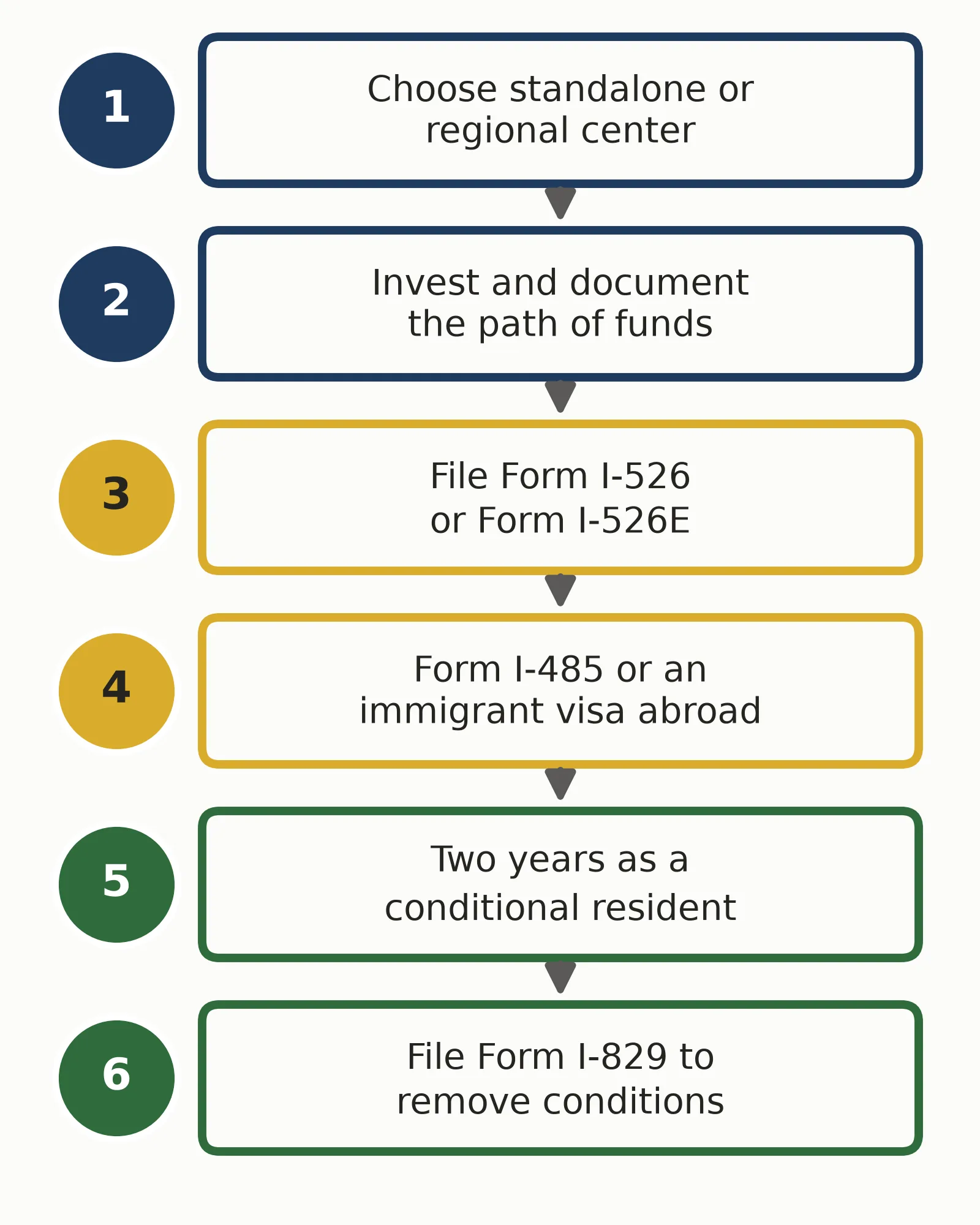
Step 1: Choose a standalone or regional center investment
Decide whether you will invest directly in your own new commercial enterprise or join a regional center project. A regional center investor should confirm that the regional center has filed Form I-956F for the offering, because Form I-526E cannot be filed until it has.
Step 2: Invest the capital and document the path of funds
The USCIS Policy Manual (Volume 6, Part G, Chapter 2) says the investor must document the path of the funds to show that the investment was made, or is actively in the process of being made, with the investor's own funds. The petition must also show the lawful source of the funds, covered in its own section below.
Step 3: File Form I-526 or Form I-526E
The standalone investor files Form I-526, Immigrant Petition by Standalone Investor; the regional center investor files Form I-526E, Immigrant Petition by Regional Center Investor. Both forms carry the edition date 01/20/25 on their USCIS pages, last updated June 1, 2026. For standalone petitions, Chapter 2 says a comprehensive business plan should describe, at a minimum, the business, its products or services and its objectives.
Step 4: Apply for the green card
The USCIS Policy Manual (Volume 6, Part G, Chapter 3) says that once the petition is approved and an immigrant visa is available, the investor may apply for an immigrant visa with the U.S. Department of State or, if eligible and in the United States, adjust status on Form I-485. Where approval of the petition would make a visa number immediately available, Form I-485 can instead be filed together with the petition, as the FAQ below explains.
Step 5: Live in the United States as a conditional resident
Conditional permanent residence lasts 2 years from the date it is granted, that is, the date the adjustment application is approved or the date the investor is admitted on an immigrant visa. The investor's derivative family members receive the same 2-year conditional status. The investment has to stay in place during the period, because the next step asks the investor to prove it was sustained.
Step 6: File Form I-829 to remove the conditions
Under Chapter 7 of the Policy Manual, the investor must file Form I-829, Petition by Investor to Remove Conditions on Permanent Resident Status, within 90 days before the 2-year anniversary of the grant of conditional residence. The petition must show that the investor invested the required capital and sustained it throughout the conditional period. It must also show that the new commercial enterprise created, or can be expected to create within a reasonable time, at least 10 full-time positions.
What does the EB-5 process cost in USCIS fees?
For a petition postmarked on or after November 30, 2026, USCIS filing fees across the whole EB-5 visa process total $15,390 for a regional center investor who adjusts status in the United States and $14,055 for a standalone investor. A petition postmarked by November 29, 2026, lowers those totals to $11,115 and $10,115.
These totals are our calculation from two official sources. The current amounts come from the USCIS Form G-1055 fee schedule, edition 10/16/26. The new amounts come from the Department of Homeland Security (DHS) EB-5 fee final rule, published in the Federal Register on September 30, 2026, which says any petition postmarked on or after November 30, 2026, must carry the new fees. The table compares the investor's own filings by postmark date.
| Filing | By Nov 29, 2026 | From Nov 30, 2026 |
|---|---|---|
| Form I-526 (standalone) | $3,675 | $7,615 |
| Initial Form I-526E | $3,675 | $7,850 |
| Integrity Fund fee (initial I-526E) | $1,000 | $1,100 |
| Form I-485 (paper) | $1,440 | Not set by the rule |
| Form I-829 | $3,750 | $5,000 |
Notes on the fees:
- Integrity Fund fee: the current schedule requires a separate $1,000 on an initial Form I-526E filed on or after October 1, 2022, under the EB-5 Reform and Integrity Act of 2022. The final rule calls it the EB-5 Integrity Fund fee and raises it to $1,100, applying an inflation adjustment.
- Technology fee: the new Form I-526 and initial Form I-526E amounts already include a $75 EB-5 technology fee, according to the rule.
- Form I-485: the current fee is $1,440 on paper or $1,390 online for an applicant over the age of 14. The rule's list of EB-5 fees does not include Form I-485, so the totals use $1,440 for both dates.
- Form I-829: it is filed near the end of the 2-year conditional period, long after November 30, 2026, so the totals use the $5,000 fee the rule sets. The fee in force on its own postmark date is the one that applies.
- Why the current fees are lower: the rule explains that a federal court in Colorado stayed certain EB-5 fees in Moody v. Noem, and USCIS reverted on November 12, 2025, to the EB-5 fees in effect until March 31, 2024.
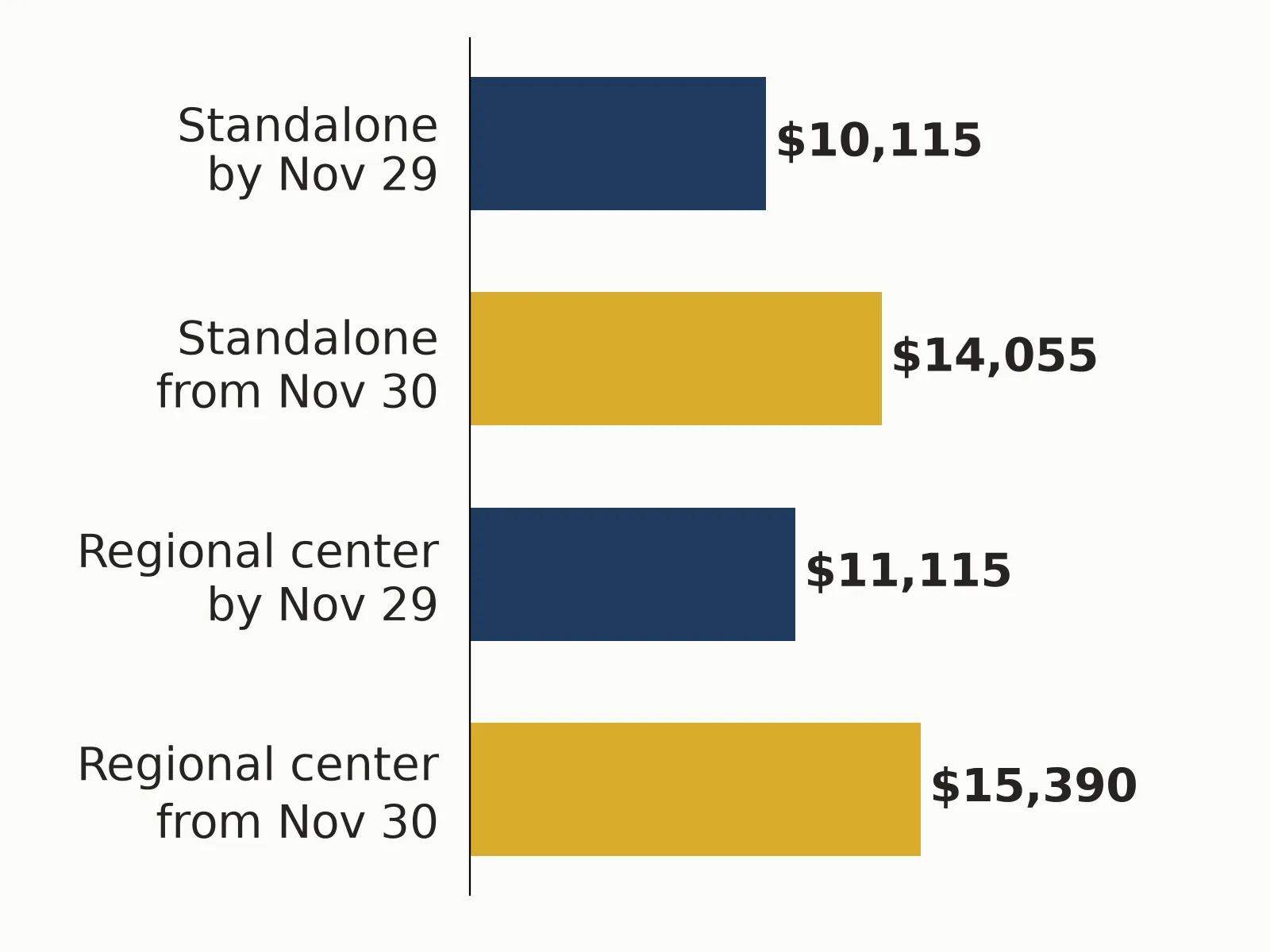
For a regional center investor whose petition is postmarked from November 30, 2026, the total is $7,850 plus $1,100 plus $1,440 plus $5,000, which equals $15,390. With a petition postmarked by November 29, 2026, it is $3,675 plus $1,000 plus $1,440 plus $5,000, which equals $11,115. A standalone investor does not pay the Integrity Fund fee, which gives $14,055 and $10,115.
These figures cover one investor who adjusts status in the United States. An investor who applies for an immigrant visa through the Department of State does not file Form I-485, and the Department of State's own fees are not part of these totals. Each family member who adjusts status files a separate Form I-485 with its own fee, and the investment itself and any professional fees are extra.
How do you prove the source of your funds?
You prove the source of your funds by showing, with documents, that the capital came from a lawful source and tracing its path from that source into the investment. Chapter 2 of the Policy Manual says assets acquired by unlawful means are not capital and the investor must show the direct and indirect source of the investment.
The Policy Manual lists the evidence a petition must include, as applicable:
- Business records: foreign business registration records and returns filed by any entity.
- Tax returns: personal tax returns of any kind filed within 5 years with any taxing jurisdiction in or outside the United States.
- Other sources: evidence identifying any other source of capital, such as audited financial statements, loan documents, earnings statements or gift instruments.
- Court records: certified copies of judgments and pending civil or criminal actions against the investor from any court in or outside the United States within the past 15 years.
The tax-return rule expressly covers returns filed outside the United States, so a Canadian investor's returns filed with the Canada Revenue Agency (CRA) are within it. Because Chapter 2 asks for both the direct and the indirect source, a file built on a business sale, a gift or a loan may have to document the earlier source as well as the final transfer.
What should Canadian investors check first?
Canadian investors should first decide whether they need a green card at all, because Canada is an E-2 treaty country, and the E-2 treaty investor classification is a separate, nonimmigrant route for business owners. The State Department's Foreign Affairs Manual, 9 FAM 402.9, lists Canada for E-2 status from January 1, 1994.
The two programs answer different needs. The E-2 is a nonimmigrant classification under INA 101(a)(15)(E), while the EB-5 leads to permanent residence. Our comparison of the E-2 and EB-5 visas sets out the trade-offs, and our guide to the E-2 visa to green card path covers investors who start on an E-2 and move to the EB-5 later.
Four timing points matter for a Canadian planning an EB-5 filing in late 2026 or 2027:
- Filing fees: the new EB-5 fees apply to petitions postmarked on or after November 30, 2026.
- Investment amounts: the minimums increase automatically on January 1, 2027.
- Regional center authorization: the program is authorized through September 30, 2027, according to the Policy Manual.
- Visa availability: the green card step can start only when an immigrant visa is available, and USCIS and the Department of State point applicants to the monthly Visa Bulletin for that.
Our guide to moving from Canada to the US covers the tax questions that come with the move.
Frequently asked questions
How long does the EB-5 visa process take?
It takes at least the 2-year conditional residence period plus everything before it, so the whole process runs over several years. The time before conditional residence depends on USCIS processing of the investor petition, the time until an immigrant visa is available, as shown in the monthly Visa Bulletin, and the green card step itself.
Can my spouse and children get green cards through my EB-5 investment?
Yes. The USCIS Policy Manual says the roughly 10,000 EB-5 visas available each fiscal year cover immigrant investors together with their spouses and unmarried children under the age of 21. Each family member who adjusts status in the United States files a separate Form I-485, with its own filing fee.
Can I file Form I-485 at the same time as my EB-5 petition?
Sometimes. The USCIS Policy Manual allows employment-based fifth preference applicants to file Form I-485 together with the investor petition, but only where approval of the petition would make a visa number immediately available. USCIS has required separate fee payments for each form in such a filing since September 1, 2022.
What happens to the EB-5 investment amount on January 1, 2027?
The USCIS Policy Manual says the $1,050,000 and $800,000 minimums for petitions filed on or after March 15, 2022, will automatically increase on January 1, 2027, and every 5 years after that. The Policy Manual chapter, current as of October 23, 2026, does not yet state the new amounts.
Can I use a gift or a loan for my EB-5 investment?
Yes, within limits. As of May 14, 2022, the USCIS Policy Manual says gifts and loans to the investor are expressly permitted as capital, provided certain conditions are met. A loan counts only if you are personally and primarily liable for it and it is secured by your own assets, not the assets of the business.
Can I file Form I-526E before the regional center project is approved?
Yes, once the regional center has filed Form I-956F for the offering. The USCIS Policy Manual says the investor may file Form I-526E while the project application is pending, but USCIS will not make a final decision on the investor's petition until it has decided the project application.
Are EB-5 filing fees going up?
Yes. A Department of Homeland Security final rule published on September 30, 2026, sets new EB-5 fees for anything postmarked on or after November 30, 2026: $7,615 for Form I-526, $7,850 for an initial Form I-526E, $1,100 for the Integrity Fund fee and $5,000 for Form I-829.
Does an EB-5 green card start as a conditional green card?
Yes. EB-5 investors and their families receive conditional permanent residence for a 2-year period. Within the 90 days before the second anniversary, the investor files Form I-829 to show that the investment was sustained, and USCIS then decides whether to remove the conditions.
Conclusion
Three dates shape the EB-5 visa process for anyone planning now: the November 30, 2026, fee increase, the January 1, 2027, investment increase and the September 30, 2027, end of the current regional center authorization. The investment amount, the route, the source-of-funds file and the timing of each form all have to line up. For a Canadian investor, the first question is often whether the E-2 already meets the goal; where permanent residence is the aim, the EB-5 gives a defined, if long, path to it.
How Mayo Law can help
Mayo Law advises Canadian investors, founders and families on U.S. immigration, from offices in Toronto and New York. Joseph Mayo, our principal attorney, is licensed in Ontario and New York, and our U.S. immigration practice helps clients compare the EB-5 with the E-2 and other routes, organize the source-of-funds evidence and plan the timing of each filing. We offer a paid one-hour consultation, because a lawyer reviews your goals, your funds and your timeline in depth before advising.
Disclaimer
This guide is for general information only and is not legal advice. Reading it does not create a solicitor-client or attorney-client relationship. Immigration rules, fees and investment amounts change, and the right route depends on your facts. Mayo Law provides legal services in Ontario and New York.