

Contents
- Quick answer
- Who qualifies for EB-2 in the first place?
- How does USCIS decide an EB-2 NIW petition?
- EB-2 NIW vs EB-1A vs PERM
- How the process works from Canada
- What does an EB-2 NIW cost in 2026?
- What USCIS approval data shows
- Issues specific to Canadian applicants
- Frequently asked questions
- Conclusion
- How Mayo Law can help
- Disclaimer
The EB-2 NIW (often searched as EB2 NIW) is one of the few U.S. green card routes a Canadian professional or founder can file without an American employer. NIW stands for national interest waiver: USCIS agrees to waive the job offer and the labor certification that a second preference (EB-2) green card normally requires, because your work serves the national interest of the United States. You can file the petition yourself, from Canada or from inside the United States.
That freedom comes with a demanding test. USCIS first checks that you qualify for EB-2 at all, then applies the three-part framework from Matter of Dhanasar. Approval rates have fallen every year since 2022, and in October 2026 the EB-2 queue for most countries, including Canada, stopped being current. This guide walks through the EB-2 NIW requirements, the government fees in effect as of October 2026, the process from Canada, and the points that trip up Canadian applicants in particular.
Quick answer
An EB-2 NIW lets you self-petition for a U.S. green card without a job offer or PERM labor certification. You need an advanced degree (or a bachelor's plus five years of progressive experience) or exceptional ability, and proof that your endeavor has substantial merit and national importance, that you can advance it, and that the waiver benefits the United States.
Who qualifies for EB-2 in the first place?
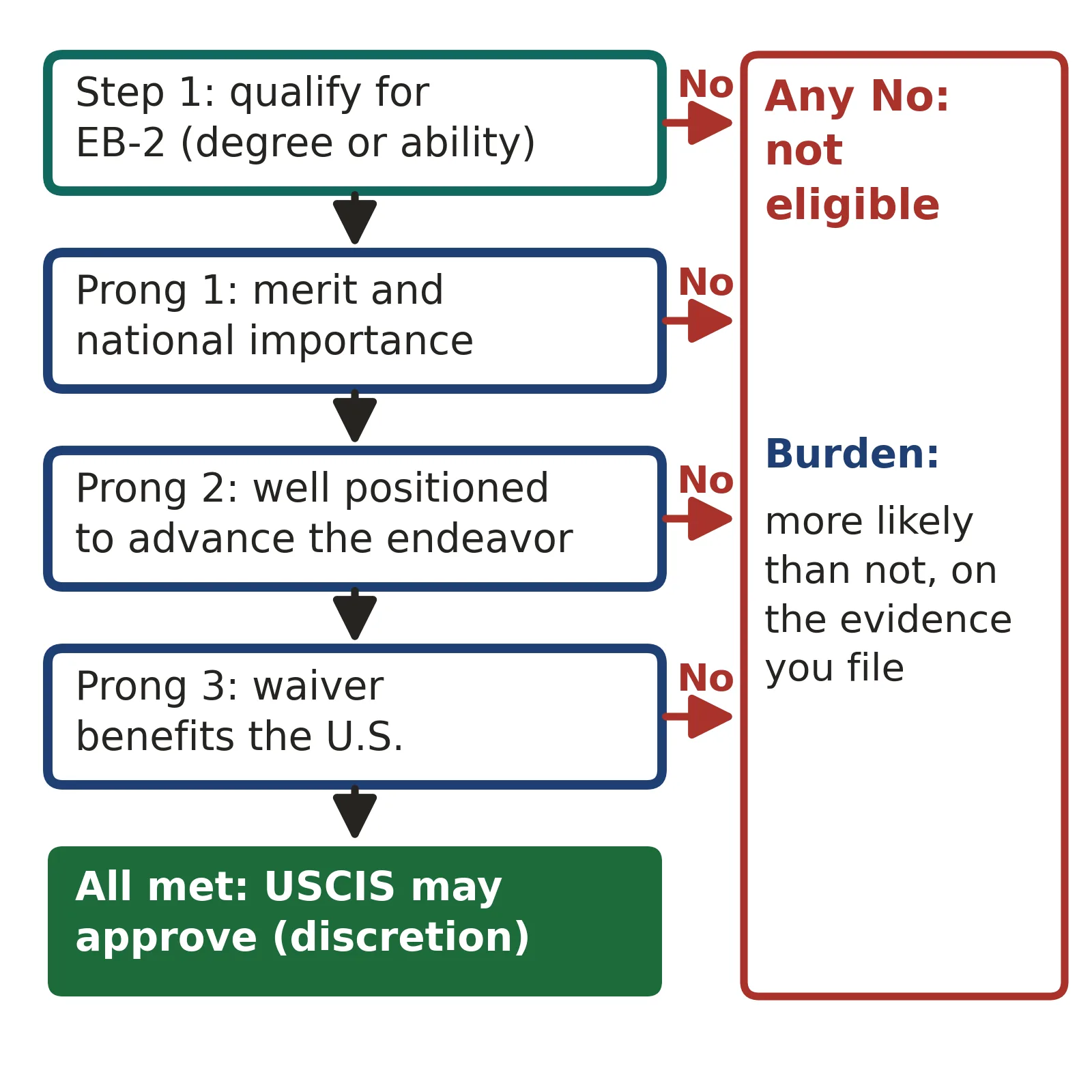
A national interest waiver is not a separate visa category. It is a waiver available inside EB-2, so the first question is always whether you fit EB-2. The waiver comes from section 203(b)(2)(B)(i) of the Immigration and Nationality Act, which lets the government waive the requirement that your services be sought by a U.S. employer when it considers the waiver to be in the national interest. Since January 15, 2025, the USCIS Policy Manual, Volume 6, Part F, Chapter 5, has spelled out that USCIS checks EB-2 eligibility before it looks at the waiver, and that it may deny a petition without reaching the national interest question if the threshold is not met.
There are two ways in.
- Advanced degree professional: a U.S. master's degree or higher, or a foreign degree evaluated as equivalent. A U.S. bachelor's degree (or foreign equivalent) followed by at least five years of progressive, post-degree experience in the specialty counts as the equivalent of a master's degree under 8 CFR 204.5(k).
- Exceptional ability: expertise significantly above that ordinarily encountered in the sciences, arts or business, shown through at least three of six types of evidence and then a review of the evidence as a whole. The six types are an official academic record in the field, letters documenting at least ten years of full-time experience, a professional licence, a salary showing exceptional ability, membership in professional associations, and recognition from peers or official bodies.
Two details catch people out. First, the advanced degree route requires that the occupation itself be a profession, meaning one that requires at least a bachelor's degree for entry. The Policy Manual's own example is an engineer with a master's degree who proposes to open a bakery: the degree is advanced, but that person may have difficulty qualifying, because the occupation of baker does not typically require a bachelor's degree for entry. Second, for exceptional ability, the area of exceptional ability must be directly related to the proposed endeavor.
For Canadians, this step usually turns on credentials. USCIS looks at whether a foreign degree is equivalent to a U.S. degree. If your file relies on a bachelor's degree plus five years of experience, the experience must come after the degree and be in the specialty, which USCIS generally reads as related to your degree and to the proposed endeavor.
How does USCIS decide an EB-2 NIW petition?
Once you clear the EB-2 threshold, USCIS applies the framework set out by its Administrative Appeals Office in Matter of Dhanasar, 26 I&N Dec. 884 (AAO 2016), decided December 27, 2016. That decision vacated the older test from Matter of New York State Department of Transportation (1998), partly because the old test was poorly suited to entrepreneurs and self-employed people. USCIS may grant the waiver as a matter of discretion if you prove each prong by a preponderance of the evidence, meaning more likely than not.
Prong 1: substantial merit and national importance
The question here is about the endeavor, not about you. USCIS wants a specific description of what you will do, which is narrower than your occupation. In Dhanasar the occupation was engineer; the endeavor was research and development on air and space propulsion systems. Merit can come from business, entrepreneurship, science, technology, culture, health or education. National importance is about potential impact, not geography: an endeavor can qualify through national or global implications in its field, or through significant potential to employ U.S. workers or other substantial positive economic effects, particularly in an economically depressed area.
The Policy Manual lists what does not work on its own: general statements that entrepreneurs create jobs, the importance of a whole industry, working in an occupation with a national shortage, classroom teaching without broader impact, and benefits that flow only to one employer, even a large one.
Prong 2: well positioned to advance the endeavor
This prong is about you. USCIS looks at your education, skills, knowledge and record of success in similar efforts, a detailed plan you developed or helped develop, progress already made, and interest from customers, users, investors or other relevant parties. You do not have to show that the endeavor will more likely than not succeed, but unsupported projections do not carry the burden.
Prong 3: on balance, the waiver benefits the United States
Here you show that the reasons to waive the job offer outweigh the protection the labor certification gives U.S. workers. Factors from Dhanasar include whether a labor certification would be impractical for someone with your qualifications or endeavor, whether the United States benefits from your contribution even if other U.S. workers are available, and whether the national interest in your work is urgent. For entrepreneurs, the Policy Manual notes that where you are self-employed in a way that generally does not hurt U.S. workers, or you own a business that employs U.S. workers, there may be little benefit from a labor certification. A national labor shortage in your occupation does not satisfy this prong by itself.
Founders, STEM degrees and supporting evidence
The current Policy Manual includes specific guidance for two groups. For people with advanced degrees in science, technology, engineering or mathematics, USCIS treats an advanced STEM degree, especially a Ph.D., tied to the proposed endeavor and to work on a critical and emerging technology or another area important to U.S. competitiveness or national security as an especially positive factor under prong 2, and as part of a strong positive factor under prong 3. For entrepreneurs, it warns that not every founder qualifies and gives examples: a consulting firm serving a nationally important occupation, or a car dealership justified by the importance of the car dealership industry, will not establish national importance without more.
The Policy Manual's non-exhaustive list of helpful evidence includes:
- Degrees, licences, patents, trademarks or copyrights in the field
- Published work, citation history, or media coverage of your work
- A plan for continuing the work in the United States, backed by independent evidence
- Letters from prospective customers, users or investors, and copies of contracts or licences
- Investment from U.S. venture capital firms, angel investors or accelerators, in amounts suited to the endeavor
- Letters from interested U.S. government agencies or quasi-governmental entities, and government grants or awards
Expert letters help most when they come from people with first-hand knowledge of your achievements, give specific examples, and are backed by other independent evidence.
EB-2 NIW vs EB-1A vs PERM
The national interest waiver sits between two other employment-based options. The table shows where each one draws its line; the standards come from 8 CFR 204.5, Matter of Dhanasar and the USCIS EB-2 page.
| Route | Employer needed? | Core standard |
|---|---|---|
| EB-2 NIW | No, self-petition | Dhanasar three prongs |
| EB-1A | No, self-petition | Sustained national or international acclaim |
| EB-2 with PERM | Yes, U.S. employer | Labor certification first |
EB-1A requires evidence of a one-time major, internationally recognized award or at least three of the ten criteria listed in 8 CFR 204.5(h)(3), and meeting three criteria does not by itself establish eligibility. It is a higher bar, and it is a separate first preference queue. An employer-sponsored EB-2 needs a job offer and, in most cases, a Department of Labor certification; our guide to getting a green card through employment covers PERM step by step. Managers and executives moving within a company often look at EB-1C instead, which we cover in our L-1A visa to green card guide.
How the process works from Canada
The filing itself is a single petition, but the green card comes later, and when it comes depends on visa availability.
- Step 1: Build the record for EB-2 eligibility and the three prongs. The petition must include a completed Form ETA-9089 Appendix A and a signed Form ETA-9089 Final Determination, even though no Department of Labor approval is needed.
- Step 2: File Form I-140, Immigrant Petition for Alien Workers, as your own petitioner. Because no labor certification is required, your priority date is the date the completed, signed petition, with all initial evidence and the correct fee, is properly filed with USCIS.
- Step 3 (optional): Request premium processing with Form I-907. For national interest waiver petitions, USCIS commits to take action (an approval, denial, request for evidence or notice of intent to deny) within 45 business days, not the 15 business days that applies to most classifications, or refund the premium fee. To request premium processing at the same time as the I-140, USCIS says to file both by mail; if you file the I-140 online, you can send the I-907 separately afterwards.
- Step 4, inside the United States: If you are in the United States and otherwise eligible to adjust status, you can file Form I-485 once your priority date is earlier than the date on the chart USCIS designates for that month. Federal regulations allow the I-140 and I-485 to be filed together when approval of the petition would make a visa immediately available, and USCIS lets self-petitioners file both together online.
- Step 4, from Canada: If you will complete the process outside the United States, the approved case goes to the State Department's National Visa Center and then to an immigrant visa interview. The State Department's instructions for applicants interviewing in Canada are for the U.S. Consulate General in Montreal: register with the courier service, then book a medical exam with a consulate-approved doctor in Canada.
According to the USCIS second preference page, once your I-140 is approved, your spouse and unmarried children under 21 may also be eligible to apply for admission to the United States in immigrant status.
Where the visa bulletin stands in October 2026
Under the State Department's Visa Bulletin for October 2026, the EB-2 final action date for "All Chargeability Areas Except Those Listed" is January 1, 2025, and the dates for filing chart shows March 15, 2026. In the September 2026 bulletin, that same final action date was "C" (current). For October 2026, USCIS says employment-based adjustment applicants must use the dates for filing chart. In practice, a Canadian-born applicant in the United States who is otherwise eligible to adjust status and has a priority date before March 15, 2026 can file an I-485 this month, but the green card itself cannot be approved until the priority date is earlier than the final action date. A petition filed now would have an October 2026 priority date, later than the March 15, 2026 cutoff, so new all chargeability filers cannot file the I-140 and I-485 together this month. Canada is not listed separately, so Canadian-born applicants use the all chargeability column. The bulletin changes monthly.
What does an EB-2 NIW cost in 2026?
The USCIS fees below come from the fee schedule edition dated October 1, 2026 (Form G-1055). Self-petitioners pay the reduced Asylum Program Fee of $300, the same rate as small employers, rather than the $600 regular rate.
| Fee | Paper filing | Online filing |
|---|---|---|
| I-140 petition | $715 | $665 |
| Asylum Program Fee | $300 | $300 |
| I-907 premium processing | $2,965 | $2,965 |
| I-485, age 14 or older | $1,440 | $1,390 |
A worked example, calculated from those figures: a self-petitioner filing the I-140 on paper pays $715 plus the $300 Asylum Program Fee, or $1,015. Adding premium processing brings the petition stage to $3,980. If the same person later adjusts status in the United States on paper, the I-485 adds $1,440, for $5,420 in government fees before any spouse or child. A consular case instead pays the State Department's immigrant visa application processing fee for employment-based applications, $345 per person as of October 2026, plus the separate USCIS Immigrant Fee. Fees for work and travel permits filed with an I-485, medical exams, translations and credential evaluations are extra. Check the current USCIS fee schedule before you file, because a petition with the wrong fee is rejected.
What USCIS approval data shows
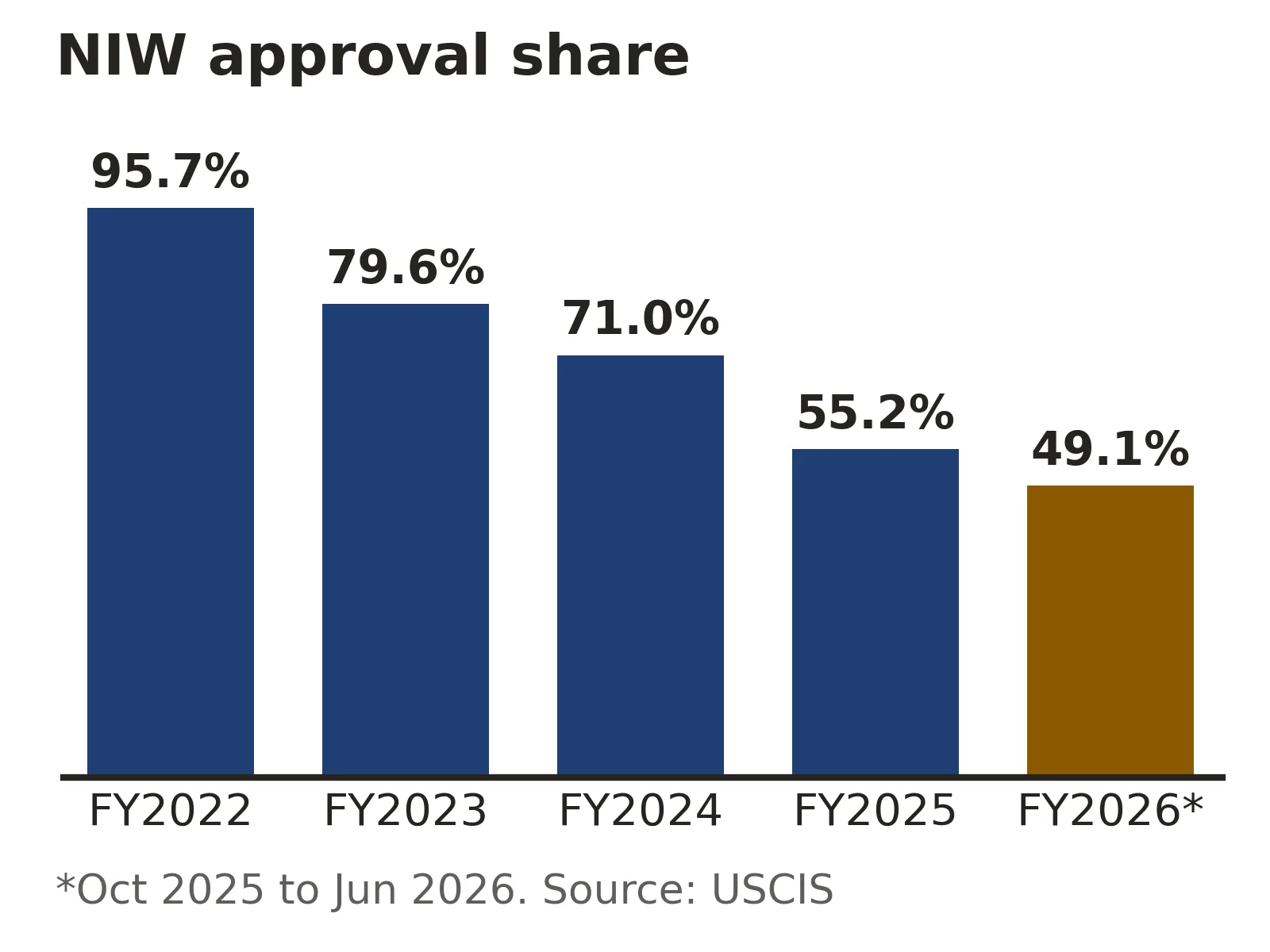
USCIS publishes quarterly counts for Form I-140 that break out national interest waiver petitions as their own line. We calculated the approval share as approvals divided by approvals plus denials in each period. In fiscal year 2022, USCIS approved 10,316 NIW petitions and denied 468, an approval share of 95.7%. The share then fell to 79.6% in fiscal 2023 (31,889 approved, 8,172 denied), 71.0% in fiscal 2024 (27,526 approved, 11,256 denied) and 55.2% in fiscal 2025 (19,532 approved, 15,863 denied). In the first three quarters of fiscal 2026, October 2025 through June 2026, USCIS approved 9,238 and denied 9,585, a share of 49.1%.
Demand rose at the same time. NIW receipts went from 21,973 in fiscal 2022 to 66,276 in fiscal 2025, about three times as many, and 96,297 NIW petitions were pending at the end of June 2026. Canadian-born beneficiaries are a small part of that pool: in April through June 2026, USCIS received 125 NIW petitions for people born in Canada, out of 13,831 in total. These are aggregate counts. They do not tell you how USCIS will view any single petition, and a well-documented case is judged on its own record.
Issues specific to Canadian applicants
Three points come up often for Canadians.
- TN status and immigrant intent: 8 CFR 214.6 defines the temporary entry that TN status requires as entry without the intent to establish permanent residence, and you must satisfy the inspecting officer that your stay is temporary. Filing an immigrant petition while relying on TN status needs planning around border crossings and renewals. Our TN visa guide for Canadians explains the dual intent issue.
- Country of birth, not passport: Under section 202(b) of the Immigration and Nationality Act, the country a green card applicant is charged to is generally decided by place of birth, with limited exceptions, such as an accompanying spouse who may in some cases be charged to the other spouse's country. A Canadian citizen born in India or mainland China is generally charged to that country, and in October 2026 both have earlier EB-2 final action dates (November 1, 2013 for India and October 1, 2021 for mainland China) than the all chargeability column.
- Founders and investors: Canadians running a U.S. business on an E-2 visa sometimes pursue an NIW as their permanent route. Our guide to moving from an E-2 visa to a green card compares it with EB-5 and other options, and our overview of the American entrepreneur visa options covers the temporary routes.
Frequently asked questions
Can a Canadian apply for an EB-2 NIW while living in Canada?
Yes. A national interest waiver petition does not require a U.S. employer, so you can file Form I-140 as your own petitioner while living in Canada. If the petition is approved and a visa number is available, the case moves to the National Visa Center and an immigrant visa interview, which for applicants in Canada is handled by the U.S. Consulate General in Montreal.
Do I need a job offer for a national interest waiver?
No. The waiver removes the job offer requirement and, with it, the PERM labor certification. You still file the employee-specific parts of Form ETA-9089, specifically Appendix A and a signed Final Determination, without Department of Labor approval. You must also show how you will advance your proposed endeavor in the United States.
Can I file an EB-2 NIW while working in the United States on TN status?
The petition can be filed, but the timing needs care. TN admission under 8 CFR 214.6 requires entry without the intent to establish permanent residence, and you must satisfy the inspecting officer that your stay is temporary. Because an immigrant petition signals a plan to live in the United States permanently, map out filings, travel and TN renewals before you file.
How long does an EB-2 NIW take in 2026?
With premium processing, USCIS commits to take action on a national interest waiver I-140, such as an approval, denial or request for evidence, within 45 business days, or refund the premium fee. The full green card timeline then depends on the visa bulletin. In October 2026, the EB-2 final action date for the all chargeability column, which includes Canada, is January 1, 2025, so recent priority dates must wait for the date to advance.
Is a bachelor's degree enough for an EB-2 NIW?
Only with experience. A U.S. bachelor's degree or foreign equivalent counts as an advanced degree if it is followed by at least five years of progressive experience in the specialty, earned after the degree. Without that experience, you would need a master's degree or higher, or you would have to qualify through exceptional ability using at least three of the six regulatory criteria.
Can my spouse and children get green cards through my NIW?
Generally, yes. According to USCIS, once your I-140 is approved, your spouse and unmarried children under 21 may be eligible to apply for admission to the United States in immigrant status based on that approval. Each family member files their own adjustment application or immigrant visa application and pays the fee that applies to them.
What happens if my NIW petition is denied?
Under the USCIS Policy Manual, a decision denying a national interest waiver must include information about appeal rights and the option to file a motion to reopen or reconsider. Read the stated reasons closely before choosing a next step, since they show which prong or threshold requirement the evidence did not establish in the eyes of the officer.
Conclusion
The national interest waiver gives Canadian professionals and founders something rare in U.S. immigration: control over their own green card petition. The price of that control is proof. You must first qualify for EB-2, then show that your specific endeavor matters nationally, that you are the person to carry it forward, and that the United States gains more by waiving the job offer than by requiring one. With approval rates near half and the EB-2 queue retrogressed in October 2026, the strength of the record matters more than the speed of filing.
How Mayo Law can help
Mayo Law is a cross-border firm with offices in Toronto and New York. Joseph Mayo, the firm's principal attorney, is licensed in Ontario and New York and advises Canadian professionals, founders and their businesses on U.S. immigration, including whether an EB-2 NIW, EB-1, employer sponsorship or another route fits the facts. We can review your credentials and proposed endeavor against the current USCIS guidance, help you assemble the evidence for each prong, and plan the timing of filings and cross-border travel around your current status. Learn more about our business immigration services.
Disclaimer
This article is for general information only and is not legal advice. Reading it does not create a solicitor-client or attorney-client relationship. Immigration rules, fees and visa bulletin dates change often; confirm the current requirements with official sources or a licensed lawyer before acting. Mayo Law provides legal services in Ontario and New York.