

Contents
- Quick answer
- Do Canadians need a visa to work in the US?
- Which Canadians can work in the US without a work visa?
- What counts as working in the US?
- Which status fits which Canadian?
- Can the spouse of a Canadian worker work in the US?
- What does a US employer need from a Canadian hire?
- What happens if a Canadian works without authorization?
- Frequently asked questions
- Conclusion
- How Mayo Law can help
- Disclaimer
Can a Canadian work in the US? Yes, but only once the person holds a US status that allows that specific job, or is already a US citizen or green card holder. A Canadian passport gets most travellers across the border without a visa. It does not give anyone the right to work. That gap catches more Canadians than any single visa rule, because a visa-free entry feels like permission when it is not.
This guide starts where the law starts: with status. It covers the Canadians who need no work visa at all, what US law treats as work, the statuses that do allow employment and where each one is decided, what spouses may do, what an employer has to check, and what unauthorized work can cost later. Every rule below was checked against the Code of Federal Regulations, the US Code, the Foreign Affairs Manual and the Department of State in October 2026. For a side-by-side comparison of the visa categories themselves, see our guide to US work visas for Canadians.
Quick answer
A Canadian can work in the US only with work authorization: US citizenship, a green card, or a nonimmigrant status that allows the job, such as TN, L-1, E-2, H-1B or O-1. A visa-free visitor entry is not permission to work. TN and L-1 can be decided at the border, while E-2 needs a visa from a US consulate.
Do Canadians need a visa to work in the US?
Usually not a visa, but always a status. The entry rule is in 8 CFR 212.1(a)(1): "A visa is generally not required for Canadian citizens," except for Canadians in the E, K, S and V categories. That rule decides how a Canadian is admitted. It says nothing about whether the person may take a job.
Work is governed by a different rule. Under 8 CFR 214.1(e)(1), a visitor for pleasure may not engage in any employment, and any other nonimmigrant may work only if the classification itself authorizes employment or the person has been granted permission to work. Under 8 CFR 214.1(e)(2), a nonimmigrant who may work "may engage only in such employment as has been authorized." So the useful question is never whether the passport is enough. It is which status the person holds, and whether that status covers this employer and this job.
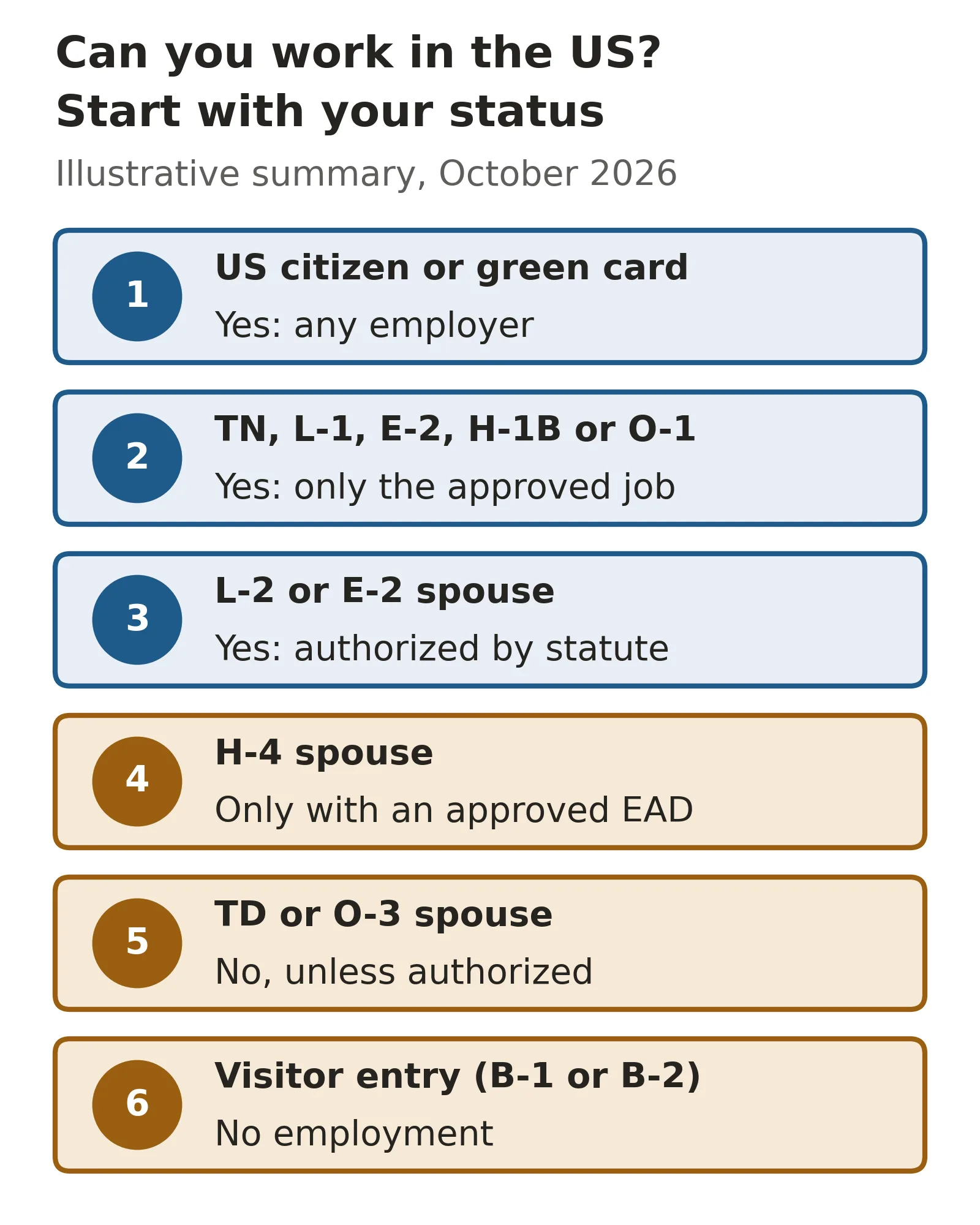
For many Canadian employees the answer comes from the TN category, for staff moving within a company group it is the L-1, and for founders and investors it is E-2. The E categories are where a Canadian does need a visa, because they are one of the exceptions written into 8 CFR 212.1(a)(1). Figure 1 sets out the order in which we test a Canadian's position.
Which Canadians can work in the US without a work visa?
Three groups of Canadians need no work visa at all, because their status already authorizes employment with any employer.
- US citizens, including some who do not know it: a Canadian born outside the United States to a US citizen parent may already be a US citizen. For a child born in wedlock on or after November 14, 1986 to one US citizen parent and one non-citizen parent, the Department of State explains that the US citizen parent must have been physically present in the United States for five years before the birth, at least two of them after turning 14. That is the rule in section 301(g) of the Immigration and Nationality Act (8 U.S.C. 1401(g)). Births before that date are governed by the law in force at the time of birth. A US passport then proves both identity and the right to work.
- Green card holders: a lawful permanent resident is authorized to work incident to that status under 8 CFR 274a.12(a)(1). The card is not tied to an employer. Our guide to the green card application process covers how Canadians usually get one.
- People holding an Employment Authorization Document: an EAD with a photograph is listed in 8 CFR 274a.2(b)(1)(v)(A)(4) as a document that proves both identity and work authorization, for the period and category it shows.
The citizenship point deserves a second look in any Canadian family with an American parent. If the parent met the physical presence rule, the child is not applying for permission to work in the US. The child is documenting a citizenship that already exists, which is a very different file.
What counts as working in the US?
The regulations define the term. Under 8 CFR 274a.1(h), "employment means any service or labor performed by an employee for an employer within the United States." Two practical points follow from that wording.
First, the place where the work is done matters. A Canadian who works from home in Canada for a US company is not performing service or labor within the United States, so that work is not a US work authorization question under this definition. Canadian payroll, tax and employment law questions still apply, and they are not covered here.
Second, a business trip is not a job. The B-1 business visitor category covers activities such as meetings, contract negotiations and conferences, as our guide on the B-1 business visitor rules for Canadians explains. The Foreign Affairs Manual states at 9 FAM 402.2-5(A) that a B-1 visa "is not appropriate for applicants who intend to obtain and engage in employment," and at 9 FAM 402.2-5(F)(1) that a person in B-1 status "may not receive a salary from a U.S. source for services rendered" in connection with US activities.
No provision in 8 CFR addresses, by name, a visitor who keeps answering email for a Canadian employer during a US holiday. The rules that do exist point to caution: a visitor for pleasure "may not engage in any employment" under 8 CFR 214.1(e)(1), and the B-1 guidance turns on where the pay comes from and what the work is for. In our view the risk concentrates where a visitor delivers services to US clients or a US business over a period of weeks. That pattern is the one most likely to be treated as unauthorized work, however the payment is routed.
Which status fits which Canadian?
The status follows the person's situation, and the place where it is decided changes how fast a Canadian can start. Table 1 matches the common situations to the status we test first.
| Situation | Status to test | Where decided |
|---|---|---|
| Job offer in a listed profession | TN | Port of entry or pre-clearance |
| Transfer within a company group | L-1 | Land port, pre-clearance or USCIS |
| Investing in your own US business | E-2 | US consulate (visa needed) |
| Specialty occupation job offer | H-1B | USCIS petition |
| Record of extraordinary ability | O-1 | USCIS petition |
| Meetings or a conference | B-1 | Not a work status |
Two of these statuses can be decided in a single visit, which is a real procedural advantage for Canadians. Under 8 CFR 214.6(d)(2), a Canadian seeking TN status applies to an officer at a Class A port of entry, a US airport handling international traffic, or a pre-clearance station. Under 8 CFR 214.2(l)(17)(i), an employer may file an individual L-1 petition for a Canadian citizen together with the application for admission, at a Class A port on the US-Canada land border or at a pre-clearance station in Canada. Our guides to the TN visa for Canadians and the L-1 visa from Canada walk through both.
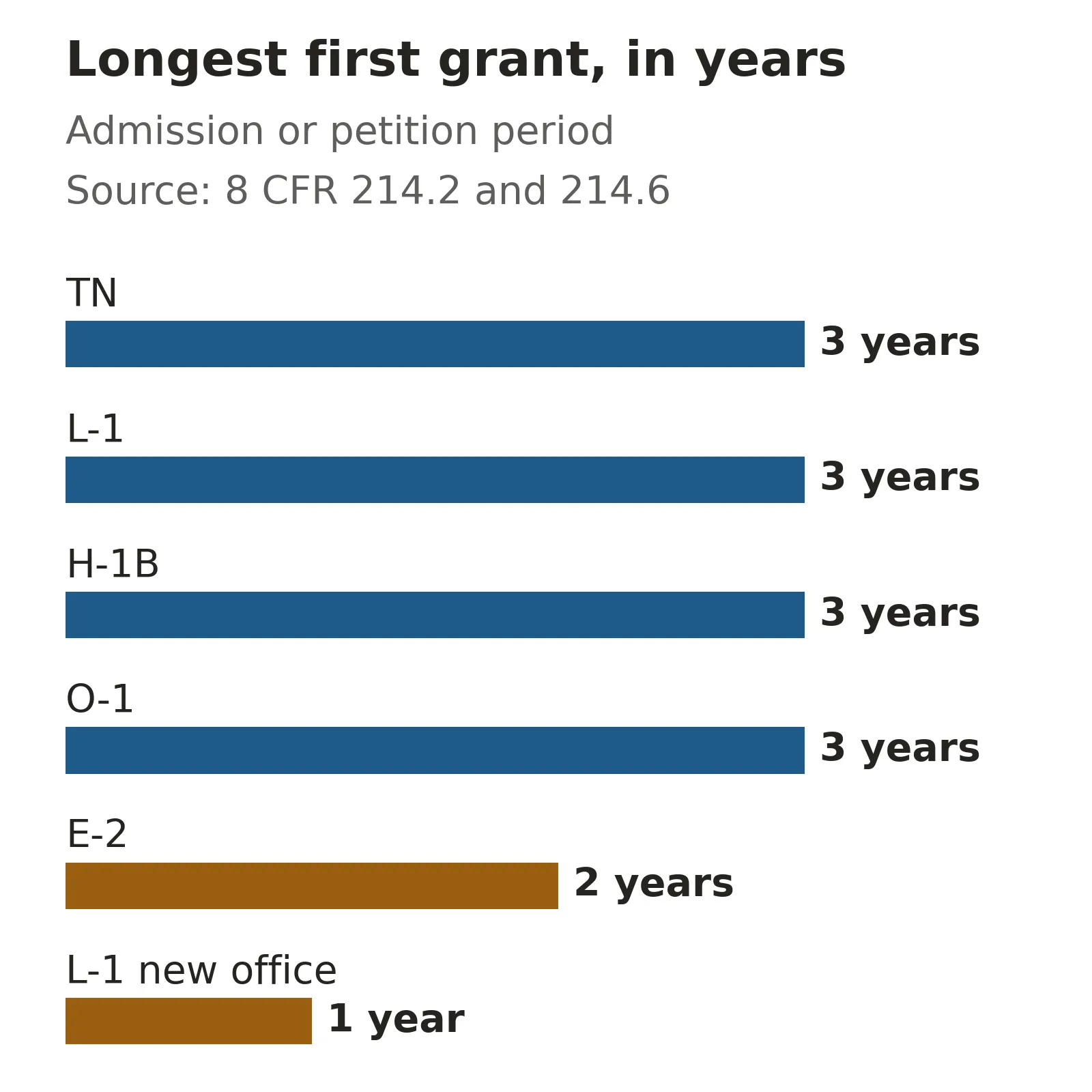
The first grant of each status has a ceiling, shown in Figure 2. TN admission is "for a period not to exceed three years" under 8 CFR 214.6(e). An individual L-1 petition is valid for up to three years, or up to one year for a new office, under 8 CFR 214.2(l)(7)(i)(A). An H-1B petition in a specialty occupation is valid for up to three years under 8 CFR 214.2(h)(9)(iii)(A)(1), an O-1 petition for up to three years under 8 CFR 214.2(o)(6)(iii)(A), and a treaty investor is admitted for an initial period of not more than two years under 8 CFR 214.2(e)(19)(i). Some statuses also have an outer limit: 8 CFR 214.2(l)(12)(i) caps time at five years in a specialized knowledge capacity and seven years as a manager or executive, and 8 CFR 214.2(h)(13)(iii)(A) caps H-1B stay at six years.
Every one of these statuses is also tied to its purpose. Under 8 CFR 274a.12(b), an E-2 investor may be employed only by the treaty-qualifying company through which the status was obtained, an H-1B, L-1 or O-1 worker only by the petitioner, and a TN professional must be engaged in business activities at a professional level under the USMCA. The TN definition in 8 CFR 214.6(b) adds that the category does not authorize a business or practice in which the professional is, in substance, self-employed. A second job, a side contract or freelance work outside the approved role is therefore not covered just because the person is lawfully in the US. Our guide on whether an E-2 visa holder can work for another company takes that question further for investors.
Can the spouse of a Canadian worker work in the US?
It depends entirely on the principal's status, and the answers run from automatic to almost never.
- L-2 spouse: the statute is mandatory. Under 8 U.S.C. 1184(c)(2)(E), for the spouse of an L-1 worker, DHS "shall authorize the alien spouse to engage in employment in the United States and provide the spouse with an 'employment authorized' endorsement or other appropriate work permit."
- E-2 spouse: 8 U.S.C. 1184(e) uses the same wording for the spouse of an E treaty trader or investor. The details, including the I-94 endorsement, are in our guide to E-2 spouse work authorization.
- H-4 spouse: under 8 CFR 214.2(h)(9)(iv), H-4 status "does not confer eligibility for employment authorization incident to status." An H-4 spouse may be eligible only if the H-1B worker is the beneficiary of an approved Form I-140 immigrant petition or has extended H-1B time under sections 106(a) and (b) of AC21, and must then apply for an EAD. See our guide to the H-4 visa and work permit.
- TD spouse of a TN worker: under 8 CFR 214.6(j)(4), the spouse and children "shall not accept employment in the United States unless otherwise authorized under the Act."
- O-3 spouse of an O-1 worker: under 8 CFR 214.2(o)(6)(iv), neither the spouse nor a child may accept employment unless granted employment authorization.
For a Canadian couple where both partners have careers, this often decides the route. A TN is quick and has no cap, but it leaves the spouse without work authorization. An L-1 or E-2 gives the spouse the right to work by statute, which can make a slower or more expensive route the better choice for the family.
What does a US employer need from a Canadian hire?
A US employer must complete Form I-9 for every new hire, Canadian or not. Under 8 CFR 274a.2(b)(1)(ii), the employer must examine the documents within three business days of the hire. A Canadian passport alone is not on the list of documents that prove both identity and work authorization. For a Canadian working incident to a status with a specific employer, 8 CFR 274a.2(b)(1)(v)(A)(5) accepts a foreign passport with a Form I-94 bearing the same name and an endorsement of the employment-authorized status, "as long as the period of endorsement has not yet expired and the employment is not in conflict with the individual's employment-authorized status."
That last condition matters to employers in practice. An I-94 for a TN or L-1 with one company does not support employment with a different company, and an expired I-94 does not support continued employment. A Canadian who is a US citizen or green card holder presents a US passport or a Permanent Resident Card instead, both listed in 8 CFR 274a.2(b)(1)(v)(A). Employers planning a cross-border transfer can review the options on our business immigration page.
What happens if a Canadian works without authorization?
The consequences reach well beyond the job itself. Under 8 CFR 214.1(e)(2), "any unauthorized employment by a nonimmigrant constitutes a failure to maintain status." Under 8 U.S.C. 1227(a)(1)(C)(i), a person admitted as a nonimmigrant who has failed to maintain that status, or to comply with its conditions, is deportable.
Unauthorized work can also block a green card years later. Under 8 U.S.C. 1255(c)(2), adjustment of status inside the United States is not available to a person who "continues in or accepts unauthorized employment prior to filing an application for adjustment of status," unless the person is an immediate relative of a US citizen or falls within certain special immigrant groups. Section 1255(k) gives a limited exception for certain employment-based applicants who are present under a lawful admission and whose status violations, including unauthorized work, total no more than 180 days since that admission.
A Canadian who stays past the authorized period faces a separate set of rules on unlawful presence. Our guide to visa overstays in the US covers that problem. The point for anyone deciding whether to start a job "for a few weeks" before the paperwork is ready is simple: the short-term gain is rarely worth the long-term cost.
Frequently asked questions
Can a Canadian work in the US without a visa?
Often without a visa stamp, but never without a status. Canadian citizens are generally visa-exempt under 8 CFR 212.1(a)(1), so TN and L-1 can be granted at a port of entry with no consular visa. The E categories are the exception and need a visa. What every Canadian worker needs is a status that authorizes the specific employment.
Can Canadians work in the US on a visitor entry?
No. A visitor for pleasure may not engage in any employment under 8 CFR 214.1(e)(1). A B-1 business visitor may attend meetings, negotiate contracts and go to conferences, but the Foreign Affairs Manual says the B-1 category is not appropriate for someone who intends to obtain and engage in employment, and a B-1 visitor may not receive a US-source salary for US services.
Can a Canadian citizen work in the US remotely for a Canadian employer during a visit?
The regulations do not address this by name. They define employment as service or labor for an employer within the United States, and they bar visitors for pleasure from any employment. A short trip with occasional contact with a Canadian employer is a different fact pattern from weeks of service to US clients. The second carries real risk of being treated as unauthorized work.
Which status is fastest for a Canadian with a US job offer?
Where the job is in a profession on the USMCA list, TN is usually the fastest, because a Canadian applies directly to an officer at a Class A port of entry, a US airport handling international traffic or a pre-clearance station under 8 CFR 214.6(d)(2). An L-1 petition can also be filed at the land border or pre-clearance for a qualifying company transfer.
Can a Canadian on a TN take a second job in the US?
Not without authorization for it. A TN professional is authorized to work in prearranged business activities at a professional level for the US employer that supports the status, and 8 CFR 214.6 has a separate procedure for a change or addition of US employers. Taking side work outside that approved employment is unauthorized employment and a failure to maintain status.
Can a Canadian born to an American parent work in the US?
Possibly as a US citizen, with no visa at all. For a child born in wedlock abroad on or after November 14, 1986 to one US citizen parent, the Department of State explains that the parent must have been physically present in the United States for five years before the birth, at least two after age 14. Earlier births follow the law in force at the time.
Is a Canadian passport enough for Form I-9?
No. A foreign passport on its own does not prove work authorization. For a Canadian working in a status tied to a specific employer, the List A document is the passport together with a Form I-94 in the same name, endorsed with the employment-authorized status, while the endorsement is unexpired and the job is consistent with that status.
Conclusion
So, can a Canadian work in the US? Yes, once the right status is in place, which makes it a status question rather than a passport question. Citizens and green card holders may work for anyone. TN, L-1, E-2, H-1B and O-1 holders may work only in the employment their status covers. Spouses range from automatic work authorization (L-2 and E-2) to none (TD and O-3). Visitors may not work at all. Getting the status in place before the first day of work protects both the job and any green card plans that come later.
How Mayo Law can help
Mayo Law is a cross-border firm with offices in Toronto and New York. Joseph Mayo, our principal attorney, is licensed in Ontario and New York. Our lawyers work with Canadian professionals, founders and employers on the status question before a start date is set: which status fits, what the spouse can do, and what the employer will need to see. A first meeting is a paid one-hour consultation, because a lawyer reviews the facts in depth before advising. You can book it through our business immigration page, or see our TN visa and L-1 visa pages for those routes.
Disclaimer
This article is for general information only and is not legal advice. Reading it does not create a solicitor-client or attorney-client relationship. Immigration rules, fees and procedures change, and the right answer depends on your own facts, so speak with a qualified lawyer before acting. Mayo Law provides legal services in Ontario and New York.