

Contents
- Quick answer
- What is EB-5 direct investment?
- How much must a standalone investor invest?
- How are jobs counted in a direct EB-5 investment?
- Can several investors pool money in a direct project?
- What role must a direct investor play?
- How do direct and regional center investment compare?
- Frequently asked questions
- Conclusion
- How Mayo Law can help
- Disclaimer
EB-5 direct investment, which U.S. Citizenship and Immigration Services (USCIS) calls the standalone program, means investing in a business you help manage, outside the Regional Center Program, where that business itself employs at least 10 full-time qualifying workers. Its rules differ from the regional center route in ways that matter before you commit capital, and several of them changed for petitions filed on or after March 15, 2022.
For Canadian business owners weighing a U.S. green card through investment, our business immigration lawyers look at both routes against the business you actually plan to operate. This guide sets out the standalone rules from the USCIS Policy Manual and compares them with the regional center route.
The filing steps, forms and current USCIS fees for both routes are covered in our guide to the EB-5 visa process, including the fee change that takes effect on November 30, 2026.
Quick answer
EB-5 direct investment is the standalone route: you invest at least $1,050,000, or $800,000 in a targeted employment area, in a business you help manage that must itself employ at least 10 full-time qualifying workers. Standalone investors count only direct jobs, and for petitions filed on or after March 15, 2022, they cannot pool with other EB-5 investors.
What is EB-5 direct investment?
EB-5 direct investment is an EB-5 petition filed through the EB-5 standalone program rather than the Regional Center Program: the investor puts capital into a new commercial enterprise, is engaged in managing it, and relies only on jobs that enterprise creates directly. The investor files Form I-526, Immigrant Petition by Standalone Investor.
The USCIS Policy Manual calls this the "direct job creation (standalone) model" and explains that the Regional Center Program was different because it allowed reasonable economic or statistical methods to credit indirect jobs. So the direct-jobs rule is not new: indirect jobs have never counted for a standalone investor.
Every investor in the EB-5 Immigrant Investor Program must meet three elements: "An investment of capital; Engagement in a new commercial enterprise; and Job creation." The Policy Manual applies them to three groups of petitions. This guide covers the group that matters for a new standalone investor: standalone petitions filed on or after March 15, 2022, the date the EB-5 Reform and Integrity Act of 2022 was signed into law.
A regional center investor, by contrast, invests in a new commercial enterprise associated with a regional center and files Form I-526E, Immigrant Petition by Regional Center Investor. Our guide to choosing an EB-5 immigration attorney covers the due diligence a regional center project needs.
How much must a standalone investor invest?
A standalone investor must invest at least $1,050,000, or $800,000 if the new commercial enterprise is principally doing business in, and creating jobs in, a targeted employment area (TEA), for petitions filed on or after March 15, 2022. The Policy Manual says these amounts "will automatically increase January 1, 2027, and every 5 years thereafter," so check the current figure before filing.
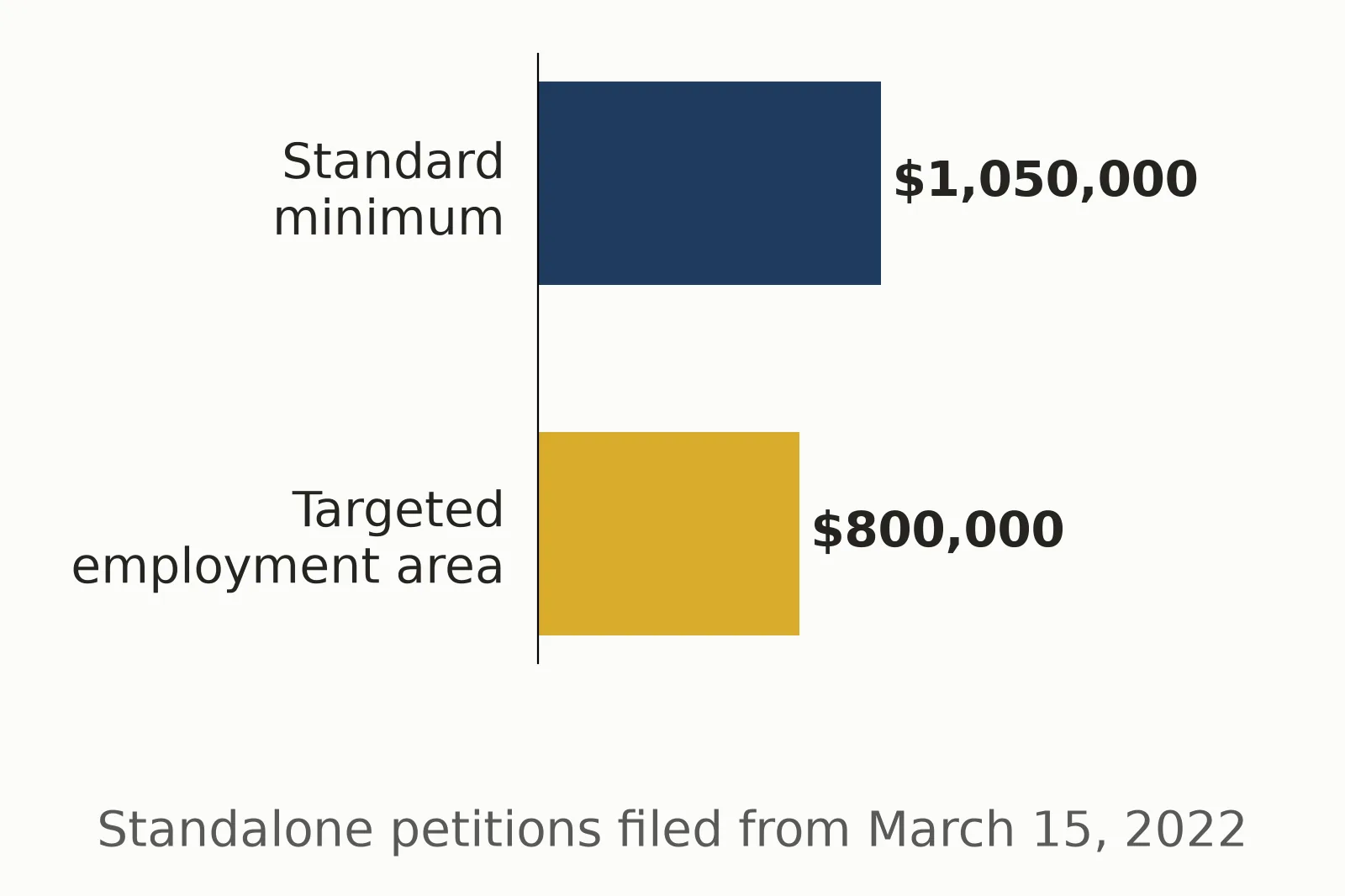
The Code of Federal Regulations still prints higher amounts, $1,800,000 and $900,000, from a 2019 rule. The Policy Manual explains that a federal court vacated that rule on June 22, 2021, and that USCIS "does not apply the amounts from the vacated rule to any petitions, regardless of when filed."
A TEA is a rural area or a high unemployment area. The Policy Manual defines a rural area as any area outside a metropolitan statistical area and outside the outer boundary of any city or town with a population of 20,000 or more. For a standalone petition filed on or after March 15, 2022, a high unemployment area is designated case by case: the investor describes the census tract or contiguous tracts where the business principally operates, and their weighted average unemployment rate must be at least 150 percent of the national average.
USCIS makes that TEA designation as part of deciding the Form I-526 petition and does not issue a separate designation notice. For petitions filed on or after March 15, 2022, a standalone investor's TEA designation is valid for 2 years from the date of investment, and an investor who invested the TEA amount during an approved designation does not have to increase the investment if the designation later expires.
A standalone investor cannot use the reduced amount for an infrastructure project: "A standalone investor cannot establish eligibility through an infrastructure project." That route is limited to regional center petitions filed on or after May 14, 2022.
Every EB-5 investor's capital must be their own, obtained lawfully and traced through a documented path of funds; as of May 14, 2022, gifts and loans to the investor are expressly permitted as capital if certain conditions are met. Our guide to EB-5 source of funds explains the documents Canadian investors gather for that.
How are jobs counted in a direct EB-5 investment?
In a direct EB-5 investment, only jobs created directly count: the new commercial enterprise, or its wholly owned subsidiaries, "must itself be the employer of the qualifying employees." The investment must result in full-time positions for at least 10 qualifying employees, and indirect or induced jobs do not count.
The Policy Manual sets out who and what counts:
- Employee: a person who provides services or labor for the new commercial enterprise and receives wages or other remuneration directly from it.
- Qualifying employee: a U.S. citizen, a permanent resident or another immigrant authorized to work, but not the investor, the investor's spouse, sons or daughters, or any nonimmigrant.
- Full time: a position requiring at least 35 working hours per week. A job-sharing arrangement can count, but combined part-time positions do not.
- Permanent: intermittent, temporary, seasonal or transient jobs do not qualify; jobs expected to last at least 2 years are generally not treated as temporary.
A standalone investor's 10 jobs do not have to exist when Form I-526 is filed. The investor can instead file a comprehensive business plan showing that the need for at least 10 qualifying employees will arise within the next 2 years, a period the Policy Manual says "is deemed to begin 6 months after adjudication of Form I-526."
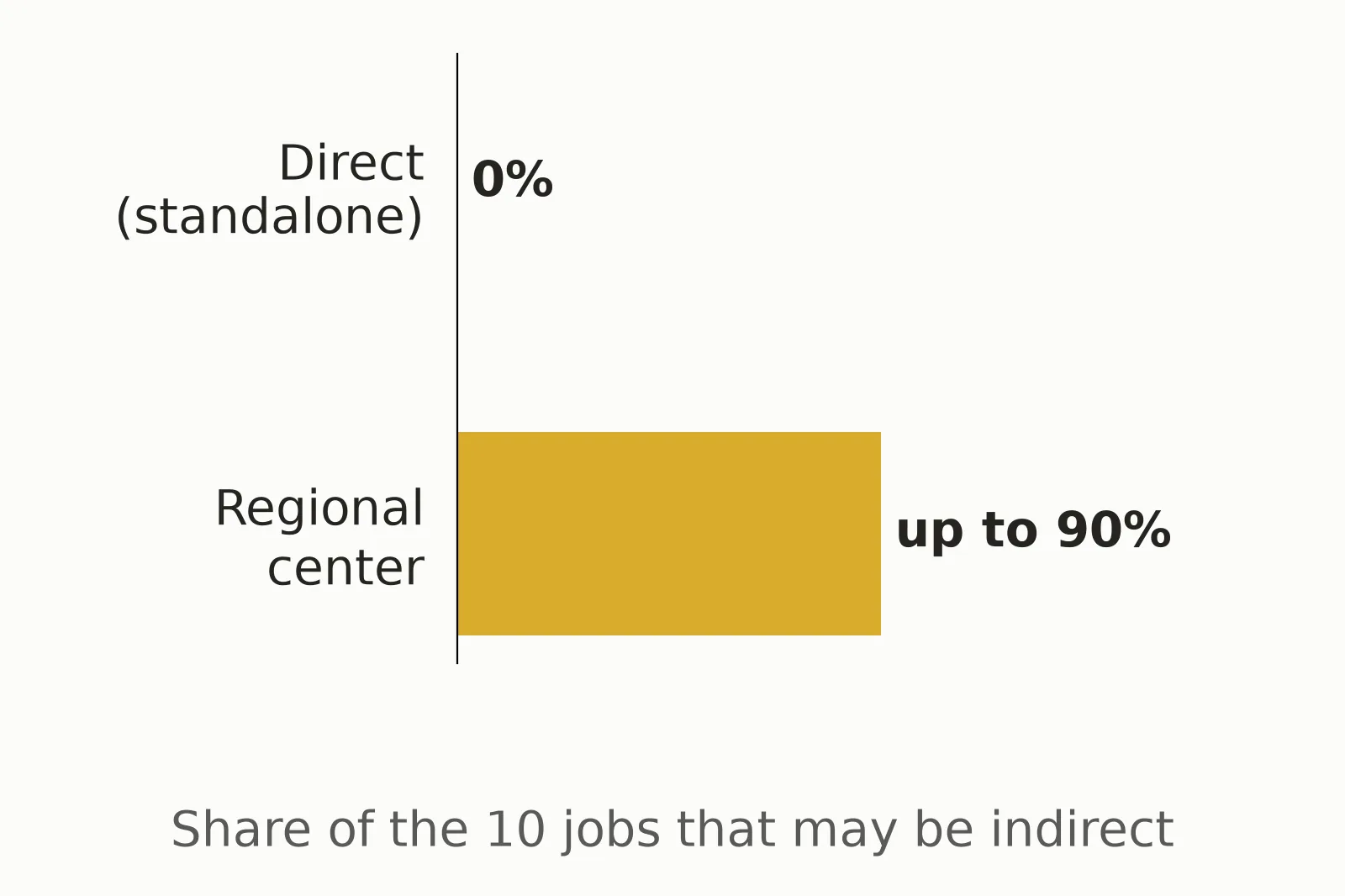
A regional center investor counts jobs differently. For regional center petitions filed on or after March 15, 2022, "up to 90 percent of full-time positions may be created indirectly," measured with economic models; at least 10 percent must be direct jobs.
A standalone investor who buys into an existing business that is losing money can use the troubled business route. The business must have existed for at least 2 years and had a net loss, in the 12 or 24 months before the petition's priority date, of at least 20 percent of its net worth before the loss. The investor must then keep existing employment at no less than the pre-investment level for at least 2 years, and still account for 10 jobs: the Policy Manual's example is four jobs created and six preserved.
Can several investors pool money in a direct project?
No, not for standalone petitions filed on or after March 15, 2022: the Policy Manual says that from that date "pooled investments with more than one EB-5 investor are only permitted under the regional center program." Before that date, several standalone investors could use one enterprise if each invested the full amount and created 10 jobs.
A standalone investor can still spread capital across more than one business, but only through one enterprise. The Policy Manual allows "a portfolio of wholly owned businesses, so long as all capital is deployed through a single commercial enterprise comprised of a holding company and its wholly owned subsidiaries," with all jobs created directly within that group. Investing separately in two different companies, outside one holding company structure, does not qualify.
The enterprise itself can take many forms. The Policy Manual's definition of a new commercial enterprise includes a sole proprietorship, a partnership, a holding company and its wholly owned subsidiaries, a joint venture, a corporation, a business trust and a limited liability company, if it is a for-profit business formed in the United States. Any commercial enterprise established after November 29, 1990 counts as new; an older business qualifies only if the investment restructures it or increases its net worth or number of employees by at least 40 percent.
What role must a direct investor play?
A direct investor must be engaged in managing the new commercial enterprise, "either through the exercise of day-to-day managerial responsibility or through policy formulation," and must place the capital at risk with evidence of actual business activity. The engagement rule applies to every EB-5 investor, not only to standalone investors.
Under 8 CFR 204.6(j)(5) and the Policy Manual, the evidence is a position title with a full description of duties, proof that the investor is a corporate officer or director, or, in a partnership, evidence of direct management or policymaking; a limited partner is sufficiently engaged if the partnership agreement gives the rights normally granted to limited partners under the Uniform Limited Partnership Act. For the capital, the rules include:
- At risk: "The mere intent to invest is not sufficient." A guaranteed return, or a guaranteed right to own or use a particular asset, reduces the amount that counts as at risk.
- Business activity: setting up and capitalizing the enterprise and signing a commercial lease are not enough without evidence of actual business activity.
- Business accounts: a sole proprietor's personal bank account does not count; the funds must be in business bank accounts.
- Time: for petitions filed on or after March 15, 2022, the capital "must be expected to remain invested for not less than 2 years."
USCIS checks the investment again at Form I-829, the petition to remove conditions, where it requires evidence that the investment was sustained in the new commercial enterprise; our guide to Form I-829 covers that step.
How do direct and regional center investment compare?
Both routes require investment and engagement in managing the new commercial enterprise; the difference is that a direct investor's own enterprise must account for every required job directly, while a regional center investor can pool capital with other investors and, for petitions filed on or after March 15, 2022, count up to 90 percent of the jobs as indirect.
The table compares the two routes for standalone petitions filed on or after March 15, 2022 and regional center petitions filed on or after May 14, 2022.
| Rule | Direct (standalone) | Regional center |
|---|---|---|
| Investor petition | Form I-526 | Form I-526E |
| Minimum investment | $1,050,000; $800,000 in TEA | Same; TEA or infrastructure |
| Indirect jobs | Not counted | Up to 90 percent |
| Pooling with investors | Not allowed | Allowed |
| Infrastructure project | Not available | Available |
| TEA validity starts | Date of investment | Form I-956F filing |
Two program-level facts also bear on the choice. Since March 15, 2022, Congress has reserved 20 percent of EB-5 visas, according to Chapter 1 of the Policy Manual, for investors in rural areas, 10 percent for high unemployment areas and 2 percent for infrastructure projects; because only regional center investors can use infrastructure projects, that last reserve is not open to a standalone investor. And the Policy Manual states that EB-5 visas "are authorized for investors in the Regional Center Program through September 30, 2027," a date it gives for the Regional Center Program only.
For a Canadian owner-operator, the standalone route can be compared with an E-2 treaty investor visa; our guides to moving from an E-2 visa to a green card and to E-2 vs EB-5 compare the two paths.
Frequently asked questions
What is the minimum EB-5 direct investment amount?
For standalone petitions filed on or after March 15, 2022, the minimum is $1,050,000, or $800,000 if the new commercial enterprise is principally doing business in, and creating jobs in, a targeted employment area. The USCIS Policy Manual says both amounts will increase automatically on January 1, 2027, and every 5 years after that.
Do indirect jobs count in an EB-5 direct investment?
No. For a new commercial enterprise outside a regional center, the full-time positions must be created directly, so the enterprise or its wholly owned subsidiaries must employ the qualifying workers. Indirect and induced jobs, measured by economic models, count only for regional center petitions; for those filed on or after March 15, 2022, up to 90 percent of the jobs may be indirect.
Can two family members invest together in one direct EB-5 business?
Not as two EB-5 investors in one standalone enterprise, for petitions filed on or after March 15, 2022, because pooled investments with more than one EB-5 investor are only permitted under the Regional Center Program. A spouse and unmarried children under 21 do not need their own investment: the Policy Manual says EB-5 visas are for immigrant investors "including their spouses and unmarried children under the age of 21."
Does the investor's own salary count as one of the 10 jobs?
No. The Policy Manual's definition of a qualifying employee excludes the immigrant investor, the investor's spouse, sons and daughters, and any nonimmigrant. The 10 full-time positions must be filled by U.S. citizens, permanent residents or other immigrants authorized to work in the United States, working at least 35 hours a week.
Can a direct EB-5 investor buy an existing business?
Yes. The Policy Manual treats any commercial enterprise established after November 29, 1990 as a new commercial enterprise, and an older business can qualify if the investment restructures it or increases its net worth or number of employees by at least 40 percent. The investment must still result in at least 10 full-time jobs; in a troubled business, preserved jobs count toward the 10.
Can a standalone EB-5 investor invest in an infrastructure project?
No, not as a qualifying infrastructure project. The reduced $800,000 amount for an infrastructure project applies only to regional center petitions filed on or after May 14, 2022, and the Policy Manual says a standalone investor cannot establish eligibility through an infrastructure project. A standalone investor can still use the reduced amount in a targeted employment area.
Conclusion
EB-5 direct investment puts you in the management of the business that carries your green card, through day-to-day management or policy formulation, and that business must account for all 10 jobs directly: indirect jobs have never counted for a standalone investor, and pooling with other EB-5 investors has not been allowed since March 15, 2022. The minimum is $1,050,000, or $800,000 in a targeted employment area, until the automatic increase on January 1, 2027.
The EB-5 direct investment requirements come down to capital, management and 10 direct jobs, and the choice between the routes turns on whether you want to build a U.S. business, how many direct jobs it can support and whether its location fits the TEA rules.
How Mayo Law can help
Mayo Law advises investors and business owners on U.S. business immigration from offices in Toronto and New York, and Joseph Mayo is licensed in Ontario and New York. Our lawyers review a planned standalone EB-5 business against the investment, job creation and management rules, and coordinate the corporate and immigration sides of the move.
Consultations are paid, one-hour sessions, because a lawyer reviews your plans and documents in depth. To start, visit our business immigration page.
Disclaimer
This article is for general information only and is not legal advice. Reading it does not create a solicitor-client or attorney-client relationship. EB-5 rules and investment amounts change, and the right route depends on your business, your funds and your goals. Mayo Law provides legal services in Ontario and New York.