

Contents
- Quick answer
- When must you file Form I-829?
- What evidence does USCIS expect?
- How is job creation judged at this stage?
- How much does Form I-829 cost?
- What happens after you file?
- What if USCIS denies Form I-829?
- What should Canadian investors check before filing?
- Frequently asked questions
- Conclusion
- How Mayo Law can help
- Disclaimer
Form I-829 is the petition an EB-5 investor files to turn a two-year EB-5 conditional green card into permanent residence without conditions. Its full name is Petition by Investor to Remove Conditions on Permanent Resident Status, and it asks U.S. Citizenship and Immigration Services (USCIS) to confirm that your investment stayed at risk and that the required jobs were created or will be. If you are a Canadian investor planning the end of your conditional period, our business immigration lawyers can review where your filing stands.
This guide covers the 90-day filing window, the evidence USCIS lists, how job creation is judged at this stage, the fee change that takes effect on November 30, 2026, and what happens after approval or a denial. Every rule below is drawn from USCIS guidance, the federal regulations or the Federal Register, as of November 2026.
Quick answer
File Form I-829 in the 90 days before your conditional residence reaches its second anniversary, proving you invested and sustained the capital and created, or will create within a reasonable time, 10 full-time jobs (or kept existing jobs in a troubled business). The fee is $3,750 if postmarked by November 29, 2026, and $5,000 on or after November 30, 2026.
When must you file Form I-829?
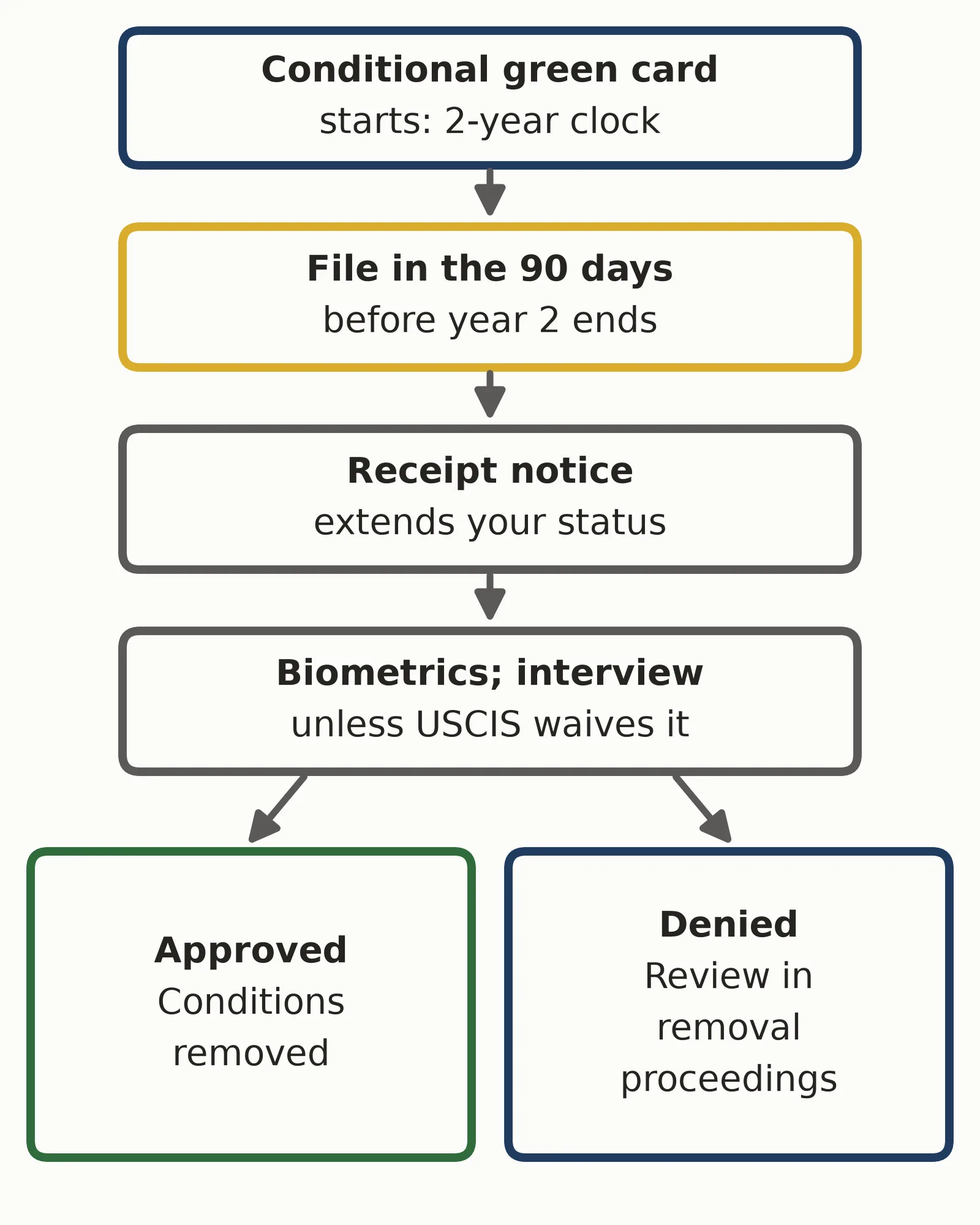
You must file Form I-829 during the 90-day period immediately before your conditional residence expires, which is the second anniversary of the day you became a conditional permanent resident. USCIS says on its Form I-829 page that the expiration date on your green card is that anniversary.
The two-year clock starts on the day conditional status was granted. The USCIS Policy Manual gives two examples: the day an adjustment of status application was approved, or the day the investor was admitted to the United States on an immigrant visa. USCIS publishes a filing date calculator on its page about when to file a petition to remove conditions; you enter the "Card Expires" date from your green card.
- Too early: USCIS may reject the petition.
- On time: a properly filed petition extends your conditional status automatically while USCIS decides it.
- Too late: under Title 8 of the Code of Federal Regulations (CFR), section 216.6, failing to file in the window results in automatic termination of your permanent resident status and the start of removal proceedings.
A missed deadline is not always final. USCIS may consider a late petition if you file it with a written explanation showing that the delay was for good cause and due to extenuating circumstances, and you ask USCIS to excuse the late filing. Excusing it is at USCIS's discretion.
What evidence does USCIS expect?
USCIS expects evidence of three things: that you invested the required capital, that you kept it invested throughout your conditional residence, and that your investment created or can be expected to create 10 full-time jobs. The form instructions list examples for each, and say USCIS may reject or deny a petition filed without required evidence.
The table sets out each requirement beside the kinds of records the instructions name.
| Requirement | Examples USCIS lists | Instruction |
|---|---|---|
| Capital invested | Audited financials, bank statements | Item 2.A |
| Investment sustained | Tax returns, contracts, licenses | Item 2.B |
| 10 full-time jobs | Payroll, tax records, Forms I-9 | Item 2.C |
| Conditional status | Both sides of each green card | Item 1 |
The sustainment period is your two years of conditional residence. The Policy Manual says USCIS checks that the investment was sustained for two years from the date you obtained conditional residence, and that you do not need to keep it invested beyond that period. For a troubled business, the test is different: you show that the enterprise kept its number of existing employees at no less than the pre-investment level during your conditional residence.
The evidence list also covers criminal history since you became a conditional resident. It asks, for example, for an official statement that no charges were filed after an arrest, a court-certified incident record showing the outcome where charges were filed, or the sentencing record and proof the sentence was completed after a conviction. Traffic offenses with no arrest and penalties of less than a $500 fine, license points or both need no documents, unless alcohol or drugs were involved.
The lawful origin of the invested money is a separate EB-5 requirement; our guide to EB-5 source of funds explains how USCIS looks at it.
How is job creation judged at this stage?
At the I-829 stage, USCIS asks whether it is more likely than not that you are in substantial compliance with the capital requirements and that the 10 jobs will be created within a reasonable time. The jobs do not all have to exist on the filing date, according to the USCIS Policy Manual, Volume 6, Part G, Chapter 7.
- Standalone investors: the new commercial enterprise must have created the positions directly.
- Regional center investors: the jobs may be created directly or indirectly, and indirect jobs are shown through reasonable methodologies backed by records such as payroll, invoices and bank statements.
- Reasonable time: the Policy Manual says jobs that will be created within a year of the two-year anniversary may generally be treated as created within a reasonable time; jobs projected more than three years after you became a conditional resident usually will not be, unless extreme circumstances are shown.
USCIS does not deny a petition to remove conditions solely because the enterprise did not follow the business plan in the original Form I-526 petition, according to the Policy Manual. Capital may also be further deployed during conditional residence in ways the first petition did not foresee, as long as it stays at risk.
Even after a change of plan, you must still show that the required capital was placed at risk and sustained throughout your conditional residence, that it was made available to the business most closely responsible for creating jobs (unless the job requirement is already met), and that the jobs were created or can be expected within a reasonable time. If a regional center is terminated, the Policy Manual says your conditional status is not automatically terminated, and you can still show compliance, including through indirect job creation.
For the full sequence that led to this point, from the first petition to the conditional green card, see our guide to the EB-5 visa process.
How much does Form I-829 cost?
The USCIS filing fee for Form I-829 is $3,750 under the current fee schedule, Form G-1055 (edition 10/26/26), and it rises to $5,000 for any petition postmarked on or after November 30, 2026. The increase comes from the EB-5 fee rule that the Department of Homeland Security (DHS) published in the Federal Register (91 FR 61940) on September 30, 2026.
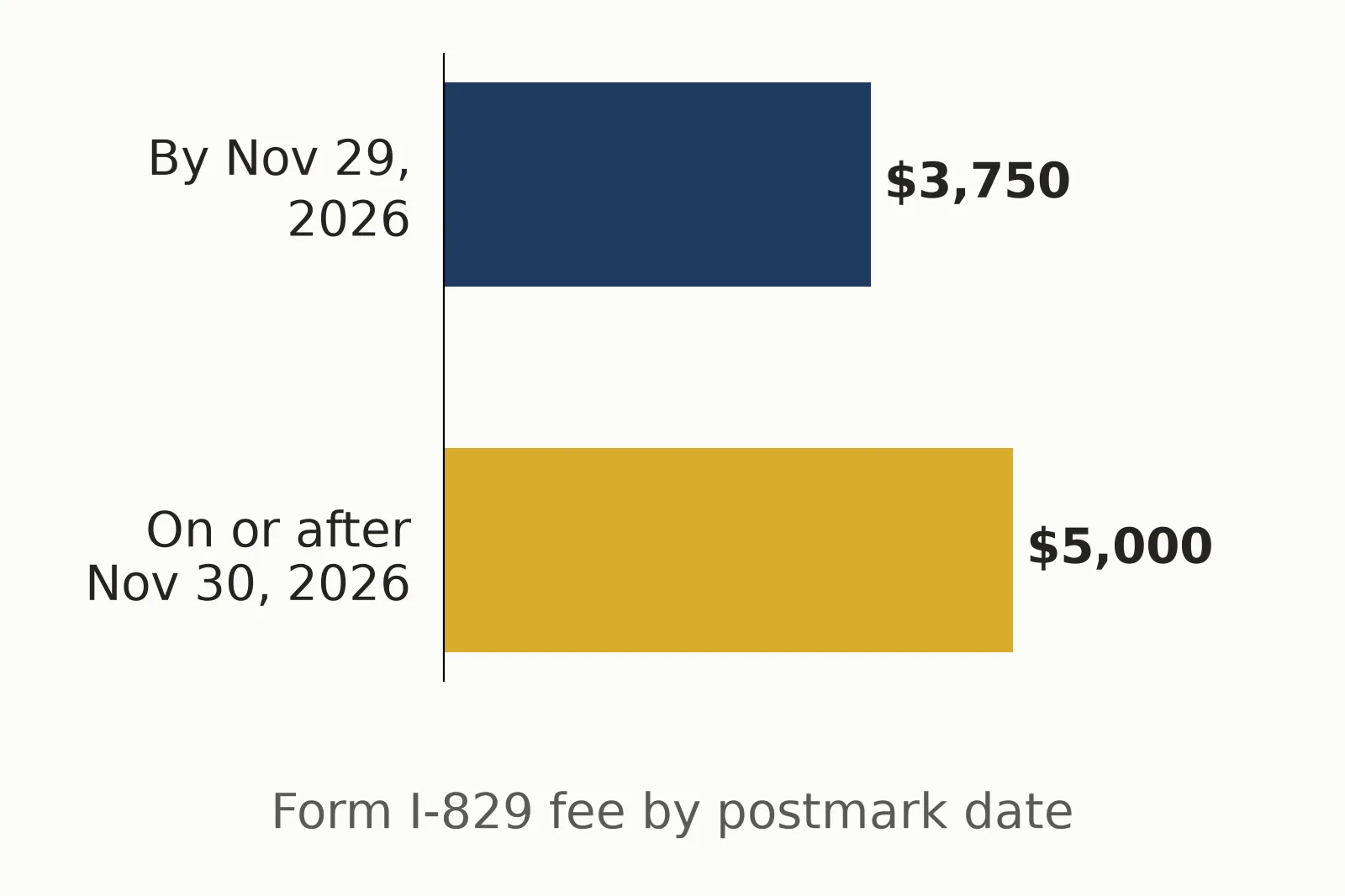
The rule states that it is effective November 30, 2026, and that any application, petition or request postmarked on or after that date must carry the new fees. The rule sets the petition fee at $5,000, an increase of $1,250 per petition (calculated from the two fees).
Family members can add to the cost: the rule notes that a spouse or child not included in the investor's petition files a separate petition with its own filing fee.
Filing early to avoid the higher fee is not possible. The $3,750 fee applies only where your 90-day window is already open and the petition is postmarked by November 29, 2026.
What happens after you file?
After USCIS accepts a properly filed petition, it sends a receipt notice (Form I-797) that extends your conditional permanent resident status for the period printed on the notice. The Policy Manual says the notice, together with your green card, serves as evidence of status for work and for returning to the United States after temporary travel abroad.
- Travel: the instructions tell you to carry the receipt with your green card and to present both when you return to the United States.
- Expired notice: if both the card and the extension period have expired, you can call the USCIS Contact Center for a field office appointment, where an officer may place an Alien Documentation, Identification and Telecommunication (ADIT) stamp in an unexpired passport or on a Form I-94 with a photo, as temporary evidence of status.
- Biometrics: USCIS may schedule a biometrics appointment, and missing it can lead to a denial.
- Interview: USCIS may waive the interview and approve the petition on the record, or require one at the office covering your enterprise, your U.S. residence or the place of adjudication.
The regulation, 8 CFR 216.6(c)(1), says a decision is to be made within 90 days of filing or of the interview, whichever is later. That is the regulation's wording. When USCIS lengthened green card extensions for pending petitions in January 2023, it said it was doing so because processing times for this petition had increased.
If USCIS approves the petition, the conditions come off as of the second anniversary of the date you became a conditional resident, and USCIS may call you and your family for biometrics to produce new permanent resident cards.
What if USCIS denies Form I-829?
If USCIS denies the petition, it sends a written decision with its reasons and a Notice to Appear, and your permanent resident status ends on the date of that decision. The regulation, 8 CFR 216.6(d)(2), says no appeal lies from the decision, but you may seek review of it in removal proceedings.
In those proceedings, the regulation puts the burden on USCIS to show by a preponderance of the evidence that the facts in your petition are not true and that the petition was properly denied. Even so, the Policy Manual adds that USCIS issues a temporary Form I-551 until a removal order becomes administratively final, meaning it is not appealed or the Board of Immigration Appeals dismisses the appeal.
Before a denial, USCIS may send a request for more information or evidence. The regulation also says that if derogatory information comes up, including evidence that the funds were not obtained by legal means, USCIS must give you the chance to rebut it.
What should Canadian investors check before filing?
Canadian investors should check four practical points before filing: where they will be for the interview, which U.S. address goes on the petition, how they will travel while it is pending, and whether family members are filing with them or separately. Each point comes from the regulation or the form instructions.
- Filing from Canada: 8 CFR 216.6(a)(3) lets you file whether or not you are physically in the United States, but if you are outside the country at filing, you must return, with your spouse and children if necessary, for any interview.
- U.S. address: the instructions say you must have a United States address to file, and a non-citizen must report a new address to USCIS within 10 days of moving.
- Cross-border travel: carry the green card and the receipt notice together each time you return to the United States.
- Living mainly in Canada: USCIS's page on international travel as a permanent resident says you can be found to have abandoned permanent resident status if you did not intend to make the United States your permanent home; an absence of more than a year is a general guide, and before an absence longer than a year it advises applying for a reentry permit on Form I-131.
- Family members: a spouse and children may be included in your petition; if they are not, each must file a separate petition. A child who turned 21 or married, or a spouse who divorced you, during the conditional period may still be included or may file separately.
If you are still weighing EB-5 against a treaty investor visa, our comparison of the E-2 visa and the EB-5 visa sets the two side by side, and our guide on choosing an EB-5 immigration attorney lists questions to ask about the I-829 stage.
Frequently asked questions
Can I file Form I-829 early?
No. USCIS says the petition must be filed during the 90-day period immediately before your conditional residence expires, and that it may reject a petition filed before that window opens. To remove conditions on permanent residence on time, use the expiration date on your green card and the USCIS filing date calculator to find the first day you can file.
What happens if I miss the 90-day filing window?
Under 8 CFR 216.6, missing the window results in the automatic termination of your conditional permanent resident status and the start of removal proceedings. USCIS may still accept a late petition if you include a written explanation showing good cause and extenuating circumstances and ask it to excuse the late filing, but that decision is discretionary.
Can I travel outside the United States while my I-829 is pending?
Yes. The Policy Manual says the receipt notice, together with your green card, serves as evidence of status for returning after temporary travel abroad. The instructions tell you to present both documents when you come back. If the extension on the notice has run out, you can ask USCIS for an ADIT stamp.
Do my spouse and children need to file their own Form I-829?
Only if they are not included in your petition. A spouse and children may be listed on the investor's petition. If they are not, each must file a separate petition with its own fee, and a child who turned 21 or married, or a spouse who divorced the investor, during the conditional period may be included or file alone.
Does USCIS always interview Form I-829 petitioners?
No. The regulation lets USCIS waive the interview and approve the petition if the record shows the requirements are met. If it is not satisfied, it may require an interview at the office covering the enterprise, your U.S. residence or the place of adjudication. If you miss a requested interview, the regulation says your status ends as of the second anniversary, but you can ask in writing for the interview to be rescheduled or waived, and if USCIS finds good cause it restores your status.
What if my EB-5 project did not follow its original business plan?
USCIS does not deny a petition to remove conditions solely because the enterprise departed from the business plan in the original petition. You must still show that the capital was placed at risk and sustained for your conditional period and that the 10 jobs were created or can be expected within a reasonable time.
Will the Form I-829 fee change in 2026?
Yes. The DHS EB-5 fee rule sets the Form I-829 fee at $5,000 for any petition postmarked on or after November 30, 2026. For petitions postmarked by November 29, 2026, the fee in USCIS Form G-1055, edition 10/26/26, is $3,750. The rule ties the new fee to the postmark date.
Conclusion
Form I-829 is the last USCIS step in the EB-5 path, and EB-5 removal of conditions turns on dates and records. File inside the 90-day window, show that the capital stayed at risk for the full two years, and document the 10 jobs (or, for a troubled business, the jobs kept) through payroll, tax records and Forms I-9, or, for regional center investors claiming indirect jobs, a reasonable methodology. Check the postmark date against November 30, 2026, and keep the receipt notice with your green card.
How Mayo Law can help
Mayo Law advises investors and business owners who move between Canada and the United States, with offices in Toronto and New York. Joseph Mayo, our principal attorney, is licensed in Ontario and New York. Our lawyers can review your filing timeline, the evidence of investment, sustainment and job creation, and the family members who need to file. A consultation with us is a paid one-hour session, because a lawyer reviews your situation in depth.
Disclaimer
This guide is general information about removing EB-5 conditions as of November 2026 and is not legal advice. Reading it does not create a solicitor-client or attorney-client relationship. Immigration rules and fees change, so confirm the current requirements with USCIS and get advice on your own facts before you file. Mayo Law provides legal services in Ontario and New York.