

Contents
- Quick answer
- How much do you have to invest for an EB-5 visa?
- What counts as an EB-5 targeted employment area?
- What are the USCIS fees for an EB-5 visa?
- What does consular processing cost versus adjusting status?
- What do the government fees total for one investor?
- Which EB-5 costs have no fixed price?
- How does EB-5 cost compare with an E-2 visa for Canadians?
- Frequently asked questions
- Conclusion
- How Mayo Law can help
- Disclaimer
The EB-5 visa cost for a Canadian investor starts with the investment itself: at least $1,050,000, or $800,000 in a targeted employment area or an infrastructure project, under the U.S. Citizenship and Immigration Services (USCIS) Policy Manual. Government fees are added to that. They depend on three things: whether you invest through a regional center or on your own, whether you finish at a U.S. consulate or file Form I-485 inside the United States, and whether your petition is postmarked before November 30, 2026, or on or after that date, when a new Department of Homeland Security (DHS) fee rule takes effect. This guide gives every figure from the official source it comes from, as of November 2026, and explains which costs have no set price at all. Our business immigration lawyers in Toronto and New York work with Canadian investors on both routes.
Quick answer
An EB-5 visa costs the investment of $1,050,000, or $800,000 in a targeted employment area, plus government fees. For the principal investor, those fees total $9,255 to $15,390 as of November 2026, counting Form I-829 at its new $5,000, depending on route, green card path and postmark date. Administrative and legal fees are extra and have no set price.
How much do you have to invest for an EB-5 visa?
For petitions filed on or after March 15, 2022, the EB-5 visa minimum investment is $1,050,000, or $800,000 if the new commercial enterprise is principally doing business in, and creating jobs in, a targeted employment area or, for regional center petitions, an infrastructure project. The figures come from Volume 6, Part G, Chapter 2 of the USCIS Policy Manual, current as of October 27, 2026, which measures the investment as the present fair market value, in U.S. dollars, of the investor's lawfully derived capital.
Two dates matter for anyone budgeting now. The Policy Manual says the amounts "will automatically increase January 1, 2027, and every 5 years thereafter." As of November 7, 2026, the chapter gives no new figure, so an investor planning a 2027 filing should expect a higher minimum and confirm it on the filing date. Petitions filed before March 15, 2022, used the original $1,000,000 and $500,000 amounts. A 2019 rule raised them to $1,800,000 and $900,000, but a federal court vacated that rule, so the Policy Manual applies the original amounts to every petition filed before March 15, 2022, even though the Code of Federal Regulations (CFR) still prints the higher figures.
The amounts are set in U.S. dollars. A Canadian who funds the investment from Canadian-dollar savings bears the exchange rate on the day the funds are converted, and the lawful source of the whole sum must be documented, as our guide to EB-5 source of funds explains. The Policy Manual also allows an investor to spread the capital across a portfolio of businesses or projects, but "only if the minimum investment amount is first placed in a single new commercial enterprise."
The investment is not a purchase price. To count, the capital must be placed at risk: the Policy Manual says "there must be a risk of loss and a chance for gain," and any guaranteed return is not at risk. Buying shares from an existing shareholder, without more, does not qualify either, because the payment goes to the seller rather than to the new commercial enterprise.
What counts as an EB-5 targeted employment area?
An EB-5 targeted employment area (TEA) is a rural area or an area that has experienced high unemployment, and investing in one lowers the minimum investment from $1,050,000 to $800,000. For petitions filed on or after March 15, 2022, a high unemployment area is one designated as such by the Secretary of Homeland Security; before that date, the test was unemployment of at least 150 percent of the national average rate. The Policy Manual sets out the rural test, the infrastructure route and the visa set-asides separately.
What is an EB-5 rural area?
The Policy Manual defines an EB-5 rural area as any area outside a metropolitan statistical area designated by the Office of Management and Budget and outside the boundary of any city or town with a population of 20,000 or more on the most recent decennial census. A standalone investor's petition must carry the evidence itself: proof that the location sits outside any metropolitan statistical area and any city or town of 20,000 or more. The Policy Manual adds that there has never been a provision allowing a state to designate a rural area.
What is an EB-5 infrastructure project?
The same reduced amount applies to an infrastructure project, but only for regional center petitions filed on or after May 14, 2022. The Policy Manual describes these as projects administered by a governmental entity, such as a federal, state or local agency, where that entity contracts with a regional center or new commercial enterprise to receive the investment, and that involve financing for maintaining, improving or constructing a public works project. For a regional center petition filed after May 14, 2022, in the Policy Manual's words, USCIS makes the TEA determination at the project application stage, and the designation is valid for 2 years.
How many EB-5 visas are reserved for these investors?
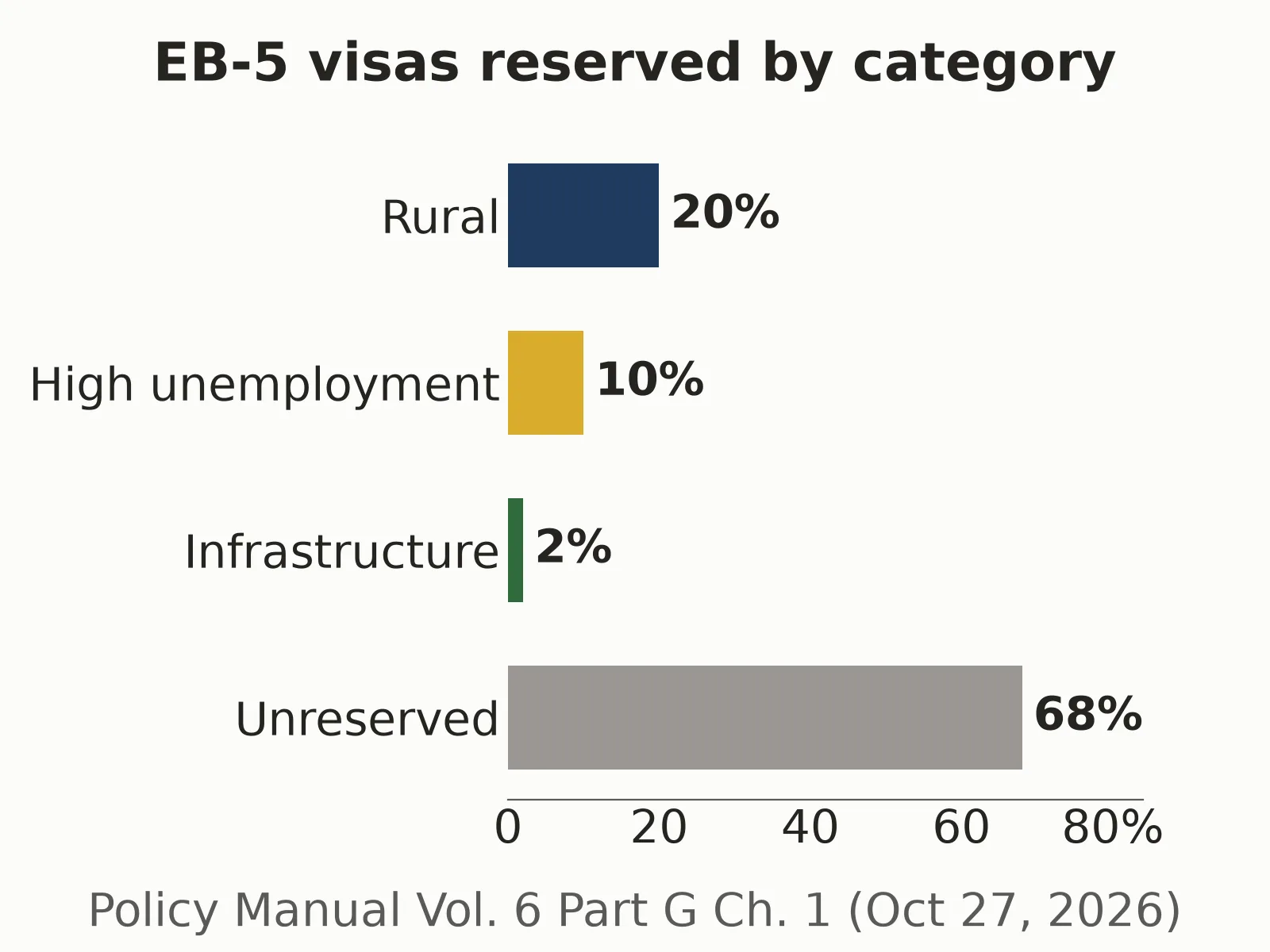
Congress amended the Immigration and Nationality Act on March 15, 2022, to reserve 20 percent of EB-5 visas for investors in rural areas, 10 percent for investors in high unemployment areas and 2 percent for investors in infrastructure projects, according to Chapter 1 of the same Part, current as of October 27, 2026. That leaves 68 percent unreserved, a share calculated from those three figures.
What are the USCIS fees for an EB-5 visa?
USCIS charges $3,675 for Form I-526 or Form I-526E and $3,750 for Form I-829 under the fee schedule in force today, and a new DHS rule raises those EB-5 fees for anything postmarked on or after November 30, 2026. After the investment, the postmark date is the largest variable among the government fees in the EB-5 visa cost. The current amounts come from the USCIS Form G-1055 fee schedule, edition 10/26/26 (dated October 26, 2026). The new amounts come from the DHS EB-5 Fee Rule, published in the Federal Register on September 30, 2026 (91 FR 61940). The rule states: "Any application, petition, or request postmarked on or after this date must be accompanied by the fees established by this final rule." The table shows what changes and what does not.
| Filing | By Nov 29, 2026 | From Nov 30, 2026 |
|---|---|---|
| Form I-526 (standalone) | $3,675 | $7,615 |
| Form I-526E (initial) | $3,675 | $7,850 |
| Integrity Fund fee (I-526E) | $1,000 | $1,100 |
| Form I-829 | $3,750 | $5,000 |
| Form I-485 (paper) | $1,440 | $1,440 (not in rule) |
| USCIS Immigrant Fee | $235 | $235 (not in rule) |
Four notes explain the table:
- EB-5 Integrity Fund fee: the fee schedule says that if you file an initial Form I-526E on or after October 1, 2022, "you must include a separate fee of $1,000 as required by the EB-5 Reform and Integrity Act of 2022," and that this amount "does not apply to an amendment request." The new rule sets it at $1,100, payable "in addition to any other fees," which it describes as a 10 percent inflation adjustment. A standalone investor filing Form I-526 does not pay it.
- Technology fee and amendments: the rule's new Form I-526 and initial Form I-526E amounts already include a $75 EB-5 technology fee. An amendment to Form I-526E costs $7,775 under the rule.
- Form I-829: an investor who files a petition now will file Form I-829 near the end of the 2-year conditional period, well after November 30, 2026, so this guide counts it at the rule's $5,000. Our guide to Form I-829 covers that filing.
- Form I-485 and the USCIS Immigrant Fee: the rule's list of EB-5 fees covers Forms I-526, I-526E, I-527, I-829 and the I-956 series only. Form I-485 ($1,440 on paper or $1,390 online for an applicant over the age of 14) and the $235 USCIS Immigrant Fee stay as the fee schedule sets them.
Why do three different petition fees circulate? A 2024 fee rule set Form I-526 and Form I-526E at $11,160 and Form I-829 at $9,525, and those figures are still codified at 8 CFR 106.2. The new rule records that on November 12, 2025, the United States District Court for the District of Colorado stayed those EB-5 fees in Moody v. Noem, and that on the same day "USCIS reverted to accepting the EB-5 fees that were in effect until March 31, 2024." That is why the fee schedule shows $3,675 and $3,750 today, why some websites still print $11,160, and why the November 30, 2026 amounts are a new step rather than a return to the 2024 figures. Our EB-5 visa process guide walks through the forms in order.
What does consular processing cost versus adjusting status?
A Canadian who applies for the immigrant visa at a U.S. consulate pays the Department of State's $345 immigrant visa application fee and the $235 USCIS Immigrant Fee, while an applicant who adjusts status inside the United States pays $1,440 for Form I-485 on paper or $1,390 online. The $345 is the employment-based immigrant visa application processing fee in 22 CFR 22.1, charged per person. The $235 USCIS Immigrant Fee applies, in the fee schedule's words, "if you are immigrating to the United States as a lawful permanent resident."
Each family member pays separately. A spouse or child who adjusts status files their own Form I-485: $1,440 on paper for an applicant over the age of 14, or $950 on paper for a child under 14 filing at the same time as a parent's Form I-485. At a consulate, each family member pays the $345 application fee and then the $235 USCIS Immigrant Fee. Our EB-5 visa process guide covers when Form I-485 can be filed.
What do the government fees total for one investor?
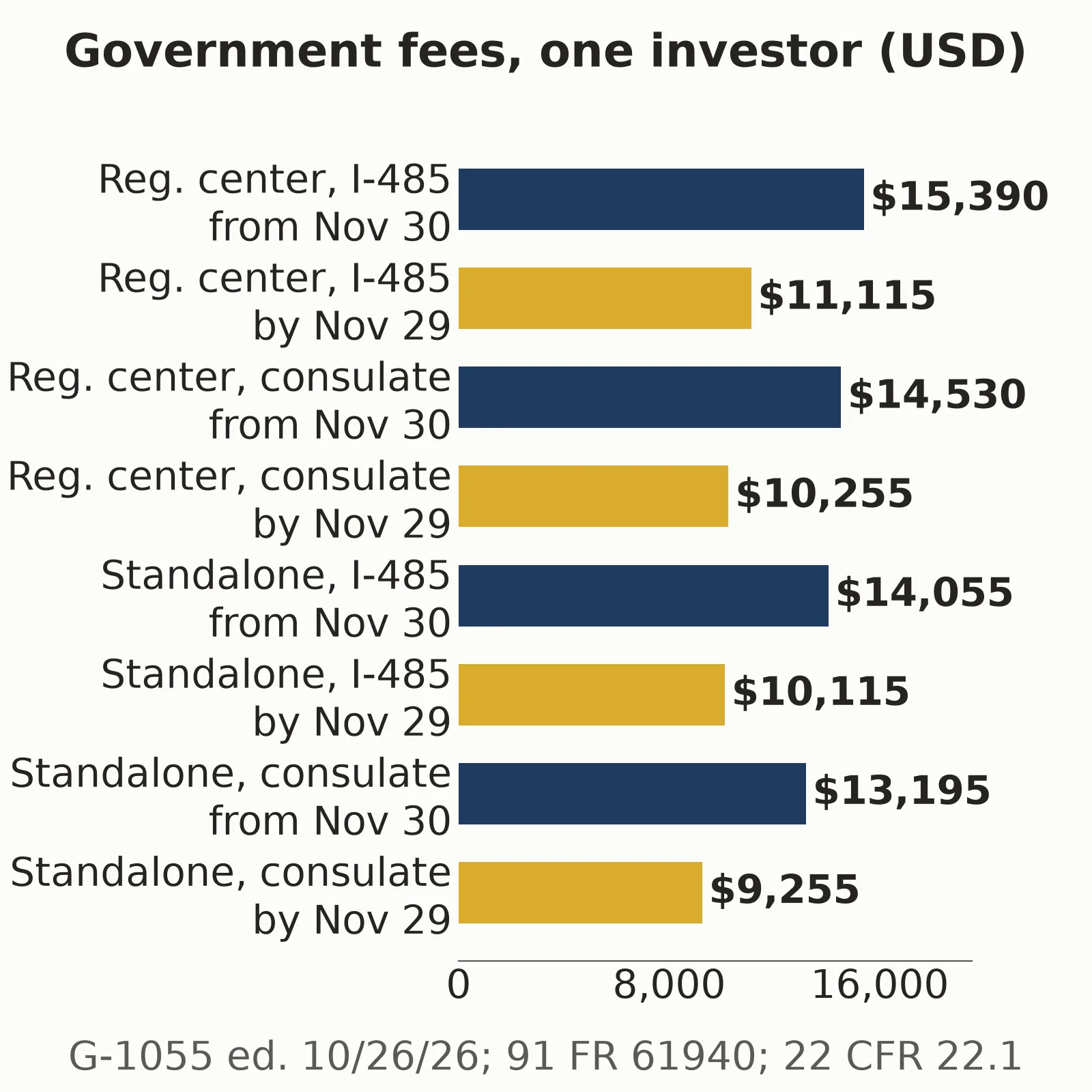
Put together, the government fees for the principal investor run from $9,255 to $15,390, depending on route, path and postmark date, as the table shows. Every total counts Form I-829 at the rule's $5,000 and Form I-485 on paper.
| Route and path | By Nov 29, 2026 | From Nov 30, 2026 |
|---|---|---|
| Regional center, consulate | $10,255 | $14,530 |
| Regional center, Form I-485 | $11,115 | $15,390 |
| Standalone, consulate | $9,255 | $13,195 |
| Standalone, Form I-485 | $10,115 | $14,055 |
The arithmetic for the highest total: $7,850 for Form I-526E, plus $1,100 for the Integrity Fund fee, plus $1,440 for Form I-485, plus $5,000 for Form I-829, equals $15,390. The lowest: $3,675 for Form I-526, plus $345 and $235 at the consulate, plus $5,000 for Form I-829, equals $9,255. Figure 2 shows all eight totals.
Against the investment, these fees are small. On an $800,000 targeted employment area investment, the highest fee total of $15,390 adds about 1.9 percent, a share calculated from the amounts above.
Which EB-5 costs have no fixed price?
Regional center administrative fees, legal fees, the business plan for a standalone project and the work of documenting the source of funds are set by the regional center or the professional, not by USCIS, so no official schedule states them and this guide gives no figure for them. They are still part of the EB-5 visa cost, so ask for each one in writing before you commit. What the official sources do say about each:
- Regional center administrative fee: a regional center or its new commercial enterprise may charge a fee for joining the offering, in addition to the $800,000 or $1,050,000. The Policy Manual treats these sums separately: since May 14, 2022, the investor must show the lawful source of "the invested funds and any funds used to pay administrative costs and fees." Ask for the amount, what it covers and whether any part of it is refundable, in writing, before you commit. Chapter 1 of the Policy Manual also states that EB-5 visas are authorized for investors in the Regional Center Program through September 30, 2027, a date a regional center investor's budget should take into account.
- Legal fees: they are set by the lawyer's engagement agreement, not by any government schedule. The preamble to the EB-5 Fee Rule records the point made to DHS that investors "may face other legal fees and administrative costs" beyond the government fees.
- Business plan and job-creation evidence: an investor who relies on jobs still to be created files "a comprehensive business plan showing that, due to the nature and projected size of the new commercial enterprise, the need for not fewer than 10 qualifying employees will result within the next 2 years," and the Policy Manual lists what such a plan should contain, from a market analysis to the permits and licences obtained. Preparing it is a professional cost with no set price. Our guide to EB-5 direct investment covers the standalone route.
- Source-of-funds documentation: the business registration records, corporate and personal tax returns and other records that trace the money to its lawful origin, as the Policy Manual's evidence list in force since May 14, 2022, requires.
How does EB-5 cost compare with an E-2 visa for Canadians?
The E-2 treaty investor visa has no fixed dollar minimum, while the EB-5 amounts are set at $1,050,000 and $800,000, so the two routes are budgeted differently. Canada has been an E-2 treaty country since January 1, 1994, according to the Department of State's Foreign Affairs Manual, which says that "no set dollar figure constitutes a minimum amount of investment to be considered 'substantial' for E-2 visa purposes" and instead weighs the funds invested against the cost of the business. The E-2 is a nonimmigrant visa whose holder must intend to leave when the status ends; the EB-5 leads to permanent residence, first on a conditional basis that Form I-829 removes. For the E-2 figures, see our guides on the E-2 visa minimum investment and the E-2 visa cost, and for the choice between the two, our comparison of the E-2 visa and the EB-5 visa.
Frequently asked questions
How much does an EB-5 visa cost in total?
For one investor, the total is the investment of $800,000 in a targeted employment area or, for a regional center petition, an infrastructure project, or $1,050,000 otherwise, plus government fees of $9,255 to $15,390 depending on the route, the path to the green card and the petition's postmark date, as of November 2026, with Form I-829 counted at the rule's $5,000. Regional center administrative fees and legal fees are additional and are set by the regional center and the lawyer, not by USCIS, so no official figure exists for them.
What is the EB-5 Integrity Fund fee?
It is a separate $1,000 fee that an investor must include with an initial Form I-526E filed on or after October 1, 2022, under the EB-5 Reform and Integrity Act of 2022, according to the USCIS fee schedule. The DHS EB-5 Fee Rule raises it to $1,100 for petitions postmarked on or after November 30, 2026. It does not apply to an amendment request or to a standalone investor's Form I-526. Regional centers pay their own annual Integrity Fund fee, which the USCIS fee schedule lists separately.
Why do some websites say the Form I-526E fee is $11,160?
A 2024 fee rule set that amount, and it is still printed at 8 CFR 106.2 in the Code of Federal Regulations. A federal court in Colorado stayed those EB-5 fees on November 12, 2025, in Moody v. Noem, and USCIS reverted to the fees in effect until March 31, 2024, which is why the fee schedule shows $3,675 today. From November 30, 2026, the new rule's $7,850 applies to an initial Form I-526E instead.
Do regional center fees count toward the $800,000 investment?
No. The Policy Manual distinguishes the invested capital from "any funds used to pay administrative costs and fees," and both have needed lawful-source evidence since May 14, 2022. The investment that counts is the capital placed at risk in the new commercial enterprise, so a fee paid to the regional center for its services is a separate cost beyond the minimum. The amount is set by the regional center, and USCIS publishes no figure for it.
Will the EB-5 investment amount go up in 2027?
Yes. The USCIS Policy Manual says the $1,050,000 and $800,000 amounts for petitions filed on or after March 15, 2022, "will automatically increase January 1, 2027, and every 5 years thereafter." As of November 7, 2026, the chapter, current as of October 27, 2026, gives no new figure. A Canadian planning to file in 2027 should budget for a higher amount and confirm it on the filing date.
Does one EB-5 investment cover my spouse and children?
One investment supports the petition for the investor and the eligible family members who immigrate with them, but each person's green card application carries its own fee: Form I-485 at $1,440 on paper for an applicant over the age of 14, or $950 on paper for a child under 14 filing at the same time as a parent's Form I-485, or $345 plus the $235 USCIS Immigrant Fee for each person who applies at a consulate, under the current fee schedule and 22 CFR 22.1. The investment itself is per investor, not per family member.
Does the fee I pay depend on when I file?
Yes. The DHS EB-5 Fee Rule is effective November 30, 2026, and says that any application, petition or request "postmarked on or after this date must be accompanied by the fees established by this final rule." A Form I-526E postmarked by November 29, 2026, carries $3,675 plus the $1,000 Integrity Fund fee; one postmarked from November 30 carries $7,850 plus $1,100. Form I-829 is filed about 2 years after conditional residence begins, so a new investor should budget for its $5,000 fee.
Conclusion
The EB-5 visa cost has three layers. The investment, $1,050,000 or $800,000 in a targeted employment area or infrastructure project, is stated in the USCIS Policy Manual and will automatically increase on January 1, 2027. Government fees for one investor run from $9,255 to $15,390 as of November 2026, with the petition's postmark date deciding which schedule applies. Regional center administrative fees and legal fees are the third layer and have no official price. Every figure here was read on its official source on November 7, 2026, and fee schedules change, so confirm each amount on the day you file.
How Mayo Law can help
Mayo Law is a cross-border firm with offices in Toronto and New York, and Joseph Mayo, our Principal Attorney, is licensed in Ontario and New York. Our lawyers help Canadian investors compare the EB-5 and E-2 routes, review the fee terms of a regional center offering, assemble source-of-funds evidence and file Form I-526 or Form I-526E, the Form I-485 or consular application, and Form I-829. The consultation is a paid one-hour session because a lawyer reviews your budget, your funds and your timing in depth before you commit capital. Start on our business immigration page.
Disclaimer
This guide is general information as of November 7, 2026, not legal advice, and reading it does not create a solicitor-client or attorney-client relationship. Government fees, investment amounts and filing rules change; confirm every figure on the official source on the day you file. Mayo Law provides legal services in Ontario and New York.