

Contents
- Quick answer
- What is the EB-1A, and who can file it?
- What are the ten EB-1A criteria?
- What is the final merits determination?
- Which evidence works for founders and executives?
- What does an EB-1A petition cost in government fees?
- How does EB-1A compare with the other routes?
- What should Canadians plan around before filing?
- Frequently asked questions
- Conclusion
- How Mayo Law can help
- Disclaimer
The EB-1A is the United States green card category for people of extraordinary ability, and it needs no employer, no job offer and no labor certification. For a Canadian founder, executive or researcher with a documented public record, that makes it worth weighing against the other US business immigration routes before choosing one.
It is also a demanding category. U.S. Citizenship and Immigration Services (USCIS) reviews an EB-1A green card petition in two steps, and meeting three of the ten regulatory criteria only gets a petition through the first. This guide sets out the EB-1A criteria, the final merits review, the evidence USCIS guidance describes for founders and executives, and the government fees, each checked against the statute, the regulation, the USCIS Policy Manual and the USCIS fee schedule as of November 2026.
Quick answer
The EB-1A is a first preference green card for people of extraordinary ability. You can file Form I-140 yourself with no job offer, if you show you will keep working in your field. You need a major international award or at least three of ten criteria, and USCIS must then find sustained acclaim at the very top of the field.
What is the EB-1A, and who can file it?
The EB-1A is the extraordinary ability subcategory of the first employment-based preference, and the person who qualifies can file the petition personally. Section 203(b)(1)(A) of the Immigration and Nationality Act (INA), found in the United States Code at 8 U.S.C. 1153(b)(1)(A), sets three requirements:
- Extraordinary ability: ability in the sciences, arts, education, business or athletics, demonstrated by sustained national or international acclaim, with achievements recognized in the field through extensive documentation.
- Continuing work: the person seeks to enter the United States to continue work in the area of extraordinary ability.
- Benefit: the person's entry will substantially benefit the United States in the future.
The regulation at 8 CFR 204.5(h), in Title 8 of the Code of Federal Regulations (CFR), defines extraordinary ability as "a level of expertise indicating that the individual is one of that small percentage who have risen to the very top of the field of endeavor." That sentence is the standard every piece of evidence is measured against.
Two features set the category apart. Under 8 CFR 204.5(h)(1), "an alien, or any person on behalf of the alien," may file the Form I-140, so a self-petition is allowed. Under 8 CFR 204.5(h)(5), neither an offer of employment in the United States nor a labor certification is required. The same paragraph still asks for clear evidence that the person is coming to continue work in the field. It lists letters from prospective employers, evidence of prearranged commitments such as contracts, or a statement from the person detailing plans for continuing the work in the United States.
The USCIS Policy Manual adds two points on the word "sustained." It does not imply an age limit, so a person early in a career can still qualify, and there is no definitive time frame for it. Acclaim must, however, be maintained: a person who was recognized in the past and did not keep a comparable level of acclaim afterwards may not meet the standard. People often say EB-1A visa, but the EB-1A is an immigrant category that leads to permanent residence, not a temporary work visa.
What are the ten EB-1A criteria?
The EB-1A criteria are ten types of evidence listed in 8 CFR 204.5(h)(3), and a petition needs either a one-time achievement or evidence under at least three of them. The one-time achievement is a major, internationally recognized award. The USCIS first preference page gives a Pulitzer, an Oscar and an Olympic medal as examples, and the Policy Manual names the Nobel Prize. Most petitions rely on the ten criteria instead. The table pairs each criterion with one example drawn from the Policy Manual's own guidance.
| Criterion | Paragraph | USCIS example |
|---|---|---|
| Lesser prizes or awards | (h)(3)(i) | Award from a national institution |
| Selective memberships | (h)(3)(ii) | Fellow-level society membership |
| Published material about you | (h)(3)(iii) | Newspaper or magazine article |
| Judging the work of others | (h)(3)(iv) | Peer review for a journal |
| Original contributions | (h)(3)(v) | Patented, commercialized technology |
| Scholarly articles | (h)(3)(vi) | Peer-reviewed journal publication |
| Artistic exhibitions | (h)(3)(vii) | Work shown at an exhibition |
| Leading or critical role | (h)(3)(viii) | Founder of a distinguished startup |
| High salary or remuneration | (h)(3)(ix) | Pay above field wage surveys |
| Commercial success | (h)(3)(x) | Box office receipts or sales |
Each criterion has its own wording in 8 CFR 204.5(h)(3), and the wording matters. The awards must be nationally or internationally recognized prizes for excellence in the field. A membership counts only where the association requires outstanding achievements of its members, as judged, in the regulation's words, by "recognized national or international experts in their disciplines or fields." The Policy Manual lists membership based solely on education, years of experience, a paid fee or a job requirement as pointing the other way. Published material must be about the person and the person's work, in professional or major trade publications or other major media, and must show its title, date and author. Commercial success, the tenth criterion, applies to the performing arts only.
If a criterion does not readily apply to the person's occupation, 8 CFR 204.5(h)(4) lets the petitioner submit comparable evidence. The Policy Manual reads "readily" as "easily," so the criterion does not have to be entirely inapplicable. A general, unsupported claim that a criterion does not fit is not enough; USCIS looks for a detailed, specific and credible explanation. There is no comparable evidence for the one-time achievement.
What is the final merits determination?
The final merits determination is the second step of USCIS review, where the officer weighs all the evidence together and decides whether it shows sustained acclaim and a place among the small percentage at the very top of the field. The USCIS Policy Manual, Volume 6, Part F, Chapter 2 tells officers to use this two-step analysis and refers to the Ninth Circuit's decision in Kazarian v. USCIS, 596 F.3d 1115 (9th Cir. 2010).
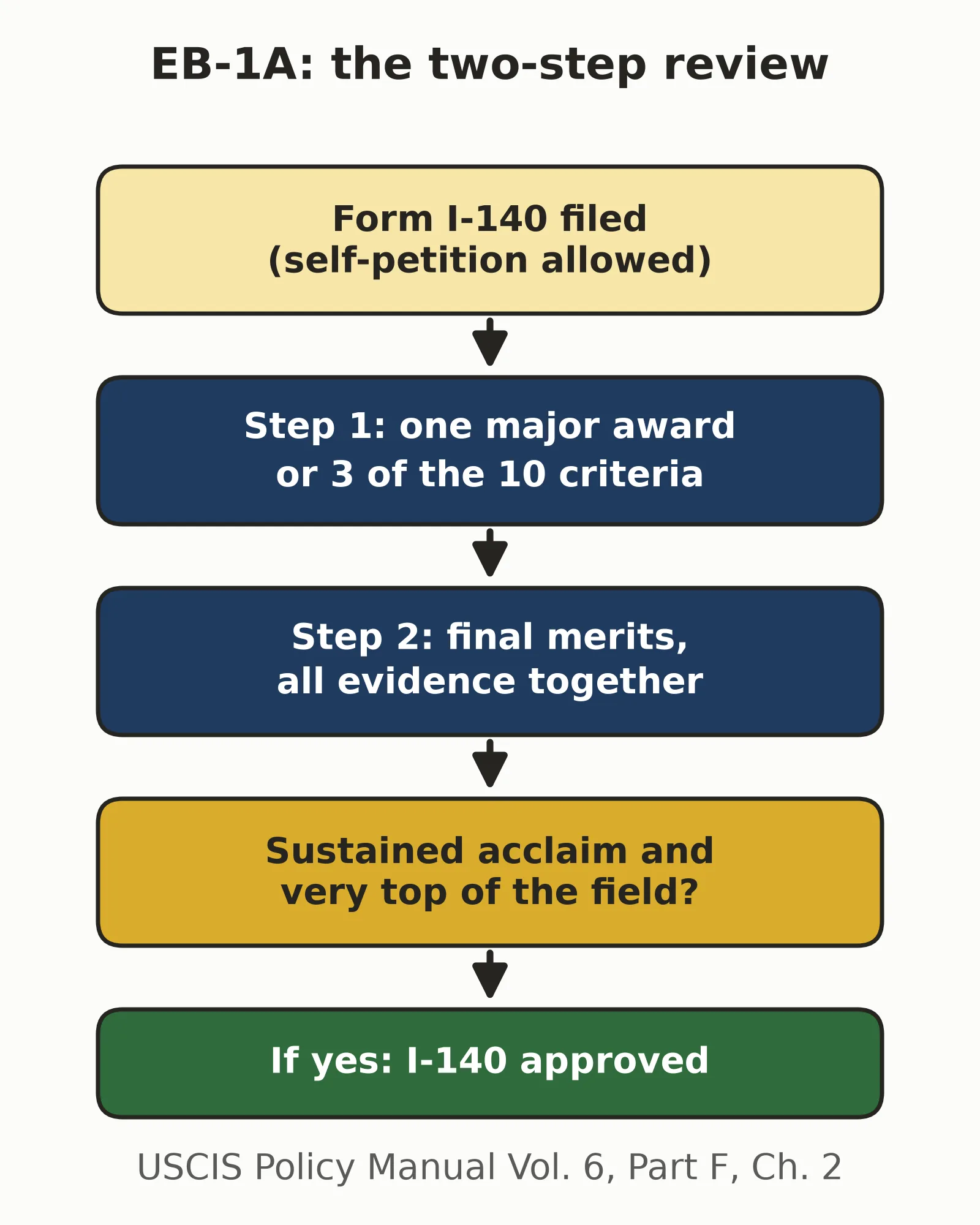
In step one, the officer decides only whether each piece of evidence objectively meets the regulatory description for its criterion. The Policy Manual gives two examples. Actually participating in judging the work of others should satisfy the judging criterion at step one, regardless of the circumstances. Publishing scholarly articles in qualifying publications should satisfy the authorship criterion, regardless of their caliber. In Kazarian, the court held that the agency could not demand proof of the research community's reaction before counting published articles as evidence at this stage.
Step two asks a different question. The Policy Manual states that objectively meeting the criteria "alone does not establish that the person in fact meets the requirements for classification." The officer considers the petition in its entirety, including evidence that fits no criterion, and applies the preponderance of the evidence standard. Positive factors the manual lists include publication in highly ranked journals, a citation rate that is high relative to others in the field, experience with leading institutions, unsolicited invitations to speak at recognized conferences, and a named role as an investigator, scientist or researcher on a peer-reviewed, competitively funded US government grant for research in science, technology, engineering or mathematics.
The same chapter sets two limits on officers. An officer may not deny a petition because one particular type of evidence is missing when the person has submitted other evidence that meets the requirements. An officer who finds the standard is not met must give specific reasons instead of general assertions. Volume is not the test: the manual notes that voluminous documentation may still lack persuasive evidence. On letters of support, the manual says they "should not form the cornerstone of a successful claim" and that the documents in the record should corroborate what the writers say.
Which evidence works for founders and executives?
For founders and executives, the Policy Manual gives usable guidance under five criteria: published material, judging, original contributions, a leading or critical role, and high remuneration. The guidance on two of them mentions startups by name.
Press and published material
Coverage must be about the person and the person's work, not only about the employer. The USCIS Policy Manual accepts material on a broader topic if it includes a substantial discussion of the person's work and names the person. It says marketing materials are not generally considered published material about the person, and that this includes seemingly objective coverage in major publications that the person or the employer paid for. USCIS then looks at whether the outlet is a professional publication, a major trade publication or major media, using intended audience and relative circulation, readership or viewership.
Judging the work of others
The person must have actually judged, not only been invited to. The USCIS Policy Manual's examples of judging are academic, such as peer review for a journal or a conference, service on a dissertation committee and review for government research funding programs. The regulation's own wording covers participation "either individually or on a panel, as a judge of the work of others in the same or an allied field."
Original contributions of major significance
USCIS asks two questions: is the contribution original, and is it of major significance to the field? Funding, a patent or publication can show originality, but the USCIS Policy Manual says they will not necessarily establish major significance on their own. A patented technology that has attracted significant attention or commercialization may. Detailed letters from people in the field help when documents in the record back them up, and the letters should state the basis of the writer's knowledge.
Leading or critical role
The USCIS Policy Manual's EB-1A examples of a leading or critical role include a founder or co-founder of, or contributor of intellectual property to, a startup business that has a distinguished reputation, and a member of a key committee within a distinguished organization. A leading role is about being a leader in the organization or a division of it, and a title with matching duties helps. A critical role is about performance: a contribution of significant importance to the outcome of the organization's activities. For the reputation of a startup, officers may treat significant funding from government entities, venture capital funds, angel investors or similar funders, in line with the rounds usual for that stage and industry, as a positive factor.
High salary or remuneration
Pay is compared with others in the field, using evidence such as tax returns, pay statements, contracts and wage surveys. USCIS does not read "has commanded" as requiring that the money was already earned. A credible contract or job offer showing prospective pay may be enough. For founders, the manual says that if a petitioner shows the high salary criterion does not readily apply to an entrepreneur, highly valued equity holdings in the startup might be presented as comparable evidence. The manual gives a second comparable-evidence example, for a different criterion: where publishing scholarly articles does not readily apply to a person working in industry, presenting work at a major trade show might be of comparable significance.
What does an EB-1A petition cost in government fees?
A self-petitioner filing Form I-140 on paper pays $1,015 to USCIS as of November 2026, made up of the $715 form fee and the $300 Asylum Program Fee for self-petitioners. Filing online lowers the form fee to $665, for $965 in total. The amounts come from the USCIS fee schedule, Form G-1055, edition 10/26/26.
- Form I-140: $715 on paper or $665 online.
- Asylum Program Fee: $300 for a self-petitioner or small employer, $600 for a regular petitioner and $0 for a nonprofit.
- Form I-907, premium processing: $2,965 for an EB-1 petition, optional.
- Form I-485, adjustment of status: $1,440 on paper or $1,390 online for an applicant over the age of 14, payable only by a person who applies for the green card from inside the United States.
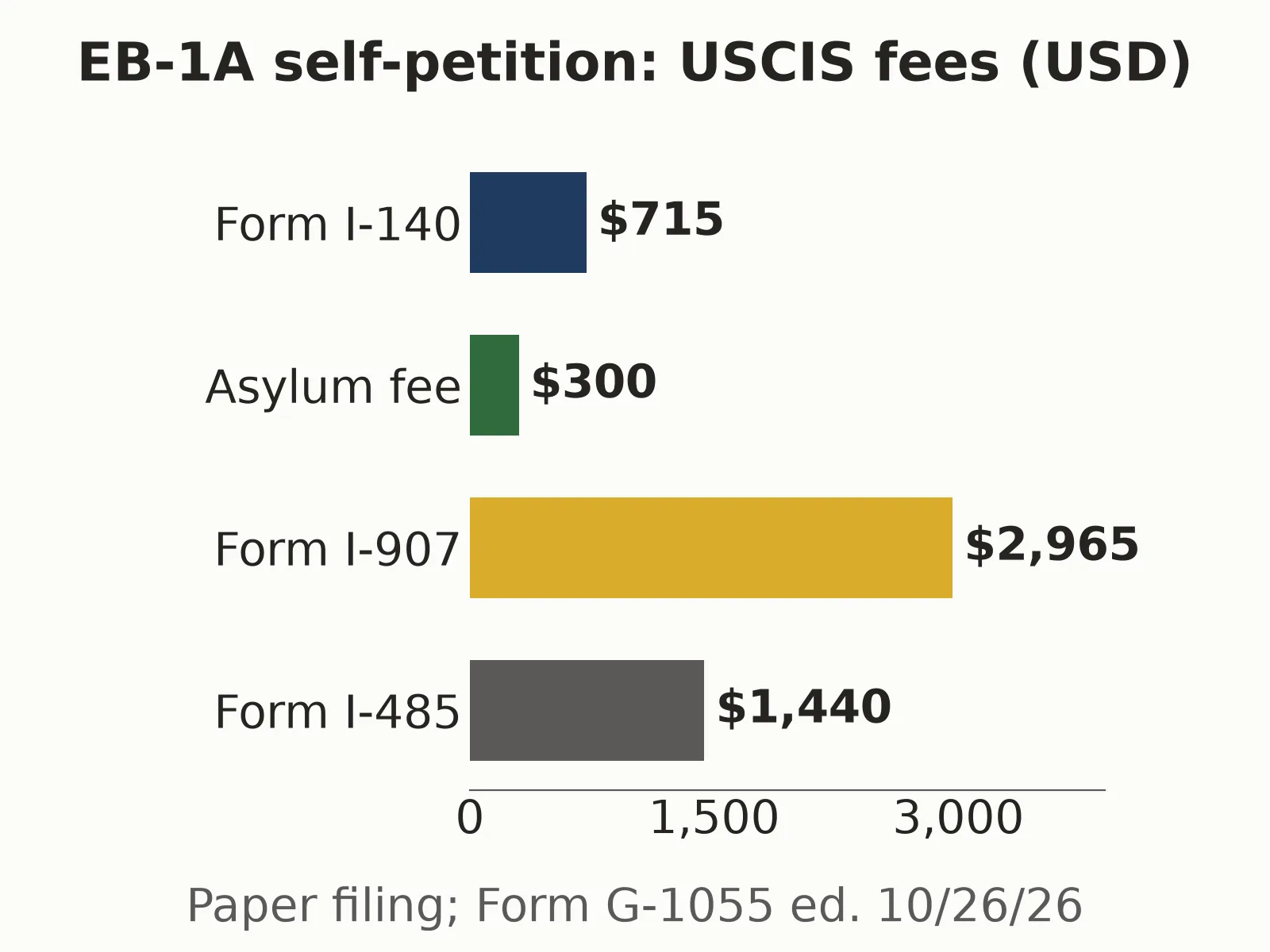
Calculated from those figures, a paper-filed self-petition with premium processing costs $3,980 at the petition stage ($715 plus $300 plus $2,965). Adding one paper-filed Form I-485 brings the USCIS total to $5,420. These are government fees only. They do not include legal fees, translations, credential evaluations or the medical examination.
Premium processing buys speed on the petition, not approval. According to the USCIS premium processing page, USCIS guarantees adjudicative action within 15 business days for Form I-140 in the extraordinary ability classification, coded E11, or it refunds the premium fee. Adjudicative action means an approval, a denial, a notice of intent to deny or a Request for Evidence (RFE), or the opening of an investigation for fraud or misrepresentation. If USCIS issues an RFE or a notice of intent to deny, the period stops and resets, and a new one starts when USCIS receives the response. A self-petitioner may file Form I-907, because the petitioner and the beneficiary are the same person. USCIS says an I-140 filed together with Form I-907 must be filed by mail, so the lower online form fee is not available for a petition filed with premium processing at the same time.
How does EB-1A compare with the other routes?
EB-1A and the EB-2 national interest waiver (NIW) both allow a self-petition, while EB-1C, the multinational executive or manager category, always needs a US employer, and the three use different tests. The table sets out the main differences.
| Feature | EB-1A | EB-2 NIW | EB-1C |
|---|---|---|---|
| Who files | You can self-petition | You can self-petition | US employer only |
| Job offer | Not required | Waived | Required |
| Core test | Sustained acclaim | Three-prong test | Managerial or executive role |
| Preference | First | Second | First |
| Premium processing | 15 business days | 45 business days | 45 business days |
Under the USCIS Policy Manual, the NIW test asks whether the proposed endeavor has substantial merit and national importance, whether the person is well positioned to advance it, and whether waiving the job offer would benefit the United States on balance. Our EB-2 NIW guide for Canadians covers that test. EB-1C, the multinational executive or manager category, is covered in our guide to the L-1A visa to green card path. For the employer-sponsored categories and how they fit together, see how to get a green card through employment. Founders weighing temporary options first can start with our overview of American entrepreneur visa options.
What should Canadians plan around before filing?
Canadians should plan around five things before filing: the temporary intent their current US status may require, what a prior O-1 approval means, how Canadian evidence is read, where the green card stage happens, and visa availability. None of them changes the EB-1A requirements, but each affects timing.
TN status and temporary intent
A Canadian professional may already be working in the United States in TN status. The TN regulation, 8 CFR 214.6(b), defines temporary entry as "entry without the intent to establish permanent residence" and requires the person to satisfy the inspecting officer that the proposed stay is temporary. An I-140 is a request for an immigrant classification, which sits uneasily with a status that requires temporary intent. For a Canadian in TN status, the order of the petition, any travel and any TN renewal is a planning point to settle before filing. Our guide to the TN visa for Canadians explains that status.
A prior O-1 approval helps but does not decide the case
USCIS describes the O-1A as the temporary classification for extraordinary ability in the sciences, education, business or athletics. The Policy Manual says a prior O-1 approval is a relevant consideration and can be an indicator of eligibility for the immigrant petition, but it is not determinative. Where USCIS denies the immigrant petition of a person it earlier approved for O-1, officers are told to explain why where possible.
Canadian salary and recognition evidence
For the high salary criterion, the Policy Manual says officers evaluate a person working outside the United States against wage statistics or comparable evidence for the place where the person works. They do not simply convert the pay to US dollars and ask whether it would be high in the United States. A Canadian executive's pay is therefore compared with Canadian data for the role and region. The statute and the regulation ask for national or international acclaim. How much weight Canadian awards, media and memberships carry still depends on what the record shows about their recognition.
Where the green card stage happens
An approved I-140 is not yet a green card. A person in the United States may apply to adjust status on Form I-485. USCIS allows that application to be filed together with the I-140, which it calls concurrent filing, only when approval of the petition would make a visa immediately available. USCIS explains that a person outside the United States goes through consular processing: USCIS sends the approved petition to the Department of State's National Visa Center, and a US consulate holds the interview. USCIS says concurrent filing is not available in consular cases. Our guide to the green card application process walks through both routes.
Visa availability and family members
The first preference receives up to 28.6 percent of the worldwide employment-based visa level, plus any visas not required for the fourth and fifth preferences, under 8 U.S.C. 1153(b)(1). Whether a visa is immediately available for a given person depends on the category and the country of chargeability shown in the Department of State's monthly Visa Bulletin, so check the current bulletin before filing. For a category that needs no labor certification, the priority date is the date the completed, signed petition is properly filed with USCIS, under 8 CFR 204.5(d). Once the I-140 is approved, USCIS says a spouse and unmarried children under 21 may be eligible to apply for admission in E-14 and E-15 immigrant status.
Frequently asked questions
What does EB-1A stand for?
EB-1A stands for the employment-based first preference, subparagraph (A): it is the common name for the extraordinary ability subcategory found in section 203(b)(1)(A) of the Immigration and Nationality Act. USCIS uses the classification code E11 for it. The other first preference subcategories cover outstanding professors and researchers and certain multinational executives and managers, and neither of those allows a self-petition.
Can I file an EB-1A petition without an employer?
Yes. Under 8 CFR 204.5(h)(1) the person, or anyone on the person's behalf, may file Form I-140, and 8 CFR 204.5(h)(5) says neither a job offer nor a labor certification is required. The petition must still include clear evidence that the person is coming to continue work in the field, such as contracts, letters from prospective employers or a detailed statement of plans.
Is meeting three of the ten EB-1A criteria enough?
No. Meeting three criteria completes only the first step of USCIS review. In the second step, the final merits determination, the officer weighs all the evidence together and decides whether it shows sustained national or international acclaim and a place among the small percentage at the very top of the field. The USCIS Policy Manual states that meeting the criteria alone does not establish eligibility.
What are the EB-1A requirements under the statute?
The EB-1A requirements in the statute are extraordinary ability shown by sustained national or international acclaim, an intent to continue work in the same area in the United States, and an entry that will substantially benefit the United States in the future. The regulation then requires initial evidence of a major international award or at least three of ten listed types of evidence.
How much are the EB-1A filing fees in 2026?
As of November 2026, a self-petitioner pays $715 for a paper-filed Form I-140, or $665 online, plus a $300 Asylum Program Fee. Optional premium processing on Form I-907 costs $2,965. That is $1,015 in total on paper. A person over the age of 14 who adjusts status in the United States also pays $1,440 for a paper-filed Form I-485. The amounts come from USCIS Form G-1055, edition 10/26/26.
How fast is EB-1A premium processing?
USCIS guarantees adjudicative action within 15 business days of receiving a properly completed Form I-907 for an extraordinary ability petition, or it refunds the premium fee. The action can be an approval, a denial, a notice of intent to deny, a Request for Evidence, or the opening of an investigation for fraud or misrepresentation. If USCIS asks for more evidence, a new 15 business day period begins when it receives the response.
Does an approved O-1 visa guarantee EB-1A approval?
No. The USCIS Policy Manual says a prior O-1 approval is a relevant consideration and can be an indicator of eligibility, but it is not determinative. The immigrant petition is decided on its own record under the two-step review, and an officer who denies it after an earlier O-1 approval is asked to explain the reasons where possible.
Conclusion
The EB-1A rewards a record that already exists. The statute asks for extraordinary ability shown by sustained national or international acclaim. The regulation asks for one major award or at least three of ten types of evidence. USCIS then decides, on everything in the file, whether the person is among the small percentage at the very top of the field. Meeting three criteria is the start of that review, not the end of it.
For a Canadian founder or executive, the practical work on an extraordinary ability green card is choosing the criteria the evidence supports, documenting each claim with independent records instead of letters alone, and sequencing the filing around current US status and travel. Under the USCIS fee schedule as of November 2026, the government fees are $1,015 for a paper-filed self-petition, or $3,980 with premium processing.
How Mayo Law can help
Mayo Law is a cross-border law firm with offices in Toronto and New York. Joseph Mayo is licensed in Ontario and New York, and our lawyers work with Canadian founders, executives and professionals on US business immigration, including extraordinary ability and national interest waiver petitions and the temporary statuses that often come first. We offer a paid one-hour consultation, because a lawyer reviews your record, your current status and your goals in depth before giving a view on which category fits. We do not promise outcomes; USCIS decides each petition on its own evidence.
Disclaimer
This guide is for general information only and is not legal advice. Reading it does not create a solicitor-client or attorney-client relationship. Immigration rules, fees and USCIS policy change, and the figures here are stated as of November 2026. Speak with a licensed lawyer about your own situation before you file. Mayo Law provides legal services in Ontario and New York.