

Contents
- Quick answer
- How long does EB-1A take for a Canada-born applicant?
- What are the stages of the EB-1A timeline?
- How long does premium processing take?
- How long does regular I-140 processing take?
- What does an RFE do to the timeline?
- How does EB-1 processing time differ by category?
- Is I-485 or consular processing faster?
- Frequently asked questions
- Conclusion
- How Mayo Law can help
- Disclaimer
EB-1A processing time is really three clocks: the petition, the visa number and the green card application. For a Canadian, the second clock is the good news. In the Department of State's Visa Bulletin for November 2026, the first preference category is current for people born in Canada, so there is no visa queue to wait in. That leaves the petition and the final application, and our business immigration lawyers plan both with clients before anything is filed.
This guide gives the published figures for each clock as of November 2026: the 15 business days that premium processing buys, what the data from U.S. Citizenship and Immigration Services (USCIS) shows about petitions filed without it, and how long the last step takes. It is a timing guide. The ten criteria and the evidence are covered in our EB-1A green card guide.
Quick answer
With premium processing, USCIS acts on an EB-1A petition within 15 business days for a $2,965 fee, as of November 2026. Without it, USCIS guarantees no time. For a Canada-born applicant, EB-1 is current in the November 2026 Visa Bulletin, so an eligible applicant in the United States can file the green card application with the petition.
How long does EB-1A take for a Canada-born applicant?
A Canada-born applicant faces no visa queue as of November 2026, so EB-1A processing time is the petition time plus the green card application time. The Visa Bulletin does not list Canada separately. A person born in Canada falls in the column headed "All Chargeability Areas Except Those Listed", and in the November 2026 bulletin that column shows "C" for the first preference on both charts. The bulletin defines "C" as current, meaning numbers are authorized for issuance to all qualified applicants.
The column is about birth, not passport. USCIS tells applicants to read the chart under the country of their birth, and its page on visa availability and priority dates says the country of chargeability is usually the country of birth. A Canadian citizen who was born in India or mainland China is therefore usually read under the India or China column, and those two columns are not current. The table below shows the first preference line of both charts in the Visa Bulletin for November 2026.
| Chargeability | Final action date | Date for filing |
|---|---|---|
| All other areas, including Canada | Current | Current |
| China, mainland born | August 1, 2023 | July 1, 2024 |
| India | February 1, 2023 | July 1, 2024 |
| Mexico | Current | Current |
| Philippines | Current | Current |
Two more points from the same bulletin explain why the column matters. The first preference receives 28.6% of the worldwide employment-based level, which is at least 140,000 visas a year, and the per-country limit is 7% of the combined family-sponsored and employment-based preference limits, or 25,620. Calculated from the first two figures, 28.6% of 140,000 is 40,040 first preference visas before any unused numbers from other categories are added. When demand in a category or country exceeds the numbers available, the bulletin sets a cut-off date. For November 2026 it names mainland China, India, Mexico and the Philippines as oversubscribed areas, and for the first preference only China and India carry a date.
The bulletin changes every month, and a category that is current can move backward. USCIS calls that visa retrogression and says it generally happens when the annual limit for a category or country has been used up or is about to be. So check the current bulletin in the month you file, not this table.
One note for executives. A Canadian company's executive or manager who is moving to a related US company usually looks at EB-1C, the multinational manager category, which the employer files. Its timing and its rules are in our L-1A visa to green card guide.
What are the stages of the EB-1A timeline?
EB-1A processing time is the sum of three stages: the Form I-140 petition, the wait for a visa number under the Visa Bulletin, and the green card application. That last stage runs through Form I-485 in the United States or through a US consulate abroad. Each stage has its own clock and its own agency rules.
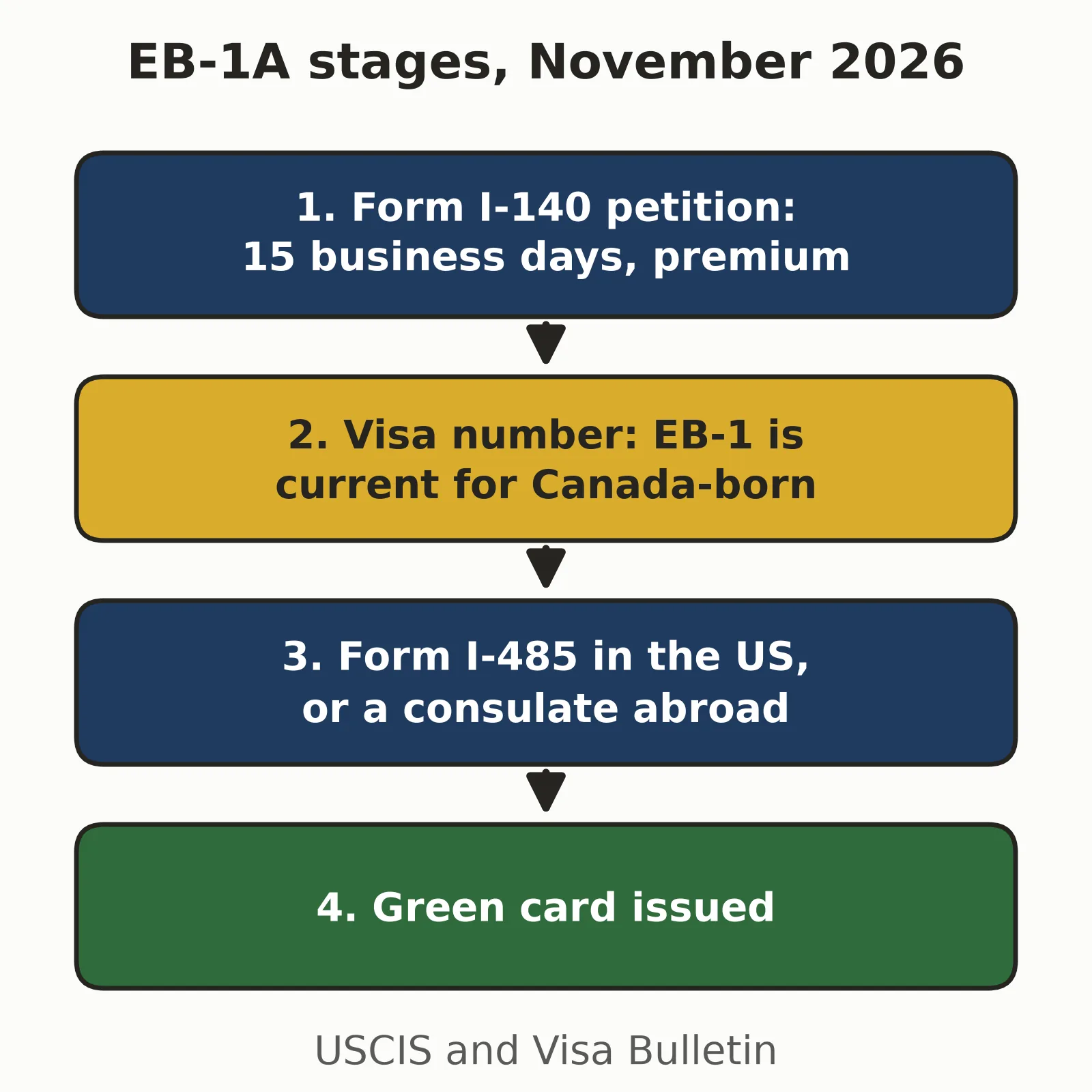
- Stage 1, the petition: the applicant files Form I-140. USCIS says a person of extraordinary ability may apply for themselves, and that no offer of employment or labor certification is required.
- Stage 2, the visa number: the priority date sets the place in line. For a category with no labor certification, USCIS says the priority date is the date it accepts Form I-140 for processing.
- Stage 3, the green card: a person in the United States applies to adjust status on Form I-485. A person abroad applies for an immigrant visa at a US consulate.
For an applicant in a column with a cut-off date, stage 2 adds a wait. For a Canada-born applicant in November 2026 it adds none, which is why the rest of this guide spends its words on stages 1 and 3.
How long does premium processing take?
Premium processing takes 15 business days for an EB-1A petition: USCIS guarantees that it will take adjudicative action within that period or refund the premium fee. The classification appears on the USCIS premium processing page as "Aliens of extraordinary ability", code E11, in the 15 business day chart for Form I-140.
Three details in that guarantee change how the EB-1A premium processing time should be read.
- The clock starts on receipt. USCIS says the period begins when it receives a properly completed Form I-907 at the correct filing address.
- Action is not approval. Within the period USCIS will issue an approval notice, a denial notice, a notice of intent to deny or a request for evidence, or open an investigation for fraud or misrepresentation.
- The fee is separate. Under the USCIS fee schedule (Form G-1055, edition dated October 26, 2026), Form I-907 filed with Form I-140 costs $2,965 on paper or online, in addition to all other filing fees.
Calculated in calendar terms, 15 business days is three working weeks, or 21 calendar days when no federal holiday falls inside the period. That is our arithmetic, not a USCIS promise.
A self-petitioner can make the request. USCIS says a beneficiary cannot file Form I-907 except where the petitioner and the beneficiary are the same person, which is the EB-1A self-petition. The request can go in with the petition or later. USCIS says a Form I-140 submitted together with Form I-907 must be filed by mail. A person whose Form I-140 is already pending files Form I-907 with the service center where the petition is pending, with a copy of the receipt notice.
Many petitioners pay for the speed. USCIS's quarterly data shows 34,563 premium requests on Form I-140 across all classifications between April 1 and June 30, 2026: 26,268 filed together with the petition and 8,295 filed as upgrades of pending petitions.
How long does regular I-140 processing take?
Regular processing has no guaranteed time, and USCIS's own data shows the number of pending extraordinary ability petitions rising from quarter to quarter in fiscal year 2026. USCIS publishes its figures on its immigration and citizenship data page, and two of its quarterly reports matter here.
The first is the agency-wide report for the third quarter of fiscal year 2026 (April 1 to June 30, 2026). It gives a median processing time of 3.9 months for Form I-140, defined as the time it took to complete 50% of the cases processed in the quarter. That median covers every I-140 classification, with no split between premium and regular cases, so it is not an EB-1A figure, and half of the completed cases took longer.
The second is the Form I-140 report by classification. For extraordinary ability petitions it shows this:
| Quarter | Received | Approved | Denied |
|---|---|---|---|
| October to December 2025 | 7,814 | 2,164 | 2,394 |
| January to March 2026 | 6,646 | 1,720 | 2,394 |
| April to June 2026 | 6,036 | 1,348 | 2,832 |
| Three quarters | 20,496 | 5,232 | 7,620 |
In each quarter USCIS received more extraordinary ability petitions than it approved or denied. Calculated from the table, the April to June quarter had 4,180 decisions (1,348 approvals plus 2,832 denials) against 6,036 new petitions. The number of petitions awaiting a decision rose from 24,785 at the end of December 2025 to 27,126 at the end of March 2026 and 28,874 at the end of June 2026, an increase of 4,089 in six months.
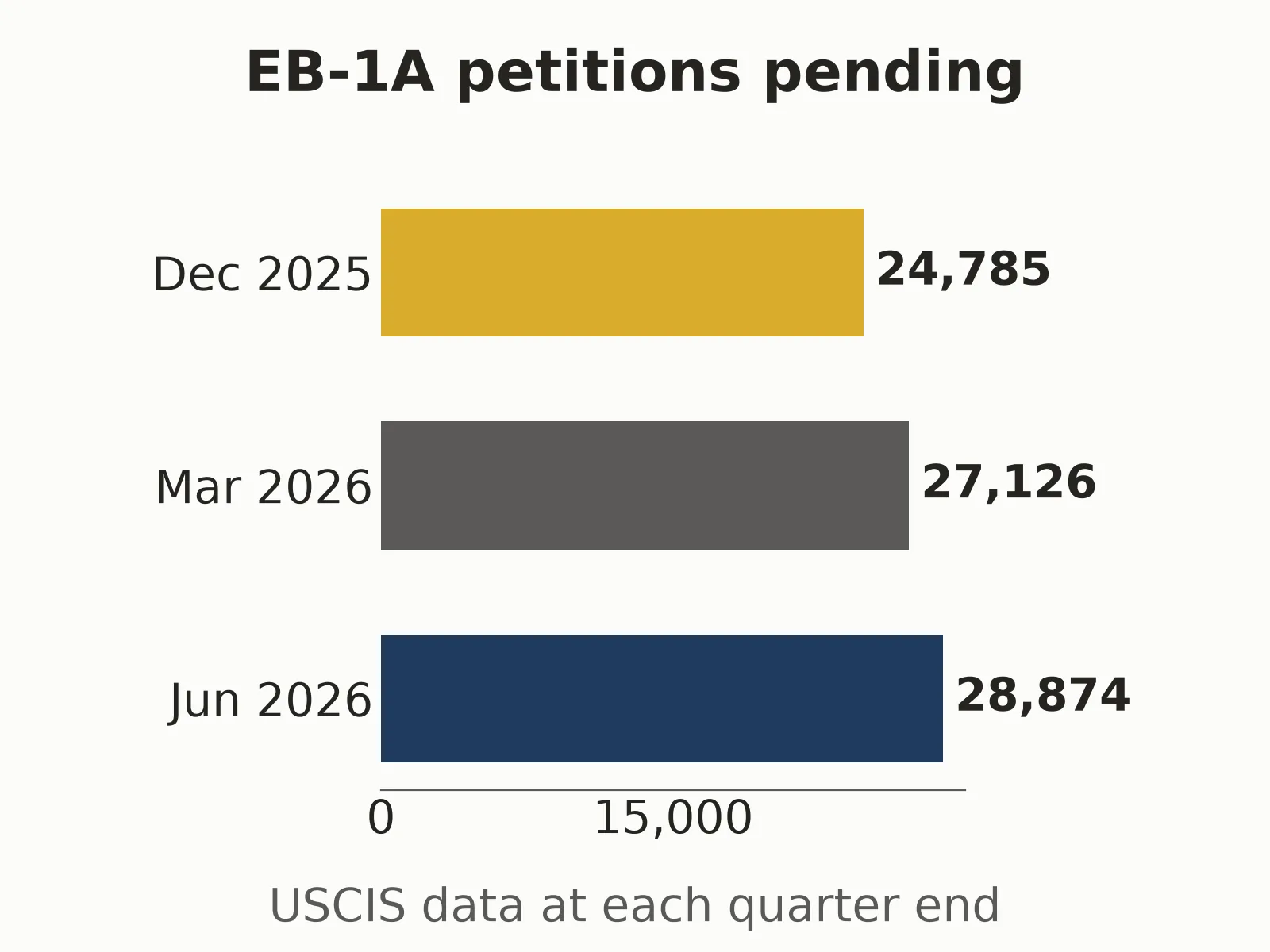
Read those numbers with the report's own cautions. Decisions in a quarter may relate to petitions received earlier, a person may file more than one petition, and USCIS says pending counts cannot be recalculated from earlier periods. The report also does not separate premium from regular cases. What it does show is direction: the pending count rose from December to March and again from March to June.
Canada is a small part of the filings. In the April to June 2026 quarter, USCIS recorded 70 extraordinary ability petitions for people born in Canada out of 6,036 received, about 1.2% by our calculation, and 29 approvals out of 1,348.
For a current estimate, USCIS posts its figures in the Check Case Processing Times tool linked from the home page of uscis.gov. Read it on the day you plan to file, and read it again before deciding whether to upgrade a pending petition, because USCIS does not fix the regular EB-1A processing time in advance.
What does an RFE do to the timeline?
A request for evidence (RFE) stops the premium processing clock and resets it: USCIS says a new premium period begins when it receives the response. A notice of intent to deny (NOID) has the same effect. So a premium case with an RFE has two USCIS periods with the petitioner's response time in between.
The response time is capped. Under the USCIS Policy Manual (Volume 1, Part E, Chapter 6, current as of October 27, 2026), the maximum response time for an RFE is 12 weeks, or 84 days, and regulations prohibit officers from granting more. An officer may set a shorter period. The Policy Manual adds 3 days when USCIS serves the request by mail, and it gives 30 days as the maximum response time for a NOID.
That allows a worked example of EB-1A processing time at the petition stage with premium processing, calculated from those figures and ignoring holidays and mailing days:
- No RFE: USCIS acts within 15 business days, about 21 calendar days.
- RFE answered in 30 days: 21 days, plus 30 days, plus a new 21 days, or up to 72 calendar days.
- RFE answered on day 84: 21 days, plus 84 days, plus a new 21 days, or up to 126 calendar days, which is 18 weeks.
The middle number is the only one the petitioner controls. A response sent early shortens the case day for day. Our guide to the EB-1A criteria and evidence explains what officers look for at each step of the review.
How does EB-1 processing time differ by category?
EB-1 processing time differs by category at the premium stage: USCIS guarantees action within 15 business days for extraordinary ability and for outstanding professors and researchers, and within 45 business days for multinational executives and managers. The visa queue does not differ, because the Visa Bulletin gives one first preference line for all three.
| Feature | EB-1A | EB-1B | EB-1C |
|---|---|---|---|
| USCIS code | E11 | E12 | E13 |
| Who files Form I-140 | The applicant | US employer | US employer |
| Premium guarantee | 15 business days | 15 business days | 45 business days |
| Premium fee | $2,965 | $2,965 | $2,965 |
| Pending, June 30, 2026 | 28,874 | 1,687 | 12,657 |
The EB-1 premium processing time is therefore three times as long for an executive or manager as for an extraordinary ability applicant, at the same $2,965 fee. The inventory differs too. At the end of June 2026 the extraordinary ability line had 28,874 pending petitions, against 1,687 for professors and researchers and 12,657 for executives and managers.
The choice between categories is not made on speed alone. EB-1B and EB-1C both need a US employer to file, and USCIS says that employer must show a continuing ability to pay the offered wage. For the executive route, including how long the employer's petition takes and how the L-1A period of stay fits around it, see our guide to moving from an L-1A visa to a green card through EB-1C. For the second preference self-petition, see our EB-2 NIW guide.
Is I-485 or consular processing faster?
Neither route has a guaranteed time, but only the I-485 can start early: USCIS allows it to be filed together with Form I-140 when a visa is immediately available, while a consular case cannot begin until the petition is approved. For a Canada-born EB-1A applicant who is in the United States and otherwise eligible to adjust status, that concurrent filing is open as of November 2026.
USCIS decides each month which Visa Bulletin chart adjustment applicants must use. On its filing charts page, it says that for November 2026 all employment-based preference categories must use the Dates for Filing chart. On that chart the first preference is current for the column that includes Canada. USCIS also says concurrent filing is allowed only when approval of the petition would make a visa immediately available.
How long the I-485 then takes is not fixed. The USCIS agency-wide report for April to June 2026 gives a median of 6 months for employment-based Form I-485 applications, measured across every employment category, with 268,408 of them pending on June 30, 2026. There is no premium processing for Form I-485; the USCIS premium page lists Forms I-129, I-140, I-765 and I-539 only. A fast petition approval therefore shortens the EB-1A processing time at the first stage only.
The consular route runs in sequence. USCIS's consular processing page says that after approval it sends the petition to the Department of State's National Visa Center (NVC), which collects the visa fees and supporting documents, and that the consular office schedules an interview once a visa is available. USCIS publishes no time for those steps on that page, so we give none here. A Canadian living in Canada will normally use this route, because adjustment of status is for people already in the United States.
The general mechanics of both routes, for every green card category, are in our guide to how long the green card process takes.
Frequently asked questions
How long is the EB-1A premium processing time?
USCIS guarantees adjudicative action within 15 business days of receiving a properly completed Form I-907 for an extraordinary ability petition, or it refunds the premium fee. Action can be an approval, a denial, a notice of intent to deny or a request for evidence. As of November 2026 the fee is $2,965.
Does premium processing speed up the whole green card?
No. Premium processing applies to Form I-140, the petition. The USCIS premium processing page lists Forms I-129, I-140, I-765 and I-539, and Form I-485 is not among them. The green card stage, whether by adjustment of status in the United States or through a US consulate abroad, runs on its own time after or alongside the petition.
Is EB-1 current for Canadians in November 2026?
Yes, for people born in Canada. The Department of State's Visa Bulletin for November 2026 shows the first preference as current on both the final action chart and the dates for filing chart for "All Chargeability Areas Except Those Listed", the column that covers Canada. The bulletin is reissued every month, so confirm the position in the month you file.
What is the EB-1 green card processing time after the I-140 is approved?
USCIS does not guarantee one. Its agency-wide data for April to June 2026 gives a median of 6 months for employment-based Form I-485 applications across all categories, and half of the completed cases took longer. A consular case moves through the National Visa Center and a US consulate, and USCIS's consular processing page gives no time for it.
What is the regular EB-1A processing time?
USCIS does not guarantee one. Its agency-wide data for April to June 2026 gives a median of 3.9 months for Form I-140 across every classification, with no split between premium and regular cases, and its classification data shows 28,874 extraordinary ability petitions pending on June 30, 2026. The current estimate is in the Check Case Processing Times tool on uscis.gov.
Can a pending EB-1A petition be upgraded to premium processing?
Yes. USCIS says a petitioner whose Form I-140 is already pending may file Form I-907 with the service center where the petition is pending, together with a copy of the Form I-797 receipt notice. The 15 business day period starts when USCIS receives that request, not on the date the original petition was filed.
How long do you have to answer a request for evidence?
The USCIS Policy Manual sets a maximum of 12 weeks, or 84 days, to respond to a request for evidence, plus 3 days when the request is served by mail, and officers may not extend it. An officer may set a shorter period. For a notice of intent to deny, the Policy Manual gives a maximum of 30 days.
Does a Canadian citizen born in India or China wait longer?
Usually, yes. USCIS says the country of chargeability is usually the country of birth, not citizenship. In the Visa Bulletin for November 2026 the first preference final action date is February 1, 2023 for India and August 1, 2023 for mainland China, so an applicant charged to either country needs an earlier priority date before a green card can be issued.
Is the EB-1 premium processing time the same for every EB-1 category?
No. USCIS guarantees action within 15 business days for extraordinary ability petitions (E11) and for outstanding professors and researchers (E12), and within 45 business days for multinational executives and managers (E13). The premium fee is $2,965 for all three as of November 2026, under the fee list in Form G-1055.
Conclusion
For a Canada-born applicant, the EB-1A processing time in November 2026 comes down to two stages, because the visa queue is current. Premium processing puts the first on a 15 business day clock for USCIS action, for $2,965, and a request for evidence or a notice of intent to deny restarts that clock. Without premium, the petition joins an extraordinary ability inventory that USCIS's own data shows grew to 28,874 pending petitions by the end of June 2026. The green card stage has no premium option and no guaranteed time. The practical plan is to check the Visa Bulletin in the month of filing, decide on premium processing with the current USCIS figures in hand, and file a petition complete enough to avoid a request for evidence.
How Mayo Law can help
Mayo Law advises Canadian founders, executives and professionals on US immigration, with offices in Toronto and New York. Joseph Mayo is licensed in Ontario and New York. Our lawyers work on extraordinary ability petitions from the first assessment of the record through the timing questions in this guide: whether to request premium processing, when a concurrent Form I-485 is open, and how the plan fits your current US status and travel. We offer a paid one-hour consultation, because a lawyer reviews your record, your status and your timeline in depth before giving a view. You can start on our business immigration page.
Disclaimer
This guide is for general information only and is not legal advice. Reading it does not create a solicitor-client or attorney-client relationship. Processing times, government fees and Visa Bulletin dates change, and the figures here are stated as of November 2026 with their sources named; confirm the current position with the official sources or a licensed lawyer before acting. Mayo Law provides legal services in Ontario and New York.