

Contents
- Quick answer
- What is an L-1B to L-1A conversion?
- When does a promotion support an L-1A petition?
- How do the L-1B and L-1A time limits count?
- When should the employer file?
- What does the amended petition cost?
- Does an L-1A lead to an EB-1C green card?
- What changes for Canadians at the border?
- Frequently asked questions
- Conclusion
- How Mayo Law can help
- Disclaimer
An L-1B to L-1A conversion moves an intracompany transferee who was admitted for specialized knowledge into a managerial or executive role, with U.S. Citizenship and Immigration Services (USCIS) approving the change on a new or amended petition. For a Canadian company that sent a specialist to its US affiliate and now wants that person to run a team or a function, the reward is concrete. The maximum stay rises from five years to seven, but only when the timing rules are met.
Our lawyers advise Canadian employers on US business immigration, including L-1 transfers for managers and specialists. This guide explains when a promotion supports the change, how the two time limits count, what the filing costs in government fees, and what the change does and does not do for a later green card. The rules below are stated as of November 2026, from USCIS and the federal regulations.
Quick answer
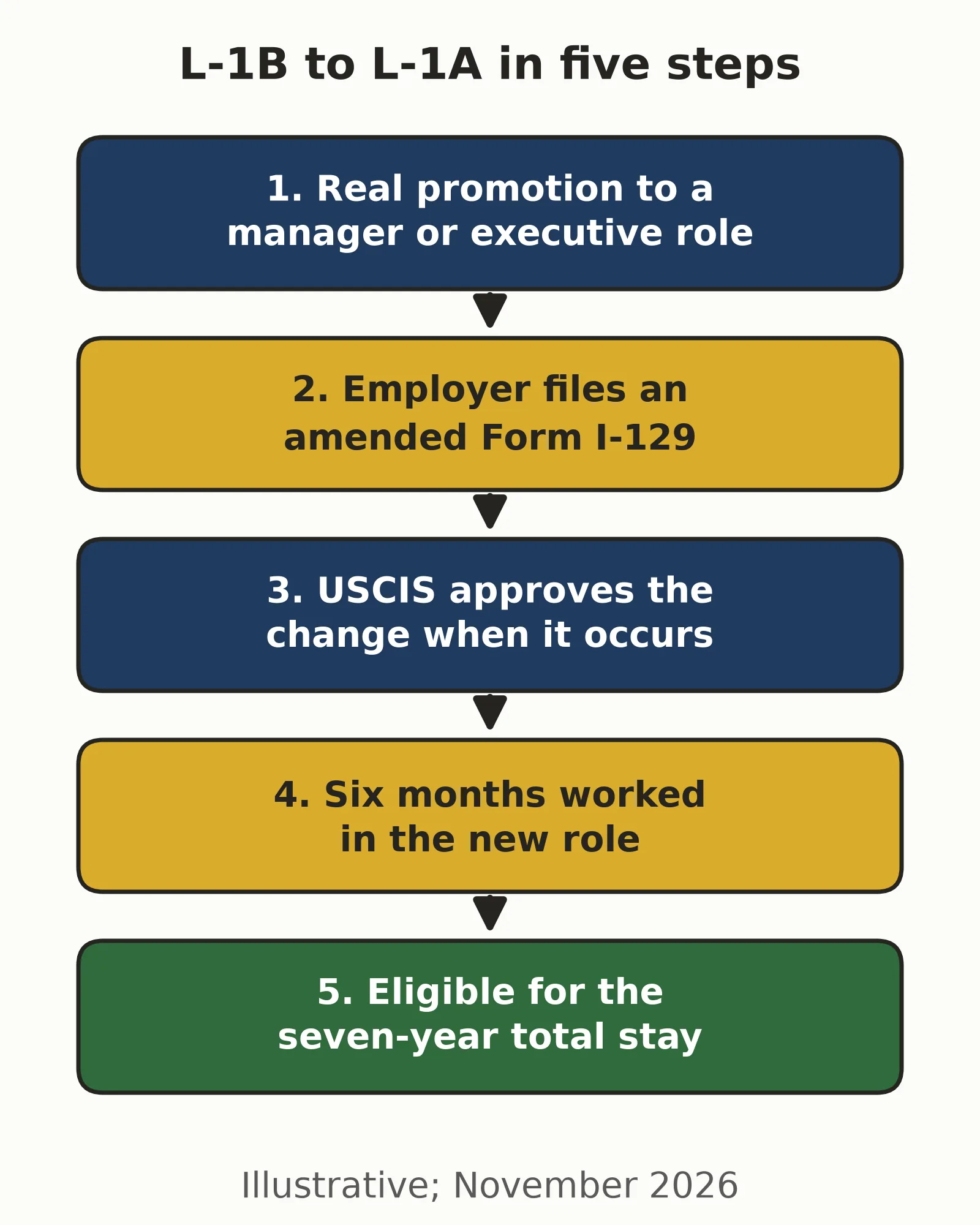
To convert L-1B to L-1A, the US employer files a new or amended Form I-129 showing that the employee will work primarily as a manager or executive. USCIS must approve the change at the time it occurs, and the employee needs at least six months in the new role to qualify for the seven-year total stay, as of November 2026.
What is an L-1B to L-1A conversion?
An L-1B to L-1A conversion is not a separate visa: it is a new or amended L-1 petition, filed by the employer on Form I-129, that reclassifies the same employee from a specialized knowledge capacity to a managerial or executive capacity.
The federal regulation on intracompany transferees, 8 CFR 214.2(l) in the Code of Federal Regulations (CFR), treats it that way. Under paragraph (l)(7)(i)(C), the petitioner must file an amended petition, with fee, to reflect a "change in capacity of employment (i.e., from a specialized knowledge position to a managerial position)". The employee cannot file it. Only the employer can.
The two classifications share the same foundation and differ in the role and the clock, as the table shows.
| Point | L-1B | L-1A |
|---|---|---|
| Role in the United States | Specialized knowledge | Manager or executive |
| Maximum total stay | 5 years | 7 years |
| Extension increments | Up to 2 years | Up to 2 years |
The year of work abroad is measured as of the first L-1 petition. The USCIS Policy Manual, Volume 2, Part L, Chapter 6, states that when a petitioner requests an extension of L-1 status, including a change from L-1B to L-1A status, the one-year foreign employment requirement must have been met when the initial L-1 petition was filed. The regulation adds, at paragraph (l)(3)(iv), that the work in the United States need not be the same work the employee performed abroad. So a person who was a specialist in Toronto can become a manager in New York. Our guide to the L-1 visa from Canada covers the qualifying relationship between the companies and the year abroad in full.
When does a promotion support an L-1A petition?
A promotion supports an L-1A petition only when the new job is primarily managerial or executive as the regulation defines those words, not merely more senior or better paid.
The definitions sit in 8 CFR 214.2(l)(1)(ii). A manager is an employee who primarily does four things:
- Manages: the organization, or a department, subdivision, function or component of it.
- Supervises: other supervisory, professional or managerial employees, or manages an essential function.
- Controls personnel decisions: has authority to hire and fire, or to recommend those actions, where staff are directly supervised; where none are, functions at a senior level for the function managed.
- Uses discretion: over the day-to-day operations of the activity or function.
An executive primarily directs the management of the organization or a major component or function, establishes goals and policies, exercises wide latitude in discretionary decision-making, and receives only general supervision from higher executives, the board of directors or stockholders.
Two parts of the manager definition matter most for a promoted L-1B specialist: the first-line supervisor rule and the essential-function route. First, the regulation says a first-line supervisor is not acting in a managerial capacity merely because of supervisory duties, unless the employees supervised are professional. A senior engineer who becomes lead of a crew of technicians may not qualify. Second, a person can qualify with no direct reports by managing an essential function at a senior level. USCIS describes this on its L-1A page as managing an essential function of the organization at a high level, without direct supervision of others.
The petition must carry evidence that the employee will work in the new capacity, "including a detailed description of the services to be performed", under paragraph (l)(3)(ii). Documents that can show this include an organization chart, a duty description that shows where the working week goes, and records of who reports to the employee. A new title alone proves little. If the person still spends most of the week doing the specialist work, the role has not changed in the way the regulation requires. If the new role does not meet the L-1A tests, other categories exist, and our overview of US work visas for Canadians compares them.
How do the L-1B and L-1A time limits count?
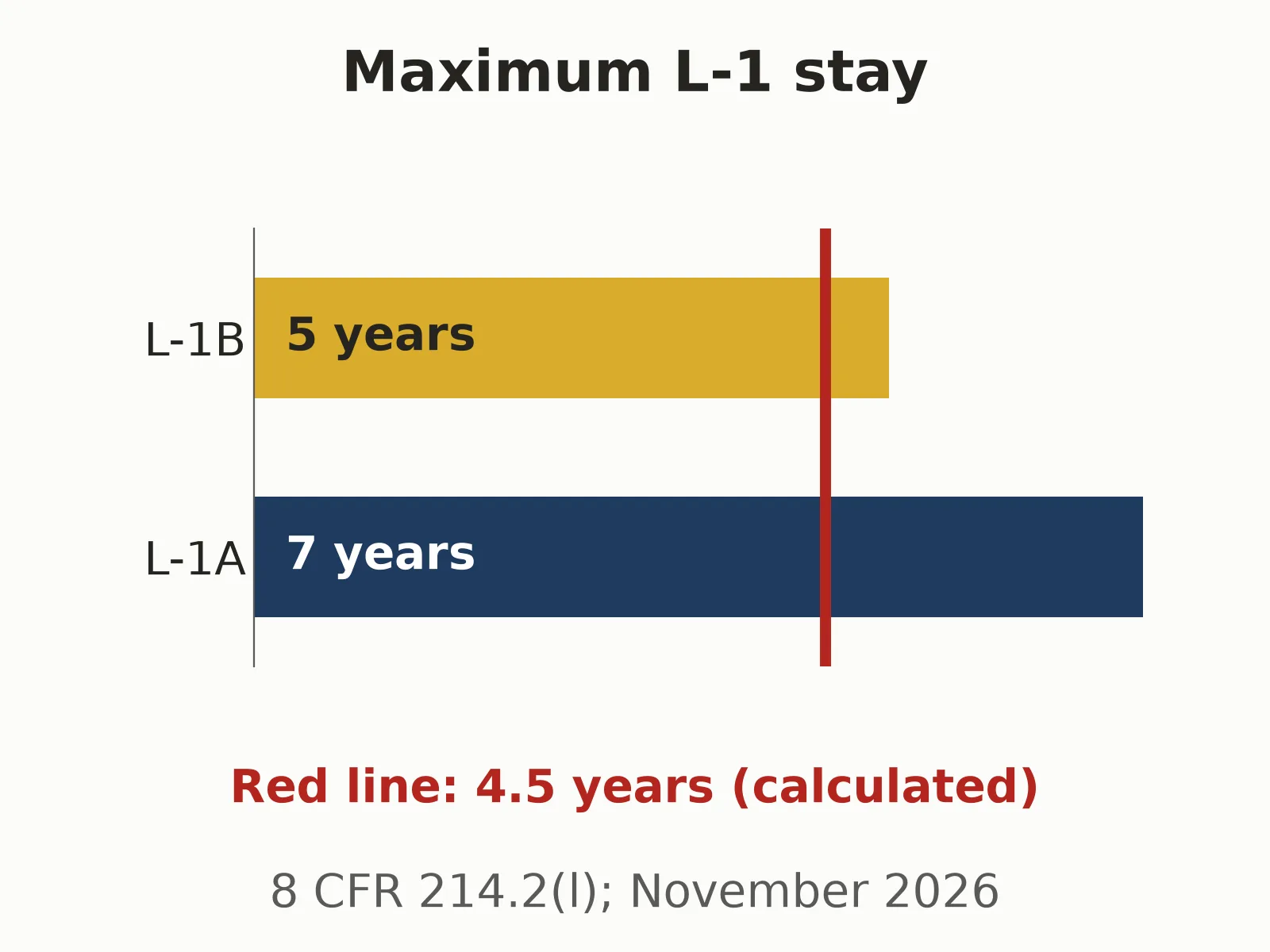
L-1B time and L-1A time run on one clock: USCIS adds together the periods a person has spent in the United States in H or L status, and the cap is five years for specialized knowledge and seven years for managers and executives.
The limits are in 8 CFR 214.2(l)(12)(i). The USCIS Policy Manual, Volume 2, Part L, Chapter 10, tells officers to combine periods of stay in the H and L categories, including time with previous employers. Its own example is a person who spent two years in H-1B status and then three years in L-1B status. That person has reached the five-year limit and cannot extend L status.
The conversion does not restart the clock. It raises the ceiling, and only on two conditions set by paragraph (l)(15)(ii):
- Six months in the role: an employee first admitted in a specialized knowledge capacity and later promoted must have been employed in the managerial or executive position for at least six months to be eligible for the seven-year total.
- Approval at the time: the change to managerial or executive capacity must have been approved by USCIS in an amended, new or extended petition at the time the change occurred.
What is the latest point to convert L-1B to L-1A?
By our calculation, the latest practical point to convert L-1B to L-1A is about four and a half years of combined H and L time: five years less six months. That figure is our reading of 8 CFR 214.2(l)(12)(i) and (l)(15)(ii), not a deadline USCIS prints. The reasoning is that a specialized knowledge stay cannot run past five years, so the six months in the managerial role have to fit inside that time. The Policy Manual hints at what happens otherwise: an extension for a manager whose prior approval covered only a short period could be an indicator that the person was not eligible to go beyond the five-year mark.
Here is an illustration. An employee is admitted in L-1B status on March 1, 2023, with no earlier H or L time. Five years of stay runs out at the end of February 2028. Counting back six months gives September 1, 2027. If USCIS has approved the managerial role and the employee is working in it by that date, the six months are complete when the five-year point comes. Any earlier H-1B or L-1 time makes both dates earlier. The regulation counts time spent in the United States, and this illustration assumes the employee is in the United States for the whole period.
Once the maximum is reached, 8 CFR 214.2(l)(12)(i) bars a new H or L admission until the person has resided and been physically present outside the United States for the immediate prior year. Paragraph (l)(12)(ii) sets two exceptions: people who do not reside continually in the United States and whose work there is seasonal, intermittent or totals six months or less per year, and people who reside abroad and regularly commute to part-time work in the United States.
Family members follow the employee. The spouse and unmarried minor children hold L-2 status subject to the same period of admission and limits as the principal, under paragraph (l)(7)(ii).
When should the employer file?
The employer should file early enough that USCIS approval is in place when the employee moves into the managerial or executive role, because the regulation requires the change to have been approved at the time it occurred.
Three timing rules come from the USCIS Policy Manual, Volume 2, Part L, Chapter 7, and the USCIS premium processing page:
- Earliest filing: a petitioner may not file the L-1 petition more than six months before the start date shown on Form I-129.
- Eligibility on the filing date: the Policy Manual says the petitioner must meet every eligibility requirement as of the day it files.
- Decision time: the manual says USCIS should in general process L petitions within 30 days of receipt. With premium processing, requested on Form I-907, USCIS guarantees adjudicative action within 15 business days or refunds the premium fee.
An employer may also need an extension of stay for the employee. Paragraph (l)(15)(i) requires the petition extension and the extension of stay to be requested together on Form I-129, and the employee must be physically present in the United States when the extension of stay is filed. An amended petition that also seeks an extension can cost some large employers more, as the fee section below explains.
What does the amended petition cost?
As of November 2026, a regular employer filing the amended L petition on paper pays $1,985 in USCIS fees, calculated as the $1,385 Form I-129 fee plus the $600 Asylum Program Fee, and optional premium processing adds $2,965. A covered large employer whose amended petition also seeks an extension owes a further $4,500, as explained below.
The amounts come from Form G-1055, the USCIS Fee Schedule, edition 10/26/26. All are in US dollars. The totals in the last two rows are our arithmetic from the published amounts.
| USCIS fee | Regular employer | Small employer |
|---|---|---|
| Form I-129, L petition (paper) | $1,385 | $695 |
| Asylum Program Fee | $600 | $300 |
| Premium processing (optional) | $2,965 | $2,965 |
| Total without premium | $1,985 | $995 |
| Total with premium | $4,950 | $3,960 |
The fee schedule lists an online filing fee of $1,335 for a regular employer. A nonprofit pays the $695 base fee and a $0 Asylum Program Fee.
Two statutory fees need a closer look. The $500 Fraud Prevention and Detection Fee is listed for a petitioner seeking initial approval of L status for a beneficiary, or approval to employ an L worker who currently works for another petitioner. A same-employer change of capacity for someone who already holds L-1 status is not on that list, so on our reading of the schedule the $500 fee is not triggered. Employers should check the current Form I-129 instructions before filing.
The second statutory fee is the $4,500 fee under Public Law 114-113, which USCIS also calls the 9-11 Biometric Fee. It applies to a covered employer, meaning one that employs 50 or more people in the United States with more than 50 percent of them in H-1B, L-1A or L-1B status. Under a final rule issued on August 10, 2026 and effective September 9, 2026, covered employers pay it on all L-1 petitions, with one exception: an amended petition that does not seek an extension of the employee's currently authorized L-1 status. On that wording, a covered employer whose amended petition asks for the change of capacity alone does not owe the $4,500, and one whose amended petition also seeks an extension does. The schedule applies this fee to petitions filed on or before September 30, 2027.
Does an L-1A lead to an EB-1C green card?
An L-1A does not by itself qualify anyone for the EB-1C multinational manager or executive green card: the employee must also have worked abroad for the related company for at least one year in a managerial or executive capacity.
This is the point a promoted specialist most often misses. Under 8 CFR 204.5(j)(3)(i)(B), when the person is already in the United States working for the same employer or its affiliate, the petition must show that in the three years preceding entry as a nonimmigrant, the person "was employed by the entity abroad for at least one year in a managerial or executive capacity". The L-1 petition accepts a specialized knowledge year abroad. The EB-1C petition does not.
The USCIS Policy Manual, Volume 6, Part F, Chapter 4, says it plainly: no provision of law allows a person who was employed abroad in a purely specialized knowledge capacity to be classified as a multinational executive or manager immigrant. It then adds a qualification that matters. Some L-1B workers may still qualify, because their employment abroad would also have qualified as managerial or executive and the employer intends to employ them permanently in such a position.
So the question for a converted employee is what the job in Canada really was. An employee whose job in Canada already included managing people or a function may have a managerial year abroad that can be documented. An employee whose year abroad was purely specialized knowledge work does not, and for that person the L-1A buys time in the United States, not EB-1C eligibility. Where the history fits, the category has real advantages: no labor certification is required, and USCIS guarantees premium processing action within 45 business days on a multinational manager Form I-140. The L classification also permits a person to seek permanent residence while holding temporary status, provided the person intends to depart voluntarily at the end of the authorized stay, under paragraph (l)(16). Our guide to the L-1A visa to green card route walks through the EB-1C petition.
What changes for Canadians at the border?
For a Canadian citizen, an L-1B to L-1A conversion is a USCIS filing made while the employee works in the United States; after approval, a visa-exempt Canadian may present the new approval notice at a port of entry instead of a visa.
USCIS states on its L-1A page that Canadian citizens are exempt from the L-1 visa requirement. Under 8 CFR 214.2(l)(13)(i), the beneficiary of an individual petition who does not require a visa may present a copy of Form I-797, the approval notice, at a port of entry. After the change is approved, the employee carries the L-1A approval when crossing.
The treaty route that lets an employer file an individual L-1 petition for a Canadian citizen with an immigration officer at a Class A port of entry on the land border, or at a preclearance station in Canada, is set out in paragraph (l)(17). The amendment rule in paragraph (l)(7)(i)(C), by contrast, speaks of filing the amended petition with USCIS. Employers should not assume that a change of capacity can be handled at the bridge the way a first transfer sometimes is.
Frequently asked questions
Can an employer convert L-1B to L-1A without the employee leaving the United States?
Generally yes. The regulation handles the change through a new or amended Form I-129 that the employer files with USCIS, not through a visa application abroad. If the employer also asks for an extension of stay, 8 CFR 214.2(l)(15)(i) requires the employee to be physically present in the United States when it is filed.
How long must the employee be a manager before the seven-year limit applies?
At least six months. Under 8 CFR 214.2(l)(15)(ii), an employee first admitted in a specialized knowledge capacity must have been employed in the managerial or executive position for at least six months to be eligible for the seven-year total, and USCIS must have approved the change at the time it occurred.
Does an L-1B to L-1A conversion restart the L-1 clock?
No. Time in L-1B and L-1A status counts on one clock, together with any time in H status, including time with earlier employers. The change raises the ceiling from five years to seven. A fresh period becomes available only after the person has resided and been physically present outside the United States for the immediate prior year, apart from the regulation's narrow exceptions for intermittent and commuter employment.
Is premium processing available for an L-1B to L-1A petition?
Yes. L-1A and L-1B petitions on Form I-129 are designated for premium processing. As of November 2026 the fee is $2,965, requested on Form I-907, and USCIS guarantees adjudicative action within 15 business days or refunds the premium fee. Adjudicative action can be an approval, a denial, a notice of intent to deny or a request for evidence, or the opening of a fraud investigation.
Does the employee need a new qualifying year abroad?
No, according to the USCIS Policy Manual. It states that when a petitioner requests an extension of L-1 status, including a change from L-1B to L-1A status, the one-year foreign employment requirement must have been met at the time the initial L-1 petition was filed. The regulation also says the US work need not be the same work performed abroad.
Can a former L-1B specialist get an EB-1C green card after the change?
Only if the year of employment abroad was itself managerial or executive. The EB-1C regulation, 8 CFR 204.5(j)(3)(i)(B), looks at the capacity in which the person worked for the related company before entering the United States. A year abroad in a purely specialized knowledge role does not meet it, whatever the current US title.
Does the $4,500 Public Law 114-113 fee apply to an L-1B to L-1A amendment?
Only for covered employers, and not always. The fee applies to employers with 50 or more US employees, more than half of them in H-1B or L-1 status. An amended petition that does not seek to extend the employee's currently authorized L-1 status is exempt, according to USCIS Form G-1055. An amended petition that also seeks an extension is not.
Conclusion
An L-1B to L-1A conversion is simple to describe and easy to mistime. The role in the petition must meet the regulatory definition of managerial or executive capacity. USCIS must approve the change at the time it occurs. The employee then needs at least six months in the role to qualify for the seven-year total, which by our calculation puts the practical cut-off at about four and a half years of combined H and L time. And the L-1A, once approved, opens the EB-1C route only for an employee whose year abroad was managerial or executive too.
How Mayo Law can help
Mayo Law is a cross-border firm with offices in Toronto and New York, and Joseph Mayo is licensed in Ontario and New York. Our lawyers work with Canadian companies on L-1A and L-1B petitions, including amended petitions when a specialist is promoted, extensions, and the planning that connects an L-1 transfer to permanent residence. We also advise on the wider business immigration picture when a role does not fit the L-1A tests. Mayo Law offers a paid one-hour consultation, because a lawyer reviews the employee's history, the US role and the dates in depth before giving a view.
Disclaimer
This guide is general information, not legal advice, and reading it does not create a solicitor-client or attorney-client relationship. US immigration rules and fees change, and the outcome of any petition depends on its own facts. Mayo Law provides legal services in Ontario and New York.