

Contents
- Quick answer
- Is a business plan required for an EB-2 NIW?
- What must an NIW plan prove under Dhanasar?
- What should an NIW business plan include?
- What evidence should back an NIW business plan?
- What weakens an entrepreneur's NIW plan?
- How does an NIW plan differ from an E-2 plan?
- Who should write an NIW business plan?
- Frequently asked questions
- Conclusion
- How Mayo Law can help
- Disclaimer
A business plan for EB-2 NIW petitions is the document a founder uses to show U.S. Citizenship and Immigration Services (USCIS) what the proposed venture is, why it matters to the United States and why the founder is the person to build it. No rule makes the plan mandatory. For an entrepreneur who files without an employer, though, it usually carries the description of the endeavor that the whole case rests on.
This guide is written for Canadian founders and owners who are weighing a national interest waiver (NIW) as part of their business immigration planning. It follows the USCIS Policy Manual as it read in November 2026 and the decision that set the test, Matter of Dhanasar.
Quick answer
USCIS does not require a business plan for an EB-2 national interest waiver, but its Policy Manual lists a detailed plan among the factors it considers in deciding whether a founder is well positioned. A useful plan speaks to the three Dhanasar prongs the petitioner must meet, and USCIS says it should be supported by other independent evidence.
Is a business plan required for an EB-2 NIW?
No, a business plan is not a required document for a national interest waiver, and neither the statute nor the regulation names one. The statute, at section 203(b)(2)(B)(i) of the Immigration and Nationality Act, lets the government waive the job offer requirement when it deems the waiver to be in the national interest. The regulation, at Title 8 of the Code of Federal Regulations (8 CFR), section 204.5(k)(4)(ii), asks for evidence to support the claim that the exemption would be in the national interest. It does not say what form that evidence takes.
The business plan's role in a national interest waiver comes from USCIS guidance, not from the statute or the regulation. In the USCIS Policy Manual, Volume 6, Part F, Chapter 5, current as of October 27, 2026, USCIS lists the factors it weighs when it decides whether a person is well positioned to advance an endeavor. One of them is evidence of a detailed proposal or plan that the person developed, or played a significant role in developing, for future activities related to the proposed endeavor. The same chapter lists, among examples of useful evidence, a plan describing how the person intends to continue the proposed work in the United States.
USCIS adds that this list of examples is not a checklist, and that no single type of evidence is either required or sufficient. So a founder can, in theory, file without a formal plan. In practice a self-petitioning entrepreneur has no employer letter and no job description to explain the work. The plan fills that gap. Our guide to the EB-2 NIW requirements for Canadians covers who qualifies for the category in the first place, which USCIS checks before it reaches the waiver.
What must an NIW plan prove under Dhanasar?
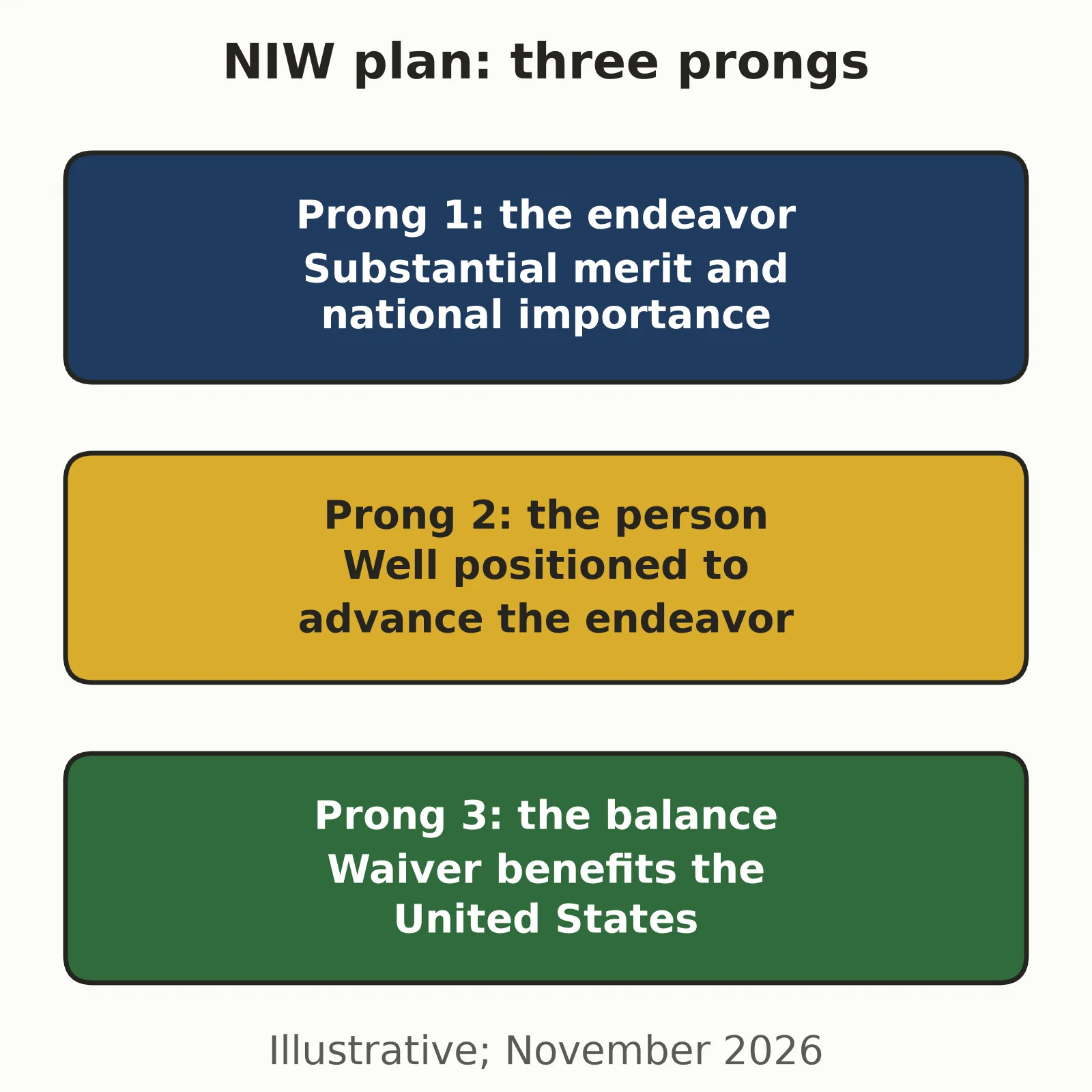
A plan should give USCIS the facts for all three prongs the petitioner must meet under Matter of Dhanasar: that the endeavor has substantial merit and national importance, that the founder is well positioned to advance it, and that waiving the job offer and labor certification requirements would, on balance, benefit the United States.
The three-prong test comes from Matter of Dhanasar, 26 I&N Dec. 884, decided on December 27, 2016 by the Administrative Appeals Office (AAO) of USCIS. The petitioner carries the burden on each prong by a preponderance of the evidence, and approval remains a matter of discretion.
Prong 1: substantial merit and national importance
The first prong looks at the venture, not the founder. USCIS says the endeavor is more specific than the occupation, so a plan should describe the particular projects and goals and not a job title. The Policy Manual warns that general statements about the value of business owners or entrepreneurs for job creation will not, alone, show national importance. A petition involving a startup should show in detail how this specific endeavor meets the standard.
On national importance, USCIS tells its officers to focus on the nature of the endeavor more than its geographic reach. An endeavor may have national importance because it has national or global implications within a field. It may also qualify because it has significant potential to employ U.S. workers, or other substantial positive economic effects, particularly in an economically depressed area.
Prong 2: well positioned to advance the endeavor
The second prong shifts to the founder. Dhanasar names four factors, without limiting the list to them: education, skills, knowledge and record of success in related efforts; a model or plan for future activities; progress already made; and the interest of potential customers, users, investors or other relevant entities or individuals. The plan is one of the four, and it is also the place where the other three are pulled together.
A founder does not have to prove the venture will succeed. The decision says that many entrepreneurial endeavors may fail despite an intelligent plan and competent execution, and that petitioners need not show success is more likely than not. Unsubstantiated claims, however, do not meet the burden.
Prong 3: on balance, a waiver benefits the country
The third prong asks whether the benefits of the waiver outweigh the purpose of the labor certification process, which protects U.S. workers. For entrepreneurs, the Policy Manual notes that where a person is self-employed in a way that generally does not adversely affect U.S. workers, or owns a business that provides jobs for U.S. workers, there may be little benefit from a labor certification. Potential job creation and considerable economic impact are among the points officers may weigh.
What should an NIW business plan include?
An EB-2 NIW business plan should describe the endeavor in plain terms, set out the founder's role and record, and give forecasts for market size and share, job creation and revenue growth, which are among the metrics USCIS says it would welcome evidence on. USCIS prescribes no format, section list or length.
Because USCIS prescribes none of these, page counts and layouts published elsewhere do not come from the agency. The Policy Manual says that strong petitions discuss how the person's record of success would translate to a proposed plan or forecast for continued success, the steps already taken toward those activities, and plans that tie into the person's background. The table below shows how common plan sections line up with the prongs and with the outside proof each one needs.
| Plan section | Prong it serves | Outside proof |
|---|---|---|
| Endeavor description | Prong 1 | Field or industry data |
| Market size and share | Prongs 1 and 2 | Third-party market sources |
| Founder role and record | Prong 2 | Degrees, licences, past ventures |
| Funding plan | Prong 2 | Investor commitments, grants |
| Customers and traction | Prong 2 | Letters, contracts |
| Jobs and revenue forecast | Prongs 1 and 3 | Growth records, regional data |
Two drafting points for an NIW business plan follow from the Manual's own words. First, write for a general reader. USCIS notes that many petitioners work in technical fields and says it would be helpful to describe the endeavor in a way an average person could understand. Second, keep the founder at the centre. USCIS describes the entrepreneur it has in mind as someone who typically holds an ownership interest in a U.S. entity and keeps an active and central role in it.
What evidence should back an NIW business plan?
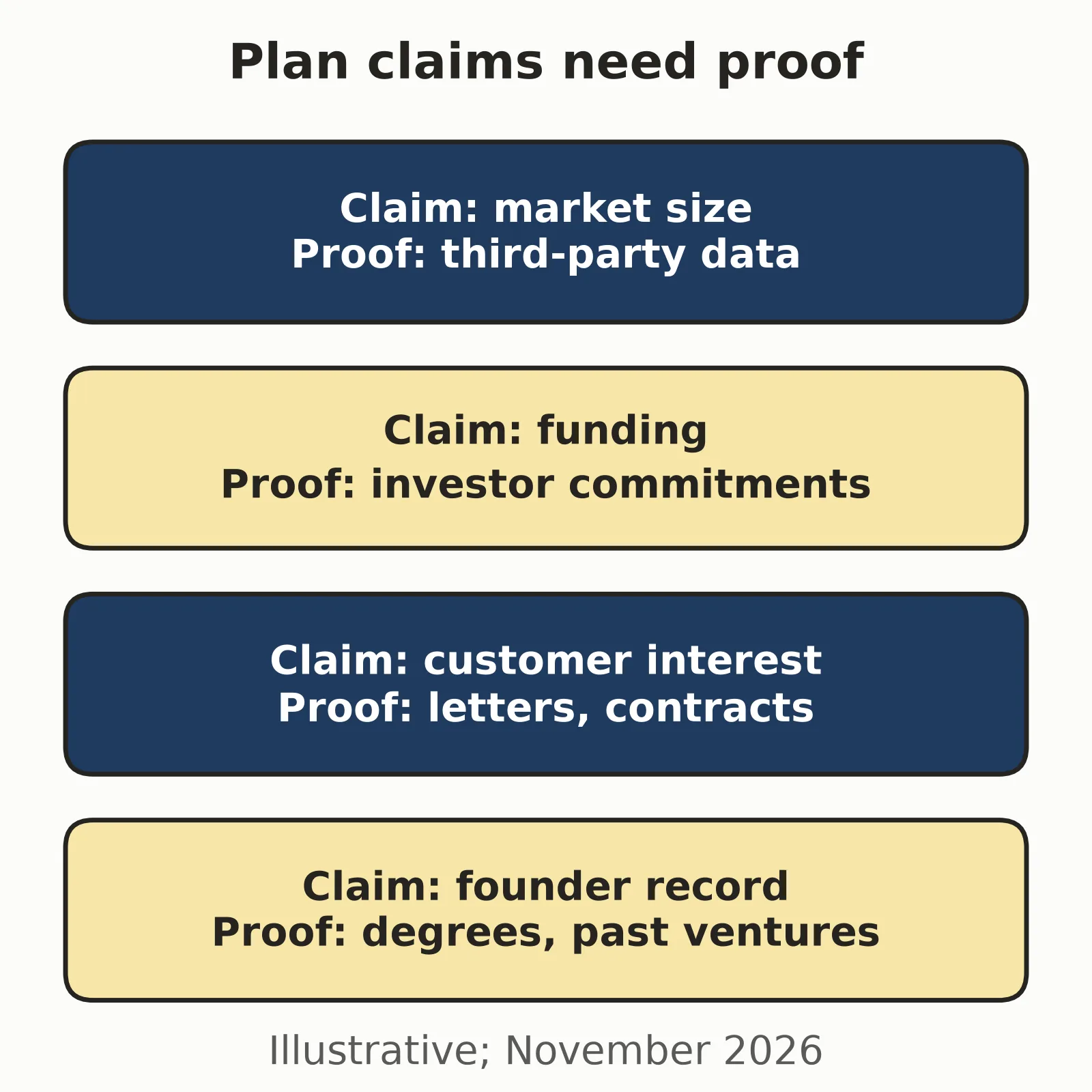
Every material claim in a business plan for EB-2 NIW filings should be matched by evidence that does not come from the founder alone, because USCIS states that business plans, while useful in explaining a person's objectives, should be supported by other independent evidence.
The Policy Manual has a section on evidence specific to entrepreneurs. It groups that evidence under nine headings, and each can stand behind a part of the plan:
- Ownership and role: proof of the founder's ownership interest and position as an officer or in another key role in the U.S. entity.
- Background: degrees, certifications, licences and letters of experience.
- Investments: an investment, a binding commitment to invest, or other proof of an outside investor's intent to invest, consistent with industry standards.
- Incubators and accelerators: admission to a program, which officers may treat as an endorsement of the plan or track record.
- Awards or grants: funds from federal, state or local government bodies, or from policy or research institutes.
- Intellectual property: patents and similar rights, with documents showing why they matter to the field.
- Published materials: media coverage of the founder or the company that refers to the founder's role.
- Revenue, growth and jobs: records of revenue generation and of jobs created in the United States, and the founder's contribution to that growth.
- Third-party letters: letters and other statements from third parties such as government entities, outside investors and established business associations.
On funding, the Manual says under its investments heading that USCIS considers the amount of capital that would be appropriate to the endeavor, since different ventures have different capital needs. There is no minimum investment for a national interest waiver in the statute, the regulation or the Manual.
USCIS evaluates the evidence in the aggregate. It says, for example, that ownership of a company is relevant to whether the person is well positioned but rarely establishes eligibility on its own. A founder who files while still building the company should also plan for the wait that follows; our guide to NIW processing time sets out the stages.
What weakens an entrepreneur's NIW plan?
The weaknesses USCIS itself describes include broad claims about helping the economy, reliance on the importance of an industry as a whole, and a founder whose experience does not match the venture. The Policy Manual states each point in the list below.
- General economic claims: USCIS states that broad assertions regarding general benefits to the economy and potential to create jobs will not establish an entrepreneur's qualification.
- Industry importance: statements about the importance of an industry overall, such as the car dealership industry, will not show that a person seeking to start a car dealership meets the national importance prong.
- Consulting for an important field: an entrepreneur cannot show national importance solely by opening a consulting firm for people working or seeking to work in a nationally important occupation.
- A thin record: the Manual's example is a person whose banking experience is limited to work as a teller or accounts manager and who proposes a business advising U.S. banks nationally on customer relations. USCIS may find that person is not well positioned.
- Benefits to one company: USCIS says benefits to a specific employer alone are not sufficiently relevant, and that a person may not be able to establish national importance on evidence that a technology benefits one company or its clients alone; the question is whether the endeavor has broader implications for a field, a region or the public.
- Uncorroborated projections: claims lacking corroborating evidence are not sufficient to meet the burden of proof.
A related problem is the occupation behind the venture. A founder who relies on an advanced degree must show that the occupation through which the endeavor will be advanced is a profession. The Manual's example is a person with a master's degree or doctorate in engineering who intends to start a bakery. USCIS says that person may have difficulty, because the degree is advanced but baker is not an occupation that typically requires a bachelor's degree for entry. A plan that drifts away from the founder's field can therefore cause trouble before USCIS even reaches the waiver.
How does an NIW plan differ from an E-2 plan?
An E-2 plan supports a nonimmigrant treaty investor visa and has to show a substantial, at-risk investment in a business that is more than marginal, while a business plan for EB-2 NIW petitions supports a green card petition and has to show national importance and a well-positioned founder. The two documents answer different legal questions.
Canadian citizens can apply for the E-2: Canada appears on the E-2 treaty country list in the State Department's Foreign Affairs Manual (FAM), at 9 FAM 402.9. Under 9 FAM 402.9-6(E), an E-2 enterprise must have the present or future capacity to generate more than a minimal living for the investor and family, or to make a significant economic contribution, and that projected capacity should generally be realizable within five years from the date the applicant commences normal business activity. The same chapter's suggested document list for a new business asks for financial projections for the next five years, supported by a thorough business plan. The comparison below sums up the main differences.
| Point | NIW plan | E-2 plan |
|---|---|---|
| Result sought | Immigrant petition | Nonimmigrant visa |
| Core question | National importance | More than marginal |
| Investment | No minimum set | Must be substantial |
| Forecast horizon | None prescribed | Generally five years |
For the E-2, the FAM says no set dollar figure constitutes a minimum amount of investment. Our guide to E-2 visa business plan requirements covers that document in detail.
A founder who applies for an E-2 visa after an immigrant petition has been filed faces a question about intent. Under 9 FAM 402.9-4(C), an E visa applicant who is the beneficiary of an immigrant visa petition will need to satisfy the consular officer that the intent is to depart the United States at the end of the authorized stay, and not to stay in the United States to adjust status. A plan built to show that a business can support a family and employ staff does not, without more, address national importance.
Who should write an NIW business plan?
The founder should be the author in substance, because the factor USCIS weighs is a plan that the person developed, or played a significant role in developing. That wording comes directly from the Policy Manual's list of second prong factors.
The Manual's entrepreneur guidance does not address outside help with drafting, formatting or financial modelling. What the wording does mean is that the plan should reflect the founder's own knowledge of the market, the product and the numbers. The Manual also says the more integral a person is to an endeavor, the stronger the case that the person is well positioned to advance it. A document the founder cannot explain or support with records does not serve that purpose.
The Manual points to a second kind of review that carries weight: the merits of an entrepreneur's business, business plan, product or technology may be reviewed by third parties such as prospective investors, retailers or others in the industry, and letters from those reviewers may have probative value. A plan that outside investors or customers have already examined, and acted on, gives USCIS more to rely on than a plan that only the founder has read.
Frequently asked questions
Is a business plan for EB-2 NIW required by USCIS?
No. Neither the statute nor 8 CFR 204.5(k) names a business plan as a required document. The USCIS Policy Manual, current as of October 27, 2026, lists a detailed proposal or plan as one factor in deciding whether a person is well positioned to advance the endeavor, and says its list of evidence is not a checklist.
How long should an NIW business plan be?
USCIS sets no page count, section list or format for a national interest waiver business plan. The Policy Manual asks for a detailed description of the proposed endeavor with supporting documents and says a description an average person could understand would be helpful. Length figures published elsewhere are preferences, not USCIS rules, as of November 2026.
Does an NIW business plan need five-year financial projections?
No forecast period is prescribed for a national interest waiver. USCIS says it would welcome probative evidence of how the founder has anticipated metrics such as market size and share, job creation and revenue growth. The five-year horizon belongs to the E-2 visa, where 9 FAM 402.9-6(E) says projected capacity should generally be realizable within five years.
Is there a minimum investment for an entrepreneur's NIW?
No minimum investment appears in the statute, the regulation or the USCIS Policy Manual. The Manual treats outside investment as one type of evidence and says USCIS considers the amount of capital that would be appropriate to advance the particular endeavor, because different endeavors have different capital needs. Self-funded founders are assessed on the rest of the record.
Does the business have to be running before I file?
USCIS does not state that the company must already operate. The Policy Manual refers to an entity in which the petitioner possesses or will possess an ownership interest, and it counts any progress toward the endeavor as a factor. Customers, outside funding and admission to an accelerator are examples of the progress and outside interest the Manual describes.
Can I use my E-2 business plan for an NIW petition?
Not without rewriting it. An E-2 plan is built to show a substantial investment and a business that is more than marginal under 9 FAM 402.9. An NIW plan must show substantial merit and national importance and a founder who is well positioned, under Matter of Dhanasar. The financial data may carry over, but the argument does not.
Will USCIS deny the petition if the business might fail?
Not for that reason alone. Matter of Dhanasar says many entrepreneurial endeavors may fail despite an intelligent plan and competent execution, and it does not require proof that success is more likely than not. The petitioner must still show, by a preponderance of the evidence, that the founder is well positioned to advance the endeavor.
Conclusion
For a self-petitioning founder, the business plan is where the endeavor is defined and where the three Dhanasar prongs are tied to facts. USCIS does not demand the document, set its length or fix its format. It does say what it looks for: a specific endeavor with importance beyond one company, a founder whose record fits the venture, and forecasts that outside evidence supports. A plan written to those points, in plain language and by the person who will run the business, does the work the Policy Manual describes. A plan that repeats general claims about entrepreneurship does not.
How Mayo Law can help
Mayo Law is a cross-border firm with offices in Toronto and New York. Joseph Mayo is licensed in Ontario and New York, and our lawyers work with Canadian founders and companies on U.S. business immigration, including national interest waiver petitions and E-2 treaty investor cases. We review how a proposed endeavor and its supporting record line up with the Dhanasar prongs before a petition is filed. Mayo Law offers a paid one-hour consultation, because a lawyer reviews your situation in depth during that session.
Disclaimer
This article provides general information only and is not legal advice. Reading it does not create a solicitor-client or attorney-client relationship. Immigration rules and agency guidance change, and each case turns on its own facts. Mayo Law provides legal services in Ontario and New York.