

Contents
- Quick answer
- What are the O-1 visa requirements?
- Which O-1 visa criteria must you meet?
- How does an O-1 visa for startup founders work?
- Who files the petition and what goes with it?
- What does an O-1 petition cost in USCIS fees?
- What happens at the Canadian border after approval?
- How long does O-1 status last?
- Frequently asked questions
- Conclusion
- How Mayo Law can help
- Disclaimer
The O-1 is a United States work visa for people with extraordinary ability in the sciences, education, business, athletics or the arts, or extraordinary achievement in film or television. This guide sets out the O-1 visa requirements as U.S. Citizenship and Immigration Services (USCIS) applies them in November 2026, with a focus on founders, executives and Canadians. It sits alongside our business immigration work for founders and employers.
Everything below is United States federal law. The rules come from the regulation at 8 CFR 214.2(o), in the Code of Federal Regulations (CFR), and from Volume 2, Part M of the USCIS Policy Manual, which USCIS showed as current on October 27, 2026. Each source was checked in November 2026 and is named where the guide relies on it.
Quick answer
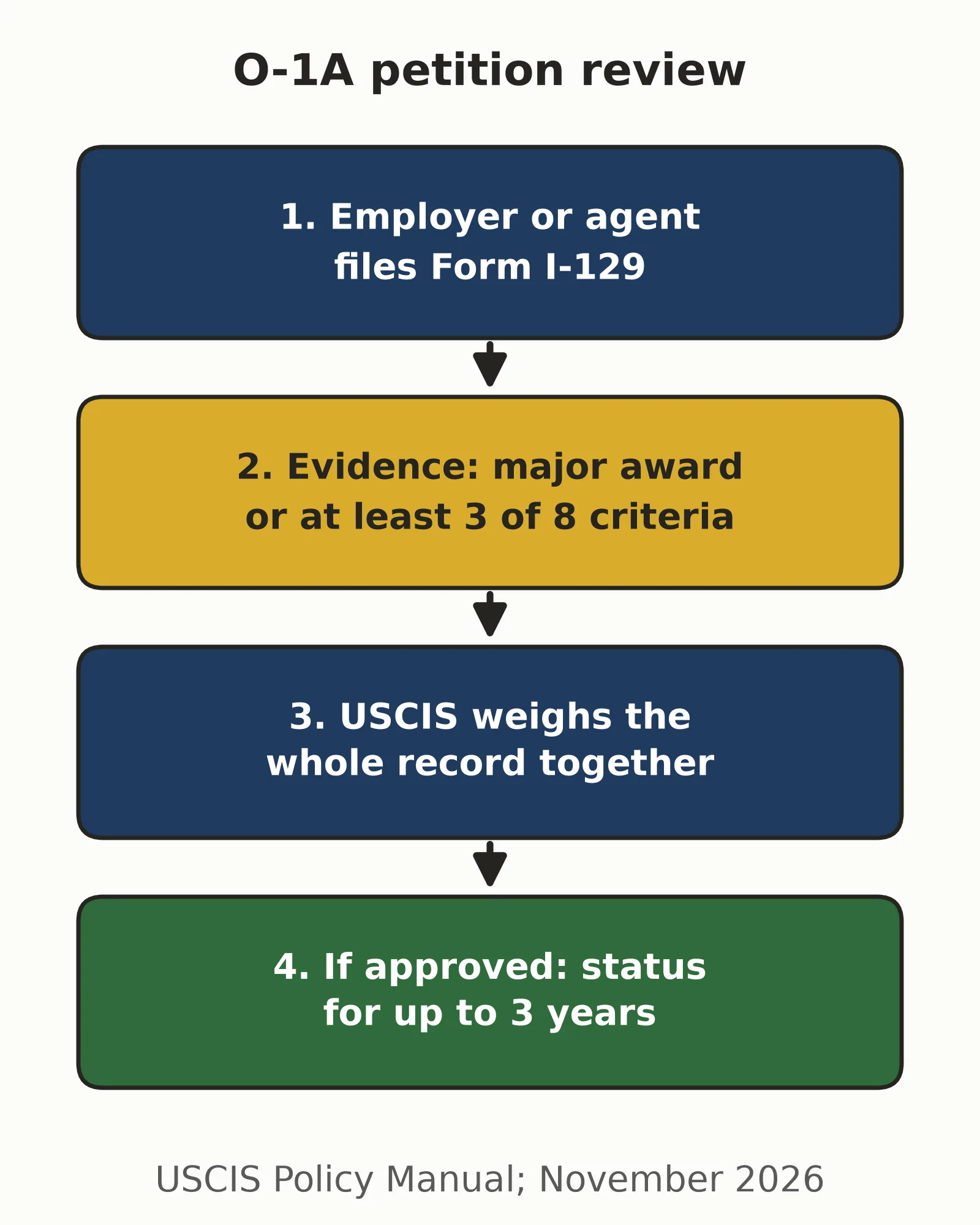
To meet the O-1 visa requirements, a U.S. employer or agent files Form I-129 showing that you have sustained national or international acclaim and are coming to continue work in your field. For an O-1A, the evidence must show a major internationally recognized award or at least three of eight listed criteria, plus a written advisory opinion.
What are the O-1 visa requirements?
For an O-1A, the O-1 visa requirements are three: extraordinary ability shown by sustained national or international acclaim, achievements recognized in the field through extensive documentation, and a plan to continue work in that area in the United States. Chapter 4 of the Policy Manual lists these three points as what the petitioner must establish for an O-1A.
Under 8 CFR 214.2(o), extraordinary ability in science, education, business or athletics means a level of expertise indicating that the person is one of the small percentage who have arisen to the very top of the field of endeavor. The USCIS Policy Manual adds a point that helps executives: the petitioner must show the person is coming to continue work in the area of extraordinary ability, but not necessarily that the particular duties require someone of that ability.
USCIS's page "O-1 Visa: Individuals with Extraordinary Ability or Achievement" describes four classifications:
- O-1A: extraordinary ability in the sciences, education, business or athletics. An O-1A visa covers business, so it is the classification this guide follows for founders and executives.
- O-1B: extraordinary ability in the arts, or extraordinary achievement in the motion picture or television industry.
- O-2: people who accompany an O-1 artist or athlete to assist in a specific event or performance.
- O-3: the spouse or children of an O-1 or O-2 holder.
USCIS reviews an O-1 petition in two steps. First, the officer checks whether the evidence includes a qualifying award or meets the minimum number of listed criteria. Second, the officer weighs all the evidence in the record together. The Policy Manual is direct about the gap between the two: meeting at least three criteria "does not necessarily establish that the beneficiary is eligible for the O-1 classification." The criteria are the way to show the standard is met. They are not the standard.
O-1B in brief
For the arts, extraordinary ability means distinction: a high level of achievement, shown by skill and recognition substantially above what is ordinarily encountered. The petition must show that the person received, or was nominated for, a significant national or international award such as an Academy Award, an Emmy, a Grammy or a Director's Guild Award, or at least three of the criteria 8 CFR 214.2(o) lists for artists. For film and television the test is a record of extraordinary achievement, and the advisory opinions must come from both a labor union and a management organization. The rest of this guide is about the O-1A.
Which O-1 visa criteria must you meet?
An O-1A petition must show either a major internationally recognized award, such as the Nobel Prize, or evidence that meets at least three of the eight O-1 visa criteria in 8 CFR 214.2(o)(3)(iii). Some guides call these the O-1 visa qualifications; the regulation calls them evidentiary criteria. In the Policy Manual's order, they are:
- 1. Awards: nationally or internationally recognized prizes or awards for excellence in the field.
- 2. Memberships: membership in associations that require outstanding achievements of their members, as judged by recognized national or international experts.
- 3. Published material: material about the person and their work in professional or major trade publications or major media.
- 4. Judging: taking part, on a panel or individually, as a judge of the work of others in the same or an allied field.
- 5. Original contributions: original scientific, scholarly or business-related contributions of major significance in the field.
- 6. Scholarly articles: authorship of scholarly articles in the field, in professional journals or other major media.
- 7. Critical role: employment in a critical or essential capacity for organizations and establishments that have a distinguished reputation.
- 8. High pay: a high salary or other remuneration, past or future, shown by contracts or other reliable evidence.
The USCIS Policy Manual explains how officers read each one. A few of its points matter to business applicants in particular:
- Awards: a team award counts if the person is one of its recipients. An award open only within one locality, employer or school may have little national or international recognition.
- Memberships: membership based only on education, years of experience or payment of a fee does not show outstanding achievement.
- Published material: a brief citation or passing reference is not material "about" the person. The person does not have to be the only subject of the piece.
- Judging: the petitioner must show the person actually took part in the judging, not only that an invitation was sent.
- Critical role: it is the person's duties and performance, not the job title, that show whether a role was critical or essential.
- High pay: the petitioner carries the burden of showing the pay is high relative to others in the field, for example with compensation surveys. For work outside the United States, officers compare against wage data for that locality instead of converting the salary to U.S. dollars.
What is comparable evidence for an O-1?
If a listed criterion is not readily applicable to the person's occupation, the petitioner may submit comparable evidence in its place. The petitioner must explain why the criterion does not readily apply and why the substitute is comparable. A general, unsupported assertion is not enough. The petition must still satisfy at least three separate criteria, and the standard itself does not change.
How does an O-1 visa for startup founders work?
For startup founders, the O-1 visa works through the same eight criteria, and the USCIS Policy Manual names founder evidence under several of them: the founder's role, the startup's funding and the founder's equity. The table below maps that wording to the criteria; its last two rows are the manual's general examples, which also fit a founder's record. Each entry is taken from Chapter 4, Section C of the Policy Manual; it shows what USCIS names, not what any petition will achieve.
| Criterion | Evidence USCIS names | Limit or condition |
|---|---|---|
| 7. Critical role | Founder of a distinguished startup | Duties count, not title |
| 7. Critical role (reputation) | Significant investor or government funding | Matched to stage and industry |
| 8. High pay | Contract or job offer letter | Funding supports its credibility |
| 8. Comparable evidence | Highly valued startup equity | Explain why salary does not apply |
| 5. Contributions | Patents, licenses, commercial use | Pending patent likely needs more evidence |
| 6. Comparable evidence | Major trade show presentation | Occupation in industry, not academia |
Three passages carry most of the weight for a founder. Under criterion 7, the Policy Manual lists a "founder or co-founder of, or contributor of intellectual property to, a startup business that has a distinguished reputation" as an example of a critical or essential role. For the startup's reputation, officers may treat significant funding from government entities, venture capital funds, angel investors or similar funders as a positive factor, when it is commensurate with the funding rounds generally achieved for that startup's stage and industry.
Under criterion 8, the same kind of funding helps officers judge the credibility of a founder's contract or job offer letter. And where a founder draws little salary, the comparable evidence section gives its own example: a petitioner who shows that a high salary is not readily applicable to an entrepreneur might present the founder's highly valued equity holdings in the startup instead.
The Policy Manual also covers research-based companies. It lists a principal or named investigator for a business that received a merit-based government award, such as a Small Business Innovation Research (SBIR) grant, as an example under criterion 7. A detailed letter from an interested government agency can also support criteria 5 and 7.
The same section of the Policy Manual names patents, licenses and commercial use of the person's work as evidence of original contributions under criterion 5, and says a pending patent will likely need additional supporting evidence. Where the occupation is in industry and not academia, it gives a presentation of work at a major trade show as possible comparable evidence for criterion 6.
For a founder, the O-1 is one of several routes. Our guide to U.S. work visas for Canadians compares it with the others, and whether a Canadian can work in the U.S. covers the basics. Our guide to the TN visa for Canadians covers another route.
Does starting a company count as the same field?
It can. The USCIS Policy Manual reads the area of extraordinary ability broadly, to include other occupations that involve shared skillsets, knowledge or expertise, and uses "an engineer coming to start a technology company" as an example. That matters to a founder who built a reputation as an engineer, scientist or executive and is now changing roles. Officers look at whether the two occupations are in the same industry, whether the new role is a leadership position over the old one, and whether the move is a common one.
Can a founder petition for themselves?
Not personally, but a separate legal entity the founder owns can. Chapter 3 of the USCIS Policy Manual says O beneficiaries may not petition for themselves. It then adds that a separate legal entity owned by the beneficiary, such as a corporation or limited liability company, may file the petition on their behalf. The petition must also rest on real work: Chapter 9 says speculative employment and freelancing are not allowed, and the petitioner must establish that there are events or activities in the person's field for the period requested.
Who files the petition and what goes with it?
A U.S. employer, a U.S. agent, or a foreign employer acting through a U.S. agent files Form I-129, Petition for a Nonimmigrant Worker, with the evidence of extraordinary ability, a written advisory opinion, the contract and a description of the work. An O-1 petition covers one person only.
- Advisory opinion: a written consultation from a U.S. peer group in the person's area of ability, which may be a labor organization, or from a person with expertise in that area. A favorable opinion describes the person's ability and achievements and the duties to be performed, or it may simply state "no objection".
- Contract: a copy of any written contract between the petitioner and the person, or a summary of the terms of an oral agreement.
- Events or activities: an explanation of the nature of the events or activities, their beginning and ending dates, and a copy of any itinerary.
- Timing: the petition cannot be filed more than one year before the services are needed. USCIS's O-1 page says to file at least 45 days before the employment starts to avoid delays.
The advisory opinion is advisory only. Chapter 7 of the USCIS Policy Manual says it is not binding on USCIS and that a negative opinion does not automatically result in denial. If the petitioner establishes that no appropriate peer group exists, USCIS decides on the evidence of record.
When can a U.S. agent file an O-1 petition?
A U.S. agent may be the person's actual employer, the representative of both the employer and the person, or someone the employer has authorized to act in its place. An agent may file for a person who is traditionally self-employed or who uses an agent to arrange short-term work with numerous employers. A petition for multiple employers must include a complete itinerary with dates, the names and addresses of the employers and the locations, and the contracts between the employers and the person. Without an agent, each employer files its own petition.
What does an O-1 petition cost in USCIS fees?
As of November 2026, the USCIS fee to file Form I-129 for an O petition on paper is $1,055, or $530 for a small employer or nonprofit, plus an Asylum Program Fee of $600 ($300 for a small employer, $0 for a nonprofit), and an optional $2,965 for premium processing. These are U.S. government fees in U.S. dollars, taken from the USCIS Fee Schedule (Form G-1055).
- Form I-129, O petition: $1,055 on paper. The fee page also lists $1,005 for online filing. A small employer or nonprofit pays $530 either way.
- Asylum Program Fee: $600, reduced to $300 for a small employer and $0 for a nonprofit.
- Premium processing (Form I-907): $2,965 for an O petition, paid on top of the other fees.
USCIS's questions and answers on its fee rule, last updated April 1, 2025, describe a small employer as one with 25 or fewer full-time equivalent employees. They also say that when the person named in the petition owns part or all of the petitioning company, the Asylum Program Fee still depends on that company's number of employees and nonprofit status.
The totals below are our arithmetic from those published fees, for a paper filing. A nonprofit pays $530 in USCIS fees without premium processing, a small employer pays $830, and other employers pay $1,655. With the $2,965 premium processing fee, the totals are $3,495, $3,795 and $4,620.
| Petitioner | USCIS fees | With premium |
|---|---|---|
| Nonprofit | $530 | $3,495 |
| Small employer | $830 | $3,795 |
| Other employer | $1,655 | $4,620 |
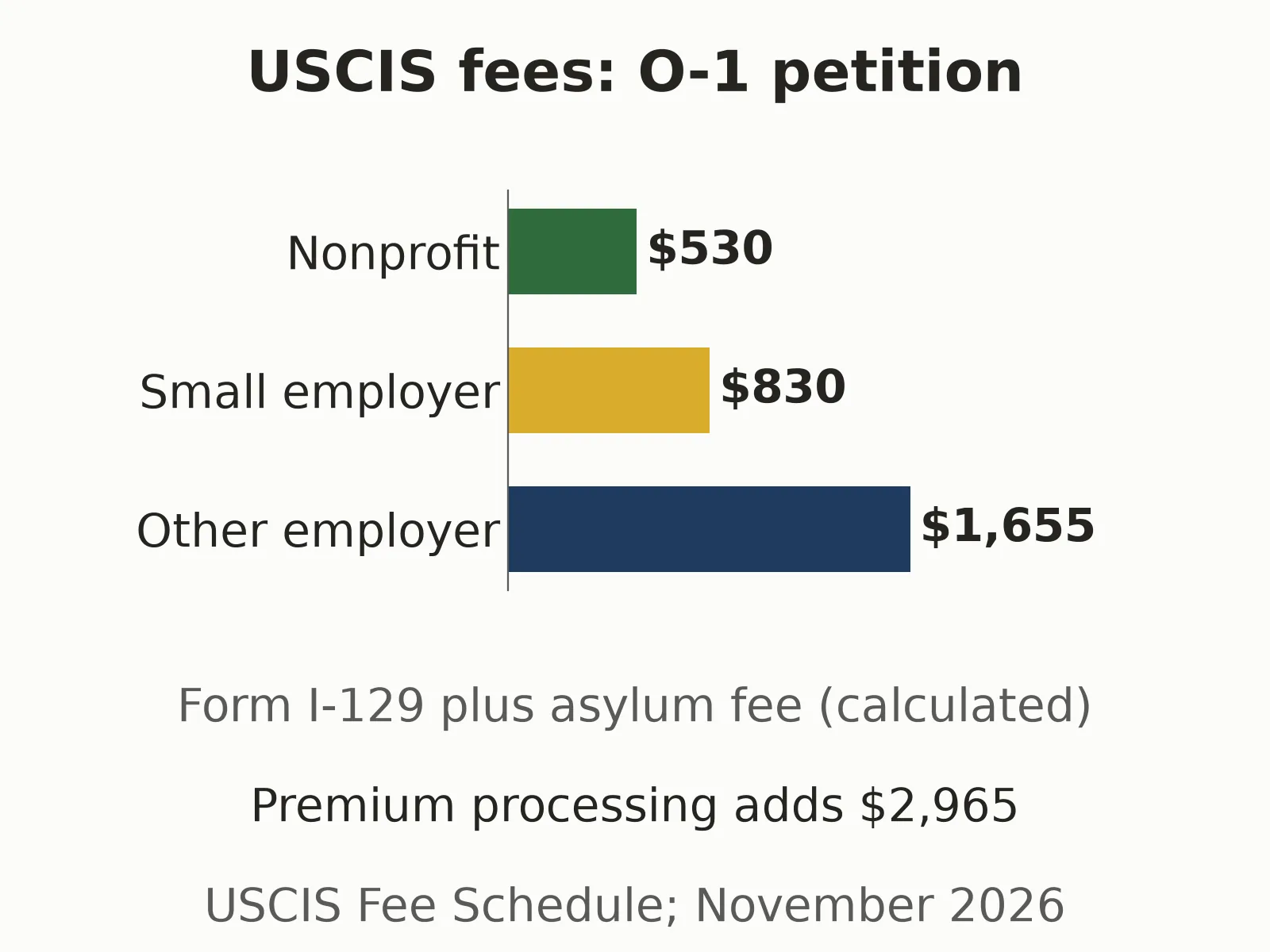
Premium processing buys speed, not a result. USCIS's page "How Do I Request Premium Processing?", updated November 10, 2026, says it will take adjudicative action within 15 business days for most classifications, and it lists the O-1 among them. That action can be an approval notice, a denial notice, a notice of intent to deny or a request for evidence. If USCIS asks for more evidence, the period stops and a new one begins when it receives the response.
These figures do not include legal fees, the cost of gathering evidence, or the Department of State's visa fees for people who need a visa.
What happens at the Canadian border after approval?
A Canadian citizen with an approved O-1 petition generally does not need a visa and instead applies for admission at a port of entry with a passport and the approval notice. The regulation at 8 CFR 212.1(a)(1) says a visa is generally not required for Canadian citizens, except those in the E, K, S and V categories.
The O regulation fits with that rule. Under 8 CFR 214.2(o)(15), USCIS notifies the petitioner of an approval on Form I-797, Notice of Action. A person "who does not require a nonimmigrant visa may present a copy of the approval notice at a Port-of-Entry to facilitate entry into the United States." The same paragraph says to keep a copy of the notice and present it when reentering during the petition's validity to resume the same employment with the same petitioner.
Approval of the petition is not the last decision. The USCIS Policy Manual says a person approved for O classification may be admitted if "found otherwise admissible". Admission can be for the validity period of the petition plus up to 10 days before it begins and 10 days after it ends, but work is authorized only during the validity period.
- Passport: 8 CFR 212.1(a)(1) requires a valid unexpired passport for Canadian citizens arriving in the United States, with listed exceptions such as the NEXUS program at certain crossings.
- Approval notice: a copy of the Form I-797 for the O-1 petition.
- Family: a spouse and children under 21 may be eligible for O-3 classification, with the same period of admission. USCIS's O-1 page says they may study but may not work under that classification.
The exemption is written for Canadian citizens. People who do need a visa apply at a U.S. embassy or consulate once the petition is approved. Not every category works this way for Canadians: 8 CFR 212.1 also requires a visa for the E classification, which is why a Canadian investor applies for an E-2 treaty investor visa at a consulate.
How long does O-1 status last?
O-1 status is approved for the time needed to accomplish the event or activity, up to three years, and USCIS may then extend it in increments of up to one year to continue or complete the same event or activity, with no limit on the number of extensions. Chapter 9 of the USCIS Policy Manual notes that, unlike other nonimmigrant categories, the O category has no specified time limit.
An extension to continue or complete the same event or activity is requested on a new Form I-129, with a copy of the Form I-94 arrival record and a statement explaining the reasons. Where the extension is based on a new event or activity, USCIS may approve up to three years again. Continuing employment in the same capacity can support an extension of up to one year.
What happens to the job during that period matters too:
- If the job ends: USCIS does not treat an O-1 holder as out of status solely because the employment stopped, for up to 60 days or until the validity period ends, whichever is shorter. USCIS may shorten or remove that period, and the person may not work during it unless otherwise authorized.
- New employer: the new employer must file its own Form I-129. If an agent filed the original petition, the agent files an amended petition.
- Material changes: a material change in the terms and conditions of employment calls for an amended petition.
- Return transportation: if the employment is terminated for reasons other than voluntary resignation, the employer and the petitioner are liable for the reasonable cost of return transportation to the person's last place of residence before entering the United States.
Can you seek a green card while in O-1 status?
Yes. Under 8 CFR 214.2(o)(13), the approval of a permanent labor certification or the filing of a preference petition is not a basis for denying an O-1 petition, an extension, or the person's admission. The paragraph says a person may come to the United States temporarily as an O-1 "and, at the same time, lawfully seek to become a permanent resident of the United States." Our guides to the EB-1A green card and the EB-2 national interest waiver cover two categories in which a person can file for themselves.
Frequently asked questions
What are the O-1 visa requirements in plain terms?
For an O-1A, a U.S. employer or agent must show USCIS that you have extraordinary ability, demonstrated by sustained national or international acclaim, that your achievements are recognized in your field through extensive documentation, and that you are coming to the United States to continue work in that area. 8 CFR 214.2(o) defines that level as one of the small percentage at the very top of the field.
How many O-1 criteria do you need to meet?
An O-1A petition needs evidence of a major internationally recognized award, such as the Nobel Prize, or evidence that satisfies at least three of the eight criteria in 8 CFR 214.2(o)(3)(iii). Meeting three is the minimum, not a pass. The USCIS Policy Manual says officers then weigh the totality of the evidence to decide whether the person has sustained acclaim.
Can a startup founder file their own O-1 petition?
Not personally. The USCIS Policy Manual says O beneficiaries may not petition for themselves. It also says a separate legal entity owned by the beneficiary, such as a corporation or limited liability company, may file the petition on their behalf, and a U.S. agent may file for a person who is traditionally self-employed or who uses an agent to arrange short-term work with numerous employers. The petition must still describe real events or activities for the period requested.
Do Canadian citizens need a visa for O-1 status?
Generally no. Under 8 CFR 212.1(a)(1), a visa is generally not required for Canadian citizens, except in the E, K, S and V categories. Under 8 CFR 214.2(o)(15), a person who does not require a visa may present a copy of the Form I-797 approval notice at a port of entry. The officer there still decides whether the person is admissible.
How much are the USCIS fees for an O-1 petition?
As of November 2026, the Form I-129 fee for an O petition filed on paper is $1,055, or $530 for a small employer or nonprofit. The Asylum Program Fee adds $600 ($300 for a small employer, $0 for a nonprofit). Premium processing is an optional $2,965. By our arithmetic, USCIS fees for a paper filing run from $530 to $4,620, before legal and other costs.
How long can you stay in the United States on an O-1?
USCIS may approve an O-1 petition for the period needed to accomplish the event or activity, up to three years. After that, it may grant extensions in increments of up to one year to continue or complete the same event or activity. The USCIS Policy Manual says there is no limit to the number of extensions that may be approved for the same person.
Can the spouse of an O-1 holder work in the United States?
Not on the basis of O-3 status. USCIS's O-1 page says the spouse and children under 21 of an O-1 holder may be eligible for O-3 classification, subject to the same period of admission and limitations. They may not work in the United States under that classification, but they may take part in full-time or part-time study.
Conclusion
The O-1 visa requirements come down to proof. The petitioner must document sustained national or international acclaim through a major award or at least three of eight criteria, and USCIS then weighs the whole record. For founders, the Policy Manual names the evidence that fits a startup: the founder's role, the company's funding and, where salary is low, equity. For Canadian citizens, an approved petition generally leads to a port of entry instead of a consulate, where the officer still decides admission. Fees, forms and guidance change, so check the USCIS Policy Manual, 8 CFR 214.2(o) and the USCIS Fee Schedule (Form G-1055) before filing.
How Mayo Law can help
Mayo Law advises founders, executives and employers on U.S. work visa options, including the O-1, as part of its business immigration practice. We work from offices in Toronto and New York, and Joseph Mayo is licensed in Ontario and New York. Our lawyers can review a record against the O-1 visa requirements, compare the O-1 with other routes and plan the petition and the border step. Mayo Law offers a paid one-hour consultation, because a lawyer reviews your situation in depth.
Disclaimer
This guide is for general information only. It is not legal advice, and reading it does not create a solicitor-client or attorney-client relationship. Immigration rules, fees and agency guidance change, and the outcome of any petition depends on its own facts. Mayo Law provides legal services in Ontario and New York.