

Contents
- Quick answer
- What is the O-1 visa to green card process?
- Does a green card filing put O-1 status at risk?
- Which green card paths fit an O-1 holder?
- Is O-1 evidence enough for EB-1A?
- What does the green card step cost in USCIS fees?
- When can a Canadian file the green card step?
- Can you travel and keep working while you wait?
- Frequently asked questions
- Conclusion
- How Mayo Law can help
- Disclaimer
Moving from an O-1 visa to green card status is a second, separate case, not an upgrade of the first one. The O-1 is a temporary work classification for people of extraordinary ability. It is approved for a set period of up to 3 years, and it is tied to the employer or agent that filed the petition. Permanent residence comes through an immigrant petition in a category you qualify for on your own record. Canadian founders, executives, researchers and artists bring our business immigration lawyers the same three questions: which category fits, whether filing puts the O-1 at risk, and what changes once the green card application is pending.
This guide answers them from the Code of Federal Regulations (CFR), U.S. Citizenship and Immigration Services (USCIS) materials and the Department of State's Foreign Affairs Manual (FAM), all read on November 20, 2026. Fees, filing dates and policy text are dated where they appear, because all three change.
Quick answer
Yes, but the O-1 does not convert by itself. You can self-petition on Form I-140 under EB-1A or the EB-2 national interest waiver (NIW), or a U.S. employer files in EB-2 or EB-3, generally with a permanent labor certification (PERM). Under 8 CFR 214.2(o)(13), an approved labor certification or a filed immigrant petition is no ground to deny O-1 status.
What is the O-1 visa to green card process?
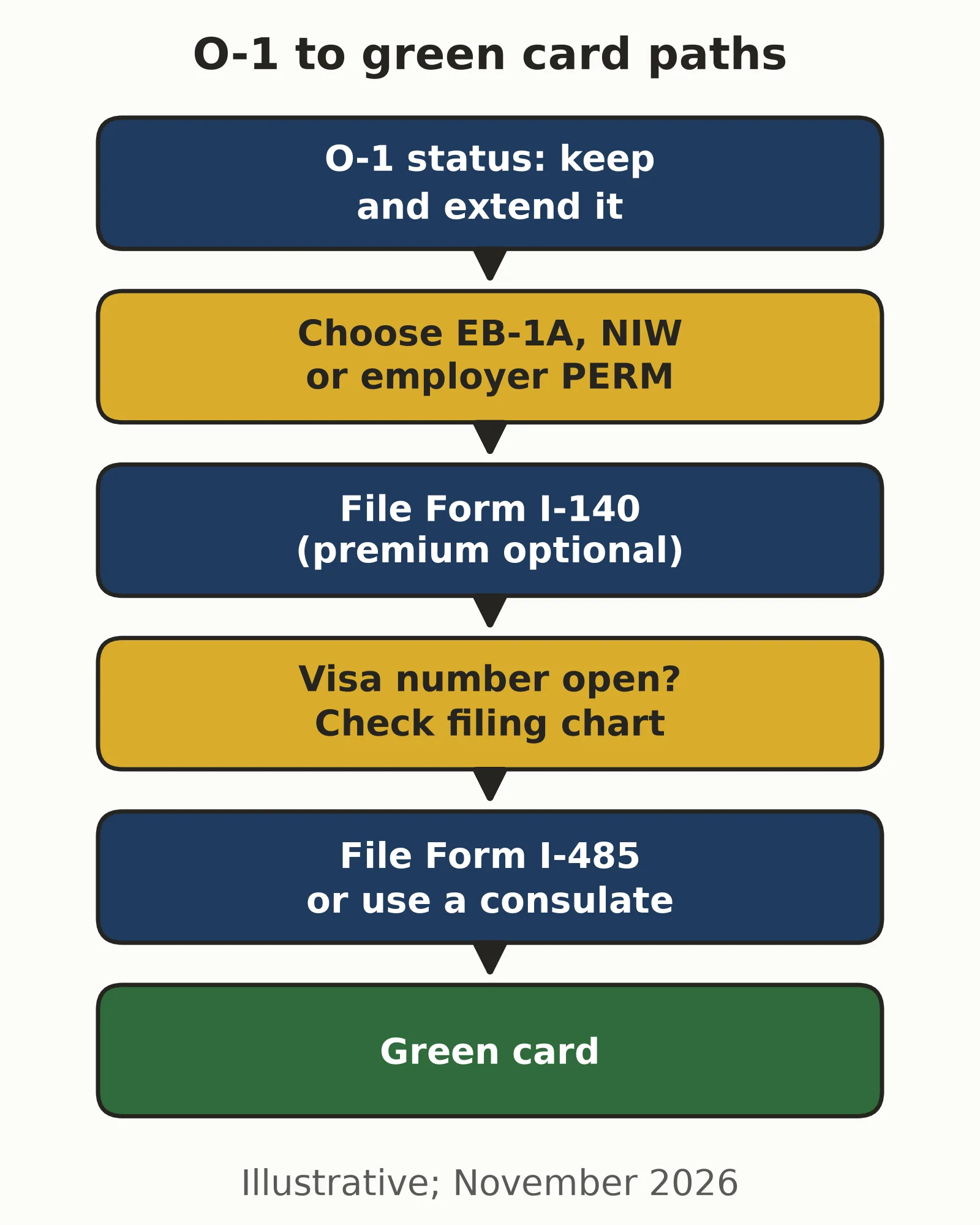
The O-1 visa to green card process has two stages: an immigrant petition on Form I-140, then a green card application on Form I-485 inside the United States or an immigrant visa case at a U.S. consulate.
The O-1 rules, at 8 CFR 214.2(o), contain no step that turns O-1 status into permanent residence. They mention permanent residence once, in paragraph (o)(13), and only to say that a person may seek it while holding O-1 status. So the move from O-1 to green card status stands on its own law and its own evidence.
- Stage 1, the petition: Form I-140, Immigrant Petition for Alien Workers, asks USCIS to classify you in an employment-based category. Who signs it depends on the category. In two categories, EB-1A and the EB-2 national interest waiver, you can file for yourself. In employer-sponsored EB-2 and EB-3 cases, a U.S. employer files.
- Stage 2, the green card application: Form I-485, Application to Register Permanent Residence or Adjust Status, is the form for a person who is in the United States. A person outside the United States, or one who prefers that route, applies for an immigrant visa through the Department of State instead.
- The gate between them: under 8 CFR 245.1(g), Form I-485 can be filed only when an immigrant visa is immediately available in your category. The monthly Visa Bulletin sets the cut-off dates, and each month USCIS names the Visa Bulletin chart that adjustment applicants must use.
The order of the O-1 and the Form I-140 is flexible. Under 8 CFR 214.2(o)(13), an immigrant petition filed earlier is not a basis for denying a later O-1 petition or a later extension, so the Form I-140 can come first and the O-1 can be the status a person works in while the petition is pending.
Does a green card filing put O-1 status at risk?
An immigrant petition does not, by itself, put O-1 status at risk. Under 8 CFR 214.2(o)(13), an approved labor certification or a filed immigrant petition is not a basis for denying an O-1 petition, an extension, a change of status or admission. The holder must still qualify for the classification.
The regulation, 8 CFR 214.2(o)(13), says that the approval of a permanent labor certification or the filing of a preference petition "shall not be a basis for denying an O-1 petition, a request to extend such a petition, or the alien's application for admission, change of status, or extension of stay." The regulation adds that the person may come to the United States "for a temporary period as an O-1 nonimmigrant and depart voluntarily at the end of his or her authorized stay and, at the same time, lawfully seek to become a permanent resident." The USCIS Policy Manual, Volume 2, Part M, Chapter 9, current as of October 27, 2026, repeats the instruction for extensions and changes of status.
People call this O-1 dual intent, and the Department of State uses the same words. Its Foreign Affairs Manual, at 9 FAM 402.13-10 (text dated October 13, 2022), tells consular officers that "dual intent" is permissible for O-1 visa holders and that an O-1 applicant "does not have to have a residence abroad which they do not intend to abandon." Three limits sit beside that sentence:
- The visa interview still starts from a presumption. The same FAM section says an O-1 visa applicant "is presumed to be an immigrant" until the officer is satisfied that the person is entitled to O-1 status, and that an intent to remain temporarily is a requirement of the classification. Under 9 FAM 402.13-5(B), an approved labor certification or a filed preference petition is not a basis for denying O-1 classification. The applicant still has to qualify.
- O-2 support staff are treated differently. Unlike the O-1, an O-2 visa applicant must show a residence abroad and no intent to abandon it. The protection in the regulation names only the O-1.
- O-3 family members follow the principal. The FAM applies the O-1 standard to the O-3 spouse and children of an O-1 holder, and the O-2 standard to the family of an O-2 holder.
For Canadians there is one more point. A Canadian citizen generally does not need a visa to enter in O-1 status (8 CFR 212.1(a)(1)), so there is usually no consular interview. Admission is decided by a border officer, and paragraph (o)(13) lists the "application for admission" among the decisions for which an approved labor certification or a filed immigrant petition is not a basis for denial. Our guide to US work visas for Canadians compares how the other work categories treat immigrant intent. Treaty investors face the same question under different rules, which our guide to the E-2 visa to green card move covers.
Which green card paths fit an O-1 holder?
An O-1 holder has three main employment-based paths: EB-1A extraordinary ability, the EB-2 national interest waiver, and an employer-sponsored EB-2 or EB-3 case built on a PERM labor certification. The first two can be filed without an employer, which the O-1 itself never allows.
That last point matters to founders. The O-1 regulation, 8 CFR 214.2(o), says "An O alien may not petition for himself or herself," so every O-1 rests on a U.S. employer or agent. EB-1A and the NIW drop that requirement. The table below compares the paths on the three points that decide most plans, with the premium processing clocks from the USCIS premium processing page as of November 2026.
| Path | Who files | Labor certification | Premium clock |
|---|---|---|---|
| EB-1A extraordinary ability | You or an employer | Not required | 15 business days |
| EB-2 national interest waiver | You or an employer | Waived | 45 business days |
| EB-2 with PERM | U.S. employer | Usually required | 15 business days |
| EB-3 with PERM | U.S. employer | Usually required | 15 business days |
EB-1A, extraordinary ability
EB-1A is the first-preference category for a person of extraordinary ability in the sciences, arts, education, business or athletics. Under 8 CFR 204.5(h)(5), neither a job offer nor a labor certification is required, but the petition must carry clear evidence that the person is coming to the United States to continue work in the field. Our EB-1A green card guide covers the ten criteria and the final merits review in full.
EB-2 with a national interest waiver
The NIW is a second-preference petition in which USCIS waives the job offer and the labor certification. The person must first qualify for EB-2, as a member of the professions holding an advanced degree or as a person of exceptional ability. USCIS may then grant the waiver, as a matter of discretion, on three prongs set out in its Policy Manual, Volume 6, Part F, Chapter 5: the proposed endeavor has substantial merit and national importance, the person is well positioned to advance it, and on balance it would benefit the United States to waive the job offer. Our EB-2 NIW guide explains each prong, and founders will find the planning document covered in our guide to the business plan for an EB-2 NIW.
Employer sponsorship with PERM
In the standard EB-2 and EB-3 cases a U.S. employer files Form I-140, usually after it obtains a labor certification from the U.S. Department of Labor (DOL). The USCIS permanent workers page describes what the certification verifies: that there are insufficient available, qualified, able and willing U.S. workers for the position at the prevailing wage, and that hiring a foreign worker will not adversely affect the wages and working conditions of similarly employed U.S. workers. PERM is the DOL's permanent labor certification system: the USCIS Policy Manual, Volume 6, Part E, Chapter 6, current as of October 27, 2026, says the DOL implemented it on March 28, 2005. On this path a U.S. employer files, for the position being offered; the two self-petition categories do not need an employer.
One further category deserves a sentence. EB-1B, for outstanding professors and researchers, needs no labor certification but does need a job offer from a university or a qualifying private employer, so it suits research staff more than founders.
Is O-1 evidence enough for EB-1A?
O-1 evidence is not automatically enough for EB-1A: USCIS treats a prior O-1 approval as a relevant consideration but says it is not determinative, and the immigrant petition goes through its own two-step review of the evidence.
The two standards read almost alike. For the O-1A, 8 CFR 214.2(o)(3)(ii) defines extraordinary ability in science, education, business or athletics as a level of expertise showing that the person is "one of the small percentage who have arisen to the very top of the field of endeavor." For EB-1A, 8 CFR 204.5(h)(2) uses nearly the same words. The evidence lists are close too, and that is where the differences start:
- Criteria count: an O-1A petition needs a major internationally recognized award or at least three of eight listed kinds of evidence. An EB-1A petition needs a one-time achievement of that kind or at least three of ten.
- The second step: the USCIS Policy Manual, Volume 6, Part F, Chapter 2, current as of October 27, 2026, tells officers to count the criteria first and then make a final merits determination on all the evidence together. Meeting three criteria does not settle the case.
- The prior approval: the same chapter says the prior approval of an O-1 petition "is a relevant consideration and can be an indicator of eligibility" for the immigrant category, but "it is not determinative." Where an officer denies an EB-1A petition for a former O-1 holder, the manual asks officers, where possible, for a brief explanation of why.
- Artists: an O-1B in the arts is measured by "distinction," which the regulation defines as a high level of achievement substantially above that ordinarily encountered. EB-1A applies its small-percentage standard to the arts as it does to science and business, so an O-1B record may need more depth before it supports an EB-1A filing.
In practice the O-1 file is the starting inventory for the green card file. The awards, press, judging, original contributions and salary evidence that carried the O-1 are gathered again, updated, and tested against the longer immigrant list and the final merits review. Our guide to the O-1 visa requirements sets out the O-1 criteria themselves, including how they apply to founders. A person whose record is strong but not yet at that level may look at the NIW, which asks a different question: whether the planned work matters to the United States and whether the person is positioned to carry it out.
What does the green card step cost in USCIS fees?
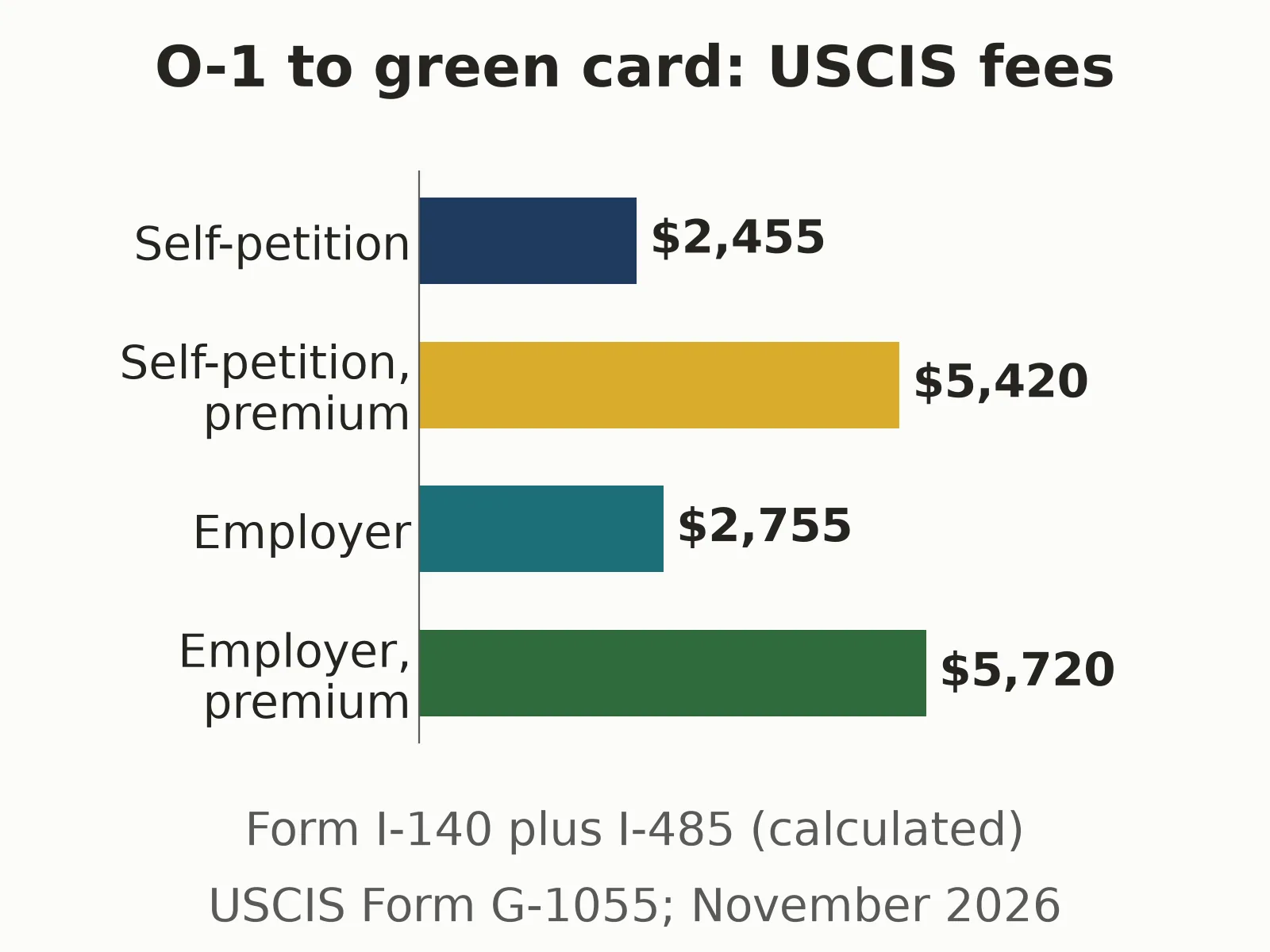
As of November 2026, a self-petitioner who files Form I-140 and one Form I-485 on paper pays USCIS $2,455, or $5,420 with premium processing, calculated from the USCIS fee schedule; a regular employer's petition brings those totals to $2,755 and $5,720.
The amounts come from the USCIS Fee Schedule, Form G-1055, edition dated November 19, 2026. They are in U.S. dollars and cover government filing fees only, not legal fees, medical examinations or translation costs.
- Form I-140: $715 on paper. The schedule lists $665 for an online filing.
- Asylum Program Fee, paid with Form I-140: $600 for a regular petitioner, $300 for a small employer or a self-petitioner, and $0 for a nonprofit.
- Form I-907, premium processing of Form I-140: $2,965, optional, for EB-1, EB-2 and EB-3 petitions.
- Form I-485: $1,440 on paper for each applicant, or $950 for a child under 14 who files together with a parent.
- Optional filings while Form I-485 is pending: $260 for Form I-765, the application for an Employment Authorization Document (EAD), and $630 on paper for Form I-131 when it requests an advance parole travel document.
For one applicant, the calculated totals are $2,455 for a self-petition and $2,755 for a regular employer petition, or $5,420 and $5,720 with premium processing. The regular employer pays $300 more because of the higher Asylum Program Fee, and a small employer pays the self-petition amounts. The totals leave out the optional work and travel documents.
| Filing | Self-petition | Regular employer |
|---|---|---|
| Form I-140, paper | $715 | $715 |
| Asylum Program Fee | $300 | $600 |
| Form I-485, paper | $1,440 | $1,440 |
| Total without premium | $2,455 | $2,755 |
| Premium processing | $2,965 | $2,965 |
| Total with premium | $5,420 | $5,720 |
A spouse or a child who adjusts status files a separate Form I-485 and pays a separate fee. A person who takes the consular route pays Department of State fees instead of the Form I-485 fee; those are not covered here.
When can a Canadian file the green card step?
A Canadian-born O-1 holder can file Form I-485 when the category is current, or the priority date is earlier than the cut-off, in the Visa Bulletin chart that USCIS designates for the month. In the Dates for Filing chart that USCIS designated for November 2026, the column for people born in Canada (All Chargeability Areas Except Those Listed) shows EB-1 current, EB-2 at March 15, 2026 and EB-3 at August 1, 2024.
Three terms explain that sentence. The priority date is generally the day the Form I-140 was properly filed with USCIS, or, where a labor certification is required, the day the Department of Labor accepted the labor certification application. The Visa Bulletin is the Department of State's monthly list of cut-off dates by category and country. And each month USCIS names which of the bulletin's two charts adjustment applicants must use. For November 2026, the USCIS filing charts page says employment-based applicants must use the Dates for Filing chart. On November 20, 2026, it had not yet named the chart for December.
The cut-off generally depends on where you were born, not on your passport: the USCIS chart tells applicants to read the column for the country of their birth. A Canadian citizen born in Canada reads the column headed "All Chargeability Areas Except Those Listed." A Canadian citizen born in India or mainland China generally reads that country's column, where the November 2026 cut-offs are stricter: for India, EB-1 July 1, 2024, EB-2 January 15, 2015 and EB-3 January 15, 2015; for mainland China, EB-1 July 1, 2024, EB-2 January 1, 2023 and EB-3 April 1, 2024.
| Category | Born in Canada | Born in India | Born in China |
|---|---|---|---|
| EB-1 | Current | July 1, 2024 | July 1, 2024 |
| EB-2 | March 15, 2026 | January 15, 2015 | January 1, 2023 |
| EB-3 | August 1, 2024 | January 15, 2015 | April 1, 2024 |
When the chart USCIS designates for the month shows your category current, or your priority date earlier than its cut-off, USCIS allows concurrent filing: Form I-485 goes in together with Form I-140, or while the petition is still pending. In the November 2026 Dates for Filing chart, EB-1 is current for people born in Canada, so a Canada-born EB-1A petitioner can file both stages together. A Canada-born NIW petitioner who files a first petition in November 2026 has a priority date later than March 15, 2026, so the Form I-485 waits until the chart moves forward. Under 8 CFR 204.5(e), a person with an earlier approved employment-based petition generally keeps that earlier priority date for a later one. Concurrent filing is not possible in a consular case.
Premium processing shortens only the petition stage. USCIS guarantees that it will act on the Form I-140 within 15 business days for EB-1A, EB-2 with PERM and EB-3, and within 45 business days for the NIW, or refund the premium fee. To act can mean an approval, a denial, a request for evidence or a notice of intent to deny, so the guarantee is a clock for a first response, not a promise of approval. This guide states no standard processing time for Form I-140 or Form I-485. Our dated guides track them: EB-1A processing time, NIW processing time and how long the green card process takes.
Can you travel and keep working while you wait?
You can keep working in O-1 status, and an approved labor certification or a filed immigrant petition is not a basis for refusing an extension, but once Form I-485 is filed, leaving the United States without an advance parole document generally abandons the application.
Before Form I-485 is filed, travel follows the ordinary O-1 rules. Under 8 CFR 214.2(o)(13), a filed Form I-140 is not a basis for denying admission in O-1 status. After Form I-485 is filed, a different regulation takes over. Under 8 CFR 245.2(a)(4)(ii), the departure of an adjustment applicant who is not in exclusion, deportation or removal proceedings "shall be deemed an abandonment of the application" unless the person was granted advance parole before leaving and is inspected on return. The regulation then lists the travelers who are exempt: people in lawful H-1 or L-1 status returning to the same employer, their H-4 and L-2 family members, and people in K-3, K-4 or V status. O-1 is not on the list.
- Travel: an O-1 holder with a pending Form I-485 requests advance parole on Form I-131 and waits for the document before any trip abroad, including a short trip home to Canada. The USCIS travel documents page warns that a person who leaves without it may not be allowed to reenter and may be found to have abandoned the application.
- Unlawful presence: the same USCIS page reports that, as of August 13, 2026, leaving the United States on an advance parole document counts as a departure for the three-year and ten-year inadmissibility bars that apply to people who accrued more than 180 days of unlawful presence. A person who has never accrued unlawful presence is not in that group.
- Work: the O-1 continues to authorize work for the petitioner for as long as the petition is valid. An adjustment applicant may also apply for an EAD on Form I-765 under category (c)(9).
- Extensions: the first O-1 approval can run up to 3 years, and USCIS may extend the stay in increments of up to 1 year to continue the same activity. The USCIS Policy Manual says there is no limit on the number of extensions and that they should not be denied on the basis of an approved labor certification or a filed immigrant petition.
- Family: an O-3 spouse or child may not work on the strength of O-3 status. Once the family's Form I-485 applications are pending, each member may apply for an EAD in the same way as the principal.
Canadians who hold an L-1 instead of an O-1 are named in that travel exemption. Our guide to the L-1A visa to green card path covers that route.
Frequently asked questions
Does an O-1 visa lead to a green card?
Not by itself. The O-1 is a temporary classification and nothing in its regulation converts it into permanent residence. An O-1 holder becomes a permanent resident through a separate immigrant petition, most often EB-1A, an EB-2 national interest waiver or an employer-sponsored case, followed by a green card application. The O-1 record often supplies much of the evidence.
Is the O-1 a dual intent visa?
In practice, yes, for the O-1 principal. Under 8 CFR 214.2(o)(13), an approved labor certification or a filed immigrant petition is not a basis for denying an O-1 petition, extension, change of status or admission. The Foreign Affairs Manual calls dual intent permissible for O-1 holders, while still requiring an O-2 worker to keep a residence abroad.
How long does the O-1 visa to green card process take?
There is no single official figure. With premium processing, USCIS guarantees action on Form I-140 within 15 business days for EB-1A and 45 business days for a national interest waiver, as of November 2026. After that, the timing depends on the Visa Bulletin date for your category and country of birth and on how long USCIS takes with Form I-485.
Can you file a green card petition before you get the O-1?
Yes. Under 8 CFR 214.2(o)(13), an immigrant petition filed earlier is not a basis for denying a later O-1 petition, so the order is flexible. A person can file Form I-140 first and then obtain or extend O-1 status to work in the United States while the immigrant petition is pending. The O-1 petition must still meet every O-1 requirement.
Can you travel on an O-1 while Form I-485 is pending?
Generally not without advance parole. Under 8 CFR 245.2(a)(4)(ii), leaving the United States while an adjustment application is pending is treated as abandoning it unless advance parole was granted first. The regulation exempts H-1 and L-1 workers and a few other groups, and O-1 holders are not among them.
Does an approved O-1 guarantee an EB-1A approval?
No. The USCIS Policy Manual says a prior O-1 approval is a relevant consideration and can be an indicator of eligibility, but it is not determinative. EB-1A has ten evidence criteria, against eight for the O-1A, and officers finish with a final merits determination on the whole record, so the immigrant petition has to be proven again.
Do Canadians wait in a green card queue?
It depends on the category and on the country of birth. In the November 2026 Dates for Filing chart, EB-1 is current for people born in Canada, while EB-2 shows March 15, 2026 and EB-3 shows August 1, 2024. A Canadian citizen born in India or mainland China generally uses that country's dates, which are stricter in all three categories in that chart.
Can a spouse and children get green cards with an O-1 holder?
Yes, as family members of the principal applicant. USCIS says that if the Form I-140 is approved, a spouse and unmarried children under 21 may be eligible to immigrate with the principal. Each family member in the United States files a separate Form I-485 with its own fee, and other family-based categories exist outside this guide.
Conclusion
The O-1 visa to green card move works because the law lets an O-1 holder do two things at once: work temporarily in a field of extraordinary ability and pursue permanent residence. A sound O-1 green card plan has three decisions. First, the category: EB-1A where the record reaches the highest standard, the NIW where the work has national importance, or an employer case with PERM. Second, the timing: under the November 2026 Dates for Filing chart, Canada-born applicants can file both stages together in EB-1, while EB-2 and EB-3 have cut-off dates. Third, the conduct of the wait: extend the O-1, and do not leave the United States after filing Form I-485 without advance parole in hand. Each of those points rests on a dated rule, so check the fee schedule and the filing chart again on the day you file.
How Mayo Law can help
Mayo Law is a cross-border law firm with offices in Toronto and New York. Joseph Mayo, our principal attorney, is licensed in Ontario and New York, and our lawyers work with Canadian founders, executives and professionals on U.S. business immigration, from work classifications such as the O-1 to employment-based green card petitions. We review the existing O-1 record against the immigrant criteria, map the filing order against the Visa Bulletin, and plan travel and extensions around the pending case. A first meeting is a paid one-hour consultation, because a lawyer reviews your situation in depth before giving a view. No lawyer can promise the result of an immigration filing, and we do not. You can start from our business immigration page.
Disclaimer
This guide is general information, not legal advice, and reading it does not create a solicitor-client or attorney-client relationship. U.S. immigration rules, fees and Visa Bulletin dates change, and the figures above are dated November 2026. Speak with a licensed lawyer about your own facts before you act. Mayo Law provides legal services in Ontario and New York.