

Contents
Owner-managers borrow from their own corporations all the time: a cheque for a personal expense, a draw against next year's dividend, a car bought on the company card. Shareholder loans in Canada are legal, but the Income Tax Act treats most of them as income to the borrower unless the loan fits an exception or is repaid on time. This guide explains how the rules in section 15 work, what the corporation's records should show, and how the picture changes for an American shareholder or a New York company.
Everything below is current as of October 2026 and is drawn from the Income Tax Act (current to September 21, 2026 on the Justice Laws website), the Canada Revenue Agency's Income Tax Folio S3-F1-C1, Shareholder Loans and Debts, Ontario's Business Corporations Act and New York's Business Corporation Law.
Quick answer
If a corporation lends money to a shareholder, or to someone connected with a shareholder, subsection 15(2) of the Income Tax Act adds the loan to the borrower's income for the year it was received. The main escape is repaying it within one year after the end of the corporation's tax year, without re-borrowing to do so.
What is a shareholder loan?
When people talk about shareholder loans in Canada, they usually mean one of two opposite arrangements. In the first, the corporation lends money to the owner. In the second, the owner lends money to the corporation, often to fund start-up costs before the business can borrow from a bank. The tax rules discussed in most of this guide apply only to the first direction. Money you lend to your own corporation is a debt the corporation owes you, and subsection 15(2) does not apply to it.
The CRA's folio explains that a loan to a shareholder rarely looks like a formal loan. It notes that corporations keep loan accounts, drawings accounts and similarly named accounts, and that the entries in them can include loans, payments the corporation makes to third parties on a shareholder's behalf, and advances against future salary, rent or dividends (folio paragraph 1.11). Revolving credit, such as a line of credit or a credit card, is generally treated as a loan or debt too (paragraph 1.12). So a personal bill paid from the business account is exactly the kind of entry the CRA expects to find in a shareholder account.
The CRA also says that a loan can be proven by a written agreement or other convincing evidence, such as a corporate resolution setting out the terms that is reflected in the financial statements (paragraph 1.13). Where a shareholder takes money and no debtor and creditor relationship exists, subsection 15(2) does not apply, but subsection 15(1) may tax the amount as a shareholder benefit instead. Paperwork is therefore not a formality: it decides which rule applies.
When does subsection 15(2) apply?
Subsection 15(2) applies when a person or partnership that is a shareholder of a corporation, is connected with a shareholder, or is a member of a partnership or a beneficiary of a trust that is a shareholder, receives a loan from or becomes indebted to that corporation, a related corporation, or a partnership in which either is a member. The amount of the loan is then included in the borrower's income for the year.
A person is connected with a shareholder if the person does not deal at arm's length with, or is affiliated with, the shareholder (subsection 15(2.1)). Under section 251, related persons are deemed not to deal at arm's length, and individuals connected by blood relationship, marriage, common-law partnership or adoption are related. A loan to a shareholder's spouse or child can therefore be caught even though the borrower owns no shares. The rule also reaches loans from sister corporations, because a related corporation is a listed lender.
Two borrowers are outside the rule. Subsection 15(2) does not apply when the borrower is a corporation resident in Canada, or a partnership whose members are all corporations resident in Canada. And under subsection 15(7), as the folio notes at paragraph 1.4, the rule applies whether or not the lending corporation is resident in Canada or carries on business here.
The Act then lists the exceptions that decide most shareholder loans in Canada. Most must be satisfied at the moment the loan is made, not afterwards (folio paragraph 1.19). The table below summarizes them before we look at the ones owner-managers rely on.
| Exception | Provision | Key condition |
|---|---|---|
| Lending business | s. 15(2.3) | Ordinary course, repayment arranged |
| Ordinary employee | s. 15(2.4)(a) | Not a specified employee |
| Home purchase | s. 15(2.4)(b) | Dwelling for the employee |
| Treasury shares | s. 15(2.4)(c) | New shares held by employee |
| Work vehicle | s. 15(2.4)(d) | Used in the employee's duties |
| Repaid in time | s. 15(2.6) | Within one year, no series |
The employee exceptions
Subsection 15(2.4) protects four kinds of loans made to employees. A loan to an employee who is not a specified employee is exempt in general. A loan to any employee, or the employee's spouse or common-law partner, to buy a home to live in is exempt, as is a loan to buy previously unissued, fully paid shares of the employer or a related corporation, and a loan to buy a motor vehicle used in the employee's duties.
The catch is that every one of these needs two further conditions. Under paragraph 15(2.4)(e) it must be reasonable to conclude that the loan was received because of the person's employment and not because of anyone's shareholding. Under paragraph 15(2.4)(f), bona fide arrangements for repayment within a reasonable time must be made when the loan is made. A specified employee is, in general terms, one who owns at least 10% of any class of shares of the corporation or a related corporation, or who does not deal at arm's length with it (folio paragraphs 1.43 and 1.44). An owner-manager who holds 10% or more of any class of shares is a specified employee, so the general employee exception is closed to that person.
The folio lists the facts the CRA weighs on the employment test. Pointing toward employment: the loan was made on the same terms as loans to employees who are not shareholders. Pointing toward shareholding: the corporation lends only to shareholders, the terms are better than other employees get, the borrower can significantly influence business decisions, the loan is large compared with retained earnings, or a large loan was made without security (paragraphs 1.58 and 1.59). Repayment arrangements must also allow the repayment period to be determined with some certainty when the loan is made (paragraph 1.68).
How does the one-year repayment rule work?
Subsection 15(2.6) is the exception most owner-managers use. It says subsection 15(2) does not apply to a loan repaid within one year after the end of the lender's taxation year in which the loan was made, as long as it is established, by later events or otherwise, that the repayment was not part of a series of loans or other transactions and repayments.
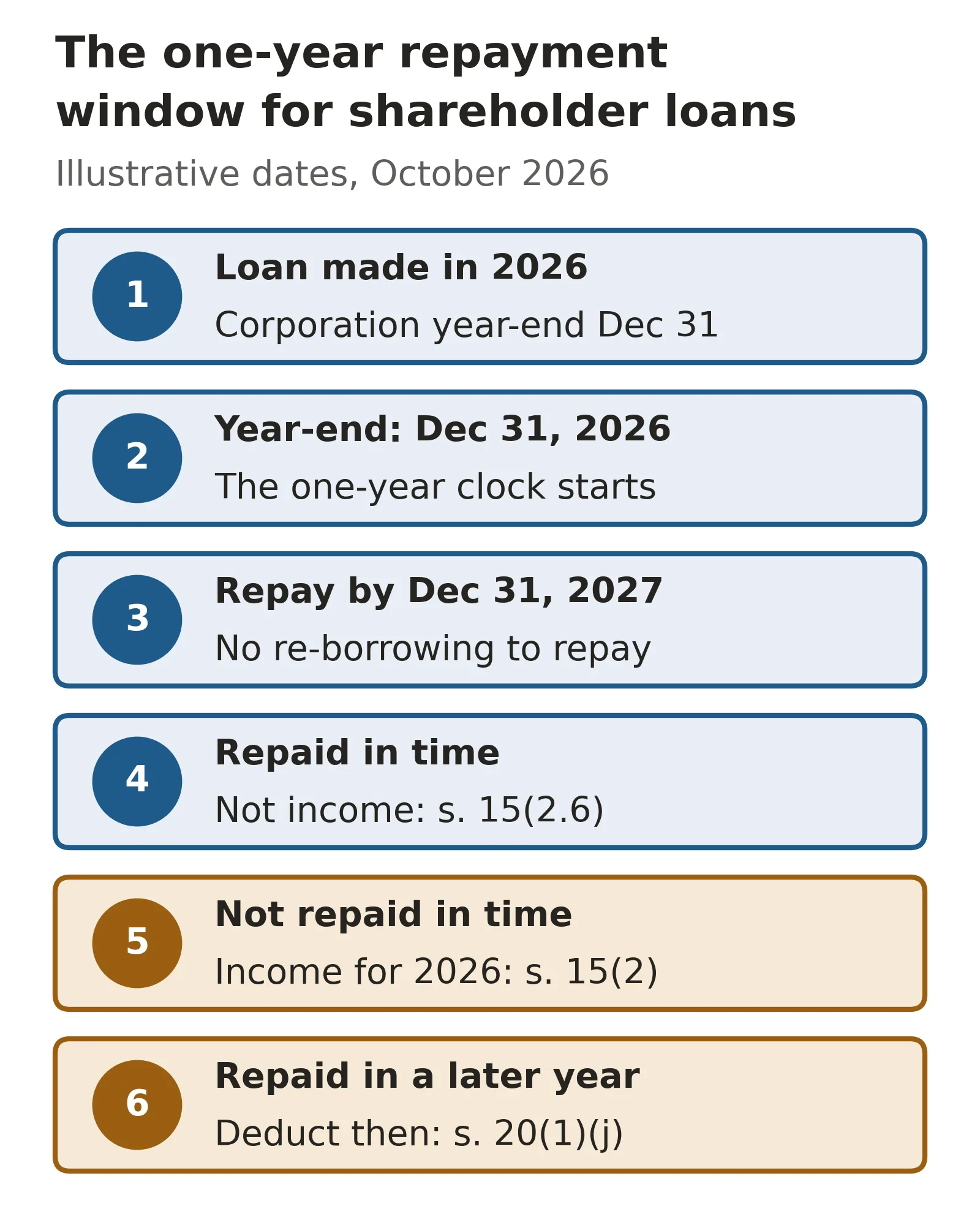
The deadline runs from the corporation's year-end, not from the date of the loan. For a corporation with a December 31 year-end, a loan taken on March 1, 2026 must be repaid by December 31, 2027. A loan taken on December 15, 2026 has the same deadline. If the corporation's year ends on June 30, the window shifts with it. Figure 1 shows the sequence.
Because nobody knows whether the exception applies until the window closes, the CRA expects prior-year returns to be fixed after the fact. If the loan was left out of income because repayment was expected and the repayment did not happen, the borrower's return for the year of the loan must be amended to include it. In the opposite case, where the loan was included and then repaid in time, the return is amended to remove it, which generally produces a refund with interest (folio paragraphs 1.73 and 1.74).
What counts as a series of loans and repayments
The series rule exists, in the CRA's words, to stop taxpayers from deferring tax indefinitely by using new loans to repay old ones (paragraph 1.84). The CRA will generally treat a repayment as part of a series where the loan is repaid before the lender's year-end and an amount is then borrowed again. A repayment funded by a new loan is also suspect, unless the new loan came from an independent source, was received for a genuine business purpose and was not taken to repay the shareholder loan (paragraph 1.85).
One practical point matters a great deal. The folio states that repayments made by applying dividends, salaries or bonuses owed to the borrower are not part of a series for the purposes of subsection 15(2.6) and paragraph 20(1)(j), even when more borrowing follows (paragraph 1.86). That is why many owner-managers clear the shareholder account at year-end by declaring a bonus or a dividend and setting it off against the balance. The bonus or dividend is taxed in its own right, so this is a choice about which tax to pay, not a way to avoid tax.
Repaying late, or with property
If the deadline is missed, the loan stays in income for the year it was received. When the borrower later repays all or part of it, paragraph 20(1)(j) allows a deduction for the repayment in the year it is made, again only if the repayment is not part of a series of loans or other transactions and repayments (folio paragraphs 1.76 and 1.77). Repayment does not have to be in cash. A borrower can transfer property to the corporation, and the transfer counts as repayment to the extent of the property's fair market value at the time (paragraph 1.80).
A dividend used to clear the account must also be lawful under corporate law. For an Ontario corporation, section 38(3) of the Business Corporations Act bars declaring or paying a dividend if there are reasonable grounds to believe the corporation is, or would be after the payment, unable to pay its liabilities as they become due, or that the realizable value of its assets would fall below its liabilities and stated capital. Directors who vote for a dividend paid in breach of section 38 are jointly and severally liable to restore it under section 130(2).
Forgiving the loan is a different event again. Subsection 15(1.2) treats the value of the benefit on a settled or extinguished debt as the forgiven amount, for the purposes of the shareholder benefit rule in subsection 15(1). If you are closing the business, this belongs on the checklist alongside the steps in our guide to articles of dissolution in Ontario.
Do you have to charge interest?
No statute requires interest on a shareholder loan, but an interest-free or low-interest loan has its own tax cost. Subsection 80.4(2) deems a shareholder, or a person connected with a shareholder, who borrows from the corporation because of the shareholding to receive a benefit. The benefit is interest at the CRA's prescribed rate for the period the loan was outstanding, minus the interest actually paid for the year no later than 30 days after the year ends.
The two rules do not stack. Subsection 80.4(3)(b) switches off the deemed interest benefit for any loan or part of a loan that was included in income under Part I, which covers an amount already taxed under subsection 15(2). So the interest benefit is the cost of a loan that escapes subsection 15(2), for example one repaid within the one-year window (folio paragraph 1.20).
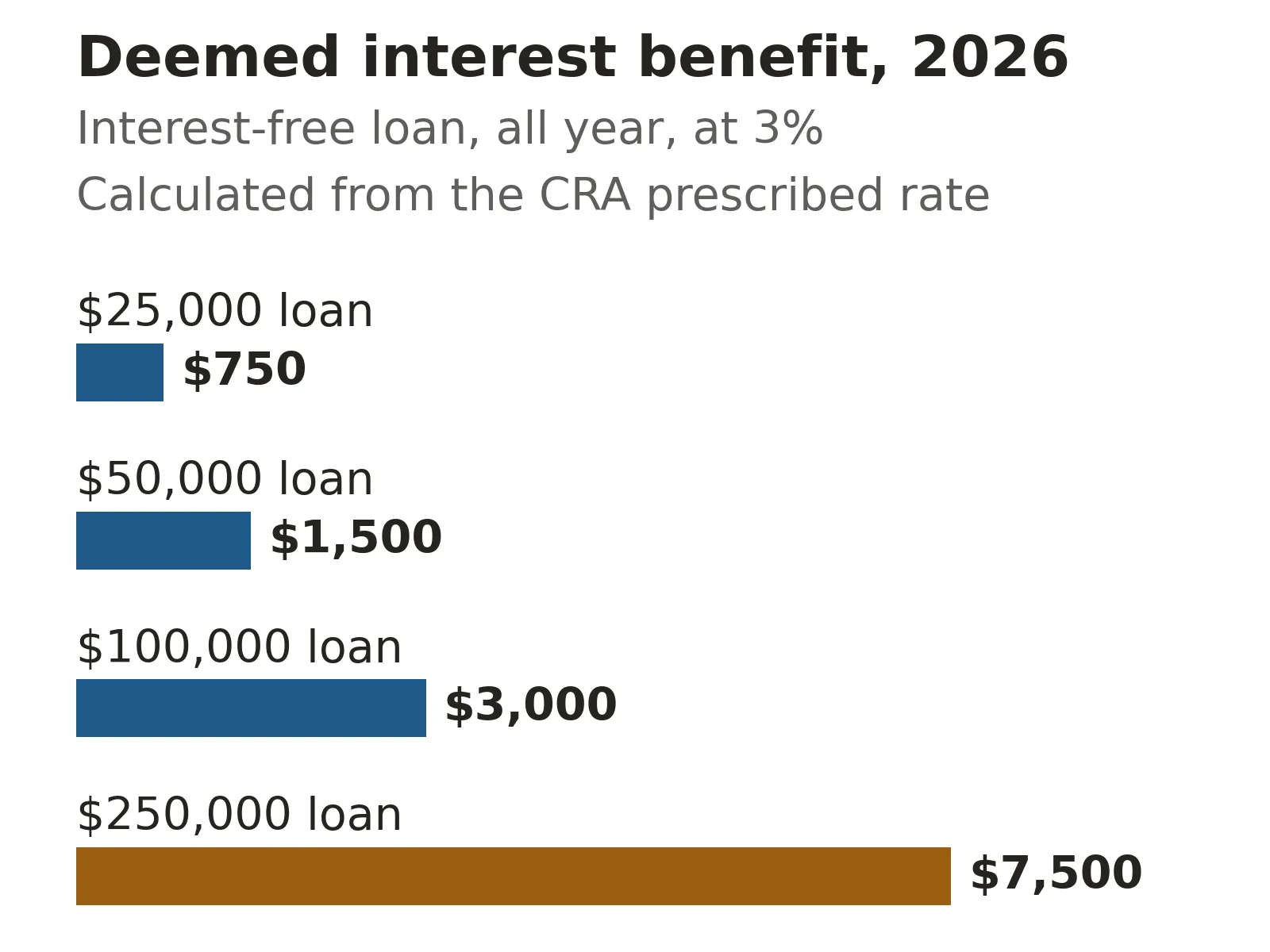
The CRA's prescribed rate for taxable benefits on interest-free and low-interest loans to employees and shareholders was 3% in each quarter of 2026 (CRA announcements for the first to fourth calendar quarters). On that rate, a loan outstanding for all of 2026 produces the deemed benefits in Table 2 and Figure 2. These are our calculations from the published rate, before any interest the borrower paid.
| Balance all of 2026 | Benefit at 3% | If 3% interest paid |
|---|---|---|
| $25,000 | $750 | $0 |
| $50,000 | $1,500 | $0 |
| $100,000 | $3,000 | $0 |
| $250,000 | $7,500 | $0 |
For an individual with a calendar tax year, "no later than 30 days after the end of the year" means interest for 2026 paid by January 30, 2027. Paying it on time, at a rate at least equal to the prescribed rate, removes the benefit for that year.
What if the shareholder lives in the United States?
A Canadian corporation may have a shareholder who lives in the United States, or one who moves there after the loan is made. For a non-resident borrower, the shareholder loan rule works through withholding tax rather than a tax return. Paragraph 214(3)(a) deems an amount that section 15 would include in income, if Part I applied, to be a dividend paid to the non-resident by a Canadian corporation. Subsection 212(2) imposes a 25% tax on that deemed dividend. The CRA notes that a tax treaty may reduce the rate and that the specific treaty must be checked (folio paragraph 1.89).
The corporation, not the shareholder, must withhold and remit the tax (subsection 215(1), folio paragraph 1.90). Since the one-year exception cannot be tested until the window closes, the CRA's stated practice, where there is no series of loans and repayments, is not to charge a penalty or interest if the lender remits by the 15th day of the 13th month after the end of the tax year in which it made the loan. If the loan is later repaid, and the repayment is not part of a series, subsection 227(6.1) lets the non-resident apply in writing, within two years after the end of the calendar year of the repayment, for a refund of up to the tax that was remitted.
The United States tax treatment of the same transaction is a separate question for a US tax adviser. What Canadian law settles is who withholds, how much, and how the money comes back.
How should the loan be documented?
Records are central to how the CRA approaches shareholder loans in Canada, and they matter under corporate law too. On loans to directors, the corporate rules in Ontario and New York differ sharply, as Table 3 shows.
| Issue | Ontario (OBCA) | New York (BCL) |
|---|---|---|
| Loan to a director | No statutory approval step | Shareholder or board approval |
| Guarantee for a director | No statutory approval step | Same approval as a loan |
| Director liability | Unlawful dividends, s. 130 | Unlawful loans, s. 719 |
Ontario corporations
The Ontario Business Corporations Act once regulated financial assistance by a corporation to its shareholders and directors in section 20. That section was repealed by S.O. 2006, c. 34, Sched. B, s. 4, and clause (a) of the director-liability rule in section 130(2) was repealed by the same 2006 statute. The Act therefore sets no special approval step before an Ontario corporation lends to an owner. Other rules still apply. Under section 132(1), a director or officer who is a party to a material contract or transaction with the corporation must disclose the nature and extent of the interest in writing, or have it entered in the minutes of directors' meetings. A corporation also cannot exercise a power contrary to its articles (section 17(2)), and a unanimous shareholder agreement may restrict the directors' powers (section 108(2)), which is one reason to read your shareholder agreement and by-laws before money moves.
A loan the corporation makes to an owner should be recorded with a board resolution, a written agreement or promissory note with a fixed repayment schedule, an interest rate, and entries in the shareholder account that match the financial statements. Those same documents are the evidence the CRA looks for under folio paragraphs 1.13 and 1.65 to 1.68. If you are setting up a new company, these terms belong in the founders' discussion, along with the points in our guide to shareholder agreement clauses.
When the shareholder lends to the corporation
Money you put into the corporation as a loan rather than as shares is a debt the corporation owes you, and without security it is unsecured. A shareholder who wants security can take a security agreement over the corporation's personal property. Under Ontario's Personal Property Security Act, a security interest is not enforceable against third parties unless it has attached (section 11(1)), and registration of a financing statement perfects it (section 23). A bank lender may ask the shareholder to postpone or subordinate that loan, so the documents should be drafted with the bank's terms in view.
New York corporations
New York takes the opposite approach for directors. Section 714(a) of the Business Corporation Law says a corporation may not lend money to, or guarantee the obligation of, a director unless the specific loan is approved by the shareholders, with the benefited directors' shares excluded from the vote and the quorum, or, for corporations that qualify under section 714(a)(2), the board determines that the loan benefits the corporation and approves it or a general plan for such loans. A loan made in breach of the section still binds the borrower (section 714(b)), and directors who vote for it are jointly and severally liable under section 719(a)(4) to the extent of any injury to creditors or shareholders. A Canadian owner who also controls a New York subsidiary needs to follow both sets of rules.
Frequently asked questions
Are shareholder loans in Canada taxable?
A loan from a corporation to its shareholder, or to a person connected with a shareholder, is included in the borrower's income under subsection 15(2) of the Income Tax Act unless an exception applies. The most common exception is repayment within one year after the end of the corporation's tax year, without a series of loans and repayments.
What is the deadline to repay a shareholder loan in Canada?
Under subsection 15(2.6), the loan must be repaid within one year after the end of the lender's taxation year in which the loan was made. For a corporation with a December 31 year-end, any loan taken during 2026 must be repaid by December 31, 2027, and the repayment cannot be funded by new borrowing from the corporation.
Can I repay a shareholder loan with a bonus or dividend?
Yes. The CRA's Income Tax Folio S3-F1-C1 states at paragraph 1.86 that repayments made by applying dividends, salaries or bonuses owed to the borrower are not treated as part of a series of loans and repayments. The bonus or dividend is taxable itself, and an Ontario dividend must also pass the solvency test in section 38(3) of the Business Corporations Act.
Does the rule apply to a loan to my spouse?
It can. Subsection 15(2) covers a person connected with a shareholder, which subsection 15(2.1) defines as a person who does not deal at arm's length with, or is affiliated with, the shareholder. Section 251 deems related persons, including spouses and common-law partners, not to deal at arm's length, so a loan to a spouse is tested under the same rules as a loan to the shareholder.
Do I have to charge interest on a shareholder loan?
The law does not require interest, but if the loan escapes subsection 15(2), an interest-free or low-interest loan produces a deemed benefit under subsection 80.4(2) at the CRA's prescribed rate, which was 3% in every quarter of 2026. Interest paid no later than 30 days after the end of the year reduces that benefit.
What happens if the shareholder lives in the United States?
For a non-resident borrower, paragraph 214(3)(a) deems the loan to be a dividend, and subsection 212(2) imposes 25% tax unless a tax treaty reduces the rate. The Canadian corporation must withhold and remit it. If the loan is later repaid outside a series, subsection 227(6.1) allows a refund application within two years after the end of that calendar year.
Does an Ontario corporation need shareholder approval to lend to a director?
Not under the Business Corporations Act itself, because the former financial assistance rule in section 20 was repealed in 2006. A director or officer who is party to the loan must still disclose the interest under section 132, and the articles or a unanimous shareholder agreement may restrict the directors' powers. New York's section 714 is stricter.
Conclusion
The tax rules on shareholder loans in Canada reward planning and punish drift. A loan to an owner is income unless it fits a narrow exception, the most useful of which depends on repayment within a deadline set by the corporation's year-end. Interest-free loans carry a deemed interest cost, American shareholders face withholding that the corporation must handle, and the corporate rules in Ontario and New York point in different directions on approval. Write the terms down when the money moves, track the shareholder account through the year, and decide before year-end how any balance will be cleared. For the wider choices about how your business is set up, see our guide to Ontario business structures and the business and startup law hub.
How Mayo Law can help
Mayo Law is a cross-border business law firm with offices in Toronto and New York. Joseph Mayo, our principal attorney, is licensed in Ontario and New York. We prepare shareholder loan agreements, promissory notes and board resolutions, review shareholder agreements and by-laws for lending limits, and coordinate the corporate side with your accountant when a Canadian company has American owners or a New York subsidiary. Learn more about our international business law services or our work as an incorporation lawyer.
Disclaimer
This article is for general information only and is not legal or tax advice. Reading it does not create a solicitor-client or attorney-client relationship. Tax results depend on your facts, and you should obtain advice on your situation from a qualified tax professional before acting. Mayo Law provides legal services in Ontario and New York.