

Contents
- Quick answer
- How to buy an existing business: the steps
- What should a letter of intent cover?
- What goes on a buyer's due diligence checklist?
- Should you buy the assets or the shares?
- What protections belong in the purchase agreement?
- Which Ontario and New York rules can catch a buyer?
- Can a Canadian buy a US business, or vice versa?
- Frequently asked questions
- Conclusion
- How Mayo Law can help
- Disclaimer
Knowing how to buy an existing business starts with one idea: you are buying a history as well as a cash flow. The customers, staff and supplier contracts come with the deal, and so can old tax bills, liens and employee claims. This guide walks a buyer in Ontario or New York through the process in order, with the filings and deadlines that each place adds.
Many people choose buying an existing business over starting one because the business already has revenue, a team and a track record a lender can read. The trade-off is risk you did not create. Good process is how you find that risk before you pay for it, and how you put the cost of it on the right side of the table.
Quick answer
To buy an existing business, screen and value it, sign a letter of intent, run legal and financial due diligence, choose an asset or share purchase, negotiate a purchase agreement with protections, then close. In Ontario and New York, also run lien searches, check sales tax and employee rules, and calendar the filings with deadlines.
How to buy an existing business: the steps
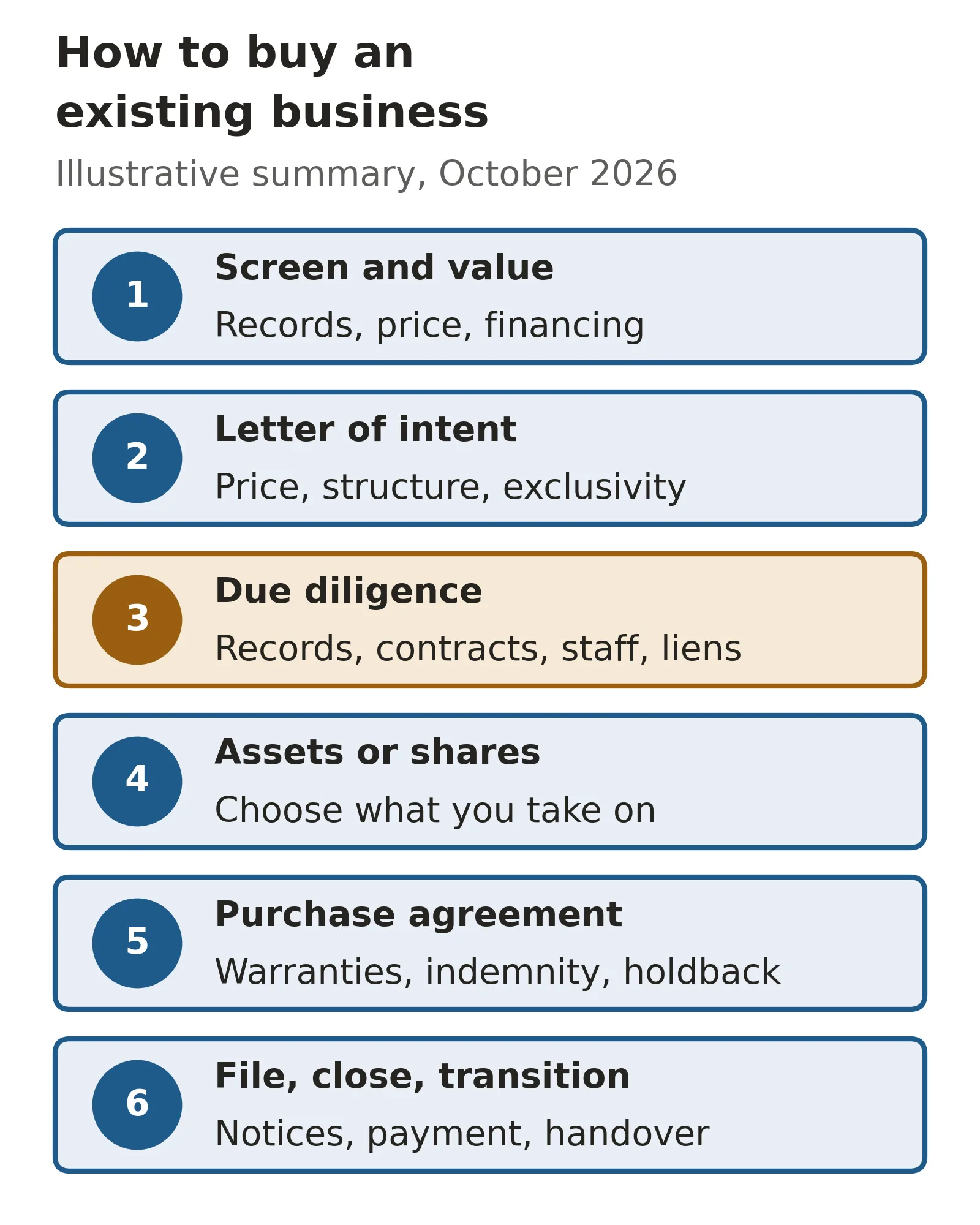
Most of how to buy an existing business is getting the order right, because each step narrows the deal before you spend more money on it. A typical path looks like this:
- Step 1: Screen and value. Decide what you want to own, then test a target's financial statements, tax returns and customer base against the asking price.
- Step 2: Sign a letter of intent. Agree on price, structure and an exclusivity period while most terms stay non-binding.
- Step 3: Run due diligence. Review the records, contracts, employees, liens and tax accounts.
- Step 4: Pick the structure. Buy the assets or buy the shares, based on what diligence found.
- Step 5: Negotiate the purchase agreement. Turn what you learned into representations, an indemnity and a holdback or escrow.
- Step 6: File, close and transition. Make the pre-closing filings, sign, pay and take over the business.
Screening is where most deals should die. Look for a business you can run, in a sector you understand, at a price the cash flow can carry after you pay any loan. Brokers, online marketplaces, accountants and direct approaches to owners all produce leads. For value, buyers and lenders usually look at earnings, comparable sales and the value of the assets. Ask for at least three years of financial statements and tax returns, and compare the two. Gaps between what the books show and what was reported to the tax authority are the first warning sign.
Line up financing early. A lender will want the same records you do, and its conditions often shape the timeline. Seller financing, where part of the price is paid over time, is one option, and it also keeps the seller interested in a smooth handover.
What should a letter of intent cover?
A letter of intent, or LOI, sets the main business terms before lawyers draft the full agreement. It usually covers the price and how it is paid, whether you are buying assets or shares, what is included and excluded, the timeline for due diligence, conditions such as financing, and how long the seller must stop talking to other buyers.
Most of an LOI is meant to be non-binding, but some clauses are usually meant to bind, such as confidentiality and exclusivity. The wording decides which is which, so read it as if it were a contract. Our guide to the letter of intent to purchase a business covers what binds you and what does not.
What goes on a buyer's due diligence checklist?
Due diligence is where you test the seller's story. A buying an existing business checklist should cover the legal side as well as the numbers, because legal problems can survive closing. A practical due diligence checklist for buying a business has four parts.
Corporate records and ownership
If the seller is a corporation, review its articles, by-laws, minute book, share register and any shareholders' agreement. Confirm who owns the shares, who the directors are and whether past decisions were properly approved. In a share purchase these records are what you are buying, so any gap becomes yours. A shareholders' agreement may also give other owners a right of first refusal or require their consent to a sale.
Contracts, leases and intellectual property
List every contract that matters: the premises lease, key customer and supplier agreements, equipment leases, licences and loans. Look for change-of-control or anti-assignment clauses, which let the other side refuse or end the contract when the business changes hands. Confirm that the business, not the owner personally, owns its trademarks, domain names, software and customer data. Read liability caps and indemnities in the major contracts too, since our guide on limitations of liability explains how they shift risk.
Employees
Get a list of employees with start dates, pay, vacation owed and written contracts. In Ontario, length of service can follow employees to a buyer of the assets (explained below), so their past service affects your future termination costs. Check for open claims, unpaid overtime, contractors who may really be employees, and any union.
Liens, taxes and litigation
Search for registered security interests against the seller. In Ontario, a PPSA search is run through ServiceOntario's Personal Property Security Registration system on its Access Now service. In New York, the Department of State's online search covers UCC filings and federal tax liens, and the Department states that there is no charge for the online search. Ask the seller for tax account statements and any notices from the tax authorities, and search for lawsuits and judgments in the courts where the business operates.
Should you buy the assets or the shares?
In an asset purchase you choose the assets you want, such as equipment, inventory, contracts and goodwill, and the seller's company stays behind with its own liabilities, subject to rules that can follow the assets (such as employee service in Ontario and sales tax in New York). In a share purchase, or stock purchase in the US, you buy the company itself, with its history, its contracts and its liabilities, known or not.
Buyers often prefer assets for that reason. Sellers often prefer shares, because the whole company leaves in one transaction, and the tax result may differ for them, which their accountant will weigh. Share deals can also be simpler when key contracts, licences or permits cannot be transferred. Some deals end up as a share purchase with stronger protections in the agreement. For the seller's view of the same choice, see do I need a lawyer to sell my business, and for the document used in a share deal, our guide to stock purchase agreements.
What protections belong in the purchase agreement?
The purchase agreement is where diligence findings turn into money. The parts that do the most work for a buyer are these:
- Representations and warranties: the seller's written statements about the business, such as accurate financial statements, no undisclosed debts and no pending lawsuits.
- Indemnity: the seller's promise to pay you back if a representation proves false or a pre-closing liability appears, with any caps, deductibles and time limits spelled out.
- Holdback or escrow: part of the price kept back or held by a third party for a period, so an indemnity claim has money behind it.
- Conditions to closing: financing, landlord consent, third-party consents and clean lien searches.
- Restrictive covenants: the seller's promise not to compete or solicit customers for a defined time and area.
- Transition help: how long the seller stays to introduce customers and train you.
Non-competes need care in Ontario. The Employment Standards Act, 2000 has prohibited employers from entering into non-compete agreements with employees since October 25, 2021, but the Ontario government's guide to the Act describes an exception for a sale of a business operated as a sole proprietorship or partnership where the seller becomes an employee of the buyer immediately after the sale. Our guide to the non-compete agreement in Ontario explains the rest of the rule.
Which Ontario and New York rules can catch a buyer?
Each place adds its own rules. The table below sets them side by side, and the deadlines that follow are the ones most worth putting in a calendar.
| Check | Ontario | New York |
|---|---|---|
| Lien search | PPSA search, ServiceOntario | UCC search, Department of State |
| Sales tax on assets | GST/HST, unless GST44 election | Bulk sale notice, AU-196.10 |
| Tax filing after closing | GST44 with first return | IRS Form 8594, both parties |
| Foreign buyer | Investment Canada Act notice | SBA 7(a) ownership rule |
Ontario: employees and HST
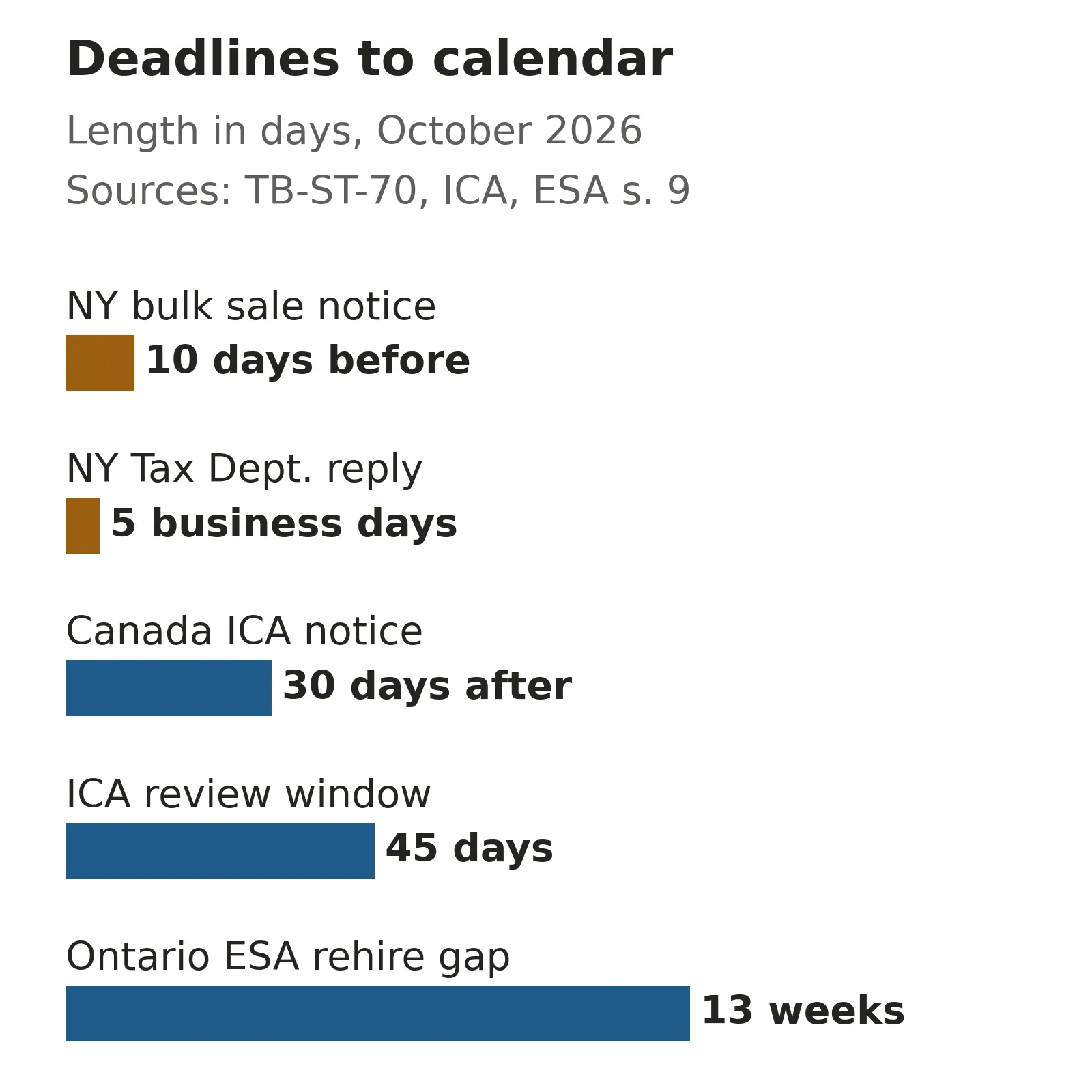
Section 9 of the Employment Standards Act, 2000 says that if an employer sells a business or part of it and the buyer employs an employee of the seller, the employment is deemed not to have been terminated or severed for the purposes of the Act, and the employee's time with the seller counts as time with the buyer. Under section 9(2), the rule does not apply if the buyer hires the employee more than 13 weeks after the earlier of the employee's last day with the seller and the day of the sale. The Ontario government's policy and interpretation manual adds that section 9 does not apply to a sale of shares, because the employer corporation stays the same.
On HST, the Canada Revenue Agency says buyer and seller may be able to jointly elect on Form GST44 so that no GST/HST is payable on the sale. The buyer must acquire all or substantially all (at least 90%) of the property needed to carry on the business and be able to keep operating it, and the election cannot be used if the seller is a registrant and the buyer is not. The CRA says the form is due on or before the day the buyer must file the GST/HST return for the first reporting period in which the purchase was made. If you will operate under a name that is not your corporation's legal name, read our guide to business name registration in Ontario.
New York: the bulk sale notification
New York's sales tax rules put real money at stake in an asset purchase. Under Tax Law section 1141(c), as explained in the Department of Taxation and Finance's bulletin TB-ST-70 (updated June 17, 2025), the buyer of business assets from a seller required to collect sales tax must file a bulk sale notification on Form AU-196.10 at least 10 days before paying for or taking possession of the assets, whichever comes first. Within five business days after receiving it, the Department must issue Form AU-197.1 (no unpaid sales tax) or Form AU-196.2 (the seller owes tax or is under review or audit). A buyer who does not follow the procedure may be held liable for the seller's unpaid sales and use taxes, and the bulletin advises a buyer who receives Form AU-196.2 to place the full purchase price in escrow.
At the federal level, the IRS says both the seller and the buyer of a group of assets that makes up a business, where goodwill or going concern value attaches or could attach, use Form 8594 to report the sale.
Can a Canadian buy a US business, or vice versa?
Yes in both directions, with a few extra steps. For a US buyer of an Ontario business, sections 11 and 12 of the Investment Canada Act require a non-Canadian who acquires control of a Canadian business to give notice to the Director at any time before the investment is implemented or within 30 days after, unless the investment is reviewable under section 14. Under section 13, once a complete notice is received, the Director sends a receipt. The receipt states either that the investment is not reviewable, or that it becomes non-reviewable unless the Director sends a review notice under section 15 within 45 days after the certified date (or another prescribed period).
For a Canadian buyer of a New York business, financing can be the harder part. The U.S. Small Business Administration lists changes of ownership as a permitted use of a 7(a) loan, with a maximum of $5 million. As described in a GAO decision (B-338157), SBA notices issued in February 2026 require the business to be owned 100% by U.S. citizens or U.S. nationals with a principal residence in the United States, effective March 1, 2026, and lawful permanent residents may no longer hold any ownership interest. A Canadian buyer should plan on other financing, such as seller financing or a lender outside the SBA program, and check the SBA's current rules first.
A Canadian corporation that buys and runs a business in New York may also need to qualify there, which our guide to foreign qualification explains, and should read can a Canadian own a business in the US on the immigration side: owning a US business does not, by itself, give you the right to work in it. If you plan to run the business on an E-2 visa, the purchase itself has to meet the investment tests, which our guide to an E-2 visa business for sale covers. Readers asking how to buy a business in Canada as a non-Canadian can start with the Investment Canada Act notice above.
Frequently asked questions
What is the first step in buying an existing business?
The first step is deciding what you can run and afford, then screening targets against that. Before you sign anything, ask for at least three years of financial statements and tax returns and compare them. A target that cannot produce clean records, or whose records do not match its tax filings, usually costs more to investigate than it is worth.
Does the buyer take on the seller's debts?
In a share purchase the company keeps all of its debts and liabilities, so you take them on indirectly through the shares you buy. In an asset purchase the seller's company usually keeps its debts, but some obligations can follow the assets, such as New York sales tax if the bulk sale procedure is skipped and employee service under Ontario's sale of business rule.
What happens to employees when you buy a business in Ontario?
In an asset purchase, if you employ the seller's employees, section 9 of the Employment Standards Act, 2000 treats their employment as continuous, so their years with the seller count toward notice and severance with you. The rule does not apply if you hire them more than 13 weeks after the earlier of their last day and the sale date. In a share purchase the employer does not change at all.
Does a New York buyer need to tell the tax department about the purchase?
Yes, if you are buying business assets from a seller required to collect sales tax and the sale is not in the ordinary course of business. You file Form AU-196.10 at least 10 days before paying for or taking possession of the assets, whichever comes first. The Department of Taxation and Finance then replies within five business days on whether the seller owes tax.
Is HST charged when you buy a business in Ontario?
GST/HST can apply to the taxable assets in an asset purchase. The Canada Revenue Agency allows the buyer and seller to jointly elect on Form GST44 so that no tax is payable, if the buyer acquires at least 90% of the property needed to carry on the business and can keep operating it. The election is not available if the seller is a registrant and the buyer is not.
Can a Canadian get an SBA loan to buy a US business?
Under SBA notices that took effect on March 1, 2026, as described by the GAO, 7(a) and 504 loans require the business to be owned 100% by U.S. citizens or U.S. nationals living in the United States. A Canadian citizen without US citizenship would not meet that rule, so other financing, such as seller financing, is usually needed. Check the SBA's current rules before relying on this.
Conclusion
Buying a business that already works can be faster and safer than building one, but only if you buy it on evidence. Screen hard, put the deal terms in a letter of intent, run real due diligence, choose assets or shares on purpose, and write what you find into the purchase agreement. Then handle the place-specific rules: employee service and HST in Ontario, the bulk sale notice in New York, and the Investment Canada Act notice or financing limits when the buyer crosses the border. That is how to buy an existing business without inheriting surprises you could have found.
How Mayo Law can help
Mayo Law advises buyers and sellers of businesses in Ontario and New York, with offices in Toronto and New York. Joseph Mayo is licensed in Ontario and New York, and our lawyers review letters of intent, run legal due diligence, draft and negotiate purchase agreements, and handle the filings around closing, including for buyers who cross the Canada-US border. Learn more about our work as a business lawyer in Toronto and our international business law practice. We offer a paid one-hour consultation, because a lawyer reviews your deal in depth before advising on it.
Disclaimer
This article is for general information only and is not legal, tax or financial advice. Reading it does not create a solicitor-client or attorney-client relationship. Laws, fees, forms and lender rules change, and the right steps depend on the facts of each purchase. Speak with a qualified professional about your situation before acting. Mayo Law provides legal services in Ontario and New York.